
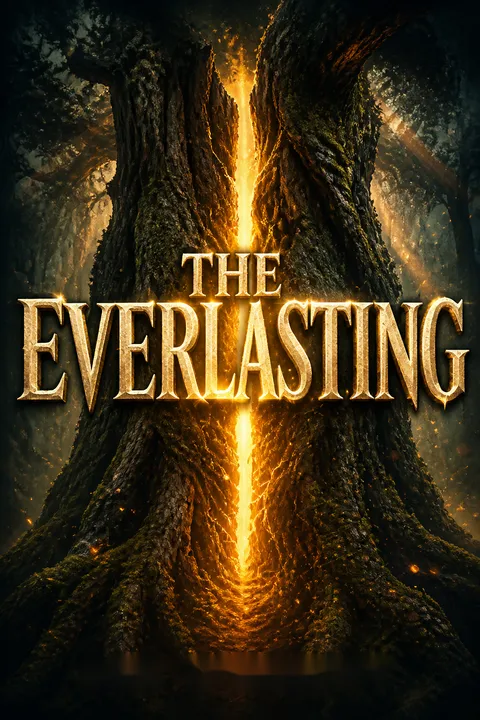


Plot Summary
Prologue
The legend begins beneath a yew tree, where a nameless orphan girl pulled an ancient sword from the bark and used it to slaughter the brigand prince who had taken a captive noblewoman. That woman, Yvanne,3 knighted the girl and named her Una2 — meaning only.
Over decades, Una2 won Yvanne's3 crown, conquered a continent, and earned a litany of titles: the Red Knight, the Virgin Saint, the Drawn Blade of Dominion. Her story became a nation's founding myth — honor, sacrifice, chivalry, tragedy. But behind every legend, someone is telling it. And behind this one, someone has been telling it over and over, adjusting the details each time, for a very long time.
The Find of a Millennium
Owen Mallory1 is a war-damaged medievalist at Cantford College, nursing a scarred throat, shaking hands, and a stalled manuscript on the Everlasting Cycle.
As a fatherless boy in Queenswald, he discovered Una's2 legend in a children's book beneath an ancient yew and fell so completely that at twenty-three he enlisted in Dominion's war against the Hinterlands. He proved an inexplicably perfect marksman but a wretched soldier — he deserted at the final battle, and his commanding officer9 slit his throat.
Now, years later, an impossible book arrives at his desk: The Death of Una Everlasting, bound in red heartwood, bearing a dragon-eating-its-tail device. Every historian in the country has declared this text a myth. Owen1 hides it from his rival Harrison8 and runs.
Blood on Blank Pages
The book vanishes from Owen's1 flat. A white card leads him to the capitol, where he encounters his father4 protesting outside and Vivian Rolfe3 — the former Minister of War — inside. Vivian3 flatters Owen,1 declaring him the man to translate Dominion's greatest artifact and rekindle national spirit. He opens the book, radiant with ambition — and finds every page blank.
Before he can process this, Vivian3 drives a letter opener through the back of his hand, pinning it to the paper. His blood spreads across the empty pages. She leans close and whispers that Una2 needs him. The smell of pine and snow fills his lungs. The office dissolves, and Owen1 falls backward through nine hundred years of history.
Valiance at His Throat
Winter sunlight. Frost-heavy branches. Owen's1 hand pressed to the trunk of a yew tree that was cut down years ago in his own time. A blade settles against his larynx — held by a woman nothing like the golden saint of propaganda posters. Una2 is vast-shouldered, pocked, wind-burnt, with white hair and a scar cleaving her left pupil into a black tear.
She is nothing like the paintings, and Owen1 knows her instantly. He addresses her by name; she tells him to drop the knife. He faints instead. When he wakes in her ruined cottage, she dismisses him as a madman, but he recognizes her expression: the look of someone who has forgotten where they meant to go, and no longer believes it matters.
Owen's Voice, Not God's
Days pass in stubborn standoff. Una2 ignores Owen's1 claims about the future while he fills the silence with questions, cigarette smoke, and provocation. He learns she has abandoned her quest for the grail — the artifact meant to heal the dying Queen Yvanne3 — and retreated to the woods where she was raised by two fathers, now dead.
She hasn't slept in days, avoiding dreams. Owen1 volunteers to tend the fire so she can rest. She sleeps, leaning against his shoulder. She wakes transformed: she dreamed of Cloven Hill and the dragon's location. But the voice in her dream was not God's. It was Owen's.1 She reaches down her calloused hand, and for the first time, he takes it. They ride north together.
The Knight of Worms
The journey north takes weeks. Owen1 clings to Hen7 — Una's2 ancient, murderous horse — while he and Una2 navigate the widening gap between legend and reality. She confesses she is no virgin saint; he collects stories about her from villagers who fear her as much as they revere her. In a Hyllman village, a scarred man grabs her hair.
Una2 almost decapitates him; Owen1 shouts her name just in time to deflect the blow — she takes the man's hand instead of his head. That night, bandaging Owen's1 wound, she tells him the northerners call her the Knight of Worms, because she feeds them so well. Owen1 catches her hand and tells her he is not afraid. They nearly kiss. He flinches away, sickened by what he knows is coming.
The Last Dragon's Cry
At Cloven Hill, Owen1 arms Una2 for battle — fastening each plate with hands that know the shapes by instinct, braiding her hair for the first time. She goes alone into the mountain mist. Owen1 waits below, pen motionless over blank pages. A keening cry splits the air — an unearthly wailing that stretches on so long it resolves into a single, pure note.
Something irreplaceable is lost when it ends. Una2 emerges with the grail and a scrape across her temple, but her eyes have been emptied of something she cannot name. She tells Owen1 the dragon was not terrible. It was beautiful, and old — older than anything that ever lived. She shoves the cup into his hands and falls silent for hours.
Three Bullets, One Betrayal
They ride south to Cavallon Keep, where the ailing queen waits. Owen1 has lied: he told Una2 the story ends happily. In truth, it is a tragedy. At the gates, his nerve shatters. He shouts a warning about Hinterlander traitors hiding inside.
Three archers appear on the walls. Owen1 lifts his revolver — three shots, three bodies — and discovers his hands are perfectly steady when it matters. Una2 survives the ambush and destroys the remaining soldiers.
But inside the Keep, kneeling before the miraculously restored queen with the grail held high, the blow comes from her blind side. Ancel, the Knight of Hearts,6 drives his sword through her body. She kills him and collapses in Owen's1 arms. She begs him to come back, to wait beneath the yew. He promises. She dies.
The Queen Speaks English
Owen1 crouches over Una's2 body, shattered, until a woman's voice reaches him — not in archaic Middle Mothertongue, but in his own modern language. He looks up at Queen Yvanne3 and sees Vivian Rolfe.3 She traveled back using the same book, replaced the real queen on her deathbed, and has been ruling Dominion ever since.
The grail is meaningless — a cup of wine that cures nothing. What matters is the story: Una's2 tragedy, properly written, becomes a founding myth powerful enough to hold a nation together for a millennium.
Vivian3 tried ruling without the legend once; she was overthrown in three years. She needs Owen1 to write the tale. He does — in one feverish night, transmuting messy truth into clean propaganda — and Vivian3 crushes his hand against the book, sending him home.
The Knight Who Wanted Him
The cycle repeats, and this time Una2 tells it. She had been standing at the yew in full armor, preparing to drive the blade through her own chest, when Owen1 appeared. She was drawn to this trembling, jackdaw-voiced man who looked at her without terror.
As they traveled, she wanted him — pressed against him in the saddle, lay awake imagining his hands — but he always pulled away. She understood he was leading her knowingly to her death.
Before Cavallon, she confessed the burning of the Black Bastion: civilians incinerated on the queen's3 orders while she plugged her ears with wax and vomited wine she could not keep down. Owen1 bared his own slit throat in answer. They kissed once, desperately, beneath the shadow of the gate. Then she rode on to the ending he had chosen for her.
Twenty-Six False Commas
In the vault beneath Cavallon, Owen's1 fragmentary memories sharpen. Vivian3 reveals she has repeated this process many times, adjusting the story each iteration — she made Ancel6 into a traitor because Una2 kept surviving the original ambush, and Owen1 kept shooting the archers.
Owen1 is imprisoned in a freezing tower, frostbitten and concussed. He writes the story again, adding a prophecy about the crown and grail returning to serve Vivian's3 future coronation. Into the text he weaves twenty-six deliberate punctuation errors — a cipher his father4 taught him at age ten.
Odd count: take the second letter. Even count: take the first. Letter by letter, the hidden message spells out across the centuries: Wait for me, beneath the yew tree. Then he digs the knife into his palm and falls through time once more.
The Cipher Cracks Open
Another iteration. This time Vivian3 wants a translator, not an author — the pages are pre-written. Owen1 publishes the book to national acclaim, becomes Sir Owen Mallory, wins the endowed professorship. But Professor Sawbridge5 has been fired for trying to smash the grail with a rock during an excavation.
She presses a crushed Lucky Star cigarette butt into Owen's1 palm — found sealed inside Una's2 thousand-year-old tomb, where no modern object should exist. Owen1 pulls out his own translation and counts the punctuation errors.
Twenty-six marks. He copies the coded letters. The message reads: Wait for me, beneath the yew tree. Memory strikes him with the accumulated force of centuries. Every iteration, every death, every stolen touch. He says aloud, to no one: I'm coming.
Nine Years Stolen from Time
Owen1 breaks into Vivian's3 bedroom at gunpoint and seizes the book. She draws Valiance; he fires, but the bullet strikes the blade. The book hurls him back to the yew, where Una2 waits — and remembers. They run.
Not across land but through centuries, using the book to leap forward and backward, shedding names, armor, identities. They settle in the ancient woods a thousand years before Dominion. Una2 builds a cottage. Owen1 trades stories for bread, living like his mother's people.
Their son Marro10 is born beneath the yew with a yewberry birthmark on his foot; their daughter Thea10 arrives screaming the following spring. For nine years they are no one — unnamed, unrecorded, free. Owen1 watches Una2 laugh with berry juice running down her chin and thinks: no dream ever tasted this sweet.
Vivian Finds Paradise
On a summer afternoon, while the children10 chase each other through the thicket, a voice speaks in modern English behind them. Vivian3 has tracked them down, flanked by soldiers recruited from this era.
Una2 detonates into violence — bare-handed, nine years of peace falling away like shed skin — and kills every soldier in the cottage. But Vivian3 draws a revolver and shoots Una2 through the chest at point-blank range. Owen1 holds her as she dies, whispering their children's10 names.
Vivian3 turns the gun toward the children and tells Owen1 the terms: go back, play his part as written, and she will return his family. Owen1 presses his bleeding hand to the book. His children disappear from beneath the yew, unborn, as he is wrenched back to a century where they never existed.
The Bullet and the Baby
Forced into another iteration, Owen1 visits his imprisoned father.4 For the first time across any of his lives, the old man tells the full truth. During the last war, his unit opened fire on a group of Roving Folk at the Marro River.
Among the dead was a young woman curled around a screaming infant — Owen.1 His father4 doesn't know which bullet killed her; it might have been his own. He picked up the baby and refused to set it down for a hundred miles of marching. When the army wouldn't accept his resignation, he shot himself through the hip.
Owen1 realizes he was never a true son of Dominion — only a war orphan, loved fiercely by a broken man who could never atone. He asks his father4 one question: how does a person break into the Chancellor's private quarters?
Knighted to No One
Owen1 returns to the past one final time, knowing everything. Beneath the yew, he kneels Una2 and swears her to a different oath — not to queen or country, but to her own heart and their family. He strips the leather from Valiance's hilt, exposing a factory maker's mark: the sacred sword was always a modern product, replaced by Vivian3 whenever it broke. They ride north together.
This time, Una2 enters the dragon's cave and spares the ancient creature, taking only the grail. At Cavallon, Owen1 shoots the archers before Una2 enters the gates. She fights the Hinterlanders, the Queen's Guard, and Ancel6 — whom she hamstrings but refuses to kill, begging him to remember they were once brothers. The book lies on the flagstones between two sides.
Ancel's Final Toss
Vivian's3 hidden crossbow archers line the walls. Owen1 dives for the book but Ancel6 — dragging his crippled legs, still fanatically loyal — tackles him. Owen1 shouts at Ancel6 to look at Una:2 bloodied, surrounded, about to be executed again by the queen he serves. Ancel6 looks. His hand closes on the book. Vivian3 extends her palm.
The Knight of Hearts6 smiles — tired, genuine, sorry — tells her to save him a kiss in the afterlife, and throws the book to Owen1 instead. Owen1 and Una2 press their bleeding hands to the pages and vanish together, plunging all the way back to the very beginning — before the yew, before the sword, before Dominion itself. In an ancient, empty landscape, they find the red dragon-heart seed buried in the earth.
Owen Turns His Head
A girl approaches on the empty hilltop — young Vivian,3 not yet queen, barely grown. She tells the origin: she was a slave who bore a king's child. The king stole the infant's heart to plant the dragon seed. Vivian3 killed him and buried the dead baby with the seed in its chest.
From that body grew the yew. From the yew, Una2 was reborn. Now Vivian3 holds a knife to Owen's1 throat, demanding the cycle continue. Owen1 looks at Una.2 He sees her whole: the scared girl, the broken knight, the woman who laughed with berry juice on her chin.
He has learned from his parents that love makes not cowards but heroes. He turns his head three degrees into the blade. Una,2 freed at last, asks Vivian3 if she would ever stop. Vivian3 says never. Una2 kills her. Then she buries Owen1 with the seed in his heart.
Epilogue
Una2 waited beside the growing yew for years — perhaps centuries. She guarded the sapling through storms and drought, watched it climb skyward and thicken into something ancient. One summer morning she circled the trunk and found Owen1 sitting against the bark: white-haired now, amber-eyed, a silver scar over his heart where the seed had grown.
He remembered her. They rebuilt the cottage. Marro10 was born again with his yewberry birthmark; Thea10 arrived screaming. They grew old in an unnamed wood, protecting deserters and dreamers.
Owen1 wrote their story on ordinary paper, bound it with twine, and sent it through time to Professor Sawbridge.5 In her final telegram, she promised to visit — centuries ago — with Owen's father4 in tow. The Green Knight and her scholar are waiting beneath the yew.
Analysis
The Everlasting literalizes the metaphor that every nation is a story someone is telling — and asks who profits from the telling. Vivian Rolfe3 does not merely manipulate history; she manufactures it iteration by iteration, adjusting the myth of Una Everlasting2 to justify each new war, each new queen, each new act of state violence. The novel argues that founding myths are not organic expressions of identity but precision instruments of power, engineered to define who belongs, who threatens, and who may be sacrificed.
Harrow constructs a devastating parallel between personal and political self-determination. Una's2 struggle to exist beyond her legend mirrors the broader argument about how individuals are deformed by national roles. Owen1 is the loyal patriot who discovers his patriotism was manufactured from his infancy; Una2 is the hero who discovers her heroism was forged in someone else's furnace. Both must dismantle the identities that gave them purpose before they can build ones worth keeping.
The time-loop structure performs this argument formally. Each iteration slightly adjusts the variables — Ancel's6 character, the number of enemies, the color of a hero's hair — demonstrating how narrative details shift to serve political needs while the underlying architecture of exploitation holds constant. The body-remembers conceit means liberation requires not intellectual understanding alone but the accumulated weight of lived repetition: you must feel the same wound enough times to finally refuse it.
Most provocatively, Harrow refuses to frame freedom as a clean triumph. Owen1 cannot save everyone. The Hinterlands may still be invaded. His mother is still dead. Freedom is not a condition achieved but a choice remade daily, defended with whatever is at hand — a sword, a revolver, a story told differently. The final image — two people living small, unnamed, and fiercely protective in a wood that belongs to no nation — rejects the epic scale the novel spent a hundred thousand words building, and argues that the only story worth telling is the one no empire can use.
Review Summary
People Also Read
Characters
Owen Mallory
Historian, narrator, coward-heroA war-scarred medievalist with dark curling hair, thick spectacles, and a throat ravaged by the knife of his own commanding officer9. Owen is driven by a lifelong hunger to belong—to Dominion, to academia, to any structure that might validate the half-foreign, fatherless boy who cried too easily and read too much. His devotion to Una2 began as a child's worship of an ideal and matured into something far more dangerous: love for a real woman he was commissioned to lead to slaughter. Owen calls himself a coward with such conviction that others believe it, but his cowardice repeatedly manifests as reckless bravery from a man who has nothing left to lose. His deepest trait is loyalty—ferocious, irrational, and deeper than he credits himself for.
Una Everlasting
Legendary knight, Owen's belovedThe legendary champion of Dominion—enormous, white-haired, scarred through one golden eye, with hands so calloused they feel like shaped stone. Born from the heartwood of a yew tree, Una carries the accumulated muscle memory of lifetimes of combat, making her virtually unbeatable. Beneath the legend is a woman drowning in guilt: she burned the Black Bastion on her queen's3 orders, watched civilians die, and lost the ability to distinguish herself from the weapon she was made to be. Her central struggle is whether she is a person or a tool—whether she can exist without a master to serve or a purpose handed to her by someone else. She reaches for love the way she reaches for a bare blade, expecting it to cut.
Vivian Rolfe
Every queen of DominionThe architect of Dominion—a woman who has worn every crown in the nation's history under different names. Born into slavery and exploitation, she was sold as a child to a powerful man who used her body to fuel alchemical experiments. She killed him and spent the next millennium building an empire from the ruins of her suffering, manipulating centuries of history through careful adjustments to one founding myth. Vivian operates with the dispassionate precision of a clockmaker who has built the world's most intricate mechanism. She genuinely believes she has given civilization something it could not have made for itself. Her tragedy is that she cannot distinguish between love and ownership, or between building a kingdom and building a cage.
Owen's father
Drunk, deserter, devoted fatherA war deserter who found Owen1 as an infant on a battlefield and raised him as his own son. He is a drunk, a radical pamphleteer, and a man whose flippancy masks bone-deep guilt. His political radicalism—protests, pamphlets, coded letters—is not ideology but penance. Every act of defiance against the state is an attempt to dismantle the machine that made him into a killer and broke everything he loved. His devotion to Owen1 is absolute and clumsy, expressed in wrong-footed silences and too-late apologies.
Professor Gilda Sawbridge
Brilliant, furious archaeologistOwen's1 acerbic academic adviser—the only female professor at Cantford, an archaeologist who trusts bones over words. She is fearless in her scholarship and devastating in debate, but her razor tongue conceals a secret: her relationship with the college archivist11, which the regime uses as leverage. Her instinct that Dominion's history has been manufactured proves correct. She represents the stubborn, unglamorous resistance of a person who cannot run but refuses to kneel.
Ancel of Ulwin
Knight of Hearts, tragic rivalUna's2 rival, brother-in-arms, and sometime lover—beautiful, vain, and devastatingly skilled. Across iterations, Vivian3 corrupted him from chivalrous hero into history's most infamous traitor, manipulating his jealousy and devotion. Ancel embodies the cost of absolute loyalty to a master who views love purely as leverage. Beneath centuries of manipulation, his capacity for genuine feeling endures, awaiting one moment where a choice still belongs to him.
Hen
Ancient, unkillable warhorseUna's2 cadaverous, spectacularly ill-tempered blood-bay horse. Sent back through time as many times as his rider, Hen has become virtually unkillable and entirely demented. He bites everyone except Una2, attempts murder on most people who approach him, and is the only character in the story who never once hesitates to fight.
Jeremy Harrison
Rival scholar, Vivian's pawnOwen's1 academic rival at Cantford, whose aristocratic affectations conceal humble origins engineered by Vivian3. He functions as Owen's1 petty foil and as Vivian's3 campus informant, a man whose entire identity was manufactured for someone else's use.
Colonel Drayton
Owen's commanding officerA patriotic liberal who gave rousing speeches about crown and country, then slit Owen's1 throat when Owen1 deserted at the southern dunes. His death—by Owen's1 accidental shot—saved Owen's1 life and gave him a medal he could never bring himself to wear.
Marro and Thea
Owen and Una's childrenBorn during Owen1 and Una's2 nine-year escape through time. Marro, their quicksilver-haired son; Thea, their fierce dark-haired daughter. They are the couple's deepest motivation and Vivian's3 ultimate leverage.
Mistress Sylvia Shaw
Archivist, Sawbridge's loverThe formidable Cantford College archivist whose secret relationship with Sawbridge5 becomes the leash that keeps the professor compliant under Vivian's3 regime.
Plot Devices
The Book
Time travel via blood on pagesBound in red heartwood with bronze hinges and a dragon-eating-its-tail device, The Death of Una Everlasting2 is the instrument through which Vivian3 controls history. Its pages are milled from the wood of the yew tree—itself grown from a dragon-heart seed—and when blood touches them, the bearer is transported through time. The book always returns its users to the yew, no matter where they are. It serves as both prison and escape route: Vivian3 uses it to send Owen1 and Una2 back into the same tragedy over and over, but Owen1 eventually turns it into a vehicle for rebellion. The book contains whatever text Owen1 has most recently written into it, making each iteration's propaganda a palimpsest of the versions before.
Valiance
The sword that built DominionThe most famous weapon in Dominion's history—the blade Una2 pulled from the yew as a child, which legend says can never be broken. When shattered, it appears whole again by morning, reinforcing the myth of divine destiny. In truth, Valiance is a mass-produced Saint Sinclair factory product, replaced by Vivian3 each time it breaks. The maker's mark is hidden beneath leather wrapping on the hilt. Valiance functions as the novel's central symbol of manufactured myth: what appears to be an unbreakable miracle is simply a prop, replaced as needed by the stagehand behind the curtain. When Owen1 strips the leather to expose the factory stamp, it shatters Una's2 last illusion that her fate was ever ordained by anything but Vivian's3 ambition.
The Dragon-Heart Seed
Engine of rebirth and timeA red, jewel-like seed found in every dragon's heart. When planted in a dead body, it grows into a yew tree, and the dead person is eventually reborn from the trunk. This is the true source of the yew's power and the book's magic—the paper was milled from a yew grown from such a seed. Vivian's3 teacher discovered the seed's properties and used it to steal Vivian's3 unborn child, planting it in the dead infant's body. Una2 was the result: a woman born from death, reborn from wood, carrying dragon's gold in her irises. The seed is indestructible by fire, making it both the story's deepest problem and its ultimate solution.
Owen's Punctuation Cipher
Message across iterationsA simple code Owen1 learned from his father4 at age ten: deliberate punctuation errors are placed throughout a text, and the letters following each error spell a hidden message. Owen1 embeds this cipher in his handwritten version of The Death of Una Everlasting while imprisoned and concussed in Cavallon's tower. The message—Wait for me, beneath the yew tree—survives through every subsequent iteration of the text, including the published translation in Owen's1 modern era. When Owen1 finally counts the errors and decodes the message, the act triggers the recovery of all his suppressed memories across every timeline, transforming him from Vivian's3 unwitting pawn into a man who remembers exactly what has been done to him and to Una2.
Owen's Service Revolver
Anachronism that breaks the scriptA Saint Sinclair Mark III six-shot revolver, standard military issue, which Owen1 carries beneath his red service jacket into the medieval past. It holds only three bullets at any given time—a constraint that transforms each shot into a moral decision. Owen1 uses the revolver to kill the archers who would otherwise kill Una2 at Cavallon, breaking the scripted tragedy Vivian3 has designed. The gun represents modern violence intruding on the curated medieval world Vivian3 has built, an anachronism that refuses to play its assigned role. It also establishes Owen's1 inexplicable marksmanship—a skill his body accumulated across dozens of lifetimes of being sent to war, though he never consciously remembers the practice.
About the Author
Download PDF
Download EPUB
.epub digital book format is ideal for reading ebooks on phones, tablets, and e-readers.








































