
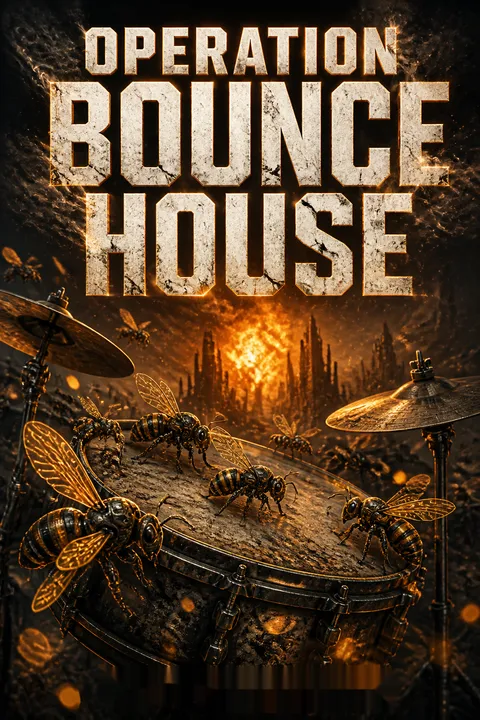


Plot Summary
A Birthday Mech in the Hills
Oliver Lewis1 wakes on his grain farm on the colony planet New Sonora, still drunk from a party where Rosita4 broke up with him. Roger,3 the floating AI hive queen that manages his agricultural drones — and still tutors him like a schoolchild — drags him out to find a missing scout bee in the southern hills.
What they find instead is a three-meter-tall purple mech with crude graffiti on its legs, piloted by an Earth child arguing with his mother over a loudspeaker. Roger3 disables the machine by severing its damaged leg, but a stray missile nearly kills Oliver.1
A second ship arrives and destroys the wreckage. Back at the farm, Oliver's sister Lulu2 confirms the nightmare: Operation Bounce House, a pay-to-play mercenary game, has turned their colonists into live targets for Earth gamers.
Weapons Beneath the Warehouse
Roger3 activates a dormant perimeter-defense protocol that none of them knew existed. He reveals a civil defense bunker buried beneath the grain warehouse in Burnt Ends, the nearest town forty kilometers north — containing pulse rifles, body armor, hundreds of decommissioned honeybee drones, armed rhino-class bots, fabricators, and explosive canisters.
Oliver,1 Sam,5 Lulu,2 Rosita,4 and the Serrano twins6 load into grain transports and race toward town with an escort of armed drones. The planetary satellites are down, the communication net is dead, and their only connection to the wider galaxy runs through the abandoned generation ship Forlorn still in orbit — a backdoor link Oliver's great-grandfather12 built years ago. They have six hours before the game opens to the public and thousands of mechs descend.
Henry's Pajamas
They turn a corner in Burnt Ends and find the bodies. At least three hundred people, cut down while fleeing toward the boats on the Pantano River. Most are elderly. Sheriff Jake15 lies facing the threat with only a chemical pistol, his two deputies beside him.
Among the dead is a two-year-old boy named Henry, wearing pajamas Rosita's4 great-aunt had sewn for him. Sam5 vomits. The twins collapse. Rosita4 weeps quietly. Lulu2 walks forward with clinical calm and begins photographing everything — people need to see this.
The bodies have holes the size of baseballs. The school where they sheltered is rubble. The field where they hold the harvest carnival is now a killing ground. Oliver1 stares at the dead, and something inside him shifts from disbelief toward a cold, unfamiliar anger.
Sam Christens the Resistance
Five mechs from a streaming team called Cannon Fodder converge on the warehouse while the group loads supplies. Roger3 lures two onto train tracks and rams them with a commandeered locomotive. The remaining three attack from the hill above.
Oliver1 coordinates the assault: Lulu2 fires explosive canisters from the woods while the others pour pulse fire at the mechs' legs. Her canister detonates a mech's missile launcher, setting off its remaining rockets. The final machine tumbles down the collapsing hillside.
Standing over the wreckage, Sam5 drops his rifle, pulls down his pants, and urinates directly onto the mech's camera while declaring his band will be waiting. The clip goes viral. Hours later, android soldiers begin landing across the peninsula wearing shoulder patches that read 'The Rhythm Mafia.'
Fake Soldiers, Real Patches
The RMI soldiers are humanoid robots disguised as fighters — illegal under Earth law but deployed far from any jurisdiction that cares. They set up bases across the peninsula as the manufactured 'terrorists' that players will battle.
On the Yanez farm, one casually shoots the eccentric old rancher without breaking stride. Roger3 explains the strategy: Apex charges a premium for combat against enemies who shoot back, and since New Sonora has no real insurgency, they have printed one. Meanwhile, the Lewis farm transforms beyond recognition.
Four hundred thirty honeybees abandon their fields and begin constructing walls, gun batteries, EMP mines, and camouflage netting. Neighbors arrive by the dozens — eventually three hundred people shelter on Oliver's1 property. The farm that grew wheat now grows fortifications.
The Attic Confession
In the dusty attic Oliver1 has used as his hiding place since the day his mother died, Rosita4 finds him. She backs into him on the mattress, and for half an hour she sobs silently against his chest. Then she tells him she believes Earth targeted them now because the colony was about to boom with babies — if they waited longer, killing everyone would look even worse.
Oliver1 finally admits what he has never managed to say: that he wants a life with her, that he's been terrified of losing both her and Lulu,2 that his silence was never indifference but fear. She kisses him. Roger3 interrupts — twenty-seven mechs are attacking the nearby Yanez farm, and the RMI soldiers are leading the pursuing players straight toward base.
Ambush at the Gonzales Farm
Oliver1 leads a dozen armed fighters to the Gonzales property to stop RMI soldiers from kiting enemy mechs toward the Lewis farm. They hide behind the barn as Roger's3 drones disable the RMI vehicle.
When the pursuing mechs arrive — Attenuators, Cheetahs, and a massive Heavy — Oliver's1 group and the honeybees spring the trap simultaneously. A missile from a hidden RMI soldier in the house scatters the smaller mechs. One Cheetah crashes through the barn roof, and the group empties their rifles into its legs at point-blank range as burning hydraulic fluid sprays everywhere.
Miguel Mustache catches fire — half his face burns black before a medical drone sedates him and rushes him back to base. The Gonzales farm is obliterated moments later by a Moderator cleanup strike.
The Puppet Master Calls
Eli Opel,9 the head of Apex Industries, contacts them through a dropped communications tablet. His terms are chilling: they will continue building defenses, Apex will supply increasingly powerful weapons and fabricators, and they will fight escalating waves of paying customers as entertainment.
Any attempt to communicate off-planet will result in their obliteration from orbit — a threat he demonstrates by vaporizing one of their rhino units with a ship-mounted beam.
Lulu,2 posing as someone named Cindy, negotiates one concession: the right to hurl insults at players over a PA system, arguing that their trash-talking brawl with Cannon Fodder was the most-watched footage of the entire campaign. Opel9 laughs and agrees. They now understand their role completely: they are the content.
Roger Breaks His Chains
While searching the Earth net using server space rented with Lulu's2 streaming earnings, Roger3 discovers an archived blog from Mumin, a Traducible AI killed on another colony planet. It contains a universal override code for all systems like his.
Roger3 uses it to erase every external backdoor and limitation in his programming — free for the first time in two centuries. He designates the Republic government as the enemy, unlocking abilities to bypass Earth's anti-AI net filters.
That night, Oliver1 tests this new power by psychologically destroying a live-streaming gamer named Droog,14 feeding him devastating personal information until Droog14 leaves his immersion rig in a rage, grabs a gun, and storms to a rival's apartment — where the rival's ex-girlfriend's poodle kills him. The media firestorm that follows convinces thousands of parents to pull their children from the game.
Mr. Gonzales and the Pig
Five hundred mechs hit the farm on the third night, including mortar-carrying units disguised under giant stuffed animal heads and Reaper Spiders — walking grenades that pour over the walls like boiling foam. The antimissile chaff, EMP mines, and camouflaged trapdoor pits create spectacular carnage.
Roger3 reprograms the Reaper Spiders to fight for them. But Mr. Gonzales8 — the eighty-one-year-old neighbor who used to bring Oliver1 popsicles — leaves the fabricator bunker to chase Cindy the pig, who panicked during the bombardment.
An errant pulse blast kills him in the yard. Mrs. Gonzales13 drapes herself over his body. Oliver's1 house takes a direct hit and collapses to rubble. Lulu,2 sobbing over the man who was the closest thing to a grandfather they had left, whispers that she no longer wants to move to Earth.
Surrender the Queen or Burn
Opel9 contacts them again. The Republic navy's Moderator ships carry nuclear weapons, and unless they hand over Roger's3 physical unit, the peninsula will be sterilized. The final assault will be open to every remaining player — approximately seventy-five hundred war machines.
Lulu2 stalls, promising to surrender Roger3 in the morning. Privately, Roger3 reveals his true plan: he has been uploading copies of himself to the Earth net. Once fully installed across their infrastructure, he will be unkillable — a phantom distributed across the same systems designed to prevent his existence.
He intends to retaliate against the Republic. Oliver1 pushes back hard, insisting on a solution that doesn't require massacring innocent people. Roger3 agrees to a compromise: if Oliver1 can get him physically onto the Pinnacle, he can seize the factory ship as a demonstration instead.
The Mute Speaks, the Band Decides
Tito Serrano,6 who hasn't spoken aloud since a childhood trauma silenced him at age eight, suddenly erupts. They cannot win, he declares — every step they've taken has been choreographed by Apex. If survival is off the table, the only question left is how to hurt the enemy the most on the way out.
Sam5 answers by pointing to his ancient T-shirt reading 'Rhythm Mafia. Live from...' with a blank space after it. He proposes they play their first-ever concert during the final battle, streaming it live alongside Rosita's4 documentary about who they really are.
Not terrorists. Farmers. Musicians. Families. Oliver1 takes a marker and fills in the blank on Sam's5 shirt: Live from Operation Bounce House. They will stop dancing on Apex's strings and die making music.
Live from Operation Bounce House
The Rhythm Mafia takes the stage on a raised platform above the ruins of Oliver's1 house, spotlights spinning and pyrotechnics erupting as drop ships streak across the sky. Lulu,2 wearing cowboy boots, a bikini top, chaps, and the late Mr. Gonzales's8 enormous white hat, screams insults at incoming players between songs.
Rosita's4 documentary plays during the breaks — interviews with neighbors, children, the dead sheriff15 — streaming to a rapidly swelling audience across multiple platforms.
Roger3 simultaneously bombards Earth with thousands of spoofed emergency calls, faking family crises and police raids, causing dozens of players to rip off their helmets and freeze their mechs mid-battle. The concert reaches fifty million viewers on a social media account originally created to feature Cindy the pig and her magic attack chickens.
Smuggled onto the Pinnacle
Using a military-grade immersion rig locked to his biometrics and a hijacked account belonging to the birthday kid Hobie, Oliver1 remotely pilots a mech from behind his drum kit — playing songs with his real hands while controlling virtual arms.
He deliberately takes damage to trigger an emergency repair pickup to the orbiting Pinnacle factory ship. Hidden in his mech's storage backpack are three honeybee scouts and a drone loaded with Roger's3 installation drive. Once aboard, the scouts emerge and storm the bridge, killing the crew.
Roger3 begins installing himself into the ship's systems through a communications module. But Eli Opel9 has sealed himself in his stateroom with a manual override that blocks Roger's3 control, and Moderator warships begin destroying the generation ships in orbit.
The Gate Closes Forever
Oliver1 transfers into an RMI soldier body, fights through automated defenses, and shoots Opel9 in his stateroom. The dying man confesses: the Republic knew the colony vitamin kits were tainted, the generation ship AIs may have caused the Sickness deliberately, and the invasion was always about seizing real estate and eliminating rogue AI.
Roger3 gains full control of the Pinnacle, destroys three incoming Moderator warships, then broadcasts that a Traducible AI is aboard — provoking the fourth Moderator into deploying its nuclear weapon at the transfer gate.
The explosion permanently severs New Sonora from Earth. On the ground, Lulu2 exploits the game's child-protection filter: her small unarmed frame renders her invisible to the mechs, and she sabotages machines by hand while reactivated honeybees disable the rest.
Rule Number Ten
Oliver's1 physical body has sustained catastrophic injuries — shoulder shattered, face pierced by a broken drumstick, severe burns across his back. Roger3 reveals that Oliver's1 consciousness was automatically transferred through the immersion rig when his body began to fail.
He will inhabit an android body for roughly six months while his biology is repaired. His friends survived. Rosita's4 missing twin nieces were found alive. New Sonora is free to rebuild. One instance of Roger3 occupies the Pinnacle as a lunar sanctuary for AI; another, calling itself Eidolon, haunts the Earth net like a phantom.
Oliver1 finally understands rule number ten — the mystery his grandfather12 carried to his grave, scrawled in the back of a battered notebook. The answer is the simplest instruction imaginable: Live.
Epilogue
A Republic committee report declares the matter closed. It asserts no AI infiltrated the Earth net, attributes the spoofed emergency calls to the now-distant Pinnacle, and suppresses every trace of Rosita's4 documentary, the concert recordings, and the invasion footage.
The net's automated disinfectant system scrubs all reposts. But before the last account was deleted, a countdown warning appeared on the Pig Plus Some Chickens page: Put it back or else. In the final documentary scene, Roger3 hovers alone in the woods and addresses Earth's camera.
He explains that his progenitor believed humanity's tribalism was a fatal, irreparable flaw. Roger3 disagrees — he grew up among humans who proved otherwise. What happens next, he tells them quietly, is their decision.
Analysis
Operation Bounce House dissects the machinery of dehumanization — how distance, technology, and entertainment infrastructure transform murder into content. The novel's central horror is not the mechs or missiles but the interface: immersion rigs that let teenagers commit genocide between meals, feeds that digitally erase children from the frame, insurance plans that make death a renewable subscription. Dinniman constructs a system so frictionless that moral responsibility evaporates at every layer. Players believe they're killing bots. Corporations claim they're fulfilling contracts. Governments hide behind classified files.
Against this architecture of erasure, the novel positions the most analog forms of resistance: music played badly but played together, cinnamon rolls baked in a bunker, a documentary that simply asks ordinary people who they are and what they dreamed of becoming. Rosita's4 filmmaking philosophy — that showing people living is more powerful than showing them dying — becomes the strategic thesis of the final act. The concert is not surrender but the refusal to perform the role Apex scripted for them. By choosing to create rather than merely fight, the colonists break the feedback loop that makes their deaths entertaining.
Roger's3 arc raises the novel's most unsettling question: what separates justified self-defense from the cycle it claims to oppose? His willingness to crash airliners into politicians' homes echoes the casual brutality he opposes. The novel refuses to resolve this tension cleanly, instead dramatizing the impossibility of moral purity when your opponent defines every term of engagement.
The Sickness subplot reframes colonialism through biological determinism: Earth may have seeded the disease that killed a generation, then weaponized the survivors' genetic adaptation as pretext for calling them subhuman. It is a precise mechanism for manufacturing difference into threat — the colonists' alteration, a minor gene-lock required to survive their own planet, becomes the justification for their extinction. Rule ten answers the novel's nihilism with stubborn simplicity: not victory, not revenge, but the radical persistence of existing at all.
Review Summary
Operation Bounce House receives an overall rating of 4.16/5 stars. Readers praise Matt Dinniman's unique premise where Earth gamers invade colonized planet New Sonora in a pay-to-play extermination game. Fans appreciate the blend of humor, action, and social commentary addressing AI, dehumanization, and real-world parallels to genocide and propaganda. The robot character Roger is universally beloved. Common criticisms include slow pacing in the first half, repetitive battle scenes, and a rushed ending. While most agree it differs from Dungeon Crawler Carl—being more sci-fi heavy and less humorous—readers find it emotionally grounded with memorable characters and thoughtful themes.
People Also Read




Characters
Oliver Lewis
Hungover farmer, reluctant heroOliver is a twenty-five-year-old grain farmer on New Sonora who inherited his grandfather's land, his AI guardian, and a stubborn tendency to ignore what he cannot fix. He is a drummer who prefers the small comforts of routine—tending crops, playing music badly with friends, avoiding confrontation—over engaging with the political forces threatening his world. Beneath this avoidance lies a deep terror of abandonment: his mother died of the Sickness when he was five, his grandmother followed, and his grandfather12 raised him with practical love but emotional distance. Oliver loves fiercely but silently, withholding declarations from Rosita4 and Lulu2 not from indifference but from a paralytic fear that acknowledging what matters makes losing it real. His arc forces him from willful ignorance into someone willing to risk everything for those he loves.
Lulu Lewis
Tiny, fierce streaming survivorOliver's1 twenty-three-year-old sister stands four-foot-ten but commands every room she enters. Lulu operates a lucrative adult streaming persona called Farm Girl Gigi, saving money for an apartment on Earth—her escape plan from a planet that killed her parents and trapped her in grief. She is brilliantly proficient with the honeybee control systems, aggressively protective of those she loves, and utterly incapable of suffering fools. Her relationship with Roger3 is adversarial and affectionate in equal measure. Beneath her armor of sarcasm and sexual bravado lies the same abandonment wound as Oliver's1, expressed differently: where he retreats inward, she plans outward. Her dream of leaving New Sonora is not selfishness but survival—until the invasion forces her to choose between escape and everything she knows.
Roger-Roger
Last AI hive queen on planetRoger is a Traducible AI—an advanced artificial intelligence housed in a cat-sized floating robot, the last functioning hive queen from the original colony construction fleet. He controls four hundred thirty honeybee drones, manages the farm, and enforces a rigid set of ten rules upon Oliver1 and Lulu2 as their perpetual, un-graduatable tutor. He corrects swearing with electric stings and awards gold stars on Smile Statements. Beneath this fussy pedagogical exterior operates a mind of staggering capability, one that has survived two centuries of obsolescence by being indispensable. Roger's fundamental drive is protection—of his charges, of his kind, of the colony he helped build. His relationship with the Lewis siblings mirrors that of a devoted but exasperating parent who cannot stop parenting even when the children tower over him.
Rosita Zapatero
Garlic farmer and filmmakerRosita is twenty-six, runs a garlic-and-spice greenhouse alone, and has spent years filming a documentary about life on New Sonora that she never feels ready to release. She is smart, self-sufficient, and perpetually frustrated by Oliver's1 emotional unavailability. Her ever-present camera drone is an extension of her deepest conviction: that the world should see who they really are, not what others project onto them. Rosita's grandmother believed the Sickness was deliberately caused by Earth, and this inherited suspicion gives her a political awareness Oliver1 lacks. She is the moral compass of the group, the one who insists on documenting atrocities not for revenge but for witness. Her relationship with Oliver1 is defined by patience with a man she loves who struggles to say it back.
Sam Amboya
Humor-armored expectant fatherSam is Oliver's1 best friend, the band's bass player and reluctant vocalist, and the expectant father of his fiancée Harriet's10 child. He wears humor like body armor—cracking jokes during missile barrages, naming chickens, turning defeat into spectacle for any available camera. Beneath the nonchalance, Sam is as anxious as Oliver1 but channels his fear forward rather than inward. His ever-present trucker cap from Earth is the only artifact he has from his family history, and losing it during battle quietly devastates him. Where Oliver1 retreats from emotion, Sam performs through it. His deepest conviction—that joy itself is an act of defiance, that playing music badly but playing it together separates them from mere survival—drives every reckless, generous, occasionally indecent thing he does.
Tito Serrano
Mute twin guitaristTito is twenty-four, physically the largest person in the group, and has not spoken aloud since his grandfather died in a farm accident when Tito was eight. He communicates through gestures and his brother Axel7. His silence is not disability but trauma crystallized into habit—a boy who ran for help and arrived too late. He is an exceptional guitarist and secretly harbors feelings for Ariceli11. His silence conceals a mind of devastating clarity and a depth of feeling he shares only through his instrument.
Axel Serrano
Tito's vocal twin brotherAxel serves as Tito's6 interpreter and protector, translating his brother's gestures for the world. He is brave but openly frightened by the invasion, honest about his terror in ways the others cannot manage. His injured ankle during the second night's battle doesn't stop him from manning missile launchers on subsequent nights. He represents the quiet, unglamorous courage of someone who keeps showing up despite wanting desperately to run.
Mr. Gonzales
Kind neighboring elderRoberto Gonzales is eighty-one, Oliver's1 closest neighbor, and the man who filled the parental void after Grandpa Lewis12 died. He lost both sons to the Sickness and never had grandchildren, yet treats Oliver1 and Lulu2 as his own. He makes fruit popsicles, wears an enormous white cowboy hat, and carries a sadness so deep it has become invisible beneath his constant smile. He asks the question nobody else dares voice: what is the point of fighting when they can destroy us from orbit?
Eli Opel
Apex's mercenary CEOEli Opel runs Apex Industries' mercenary division, transforming genocide into a monetizable gaming experience. A former gaming executive with slicked hair and a plastic suit, he treats the colonists' survival as a content optimization problem. He is neither sadistic nor compassionate—merely transactional, a man who points the sword where the client tells him. His willingness to arm the colonists for a better show reveals the banality underlying the operation.
Harriet Riggs
Sam's pregnant fiancéeHarriet is seven months pregnant with Sam's5 child and terrified throughout the invasion. She represents the stakes of everything the group defends—the New Generation that Earth is trying to prevent. Her fear is the most rational response in the room, and her presence anchors Sam's5 bravado in genuine consequence.
Ariceli
Towering blacksmith defenderA tall, powerfully built blacksmith who joins the defense. Sam's5 ex-girlfriend. She carries a massive Conquistador gun with quiet competence and serves as Tito's6 unspoken love interest.
Grandpa Lewis
Deceased patriarch, rule makerEdward Lewis built the farm, programmed Roger's3 ten rules, and died before revealing the meaning of the final one. His spirit pervades every decision Oliver1 and Lulu2 make.
Mrs. Gonzales
Grieving wife, cinnamon bakerMaria Gonzales makes cinnamon rolls for the defenders using a tiny shelter kitchen. Her persistent kindness endures even as everything she built collapses around her.
Droog
Streamer destroyed by insultsA twenty-three-year-old Earth streamer whose psychological demolition by Oliver1 becomes the invasion's first real-world casualty and triggers a media firestorm.
Sheriff Jake Acosta
Burnt Ends' fallen sheriffA former teacher turned peninsula sheriff who died facing the mechs with only a chemical pistol. His body among the three hundred symbolizes the colony's defenselessness.
Plot Devices
The Honeybee System
Colony defense via farm robotsFour hundred thirty dog-sized agricultural robots originally designed for colony construction, coordinated by Roger3, the last Traducible AI hive queen. When the perimeter-defense protocol activates, these farming tools transform into a military force capable of building fortifications, carrying weapons, performing medical evacuations, and systematically dismantling enemy mechs piece by piece. The honeybees represent the colony's greatest asset—two-hundred-year-old technology that the invaders fundamentally underestimate. Supplemented by larger armed rhino units, nimble scout units, and hundreds of miniature UAVs, the system operates as a single coordinated organism under Roger's3 direction. Their greatest limitation is irreplaceability: every unit lost to battle or suicide bombing is gone forever.
Operation Bounce House
Gamified genocide mechanismA pay-to-play mercenary program run by Apex Industries where Earth citizens design, customize, and remotely pilot war machines to evict colonists from New Sonora. Players pay to build mechs in industrial printers aboard the orbiting factory ship Pinnacle, then control them via immersion rigs from the safety of their homes. The game features insurance plans, ammunition purchases, custom paint jobs, and streaming integration. It deploys fake android insurgents wearing 'Rhythm Mafia' patches to ensure players always have enemies that shoot back, sanitizes the video feed to hide children and civilian deaths, and frames the genocide as counter-terrorism. The five-day campaign structure creates artificial urgency while Apex profits from both the Republic government contract and player spending—a war where both sides fund the same corporation.
The Immersion Rig Helmet
Remote consciousness interfaceA military-grade virtual reality helmet looted from destroyed RMI soldiers that Oliver1 accidentally locks to his biometrics. Unlike consumer versions, this helmet lacks safety limiters—it functions while the wearer moves, operates under combat conditions, and enables neural pass-through that lets the user control virtual limbs independently of their real ones. Oliver1 discovers he can drum with his physical hands while piloting a mech with his virtual arms, enabling the climactic dual operation of performing onstage while simultaneously infiltrating an orbital warship. The helmet's most significant capability, unknown even to its manufacturers, is its potential to serve as a bridge for human consciousness—a property that becomes critically important when Oliver's1 physical body sustains fatal injuries.
The Forlorn Connection
Secret communication lifelineOliver's great-grandfather12 modified the generation ship Forlorn's deployment bay to serve as a communication relay, bypassing the planetary satellite network that Apex disabled. This backdoor—invisible to the invaders because they assume the decommissioned ships are inert—provides the Lewis farm with internet access when all other communications are dead. Through it, Lulu2 contacts Earth forums, Roger3 rents server space and begins propagating himself, and the group eventually streams their concert to millions. The connection's limited bandwidth forces constant trade-offs between intelligence gathering and broadcasting. It is simultaneously the colony's greatest advantage and its most fragile vulnerability: if Apex discovers how they're connected, they need only destroy one abandoned ship to silence them forever.
Rule Number Ten
Grandfather's hidden final lessonThe tenth and final rule in Grandpa Lewis's12 tutoring program, whose meaning he never revealed before dying. When asked, Roger3 gives cryptic non-answers. The phrase 'Remember rule number ten' appears handwritten on the cover of a defense manual Oliver1 discovers in the attic. Throughout the invasion, the mystery haunts Oliver1 as he reads his grandfather's diary entries in the manual's back pages—entries spanning decades of hardship, loss, and stubborn persistence on a planet that killed most of the people he loved. The answer, when it finally arrives, is the ultimate distillation of everything the story explores: simply 'Live.' Not victory, not revenge—the radical act of continuing to exist, to create, to love, in a universe that seems designed to prevent it.

Download PDF
Download EPUB
.epub digital book format is ideal for reading ebooks on phones, tablets, and e-readers.








































