
Key Takeaways
1. Serbian Nationalism as a Destabilizing Force
"Where a Serb dwells, that is Serbia."
Regicide and rise. The brutal 1903 regicide of King Alexandar Obrenović and Queen Draga marked a new era for Serbia, bringing the Karadjordjević dynasty to power under King Petar I. This shift empowered figures like Nikola Pašić and the ultra-nationalist military officer Dragutin Dimitrijević, known as "Apis," who became central to Serbian politics. Apis, a master conspirator, wielded significant influence within the army and nationalist circles, often operating outside formal government control.
Greater Serbia ideology. The core of Serbian nationalism was the "Greater Serbia" vision, articulated in Ilija Garašanin's 1844 "Načertanije," which aimed to unify all Serbs into a single state. This expansive ideology, deeply rooted in the myth of the medieval Stepan Dušan empire and the Kosovo epic, saw Bosnia-Herzegovina as the "heart of Great Servia." This vision inherently put Serbia on a collision course with the Ottoman and Austro-Hungarian Empires.
Covert operations and terrorism. The pursuit of this irredentist goal often involved clandestine operations and paramilitary groups. The "Black Hand" (Ujedinjenje ili smrt!), co-founded by Apis in 1911, epitomized this, advocating for Serbian unification by any means, including revolutionary work and terrorism in territories inhabited by Serbs. Groups like "Mlada Bosna," which produced figures like Bogdan Žerajić and Gavrilo Princip, were radicalized in Belgrade's nationalist milieu, blending anarchist and nationalist ideals with a cult of sacrifice and revenge.
2. The Complexities of the Austro-Hungarian Empire
"Its internal crises are often crises of growth rather than crises of decay."
Dual Monarchy's structure. The Austro-Hungarian Empire, formed by the 1867 Compromise, was a unique dual monarchy where power was shared between Austrian Germans and Hungarian Magyars. This structure led to constant internal friction, particularly over nationality rights and resource allocation, often paralyzing parliamentary life in both Cisleithania and the Kingdom of Hungary. Despite these political challenges, the empire experienced robust economic growth and modernization in the decades leading up to 1914.
Stability and imperial identity. The empire, personified by the long-reigning Emperor Franz Joseph, maintained a curious stability amidst its turmoil. The Habsburg bureaucracy provided orderly government, public services, and a framework for diverse nationalities, many of whom valued the commonwealth as a system of collective security against external threats or internal ethnic strife. Radical separatism remained a minority view, with many minority activists recognizing the benefits of the larger imperial structure.
Bosnia-Herzegovina's development. The annexed provinces of Bosnia-Herzegovina, often portrayed as oppressed, actually saw significant development under Habsburg rule. Austrian administration invested heavily in infrastructure, industry, and agriculture, leading to economic prosperity comparable to other parts of the monarchy. While nationalist sentiments simmered, particularly among Bosnian Serbs, the region was largely stable, and the administration was generally fair, though sometimes heavy-handed against perceived anti-imperial agitation.
3. Europe's Polarization into Two Armed Camps
"The Franco-Russian Alliance marked a 'turning-point in the prelude to the Great War'."
Bismarck's balancing act. Otto von Bismarck's foreign policy aimed to prevent a hostile coalition against Germany by maintaining complex alliances, notably the Three Emperors' League and the Reinsurance Treaty with Russia. He sought to exploit rivalries between other powers, particularly Anglo-Russian imperial tensions, to keep France isolated and Germany secure. His strategy, however, was seen by some as overly complex and constraining for a rising power.
Franco-Russian alignment. The lapse of the Reinsurance Treaty in 1890, coupled with growing Russian fears of an Anglo-German rapprochement, paved the way for the Franco-Russian Alliance in 1894. This alliance was a military convention explicitly designed to counter Germany, threatening a two-front war. For Russia, it also served to balance against Austria-Hungary in the Balkans and Britain globally, while for France, it was a crucial step in containing German power.
British reorientation. Britain, initially pursuing a policy of "splendid isolation" and focused on imperial rivalries (especially with Russia), gradually shifted its alignment. The Anglo-Japanese Alliance (1902) countered Russia in the Far East, while the Entente Cordiale (1904) resolved colonial disputes with France. The Anglo-Russian Convention (1907) further eased tensions with Russia, completing the formation of the Triple Entente. Germany's "Weltpolitik" and naval build-up, though not the sole cause, increasingly focused British anxieties on Berlin, contributing to Europe's polarization.
4. The Balkan Wars as a Catalyst for European Conflict
"The First World War was the Third Balkan War before it became the First World War."
Italo-Turkish War's ripple effect. Italy's unprovoked invasion of Ottoman Libya in 1911 "broke the ice" for the Balkan states, signaling the vulnerability of the Ottoman Empire. This opportunistic aggression, encouraged by Entente powers, triggered a cascade of assaults on Ottoman territories in the Balkans. The war exposed the weakness of the Triple Alliance, as Italy's allies (Austria-Hungary and Germany) were disregarded, and it dissolved the traditional European concert that had previously contained conflicts in the region.
Balkan League's triumphs and strife. The formation of the secret Balkan League (Serbia, Bulgaria, Greece, Montenegro), sponsored by Russia, led to the First Balkan War (1912–1913). The League achieved astonishing victories, expelling the Ottomans from most of Europe. However, disputes over the spoils, particularly in Macedonia, immediately led to the Second Balkan War (1913), where Serbia, Greece, Romania, and Turkey turned against Bulgaria, further destabilizing the region and fueling nationalist resentments.
Austrian isolation and Russian shift. The Balkan Wars dramatically altered the geopolitical landscape. Serbia emerged significantly enlarged and strengthened, becoming Russia's primary client in the Balkans, replacing Bulgaria. This shift, coupled with Romania's drift towards the Entente, left Austria-Hungary increasingly isolated and vulnerable on its southern flank. The weaponization of international credit, with France and Germany backing rival Balkan states, further entrenched the region's conflicts within the broader European alliance system.
5. Fluidity of Power in European Foreign Policy
"The volatility inherent in such a constellation was heightened by the fluidity of power within each executive and its tendency to migrate from one node in the system to another."
Monarchical influence. European executives, though monarchical, saw fluctuating royal influence. While figures like Kaiser Wilhelm II and Tsar Nicholas II often sought to assert personal control, their effectiveness varied. Wilhelm's impulsive pronouncements often contradicted official policy, while Nicholas's initial Far Eastern adventurism led to disaster, temporarily diminishing his authority. Franz Joseph, though diligent, became a force for inertia, and George V largely deferred to his ministers.
Ministerial autonomy and factionalism. Foreign ministers' power was rarely absolute, often constrained by internal rivalries, parliamentary politics, and the monarch's whims. In Russia, the struggle between Prime Minister Kokovtsov and War Minister Sukhomlinov over military spending and foreign policy exemplified this. In France, the Quai d'Orsay often operated with significant autonomy, but ministers like Delcassé and Poincaré had to contend with powerful permanent officials and shifting parliamentary support.
Civil-military and public pressures. The relationship between civilian and military leadership was complex. While civilian control generally prevailed, military figures like Conrad von Hötzendorf (Austria), Helmuth von Moltke (Germany), and Joseph Joffre (France) exerted significant influence on strategic planning and resource allocation. Public opinion, often shaped by a burgeoning nationalist press, also played a role, creating a "defensive patriotism" that, while not always overtly bellicose, fostered a widespread acceptance of war's inevitability.
6. The Sarajevo Assassination and its Immediate Aftermath
"The shadow of a dead man, of a great dead man, lay upon these discussions."
A fateful day. On June 28, 1914, Archduke Franz Ferdinand and his wife Sophie arrived in Sarajevo, a date laden with symbolic significance for Serbian nationalists (Kosovo Day). Despite warnings and a prior assassination attempt that morning, the archduke insisted on continuing his itinerary. This decision tragically led to Gavrilo Princip's successful shooting of the couple, a moment that would forever be etched in history.
Security failures and composure. The assassination highlighted glaring security lapses, for which Governor Oskar Potiorek bore ultimate responsibility. Despite the initial bomb attack, Franz Ferdinand displayed remarkable composure, prioritizing the injured and continuing to the City Hall. This stoicism, however, inadvertently provided Princip with a second opportunity, leading to the fatal shots that ended the lives of the heir and his wife.
Austrian outrage and Serbian defiance. The murders, though not universally mourned due to Franz Ferdinand's unpopularity, profoundly shocked the Austro-Hungarian elite. Figures like Berchtold, Conrad, and Biliński immediately perceived Serbian complicity and pressed for decisive action. In Serbia, official condolences were overshadowed by public jubilation and nationalist press rhetoric, which Austrian observers interpreted as insolence and further proof of Belgrade's culpability, fueling Vienna's determination for retribution.
7. The "Blank Cheque" and the Escalation of the Crisis
"For once, the German government was speaking with one voice. The Kaiser and the chancellor (who was also the foreign minister) were in agreement... The result was the assurance of German support that has become known as the 'blank cheque'."
Austrian resolve for action. Following the assassinations, a consensus quickly formed within the Austrian leadership that military action against Serbia was imperative. Despite initial reservations from Hungarian Prime Minister István Tisza, who feared Romanian opportunism, the hawks, including Conrad von Hötzendorf and Berchtold, pushed for a decisive response. Franz Ferdinand's death removed a key voice of restraint, and the perceived need to reassert imperial authority became paramount.
Hoyos mission to Berlin. To secure German backing, Berchtold dispatched Count Alek Hoyos to Berlin with a personal letter from Emperor Franz Joseph and a revised memorandum. These documents, though somewhat unfocused, conveyed Vienna's determination to neutralize Serbia as a regional power. Hoyos, a hardliner, ensured that the German leadership understood Austria's intent for a military solution.
German unconditional support. Kaiser Wilhelm II, initially urging caution, quickly endorsed a "clean sweep" of Serbia, influenced by the perceived assault on monarchical principle and the belief that Russia was unprepared for war. Chancellor Bethmann Hollweg, sharing concerns about Russia's growing power and the fragility of the Austro-German alliance, formally assured Vienna of Germany's "full support." This "blank cheque" emboldened Austria, as German leaders believed a localized conflict was achievable, or, if not, a war now was preferable to a later, less favorable one.
8. Russian Mobilization and the Point of No Return
"The war was already a decided thing, and all the flood of telegrams between the governments of Russia and Germany were nothing but the staging for an historical drama."
Sazonov's firm stance. Upon learning of the Austrian ultimatum, Russian Foreign Minister Sazonov immediately condemned it as an unacceptable affront to Serbian sovereignty and Russian prestige. He believed Germany was behind Austria's intransigence and that Russia could not afford another "humiliation" like the Bosnian crisis. Supported by hawkish ministers like Krivoshein, Sazonov pushed for a firm response, including military measures.
Pre-mobilization and its risks. The Russian Council of Ministers, on July 24-25, authorized extensive "Period Preparatory to War" measures across European Russia, including troop movements and reservist call-ups. While initially aiming for a "partial mobilization" against Austria only, this was technically unfeasible due to Russia's integrated mobilization plans. These measures, intended to signal resolve and deter Austria, were inherently escalatory and quickly misinterpreted by Germany as a full mobilization.
Tsar's vacillation and final decision. Tsar Nicholas II, deeply averse to war, initially hesitated, even rescinding a general mobilization order on July 29 after a personal appeal from Kaiser Wilhelm II ("Willy-Nicky telegrams"). However, facing pressure from his military and Sazonov, who emphasized the technical impossibility of partial mobilization and Germany's perceived aggression, Nicholas ultimately authorized full general mobilization on July 30. This decision, driven by a mix of strategic necessity, alliance commitments, and a belief in the inevitability of conflict, made a European war virtually certain.
9. British Indecision and the Belgian Trigger
"The parishes of Fermanagh and Tyrone faded back into the mists and squalls of Ireland and a strange light began by perceptible gradations to fall upon the map of Europe."
Domestic distractions. In late July 1914, Britain's political attention was consumed by the escalating Ulster Crisis, with civil war looming in Ireland. Prime Minister Asquith initially viewed the Austro-Serbian conflict as a distant affair, hoping Britain could remain a "spectator." Foreign Secretary Edward Grey, though recognizing the gravity, faced a cabinet largely opposed to intervention and a public sphere unenthusiastic about a continental war.
Grey's tightrope walk. Grey navigated a complex path, assuring Germany of no binding commitments to France while simultaneously warning that British public opinion might shift if Germany attacked France or violated Belgian neutrality. He proposed a four-power mediation, but his underlying commitment to the Entente, reinforced by advisors like Eyre Crowe, meant he tacitly supported the Franco-Russian stance, viewing the crisis through the lens of containing German hegemony.
The Belgian catalyst. The German ultimatum to Belgium on August 2 and the subsequent invasion on August 4 proved decisive. While the cabinet had initially downplayed the obligation to defend Belgian neutrality, the blatant violation, coupled with France's vulnerability (having moved its fleet to the Mediterranean based on Anglo-French naval arrangements), galvanized public and political opinion. Grey, leveraging a moral obligation to France and the strategic imperative of preventing German dominance, secured cabinet approval for intervention, transforming Britain's stance from neutrality to war.
10. Shared Misperceptions and the Tragedy of War
"There is no smoking gun in this story; or, rather, there is one in the hands of every major character."
Complex, multipolar interactions. The July Crisis was not a simple narrative of a single aggressor but a tragedy born from complex, multipolar interactions among heavily armed, autonomous powers. Each nation operated under unique domestic pressures, fluctuating power dynamics within its executive, and a pervasive atmosphere of distrust. Rapid, short-range realignments, like Russia's shift to Serbia or the Turco-Russian naval race, amplified the instability.
Distorting narratives and security dilemma. Decision-makers filtered events through self-serving narratives: Serbian victimhood, Austrian decline, German aggression, Russian humiliation. This led to a "security dilemma," where defensive actions by one power were perceived as offensive threats by others, compelling them to prepare for the worst. The widespread belief in Austria-Hungary's inevitable collapse, for instance, disinhibited its rivals, undermining its right to self-defense.
Sleepwalkers into catastrophe. The protagonists of 1914 were "sleepwalkers," watchful but unseeing, driven by dreams and fears, yet blind to the full horror they were unleashing. Despite warnings of a long, devastating war, a "short-war illusion" or a fatalistic acceptance of war's inevitability often prevailed. The intricate chain of events, fueled by misperceptions, rigid military plans, and a failure of diplomacy to bridge fundamental ethical and political divides, swiftly led Europe into a cataclysm none truly desired, but all contributed to.
Review Summary
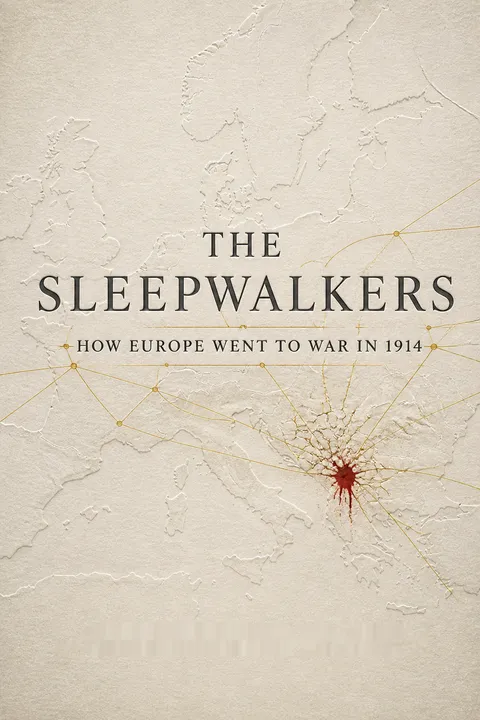
The Sleepwalkers examines how Europe stumbled into World War I, challenging the notion that Germany bore sole responsibility. Christopher Clark presents the July 1914 crisis as resulting from complex diplomatic failures across all major powers rather than deliberate warmongering. The extensively researched work focuses on Serbian nationalism's destabilizing role, the precarious alliance system, and fragmented decision-making processes. While academically dense and requiring concentration, readers find Clark's analysis groundbreaking for distributing blame widely and emphasizing the Balkans' centrality. Critics debate his "sleepwalkers" metaphor, questioning whether leaders were truly blind to war's approach. Most reviewers praise the meticulous scholarship despite its demanding 550+ pages.
People Also Read

About the Author
Other books by Christopher Clark
Download PDF
Download EPUB
.epub digital book format is ideal for reading ebooks on phones, tablets, and e-readers.








































