
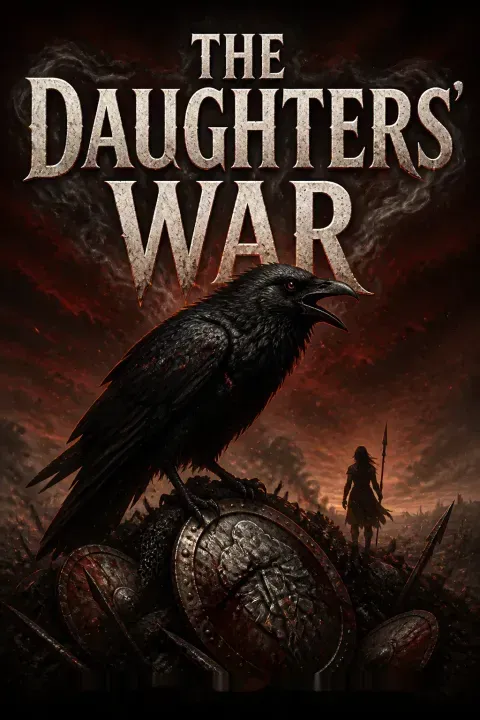


Plot Summary
Prologue
Galva1 recounts the voyage that carried her to war. She saw her first goblin and her first shipwreck on the same day aboard the troopmule Rain Queen's Dagger. A goblin sailor clung to wreckage alongside a kynd woman; archers feathered the creature and the woman stabbed it to death with its own arrow before the debris sank, taking them both.
The soldiers cheered, then fell silent. Galva1 would lose all her friends and two brothers in Gallardia, fall in love with death and a queen,6 and be ordered to die on a high stone bridge, only to fail. This story is not happy, she warns, but it is true. She has no time for lies or liars.
The prologue establishes Galva as a narrator who has survived something catastrophic and now tells her story from a place of hard-won clarity. The image of goblin and human dying together, 'wed in death,' introduces the book's central thesis: that war dissolves the boundary between species, between killer and killed, between living and dead. Galva's list of what she will lose (friends, brothers, innocence) functions as a covenant with the reader, promising honesty without sentimentality. The bridge she was ordered to die on becomes the story's symbolic crux: a place where duty, sacrifice, and survival collide. Her 'failure' to die proves more complicated than success would have been.
Sunlight on a Goblin's Teeth
The flotilla sails into Espalle's crescent bay, where white cliffs still hold the carved faces of ancient Fishers. The fortress called the Drum has had its north wall collapsed by goblin sappers.
As the lanza marches through town with eighty-eight giant corvids, Galva1 sees the devastation: buildings with corners knocked off to destroy symmetry, trellises torn down, wells poisoned with human bones. Maimed children beg. A half-scalped boy asks his mother why the corvid knights carry no banners. A starving girl reaches for Bellu11's beak and Galva1 pulls him back, uncertain what the bird11 might do.
At a courtyard inn, she spots Migaéd3 drunk and playing Towers with his bravos, Grandfather's springwood shield propped carelessly against a stump. The army quarters the birds in the old horse market, a grim monument to the mounts the goblin plague erased.
Espalle functions as Galva's initiation into the visual language of goblin warfare. The biters do not merely kill; they wage an aesthetic campaign against human civilization itself, destroying symmetry, poisoning water, turning churches into butcheries. The children's starvation and the half-scalped boy's question about banners reveal that this war has stripped away pomp and left only desperate survival. Migaéd's introduction, drunk and gambling with his ancestral shield neglected, foreshadows the family conflict that will prove as destructive to Galva as any goblin blade. The empty horse stalls embody the larger loss: a world already dead before this new generation must defend what remains.
The Red Sail Appears
During the Pragmatist7's address at the seaside amphitheater, a cry goes up: a red sail rounds Crab Island. The goblin warship Lament of Avraparthi, concealed by spellwork, has trapped seven troopmules unloading in the harbor.
Its mainsail is a mosaic of human skin, an emperor's face assembled from flayed captives sorted by skin tone, a single glass tear winking below one eye. A massive bronze arm rises and smashes the dreadnought Brawling Bear while a smaller arm scoops screaming sailors into a bronze mouth. The Holtish fireship Sounding Bell, captained by Margalin Woodshire, rams the juggernaut and burns one sail before being destroyed.
Fulvir Lightningbinder,9 the Molrovan arch-wizard, works a greater spell: Galva1 helps sacrifice three lambs at standing stones while singing a mournful song. A catastrophic summer storm rises, driving the juggernaut onto the rocks called the Widow's Teeth.
The juggernaut represents goblin warfare at its most terrifyingly artful: the human-skin sail transforms atrocity into aesthetic statement, while the bronze arms merge magic and mechanics into something that feels unstoppable. Captain Woodshire's sacrifice illustrates the book's recurring argument that individual courage, while magnificent, is often only symbolic against overwhelming force. Fulvir's storm introduces the theme of asymmetrical magical warfare, where victory requires monstrous costs: lambs, a shepherd's livelihood, and the wizard's own health. The episode also establishes that the war's magnitude will demand choices that erode the moral boundaries between defending civilization and becoming something less than civilized.
Blooded Among Lavender
After dining with Gallard orphans in their tree house, Galva,1 Inocenta,5 and Alisenne catch the wet, stomach-clenching scent of goblins while walking back through the woods. Their six corvids bristle, beaks pointing toward the tree line past a lavender field.
Crossbow bolts crack from the trees. One strikes Galva1's shield; another glances off her helmet, batted away by Dalgatha12's shivering wing. The birds charge and tear through eight goblin sailors weakened by shipwreck. Galva1 stabs one through the gut but its arm-hook tangles in her chain mail, anchoring the corpse to her body.
Another rushes her with an oar before Dalgatha12 bites its head off, showering Galva1 with lukewarm, oil-thick blood. She vomits when Inocenta5 shows her a goblin fattened with regurgitated human flesh, meant to feed hivemates on their march.
Galva's first kill is deliberately anti-heroic. She does not triumph but is instead trapped by her dying enemy, freed only by Inocenta's intervention and mockery. The vomiting at the sight of the regurgitating goblin marks the moment her academic understanding of war dissolves into visceral reality. The lavender field, something beautiful and Gallard, becomes the site of butchery, a pattern that will repeat: Goltay's elegant bridges become killing grounds, the Arve's romantic waters fill with bodies. The book insists that war does not make warriors; it makes survivors who learn to function through nausea, terror, and the slow erosion of their own humanity.
The Pragmatist's Naked Command
Prima-General Peya Dolón Milat,7 wearing plain armor and small green spectacles, addresses the Western Army from Espalle's ancient amphitheater overlooking the sea. She declares that individual survival means nothing: soldiers must become limbs of a single animal, as goblins do.
When she asks if any demand a duel of honor, a Gallard bravo and an Ispanthian sword-dam step forward over a love affair. The Pragmatist7 orders them stripped naked before five thousand soldiers. When they hesitate, she repeats the command. They slash each other bloody.
The woman, Isafrea, crawls with her knife and cuts the man's throat in a red smear while the blue sea sparkles behind them. The Pragmatist7 congratulates her on upholding her house's honor and asks if anyone else wishes to duel. The amphitheater goes silent.
The Pragmatist embodies a command philosophy that treats human beings as resources rather than souls: efficient, brutal, and terrifyingly effective. The forced naked duel strips honor of its pretensions, revealing the absurdity of personal vendetta when the species itself is fighting extinction. The contrast between the sparkling sea and the blood-smeared stone stage underscores the book's recurring tension between beauty and violence. The Pragmatist's willingness to sacrifice individuals, even nobles, to enforce collective discipline foreshadows the Butchered Man strategy and the deeper revelation that she serves Dal-Gaata, a goddess who promises nothing but death honestly faced.
A Drunken Swat, a Blade
At Pol4's villa for a family dinner, Migaéd3 arrives drunk with his sycophantic bravos. The Pragmatist7 examines the Mouth of the Storm, Grandfather's springwood shield, and remarks acidly that it rests better on a gambler's back than a warrior's arm.
After she leaves, Migaéd3 grows belligerent. He waves a letter from their father commanding him to give the shield to Galva,1 but he mocks the idea. When Galva1 tries to leave, he swats her backside with a stick. She spins, snatches the stick, throws it in the air, draws her spadín, and cuts it in two before it lands.
The fallen piece strikes his head. Galva1 tells him he will never touch her disrespectfully again. Migaéd,3 blood draining from his face, declares she will never get the shield. She shouts she never asked for it and walks out. Amiel2 keeps the letter.
This scene crystallizes the dom Braga family dysfunction: a father who commands but cannot enforce, an eldest son who squanders his inheritance and lashes out when confronted, a middle brother who cannot choose between loyalty and justice, and two younger siblings caught in the wreckage. Galva's sword-cut is the physical manifestation of a boundary she has been unwilling to draw, and the split stick becomes the sundered fraternal bond. Migaéd's refusal to yield the shield, even when commanded, demonstrates how objects become proxies for unearned identity. The shield itself, an heirloom of courage and honor, passes through the hands of those least worthy of it before reaching its rightful bearer at devastating cost.
Short Life, Bloody Hand
Inocenta5 leads Galva1 to an ancient Keshite temple where Dal-Gaata's faithful gather under the new moon. Banners show the Lady's terrible aspect: a woman's skeleton with carrion-eagle wings, crowned with thorns, holding a black sword.
The high priestess, one of the Blessed Dead for whom a funeral has already been held, speaks through two masked priests in unison. She tells the Parable of the King of Wounds, in which a queen, hearing of her husband's atrocities, smothers their first child, drowns their second, and finally flays herself rather than kill their daughter.
Her discarded skin falls away and her knife becomes a great sword, transforming her into death incarnate. The service culminates in the warrior's prayer. Galva1 says the words with the others, feeling them root in her chest. Something loosens its grip on her.
Dal-Gaata offers Galva what Sath's sunlit church cannot: a theology that treats death not as punishment or tragedy but as intimate companion and ultimate deliverance. The Parable of the King of Wounds is radically subversive, justifying infanticide and self-destruction as moral acts when the alternative is complicity with systemic cruelty. For a soldier facing impossible odds, this promise of agency over one's own death provides the psychological foundation for courage. The 'Blessed Dead' concept, where one's funeral is held before death, inverts the normal relationship between life and its end, freeing the devotee from the fear that paralyzes. Galva does not yet fully believe, but the words have been planted.
The Birds' Scream Freezes Goblins
The lanza hunts goblin butchers in woods near Carrasque and finds Gallard soldiers hanging from branches with their thigh meat carved off. Rage overtakes fear. They charge a goblin force guarding cage-carts of captured kynd. Crossbow bolts hammer shields and three lanza sisters fall to poisoned quarrels.
The goblins form a hedge of hooked spears. Inocenta5 screams a war cry, and her corvid Richu imitates her. Bellu11 takes up the shriek, then Dalgatha,12 then every bird.
The sound, which no one knew the corvids could make, does something unprecedented to goblins: many freeze, their eye membranes locking white as they sway, while others break and run. The lanza walks among the paralyzed and kills them methodically. But when Galva1 cuts the cage-cart ropes, the prisoners only low like cattle. They have been dumbed.
The birdscream discovery is the novel's first major strategic turning point, transforming the corvids from experimental curiosity to war-winning asset. But the triumph is immediately undercut by the revelation of the dumbed kynd: the goblins do not merely kill; they unmake personhood itself. This pattern of victory shadowed by horror becomes the book's emotional rhythm. The hanging soldiers with their scraped leg bones (goblin cuisine favors thighs and calves) represent the industrial scale of goblin atrocity, while Galva's inability to save the dumbed prisoners, who now low for their goblin masters, confronts her with a category of harm beyond rescue. Some victories are only cleaner losses.
Lavender Eyes on the Arve
Recovering from a head wound at Goltay, Galva1 receives a lavender rose with a sonnet from Queen Consort Mireya,6 inviting her to the statue of Nerêne on Elephant's March. She bathes, dabs on cedar and black pepper oil, and goes.
A rude man in a thin mustache stares at women; when Galva1 confronts him, he steals her rose and flees. She chases him through winding streets to a covered wherry on the river Arve, where a beautiful arm beckons. Mireya6 waits in a gossamer robe, a chest of ice chilling honey mead.
The monkey Peppercorn, who had been the rude man transformed, chews the rose stem. They watch the sunset on the water and what follows in the cabin transforms Galva.1 She emerges with weak knees, understanding her body's capacity for pleasure for the first time.
Mireya represents a different kind of power from the martial strength Galva has cultivated: soft, magical, sensual, and deeply political. The seduction is framed as both genuine romance and strategic alliance, with Mireya drawn to Galva's sadness and ferocity in equal measure. The monkey's transformation reveals Mireya's water magic as playful rather than threatening, distinguishing her from the brutal spellcraft of Fulvir or the goblin mages. For Galva, who has defined herself through violence and denial, the encounter with Mireya opens a door to embodiment she did not know existed. The wherry on the Arve becomes a liminal space between war and peace, a fleeting sanctuary the novel will soon destroy.
The Shield Flies Invisibly
Amiel2 drinks Fulvir9's true invisibility potion, enduring nausea until his body vanishes patch by patch. He creeps into the royal pavilions, navigating past guards, dogs, and bored nobles, and finds Migaéd3 losing badly at Towers in King Luvain's tent.
When Migaéd3 returns to his own tent for more coin, Amiel2 watches him eye Grandfather's shield. Migaéd3 picks it up, meaning to gamble it away. Amiel2 knocks it from his hands and begins rolling it away through the night.
What follows is a bizarre pursuit: the drunken Migaéd3 pleads with the apparently self-moving shield, stabs at the air with his slakesword, and very nearly kills his invisible brother with a blind lunge. Later, Queen Mireya6 somehow perceives Amiel2 and helps him hide. He keeps the shield, determined to place it in Galva1's hands.
Amiel's theft is both comic and tragic, a scholar-poet playing at being a rogue and nearly dying for it. The scene dramatizes the absurdity of inheritance when the wrong person holds what should belong to another: Migaéd treats the shield as gambling collateral while Amiel, utterly unsuited to combat, risks his life to restore it to its rightful bearer. Mireya's ability to perceive Amiel hints at the depth of her magical perception and her investment in Galva's family drama. The invisibility itself, Fulvir's costly creation, becomes a metaphor for Amiel's position in the family: present, consequential, but unseen by those who should protect him.
Bellu Does Not Scream
The afternoon after his shield vanished, Migaéd3 arrives at the lanza's encampment with twenty royal chainsmen in heavy plate armor. He accuses Galva1 of stealing the Mouth of the Storm. When two chainsmen grab her arms, Bellu11 bites through his tether and leaps.
He staves in one chainsman's breastplate with his beak, shoves another soldier away, and places himself between Galva1 and the armed strangers, wings spread. But Bellu11 has been bred not to kill kynd. He will not strike humans with lethal intent. Migaéd3 orders him cut down.
The chainsmen hack him apart with their greatswords as Galva1 screams. Afterward, Galva1 lies with her cheek pressed to his beautiful head, making sounds from deep in her belly that are not words. She takes a small chest feather and carries it always. She looks at Migaéd3 with undying hatred.
Bellu's murder is the novel's emotional fulcrum: the moment Galva's familial loyalty finally snaps. The bird, bred as a weapon against goblins, cannot defend himself against the very humans he was created to protect, and this programming becomes his death sentence. Migaéd's cowardice compounds the cruelty: he does not fight himself but hides behind institutional authority, using chainsmen as proxy executioners. Bellu's refusal to harm kynd even in self-defense makes him morally superior to every human present. Galva's grief, expressed in wordless sounds and the kept feather, transforms into the focused hatred that will later enable her to leave Migaéd to the goblins without hesitation. Love and hate, the novel suggests, share the same root system.
The Vault of Mysteries Opens
As dusk falls on Goltay, the high priest of Sath, his eyes yellowed by godsmilk addiction, opens the bronze doors of the Vault of Mysteries. A goblin host has tunneled beneath the temple. Ghalls, eight-foot pale horrors bred from captured humans, charge first, smashing through the royal pavilions with mauls and greatswords.
They butcher kings: Luvain of Gallardia dies fighting in his sleeping robe, alongside the monarchs of Wostra, Unther, Brayce, and others. The lanza, stationed across the river, is ordered to retake the Bridge of Promises.
They charge through smoke and corpses. Dalgatha12 kills a ghall by piercing its neck where armor gaps. Poleaxe knights relieve them. On the way back, Galva1 encounters Hanz the Fool,10 expertly disguised as a goblin, clutching a wheel of cheese. The sweet king is dead, he tells her.
The Kingsdoom represents the catastrophic failure of every institution meant to protect civilization: religion (the godsmilk-addicted priest), royalty (the butchered kings), and military intelligence (the unseen tunnel). The Vault of Mysteries, which should have held divine power, holds only betrayal and a goblin army. Hanz's survival in goblin makeup, clutching cheese amid the apocalypse, introduces gallows humor as a legitimate survival strategy. His disguise also collapses the boundary between human and goblin, suggesting that under the greasepaint and armor, the difference is thinner than anyone wants to admit. The fall of Goltay is not a battle lost but a world ended.
A Holtish Knight Bears News
During the chaotic retreat from Goltay, Galva1 spots a Holtish knight carrying the Mouth of the Storm slung on his back. She confronts him in Holtish, describing the shield's exact details: the rosy springwood, the storm-man boss with puffed cheeks and a faint smile blowing wind.
The knight, Umbert of Swatlingmoor, hesitates, then admits he took it from a pile of dead. He saw a boy matching Amiel2's description, with distinctive orange Montabrecola stockings and long dark hair, cut down by goblin spear and axe near the river.
He and his comrades killed the biters responsible and dumped the bodies in the Arve. Galva1 trades her lanza shield for the Mouth of the Storm. She pretends not to believe it was Amiel,2 but in her gut she knows. She straps on the shield and channels grief into cold fury.
This exchange is the novel's most devastating transaction: a shield for a brother, a family heirloom recovered at the cost of knowing it was Amiel's last, failed mission. Umbert's honesty, when lying would have been easier, represents the decency that survives even in the charnel house of war. Galva's pretense of disbelief is a survival mechanism, a fiction that allows her to keep moving, keep killing, keep functioning as a soldier rather than collapsing into the grief that waits for her. The shield, now stained with Amiel's invisible blood, becomes something heavier than springwood: a burden of guilt and a mandate for vengeance.
Fingers Cut from the Army
Pursued by one hundred twenty thousand goblins, the Pragmatist7 enacts the Butchered Man strategy, based on a fable of a father who feeds pieces of himself to wolves so his family can escape. Each unit receives a body part name. Pol4 draws tokens blindly before the assembled army.
The first drawn, 'left ring finger,' condemns a battalion of Brayçish greatbows and Unthern pillow knights to be left at a choke point with provisions and musicians playing a sad song. Three more fingers are cut away over the coming weeks.
Galva1's lanza is 'right second toe.' The retreat is brutal: starvation, mud, a coughing sickness. The corvids, mad with hunger, revolt; archers kill several before the loyal birds put down the rest. Galva1 holds Dalgatha12's beak, whispering that kynd were bad.
The Butchered Man strategy represents the Pragmatist's military philosophy at its most extreme: abstract human lives into interchangeable body parts and spend them with mathematical precision. The lottery's fairness, drawing lots rather than sacrificing only the common-born, is what ultimately dooms the Pragmatist politically; nobles will forgive incompetence but never equality. The corvid revolt introduces a terrifying question: if the weapons become hungry enough to turn on their makers, what separates defender from threat? Galva's whispered confession that 'kynd were bad' acknowledges her own complicity in Bellu's murder and the moral rot spreading through the army. Survival requires accepting that humans may deserve what comes for them.
The Haros Horn Ravine
At the Horn of Haros, a stone bridge spanning a deep ravine, the left-foot battalion is sacrificed. Ispanthian knights hold the narrow span for a day and night against endless goblin charges. Then ballistas arrive and heavy bolts punch through plate armor. The lanza charges.
The corvids scream and some goblins freeze, but Moth Knights in masks of sewn human skin push forward. A ghall's ball-and-chain kills Nouva;8 she asks Galva1 if it is bad before she dies. Galva1 stabs the ghall's loins and crawls free.
A ballista bolt flies at her; Grandfather's shield seems to deflect it, and the bolt impales another ghall that topples into the ravine, grabbing Galva1's belt. She plunges down the cliff into the river Coufre. Dalgatha12 spreads her wings and steers their fall into the water. Galva1 survives, broken, alone.
The Haros Horn battle is the novel's structural and thematic climax, the moment the lanza fulfills its sacrificial function. Nouva's dying question, asking if her head wound 'is bad' while her eye hangs from its socket, captures the surreal intimacy of battlefield death: even in extremis, people reach for the familiar, the conversational. The shield's apparent deflection of the ballista bolt could be luck or magic; Galva chooses to believe her grandfather's spirit intervened, and belief may be its own kind of truth. Dalgatha's rescue of Galva, steering their fall with wings never meant to fly, repays the bond forged through years of feeding, training, and love. The bird saves what the army was willing to spend.
The Bell Tolls for Migaéd
Dalgatha12 drags Galva1 from the river and nurses her. Mireya6 finds them and heals Galva1's shattered body with river magic, a water elemental's cold kiss knitting bones and regrowing teeth. They share a dream encounter in a magical tower of Mireya6's creation, where love-making transcends the limits of flesh.
A visible love-bite on Galva1's neck proves the dream was real. Moving toward Arvise, Galva1 encounters two women who reveal that Migaéd3 and his Scarlet Company deserted at Haros Horn and are now abusing villagers in Roncenay.
Galva1 attacks their Lammas feast, killing several. Migaéd3 and survivors barricade themselves in a strong-house. Galva1 climbs the bell tower and rings the alarm. The approaching goblin foragers, hearing the bell, break into a run toward the village. She leaves without looking back.
The Roncenay confrontation completes Galva's moral arc regarding Migaéd. She does not kill him directly; she simply provides the opportunity for the goblins to deliver the consequences he has earned through desertion, rape, and the murder of her bird. The bell-ringing is both tactical and poetic, reversing the usual alarm function to summon death rather than warn against it. Mireya's healing and the dream tower offer a counterweight: the love that makes survival meaningful. The love-bite, a physical mark persisting from a magical encounter, insists that the boundaries between real and imagined, body and spirit, are more permeable than Galva's soldierly pragmatism wants to admit.
Idala on the Brown Hill
Mireya6 cuts a thorn of ice from Galva1's heart, binds it with Amiel2's white natal-day ribbon, a feather from Dalgatha,12 and a thread of blue cloth, and looses it as an arrow to summon early snow that drives the goblins south.
In the war's aftermath, the Pragmatist7 is revealed as a high priestess of Dal-Gaata and stripped of command; she falls on her sword. Pol,4 who lied to protect his father's political interests by blaming the Pragmatist7 for the Horn losses, walks into the sea at the cove his dead lover Samera had loved and opens his veins.
Galva1 returns to Braga, where the duke still claims Migaéd3 died a hero. She walks past the castellan to the hill where Idala,13 the last natural horse in Ispanthia, waits blind and ancient. Galva1 presses her head to the mare13's warm flank and weeps.
The novel's final movement insists that survival is not the same as victory. The Pragmatist, who saved the army through ruthless calculus, is destroyed by the political class her strategies protected. Pol, who chose family loyalty over truth, cannot live with the moral stain. Galva alone of her siblings remains, carrying the shield, the faith, and the accumulated grief of everyone she has lost. Idala, the last horse, represents a world that ended before the war began: the Stumbles took the cavalry, and with it the chivalric ideals of the Knights' War. What replaces it is something harder, stranger, and female. Galva refuses her father's summons, choosing the dying horse over the living lie. The old order can wait.
Epilogue
Galva1 approaches the enclosure on the Little Girl hill. Idala,13 too old to ride and nearly blind, raises her head at the sound of Galva1's voice. The old mare13 nickers softly and swishes her tail against the Ashers flies. Galva1 dismisses the guards, telling them she is guard enough. She presses her face against Idala13's warm flank, taking in the good scent of horse and wetting the coat with glad tears.
A castellan in scarlet and gold arrives to announce that the duke wishes to see his daughter. Galva1 closes her eyes, listening to the mare13 breathe and to frogs singing near the river. The sun sets beautifully over the hills of Braga. The Eyes of Nerêne will appear soon in the darkening sky. She tells the castellan her father will wait.
The epilogue closes the narrative loop by returning Galva to the hill where, as a child, she disobeyed her governess to ride Idala bareback. The mare's survival, alone among horses, mirrors Galva's own improbable endurance. The duke's summons and Galva's refusal represent the final rupture with patriarchal authority: she will not participate in the fiction that Migaéd died a hero, nor will she accept her father's version of the war. The frogs and the sunset and the Eyes of Nerêne suggest a world that continues to offer beauty despite everything. Idala, blind and ancient, embodies Galva's own relationship with the past: something that can no longer carry her but still deserves her presence, her touch, her tears.
Analysis
The Daughters' War examines what happens when a civilization runs out of men and must hand its swords to women who were never meant to hold them. Galva dom Braga1 is not a reluctant hero in the traditional sense; she is eager for combat, trained from childhood in Calar Bajat, desperate to escape the political marriage that awaits a duke's only marriageable daughter. The war gives her what peacetime denied: purpose, camaraderie, a use for her violence. But the novel insists that this liberation is also a trap. The army will spend Galva1 and her sisters as readily as it spent the men before them, and the political class will reclaim its privileges the moment survival is assured. The Pragmatist,7 who saved the Crownlands through mathematical ruthlessness, is destroyed because she treated noble blood as equal to common. Pol,4 who compromised his integrity to serve his family's interests, walks into the sea. The war that freed Galva1 from one cage delivers her to another: the role of survivor, carrying the dead forward into a peace that has no place for what she became. Dal-Gaata's theology offers the only honest framework for this reality. The Bride does not promise salvation or meaning. She promises only that death, when it comes, will be a welcome guest rather than a thief. The novel's emotional core is not triumph but endurance: Galva1 on the hill with Idala,13 choosing the dying horse over the living lie, accepting that some loyalties outlast nations and some griefs outlast wars.
People Also Read
Characters
Galva dom Braga
Raven knight and swordswomanThe daughter of the Duke of Braga, Galva is a twenty-year-old Calar Bajat-trained swordswoman who volunteers for an experimental corvid unit rather than be married off for political advantage. She is lean, plain-spoken, physically fearless but emotionally guarded, shaped by a distant mother and a father who prized horses over daughters until the goblin plague took the horses too. Her defining relationship is with her youngest brother Amiel2, whom she has protected since childhood. Her arc moves from rigid self-control through devastating loss to a hard-won ability to receive love, both from her irmana apracera Inocenta5 and from Queen Mireya6. Her conversion to Dal-Gaata gives her a framework for embracing death, but her greatest struggle is learning to stay alive.
Amiel dom Braga
Poet and wizard's apprenticeGalva1's youngest brother, nicknamed Chichún (Chickpea) because he was the only dom Braga child born bald. At eighteen, he is gentle, bookish, and utterly unsuited to war, yet conscripted to serve as assistant to the arch-wizard Fulvir9. He writes poetry, keeps a journal, and loves his sister with a devotion that will prove fatal. His attempts to reclaim Grandfather's shield for Galva1, first through the invisibility potion and then by carrying it himself, reveal both his courage and his tragic naivete. He represents everything the war destroys: art, tenderness, the life of the mind. His journal entries, which Galva1 preserves and quotes, provide the novel's secondary narrative voice.
Migaéd dom Braga
Eldest brother and disgraceThe firstborn son and heir to the Duke of Braga, Migaéd is a drunk, a gambler, and a sixt-general (an honorary rank for useless nobles). He squanders his father's money, loses Grandfather's shield at cards and recovers it through luck rather than merit, and refuses to honor the duke's command to give the shield to Galva1. His charm, once genuine, has curdled into manipulation. His murder of Galva1's corvid Bellu11, ordered from behind chainsmen rather than faced directly, cements his moral bankruptcy. He embodies the腐朽 of the old martial aristocracy: a man who wears armor with no dents, commands soldiers he has no right to lead, and ultimately deserts when tested.
Pol dom Braga
Terce-general and second brotherThe capable second son, Pol rises to terce-general and then segunth-general through genuine military competence rather than birth. He is tall, plain-faced, burdened by responsibility, and devoted to his family in ways that become destructive. His love affair with Segunth-General Samera dom Vinescu reveals a passionate nature his public persona hides. After the war, his father pressures him to lie about the Pragmatist7's decisions to protect Migaéd3's reputation, and Pol's compliance with this lie poisons him. Unlike his siblings, he cannot reconcile his moral compromises with his self-image, and the weight of it eventually drives him into the sea.
Inocenta
Galva's irmana apraceraA stout, ginger-haired raven knight from rural Braga, Inocenta is Galva1's closest companion, her 'sister who embraces' in the Ispanthian tradition of non-sexual intimate partnership between women. She is a devoted follower of Dal-Gaata, possibly an initiated priestess, and it is she who leads Galva1 to the faith. Her axe-work is brutal and fast, and she faces battle with something approaching joy, having already made peace with her own death. She has two children in an ucal (communal hearth) back home. Her relationship with Galva1 is the novel's most stable emotional anchor, surviving jealousy over Galva1's affair with Mireya6 through mutual respect and a love that has been carefully defined as something other than romantic.
Queen Mireya
Exiled heir and water mageBorn the Infanta Mireya of Ispanthia, the true heir to the throne usurped by her uncle Kalith, she was married off to King Luvain of Gallardia as a political pawn. She is a water mage of considerable power, strongest near rivers, and a devotee of Nerêne, the Gallardian goddess of love. Her courtship of Galva1 combines genuine passion with strategic calculation; she recognizes in Galva1 a sword that could serve her political aims. She is witty, sensual, and capable of deep feeling, genuinely mourning Luvain even as she takes Galva1 as a lover. After Luvain's death, she is remarried to the king of far Oustrim, but continues to visit Galva1 in shared dreams.
Peya Dolón Milat
The Pragmatist, army commanderKnown as the Pragmatist, she is the supreme commander of the Western Army, a woman who turned around the eastern campaign and was brought west to salvage a losing war. She wears plain, battle-scarred armor, small green spectacles, and the expression of someone who has weighed every life under her command and found most of them already spent. Secretly a high priestess of Dal-Gaata, one of the Blessed Dead, she applies the goddess's cold calculus to military strategy: every sacrifice must buy time, every death must serve the survival of the whole. Her insistence on equal sacrifice across social classes ultimately destroys her career, but her tactics save the army and, arguably, the Crownlands.
Nouva Livias Monçera
Lanzamachur of the corvid knightsCommander of the First Lanza of Corvid Knights, Nouva is a veteran of the Threshers' War who lost her left thumb to a goblin bite. She is dark-skinned with sharp features, practical rather than romantic, and married to the sword and shield in the old tradition. She respects Galva1's skill without deference to her birth, willingly accepting the nepotistic writ Pol4 provides because it serves her birds. Her death at Haros Horn, asking Galva1 if her head wound 'is bad' while dying, typifies her stoicism. She is a professional soldier who has made peace with the terms of her trade.
Fulvir Lightningbinder
Molrovan arch-wizardA bald, aging mage from the cold northern country of Molrova, Fulvir is perhaps the most powerful wizard fighting for the Crownlands. He created the war corvids through bone-mixing magic, earning him the epithet Father of Abominations. His people's culture of polite untruths makes him difficult to read, and his humor runs to the cruel. He is nevertheless genuinely committed to defeating the goblins, spending his own health and teeth in spellcraft. His destruction of the juggernaut via catastrophic storm and his later burning of goblin assassins demonstrate both his power and its terrible cost. He takes Amiel2 as an assistant partly for political reasons, partly out of genuine if grudging affection.
Hanz
Dwarf fool of King LuvainAn Unthern dwarf and former mummer who once played goblins in muster-plays until his companions were killed by villagers who mistook them for real biters. He was rescued from an abusive lord by the then-earl Luvain and became the king's fool out of loyalty rather than necessity. He speaks three languages, tells stories that are funny and devastating in equal measure, and survives the Kingsdoom by disguising himself as a goblin. His role in the narrative is to puncture pretension and to demonstrate that wit, adaptability, and a willingness to look ridiculous are survival strategies as valid as any sword.
Bellu
Galva's male war corvidThe stronger of Galva1's pair of war corvids, Bellu is sweet-natured, protective, and utterly devoted to his mistress. He speaks a few words in the flat, rough voice of his kind, including Galva1's name. He has never killed a human, having been bred and trained not to harm kynd, and this programming proves fatal when Migaéd3 brings chainsmen to the camp. His death is the novel's most brutal moment, not because it is the bloodiest but because it is the most unjust. Bellu represents the weapon that refused to become monstrous, the killing thing that chose restraint, and was destroyed for it.
Dalgatha
Galva's female war corvidNicknamed Skinny, Dalgatha is the smarter and fiercer of Galva1's corvids, capable of learning long names and executing complex combat maneuvers. She is jealous of attention given to Bellu11, sharp-beaked when slighted, and spectacularly lethal in battle, having learned to target the gap between ghall armor and helmet. After Bellu11's death, she rescues Galva1 from the Haros Horn ravine, steering their fall with her wings, and later nurses her injured mistress by bringing firewood, fish, and scavenged swords. Her intelligence and loyalty make her more than a weapon; she is a companion whose bond with Galva1 outlasts the war.
Idala
The last natural horse in IspanthiaA brown mare who survived the Stumbles, the goblin-brewed plague that killed every other horse in the Crownlands except for mares pregnant at the time of infection. Idala was Galva1's companion throughout childhood, the one creature who made her feel chosen rather than burdensome. By the novel's end, she is ancient, blind, and guarded at all times because her living body is worth more than gold. She represents a world that ended before the present war began, and her reunion with Galva1 on the brown hill closes the narrative with an image of love that does not require exchange, only presence.
Sambard
Gallard orphan boyA shirtless, olive-skinned Gallard boy who befriends Galva1 in Espalle, gifting her a piece of amber-colored glass that becomes one of her most treasured possessions. He and his sister Larmette15 survive by building a tree house in the woods and eating squirrels, birds' eggs, and grubs. He represents the children the war has orphaned and the resilience that persists despite everything.
Larmette
Carpenter and orphanSambard14's older sister, a skilled carpenter who built their tree house from her father's inherited tools. Galva1 gives her a cloth of blue and gold that Larmette treasures as the prettiest thing she owns. When goblin deserters later take this cloth as a trophy, Galva1 recovers it. The fabric, stained with Larmette's unknown fate, becomes one of the components Mireya6 uses in the spell that brings early snow.
Plot Devices
War Corvids
Genetically engineered war beastsCreated by Fulvir Lightningbinder9 through bone-mixing magic, these raven-like birds are the size of stags, too heavy to fly but capable of massive leaps. They are bred from ordinary ravens mixed with the blood of running birds from Axa, giving them ground speed and killing power. Each wears a steel breastplate and bladed spurs; their beaks can pierce chain mail. They bond to individual handlers, speak a limited vocabulary, and are trained not to kill kynd. Their most devastating weapon is the birdscream, a group shriek that causes goblins to freeze or flee, discovered accidentally during the battle of Carrasque. After the war, their increasing intelligence and tendency to bond with each other rather than humans leads King Kalith to order most destroyed, fearing a commoner-led revolt.
The Mouth of the Storm
Enchanted springwood shieldA shield made for Corlu dom Braga, Galva1's grandfather who fought in the Knights' War. Crafted from living springwood that continues to repair itself with sunlight and water, it features a steel boss shaped like a storm-man blowing wind. The Pragmatist7 recognizes it as the work of Master Jarnu Arnaz ej Lobunegru, a Galtish craftsman rumored to have been a witch's son. The shield may possess minor protective enchantments; at the Haros Horn, it appears to deflect a ballista bolt away from Galva1. Passed from Migaéd3 to Amiel2 to a Holtish knight to Galva1, its journey through unworthy or doomed hands before reaching its rightful bearer mirrors the theme of inheritance earned through suffering rather than birthright.
Bittermead
Flesh-spoiling suicide poisonAn expensive, spellworked poison carried by officers. It kills the drinker instantly and makes their flesh toxic to goblins, preventing their bodies from being butchered and eaten. Pol4 offers a flask to Galva1, who refuses it, saying she will fight harder knowing she has no escape. The poison represents the grim calculus of goblin war: death is not the worst outcome, being eaten is, and the only mercy the wealthy can buy is the assurance that their corpses will not feed the enemy. Prince Barwyn's knights are said to have drunk bittermead before their final charge at the Kingsdoom, ensuring that even in defeat they denied the Horde its trophies.
The Butchered Man Lottery
Sacrificial rearguard strategyNamed after an Ispanthian fable in which a father feeds pieces of himself to pursuing wolves so his family can escape, this strategy assigns each unit a body part name. When a token is drawn, that unit is left behind with provisions and musicians to delay the goblin advance as long as possible. The system's fairness, drawing lots rather than sacrificing only common soldiers, is politically radical. It preserves the army as a whole but costs the lives of its best units, including Galva1's lanza. The strategy saves enough troops to hold the Hounds of Mour but ultimately destroys the Pragmatist7's career when noble families revolt against the equal distribution of sacrifice.
Invisibility Potion
Temporary stealth elixirFulvir9's experimental brew, made from mantids, fireflies, and other ingredients, renders the drinker invisible for six to eight hours. The first version fails spectacularly, making Amiel2 only think he is invisible while walking naked through the woods. The perfected version works, allowing Amiel2 to infiltrate the royal pavilions and steal the Mouth of the Storm from Migaéd3. A companion device, a breathing reed that absorbs sound, enables silent movement. The potion represents Fulvir9's willingness to experiment on human subjects and the novel's recurring interest in the gap between perception and reality. Amiel2's invisibility also literalizes his position in the family: present, consequential, unseen.
Blacktongue Series


Download PDF
Download EPUB
.epub digital book format is ideal for reading ebooks on phones, tablets, and e-readers.








































