
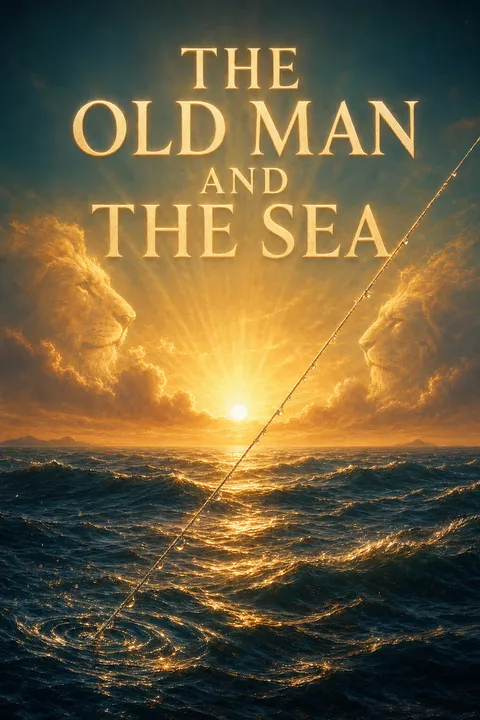


Plot Summary
Eighty-Four Days Empty
Santiago,1 a gaunt Cuban fisherman whose eyes alone stay young and undefeated, has gone eighty-four days without landing a fish. The boy he taught, Manolin,2 was pulled away by his parents who declared the old man salao, the worst kind of unlucky, and sent to a luckier boat.
Still the boy2 loves him, hauling his gear up the beach, buying him beer on the Terrace, pretending alongside him that there is rice and fish to eat when the shack holds neither. They talk baseball and the great DiMaggio,5 son of a fisherman. Manolin2 fetches sardines and fresh baits. Santiago,1 lean with humility but rich in resolve, declares he will row far out tomorrow, where the truly big September fish run.
Hemingway opens not with action but with stripped dignity. Santiago's poverty is total, yet the fictions he and Manolin maintain (imaginary supper, a cast net long since sold) reveal love as ritual rather than transaction. The old man's humility carries no shame, no loss of pride, an early statement of the book's ethic. Baseball functions as secular scripture, DiMaggio as a saint whose suffering (the bone spur) sanctifies endurance. The number eighty-five becomes a talisman of hope. Hemingway establishes a world where worth is measured not by catch but by precision, faith, and the refusal to surrender belief, even as practical reality strips a man down to bone.
Rowing Past the Others
In the dark Santiago1 wakes the boy,2 drinks coffee at the fishermen's stand, takes his sardines and tuna baits, and rows out of the harbor while other boats scatter inshore. He goes farther than the rest, past the great well of seven hundred fathoms, into water so dark it is nearly purple.
He sets his baits with care no other fisherman matches, each hook sweet-smelling and exact at its proper depth. He speaks to the sea as la mar, a woman who gives and withholds favors. A man-of-war bird marks feeding dolphin; Santiago1 catches a small albacore for bait. Confident, talking aloud to himself now that the boy is gone, he waits, certain that his big fish is somewhere out in that solitude.
Solitude becomes the novella's true arena. Santiago's habit of speaking aloud, begun after the boy left, dramatizes loneliness without self-pity. His feminine personification of the sea reveals a relational, almost devotional cosmology: nature is neither enemy nor servant but a beloved who cannot help her cruelties. The contrast between his exactness and other fishermen's careless drifting frames his identity, he would rather be precise than lucky, so that when luck comes he is ready. Hemingway's iceberg method submerges meaning beneath surface detail: the baited hooks, the bird, the depths. Going far out is both literal craft and metaphor for the existential reach that defines and endangers him.
Something Takes the Bait
A green stick dips. One hundred fathoms down, a marlin3 mouths the sardines, and Santiago1 feeds line with delicate patience, willing the fish to swallow the hook into its heart. When he strikes hard with both hands, nothing yields. Instead the unseen fish3 begins to swim, pulling the skiff steadily northwest.
Santiago1 braces the line across his back and becomes, as he puts it, the towing bitt for a creature he cannot raise an inch. Hours pass, then a whole night, the boat drawn farther from land beneath the stars. He cannot make the line fast for fear it will snap. Again and again he wishes the boy were with him, alone now with a fish3 whose size and strength dwarf anything he has ever hooked.
The hooking inverts the hunter-prey hierarchy: the man becomes anchored to the fish, his body the instrument of a contest he cannot control, only endure. Hemingway converts fishing into a sustained meditation on commitment, once joined, Santiago will not let go, framing the struggle as a bond rather than a battle. The repeated longing for the boy measures the cost of self-sufficiency and the dignity of bearing pain alone. The fish, still unseen, grows mythic through absence. This is the point of no return: the old man has gone too far to turn back, tethered to a will equal to his own, and time itself dissolves into the rhythm of holding on.
The Fish Reveals Itself
Through a freezing night and a second day Santiago1 suffers a cramped left hand he curses like a traitor, forcing himself to eat raw tuna and a caught dolphin to stay strong. He recalls his youth, the day-long arm-wrestling match in Casablanca against the great negro from Cienfuegos7 that earned him the title El Campeon.
Then the line rises and the marlin3 breaks the surface in full length, sword like a baseball bat, two feet longer than the skiff. Awed, Santiago1 begins to call the fish his brother,3 pitying it even as he vows to kill it. The creature3 circles for hours while he gains line in agonizing inches, sweating, half-fainting, his hands raw, praying Hail Marys and promising a pilgrimage if he lands his impossible prize.
Revelation transforms abstraction into intimacy. Seeing the marlin, Santiago names it brother, collapsing the distance between predator and prey into kinship and love. The cramped hand, treated as a separate, shameful entity, externalizes the body's betrayal of an aging man's will. The Casablanca memory restores his youthful potency by association, binding present endurance to past triumph. His mechanical prayers reveal pragmatic faith, bargaining with a God he barely claims to believe in. Hemingway's central paradox crystallizes here: one can love what one must destroy, and the worthiness of the adversary ennobles the killer. Pride and tenderness become indistinguishable, the moral knot at the heart of the struggle.
The Harpoon Goes In
On the third sunrise the circles tighten. The marlin3 tries again and again to right itself and swim free, and each pass nearly finishes the old man, who feels himself going faint, his vision flashing, his hands mushy. Talking to himself and to the fish,3 he gathers every scrap of pain, pride, and leftover strength and pulls the giant3 onto its side.
As it glides past the planks, long and silver and barred with purple, he drives the harpoon down behind the great chest fin, into the heart. The fish3 rises in a last towering leap, hangs above the skiff in all its power, then crashes dead into the sea, blood spreading like a cloud. Santiago1 lashes it alongside, too big to lift aboard, and sets sail for home, triumphant and emptied.
The kill is climax and consummation rather than victory pure. Hemingway renders the marlin's death as transfiguration, the leap suspending the fish in glory before it falls, so that conquest and mourning arrive in the same instant. Santiago's summoned strength dramatizes the proposition that a man's measure lies in what he endures beyond his apparent limit. Yet the language of brotherhood persists, undercutting any clean heroism. The harpoon to the heart is intimate, almost sacramental. Having proved himself against the worthiest opponent of his life, the old man begins the long sail back already aware that the sea rarely lets a man keep his greatest achievement whole and unchallenged.
The First Shark
An hour into the voyage home, a massive Mako shark,4 beautiful and fearless with eight rows of clawlike teeth, follows the scent of the marlin3's blood. Santiago1 waits with grim resolution and rams the harpoon into its brain. The shark4 thrashes, wraps itself in the rope, plows the surface like a speedboat, and sinks, but not before tearing forty pounds of meat from the fish3 and carrying off the harpoon and all its rope.
Sickened to see his brother3 mutilated, the old man feels struck himself. He insists a man can be destroyed but not defeated, then sets about lashing his knife to an oar handle as a new weapon. He knows the bleeding marlin3 now lays a scent trail across the sea wide as a highway, and that more sharks4 will come.
The novella's tragic engine starts here: the sea reclaims what it gave. The Mako, admired even in attack as noble and well-armed, mirrors Santiago, a true hunter rather than scavenger. His famous credo, that a man may be destroyed but not defeated, articulates Hemingway's stoic existentialism: meaning resides in the manner of resistance, not the outcome. The loss of the harpoon strips the old man's tools one by one, a deliberate diminishment. His grief at the marlin's wounding (feeling the bite as his own) confirms that the kinship was real. The improvised knife-oar signals adaptation, but the highway of blood foretells that defense is now only delay.
Weapons Break, One by One
Through the afternoon the galanos4 arrive, hateful shovel-nosed scavengers drawn by the trail. Two come together; Santiago1 kills both with the knife lashed to the oar, apologizing to the fish3 for having gone out too far.
A single shovelnose4 follows, and as he drives the blade into its brain the knife snaps off, leaving him with only oars, a club, and the tiller. At sunset two more4 attack and he batters their skulls with the club, hurting them, driving them off. He tells himself he could have killed them cleanly in his prime.
Each assault carries away more of the best meat, and the old man no longer wants to look at his ruined prize.3 He keeps steering toward the glow of Havana, exhausted, sustained only by the will to bring home what remains.
The serial loss of weapons enacts entropy as narrative form: harpoon, then knife, then the club's effectiveness, each subtraction a step toward helplessness. Santiago's repeated apology to the fish reframes the sharks as consequence of his own ambition, his crime of going too far, introducing guilt into heroism. The scavenger galanos contrast pointedly with the noble Mako, distinguishing kinds of death and kinds of opponent. Hemingway dramatizes aging as the gap between what a man could once do and what he can do now. Yet Santiago neither despairs nor quits; he simply adapts and steers, locating dignity not in winning but in the unglamorous persistence of doing what little remains to be done.
Nothing Left But Bone
By midnight a whole pack4 strikes, visible only as fins and phosphorescent streaks tearing at the carcass. Santiago1 clubs at heads he can barely see until the club is wrenched away; he beats with the tiller until it splinters, then stabs with the jagged butt. When a shark4 seizes the marlin3's head itself, he knows it is over.
He spits blood, tastes something coppery and broken in his chest, and tells the scavengers4 to dream they have killed a man. Fitting the broken tiller into the rudder, he sails the lightened skiff home, past feeling, thinking only of steering well. Reaching the dark harbor, he shoulders the mast, falls repeatedly, and climbs to his shack to collapse face down on the newspapers, arms out, palms up, utterly spent.
The final assault completes the stripping: prize, weapons, and nearly the man himself are consumed, leaving a skeleton and a body broken inward. Santiago's diagnosis, that he was beaten only because he went out too far, converts catastrophe into self-knowledge rather than blame of the sea. His crucified sleeping posture (arms outstretched, palms up) supplies unmistakable Christian iconography, framing his suffering as a kind of secular passion. Hemingway refuses both triumph and self-pity; the old man's lightened skiff sails well, a small mercy. The struggle's value survives its material erasure. What the sharks cannot take is the proof, written in his ruined hands and chest, of how far a man went and how he bore it.
The Skeleton and the Lions
At dawn Manolin2 finds the old man1 asleep, sees his maimed hands, and weeps, then weeps again all the way down the road. Other fishermen measure the skeleton lashed to the skiff at eighteen feet.
The boy2 brings coffee and, when Santiago1 wakes, refuses to let him claim defeat by the fish,3 insisting it was only afterward that they beat him. He declares he will fish with the old man1 again whatever his parents say, for he still has much to learn, and he plans new gear and tends his hands.
That afternoon, tourists at the Terrace see the great spine and tail and mistake it for a shark's, marveling at its handsome shape, understanding nothing. Up the road Santiago1 sleeps once more, and the boy2 watches over him while the old man dreams of the lions.
The ending braids loss and continuity. The tourists' ignorant misreading of the skeleton stages the gulf between heroic experience and casual observation, no one who was not there can know what the bones mean. Manolin's tears and renewed devotion restore the human bond that solitude had suspended, and his refusal to call the fish the victor reaffirms the ethic of indomitable spirit. The transfer of knowledge to the boy promises that Santiago's craft outlives his catch. The closing dream of the lions, recurring image of youth and peace on the African beaches, suggests the old man returns to innocence and strength in sleep. Defeat in the world coexists with undefeated dreaming.
Analysis
Hemingway compresses an epic into a fisherman's three days, building a parable about dignity that refuses easy uplift. Santiago1's ordeal proposes that meaning lives in the quality of struggle rather than its reward: he lands the greatest fish of his life3 and brings home only its skeleton, yet the narrative insists this is not failure but the human condition rendered honestly. The famous formulation, that a man can be destroyed but not defeated, is tested rather than merely asserted, as the sea strips him of harpoon, knife, club, and prize until only will and a ruined body remain. The prose mirrors its hero: spare, exact, withholding more than it states, the iceberg method that lets the unsaid carry weight. Christian symbolism (the marlin3's blood, the crucified sleeping posture, the carrying of the mast) elevates a poor man's labor toward the sacred without dogma. The relationship with the marlin3 complicates any simple reading of conquest; Santiago1 loves and mourns what he destroys, calling it brother, locating tragedy in the necessity that the things we most admire are the things we must contend against. Aging is the quiet undertow throughout, the gap between what the old man could once do and what his cramping hands now manage, yet Hemingway grants no self-pity. The boy2 supplies the counterweight to nihilism: knowledge and love pass to the next generation, and the tourists' ignorant misreading of the bones underscores that heroic experience is largely incommunicable. The closing dream of the lions returns Santiago1 to an innocence untouched by loss. The book endures because it dignifies obscure, defeated labor, arguing that how one bears suffering, alone and unwitnessed, is itself the measure of a life.
Review Summary
The Old Man and the Sea is a polarizing novel, with many praising its simple yet profound story of an old fisherman's struggle against nature and himself. Readers appreciate the themes of perseverance, dignity, and the human spirit. Some find it boring or overrated, while others consider it a masterpiece of literature. The novella's sparse prose and allegorical nature invite various interpretations. Many note that appreciation for the book often comes with age and life experience.
People Also Read








Characters
Santiago
Aging solitary fishermanAn old Cuban fisherman, thin and scarred, his hands creased by years of cords and heavy fish, his eyes alone still cheerful and undefeated. He fishes alone in a small skiff and has gone months without a catch, mocked by younger men and pitied by older ones. Santiago embodies a stoic ethic of precision, endurance, and humility without shame. He talks aloud to himself, the sea, birds, and fish, personifying nature as kin and the ocean as a beloved woman. Devout in a pragmatic, bargaining way, obsessed with the great DiMaggio5 as a model of grace under pain, he measures himself against opponents worthy of respect. His love for the boy Manolin2 anchors his heart; his pride and reach define both his greatness and his peril.
Manolin
Devoted apprentice boyThe boy Santiago1 taught to fish from the age of five, who loves the old man like a father. Forced by his parents to join a luckier boat after forty fishless days, he still tends Santiago1 daily, carrying gear, supplying baits, buying food and beer, and sustaining the gentle fictions that hide their poverty. Manolin represents loyalty, continuity, and the renewal of generations. His faith in Santiago1 never wavers even when the village writes the old man off. Emotionally tender, he weeps at the sight of suffering and insists on returning to the old man's side, hungry to learn and unwilling to let either luck or parents sever their bond.
The marlin
Magnificent worthy adversaryAn enormous, dignified marlin, longer than Santiago1's skiff, with a sword like a rapier and broad purple stripes. It takes the deep bait and tows the skiff for days with calm, fearless strength, never panicking. Santiago1 comes to call it his brother, loving and pitying it even as he is bound to kill it. The fish functions as both opponent and mirror, its nobility magnifying the meaning of the contest and the cost of victory.
The sharks
Relentless plundering scavengersFirst a single magnificent Mako, fearless and clawteethed, admired even as it attacks; then packs of hateful shovel-nosed galanos, scavengers drawn by blood. They arrive after the marlin3 is killed and tear away its meat piece by piece, forcing Santiago1 to fight with harpoon, knife, club, and tiller until his weapons fail. They embody nature's indifferent reclamation and the inevitability of loss.
Joe DiMaggio
Admired absent heroThe famous baseball player, son of a fisherman, whom Santiago1 reveres as a model of greatness who performs perfectly despite the pain of a bone spur. Though never present, DiMaggio serves as Santiago1's standard of dignified endurance, invoked repeatedly for courage during the ordeal.
Martin
Generous Terrace ownerThe proprietor of the Terrace cafe who quietly sends food and beer to the old man1 through Manolin2. He represents the unspoken charity of the fishing community toward Santiago1.
The man from Cienfuegos
Past arm-wrestling rivalA powerful dockworker Santiago1 beat in a day-long arm-wrestling match in his youth, earning him the title El Campeon. Recalled during the ordeal, the memory restores the old man's sense of his former strength and will.
Plot Devices
Talking aloud at sea
Externalizes solitude and thoughtHaving begun the habit only after the boy2 left, Santiago1 speaks aloud to himself, the sea, a tired warbler, his cramped hand, and the marlin3. Hemingway uses this device to dramatize loneliness without resorting to heavy interior monologue, letting the reader hear the old man reason, encourage, scold, and pray. The talk reveals his relational worldview, in which fish and birds are brothers and the ocean a woman who gives or withholds favors. It also tracks his deteriorating clarity during exhaustion, as he repeatedly orders himself to keep his head clear. The spoken voice becomes the audible thread of a man holding himself together alone on the water.
The absent boy
Measures isolation and longingThroughout the days at sea Santiago1 repeatedly wishes the boy2 were with him, to wet the lines, rub his cramped hand, share the sight of the great fish3, and witness the struggle. Manolin2's physical absence sharpens the theme of self-sufficiency and its cost, turning every difficulty into a reminder of severed companionship. The refrain structures the ordeal emotionally, and the boy2's eventual return frames the story, opening and closing on their bond. The device lets Hemingway keep love present in a narrative that is otherwise a man utterly alone, ensuring the struggle is felt as human rather than merely physical.
Dreams of the lions
Recurring image of peaceSantiago1 no longer dreams of storms, women, or great fish, only of places and of young lions playing on the golden African beaches he saw as a sailor in his youth. The lions recur at the story's opening, during the voyage, and at its very end. They symbolize lost youth, strength, innocence, and an unbroken inner serenity untouched by the day's defeats. Hemingway deploys the image as a tender counterweight to suffering, suggesting that whatever the sea takes from the old man's body and catch, it cannot reach the peace he returns to in sleep. The final return to the lions closes the book on grace rather than loss.
Baseball and DiMaggio
Secular faith and standardReferences to the major leagues, the Yankees, and especially the great DiMaggio5 thread through the novella as Santiago1's source of courage and his measure of dignity. He wonders whether DiMaggio5, son of a fisherman, would stay with a fish3 as long as he does, and whether his own ruined hands are a handicap comparable to the player's bone spur. Baseball binds the old man to the boy2 in conversation and gives him a hero to emulate during pain. The device translates abstract endurance into a concrete, beloved frame of reference, grounding Santiago1's philosophy of grace under suffering in a shared popular mythology.
Going too far out
Frames pride and consequenceSantiago1 deliberately rows beyond all other boats into deep water to find a great fish3, an act of ambition and craft. After the sharks4 destroy his catch, he concludes repeatedly that he was beaten because he went out too far, beyond the safe limits where his prize could be kept whole. The phrase becomes the story's moral refrain, transforming triumph into a meditation on overreach, pride, and the price of greatness. It lets Hemingway hold heroism and tragedy in tension: the same reach that lets Santiago1 hook the magnificent marlin3 also dooms him to lose it, knowledge the old man accepts without bitterness.
FAQ
Synopsis & Basic Details
What is The Old Man and the Sea about?
- A fisherman's epic struggle: The story follows Santiago, an aging Cuban fisherman, as he embarks on a solitary journey far into the Gulf Stream, determined to break his long streak of bad luck.
- A battle of wills: He hooks a massive marlin, and the narrative details the intense physical and mental battle between the old man and the fish, highlighting themes of endurance and respect.
- Loss and resilience: Despite his eventual success in catching the marlin, Santiago faces further challenges, including sharks that devour his prize, forcing him to confront loss and the harsh realities of nature.
Why should I read The Old Man and the Sea?
- Timeless themes explored: The novella delves into universal themes of perseverance, dignity in the face of defeat, the relationship between man and nature, and the cyclical nature of life and death.
- Hemingway's masterful prose: The writing is concise, powerful, and evocative, showcasing Hemingway's signature style of simple yet profound language, creating a deeply immersive reading experience.
- Inspirational character study: Santiago's unwavering spirit and quiet determination serve as an inspiring example of human resilience, making the story a compelling and thought-provoking read.
What is the background of The Old Man and the Sea?
- Cuban fishing culture: The story is deeply rooted in the culture of Cuban fishermen, reflecting their daily lives, traditions, and their intimate relationship with the sea.
- Hemingway's personal experiences: Hemingway's own love for fishing and his time spent in Cuba heavily influenced the setting and the authenticity of the narrative.
- Post-World War II context: Written in the early 1950s, the story reflects a sense of existentialism and the struggle for meaning in a world marked by conflict and change.
What are the most memorable quotes in The Old Man and the Sea?
- "But man is not made for defeat... A man can be destroyed but not defeated.": This quote encapsulates the core theme of human resilience and the indomitable spirit that allows one to endure even in the face of overwhelming odds.
- "Now is no time to think of what you do not have. Think of what you can do with what there is.": This quote highlights Santiago's practical mindset and his ability to focus on the present, emphasizing resourcefulness and determination.
- "I am a strange old man.": This quote, repeated by Santiago, reveals his self-awareness and acceptance of his unique perspective and his place in the world, highlighting his humility and quiet strength.
What writing style, narrative choices, and literary techniques does Ernest Hemingway use?
- Simple and direct prose: Hemingway employs a minimalist style, using short, declarative sentences and avoiding elaborate descriptions, which creates a sense of immediacy and realism.
- Third-person limited perspective: The narrative is primarily told from Santiago's point of view, allowing readers to access his thoughts and feelings, fostering a deep connection with the protagonist.
- Symbolism and metaphor: Hemingway uses recurring symbols like the sea, the marlin, and the lions to represent broader themes, adding layers of meaning to the seemingly simple narrative.
Hidden Details & Subtle Connections
What are some minor details that add significant meaning?
- The patched sail: The old man's sail, made of flour sacks, symbolizes his poverty and the long years of struggle, yet it also represents his resilience and refusal to give up.
- The baseball references: Santiago's admiration for baseball players, especially DiMaggio, reflects his desire for perfection and his need for heroes, connecting his personal struggles to a larger world.
- The lack of a cast net: The daily ritual of the boy pretending to go for a cast net highlights their shared understanding of their poverty and their unspoken bond of loyalty and care.
What are some subtle foreshadowing and callbacks?
- The early mention of the 87-day streak: The boy's recollection of Santiago's past success foreshadows the possibility of a similar triumph, creating a sense of hope and anticipation.
- The old man's dreams of lions: These recurring dreams foreshadow his inner strength and his connection to a primal, untamed spirit, which he draws upon during his struggle with the marlin.
- The mention of the shark factory: The smell of the shark factory foreshadows the inevitable arrival of the sharks, creating a sense of foreboding and highlighting the harsh realities of the sea.
What are some unexpected character connections?
- Santiago and the marlin: The old man develops a deep respect and even affection for the marlin, viewing it as a worthy opponent and a brother in the struggle for survival, blurring the lines between hunter and prey.
- Santiago and the sea: He refers to the sea as "la mar," a feminine term of endearment, showing his deep connection and understanding of its dual nature as both nurturing and cruel.
- Santiago and DiMaggio: The old man's admiration for the baseball player reveals a connection to a figure of excellence and perseverance, mirroring his own desire for greatness and his struggle against adversity.
Who are the most significant supporting characters?
- Manolin: The boy's unwavering loyalty and care for Santiago provide emotional support and highlight the importance of human connection, representing hope and continuity.
- The other fishermen: Their reactions to Santiago, ranging from mockery to sadness, reveal the community's complex view of him and the cyclical nature of success and failure.
- The proprietor of the Terrace: His kindness in providing food and drinks to Santiago and Manolin underscores the importance of community support and compassion.
Psychological, Emotional, & Relational Analysis
What are some unspoken motivations of the characters?
- Santiago's need for validation: Beyond catching a fish, Santiago is driven by a deep need to prove his worth, both to himself and to the community, after his long streak of bad luck.
- Manolin's desire to learn: The boy's loyalty is fueled by his desire to learn from Santiago's experience and wisdom, seeing him as a mentor and a source of inspiration.
- The marlin's instinct for survival: The marlin's relentless fight is driven by its primal instinct to survive, mirroring Santiago's own struggle against the forces of nature.
What psychological complexities do the characters exhibit?
- Santiago's internal dialogue: His constant conversations with himself reveal his inner doubts, fears, and his unwavering determination, showcasing his complex psychological state.
- Santiago's acceptance of fate: Despite his struggles, Santiago accepts the cyclical nature of life and death, demonstrating a stoic acceptance of his place in the natural world.
- Manolin's emotional maturity: The boy's ability to understand and support Santiago, despite his own youth, reveals a deep emotional maturity and a profound sense of empathy.
What are the major emotional turning points?
- Hooking the marlin: This moment marks a shift from despair to hope, igniting Santiago's determination and setting the stage for the epic battle.
- Killing the marlin: This victory is bittersweet, as it is followed by the realization of the challenges that lie ahead, highlighting the cyclical nature of triumph and loss.
- The shark attacks: These attacks represent a devastating loss, forcing Santiago to confront the harsh realities of nature and the inevitability of defeat.
How do relationship dynamics evolve?
- Santiago and Manolin: Their relationship evolves from a mentor-apprentice dynamic to a bond of mutual respect and affection, highlighting the importance of intergenerational connections.
- Santiago and the marlin: Their relationship transforms from one of hunter and prey to one of mutual respect and admiration, blurring the lines between man and nature.
- Santiago and the sea: His relationship with the sea evolves from one of struggle to one of acceptance, recognizing its power and beauty while acknowledging its indifference.
Interpretation & Debate
Which parts of the story remain ambiguous or open-ended?
- The true meaning of the lions: While they symbolize Santiago's lost youth, their deeper significance remains open to interpretation, inviting readers to consider the nature of dreams and memory.
- The extent of Santiago's defeat: While he loses the marlin, his spirit remains unbroken, leaving readers to debate whether he is truly defeated or if his endurance is a form of victory.
- The role of luck: The story questions the role of luck in life, suggesting that while it may play a part, it is ultimately one's own determination and skill that determine their fate.
What are some debatable, controversial scenes or moments in The Old Man and the Sea?
- Santiago's killing of the marlin: Some readers may question the morality of killing such a magnificent creature, sparking debate about the relationship between man and nature.
- The brutality of the shark attacks: The graphic descriptions of the shark attacks may be seen as excessive, raising questions about the nature of violence and the harsh realities of the natural world.
- The ending's ambiguity: The ending, with Santiago dreaming of lions, leaves readers to interpret the significance of his journey and whether he has achieved true redemption or simply endured.
The Old Man and the Sea Ending Explained: How It Ends & What It Means
- The skeleton as a symbol: The marlin's skeleton, brought back to shore, serves as a testament to Santiago's epic struggle and his unwavering spirit, despite the loss of the fish's flesh.
- Manolin's renewed commitment: The boy's decision to fish with Santiago again signifies hope and continuity, suggesting that the old man's legacy will endure through the next generation.
- The dream of the lions: The final image of Santiago dreaming of lions reinforces the theme of inner strength and the enduring nature of the human spirit, suggesting that even in defeat, there is a form of victory.
About the Author






Download PDF
Download EPUB
.epub digital book format is ideal for reading ebooks on phones, tablets, and e-readers.








































