
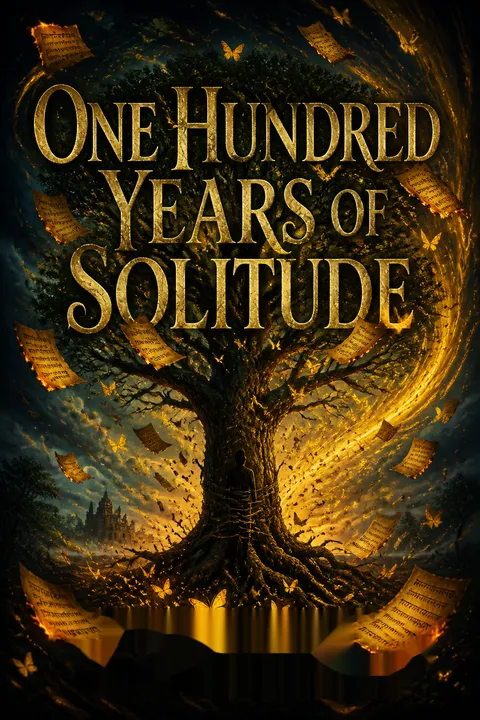


Plot Summary
A Murder Founds Macondo
José Arcadio Buendía3 and Úrsula Iguarán1 are cousins who marry despite their families' warnings that incest will produce children with pig tails. After José Arcadio Buendía3 kills a man named Prudencio Aguilar over a cockfight insult, the dead man's ghost begins appearing — mournful, lonely, trying to stanch the wound in his throat with a plug of grass.
Unable to bear the haunting, José Arcadio Buendía3 leads his wife and a band of followers on an exodus across the mountains. After fourteen months of wandering through swamps — Úrsula1 giving birth along the way — he dreams of a city with mirror walls and names the place Macondo. They found the village beside a river of clear water, on a bed of polished stones white and enormous as prehistoric eggs.
Ice and the Gypsy's Gifts
Every March, a gypsy tribe led by the wise Melquíades6 brings inventions to Macondo — magnets, telescopes, magnifying glasses. The patriarch3 buys each one, imagining military and scientific applications that never materialize.
He trades his mule and goats for magnetized ingots, burns himself testing a magnifying glass as a weapon, and reduces Úrsula's1 gold inheritance to a lump of burnt hog cracklings in a failed alchemy experiment. Melquíades,6 honest and haggard from diseases collected across the world, gives him an alchemist's laboratory and navigational instruments.
The patriarch3 abandons his family to chart the stars, then announces with devastating solemnity that the earth is round. When new gypsies arrive carrying a block of ice in a pirate chest, he pays to touch it and declares it the greatest invention of the age.
Macondo Forgets Itself
A plague of insomnia spreads from Rebeca,7 a mysterious orphan girl who arrived carrying her parents' bones in a bag and eating handfuls of earth. At first the townspeople celebrate the extra waking hours, but gradually they stop remembering.
The patriarch3 labels every object — cow, goat, chair — and hangs instructions on the cow explaining it must be milked. A sign at the town's entrance declares the existence of God. Memory dissolves into fog until a decrepit stranger appears at the door.
It is Melquíades,6 returned from death itself because he could not bear its solitude. He administers a cure and Macondo's memory floods back in an instant. Cured and staying on, Melquíades6 retreats to a small room where he begins writing cryptic parchments that no one can decipher.
The Patriarch Under the Tree
While Úrsula1 expands the house and her candy business transforms Macondo into a prosperous town, the patriarch's3 mind fractures. He becomes convinced every day is Monday, that time itself has broken.
He smashes the alchemy laboratory, the daguerreotype room, and the silver workshop in a burst of rage, shouting in what turns out to be fluent Latin. Twenty men drag him to the courtyard chestnut tree and tie him there, where he will remain for years — rained on, sunburnt, visited only by the ghost of Prudencio Aguilar.
Meanwhile his two sons diverge irrevocably: the eldest, José Arcadio,8 a giant of a young man, runs off with the gypsies; the withdrawn Aureliano2 becomes a solitary silversmith, forging tiny gold fishes and carrying premonitions he cannot explain.
Colonel Aureliano Buendía Is Born
Aureliano2 marries the magistrate's youngest daughter, Remedios Moscote20 — a girl so young they must wait years for her to reach puberty. She brings warmth to the house, tending even to the patriarch under the chestnut tree, but she dies carrying twins that cross fatally in her womb.
Grief hardens into political awareness when Aureliano2 watches his father-in-law25 swap ballot boxes after an election, discarding Liberal votes for Conservative ones. The government sends soldiers who execute dissidents without trial.
One midnight, Aureliano2 arms twenty-one men with table knives and sharpened tools, takes the garrison by surprise, and executes the captain. He tells his bewildered father-in-law not to call him Aurelito anymore. From now on, he is Colonel Aureliano Buendía.2
Arcadio Faces the Wall
Left to govern Macondo, Arcadio16 — the illegitimate grandson raised without knowing his true parents — invents himself a marshal's uniform and rules with escalating cruelty.
He issues absurd decrees, jails dissenters in stocks, and nearly executes the magistrate before Úrsula1 storms the headquarters with a cowhide whip and beats him into submission. Her intervention cannot undo what follows. When Conservative forces retake the town, Arcadio16 is court-martialed and sentenced to death.
Before the firing squad, he thinks not of heroism but of Santa Sofía de la Piedad,22 the woman Pilar Ternera9 secretly sent to his bed, and of the daughter he has not yet named. His final conscious thought before the bullets is that he forgot to say the girl should be called Remedios.11
Thirty-Two Wars, All Lost
Colonel Aureliano Buendía2 organizes thirty-two uprisings and loses every one. He survives poison in his coffee, seventy-three ambushes, and a firing squad he escapes only because his brother José Arcadio8 arrives with a shotgun at dawn.
He fathers seventeen sons by seventeen different women across the theater of war. His hardness deepens until he orders the court-martial of General Moncada24 — a Conservative friend who governed Macondo humanely. Úrsula1 pleads for mercy. Moncada24 warns the Colonel that hatred of the military has made him indistinguishable from those he fights.
The Colonel is unmoved. But standing in the blue mist after signing the death warrant, his face damp, he realizes he has placed the firing squad in the courtyard rather than the cemetery wall — a private crack only he can feel.
Blood Runs Through the House
The eldest son José Arcadio,8 returned from sixty-five voyages around the world — enormous and covered in tattoos — had married the adopted daughter Rebeca7 in a scandalous union that got them banished from the family house. One September afternoon, a gunshot echoes from their bedroom.
A trickle of blood flows from under the door, across the living room, into the street, down sidewalks, around corners, and through the Buendía front door all the way to the kitchen, where Úrsula1 is cracking eggs. She follows the scarlet thread back to its source.
No wound is found on his body; no weapon is recovered. His corpse defies all attempts to wash away the smell of gunpowder. Rebeca7 closes her doors and is not seen in public again, living out her remaining years as a specter behind cobwebbed windows.
The Bullet That Wouldn't Kill
Politicians arrive to negotiate an armistice. The Colonel2 agrees to surrender every principle the revolution fought for — land reform, religious freedom, equality for illegitimate children — because he finally understands the war was only ever about power.
His loyal aide Gerineldo Márquez17 calls it betrayal and is sentenced to death, but Úrsula1 threatens to kill the Colonel herself if the sentence is carried out. He relents. At the Treaty of Neerlandia, the Colonel signs the documents, retires to a tent, and shoots himself in the chest at the exact spot his doctor had marked with iodine.
The bullet passes cleanly through without hitting any vital organ. He survives, returns home a stranger, and begins the solitary ritual of making little gold fishes — forging them, melting them down, forging them again in an infinite loop.
The Yellow Train Arrives
Years after the wars, one of the Colonel's2 sons builds an ice factory fulfilling his grandfather's3 old dream, then brings the railroad to Macondo. The innocent yellow train delivers engineers, surveyors, and the banana company, which transforms the village beyond recognition.
Foreigners build an electrified compound, divert the river, replace the mayor with their own officials, and import trainloads of workers and prostitutes.
The Colonel's other sons arrive for a jubilee bearing ash crosses on their foreheads, but shortly after, all seventeen are hunted down and assassinated in a single coordinated night — all except one who escapes into the mountains. The Colonel, paralyzed by rage, vows to arm his family against the foreigners. But the sons are already dead, and his old age is absolute.
Remedios Leaves the Earth
Remedios the Beauty,11 Arcadio's16 posthumous daughter, grows into a creature of such devastating loveliness that men die or go mad from proximity. She shaves her head, wanders the house in a rough cassock, and cannot comprehend why her existence devastates others.
A foreign gentleman who courts her with roses deteriorates into a barroom wreck. A man watching her bathe through a broken roof tile falls and cracks his skull.
One afternoon, while folding sheets in the garden with the women of the house, Remedios the Beauty11 rises into the air — carried by a wind of light — and disappears forever into the upper atmosphere, taking the bedsheets with her. The outsiders insist the family invented the story to cover a scandal. The family simply accepts another miracle.
The Colonel's Last Parade
In his final years, Colonel Aureliano Buendía2 retreats into his workshop, making two gold fishes a day, melting them at twenty-five, and starting over — an infinite loop mirroring his campaigns.
He refuses all honors, threatens to shoot the president, and cannot summon feeling when Úrsula1 begs him to remember how they were at dinner. When a friend asks how he is, he replies that he is waiting for his funeral procession to pass.
One October afternoon he hears distant brass instruments and steps outside to watch a circus parade — a woman on an elephant, a bear dressed as a Dutch girl, clowns cartwheeling in the dust. The bright expanse of the street empties. He walks to the chestnut tree where his father once sat enchained. His family finds him the next morning.
Yellow Butterflies Shot Down
Meme,13 the vivacious daughter of the extravagant Aureliano Segundo5 and the rigid Fernanda del Carpio,10 falls in love with Mauricio Babilonia,21 a banana company mechanic perpetually trailed by yellow butterflies.
Their affair is reckless — they meet in Pilar Ternera's9 canopied bed, protected by the old fortune-teller's complicity — until Fernanda10 catches Meme13 kissing someone in the dark of a cinema. She stations a guard in the backyard, and when Mauricio21 climbs the roof tiles to reach Meme's13 bathroom, a bullet shatters his spine.
He spends the rest of his life bedridden, tormented by the butterflies that never leave him. Meme13 is dragged to a convent in a distant highland city. She chooses silence as absolute as stone. Months later, a nun delivers Meme's13 infant son in a basket to the Buendía house.
Three Thousand Dead, Denied
José Arcadio Segundo,12 the serious twin of the extravagant Aureliano Segundo,5 leads banana workers in a strike against degrading conditions — company scrip instead of wages, nonexistent medical care, shared latrines.
More than three thousand workers, women, and children pack the station square, waiting for a government mediator who never arrives. After a five-minute warning that no one heeds, fourteen machine guns open fire. José Arcadio Segundo12 wakes on a train stacked with corpses headed for the sea — nearly two hundred freight cars of the dead.
He crawls off and walks home, but no one believes him. The government declares nothing happened; official history records a peaceful resolution. He hides in Melquíades' room, where soldiers search but somehow cannot see him standing in plain sight.
Four Years of Rain
Rain falls for four years, eleven months, and two days. The banana company dismantles its operations and vanishes. Aureliano Segundo's5 fortune — once supernaturally multiplied by his concubine Petra Cotes's18 presence near his livestock — collapses as animals drown and barns rot.
The house fills with mold and leeches; Úrsula1 wakes covered in bloodsuckers. Aureliano Segundo5 loses his enormous bulk, trades the accordion for survival, and papers the house with banknotes in one last gesture of defiance before poverty closes in.
When the rain stops, Macondo is unrecognizable — zinc roofs rusted, streets choked with rubble, the banana compound reduced to wild grass. Only the Arab merchants in the old bazaar remain, sitting in their doorways as they have for decades, and when asked how they survived, each gives the same answer: they had swum.
Úrsula Sees at Last
Blind for years but hiding it through uncanny spatial memory, Úrsula1 reaches an age beyond calculation — somewhere past a hundred and fifteen — and uses her final lucidity to reassess every descendant she has known. She concludes that the Colonel2 never loved anyone and had fought his wars from sinful pride, not idealism.
She recognizes that Amaranta's4 cruelty toward her suitors was not vengeance but a mortal struggle between measureless love and invincible cowardice. She speaks Rebeca's7 name with tardy tenderness, understanding that the earth-eating orphan possessed the fierce courage she had always wanted for her bloodline.
In her final months Úrsula1 shrinks to the size of a fetus, becoming a plaything for the children, who dress her in colored rags and hang necklaces on her. She is buried in a coffin barely larger than a basket.
The Century's Last Lovers
Young Aureliano15 — Meme's13 hidden son, raised in the house without knowing his origins — has spent years deciphering Melquíades' parchments. When Amaranta Úrsula14 returns from Brussels with her devoted husband Gaston,23 radiant and determined to restore the crumbling house, Aureliano15 falls hopelessly in love with her.
Neither knows the truth: she is his aunt. He tries to drown his obsession in another woman's bed, but the substitution only sharpens his longing. When Gaston23 finally departs for Europe, the restraint collapses.
Their passion destroys the remaining furniture and devours their isolation in storms of lovemaking. They believe they are founding something new — a love that will redeem the family — unaware that they are completing the oldest pattern in the Buendía bloodline.
The Parchments Speak
Amaranta Úrsula14 gives birth to a boy — the strongest, most vital Buendía in generations — but the child carries the deformity Úrsula1 feared a century ago: a pig's tail. Amaranta Úrsula14 hemorrhages and dies. Aureliano15 wanders the ruined town searching for anyone who remembers his family and finds no one.
Returning, he discovers ants devouring the baby. In that annihilating instant, he understands Melquíades' parchments at last: written in Sanskrit and multiply coded a hundred years in advance, they are the complete history of the Buendía family.
He reads his own moment of reading. A biblical wind tears through Macondo — ripping roofs, uprooting foundations — and erases the town from the earth and from memory, because races condemned to one hundred years of solitude do not receive a second opportunity.
Analysis
García Márquez constructs a hundred-year genealogy as a closed temporal loop: the parchments prophesying the Buendía fate can only be read at the instant they describe, collapsing the distance between record and event. This architecture makes solitude not a mood but a structural condition — each character is sealed inside a moment already written, mistaking agency for destiny.
The novel's treatment of history is its most radical intervention. The banana massacre — modeled on the 1928 Ciénaga massacre in Colombia — is not simply depicted but then systematically erased within the text. Official declarations overwrite three thousand deaths; even survivors' families are told nothing happened. García Márquez dramatizes how power does not merely commit violence but retroactively edits reality, and how communities can be coerced into disbelieving their own experience. The early insomnia plague, which forces residents to label every object to preserve meaning, is the first draft of this collective amnesia — revealing that forgetting is political before it is neurological.
The repetition of names across seven generations is the novel's deepest structural argument: without genuine self-knowledge, families reproduce their traumas with cosmetic variation. The Aurelianos are withdrawn and clairvoyant; the José Arcadios are impulsive and enormous. Each generation believes it is inventing its life, but Úrsula1 — blind and ancient — sees the mechanism: the family moves in circles, mistaking the turning wheel for a road.
Love exists in inverse proportion to the capacity to escape solitude. The Colonel's2 wars and seventeen sons leave no trace of affection. Amaranta's4 suitors are destroyed by a love she cannot express. Only the final couple love without reservation — and their love produces the one thing the family spent a century trying to prevent. The novel's verdict is not that solitude is cured by love but that it is fulfilled by it: the pig-tailed child arrives precisely because two people finally stopped being afraid.
Review Summary
One Hundred Years of Solitude is a masterpiece of magical realism that follows the Buendía family across generations in the fictional town of Macondo. Readers praise Márquez's inventive storytelling, vivid prose, and exploration of themes like solitude, love, and the cyclical nature of time. While some find the narrative challenging due to its non-linear structure and large cast of characters, many consider it a profound and transformative reading experience. Critics acclaim the novel's blend of fantasy and reality, though some readers struggle with its unconventional style.
People Also Read





Characters
Úrsula Iguarán
Indestructible matriarchThe moral compass and structural backbone of the Buendía family across nearly every generation. Married to her cousin despite fears of producing deformed offspring, Úrsula is defined by practical will and tireless industry. While her husband3 chases gypsies' inventions and sons march off to war, she builds the house, expands it repeatedly, and fills it with commerce and unflinching order. She scolds tyrants with a cowhide whip, confronts soldiers barehanded, and scrubs her husband's back under the chestnut tree. Her blindness in old age, concealed for years through sheer spatial memory, becomes a paradox: she sees her family most clearly when she can see nothing at all. Her final reassessments of her descendants carry the weight of a century of accumulated wisdom and regret.
Colonel Aureliano Buendía
The legendary solitary warriorBorn with open eyes and a gift for premonition, Aureliano is the withdrawn second son who becomes the family's most legendary and most isolated figure. A solitary silversmith who falls in love with a child bride20, he is radicalized by her death and political injustice into a revolutionary commander. He organizes thirty-two uprisings, fathers seventeen sons across the war zones, and survives attempts on his life that border on the miraculous. His emotional architecture is a fortress—an inability to love that his mother1 identifies too late. The chalk circle he draws around himself, forbidding anyone within ten feet, is both military precaution and psychological portrait. His endless cycle of making and unmaking gold fishes mirrors the futility he cannot escape.
José Arcadio Buendía
The visionary patriarch of MacondoThe founder of Macondo—a man of enormous physical strength and even more enormous imagination. Every gypsy invention sends him spiraling into obsessive experimentation: magnets for gold mining, magnifying glasses for solar warfare, alchemy for transmutation. His genius is genuine but undirected; he independently deduces the earth is round, only to learn the world already knew. He is the first Buendía consumed by the hunger for knowledge that will haunt the family, and his fate—tied to a chestnut tree after his mind fractures, conversing with ghosts in the rain—establishes the pattern of brilliant men destroyed by obsession. His friendship with Melquíades6 represents the novel's purest bond: two seekers held together by wonder at a world neither can fully comprehend.
Amaranta Buendía
Love's prisoner and saboteurThe youngest daughter of the founders, Amaranta is the family's most contradictory soul—a woman of measureless love imprisoned by invincible cowardice. She falls for the Italian musician Pietro Crespi19 but cannot act; when he is promised to Rebeca7, her jealousy becomes all-consuming. She burns her own hand in penance and wears a black bandage for the rest of her life. She later rejects every suitor who courts her—including Colonel Gerineldo Márquez17, who visits her sewing room for years—not from cruelty but from a terror of vulnerability so profound it resembles spite. Her life is defined by the war between desire and self-denial, and she channels her frustrated tenderness into raising the children of others.
Aureliano Segundo
The extravagant twin revelerA man of Rabelaisian appetites who inherits his great-grandfather's physical enormity and none of the family's intellectual torment. His proximity to his concubine Petra Cotes18 causes animals to reproduce supernaturally, generating a fortune he spends on champagne, accordion music, and papering his house with banknotes. He marries the aristocratic Fernanda del Carpio10 but maintains both relationships openly. His joyfulness masks genuine tenderness—he is the family's best father, deeply devoted to his daughter Meme13 and later to his youngest daughter Amaranta Úrsula14. When fortune abandons him during the four-year deluge, he reveals unexpected resilience, selling raffle tickets door-to-door with a dying man's determination to fund his youngest daughter's education abroad.
Melquíades
The prophetic gypsy sageThe ancient gypsy who brings inventions to Macondo and writes the prophetic parchments containing the family's entire coded history. Having survived every plague and disaster known to humankind, he returns from death itself because he cannot bear its solitude. His room in the Buendía house becomes a sacred, dust-resistant space where the parchments await decipherment across generations—a still point in a crumbling world.
Rebeca Buendía
The earth-eating orphan foundlingAn orphan who arrives in Macondo carrying her parents' bones in a canvas bag, eating earth and whitewash from the walls. Adopted by the Buendías, she grows into a beautiful woman whose passions shift dramatically—from devotion to the Italian musician Pietro Crespi19 to a sudden overwhelming physical attraction to the prodigal eldest son José Arcadio8. Her fierce will and primal appetites set her apart from the family's more restrained women. Whenever earth-eating resurfaces, it signals emotional crisis boiling beneath the surface.
José Arcadio
The tattooed prodigal eldest sonThe firstborn Buendía son, a giant who runs away with the gypsies as a teenager and returns years later covered in tattoos, having sailed the world sixty-five times. His enormous physical presence and raw sexuality captivate Rebeca7 and repel polite society. He claims vast tracts of land through brute force and lives with a simple appetite for domination and pleasure.
Pilar Ternera
Fortune-teller and generational loverA fortune-teller and lover to multiple Buendía men across generations. She bears children by both the eldest son8 and the Colonel2, then arranges intimate encounters for her grandson Arcadio16. Her cards guide and mislead in equal measure. She outlives nearly everyone, eventually running a brothel where she dispenses not pleasure but maternal compassion to the family's loneliest descendants, her expansive laugh undimmed across the decades.
Fernanda del Carpio
The rigid aristocratic wifeRaised in a decayed highland family to believe she would be a queen, Fernanda imposes rigid Catholic propriety on the Buendía household. She uses euphemisms for everything, corresponds with invisible doctors about imaginary surgeries, and eats from a gold chamberpot with the family crest. Her authoritarian control over her children's fates—particularly Meme's13—drives several of the novel's cruelest consequences, born from a pridefulness so thorough it blinds her to real suffering.
Remedios the Beauty
The transcendent innocent beautyArcadio's16 posthumous daughter, whose supernatural beauty is both gift and catastrophe. She walks through the house naked in a rough cassock, shaves her head, and remains completely indifferent to social convention and to the men who destroy themselves pursuing her. Her innocence is so total it functions as a kind of invulnerability—she exists beyond the reach of desire, shame, and even gravity.
José Arcadio Segundo
The massacre's sole witnessThe serious twin of Aureliano Segundo5, a cockfighter and labor organizer who witnesses the banana workers' massacre at the train station. He becomes the keeper of suppressed truth, retreating to Melquíades' room6 and insisting thousands of people were killed—a claim no one in Macondo will corroborate. His dedication to the parchments connects him to the family's final mystery.
Meme
The silenced passionate daughterAureliano Segundo's5 vivacious daughter, trained in clavichord against her nature, who masks a rebellious spirit beneath disciplined obedience. She befriends Americans at the banana compound and falls passionately in love with a mechanic surrounded by yellow butterflies21, defying every boundary of class and propriety. Her affair is the most joyful and most brutally punished love story in the family's history.
Amaranta Úrsula
The final vivacious BuendíaThe last female Buendía, who returns from Brussels determined to resurrect Macondo with modern energy and optimism. She possesses Úrsula's1 indomitable will and Remedios the Beauty's11 allure, attacking the ruined house with carpenters, masons, and canaries from the Fortunate Isles. Her marriage to the accommodating Gaston23 gives way to a consuming passion she cannot control, driven by forces that have shaped every Buendía love before hers.
Aureliano Babilonia
The parchments' final readerMeme's13 illegitimate son, raised in secret captivity by Fernanda10, who claims he was found floating in a basket. Bookish and reclusive, he inherits the Colonel's2 cheekbones and premonitory intensity. His lifelong project—learning Sanskrit and deciphering Melquíades' coded parchments—becomes the key that unlocks the family's destiny. He frequents a wise Catalonian's bookshop, drawn to knowledge the way his forebears were drawn to gold and war.
Arcadio
The unloved tyrant grandsonThe illegitimate son of the eldest José Arcadio8 and Pilar Ternera9, raised by the Buendías without knowing his true parents. A lonely, frightened child who becomes a schoolteacher, then a petty dictator when given wartime power over Macondo. His cruelty stems from a lifetime of unacknowledged pain and the desperate need for authority he was never granted through love.
Colonel Gerineldo Márquez
The Colonel's loyal companionThe Colonel's2 most faithful companion in arms, a gentle man better suited for love than for war. He fights out of friendship rather than ideology and later courts Amaranta4 for years, visiting her sewing room with a devotion she can neither accept nor wholly reject. His quiet persistence becomes the war's most human counterpoint.
Petra Cotes
The fertile, loyal concubineAureliano Segundo's5 concubine, a generous mulatto woman whose love has the supernatural power to make animals breed prolifically. She represents earthly joy and pragmatic devotion. Even after being spurned, she sends food to Fernanda's10 household for years, and her love for Aureliano Segundo5 deepens rather than diminishes as fortune abandons them both.
Pietro Crespi
The elegant doomed Italian suitorAn Italian musician who assembles the family's pianola. He becomes the object of both Rebeca's7 and Amaranta's4 love—a gentle, elegant man destroyed by passions he cannot control or comprehend.
Remedios Moscote
The Colonel's child brideThe magistrate's25 youngest daughter, married to Aureliano2 while still essentially a child. She brings a sprite of warmth and tenderness to the Buendía house that no one before or after her can match.
Mauricio Babilonia
The mechanic with yellow butterfliesA banana company mechanic always surrounded by yellow butterflies, whose proud directness and working-class dignity captivate Meme13. He refuses to be shamed by his origins.
Santa Sofía de la Piedad
The invisible servant-motherArcadio's16 partner and the twins' mother. She cooks, cleans, and endures for decades without complaint, so unobtrusive that even her family forgets she exists.
Gaston
Amaranta Úrsula's patient husbandAmaranta Úrsula's14 Belgian husband, a former aviator who follows her to Macondo on a silk leash. His accommodating nature may disguise either genuine devotion or strategic patience.
General Moncada
The humane enemy governorA Conservative general who governs Macondo with decency and warmth. His friendship with the Colonel2 makes his court-martial the revolution's most morally devastating act.
Don Apolinar Moscote
The first government magistrateThe timid magistrate sent to Macondo by the government. He represents the intrusion of state authority into a community that had peacefully governed itself since its founding.
Plot Devices
Melquíades' Parchments
Coded prophecy of the familyWritten in Sanskrit and multiply coded, the parchments sit in Melquíades'6 room for a century, immune to dust and decay. Multiple Buendías attempt to decipher them across generations—José Arcadio Segundo12 classifies the alphabet, the last Aureliano15 learns Sanskrit and cracks the cipher. The parchments contain the entire history of the Buendía family written a hundred years in advance, arranged not chronologically but so that a century of daily episodes coexists in a single instant. They can only be fully read at the moment the last events they describe are occurring, making their decipherment simultaneous with their fulfillment—and with the destruction of everything they record. They are the novel's structural spine: the story we read is the story they contain.
The Little Gold Fishes
Symbol of futile repetitionColonel Aureliano Buendía2 makes two gold fishes per day; when he reaches twenty-five, he melts them down and starts over. This infinite cycle mirrors the futility of his thirty-two wars and the family's broader inability to escape its patterns. The fishes also serve as tokens of identity—during the war, he sends them as proof of who he is. They represent exquisite craftsmanship devoted to an object that exists only to be destroyed and remade, a perfect emblem of the Buendía compulsion to build what they will inevitably unmake. His absorption in the delicate work—fitting ruby eyes, laminating gills—grants him the only peace he ever finds, at the cost of all human connection.
The Chestnut Tree
Axis of captivity and communionThe courtyard chestnut tree is where the patriarch José Arcadio Buendía3 is tied after his madness and where he remains for years, becoming a living monument. It serves as the family's axis mundi—a fixed point around which generations revolve. Úrsula1 visits to report family news. The ghost of Prudencio Aguilar sits beside the patriarch to discuss cockfights and the tedious Sundays of death. Colonel Aureliano Buendía2 ultimately makes his final journey here. The tree connects the living and the dead, the sane and the mad, the beginning and the end of the family. It is the one place in the house that never changes, even as everything around it collapses into ruin.
The Pig's Tail Curse
Incest taboo framing the sagaÚrsula's1 fear that her cousin-marriage will produce a child with a pig's tail is established at the novel's outset and haunts the family for a hundred years. A relative born with such a tail bled to death trying to have it removed—a precedent that terrifies Úrsula1 into wearing a chastity belt on her wedding night. Every incestuous or near-incestuous relationship in subsequent generations (Amaranta4 and her nephew, the last Aureliano15 and Amaranta Úrsula14) carries this inherited dread. The curse operates as both biological prophecy and moral architecture: the family's solitude breeds inward attraction, and inward attraction breeds the thing that ends the line. It is the clock counting down from the first page.
The Insomnia Plague
Template for collective amnesiaThe early plague that strikes Macondo establishes forgetting as the novel's central threat—more dangerous than war, exploitation, or time itself. The townspeople label every object, then forget what labels mean, then construct false memories from card readings. This pattern recurs with devastating political force when the banana massacre is systematically erased: witnesses are denied, official history is rewritten, and reality is replaced with sanctioned fiction. The patriarch's3 labels on the cow—explaining that it must be milked, and the milk boiled to make coffee—prefigure a world where even the most self-evident truths require physical defense against erasure. The plague is cured once, but the disease of forgetting returns in forms no medicine can touch.
FAQ
Synopsis & Basic Details
What is One Hundred Years of Solitude about?
- Multi-generational family saga: The novel chronicles the multi-generational history of the Buendía family in the fictional town of Macondo, from its founding to its eventual destruction.
- Exploration of human nature: It delves into themes of love, war, ambition, solitude, and the cyclical nature of history through the lives of the Buendía family members.
- Magical realism narrative: The story blends realistic events with fantastical elements, creating a unique and captivating narrative style that explores the complexities of human experience.
Why should I read One Hundred Years of Solitude?
- Unique literary experience: The novel offers a unique blend of magical realism, historical fiction, and family saga, providing a captivating and thought-provoking reading experience.
- Exploration of universal themes: It delves into profound themes of love, loss, war, and the cyclical nature of history, making it relevant to readers across cultures and time periods.
- Rich and complex characters: The novel features a diverse cast of characters, each with their own unique motivations, flaws, and desires, allowing readers to connect with them on a deep emotional level.
What is the background of One Hundred Years of Solitude?
- Latin American history: The novel is deeply rooted in the history and culture of Latin America, reflecting the region's political instability, social inequalities, and cultural traditions.
- Colombian context: It draws inspiration from the author's own experiences growing up in Colombia, particularly the country's history of civil wars and the impact of modernization on rural communities.
- Cultural influences: The novel incorporates elements of indigenous mythology, folklore, and oral storytelling traditions, creating a rich and layered narrative that reflects the region's diverse cultural heritage.
What are the most memorable quotes in One Hundred Years of Solitude?
- "The world was so recent that many things lacked names, and in order to indicate them it was necessary to point.": This quote, from the beginning of the novel, highlights the theme of the newness of the world and the power of language to shape reality.
- "Time passes, but not so much.": This quote, spoken by Colonel Aureliano Buendía, reflects the cyclical nature of time and the feeling that history is repeating itself within the Buendía family.
- "Races condemned to one hundred years of solitude did not have a second opportunity on earth.": This final line of the novel encapsulates the themes of fate, solitude, and the cyclical nature of the Buendía family's history.
What writing style, narrative choices, and literary techniques does Gabriel García Márquez use?
- Magical Realism: Márquez masterfully blends realistic events with fantastical elements, creating a unique and captivating narrative style that blurs the line between reality and fantasy.
- Non-linear storytelling: The novel employs a non-linear narrative structure, often jumping between different time periods and perspectives, which reflects the cyclical nature of history and the interconnectedness of events.
- Foreshadowing and symbolism: Márquez uses subtle foreshadowing and recurring symbols to create a sense of inevitability and to enhance the novel's thematic depth, inviting readers to interpret the deeper meanings of the story.
Hidden Details & Subtle Connections
What are some minor details that add significant meaning?
- The yellow butterflies: The recurring presence of yellow butterflies often foreshadows the arrival of Mauricio Babilonia and symbolizes the passionate and ultimately tragic love between him and Meme.
- The ice: The initial discovery of ice by José Arcadio Buendía represents the allure of the unknown and the transformative power of new experiences, but also foreshadows the coldness and isolation that will come to define the family.
- The recurring names: The repetition of names like Aureliano and José Arcadio throughout the generations highlights the cyclical nature of history and the inescapable patterns of fate within the Buendía family.
What are some subtle foreshadowing and callbacks?
- The pig's tail: The birth of a Buendía with a pig's tail foreshadows the family's fear of incest and the potential for monstrous offspring, a recurring theme throughout the novel.
- The recurring dream: José Arcadio Buendía's dream of a city with mirror walls foreshadows the town's eventual destruction and the family's inability to escape their fate.
- The yellow flowers: The yellow flowers that fall during José Arcadio Buendía's death are a callback to the yellow flowers that appear during the insomnia plague, highlighting the cyclical nature of life and death in Macondo.
What are some unexpected character connections?
- Pilar Ternera and the Buendía men: Pilar Ternera's relationships with multiple generations of Buendía men, including José Arcadio, Aureliano, and Arcadio, highlight the cyclical nature of desire and the interconnectedness of the family's history.
- Melquíades and the Buendía family: Melquíades' influence on the Buendía family extends beyond his initial interactions with José Arcadio Buendía, as his parchments and prophecies continue to shape the family's destiny across generations.
- The wise Catalonian and the Buendía men: The wise Catalonian's interactions with Aureliano and José Arcadio Segundo reveal a shared love for knowledge and a sense of disillusionment with the world, highlighting the cyclical nature of intellectual pursuits within the family.
Who are the most significant supporting characters?
- Pilar Ternera: As a recurring figure throughout the novel, Pilar Ternera serves as a link between generations, offering both comfort and prophecy to the Buendía family. Her presence highlights the cyclical nature of love, loss, and fate.
- Colonel Gerineldo Márquez: As Colonel Aureliano Buendía's closest friend and confidant, Colonel Gerineldo Márquez provides a counterpoint to the colonel's relentless pursuit of war, representing the possibility of peace and reason.
- Santa Sofía de la Piedad: As a silent and devoted servant to the Buendía family, Santa Sofía de la Piedad embodies the themes of loyalty, resilience, and the enduring power of tradition.
Psychological, Emotional, & Relational Analysis
What are some unspoken motivations of the characters?
- Amaranta's fear of intimacy: Amaranta's rejection of love stems from a deep-seated fear of intimacy and vulnerability, which is rooted in her past experiences and her inability to move past her unrequited love for Pietro Crespi.
- Colonel Aureliano Buendía's pride: Colonel Aureliano Buendía's relentless pursuit of war is driven by a deep-seated pride and a desire for recognition, which ultimately leads to his disillusionment and isolation.
- Fernanda's need for control: Fernanda's rigid adherence to tradition and her attempts to control her family stem from a deep-seated need for order and security, which is rooted in her own troubled past and her fear of chaos.
What psychological complexities do the characters exhibit?
- José Arcadio Buendía's obsessive nature: José Arcadio Buendía's obsessive pursuit of knowledge and his inability to reconcile his dreams with reality highlight the complexities of human ambition and the dangers of unchecked imagination.
- Colonel Aureliano Buendía's detachment: Colonel Aureliano Buendía's detachment from his family and his inability to form meaningful relationships reveal the psychological toll of war and the corrosive effects of power.
- Amaranta's self-destructive tendencies: Amaranta's self-destructive tendencies, including her rejection of love and her obsession with death, highlight the complexities of human emotion and the destructive power of unfulfilled desires.
What are the major emotional turning points?
- José Arcadio Buendía's madness: José Arcadio Buendía's descent into madness after killing Prudencio Aguilar marks a major emotional turning point, highlighting the destructive power of guilt and the fragility of the human mind.
- Colonel Aureliano Buendía's disillusionment: Colonel Aureliano Buendía's disillusionment with war and his subsequent retreat into solitude mark a major emotional turning point, highlighting the futility of his efforts and the emptiness of power.
- Amaranta's rejection of love: Amaranta's repeated rejections of love, particularly her rejection of Colonel Gerineldo Márquez, mark a major emotional turning point, highlighting her fear of intimacy and her acceptance of a lonely fate.
How do relationship dynamics evolve?
- The cyclical nature of love and loss: The novel explores the cyclical nature of love and loss, with characters often repeating the same patterns of relationships and experiencing similar heartbreaks across generations.
- The impact of power dynamics: The novel examines the impact of power dynamics on relationships, with characters often struggling to maintain their autonomy and individuality in the face of societal expectations and family pressures.
- The complexities of family bonds: The novel delves into the complexities of family bonds, highlighting the tensions between love, loyalty, and resentment that often exist within families.
Interpretation & Debate
Which parts of the story remain ambiguous or open-ended?
- The true nature of Melquíades: The true nature of Melquíades, his origins, and his motivations remain ambiguous, leaving readers to question whether he is a supernatural being, a wise sage, or simply a figment of the Buendía family's imagination.
- The meaning of the parchments: The meaning of Melquíades' parchments and the true nature of the prophecy they contain remain open to interpretation, inviting readers to consider the role of fate and free will in the Buendía family's destiny.
- The ending of Macondo: The exact circumstances of Macondo's destruction and the fate of its inhabitants remain ambiguous, leaving readers to ponder the cyclical nature of history and the transient nature of human existence.
What are some debatable, controversial scenes or moments in One Hundred Years of Solitude?
- The incestuous relationships: The recurring theme of incestuous relationships within the Buendía family raises questions about the nature of love, desire, and the consequences of violating societal taboos.
- The violence and brutality: The novel's depiction of violence and brutality, particularly during the civil wars and the banana company massacre, raises questions about the nature of power, the corrupting influence of conflict, and the human capacity for cruelty.
- The treatment of women: The novel's portrayal of women, particularly their limited roles and their often tragic fates, raises questions about gender inequality and the societal constraints placed upon women in Latin American culture.
One Hundred Years of Solitude Ending Explained: How It Ends & What It Means
- The deciphering of the parchments: Aureliano Babilonia's deciphering of Melquíades' parchments reveals the cyclical nature of the Buendía family's history and the inevitability of their doom.
- The destruction of Macondo: The biblical hurricane that destroys Macondo symbolizes the end of the Buendía family's line and the erasure of their history from the memory of men.
- The cyclical nature of time: The ending emphasizes the cyclical nature of time and the futility of human efforts to escape fate, as the Buendía family's story comes full circle, ending in solitude and oblivion.
About the Author

Download PDF
Download EPUB
.epub digital book format is ideal for reading ebooks on phones, tablets, and e-readers.








































