
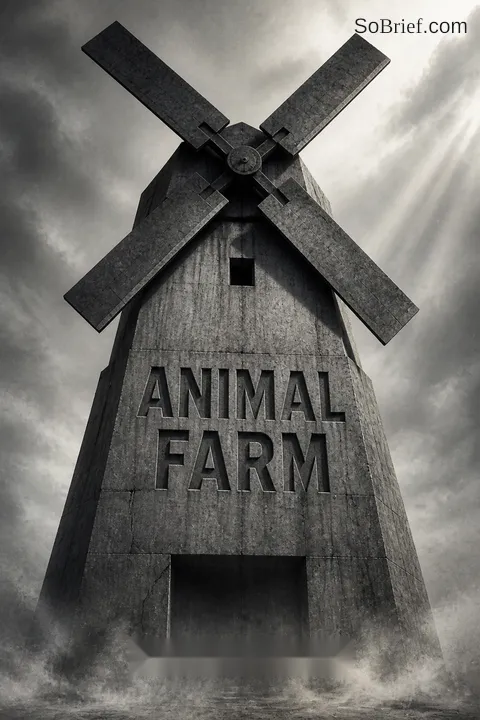


Plot Summary
Old Major's Midnight Vision
One night, after the farmer Mr. Jones9 stumbles drunkenly to bed, the animals of Manor Farm assemble in the barn to hear Old Major,7 the farm's most revered boar.
At twelve years old and sensing death approaching, Major7 delivers a speech that reframes their entire existence: humans produce nothing yet take everything — milk, eggs, labor, and finally life itself. He names Man as the sole enemy and lays down principles for a future without human masters: no animal shall tyrannize another, no animal shall adopt human vices, every animal is equal.
Then he teaches them a song recovered from a dream — an anthem of liberation that sends the animals into ecstatic chorus. Jones9 fires his gun into the dark to silence them. Three nights later, Major7 dies in his sleep.
The Animals Seize Manor Farm
Three pigs — Napoleon,1 a large fierce boar who gets his way through quiet persistence; Snowball,2 eloquent and inventive; and Squealer,4 who can argue black into white — codify Major's7 vision into a philosophy called Animalism and spread it through secret barn meetings.
Meanwhile, Jones9 sinks deeper into drink and neglect. One Midsummer's Eve he gets so drunk that by the following evening the animals still haven't been fed. A cow breaks open the store-shed door. When Jones9 and his men charge in with whips, the starving animals attack from every side — kicking, butting, biting — and within minutes chase every human off the property.
The animals burn the whips, destroy the halters and nose-rings, rename the place Animal Farm, and inscribe Seven Commandments on the barn wall — the last declaring the equality of every creature on the farm.
Milk Vanishes, Puppies Disappear
The animals finish the hay harvest in fewer days than Jones9 ever managed. Boxer,3 an enormous cart-horse of limited intelligence but limitless devotion, and his companion Clover,5 a stout motherly mare, throw themselves into the work — Boxer3 adopting a creed of always working harder, rising before anyone each morning.
The pigs perform no physical labor; they direct and supervise. When five buckets of fresh milk appear after the first milking, Napoleon1 diverts the animals to the hayfield. By evening the milk has vanished — into the pigs' mash.
Windfall apples are similarly reserved. Squealer4 explains that pigs need these nutrients for brainwork, warning that without them, Jones9 would return. Separately and quietly, Napoleon1 takes nine newborn puppies from their mothers to educate in a sealed loft. The rest of the farm forgets they exist.
Snowball's Ambush at the Cowshed
By autumn, word of the rebellion has spread across the county, frightening neighboring farmers and emboldening their animals. In October, Jones9 returns with men from adjacent farms, armed with sticks and a gun.
Snowball,2 who has studied Julius Caesar's campaigns, commands the defense: pigeons and geese as skirmishers, then a feigned retreat led by sheep and Benjamin,6 the farm's oldest animal — a cynical donkey who has lived long enough to distrust everything. When the men pursue into the yard, horses and cows spring from the cowshed behind them.
Snowball2 charges Jones9 directly, taking shotgun pellets across his back. Boxer3 strikes a stable-lad unconscious with his iron-shod hoof and is afterward stricken with guilt — insisting he never meant to kill. The humans flee. The animals name it the Battle of the Cowshed and decorate Snowball2 and Boxer3 as heroes.
Nine Dogs End Democracy
Before the political split deepens, the vain white mare Mollie8 defects — found across county lines pulling a gentleman's cart, wearing a scarlet ribbon, having chosen human comfort over revolution. The remaining animals divide over Snowball's2 windmill plan: electricity, labor-saving machines, a three-day week.
On the day of the vote, Snowball's2 eloquence carries the barn. Napoleon1 responds with a high-pitched signal. Nine enormous dogs — the puppies he raised in secret, now full-grown and fierce — burst in and charge at Snowball,2 who barely escapes through a hole in the hedge.
Napoleon1 mounts the platform where Major7 once stood and abolishes all meetings. A committee of pigs will decide everything. When four young pigs protest, the dogs' growls silence them instantly. Boxer,3 struggling to process the upheaval, settles on a new conviction: whatever Napoleon1 says must be right.
The Windmill Falls, Snowball's Blamed
Three weeks after expelling Snowball,2 Napoleon1 announces the windmill will be built after all — Squealer4 explains that the plan was always Napoleon's,1 stolen by Snowball,2 and the opposition was merely tactics. The animals labor sixty hours a week, dragging boulders up a quarry slope to shatter them.
Shortages force Napoleon1 to trade with humans through a solicitor named Whymper,15 breaking earlier resolutions that Squealer4 denies ever existed. The pigs move into the farmhouse and sleep in beds; when Clover5 checks the Fourth Commandment, it now specifies that the prohibition applies only to beds with sheets — a qualification she cannot recall.
In November, a violent gale levels the half-built windmill to its foundations. Napoleon1 sniffs the rubble, then roars that Snowball2 crept in by night and destroyed it, pronouncing a death sentence on the absent pig and ordering immediate rebuilding.
Blood Before Napoleon's Feet
Winter brings famine: potato crops rot, corn rations shrink, and Napoleon1 deceives Whymper15 by topping sand-filled bins with a thin layer of grain. When he orders the hens to surrender their eggs for sale, they rebel — laying from the rafters so eggs smash on the floor.
Napoleon1 cuts off their rations; nine hens die. Then comes the purge. Napoleon1 assembles everyone in the yard, flanked by his dogs. The dogs seize four pigs who once protested the abolition of meetings; they confess to conspiring with Snowball,2 and the dogs tear their throats out.
Three rebel hens confess next, then a goose, then sheep — each slaughtered in turn. A pile of corpses gathers. Clover5 leads the shattered survivors to the hillside, where they sing the revolutionary anthem one final time — until Squealer4 arrives to ban the song forever.
Frederick Blows It All Up
The animals rebuild with walls twice as thick, finishing the windmill by autumn. Napoleon1 sells a stockpile of timber to Frederick,11 the shrewd farmer of neighboring Pinchfield, who pays in crisp banknotes that Napoleon1 displays on a china dish. Three days later, Whymper15 arrives ashen-faced: every note is forged.
Frederick11 has the timber for nothing. The next morning, fifteen armed men march onto the farm. The animals retreat into the buildings. Benjamin6 watches Frederick's11 men drill a hole at the windmill's base and predicts what comes next: blasting powder.
The explosion erases two years of labor in seconds. Enraged beyond fear, the animals charge and drive the men off — but at terrible cost. Boxer3 limps home with pellets in his hind leg and a split hoof. Squealer4 declares it a glorious victory; Boxer3 observes they have only won back what they already had.
Boxer's Last Ride
Boxer3 refuses to rest. His split hoof barely heals, his coat dulls, his haunches waste — but he drives himself toward one goal: finishing enough stonework before retirement at twelve. One summer evening he collapses between the shafts of a cart and cannot rise. Clover5 and Benjamin6 keep vigil.
Squealer4 promises Napoleon1 has arranged hospital treatment in town. Days later, a closed van pulls into the yard. Benjamin6 — who has never once shown urgency in his long, cynical life — gallops across the farm, braying wildly. He reads the van's lettering aloud: horse slaughterer and glue boiler.
Clover5 races after the van screaming for Boxer3 to escape. Inside, hooves drum weakly against the walls, then fall silent. Squealer4 later insists the van merely bore an old label from a previous owner. That night, a grocer delivers a crate of whisky to the farmhouse.
Pig to Man, Man to Pig
Years pass. Most animals who remember the Rebellion are dead. The completed windmill generates no electricity — it mills corn for profit. The farm grows richer, but only the pigs and dogs grow fat. One evening, Clover5 neighs in terror: Squealer4 is walking upright on his hind legs.
Every pig follows suit, and Napoleon1 emerges last carrying a whip. The sheep, coached in secret, bleat a new chant proclaiming two legs superior. Clover5 leads Benjamin6 to the barn wall, where seven commandments have become one — a single assertion of equality, amended with the caveat that some animals deserve considerably more of it.
The pigs don human clothes and host neighboring farmers for dinner. Napoleon1 renames the farm back to Manor Farm. Through the window, the animals watch pigs and humans toast mutual prosperity, then quarrel — twelve shouting voices, all alike, the faces no longer distinguishable.
Analysis
Animal Farm operates as both a tightly plotted fable and a parable about the mechanics of political betrayal, but its enduring power derives from something beyond either surface. The novella anatomizes, with surgical precision, the process by which liberation movements devour themselves.
Orwell's central insight is not simply that power corrupts, but that power corrupts through language. Every stage of Napoleon's1 consolidation depends on Squealer's4 ability to redefine the past: resolutions that were never passed, commandments that always contained qualifying clauses, heroism that was really betrayal. The animals' inability to resist this revisionism stems not from stupidity but from structural asymmetry — the pigs control literacy, record-keeping, and the vocabulary of political discourse. The other animals possess moral intuitions (Clover5 senses something is wrong) and factual memories (Boxer3 remembers Snowball's2 bravery), but they lack the institutional means to verify their own experience against official narrative. Memory, Orwell demonstrates, is not merely personal — it is political infrastructure.
The novella also interrogates complicity with unusual honesty. Boxer's3 devotion — his creed of working harder, his faith in the leader's infallibility — is simultaneously heroic and catastrophic. His loyalty is genuine, his labor indispensable, and the system's exploitation of both is inevitable. Benjamin's6 cynicism offers no alternative: he sees everything clearly, says nothing useful, and acts only when action cannot change the outcome. Neither trusting faith nor knowing pessimism provides an exit from tyranny.
What makes the book perpetually contemporary is its demonstration that political betrayal follows a grammar: the early seizure of information channels, the creation of a permanent external enemy, the incremental normalization of privilege, and the strategic cultivation of collective amnesia. The final image — faces shifting between species until they merge — argues that the content of an ideology matters far less than the structure of the power it produces. Freedom is not lost in a single dramatic moment; it is edited away, one qualifying clause at a time.
Review Summary
Animal Farm is widely praised as a masterful allegory of Soviet communism and totalitarianism. Reviewers appreciate Orwell's simple yet powerful writing style, which makes complex political themes accessible. Many find the book's messages still relevant today, applying to various forms of oppression and manipulation. Readers are moved by the story's portrayal of power corruption and the manipulation of language for political gain. While some find it heavy-handed, most consider it a timeless classic that offers important lessons about society and human nature.
People Also Read
Characters
Napoleon
The farm's cunning dictatorNapoleon is a large, fierce-looking Berkshire boar who speaks little but possesses an instinct for accumulating power. Where Snowball2 excels at rhetoric and vision, Napoleon operates through back channels: canvassing support between meetings, cultivating the sheep's bleating loyalty, and making decisions that consolidate his authority. He is defined by his preference for control over persuasion. His intelligence is strategic rather than creative—he never generates ideas but understands how to appropriate them and neutralize those who do. He shows no genuine attachment to Animalism's principles and treats ideology purely as a tool for dominance. His relationship with the other animals is one of calculated dependence: they need to believe in him far more than he needs to care about them.
Snowball
Exiled revolutionary visionarySnowball is an energetic, inventive pig whose intelligence runs toward creation rather than domination. He teaches himself to read, designs a flag, organizes committees, studies military strategy from Caesar's campaigns, and drafts blueprints for a windmill that would electrify the farm. He is the revolution's true believer—a figure who genuinely attempts to improve the animals' lives through education and innovation. His critical weakness is assuming that good ideas win on merit. He focuses on persuading crowds through eloquence while neglecting the quiet power-building happening behind the scenes. His rivalry with Napoleon1 is structural: the visionary versus the operative, the debater versus the enforcer. He embodies the revolutionary intellectual who fails to recognize that revolutions are secured not by ideas but by whoever controls the means of violence.
Boxer
Loyal, exploitable workhorseBoxer is an enormous cart-horse of extraordinary strength and near-total innocence—nearly eighteen hands high, with a white stripe down his nose and a mind that cannot progress past the letter D. His devotion to the farm's cause is expressed entirely through physical labor: rising earlier, working longer, volunteering for the heaviest tasks. His two mottos—one pledging to always work harder, the other affirming the leader's infallibility—reveal a psyche defined by absolute loyalty to institutions he cannot critically examine. He embodies the indispensable worker whose very devotion makes him vulnerable to exploitation by those he trusts. His relationship with Clover5 is one of quiet mutual tenderness; his bond with Benjamin6 is the story's most understated friendship. He processes confusion and grief not through thought but through additional labor.
Squealer
Napoleon's silver-tongued propagandistSquealer is a small, plump pig with twinkling eyes and a shrill voice, whose gift is the transformation of reality through language. He skips from side to side while arguing, whisking his tail in a manner described as somehow very persuasive—a physical performance accompanying his verbal one. He functions as the regime's minister of information, deploying a consistent toolkit: rhetorical questions, falsified statistics, appeals to fear, and the incremental rewriting of both history and the Commandments. Psychologically, Squealer is the quintessential collaborator—intelligent enough to perceive the truth, articulate enough to obscure it, and morally vacant enough to do so without apparent guilt. He is never shown experiencing doubt or remorse, making him perhaps the most chilling figure on the farm.
Clover
Conscience of the working classClover is a stout, motherly cart-horse who shelters ducklings under her foreleg and chews herbal poultices for injured friends. She possesses genuine moral intuition—sensing when principles have been violated—but lacks the literacy and vocabulary to articulate her objections or mount resistance. She represents the working conscience: always feeling that something is wrong, never quite able to name it, yet remaining loyal because the alternative seems worse.
Benjamin
Cynical, all-seeing donkeyBenjamin is the oldest animal on the farm, a cynical donkey who can read as well as any pig but refuses to use the ability. He never celebrates the Rebellion, never despairs at its corruption, and insists that life always has been and always will be miserable. His one genuine attachment is to Boxer3—the only relationship capable of penetrating his carefully maintained indifference to everything around him.
Old Major
The revolution's dying prophetOld Major is an aged, prize-winning Middle White boar whose single midnight speech ignites everything that follows. A figure of genuine moral authority and rhetorical power, he articulates the animals' suffering and offers a philosophy of liberation. He dies three days after his speech, becoming a symbol whose teachings are both venerated and progressively reshaped by those who claim to carry them forward.
Mollie
Vain mare who craves comfortMollie is a pretty white mare who draws Mr. Jones's9 trap and loves sugar, ribbons, and her own reflection. She asks whether the revolution will preserve her comforts before it has even begun. She has no ideology, only appetites, and her loyalty extends only as far as personal luxury—she will follow whoever satisfies her vanity.
Mr. Jones
The drunk, deposed farmerMr. Jones is Manor Farm's human owner, a once-capable farmer who has descended into alcoholism and neglect. He forgets to feed his animals, drinks at the Red Lion, and lets the fields go to ruin. He functions as the old order whose incompetence and cruelty create the conditions for revolution, then spends his exile complaining of ingratitude.
Moses
The raven preacherMoses10 is Mr. Jones's9 tame raven who preaches about Sugarcandy Mountain—an animal afterlife of eternal clover and sugar. He does no work and functions as a distraction from present suffering.
Mr. Frederick
Shrewd neighboring farmerFrederick is the tough, calculating owner of neighboring Pinchfield Farm. He drives hard bargains, is rumored to abuse his animals, and represents the most dangerous external threat to Animal Farm.
Mr. Pilkington
Easy-going gentleman farmerPilkington12 is the easy-going gentleman farmer of neighboring Foxwood, more interested in hunting and fishing than managing his overgrown land. His casual temperament contrasts sharply with Frederick's11 ruthlessness.
Muriel
The literate goatMuriel is a white goat who reads better than most animals, often serving as a literacy intermediary—reading the Commandments aloud for those who cannot decipher the words themselves.
Minimus
The regime's poet pigMinimus is a pig gifted at composing songs and poems, whose creative talents serve the regime—producing anthems and odes that celebrate Napoleon's1 leadership rather than the animals' shared cause.
Mr. Whymper
Human broker to the farmWhymper is a sly solicitor from Willingdon who acts as intermediary between Animal Farm and the human world, profiting from the commission while enabling Napoleon's1 trade dealings.
Plot Devices
The Seven Commandments
Moral constitution that erodesThe Seven Commandments are inscribed on the barn wall after the Rebellion as the inviolable laws of Animalism, distilling Old Major's7 principles into simple rules covering beds, clothes, alcohol, killing, and equality. Their power as a plot device lies in their gradual, almost imperceptible corruption. Each time the pigs violate a commandment, Squealer4 adds qualifying words overnight—specifying sheets, or cause, or excess—exploiting the animals' poor literacy and failing memories. The Commandments function as both the revolution's constitution and its obituary: their progressive reduction tracks the entire arc of the story, from seven absolute principles to a single paradoxical assertion. They are the physical record of ideology being consumed by the power it was meant to constrain.
Beasts of England
Revolutionary anthem and barometerOld Major7 recovers this stirring song from a dream and teaches it to the animals on the night of his speech—an anthem about overthrowing Man and achieving a golden future. It becomes the emotional engine of the Rebellion: the animals sing it after victories, at meetings, and in moments of collective hope. Its melody spreads to neighboring farms, terrifying human farmers who flog any animal caught singing it. The song's presence or absence serves as a precise barometer of the revolution's spiritual health. When it is abolished following the mass executions—Squealer4 declaring the revolution complete and the song therefore unnecessary—its replacement by a bland ode to Napoleon1 marks the moment aspiration is formally supplanted by manufactured obedience.
The Windmill
Promise weaponized as controlThe windmill begins as Snowball's2 visionary project—electricity, labor-saving machinery, a three-day workweek—and becomes the central instrument of Napoleon's1 control over the animals' labor and hope. After claiming the design as his own, Napoleon1 uses the windmill's construction to justify longer hours, reduced rations, trade with humans, and the abandonment of nearly every revolutionary principle. The windmill is destroyed twice: first by a storm blamed on Snowball, then by Frederick's11 explosives. Each destruction resets the animals' labor to zero while reinforcing Napoleon's1 narrative of external threats and sabotage. The gap between what the windmill promises and what it ultimately delivers mirrors the revolution's own trajectory from liberation to exploitation.
Snowball as Scapegoat
Invisible enemy justifying allAfter his expulsion, Snowball2 is progressively transformed from political rival into omnipresent phantom menace. Napoleon1 blames him for the windmill's collapse, for crop failures, for stolen keys, even for cows being milked in their sleep. Squealer4 escalates the narrative: Snowball2 was always a traitor, secretly allied with Jones9 from before the Rebellion, deliberately trying to lose the Battle of the Cowshed. This ever-shifting history explains away every failure, justifies the purges, and makes dissent equivalent to collaboration with the enemy. The mechanism prevents the animals from connecting their suffering to Napoleon's1 rule—every problem has an external cause. Snowball2 need not be present to be useful; his absence makes him more powerful as a tool of control than he ever was as a leader.
The Farmhouse
Forbidden space of corruptionThe farmhouse is initially preserved as a museum after the Rebellion—a relic of human decadence no animal should inhabit. Its gradual appropriation by the pigs tracks the regime's evolution: first headquarters, then sleeping quarters with beds, then a private residence with Crown Derby china and whisky from the cellar. Each appropriation corresponds to a Commandment being altered. The farmhouse literalizes the distance between rulers and ruled—the pigs live inside, the animals labor outside—and its dining room becomes the setting where the story's central transformation is finally made visible to those who have been excluded from it all along.
FAQ
Synopsis & Basic Details
What is Animal Farm about?
- Animal uprising against humans: The story depicts animals on a farm who, inspired by a dream of equality, revolt against their human owner and establish their own society.
- Revolution's corruption: It explores how the initial ideals of the revolution are gradually twisted and betrayed by the new animal leaders, the pigs.
- Cycle of oppression: The narrative shows how a system meant to liberate the animals ultimately leads to a new form of tyranny, mirroring the patterns of human oppression.
Why should I read Animal Farm?
- Timeless political allegory: It offers a powerful and accessible critique of totalitarianism, applicable to various historical and contemporary contexts.
- Insight into power dynamics: The book provides a clear analysis of how power can corrupt, and how easily revolutionary ideals can be subverted.
- Thought-provoking social commentary: It encourages critical thinking about social structures, propaganda, and the importance of vigilance against oppression.
What is the background of Animal Farm?
- Russian Revolution allegory: The story is a direct allegory of revolution of the Russian Revolution of 1917 and the subsequent rise of Stalinism, with characters and events mirroring historical figures and situations.
- Critique of Soviet Union: Orwell wrote the book as a critique of the Soviet Union under Stalin, exposing the betrayal of the revolution's original goals.
- Broader political commentary: Beyond the specific historical context, it serves as a broader commentary on the nature of power, revolution, and the dangers of unchecked authority.
What are the most memorable quotes in Animal Farm?
- "All animals are equal": This foundational principle of Animalism, later corrupted, highlights the initial promise of the revolution and its eventual betrayal.
- "I will work harder": Boxer's personal motto embodies the dedication and naivety of the working class, tragically exploited by the pigs.
- "Some animals are more equal than others": This altered commandment reveals the pigs' complete abandonment of the revolution's ideals and their establishment of a new hierarchy.
What writing style, narrative choices, and literary techniques does George Orwell use?
- Simple, direct prose: Orwell employs a clear and straightforward writing style, making the complex political themes accessible to a wide audience.
- Third-person omniscient narration: The use of a third-person narrator allows Orwell to provide an objective view of the events, while also revealing the inner thoughts of some characters.
- Satire and irony: The story is filled with satire and irony, highlighting the absurdity of the pigs' actions and the animals' blind faith in their leaders.
Hidden Details & Subtle Connections
What are some minor details that add significant meaning?
- Moses's Sugarcandy Mountain: This represents religion as a tool for pacifying the oppressed, offering false hope and distracting from the present reality.
- The changing commandments: The gradual alteration of the Seven Commandments reveals the pigs' manipulation of language and their incremental corruption of the revolution's ideals.
- The disappearance of the milk and apples: This early act of the pigs reserving resources for themselves foreshadows their growing selfishness and abuse of power.
What are some subtle foreshadowing and callbacks?
- Napoleon's dogs: The puppies taken by Napoleon and raised in secret foreshadow his use of force and intimidation to control the other animals.
- The pigs learning to read: This early detail foreshadows their ability to manipulate the commandments and control the narrative of the farm.
- The animals' fading memories: The animals' inability to remember the past accurately highlights the power of propaganda and the ease with which history can be rewritten.
What are some unexpected character connections?
- Benjamin and Boxer: Despite his cynicism, Benjamin shows a deep, unspoken affection for Boxer, highlighting the importance of loyalty and friendship in the face of oppression.
- Clover and Boxer: Clover's maternal concern for Boxer and her attempts to protect him reveal the emotional toll of the pigs' actions on the more compassionate animals.
- The sheep and Napoleon: The sheep's blind obedience and constant bleating of slogans demonstrate how easily the masses can be manipulated by propaganda.
Who are the most significant supporting characters?
- Squealer: As Napoleon's propagandist, Squealer is crucial in manipulating the other animals and justifying the pigs' actions, highlighting the power of rhetoric.
- Clover: Her quiet observations and growing disillusionment represent the gradual awakening of the more thoughtful animals to the pigs' corruption.
- Benjamin: His cynicism and awareness of the pigs' deceit provide a critical perspective on the events, though his inaction contributes to the farm's downfall.
Psychological, Emotional, & Relational Analysis
What are some unspoken motivations of the characters?
- Napoleon's lust for power: Beyond the stated goals of the revolution, Napoleon's primary motivation is his desire for absolute control and personal gain.
- Squealer's desire for comfort: Squealer's loyalty to Napoleon stems from his desire for a comfortable life and the privileges he receives as a member of the ruling class.
- Boxer's need for purpose: Boxer's unwavering dedication to work is driven by his need for purpose and his belief in the revolution, even as it betrays him.
What psychological complexities do the characters exhibit?
- Boxer's cognitive dissonance: Despite witnessing the pigs' corruption, Boxer continues to believe in Napoleon, highlighting the psychological effects of propaganda and indoctrination.
- Clover's internal conflict: Clover struggles with her loyalty to the revolution and her growing awareness of the pigs' betrayal, showcasing the emotional toll of oppression.
- Benjamin's detached observation: Benjamin's cynicism and refusal to engage reveal a deep-seated pessimism and a sense of powerlessness in the face of injustice.
What are the major emotional turning points?
- Snowball's expulsion: This event marks the beginning of Napoleon's tyrannical rule and the loss of the revolution's initial promise of equality.
- The destruction of the windmill: The destruction of the windmill by Frederick's men represents the shattering of the animals' hopes and the futility of their labor.
- Boxer's betrayal and death: This is the most emotionally devastating moment, highlighting the pigs' complete disregard for the animals' well-being and the tragic consequences of blind faith.
How do relationship dynamics evolve?
- Initial unity to division: The animals' initial unity and camaraderie are gradually replaced by suspicion, fear, and a rigid social hierarchy.
- Pigs' dominance over others: The pigs' relationships with the other animals shift from comradeship to dominance, as they exploit their power and control.
- Loss of trust and loyalty: The animals' trust in their leaders erodes over time, leading to a sense of disillusionment and powerlessness.
Interpretation & Debate
Which parts of the story remain ambiguous or open-ended?
- The future of the farm: The ending leaves the future of the farm uncertain, suggesting that the cycle of oppression may continue even after the pigs' transformation.
- The extent of the animals' awareness: It's unclear how much the other animals truly understand about the pigs' betrayal, leaving open the question of their agency and potential for resistance.
- The possibility of future rebellion: The story does not explicitly state whether the animals will ever rise up again, leaving the reader to ponder the possibility of future change.
What are some debatable, controversial scenes or moments in Animal Farm?
- The executions of the "traitors": The public executions of animals who confess to crimes raise questions about the nature of justice and the use of fear to maintain control.
- The pigs' manipulation of the commandments: The pigs' gradual alteration of the Seven Commandments sparks debate about the role of language in shaping reality and justifying oppression.
- The ending's pessimism: The ending's bleakness and lack of resolution have led to debate about whether the story offers any hope for change or simply reinforces a sense of despair.
Animal Farm Ending Explained: How It Ends & What It Means
- Pigs become indistinguishable from humans: The final scene, where the animals can no longer tell the difference between the pigs and the humans, symbolizes the complete corruption of the revolution's ideals.
- Cycle of oppression completed: The farm's reversion to "The Manor Farm" and the pigs' adoption of human behaviors demonstrate the cyclical nature of oppression and the failure of the revolution.
- Warning against totalitarianism: The ending serves as a stark warning against the dangers of unchecked power and the ease with which revolutionary ideals can be betrayed, leaving the reader to reflect on the importance of vigilance and critical thinking.
About the Author

Download PDF
Download EPUB
.epub digital book format is ideal for reading ebooks on phones, tablets, and e-readers.








































