
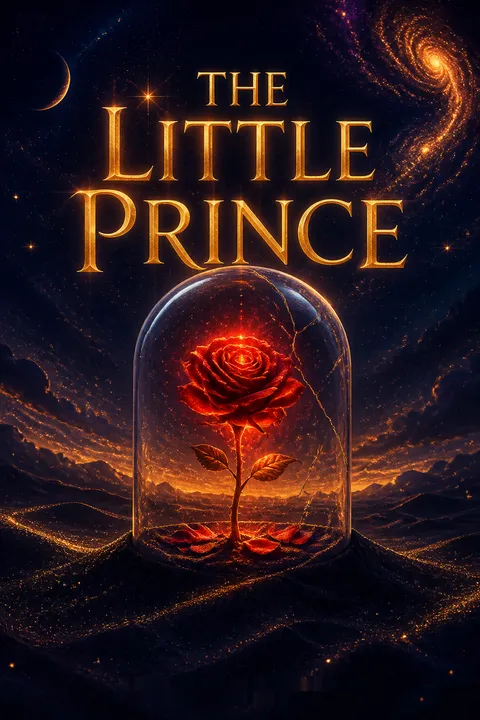


Plot Summary
The Hat Nobody Understood
At the age of six, the narrator2 drew a boa constrictor digesting an elephant — a picture inspired by a book about the primeval forest. Every adult who saw it said the same thing: it was a hat. He drew a second version, transparent, showing the elephant inside the snake. The adults told him to put down the pencils and study geography.
So he became a pilot instead, and flew all over the world, and tested every seemingly clear-sighted person he met with that first drawing. Not one ever saw the boa. He learned to talk about bridge, golf, and neckties, and the grown-ups would congratulate themselves on having met such a sensible man. He lived his life alone, without anyone who truly understood him.
Draw Me a Sheep
The pilot's2 engine failed over the Sahara, stranding him a thousand miles from any settlement with barely a week's water. At sunrise on the first morning, a small, extraordinary boy appeared and made a single request: a sheep. Not lost, not frightened, not thirsty — just insistent. The pilot tried drawing one. Too sickly. He tried again.
A ram, not a sheep. Again. Too old. Frustrated and desperate to repair his engine, the pilot sketched a box with three air holes and declared the sheep was inside. The boy's face lit up. He peered at the box and noted the sheep had fallen asleep. This was how the pilot met the little prince1 — a child who could see what wasn't drawn.
A Rose Too Proud for Love
Bit by bit, through dropped hints and half-confidences, the pilot2 learned the prince's1 story. He came from Asteroid B-612, a world so small he could watch forty-four sunsets in a single day just by moving his chair.
He tended two active volcanoes for cooking breakfast and pulled up baobab seedlings before they could split his planet apart. Then one day, a seed no one could explain produced a flower unlike any other — a rose3 who spent days preparing her beauty before blooming at sunrise.
She demanded water, screens against drafts, a glass globe at night. She claimed to have claws, lied about her origins, coughed to provoke guilt. The prince1 loved her but couldn't untangle her vanity from her affection. He confessed he'd been too young to know how to love her.
Goodbye Without the Globe
He caught a ride on migrating wild birds, but not before putting his world in order — sweeping all three volcanoes, pulling the last baobab shoots, watering the rose3 one final time. As he lifted her glass globe, she stopped him. She admitted she'd been foolish. She told him she loved him and that it was her fault he hadn't known.
She refused the globe, insisting the night air would do her good. She was a flower; she would endure caterpillars to meet butterflies. Then she urged him to leave quickly, before he could see her cry. She was too proud for that. The prince1 departed with her confession echoing behind him, her four small thorns the only thing standing between her and the world.
Six Asteroids of Absurd Adults
The prince1 visited six neighboring asteroids, each home to a solitary grown-up consumed by a single fixation. A king6 ruled over nothing but insisted all commands be reasonable. A conceited man7 heard only applause. A tippler8 drank to forget the shame of drinking.
A businessman9 counted five hundred million stars he claimed to own, locking the tally in a drawer. A lamplighter10 lit and extinguished his lamp every minute — faithful to outdated orders on a planet spinning too fast — and the prince admired him alone, the only one whose work served something beyond himself.
Last, a geographer11 who never explored his own world dismissed the prince's beloved flower with one word: ephemeral. In danger of speedy disappearance. The prince left that planet thinking of his rose,3 exposed and alone, armed with only four thorns.
The Garden That Broke Him
Earth was the seventh planet. The prince1 landed in the African desert, where a golden snake5 coiled around his ankle like a bracelet and spoke in riddles, claiming the power to send anyone back where they came from. He offered to help the prince return home someday. The prince wandered — through empty desert, past a three-petaled flower who thought only six or seven humans existed, up a mountain where only his echo answered.
Then he stumbled upon a garden blooming with five thousand roses, every one identical to the flower he'd left behind. She3 had told him she was the only one of her kind in the universe. He lay in the grass and wept, believing himself the prince of nothing — a common boy with a common rose and three knee-high volcanoes.
The Fox Begs to Be Tamed
The prince1 was still raw from the rose garden when a fox4 appeared and explained why they couldn't yet be friends: they had no ties. Taming, the fox said, meant building bonds through patience — returning at the same hour, sitting a little closer each day, letting ritual transform strangers into something irreplaceable.
After this slow approach, the fox was tamed. At parting he wept, but insisted the pain was worth it — golden wheat fields would forever echo the prince's golden hair. He sent the prince back to the five thousand roses with transformed eyes.
The prince told them they were beautiful but empty; his rose3 was unique because he had watered her, sheltered her, listened to her complaints. The fox's4 parting secret: one sees rightly only with the heart, and one is forever responsible for what one has tamed.
Water Sweetened by Stars
Eight days after the crash, the pilot's2 water was gone. The prince1 suggested they search for a well — absurd in the immensity of the Sahara, yet they walked. Through hours of silence under rising stars, the prince observed that the desert was beautiful because somewhere it hid a well, the way an old house is beautiful for hiding a treasure.
The pilot carried the sleeping boy through moonlight and found, at dawn, an impossible village well — pulley, rope, bucket. They drank together, and the water tasted unlike anything ordinary: sweetened by the walk, the stars, the effort of hauling.
Then the prince asked for the sheep's muzzle and quietly revealed that tomorrow marked the anniversary of his arrival on Earth. He'd landed very near this spot. A cold thread of dread settled in the pilot's chest.
Five Hundred Million Bells
The next evening, the pilot2 found the prince1 perched on a wall, speaking to something unseen — confirming a meeting point, asking about poison, requesting it not hurt too long. The pilot rushed forward. A yellow desert snake,5 the kind that kills in thirty seconds, slithered away at his footsteps. He caught the white-faced prince in his arms.
The prince explained he was going home, but his body was too heavy to carry; he'd leave it behind like an old shell. As a parting gift, he promised the pilot that every star in the sky would now carry laughter — five hundred million little bells. That night, the prince walked to the appointed spot. There was a flash of yellow at his ankle. He fell gently, without a sound, into the sand.
Epilogue
Six years have passed. The pilot2 never found the prince's1 body at daybreak — which he takes as proof the boy returned to his asteroid. But one detail haunts him: the muzzle he drew for the sheep had no leather strap. The sheep cannot be restrained. Sometimes he pictures the prince1 safely sheltering his rose3 under her glass globe each night, and all the stars ring with laughter.
Other times he imagines one absent-minded evening, one forgotten globe, one hungry sheep — and the bells become tears. He asks anyone who travels to the African desert: if you meet a golden-haired boy who laughs and refuses to answer questions, please send word that he has come back.
Analysis
Saint-Exupéry constructs a radical epistemological argument disguised as a children's fable: that civilization's hierarchy of knowledge — numbers over feelings, maps over flowers, ownership over stewardship — produces adults who are functionally blind. The six asteroid inhabitants form a precise taxonomy of how authority, vanity, addiction, capitalism, dutiful obedience, and abstract scholarship each sever the practitioner from lived experience. The businessman's9 stars locked in a drawer are indistinguishable from the geographer's11 unvisited mountains — both represent knowledge stripped of relationship.
The fox's4 lesson inverts this entirely. Value isn't discovered through measurement but created through investment of time. The prince's1 rose3 is objectively identical to five thousand others; she becomes singular only because he watered her, listened to her, suffered for her. This is not sentimentality — it is a philosophical claim about how meaning is constituted. Uniqueness is relational, not intrinsic. The fox4 calls this taming, but the deeper word is responsibility: the irreversible consequence of having loved.
The book's most radical move is structural. A pilot dying of thirst finds a well that shouldn't exist, carrying a child who shouldn't exist, and drinks water that tastes of starlight and effort rather than mere hydrogen and oxygen. Saint-Exupéry proposes that the material world is real but insufficient — that meaning flows through invisible channels of love, memory, and devotion that adults have systematically trained themselves to ignore. The boa constrictor drawing is not a charming anecdote but a diagnostic: society produces people who cannot see what is in front of them.
The ambiguous ending — did the sheep eat the rose?3 — refuses closure deliberately. It transforms every reader into the pilot:2 forced to choose between faith and anxiety, between laughing stars and weeping ones, between seeing with the heart and surrendering to grown-up certainty that none of this matters.
Review Summary
The Little Prince is a beloved classic that resonates with readers of all ages. Many praise its poetic language, philosophical depth, and ability to capture the essence of childhood innocence. The story's themes of friendship, love, and the importance of seeing with one's heart are frequently highlighted. Some readers find it emotionally moving and nostalgic, while others struggle to connect with its whimsical nature. The book's enduring popularity is attributed to its universal messages and ability to inspire reflection on life's important truths.
People Also Read




Characters
The Little Prince
Star-wandering boy from B-612A golden-haired boy from Asteroid B-612 who travels the universe seeking understanding after a painful confusion about love. His defining trait is an unwillingness to let go of questions—he presses until he reaches the essential truth beneath every surface. Psychologically, he operates between childhood perception and adult blindness, able to see invisible sheep in boxes and meaning in stars, yet initially unable to decode his rose's3 defensive vanity as love. His journey is one of emotional education: learning that uniqueness is created through devotion, that responsibility accompanies every bond, and that seeing with the heart requires courage. His melancholy—forty-four sunsets in a single day—reveals a boy carrying loneliness he cannot yet name.
The Pilot
Stranded narrator and artist lostA man who lost his imaginative life at age six when adults dismissed his boa constrictor drawing as a hat. He became a pilot, competent but spiritually marooned, unable to find a single person who could see beyond surfaces. The desert crash is both physical danger and metaphorical awakening—his encounter with the little prince1 rekindles the perceptive child buried under decades of adult conformity. His psychological arc moves from isolation to connection: he begins dismissing the prince's questions about thorns as trivial compared to engine repairs, and ends carrying a sleeping child through moonlit desert, understanding that what matters cannot be measured. He writes this story six years later, terrified of forgetting—of becoming the grown-up he has always feared becoming.
The Rose
Vain beloved on the asteroidThe sole flower on the prince's1 asteroid, she hides profound love behind elaborate vanity—demanding screens, water, and a glass globe while pretending invulnerability with four thorns. Her psychological pattern is deeply human: performing strength to mask fragility, using manipulation and feigned coughs when direct honesty feels too dangerous. What drives her is not narcissism but terror of being seen as vulnerable, making her the story's most poignant study in how love distorts its own expression.
The Fox
Philosopher of taming and tiesAn Earth-dwelling wild animal who serves as the story's philosophical teacher. He articulates the meaning the prince1 has been searching for: that love is created through the patient act of taming, that ritual gives time its texture, and that genuine sight requires the heart rather than the eyes. His willingness to accept the grief of parting as the price of having been loved reveals wisdom born from deep loneliness—he chooses connection knowing it guarantees future pain.
The Snake
Riddling power in the desertA golden desert serpent who speaks exclusively in riddles, claiming power greater than a king's finger despite having no feet. Enigmatic and ancient, he coils around the prince's1 ankle like a bracelet and hints at the ability to send anyone back to where they came from—a cryptic offer whose true meaning and cost unfold only at the story's end.
The King
Monarch of reasonable commandsSole ruler of the first asteroid, he insists on absolute authority but issues only reasonable commands—ordering what would happen anyway. His self-deception is benign but total, a portrait of power exercised over nothing.
The Conceited Man
Applause addict on an empty planetInhabitant of the second asteroid who hears nothing but praise. He exists in a closed loop of self-admiration, raising his hat in salute to an audience that never arrives.
The Tippler
Drinker ashamed of drinkingA solitary drinker on the third asteroid, trapped in a perfect circle of shame: he drinks to forget that he is ashamed of drinking, a miniature portrait of addiction's self-sealing logic.
The Businessman
Star-counter who owns nothingOccupant of the fourth asteroid who endlessly counts five hundred million stars he claims to own, locking tallies in drawers. He mistakes possession for purpose and numbers for meaning.
The Lamplighter
Faithful worker the prince respectsThe only adult the prince1 admires. He lights and extinguishes his street lamp every minute on a planet spinning too fast for its old orders, faithful to duty even when it has become absurd.
The Geographer
Scholar who never exploresAn old gentleman on the sixth asteroid who records geography from his desk but has never seen a mountain. His dismissal of flowers as ephemeral inadvertently pierces the prince1 with his first regret about leaving his rose3.
The Railway Switchman
Sorter of rushing travelersA worker on Earth who sorts travelers into bundles of a thousand, observing that no one is ever satisfied where they are. Only the children, he notes, press their noses to the windows.
The Pill Merchant
Seller of saved timeA salesman hawking thirst-quenching pills that save fifty-three minutes per week. The prince1 quietly decides he'd rather spend those minutes walking toward a spring of fresh water.
Plot Devices
Drawing Number One
Litmus test for perceptionThe narrator's2 childhood drawing of a boa constrictor digesting an elephant, universally mistaken for a hat by adults. He carries it throughout his life, showing it to every new acquaintance to gauge whether they can see beyond the obvious. It functions as a binary diagnostic separating those who perceive surfaces from those who perceive essences. When the little prince1 immediately identifies it as a boa with an elephant inside, it becomes the first proof of kinship between pilot and prince—and the first demonstration that what matters is often invisible to adult eyes trained on practicality.
The Sheep in the Box
Faith in the invisibleWhen the narrator2 draws a box with air holes and declares the sheep is inside, the prince1 accepts it with delight—he can see the sheep sleeping within. This establishes the prince's core ability to perceive what isn't visible and introduces the story's central proposition about invisible essences. The device carries consequences far beyond its whimsical introduction: the prince worries the sheep might eat his rose3, the narrator promises a muzzle, and the box's implications ripple through to the final chapter, where the narrator realizes he forgot to draw a leather strap on the muzzle—leaving the rose's3 fate permanently uncertain.
The Baobab Trees
Neglected dangers destroy worldsTerrible seeds that infest the prince's1 tiny planet, resembling innocent rosebushes in their infancy but growing into trees so massive they can split an asteroid apart with their roots. The prince must uproot them daily—a tedious but essential discipline. They function as the story's clearest allegory: problems, whether personal or moral, must be addressed at their first appearance or they become catastrophic and irreversible. The narrator2 draws them at the prince's urging, creating the book's most dramatic illustration as a warning to children everywhere.
The Glass Globe
Love's protective enclosureThe transparent dome the prince1 places over his rose3 each night to shield her from the cold. The rose both demands and ultimately refuses this protection, making the globe a symbol of love's tension between sheltering and suffocating. The prince holds it arrested in mid-air during their final moment together, and the rose's3 refusal of it—her insistence on facing the night air alone—marks her transformation from demanding dependent to proud survivor. The globe recurs in the narrator's2 anxious imagination as the story's unresolved question: whether the prince remembers to use it each evening.
The Snake's Bite
Passage home through poisonThe golden desert snake5 introduces himself early as possessing the power to return anyone to the earth from which they came—a riddling promise that initially seems philosophical. The prince1 later deliberately arranges to meet the snake at the exact spot where he landed on Earth one year earlier, understanding that the bite will shed his heavy body and allow his essence to return to Asteroid B-612. The device transforms a venomous animal into an ambiguous ferryman: destroyer or liberator, depending on whether one trusts the prince's faith that his body is merely an old shell.
FAQ
Synopsis & Basic Details
What is The Little Prince about?
- A journey of discovery: The story follows a young prince from a tiny asteroid as he travels to different planets, encountering various adults who represent different aspects of human nature.
- Critique of adulthood: Through these encounters, the book critiques the often-absurd behaviors and values of adults, contrasting them with the innocence and wisdom of childhood.
- Importance of relationships: The core of the story explores the significance of love, friendship, and the responsibility that comes with forming meaningful connections, particularly highlighted by the prince's relationship with a rose and a fox.
Why should I read The Little Prince?
- Profound life lessons: The book offers timeless wisdom about love, loss, and the importance of seeing beyond the surface, making it relevant for readers of all ages.
- Unique perspective on life: It encourages readers to question societal norms and to embrace a more childlike perspective and imagination, offering a fresh perspective on the world.
- Beautifully written and thought-provoking: The simple yet poetic language and the allegorical nature of the story make it a deeply moving and intellectually stimulating read.
What is the background of The Little Prince?
- Written during WWII: Antoine de Saint-Exupéry wrote the book while in exile in North America during World War II, reflecting his feelings of displacement and the loss of innocence in the world.
- Personal experiences: The pilot character is a reflection of Saint-Exupéry himself, who was also a pilot, and the story incorporates his own experiences and philosophical musings.
- Critique of societal values: The book serves as a critique of the materialistic and superficial values of modern society, contrasting them with the simplicity and depth of childhood.
What are the most memorable quotes in The Little Prince?
- "It is only with the heart that one can see rightly; what is essential is invisible to the eye.": This quote encapsulates the central theme of the book, emphasizing the importance of emotional understanding over superficial observation.
- "You become responsible, forever, for what you have tamed.": This quote highlights the theme of responsibility in relationships, emphasizing the commitment and care required for meaningful connections.
- "All grown-ups were once children... but only few of them remember it.": This quote underscores the book's critique of adulthood and the loss of imagination and wonder that often accompanies it.
What writing style, narrative choices, and literary techniques does Antoine de Saint-Exupéry use?
- Simple and poetic language: The writing style is characterized by its simplicity and clarity, making it accessible to readers of all ages, while also incorporating poetic and evocative language.
- First-person narration: The story is narrated from the perspective of the pilot, which allows for a personal and reflective tone, drawing the reader into his emotional journey.
- Allegorical storytelling: The use of allegory and symbolism is central to the book, with each character and planet representing different aspects of human nature and societal values.
Hidden Details & Subtle Connections
What are some minor details that add significant meaning?
- The drawing of the sheep: The pilot's initial inability to draw a sheep that satisfies the little prince highlights the limitations of adult thinking and the importance of imagination.
- The number of the asteroid: The little prince's home asteroid, B-612, is a seemingly insignificant detail, but it emphasizes the vastness of the universe and the smallness of human concerns.
- The baobab trees: The baobabs, which threaten to overtake the little prince's planet, symbolize the dangers of neglecting small problems, which can grow into larger, more destructive issues.
What are some subtle foreshadowing and callbacks?
- The pilot's childhood drawing: The pilot's initial drawing of the boa constrictor foreshadows his later encounter with the little prince, who is able to see beyond the surface.
- The fox's taming lesson: The fox's lesson about taming foreshadows the little prince's eventual departure and the pilot's feelings of loss, emphasizing the lasting impact of meaningful connections.
- The stars as bells: The little prince's description of the stars as bells after his departure is a callback to the pilot's initial inability to hear the stars, highlighting his newfound ability to see with his heart.
What are some unexpected character connections?
- The lamplighter and the little prince: The lamplighter is the only adult the little prince respects, suggesting a connection between duty and purpose, contrasting with the other adults' self-absorption.
- The rose and the fox: Both the rose and the fox teach the little prince about love and relationships, highlighting the different aspects of these connections, one based on care and the other on taming.
- The pilot and the little prince: The pilot's transformation from a disillusioned adult to someone who can see with his heart mirrors the little prince's journey of understanding, creating a parallel between their experiences.
Who are the most significant supporting characters?
- The fox: The fox is a crucial supporting character, as he teaches the little prince about the importance of taming and forming meaningful relationships, which is central to the book's themes.
- The rose: The rose, despite her vanity, is significant because she represents the complexities of love and the need to look beyond superficial flaws, teaching the little prince about vulnerability.
- The snake: The snake, though a brief encounter, is significant as he facilitates the little prince's return to his asteroid, symbolizing the inevitability of death and the cyclical nature of life.
Psychological, Emotional, & Relational Analysis
What are some unspoken motivations of the characters?
- The pilot's desire for connection: The pilot's initial skepticism masks a deep longing for connection and understanding, which is fulfilled through his friendship with the little prince.
- The little prince's search for meaning: The little prince's journey is driven by an unspoken desire to understand the complexities of life and to find meaning beyond his small asteroid.
- The rose's need for validation: The rose's vanity stems from an unspoken need for validation and love, which the little prince struggles to understand but ultimately provides.
What psychological complexities do the characters exhibit?
- The pilot's disillusionment: The pilot's disillusionment with adulthood reflects a psychological struggle to reconcile his childhood imagination with the pragmatic demands of the adult world.
- The little prince's innocence and wisdom: The little prince's character embodies a complex blend of childlike innocence and profound wisdom, reflecting a unique perspective on life.
- The rose's vanity and vulnerability: The rose's character is complex, exhibiting both vanity and vulnerability, highlighting the intricacies of human emotions and relationships.
What are the major emotional turning points?
- The pilot's encounter with the little prince: The pilot's encounter with the little prince is a major emotional turning point, as it rekindles his sense of wonder and challenges his views on adulthood.
- The little prince's taming by the fox: The little prince's taming by the fox is an emotional turning point, as it teaches him about the importance of forming meaningful connections and the responsibility that comes with them.
- The little prince's departure: The little prince's departure is a poignant emotional turning point, as it leaves the pilot with a profound sense of loss and a newfound appreciation for life's intangible treasures.
How do relationship dynamics evolve?
- Pilot and Little Prince: The relationship between the pilot and the little prince evolves from a chance encounter to a deep friendship, marked by mutual learning and emotional growth.
- Little Prince and Rose: The little prince's relationship with the rose evolves from a naive love to a deeper understanding of her complexities and his responsibility towards her.
- Little Prince and Fox: The little prince's relationship with the fox evolves from a simple meeting to a profound lesson in taming and the importance of creating unique bonds.
Interpretation & Debate
Which parts of the story remain ambiguous or open-ended?
- The little prince's return: The exact nature of the little prince's return to his asteroid is left ambiguous, allowing for multiple interpretations about death, transformation, and the cyclical nature of life.
- The pilot's future: The pilot's future after the little prince's departure is open-ended, leaving the reader to wonder how he will apply the lessons he has learned and if he will retain his newfound perspective.
- The meaning of the stars: The meaning of the stars, which the little prince describes as bells, is open to interpretation, symbolizing the different ways in which people perceive and find meaning in the world.
What are some debatable, controversial scenes or moments in The Little Prince?
- The rose's vanity: The rose's vanity and demanding nature can be interpreted as either a flaw or a reflection of the complexities of love and relationships, sparking debate about the nature of true love.
- The little prince's departure: The little prince's decision to return to his asteroid, which involves a seemingly fatal encounter with the snake, can be interpreted as either a tragic loss or a necessary step in his journey.
- The critique of adults: The book's harsh critique of adult behavior can be seen as either a valid commentary on societal values or an overly simplistic view of the complexities of adulthood.
The Little Prince Ending Explained: How It Ends & What It Means
- The little prince's departure: The little prince allows a snake to bite him, which is his way of returning to his asteroid, suggesting a symbolic death and a return to his true home.
- The pilot's grief and understanding: The pilot is left with a profound sense of loss but also a deeper understanding of life's intangible treasures, highlighting the lasting impact of meaningful connections.
- The cyclical nature of life: The ending emphasizes the cyclical nature of life, with the little prince's departure not being a true end but rather a transformation, leaving the reader to ponder the meaning of life and death.
Download PDF
Download EPUB
.epub digital book format is ideal for reading ebooks on phones, tablets, and e-readers.








































