


Plot Summary
Prologue
Nick Carraway2 looks back on the summer that sent him home. A Midwesterner trained by his father to withhold judgment, he came east after the war to sell bonds and found himself drawn into the orbit of his mysterious neighbor.
What he witnessed in that single season — the wealth, the longing, the carelessness — left him wanting the world returned to moral attention. Only one man earned exemption from his disgust: Jay Gatsby,1 who possessed not wealth or status but something rarer — an extraordinary, doomed gift for hope.
The Neighbor Nobody Knows
Nick2 rents a small bungalow on Long Island's West Egg for eighty dollars a month — a shack dwarfed by the mansion next door, a Normandy château sprawling across forty acres. His neighbor is a man named Gatsby,1 whom he has never met. Across the bay in fashionable East Egg, Nick2 dines with his cousin Daisy3 and her husband Tom Buchanan,4 a former Yale football star grown restless with old money.
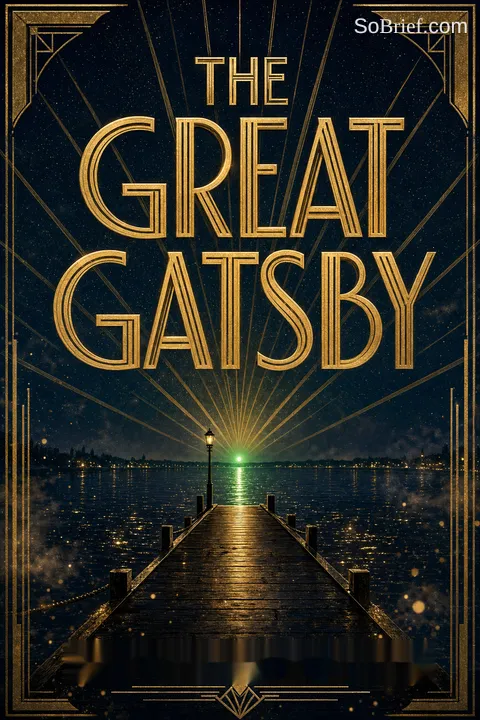
During dinner, a phone call pulls Tom4 from the table. Jordan Baker,5 a professional golfer staying with the Buchanans, explains casually: Tom4 keeps a mistress in New York. That night, back home, Nick2 spots Gatsby1 standing alone on his lawn, arms stretched toward a single green light winking from a dock across the water.
Tom's Fist Ends the Party
Tom4 hauls Nick2 off a train in the Valley of Ashes — a grey wasteland between Long Island and Manhattan, watched over by a faded billboard of giant bespectacled eyes advertising a forgotten oculist. They enter a crumbling garage where George Wilson,7 a pale, spiritless man, repairs cars.
His wife Myrtle6 descends the stairs with a vitality that dwarfs her husband; she and Tom4 exchange glances like co-conspirators. In a rented apartment uptown, Myrtle6 transforms — new dress, affected manners, a purchased dog.
Her sister Catherine arrives, neighbors drift in, whiskey flows. Late that night, Myrtle6 chants Daisy's3 name in defiance. Tom4 smashes her nose with an open hand. Nick2 ends the evening half-asleep in Penn Station, waiting for the four a.m. train.
Rumors, Champagne, and Gatsby
A formal invitation arrives by chauffeur — one of the few ever issued, since most guests crash uninvited. Nick2 enters a world of orchestras and champagne, hundreds of strangers, rumors traded like currency. Guests whisper that Gatsby1 killed a man, spied for Germany, or bootlegs liquor.
Nick2 wanders the grounds searching for his host, but every person he asks denies knowing Gatsby's1 whereabouts. In the library, an owl-eyed man11 in enormous spectacles marvels that the books are real, not cardboard props.
At a table, Nick2 chats with a friendly stranger about their shared wartime service before learning, with a jolt, that this man is Gatsby1 himself — his smile carrying a quality of eternal reassurance. Gatsby1 is called away to phone calls from distant cities, then summons Jordan5 for a private conversation whose contents she refuses to share.
Five Years to Cross a Bay
Riding in Gatsby's1 cream-colored car toward Manhattan, Nick2 hears a rehearsed autobiography — wealthy Midwestern family, Oxford education, wartime heroism — that sounds like a cut-rate adventure serial. A Montenegrin medal and an Oxford photograph lend unexpected credibility.
At lunch, Gatsby1 introduces Meyer Wolfshiem,8 the gangster who fixed the 1919 World Series, wearing cufflinks fashioned from human molars. That afternoon, Jordan5 reveals the real story: in 1917 Louisville, a young officer named Jay Gatsby1 fell in love with Daisy Fay.3
The war separated them. The night before Daisy's3 wedding to Tom,4 she got drunk and tried to return his pearls, clutching a letter. She married Tom4 the next morning. Gatsby1 bought his mansion to be near her dock's green light. His single request: that Nick2 invite Daisy3 to tea.
Gatsby Meets Daisy at Last
Gatsby1 sends a gardener to mow Nick's2 lawn and a greenhouse of flowers to fill his living room. He arrives in a white suit, pale with insomnia, nearly bolts when Daisy3 is two minutes late. When she arrives, he circles the house and knocks at the front door — rain-soaked, ashen, rigid with terror.
The first minutes are excruciating: stiff pleasantries, a mantelpiece clock nearly toppled. Nick2 steps outside. When he returns half an hour later, Daisy's3 face is wet with tears and Gatsby1 radiates an entirely new kind of joy.
He tours them through his mansion — silk bedrooms, imported shirts flung in cascading piles until Daisy3 sobs over their beauty. He points across the bay to her dock's green light, but with Daisy3 beside him, its enchantment has quietly vanished.
The Boy Who Invented Himself
Nick2 reveals the truth behind Gatsby's1 myth. Born James Gatz to poor North Dakota farmers, he was a boy whose imagination refused to accept his parentage. At seventeen, spotting a millionaire's yacht on Lake Superior, he rowed out to warn its owner of shallows and remade himself on the spot.
Dan Cody,10 the aging copper magnate aboard, hired young Gatsby1 as a personal assistant for five years of voyaging. Cody's10 death left Gatsby1 a promised inheritance of twenty-five thousand dollars, stolen by legal maneuver. He kept only the education — how to wear wealth, how to perform it.
When Tom4 and Daisy3 later attend one of his parties, Daisy3 recoils from West Egg's vulgarity. Afterward, Gatsby1 confides his impossible demand to Nick:2 Daisy3 must declare she never loved Tom,4 then return to Louisville as if the last five years never happened.
The Suite at the Plaza
On the hottest day of summer, the five of them converge at the Buchanans' for lunch. Daisy3 kisses Gatsby1 when Tom4 leaves the room and tells him she loves him. Tom4 catches the charged look between them and insists they all drive to Manhattan. On the way, he stops at Wilson's7 garage, where George7 announces he has discovered his wife's secret life and plans to move her away.
In a stifling suite at the Plaza Hotel, Tom4 tears into Gatsby's1 background — the bootlegging, the fraudulent drug stores, the ties to Wolfshiem.8 Gatsby1 demands Daisy3 say she never loved Tom.4 She tries, falters, then admits she loved them both. Gatsby's1 composure fractures into something undeniable. Tom,4 sensing victory, sends Daisy3 home in Gatsby's yellow car.
The Yellow Car Doesn't Stop
Daisy3 is at the wheel of Gatsby's car on the drive home. Near Wilson's7 garage, Myrtle6 — locked upstairs by her husband — breaks free and runs into the road, mistaking the yellow car for Tom's.4 Daisy3 swerves toward the oncoming lane, then freezes. The car strikes Myrtle6 and kills her instantly.
They never stop. Gatsby1 later confesses to Nick2 that Daisy3 was driving, but he intends to take the blame. He stations himself outside the Buchanans' house through the night, keeping watch in case Tom4 turns violent.
Nick2 peers through the kitchen window and discovers a different scene entirely — Tom4 and Daisy3 sitting together over cold chicken and ale, leaning toward each other in unmistakable conspiracy. Nick2 tells Gatsby1 it's quiet inside, then leaves him standing alone in the moonlight, guarding a house already closed against him.
Waiting for a Call
Through the night, George Wilson7 rocks and moans in his garage office beneath the giant faded eyes of Doctor Eckleburg's billboard, declaring that God sees everything. He has found a new dog leash among his wife's things — evidence of her secret life — and believes the driver of the yellow car murdered her deliberately.
By morning, he traces the car to Gatsby.1 Nick2 goes to Gatsby1 at dawn and urges him to leave town. Gatsby1 refuses, still waiting for Daisy3 to call. As Nick2 departs for work, he shouts across the lawn that Gatsby1 outshines every last one of them.
That afternoon, Gatsby1 floats on a rubber mattress in his unused pool. Wilson7 finds him there. The chauffeur hears shots. Nick2 races home to find Gatsby's1 body drifting in a thin red circle of water, Wilson7 dead in the grass nearby.
Nobody Came to Mourn
Daisy3 and Tom4 have vanished — no address, no message, no flowers. Wolfshiem8 refuses to attend, unwilling to get mixed up in it. Klipspringer,12 who lived rent-free in Gatsby's1 house for months, calls only to ask about shoes he left behind.
Gatsby's father9 arrives from Minnesota clutching a cracked photograph of the mansion and a childhood book where young Jimmy had written a daily schedule of self-improvement. At the cemetery, in thick drizzle, only Nick,2 the old man,9 a few servants, and the owl-eyed man11 from the library attend.
Months later, Nick2 encounters Tom4 on Fifth Avenue. Tom4 admits he told Wilson7 that the yellow car was Gatsby's1 — directing a grieving, armed man to Gatsby's1 door. Nick2 sees them clearly now: careless people who smash things and retreat into their wealth, leaving others to sweep up the wreckage.
Epilogue
On his last night before leaving for the Midwest, Nick2 erases an obscene word scrawled on the steps of Gatsby's1 empty mansion. Down on the beach, he imagines Long Island as Dutch sailors first saw it — a green breast of new world, offering itself to humanity's limitless capacity for wonder.
He thinks of Gatsby1 reaching toward that green light at the end of Daisy's3 dock, never knowing the dream was already behind him. The future Gatsby1 believed in receded year by year, yet he kept reaching. And so do we all — pressing forward even as the current carries us ceaselessly backward, into everything we thought we had left behind.
Analysis
The Great Gatsby performs a precise autopsy on the American Dream by showing not its failure but its structural impossibility. Gatsby's1 ambition is not flawed in its intensity — it is flawed in its object. He pursues not Daisy3 but Daisy-as-symbol: the golden girl whose voice sounds like money, whose world promises that reinvention can be total. The novel reveals that class in America operates not through titles but through time — the difference between old money and new is not amount but duration, and no quantity of imported shirts or champagne can compress that gap.
Fitzgerald's most subversive insight is that Gatsby's1 romanticism and Tom's4 brutality serve the same master. Both men treat Daisy3 as property — Gatsby1 wants to reclaim her, Tom4 wants to retain her — and her desires register only as ammunition in their contest. Daisy's3 passivity is not characterological weakness but rational survival strategy in a system where women function as prizes, not agents. Her wish for her daughter to be gorgeous and unthinking is less cynicism than survival manual.
The novel's geography encodes its moral argument. East Egg faces West Egg across a narrow bay, while the Valley of Ashes lies between both worlds and Manhattan — the invisible cost of both economies. Fitzgerald anticipates late-capitalist critiques of wealth extraction: the gorgeous parties require an ash-covered underclass, and the characters' refusal to see this connection constitutes the story's central moral failure.
Nick's2 unreliability as narrator deepens these themes. His claim to honesty is repeatedly undermined by his complicity — he arranges the affair, conceals a hit-and-run, and judges everyone while excusing himself. The green light endures as literature's most potent symbol because it names something universal: the human conviction that fulfillment is always across the water, always next year, always one more reach away — a future that exists precisely because we never arrive.
Review Summary
The Great Gatsby receives mixed reviews, with many praising Fitzgerald's lyrical prose and vivid portrayal of the Jazz Age. Readers appreciate its exploration of the American Dream, class dynamics, and moral decay. Some find the characters unlikable but compelling. The novel's brevity and symbolic depth are often noted. While some consider it overrated, many acknowledge its status as a classic and its enduring relevance. Several readers report enjoying it more upon rereading, finding new layers of meaning and appreciating its cultural significance.
People Also Read


Characters
Jay Gatsby
Self-invented dreamerBorn James Gatz to impoverished North Dakota farmers, Gatsby is the self-made architect of his own mythology—a man who invented a golden identity at seventeen and spent every subsequent year building a world to justify it. His obsession with Daisy Buchanan3 is not merely romantic but existential: she represents the life he believes he deserves, proof that reinvention can conquer origin. Beneath the lavish parties and Oxford affectations lies a disciplined, lonely man whose capacity for devotion borders on delusion. Gatsby's fundamental tension is his refusal to accept that time moves forward. He does not want Daisy3 as she is—he wants the past restored, the present erased, the dream made flesh again. His hope is magnificent and ruinous in equal measure.
Nick Carraway
Narrator and reluctant witnessThe novel's narrator and moral compass, Nick is a Yale-educated bond salesman from a respectable Midwestern family who moves to Long Island seeking reinvention of his own. His defining trait—a trained reluctance to judge—makes him the ideal confidant for people who need witnesses to their secrets. Nick is simultaneously drawn to the glamour of the East and repelled by its moral emptiness. His relationship with Gatsby1 evolves from skepticism to genuine admiration, even as he recognizes Gatsby's1 self-deception. Nick's honesty is selective; he claims it as his cardinal virtue yet participates in deceptions throughout the summer. His journey is one of disillusionment: he arrives curious and leaves permanently altered, retreating to the Midwest to recover from what he has seen.
Daisy Buchanan
Golden girl, impossible objectNick's2 cousin and Gatsby's1 obsession, Daisy is a woman whose charm operates like weather—effortless, enveloping, impossible to hold. Her low, thrilling voice promises intimacy and excitement while delivering neither. Raised in Louisville wealth, she loved young Gatsby1 but chose the security of Tom Buchanan's4 fortune. Daisy is not heartless but fundamentally passive, shaped by a world that rewards women who do not think too deeply. Her private hope that her daughter grow up charming and oblivious reveals how thoroughly she has internalized the constraints on women in her world. She is capable of genuine feeling but incapable of the sustained courage Gatsby's1 devotion demands. When pressed, she retreats to the fortress of her marriage.
Tom Buchanan
Old money's brutal enforcerDaisy's3 husband, a former Yale football star whose peak came at twenty-one—a fact that shadows everything after. Tom moves through the world with the entitled physicality of a man accustomed to forcing outcomes: he forces Nick2 to meet his mistress, forces conversations about racial pseudoscience, forces the confrontation that destroys Gatsby's1 dream. His affair with Myrtle Wilson6 is conducted with a brazenness that borders on cruelty, yet he is genuinely shocked when Daisy's3 loyalty wavers. Tom represents old money's most dangerous quality: the assumption that the world exists to serve his appetites, combined with genuine outrage when anyone disrupts the arrangement. His intelligence is narrow but effective, particularly when dismantling Gatsby's1 fabricated respectability.
Jordan Baker
Cool, dishonest golferA professional golfer and Daisy's3 close friend, Jordan carries herself with the detachment of an athlete who has trained her body to lie. Nick2 discovers she cheated in her first major tournament and is incurably dishonest—a trait she manages through careful selection of companions who will not notice. Her romance with Nick2 is marked by mutual attraction and mutual withholding. She serves as the critical intermediary between Gatsby1 and Nick2, and her cynicism provides a steady counterbalance to the story's romanticism.
Myrtle Wilson
Tom's desperate mistressTom Buchanan's4 mistress, trapped in a loveless marriage above a gas station in the Valley of Ashes. Myrtle possesses a fierce, smoldering vitality that refuses containment. In Tom's4 New York apartment, she transforms herself through new clothes and affected manners, performing the wealth she craves. Her marriage to George7 represents everything she wants to escape. Her desperation for a different life makes her both deeply sympathetic and dangerously reckless.
George Wilson
Grief-stricken garage ownerMyrtle's6 husband, a pale, spiritless garage owner ground down by poverty and the Valley of Ashes. He adores Myrtle6 without understanding her, and his ignorance of her secret life renders him nearly invisible in his own home. Beneath his meekness lies a simple, absolute faith in his marriage—and in moral certainties that, once shattered, demand accounting. He sees the world in stark, binary terms, which makes him vulnerable to grief that cannot rest without an answer.
Meyer Wolfshiem
Gatsby's underworld patronGatsby's1 criminal mentor, a gangster who fixed the 1919 World Series and wears cufflinks fashioned from human molars. He claims to have discovered Gatsby1 as a hungry, medal-covered veteran and raised him from nothing. Wolfshiem represents the criminal infrastructure behind Gatsby's1 fortune—the shadow economy that funded the parties and the mansion. Sentimental yet calculating, he operates by a strict personal code: loyalty in business, nostalgia in memory, and self-preservation above all.
Henry Gatz
Gatsby's humble fatherGatsby's1 father, a humble old man from Minnesota. He carries a cracked photograph of the mansion and a boyhood book containing Jimmy's handwritten self-improvement schedule—evidence that the ambition began in childhood, long before the name changed.
Dan Cody
Gatsby's first mentorA copper millionaire and aging adventurer whose yacht on Lake Superior represented everything young James Gatz1 wanted to become. Cody hired him as a personal assistant, giving Gatsby1 five years of education in how wealth moves and performs.
Owl Eyes
Library marvel, unlikely witnessA bespectacled party guest who marvels that Gatsby's1 library books are real, not cardboard props. He serves as an unlikely measure of Gatsby's1 thoroughness—and later, of the world's loyalty.
Klipspringer
Gatsby's permanent freeloaderA freeloader who lived at Gatsby's1 mansion so long he earned the nickname the boarder. He plays piano on command and embodies the parasitic nature of Gatsby's1 social world.
Plot Devices
The Green Light
Embodies Gatsby's longingA small green light at the end of Daisy's3 dock in East Egg, visible across the bay from Gatsby's1 lawn. Nick2 first sees Gatsby1 reaching toward it in the dark, trembling. The light functions as the visible anchor of Gatsby's1 five-year obsession—not merely with Daisy3 herself, but with the life she represents and the past he wants to recover. When Gatsby1 finally stands beside Daisy3, Nick2 observes that the colossal significance of the light has vanished; it has become just a light on a dock. In the novel's closing meditation, the green light becomes universal—a symbol of the futures we chase but never reach, receding before us even as we stretch toward them.
The Eyes of Doctor Eckleburg
Moral surveillance, absent GodA faded billboard overlooking the Valley of Ashes depicting enormous bespectacled eyes—an advertisement for a long-gone oculist. The eyes watch over every journey between Long Island and Manhattan, brooding above the wasteland where the working poor labor. They serve as a stand-in for divine judgment in a world where actual moral authority has vanished. George Wilson7, in his grief-stricken delirium, stares at the billboard and declares that God sees everything—conflating a commercial artifact with cosmic justice. The eyes witness but do not intervene, suggesting a universe indifferent to human suffering yet haunted by the feeling that someone should be watching.
Gatsby's Parties
Loneliness disguised as excessEvery weekend, Gatsby's1 mansion erupts into spectacular gatherings—orchestras, champagne, hundreds of uninvited guests who come and go without ever meeting their host. The parties serve a singular covert purpose: Gatsby1 hopes Daisy3 will wander in. She never does, so he recruits Jordan Baker5 and Nick2 to arrange the reunion instead. The irony is structural—the most extravagant social spectacle on Long Island exists to attract one woman who never attends. The parties also generate the mythology surrounding Gatsby1, making him famous while keeping him unknowable. When Daisy3 finally enters his life through other means, the parties cease entirely, replaced by discreet afternoons and Wolfshiem's8 people posing as servants.
The Yellow Car
Wealth's lethal instrumentGatsby's1 enormous cream-colored automobile, bright with nickel and swollen with excess, functions as the novel's most conspicuous emblem of new money—and becomes its deadliest weapon. The car dazzles on the road to Manhattan and impresses onlookers, but its visibility makes it fatally traceable. When it strikes and kills Myrtle Wilson6 on the road through the Valley of Ashes, witnesses remember only one detail: the color. The car links Gatsby1 to the crime regardless of who was driving, and its traceability sets the final catastrophe in motion. It embodies the paradox of Gatsby's1 wealth—spectacular enough to attract admiration, too conspicuous to escape consequences.
The Valley of Ashes
The cost beneath the wealthA grey industrial wasteland midway between Long Island's gilded communities and Manhattan, where ash coats everything—land, buildings, the people who labor there. It is the geographical and moral territory the wealthy must cross but never acknowledge. George7 and Myrtle Wilson6 live here, trapped above a failing garage beneath a billboard's blank stare. The valley represents what the American Dream discards: the labor, the waste, the lives consumed to fuel the prosperity enjoyed in East and West Egg. Every character passes through it, but only the Wilsons inhabit it. Its desolation makes it the novel's moral center—the place where carelessness becomes most dangerous.
FAQ
Basic Details
What is The Great Gatsby about?
- Wealthy man's pursuit: The story centers on Jay Gatsby, a mysterious millionaire, and his obsessive quest to win back his former love, Daisy Buchanan.
- American Dream critique: It explores the themes of wealth, class, and the illusion of the American Dream through the eyes of Nick Carraway, a Midwesterner who becomes entangled in the lives of the wealthy elite.
- Tragic love story: The narrative unfolds as a tragic love story, revealing the destructive nature of obsession and the moral decay hidden beneath the surface of the Roaring Twenties.
Why should I read The Great Gatsby?
- Timeless themes: The novel delves into universal themes of love, loss, social class, and the corrupting influence of wealth, making it relevant across generations.
- Masterful prose: F. Scott Fitzgerald's elegant and evocative writing style creates a vivid and immersive reading experience, capturing the essence of the Jazz Age.
- Complex characters: The characters are flawed and multi-dimensional, prompting readers to reflect on their own values and motivations, and sparking debate about their actions.
What is the background of The Great Gatsby?
- Roaring Twenties setting: The novel is set in the 1920s, a period of economic prosperity, social change, and cultural excess in the United States, known as the Jazz Age.
- Post-war disillusionment: It reflects the post-World War I disillusionment and the moral ambiguity that emerged as traditional values were challenged by the pursuit of wealth and pleasure.
- Long Island's social divide: The story takes place on Long Island, contrasting the old money of East Egg with the nouveau riche of West Egg, highlighting the social stratification of the era.
What are the most memorable quotes in The Great Gatsby?
- "So we beat on, boats against the current, borne back ceaselessly into the past.": This iconic line encapsulates the novel's central theme of the futility of trying to recapture the past and the human tendency to be drawn back to it.
- "Her voice is full of money.": This quote, spoken by Gatsby about Daisy, reveals the allure and corrupting power of wealth, highlighting how it shapes her character and appeal.
- "Can't repeat the past? Why of course you can!": This quote, spoken by Gatsby, reveals his unwavering belief in the power of the past and his determination to recreate it, despite its impossibility.
What writing style, narrative choices, and literary techniques does F. Scott Fitzgerald use?
- First-person narration: The story is told through the eyes of Nick Carraway, providing a subjective and intimate perspective on the events and characters, allowing for both observation and personal reflection.
- Symbolism and imagery: Fitzgerald employs rich symbolism, such as the green light, the Valley of Ashes, and Gatsby's mansion, to convey deeper meanings and enhance the novel's themes.
- Foreshadowing and irony: The narrative is filled with subtle foreshadowing and dramatic irony, creating a sense of impending tragedy and highlighting the characters' self-deception.
Hidden Details & Subtle Connections
What are some minor details that add significant meaning?
- Owl Eyes's spectacles: The character with owl-eyed spectacles in Gatsby's library, who is fascinated by the real books, symbolizes the superficiality of the wealthy class and their lack of genuine intellectual curiosity.
- The clock on Nick's mantel: The broken clock that Gatsby almost knocks over during his reunion with Daisy symbolizes the disruption of time and the impossibility of recreating the past.
- The dog leash: The dog leash found by George Wilson in Myrtle's belongings reveals her secret life and her desire for a more luxurious existence, ultimately leading to her death.
What are some subtle foreshadowing and callbacks?
- Gatsby's trembling: Gatsby's trembling when reaching for the green light at the end of chapter one foreshadows his emotional vulnerability and the fragility of his dream.
- Daisy's black and blue knuckle: Daisy's bruised knuckle, which she blames on Tom, foreshadows the violence and unhappiness within their marriage and the physical harm she will later cause.
- The car accident at the end of chapter three: The chaotic car accident outside Gatsby's party foreshadows the tragic car accident that will later claim Myrtle's life and lead to Gatsby's death.
What are some unexpected character connections?
- Meyer Wolfshiem and Gatsby: The connection between Gatsby and Meyer Wolfshiem, a gambler and a man who fixed the 1919 World Series, reveals the darker side of Gatsby's wealth and his involvement in illegal activities.
- Catherine and Myrtle: The relationship between Myrtle and her sister Catherine, who is aware of Myrtle's affair, highlights the moral ambiguity and the secrets that permeate the characters' lives.
- Owl Eyes and Gatsby: The presence of Owl Eyes at Gatsby's funeral, despite not being a close friend, suggests a deeper understanding of Gatsby's character and the superficiality of his social circle.
Who are the most significant supporting characters?
- Jordan Baker: Jordan's cynicism and dishonesty reflect the moral decay of the wealthy elite, and her relationship with Nick provides a contrasting perspective on the events.
- Meyer Wolfshiem: Wolfshiem's criminal connections and his role in Gatsby's rise to wealth reveal the corrupt underbelly of the American Dream and the source of Gatsby's fortune.
- George Wilson: Wilson's tragic fate and his desperate search for justice highlight the devastating consequences of the characters' actions and the social inequalities of the era.
Psychological, Emotional, & Relational Analysis
What are some unspoken motivations of the characters?
- Gatsby's need for validation: Gatsby's lavish parties and extravagant displays of wealth are driven by his need to impress Daisy and prove his worthiness of her love, revealing his deep-seated insecurities.
- Daisy's desire for security: Daisy's choice to stay with Tom, despite her feelings for Gatsby, is motivated by her desire for security and social status, highlighting her fear of losing her privileged lifestyle.
- Tom's need for control: Tom's aggressive behavior and his attempts to control Daisy and Myrtle stem from his need to maintain his dominance and social standing, revealing his deep-seated insecurities and prejudices.
What psychological complexities do the characters exhibit?
- Gatsby's obsessive idealism: Gatsby's unwavering belief in his dream and his inability to accept reality reveal his obsessive nature and his tendency to idealize the past.
- Daisy's emotional detachment: Daisy's superficial charm and her inability to commit to either Tom or Gatsby reveal her emotional detachment and her fear of confronting her own desires.
- Tom's moral hypocrisy: Tom's blatant infidelity and his racist views reveal his moral hypocrisy and his inability to recognize the consequences of his actions.
What are the major emotional turning points?
- Gatsby and Daisy's reunion: The awkward and emotionally charged reunion between Gatsby and Daisy at Nick's house marks a turning point, reigniting their past love and setting the stage for the tragic events to come.
- The confrontation at the Plaza Hotel: The tense confrontation at the Plaza Hotel, where Gatsby demands that Daisy declare her love for him, exposes the deep cracks in their relationships and leads to the unraveling of Gatsby's dream.
- Myrtle's death: Myrtle's accidental death and the subsequent events trigger a series of tragic consequences, leading to Gatsby's murder and the collapse of his carefully constructed world.
How do relationship dynamics evolve?
- Nick and Jordan's detachment: Nick and Jordan's relationship evolves from a casual flirtation to a more complex connection, but ultimately ends due to their differing values and Nick's disillusionment with the wealthy elite.
- Gatsby and Daisy's idealization: Gatsby and Daisy's relationship is built on an idealized vision of the past, which ultimately clashes with the realities of the present, leading to their tragic downfall.
- Tom and Daisy's power dynamic: Tom and Daisy's marriage is characterized by a power imbalance, with Tom exerting control over Daisy, highlighting the unequal dynamics within their relationship.
Interpretation & Debate
Which parts of the story remain ambiguous or open-ended?
- Gatsby's true nature: The extent of Gatsby's criminal activities and the source of his wealth remain ambiguous, leaving readers to question the true nature of his character and his motivations.
- Daisy's true feelings: Daisy's true feelings for Gatsby and Tom are never fully resolved, leaving readers to debate the depth of her emotions and her role in the tragedy.
- Nick's reliability as a narrator: Nick's subjective perspective and his own biases raise questions about his reliability as a narrator, prompting readers to consider alternative interpretations of the events.
What are some debatable, controversial scenes or moments in The Great Gatsby?
- Daisy's choice of Tom over Gatsby: Daisy's decision to stay with Tom, despite her feelings for Gatsby, is a controversial moment that sparks debate about her character and her motivations.
- Tom's role in Gatsby's death: Tom's decision to reveal Gatsby's ownership of the car to George Wilson, leading to Gatsby's murder, raises questions about his culpability and his moral character.
- Nick's final judgment of Gatsby: Nick's final assessment of Gatsby as "worth the whole damn bunch put together" is debatable, prompting readers to consider whether Gatsby's flaws outweigh his virtues.
The Great Gatsby Ending Explained: How It Ends & What It Means
- Gatsby's death and the end of his dream: Gatsby's death at the hands of George Wilson marks the tragic end of his dream and the futility of his pursuit of the past, highlighting the destructive nature of obsession.
- Nick's disillusionment and return to the Midwest: Nick's decision to return to the Midwest signifies his disillusionment with the moral decay of the East and his rejection of the superficial values of the wealthy elite.
- The green light's fading significance: The green light, once a symbol of hope and aspiration, loses its significance, representing the unattainable nature of the past and the corruption of the American Dream.
About the Author
Other books by F. Scott Fitzgerald
Download PDF
Download EPUB
.epub digital book format is ideal for reading ebooks on phones, tablets, and e-readers.








































