

Key Takeaways
Democracy dies by applause and paperwork, not tanks in the street
Hartmann's central thesis inverts our Hollywood picture of tyranny. Authoritarianism in 21st-century America did not arrive with jackboots but with a marketing slogan, a reality-TV grin, and legal loopholes exploited by clever lawyers and billionaires' checkbooks. He points to a recurring global pattern:
1. Weimar Germany: elites thought they could control Hitler
2. Venezuela: Chavez packed courts and rewrote the constitution
3. Hungary: Orban kept elections while hollowing out media and judiciary
In each case the outward forms of democracy survived (elections, courts, newspapers) while the substance was gutted. The collapse was incremental, a million small corruptions each making the next easier, until governance became raw power unconstrained by accountability.
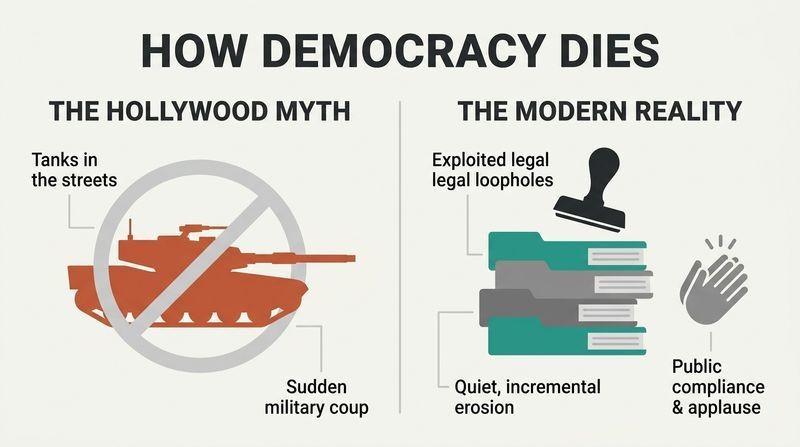
This framing echoes Levitsky and Ziblatt's How Democracies Die and Steven Levitsky's concept of competitive authoritarianism, where regimes hold elections they cannot lose. The strength of Hartmann's argument is its pattern recognition across Weimar, Caracas, and Budapest. The vulnerability is determinism: treating collapse as near-inevitable can breed the fatalism it warns against. Political scientist Kim Lane Scheppele, whom Hartmann cites, stresses that autocratic legalism succeeds precisely because citizens keep expecting a dramatic rupture that never comes. The boiling-frog metaphor is apt but incomplete, since real democracies also contain immune responses: courts, whistleblowers, and federalism that can slow the process.
A cold father taught Trump that empathy is fatal weakness
Hartmann builds a psychological autopsy rooted in Trump's childhood in a 23-room Queens mansion. His father Fred, described by niece and clinical psychologist Mary Trump as a high-functioning sociopath, drilled a zero-sum creed into his sons: you are a killer, you are a king. Winning was measured in headlines and square footage, never in happiness or contribution. His mother withdrew emotionally after a difficult childbirth. When gentler older brother Fred Jr. rejected the family business and later died of alcoholism at 42, the household treated it as moral failure rather than tragedy, cementing Donald's conviction that weakness is fatal. Sent to military school at 13, he read it as rejection and learned to dominate rather than cooperate.
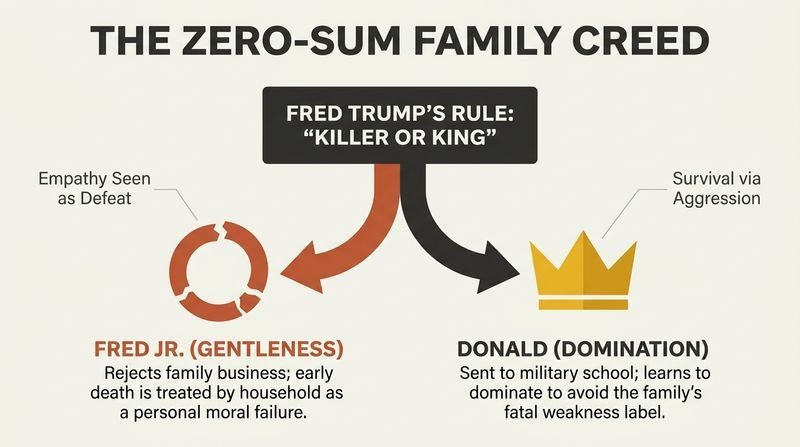
Attachment theory supports the throughline: emotionally unavailable caregiving correlates with grandiosity and difficulty with vulnerability. Yet armchair diagnosis of public figures is contested territory, and the American Psychiatric Association's Goldwater Rule exists precisely to discourage it. Hartmann leans heavily on Mary Trump, a relative with her own stake in the narrative, which readers should weigh. The deeper insight transcends one man: cultures and families that equate dominance with virtue reliably produce leaders who cannot compromise. The win-win versus win-lose distinction connects to game theory, where players trapped in zero-sum framing forfeit cooperative gains available to everyone.
Never apologize, always counterattack: the Roy Cohn operating manual
Before Trump had a party or a base, he had a mentor. Roy Cohn, the disbarred McCarthy henchman and mob lawyer, met the 27-year-old Trump in 1973 and taught him a playbook that would later scale to the presidency:
1. Never admit fault, ever
2. Counterattack harder than you were hit
3. Weaponize lawsuits to exhaust opponents, not to win
4. Manipulate media relentlessly, since accusations outlive retractions
5. Demand absolute loyalty
When the Justice Department sued Trump's company for refusing Black renters, Cohn advised countersuing the government for 100 million dollars and calling prosecutors racists. The suit was dismissed as frivolous, but the aggressive posture won the public relations war. Trump would eventually be party to over 3,500 lawsuits.
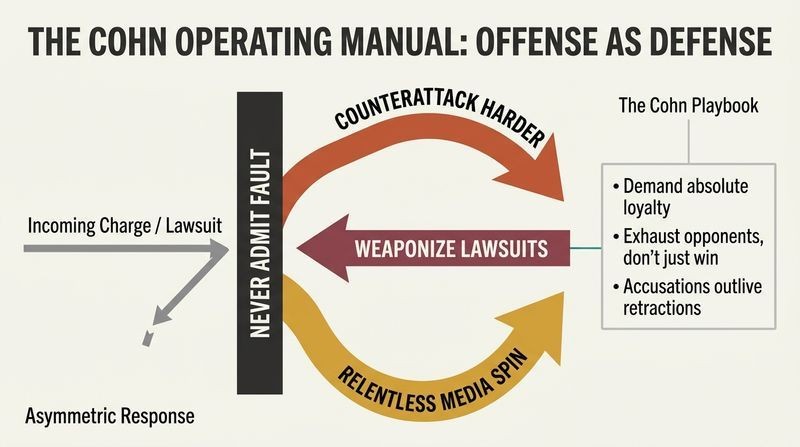
Cohn's doctrine is a distillation of what social psychologists call the backfire dynamic of denial: repeated bold assertion often beats sober correction because human memory encodes the claim more durably than the rebuttal. The tragic coda deepens the lesson. When Cohn was dying of AIDS, Trump reportedly dropped him, illustrating the transactional worldview's logical endpoint: people matter only while useful. There is irony worth noting. Cohn's tactics repeatedly produced short-term wins and long-term ruin (disbarment, death in disgrace). The playbook is not costless; it corrodes the institutions and relationships that ultimately protect its practitioner. Aggression without loyalty is a strategy that eventually runs out of allies.
Trump built a mask of success over a billion dollars in losses
Hartmann argues Trump's empire was a performance of wealth, not the real thing. A New York Times investigation found he received at least 413 million dollars (in today's dollars) from his father, much through dubious tax schemes, not the self-made fortune he claimed. IRS transcripts from 1985 to 1994 showed 1.17 billion dollars in business losses, more than nearly any other American taxpayer. He declared corporate bankruptcy six times. Trump Steaks, Trump Vodka, and the fraudulent Trump University (settled for 25 million dollars) all collapsed. Yet The Apprentice, ghostwriter-built books, and relentless self-promotion rebranded a serial failure as the ultimate winner. Ghostwriter Tony Schwartz admitted his famous phrase truthful hyperbole was simply a euphemism for lying.
This is the book's most documented chapter and its most quietly damning. The gap between perception and performance illuminates a broader media pathology: outlets that mistook charisma for competence and ratings for responsibility. Linguist George Lakoff's point about repetition strengthening neural pathways connects to research on the illusory truth effect, where familiarity is mistaken for accuracy. Worth interrogating: many genuinely wealthy heirs also inflate self-made mythologies, so the phenomenon is not unique to Trump. What distinguishes this case is scale and consequence. A brand built on projected invincibility became, in Hartmann's telling, a template for governing by spectacle, where the appearance of strength substitutes for the substance of it.
The GOP traded two centuries of principle for four years of power
Hartmann traces the Republican Party's transformation from Lincoln's antislavery founding to a grievance vehicle. Key stages:
1. Nixon's Southern Strategy courted white racial anxiety with coded language like law and order
2. Reagan launched his 1980 campaign near a civil rights murder site invoking states' rights and the welfare queen myth
3. Gingrich's 1990 memo instructed candidates to brand Democrats as traitors and sick
4. Fox News launched in 1996, creating a parallel fact universe
5. The Tea Party astroturf movement and post-2010 purges eliminated moderates
The Access Hollywood tape moment crystallized it: within 72 hours, Republicans who had denounced Trump crawled back because he was winning. Strategist Stuart Stevens concluded the abandoned principles simply were not deeply held.
The parasitic metaphor Hartmann uses (Trump as a fungus seizing the host's brain) is vivid but risks absolving individual actors of agency. A more precise account is offered by the strategist's own admission: the principles were performative all along. This aligns with political science on party sorting, where ideology increasingly follows tribal identity rather than the reverse. The counterpoint worth raising is that partisan realignment is a two-way street; scholars debate how much the Democratic coalition's own shifts accelerated white working-class defection. Still, the documentary record of GOP leaders privately calling Trump unfit while publicly genuflecting is a striking case study in collective moral abdication under competitive pressure.
Citizens United turned one dollar, one vote into one billionaire, one megaphone
Hartmann locates the machinery behind Trump in the 2010 Supreme Court ruling that let corporations and outside groups spend unlimited sums on elections. Outside spending exploded from 750 million dollars in 2008 to over 4.5 billion in 2016, with roughly 150 billionaire families providing more than 60 percent of Super PAC money. He profiles the new oligarchs: the Koch network, reclusive hedge-funder Robert Mercer (whose data firm Cambridge Analytica harvested 50 million Facebook profiles and whose loyalists Bannon and Conway took over Trump's flagging 2016 campaign), and casino magnate Sheldon Adelson. Their payoff was the 2017 Tax Cuts and Jobs Act, slashing corporate rates from 35 to 21 percent, which saved the Kochs an estimated 1.4 billion dollars a year.
Jimmy Carter's blunt verdict, quoted by Hartmann, that the system became an oligarchy with legalized bribery, is echoed by the landmark Gilens and Page study finding that average citizens have near-zero independent influence on policy while economic elites have substantial impact. That empirical backbone strengthens the argument considerably. A fair challenge: political scientists like Kenneth Mayer note that money's electoral effects are often overstated, since spending frequently follows viability rather than creating it. But Hartmann's sharper point is about agenda-setting and policy capture between elections, where the evidence for donor influence is much stronger than in vote-buying. The distinction matters for anyone diagnosing the disease correctly.
Authoritarian cruelty is not a bug, it is a profit center
Hartmann's Authoritarian Profit Model argues that hollowing out democracy pays specific beneficiaries. Its four levers:
1. Deregulation: over 100 environmental rules eliminated, saving corporations billions
2. Privatization: private prison firms GEO Group and CoreCivic earned over 1.3 billion dollars from ICE contracts in 2019, targeting 95 percent occupancy in detention facilities
3. Nationalism: manufactured enemies justify military and surveillance spending
4. Crisis exploitation: emergencies fast-track controversial policy
He opens with seven-year-old Jakelin Caal Maquin, who died in Border Patrol custody in 2018 while private-prison stocks climbed. During COVID, US billionaires gained over 1.1 trillion dollars even as more than a million Americans died, roughly half of those deaths unnecessary according to a Lancet analysis.
The framework extends Adam Serwer's phrase the cruelty is the point by adding a follow-the-money dimension: cruelty is also the payday. This resonates with Naomi Klein's shock doctrine thesis, where crises become windows for unpopular wealth transfers. The prison-quota detail is genuinely chilling and well-sourced to industry documents. Where the argument invites scrutiny is causation versus correlation. Billionaire wealth surged during COVID largely due to Federal Reserve asset inflation, a dynamic that predates and transcends Trump. Attributing it wholly to authoritarian design overstates coordination. The stronger, defensible claim is that once cruelty becomes profitable, powerful constituencies acquire a material stake in resisting reform.
Industrialized lying makes belief itself a loyalty test
Hartmann distinguishes Trump's lying from ordinary political deception. Nixon and Clinton lied defensively to cover misdeeds. Trump lied offensively as a governing tool, roughly 30,573 false or misleading claims over four years per the Washington Post, rising to 39 a day in his final year. The mechanism: getting supporters to affirm obvious falsehoods severs their tie to shared reality and binds them tighter to the leader. Believing the lie becomes an act of tribal identity. Birtherism was the prototype; the Big Lie about 2020 was the culmination. Cognitive science explains the durability through confirmation bias and the backfire effect, where debunking evidence is reinterpreted as proof of conspiracy, strengthening the false belief.
Timothy Snyder's line that post-truth is pre-fascism, and Hannah Arendt's observation that totalitarianism's ideal subject can no longer distinguish fact from fiction, give this real intellectual heft. The connection to identity-protective cognition (Dan Kahan's work at Yale) is precise: people process politically charged facts to protect group belonging, not to be accurate. One nuance Hartmann could stress more: the backfire effect itself has proven hard to replicate in recent research, and corrections often do work modestly. The more robust finding is that motivated reasoning makes correction unreliable, not impossible. That distinction matters enormously for anyone designing a counter-strategy against disinformation.
Praising dictators abroad is rehearsal for becoming one at home
Hartmann argues Trump's foreign policy imported authoritarian methods. At Helsinki in 2018 he sided with Putin over US intelligence agencies. He shielded Saudi Crown Prince Mohammed bin Salman after the CIA concluded MBS ordered journalist Jamal Khashoggi's murder, later boasting he saved him. He accepted North Korea as a nuclear power and admired Xi making himself president for life. The common thread among his favored strongmen is white Christian nationalism as cover for oligarchic economics, epitomized by Hungary's Orban, who dismantles democracy while claiming to defend Christian civilization. Corporate America tolerates this because autocrats crush unions, gut regulations, and slash taxes while granting immunity to those who fund the strongman.
The insight that admiration for foreign autocrats functions as ideological rehearsal is supported by Ruth Ben-Ghiat's research on strongmen, who study and borrow from one another across borders. The Orban-CPAC pipeline is a documented case of authoritarian policy transfer. The analysis is sharpest on the economic logic: authoritarian capitalism appeals to certain elites precisely because it removes the frictions democracy imposes. A useful counterweight is that American alliances with unsavory regimes long predate Trump (Hartmann concedes Nixon and Reagan did the same), which complicates the claim of unprecedented rupture. The novel element is less the alliances themselves than the dropping of the strategic-interest pretense in favor of open admiration.
Empathy is not sentimental softness, it is democracy's load-bearing wall
Hartmann, a former psychotherapist, argues democracy structurally depends on empathy and collapses without it. He cites that roughly 1.5 to 4 percent of people lack the capacity for empathy (clinically, sociopaths or psychopaths), yet they comprise about a third of prison populations and, by one estimate, around 21 percent of corporate CEOs. When that mindset captures governance, human suffering becomes a mere externality. He grounds the abstraction in Dwayne LaBrecque, a diabetic Maine father facing loss of heating assistance. The Constitution's Preamble invokes the general welfare, and anthropologist Margaret Mead identified a healed prehistoric femur as civilization's first sign, proof that early humans cared for their injured rather than abandoning them.
The healed-femur story, whether or not Mead said it exactly, encapsulates a real anthropological truth: human survival was cooperative, not solitary. This reframes empathy as evolutionary infrastructure rather than moral decoration, aligning with primatologist Frans de Waal's work on the biological roots of fairness and consolation in other species. Elon Musk's reported claim that empathy is Western civilization's fundamental weakness makes the ideological stakes explicit. The CEO-psychopathy statistic is popular but rests on limited studies and should be cited cautiously. The enduring argument holds regardless of exact percentages: a political system premised on human dignity cannot be run by people who experience others' pain as abstract.
Nonviolent movements succeed twice as often as armed ones
Against fatalism, Hartmann marshals evidence that authoritarians are routinely defeated. Political scientists Erica Chenoweth and Maria Stephan found nonviolent campaigns are more than twice as likely to succeed as violent ones, because they enable broad participation, make repression harder to justify, and split the loyalty of security forces. His examples:
1. South Koreans forced out two would-be authoritarian presidents through candlelight protests (2016 and 2024)
2. Chileans voted out Pinochet in his own 1988 referendum with the slogan joy is coming
3. Poles ended eight years of authoritarian rule in 2023 by uniting across ideological lines
His seven strategies include uniting across divides, protecting truth, practicing strategic nonviolence, and preparing for a marathon, not a sprint.
The Chenoweth-Stephan dataset is the most rigorous empirical anchor in the book, drawn from hundreds of 20th-century campaigns, and it genuinely reframes resistance as a practical craft rather than a moral gesture. Chenoweth's related 3.5 percent rule (no government has withstood sustained active participation by that share of the population) offers a concrete target. The honest caveat, which Chenoweth herself has noted in recent work, is that nonviolent success rates have declined in the past decade as regimes adapt with digital surveillance and disinformation. Hartmann's emphasis on protecting information ecosystems is therefore not optional garnish; it is the precondition that makes all the other strategies viable.
Regulate political AI now, before elections become predetermined rituals
Hartmann identifies artificial intelligence as the newest authoritarian weapon: power, scaled. A single system can generate millions of personalized manipulative messages instantly, populate fake news outlets with fake journalists, and enable surveillance modeled on China's facial-recognition and loyalty-scoring state. In 2024, AI-generated robocalls impersonating Joe Biden told voters to stay home. He warns of techno-feudalism, where elections still occur but outcomes are quietly engineered, and dissent is flagged by systems you cannot appeal. His proposed defenses:
1. Ban deepfakes in political ads
2. Mandate transparency for algorithmic decision-making
3. Build public, open-source alternatives to corporate models
4. Require social platforms to publish their algorithms
Pope Leo XIV, he notes, named AI a principal threat to human dignity.
This chapter is the book's most forward-looking and its most speculative. The concrete case (the fake Biden robocall) is real and prosecutable, which lends credibility. The broader techno-feudalism scenario borrows from Shoshana Zuboff's surveillance capitalism and Yanis Varoufakis's writing on platform power, both of which argue that unaccountable algorithmic control erodes the informational commons democracy requires. The regulatory proposals are sensible but face a coordination problem Hartmann underplays: AI development is global, so unilateral national bans risk simply relocating capability rather than containing it. The strongest element is the framing of algorithmic transparency as a democratic survival issue rather than a mere consumer-protection footnote.
Analysis
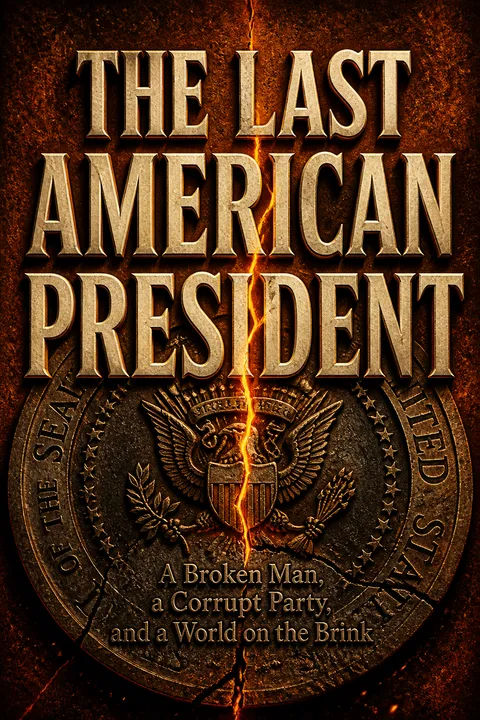
The Last American President is a work of political jeremiad, blending memoir, biography, systems analysis, and activist manual. Hartmann, a veteran progressive broadcaster, structures the book in four movements: the psychological making of Trump, the machinery (party, plutocrats, media, disinformation) that produced him, the global and domestic damage, and a closing call to resistance. Its rhetorical engine is the recurring refrain that democracies die gradually, through legal erosion rather than dramatic coup.
The book's greatest strength is synthesis. Hartmann connects individual psychology to institutional decay to global authoritarian trends with a fluency few polemicists achieve, and his best chapters (the Cohn playbook, the mask of business failure, the Citizens United machinery) rest on solid documentary reporting. He wisely insists Trump is symptom, not disease, directing attention to the campaign-finance rulings, media consolidation, and donor networks that would outlast any single figure. The empathy argument, grounded in his clinical background and in anthropology, is unusually thoughtful for the genre.
The weaknesses are those of advocacy writing. The tone is unrelentingly alarmist, which can flatten nuance and preach mainly to the converted. Some claims (the CEO-psychopathy figure, the wholesale attribution of pandemic billionaire gains to authoritarian design, portions of the 2024 stolen-election chapter) rest on contested or thin evidence presented with more certainty than warranted. The armchair psychoanalysis, however compelling, violates professional norms and relies heavily on an interested relative. Hartmann's determinism about collapse sits in tension with his own inspiring evidence that authoritarians are regularly defeated.
Read critically, the book delivers genuine value: a coherent map of how money, media, grievance, and personality can converge to threaten self-governance, paired with an empirically grounded (via Chenoweth and Stephan) argument that ordinary citizens hold the decisive power. Its enduring lesson is that democracy is not a possession but a practice, requiring active daily defense rather than passive faith in institutions to defend themselves.
Review Summary
The Last American President by Thom Hartmann examines Donald Trump's rise as an inevitable product of systemic failures rather than an anomaly. Reviews are mixed but lean positive (4.49/5). Supporters praise its comprehensive analysis of Trump's psychology, Republican Party corruption, and documented voter suppression in 2024. Critics note repetitive writing, lack of new insights for informed readers, and possible AI-generated prose. Many find Chapter 8's voter suppression data particularly compelling. Some fault insufficient critique of Democratic complicity and American exceptionalism. Readers value its accessibility for those less familiar with Trump's history.
People Also Read




Download PDF
Download EPUB
.epub digital book format is ideal for reading ebooks on phones, tablets, and e-readers.








































