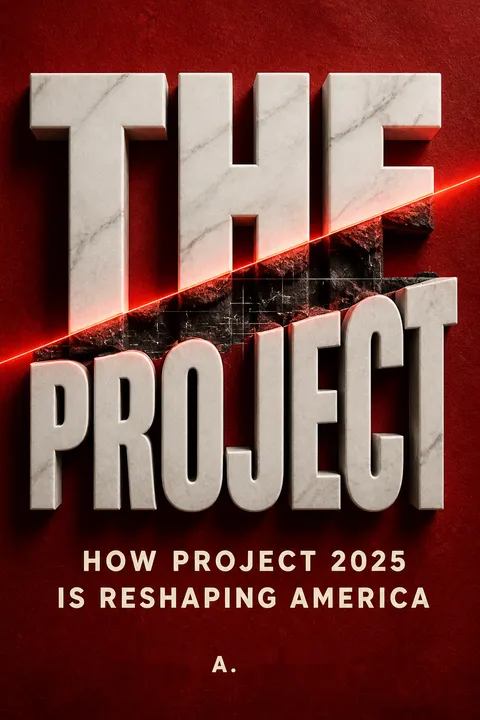

Key Takeaways
1. Project 2025: A Radical Blueprint for a Second Trump Term
Project 2025 is a skeleton key for understanding the second Trump presidency—as well as the future of the Republican Party and the American right.
A comprehensive plan. Project 2025, spearheaded by the Heritage Foundation and former Trump administration officials like Paul Dans and Russell Vought, is a meticulously crafted strategy to fundamentally transform the U.S. government and society during a potential second Trump presidency. Convinced that Trump's first term was "sabotaged" by internal resistance and that the 2020 election was "stolen," its proponents believe the existing constitutional order is broken, necessitating radical action.
Four core goals. The project outlines four ambitious objectives:
- Restore the family as the centerpiece of American life and protect children.
- Dismantle the administrative state and return self-governance.
- Defend national sovereignty, borders, and bounty against global threats.
- Secure God-given individual rights, or "the Blessings of Liberty."
These goals hint at a vision far beyond typical conservative policy, aiming for a "second American Revolution" that would remain "bloodless if the left allows it to be."
Beyond policy proposals. Unlike typical pre-election documents, Project 2025 is a detailed operational manual. It includes a vast database of potential hires (over 10,000 names), extensive training courses for aspiring staffers, and a playbook for a rapid, Day One takeover of the government. This meticulous preparation ensures that a new administration, particularly one led by Donald Trump, can immediately implement its agenda, bypassing the "shambolic improvisation" of his first term.
2. Dismantling the Administrative State and Expanding Presidential Power
Project 2025 is a scheme to massively expand the power of the president.
Centralizing authority. At its core, Project 2025 seeks to dramatically centralize power within the presidency, viewing the existing federal bureaucracy—the "administrative state"—as an unelected fourth branch of government that obstructs the will of the voters. The plan aims to overcome this perceived obstruction by enabling the president to:
- Stock the executive branch with ideologically aligned political appointees.
- Fire career civil servants at will.
- Discard the historical impartiality of the Justice Department.
- Attack the statutory independence of agencies like the Federal Communications Commission.
- Seize powers traditionally held by Congress.
"Destroy the village to save it." This approach is rooted in a "nihilistic view" that the American system is so "rotten" it needs to be "burned down" to be saved. Proponents argue that the only way to reverse the perceived politicization of the executive branch is to further politicize it, ensuring that all government functions align with the president's agenda. This radical shift is framed as a defense of the Constitution, despite its clear intent to bypass traditional checks and balances.
A "post-constitutional moment." Key figures like Russell Vought believe the U.S. is in a "post constitutional moment," where existing institutions no longer reflect the "words on the paper." This conviction justifies "radical" actions to "discard or rethink the legal paradigms" that limit presidential power. The goal is to "identify the pockets of independence and seize them," transforming the government into a direct instrument of the president's will.
3. Weaponizing the Bureaucracy: OMB and DOJ as Tools of Control
What we’re trying to do is identify the pockets of independence and seize them.
OMB as air-traffic control. Project 2025 elevates the Office of Management and Budget (OMB) from a traditionally "dull" budget office to a powerful instrument for enforcing presidential priorities across the executive branch. Russell Vought, a key architect, believes OMB "has the only statutory tools in the White House that are powerful enough to override implementing agencies’ bureaucracies," ensuring policies are not "stillborn" due to bureaucratic resistance.
Impoundment power. A critical tactic involves aggressively using impoundment—the presidential refusal to spend congressionally appropriated funds. Project 2025 advocates for challenging the 1974 Impoundment Control Act, which requires congressional approval for impoundment, potentially through direct violation and Supreme Court appeal. This would drastically reduce Congress's constitutional spending power, allowing the president to nullify legislative decisions.
Politicizing the Justice Department. The plan aims to strip the Department of Justice (DOJ) of its semi-independent status, integrating it tightly with the president's policy agenda. This includes:
- Eliminating rules that insulate the White House from DOJ communications.
- Directing litigation decisions to align with the president's agenda.
- Bringing the FBI "to heel" by eliminating the director's ten-year term and ensuring no circumvention of the Attorney General.
This transformation would turn the DOJ into a "partisan cudgel," capable of investigating critics and enforcing the president's will, raising clear dangers of political warfare.
4. Reshaping the Federal Workforce: Loyalty Over Expertise
We want the bureaucrats to be traumatically affected. When they wake up in the morning, we want them to not want to go to work because they are increasingly viewed as the villains.
Recruiting true believers. Project 2025 aims to staff the executive branch with ideologically committed individuals, moving beyond the "clueless and lazy" appointees of Trump's first term. A database of over ten thousand potential hires, including those "who’ve been cancelled" or "given blood for the movement," has been compiled, alongside training courses like "Conservative Governance 101" to prepare them for government work.
Dismantling the civil service. The plan seeks to convert approximately fifty thousand career civil service jobs, deemed "policy-related," into political appointments under a revived "Schedule F" executive order. This would allow the president to fire these employees at will, bypassing traditional merit-based protections. The goal is to replace a professionalized civil service, perceived as leaning Democratic and resistant to change, with a workforce loyal to the MAGA agenda.
"Traumatizing" bureaucrats. Beyond reclassification, the strategy includes intimidating existing civil servants. Russell Vought explicitly stated the desire to "traumatically affect" bureaucrats, making them feel like "villains" and encouraging them to quit. This approach prioritizes ideological alignment over expertise, risking a significant loss of institutional knowledge and competence, as seen in agencies like the CDC, where failures of expertise, not ideology, were highlighted during the pandemic.
5. Reimagining American Society: Christian Nationalism and Traditional Family Values
Our Constitution grants each of us the liberty to do not what we want, but what we ought.
A Christian nation. Project 2025 explicitly advocates for an America governed by fundamentalist Christian principles, defining freedom not as individual autonomy but as the liberty "to do what we ought." This vision prioritizes the "biblically based" traditional family—a married man, woman, and gender-conforming children—as the "centerpiece of American life," influencing policies from education to labor law.
Banning abortion and policing sex. The plan's number-one priority is to ban abortion nationwide, viewing the Dobbs decision as "just the beginning." Key proposals include:
- Banning abortion drugs via telehealth and mail, enforcing the 1873 Comstock Act.
- Aggressive government surveillance of abortions, including out-of-state procedures.
- Defunding Planned Parenthood and restricting VA abortion access.
- Aligning federal medical research with pro-life goals and promoting abstinence-only education.
- Outlawing pornography and imprisoning its producers and distributors.
Erasing trans rights and traditional gender roles. Project 2025 seeks to eliminate the existence of trans and nonbinary people from federal language and policy. This involves:
- Rescinding anti-discrimination rules based on sexual orientation and gender identity.
- Defining "sex" as biological at birth under Title IX.
- Banning federal funds for gender-affirming care for minors and discontinuing VA gender-reassignment surgery.
- Promoting policies that reinforce men as breadwinners and women as mothers, with tax incentives for marriage and in-home childcare.
Ending public education as we know it. The ultimate goal for education is the elimination of the federal Department of Education and the end of public schooling. The plan proposes:
- Promoting school vouchers and savings accounts for private or religious schools.
- Ending Head Start and loosening restrictions on charter schools.
- Sending federal education funding to states as block grants with "full control," likely leading to vast disparities and religiously-based curricula.
- Slashing federal financial aid and rescinding student debt forgiveness.
6. Fortress America: Drastic Reductions in Immigration and Border Enforcement
The U.S. immigration system is, by almost universal agreement, badly broken.
Sealing the border. Project 2025 aims to drastically reduce both legal and illegal immigration, transforming the U.S. into a "much harsher and less hospitable" nation. It proposes a "Title 42-like authority" triggered by a "loss of operational control of the border," allowing the summary turning away of asylum seekers. Other measures include raising asylum standards and reducing visas for crime victims.
Reorganizing DHS for enforcement. The plan suggests abolishing the Department of Homeland Security (DHS) to create a single agency solely focused on immigration enforcement, or consolidating Immigration and Customs Enforcement (ICE) and Customs and Border Protection (CBP). This reorganization would prioritize immigration above other DHS functions like disaster relief (FEMA), which would see its role diminished and burdens shifted to states.
Mass deportations and reduced legal pathways. The administration would pursue mass deportations by:
- Removing Temporary Protected Status and limiting "parole" authority.
- Expanding "expedited removal" nationwide, risking deportation of lawful residents without due process.
- Limiting the use of bond for apprehended immigrants and funding huge new detention facilities.
- Eliminating "sensitive location" protections for ICE arrests (schools, hospitals, churches).
- Making E-Verify mandatory for all private companies.
- Weaponizing federal grants to compel state and local law enforcement cooperation with ICE.
Military involvement and economic impact. The plan advocates deploying active-duty military for arrest operations at the border, challenging the Posse Comitatus Act. It also seeks to reduce legal immigration by narrowing H-2A and H-1B visas and suspending visas from non-cooperative countries. While promising to curb inflation, mass deportations could cripple immigrant-dependent sectors like agriculture and construction, potentially driving costs higher and causing economic harm.
7. Economic Overhaul: Tax Cuts, Trade Wars, and Tech Regulation
The biggest divisions within the American right today are over how to manage the economy—or whether to manage it at all.
Tax cuts for the wealthy. Project 2025 advocates for significant tax cuts, particularly benefiting high earners and corporations. Proposals include:
- Simplifying the income tax system from seven brackets to two.
- Taxing capital gains and dividends at a flat 15 percent.
- Reducing the corporate income tax from 21 percent to 18 percent.
In the long run, the plan suggests shifting to a consumption tax (like a national sales tax), which would be more regressive, disproportionately affecting lower earners.
Protectionism and trade wars. The document reveals internal conservative divisions on trade, with some advocating for aggressive tariffs, particularly against China. Peter Navarro, a Trump advisor, proposes tariffs high enough to stop Americans from buying Chinese products and financial incentives to reshore factories. Critics within Project 2025 argue that tariffs act as a tax on American consumers, raising prices and benefiting only "special interests."
Regulating Big Tech and financial markets. Project 2025 is largely antagonistic towards Big Tech, advocating for banning apps like TikTok and WeChat. It proposes that the FCC regulate platforms for "censorship" by narrowly interpreting Section 230 of the Communications Decency Act, potentially compelling speech from private companies. In financial regulation, the plan seeks to repeal key sections of the Dodd-Frank Act, dismantle the Consumer Financial Protection Bureau, and aggressively combat ESG (environmental, social, and governance) investing, a reversal of traditional free-market principles.
Federal Reserve and labor policy. The plan aims to reduce the Federal Reserve's power, focusing its mandate solely on price stability and eventually advocating for its abolition in favor of a commodity-backed currency (gold standard) or "free banking," which could be incredibly destabilizing. On labor, it seeks to empower workers without endorsing unions, loosening child labor laws in hazardous jobs, and classifying gig workers as contractors, reducing company responsibility.
8. Undoing Environmental Protections and Unleashing Fossil Fuels
Stop the war on oil and natural gas.
Dismissing climate change. Project 2025 operates from a perspective that largely dismisses the scientific consensus on climate change, referring to warnings as coming from the "climate change alarm industry." It expresses effectively no concern for greenhouse gas emissions, rising sea levels, extreme weather, or chronic droughts, instead framing environmental regulations as an "unprovoked war on fossil fuels."
Dismantling climate initiatives. The plan calls for a sweeping reversal of federal climate efforts, including:
- Closing the White House Office of Domestic Climate Policy.
- Withdrawing all climate-change-related work from USAID.
- Pulling federal funding for carbon capture research.
- Calling for the wholesale liquidation and privatization of the National Oceanographic and Atmospheric Administration (NOAA), including its weather forecasting services, due to its "climate alarmism."
- Repealing or chipping away at Biden's Bipartisan Infrastructure Law and Inflation Reduction Act.
Promoting fossil fuel dominance. The core energy vision is a massive push to aid the fossil fuel industry. This includes:
- Expanding leases for oil and gas drilling on federal lands, including the Arctic National Wildlife Refuge.
- Expediting approvals and permits for fossil fuel projects.
- Encouraging natural gas exports and pipeline construction.
- Reducing oversight of the coal industry.
The plan views environmental advocates as "special interests" while treating oil and gas companies as needing government protection and encouragement.
Anti-electric vehicle stance. Project 2025 reserves particular animus for electric vehicles (EVs), arguing they increase dependence on China for rare earth minerals and strain the power grid. It seeks to reverse EV subsidies, lower fuel economy standards for traditional cars, and shift control of these standards from the EPA to the Department of Transportation. The plan also advocates for loosening environmental regulations across the board, from PFAS chemicals to the Clean Water Act and the Endangered Species Act.
9. A Politicized National Security: Confronting China and Purging "Wokeness"
By far the most significant danger to Americans’ security, freedoms, and prosperity is China.
A new Cold War mindset. Project 2025 envisions the U.S. fighting a two-front war: containing China's global expansion and purging "progressivism and 'wokeness'" from the State Department, Pentagon, and Intelligence Community (IC). This approach signals a return to a Cold War mentality, where the nation must be ideologically mobilized to counter an existential threat, requiring a political purge within the national-defense establishment.
Military expansion and modernization. To confront China, the plan recommends:
- Expanding the armed forces to fight and win two major regional wars simultaneously.
- Significantly increasing defense spending.
- Modernizing and expanding the American nuclear arsenal.
- Ramping up the purchase of F-35A fighter jets.
- Making the military available to police the U.S. border, challenging the Posse Comitatus Act.
Diplomacy as a weapon. The State Department and foreign aid (USAID) would be retooled as instruments of American strategic policy. This includes ruthlessly slashing funding for international bodies that don't align with U.S. policy and ensuring foreign aid serves American interests. The plan acknowledges internal conservative divisions on Russia and Ukraine but emphasizes strengthening NATO and weakening Putin.
Purging "wokeness" and ensuring loyalty. The authors believe that "progressivism" is a "cancer" weakening the U.S. against China. This leads to calls for:
- A "Vindman provision" to remove nonessential detailees from the National Security Council and replace them with loyalists.
- Rigorous review of general and flag officer promotions to prioritize "warfighting prowess" over "social engineering" (e.g., climate change, critical race theory, DEI).
- Abolishing DEI offices, reinstating vaccine-refusing service members, and expelling trans and HIV-positive personnel.
- Ensuring the State Department and IC are politically controlled, suppressing dissenting views, and summarily firing leakers, despite claims of protecting against "politicization."
10. Eroding Checks and Balances: A "Post-Constitutional Moment"
The MAGA movement seeks to consolidate power with Trump, erode checks and balances from Congress, degrade expertise, and remove anyone who might object to violations of the rule of law.
Systemic collapse from within. Project 2025 represents a deliberate strategy to fundamentally alter the structure of American governance, not through overt authoritarianism, but by quietly collapsing the system from within. By centralizing power in the presidency, politicizing key executive agencies, and replacing experienced civil servants with loyalists, the plan aims to remove traditional checks and balances and ensure unquestioning adherence to the president's agenda.
A terrifying conclusion. The architects of Project 2025, particularly Russell Vought, openly declare that the U.S. is in a "post constitutional moment," justifying radical departures from established legal and governmental norms. This belief underpins the willingness to challenge long-standing laws like the Impoundment Control Act and the independence of the Justice Department, effectively nullifying congressional authority and judicial oversight.
Consequences for democracy. The cumulative effect of Project 2025's proposals would be a significant degradation of democratic institutions and the rule of law. By prioritizing ideological loyalty over expertise, intimidating dissent, and weaponizing government agencies, the plan risks creating a system where accountability is diminished, civil liberties are curtailed, and the government serves primarily the political aims of the executive, rather than the broader public interest.
People Also Read




Download PDF
Download EPUB
.epub digital book format is ideal for reading ebooks on phones, tablets, and e-readers.








































