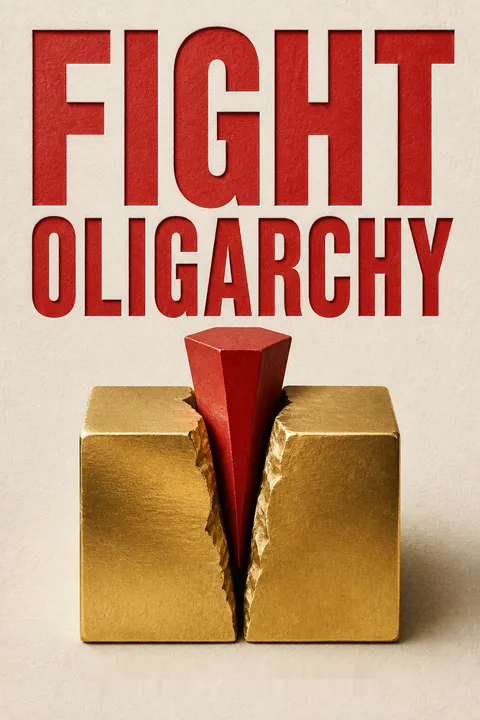

Key Takeaways
1. Oligarchy: A System of Extreme Wealth and Power Concentration
Oligarchy is a system in which a small number of extremely wealthy individuals control the economic, political, and media life of a nation.
Defining Oligarchy. This system, increasingly dominating countries worldwide, means ordinary people have minimal power over their nation's future. In America, this translates to unprecedented income and wealth inequality, where the rich thrive while the middle class struggles and the poor live in desperation. This stark contrast highlights a fundamental imbalance of power.
Staggering Inequality. The wealth disparity is shocking: one man, Elon Musk, owns more than the bottom 52% of American households combined, and the top 1% possess more wealth than the bottom 93%. CEOs of large corporations earn 350 times more than their average employee, illustrating a system rigged to benefit a tiny elite. This extreme concentration of wealth is a defining characteristic of oligarchy.
Concentrated Ownership. Beyond individual wealth, a handful of giant corporations control vast sectors of the economy, from agriculture to transportation, finance, energy, and tech. This consolidation means a few multinational entities dictate production, employee treatment, and consumer prices. For example, just three Wall Street firms—Vanguard, BlackRock, and State Street—are major shareholders in 95% of S&P 500 corporations, exerting significant influence over the entire economy and making accountability opaque.
2. America's Oligarchic Reality: Control Over Economy, Media, and Politics
Oligarchy today has not only produced unprecedented income and wealth inequality. It has not only created an unprecedented concentration of ownership. It has also given us an extremely corrupt political system that is heavily dominated by billionaires and their super PACs.
Media Manipulation. The media, meant to inform objectively, is largely controlled by a handful of international conglomerates and billionaires. This ownership dictates what issues receive airtime, often sidelining concerns of the working class or serious analyses of wealth and power. For instance, topics like universal healthcare or the growing rich-poor gap are rarely discussed, as they are not of great interest to the billionaire owners.
Corrupt Politics. The political system is deeply corrupted by billionaire money, especially since the 2010 Citizens United Supreme Court decision. This ruling allowed unlimited spending on political campaigns, leading to a 1,600% increase in political spending. In the 2024 election, 100 billionaire families spent $2.6 billion, effectively turning elections into contests of billionaire-controlled super PAC ads rather than ideas.
Legislative Influence. Billionaire influence extends directly into the legislative process. Republicans in Congress, for example, passed Trump’s "Big Beautiful Bill," providing $1 trillion in tax breaks to the top 1% while making massive cuts to essential programs like Medicaid and education. Members of Congress who dared to oppose such legislation faced threats from oligarch-funded super PACs, demonstrating how billionaires dictate policy and punish dissent.
3. Trump's Authoritarian Oligarchy: Betrayal of the Working Class
At Trump’s inauguration I was witnessing, up front, a very different vision of government. It was a government of the billionaire class, by the billionaire class, for the billionaire class.
Billionaire Cabinet. Trump's second inauguration showcased his vision: the three wealthiest men in America—Elon Musk, Jeff Bezos, and Mark Zuckerberg—stood behind him, alongside thirteen other billionaires nominated to head federal agencies. This signaled a government explicitly designed to serve the interests of the ultra-rich, a stark contrast to Abraham Lincoln's "government of the people, by the people, for the people."
Kleptocracy and Special Deals. Trumpism is fundamentally about wealth and power for the demagogue and his allies. His "Big Beautiful Bill" transferred over a trillion dollars to the top 1% and large corporations, marking the largest wealth transfer in modern American history. Beyond this, Trump and his family have personally profited immensely, accepting gifts like a $400 million luxury jet from Qatar and establishing his own crypto coin, while his son-in-law received a $2 billion investment from Saudi Arabia.
Dismantling Worker Protections. Trump's administration aggressively pursued an anti-union agenda, effectively shutting down the National Labor Relations Board (NLRB) and illegally breaking several major federal trade unions. By firing tens of thousands of federal employees, he signaled to corporate CEOs that workers' rights need not be respected. This aligns with the oligarchs' goal of privatizing federal programs like Social Security and Medicare, turning public services into profit opportunities.
4. The Roots of Trumpism: Democratic Failures and Working-Class Despair
Donald Trump filled the political vacuum that the Democrats created.
Democratic Neglect. Trump's rise is directly linked to the Democratic Party's long-standing neglect of America's working class. While party leaders focused on fundraising from the wealthy, millions of working families experienced despair and political isolation. Trump, unlike many Democrats, understood the economic system was broken for the majority and capitalized on this widespread disillusionment.
Economic Hardship. Despite technological advancements and increased worker productivity, the average American worker earns less today than in 1973, adjusted for inflation. This stagnation, coupled with a $79 trillion wealth transfer from the bottom 90% to the top 1% over fifty years, has created immense pain and anger.
- 60% of Americans live paycheck to paycheck.
- Nearly half of older workers have no retirement savings.
- High rates of childhood poverty persist.
- 800,000 Americans are homeless.
- 85 million are uninsured or underinsured.
Diseases of Despair. The cumulative effect of low wages, inadequate healthcare, housing insecurity, and unaffordable food has led to "diseases of despair." People succumb to drugs, alcohol, obesity, or suicide due to unbearable stress and a loss of hope. The bottom 50% of society now live, on average, seven fewer years than the top 1%, a stark indicator of systemic failure and the human cost of economic inequality.
5. Global Oligarchy: Billionaires Win, the World Suffers
Today, a tiny handful of the richest people on Earth have extraordinary power over the lives of billions of inhabitants in virtually every country on Earth.
Worldwide Phenomenon. The rapid ascent of oligarchy, extreme inequality, and authoritarianism is a global reality, not confined to America. A few thousand multibillionaires now wield extraordinary power, influencing governments and shaping policies worldwide, often prioritizing their own wealth and power over national allegiances or the well-being of billions.
Hidden Wealth and Greed. Document leaks like the Paradise, Panama, and Pandora Papers reveal trillions hidden in offshore tax havens, highlighting a staggering scale of money laundering and tax avoidance by the world's richest. While governments struggle to fund public services, these oligarchs evade their fair share of taxes, embodying a value system where money is their god and greed is paramount.
- $12 trillion in private wealth hidden offshore.
- Top 1% own more wealth than the bottom 95% of humanity.
- Five richest people tripled their wealth to $1.34 trillion in five years.
- 3,000 billionaires own more wealth than the GDP of every country except the US and China.
Exploitation and Suffering. Across continents, from Russia's kleptocratic regime to the opulent monarchies of the Middle East and the concentrated wealth in India and Mexico, the pattern is consistent: immense wealth for a few, built on the exploitation of impoverished labor and vast natural resources, while billions live in extreme poverty, lacking basic necessities. This global system perpetuates suffering and undermines human dignity, as Pope Francis noted, creating a "dictatorship of an economy which is faceless and lacking any truly humane goal."
6. Lessons from History: Ordinary People Can Overcome Entrenched Power
It always seems impossible until it is done.
Power of Collective Action. History repeatedly demonstrates that ordinary people, united by courage, intelligence, hard work, and discipline, can overcome daunting crises and entrenched injustices. The political establishment's goal is to foster a sense of powerlessness, but resistance is not hopeless. When people stand together, they win; when divided, they lose.
Historical Victories:
- American Revolution: Thirteen struggling colonies defeated the most powerful monarchy in the world, driven by a vision of equality and liberty.
- Abolitionist & Civil Rights Movements: Despite immense opposition and violence, slavery was abolished, and Jim Crow segregation was dismantled through mass mobilization and civil disobedience.
- Workers' Rights: Trade unionists fought brutal conditions, leading to the eight-hour workday, end of child labor, safer conditions, minimum wage, and the creation of a vibrant middle class.
- Women's Rights: Suffragists, facing ridicule and sexism, won the right to vote and broke down barriers to equality.
- Free Public Education: Working-class movements established free public schools and higher education for all, regardless of income.
- LGBT Rights: Decades of persecution culminated in the Stonewall rebellion and widespread activism, leading to the legalization of gay marriage.
Enduring Truth. As Frederick Douglass famously stated, "Power concedes nothing without a demand. It never did and it never will." The limits of tyrants are prescribed by the endurance of those they oppress. These historical struggles serve as powerful reminders that fundamental change is possible when people refuse to quietly submit to injustice and actively fight back.
7. Fighting Back: Building a Grassroots Movement Against Oligarchy
The most powerful tool the ruling class has to protect their interests is to make ordinary people feel powerless.
Overcoming Powerlessness. The "Fighting Oligarchy" tour, launched in January 2025, aimed to counter the narrative that resistance is hopeless. By bringing together thousands of Americans in both red and blue states, the tour demonstrated that a significant portion of the population is ready to fight back against oligarchy, authoritarianism, and the war on the working class. The passionate response, with huge turnouts, proved that people instinctively understand the problem of extreme inequality.
Broad Appeal. The rallies attracted diverse attendees, with a significant portion not on traditional progressive lists, including Independents and Republicans. This indicated a widespread outrage at the status quo in Washington. Events in places like Omaha, Nebraska, and Kenosha, Wisconsin, showed that the message resonated even in conservative areas, especially when directly confronting billionaire influence in local elections, like Elon Musk's spending in a Wisconsin Supreme Court race.
Building Momentum. The tour, featuring figures like Alexandria Ocasio-Cortez, strategically targeted Republican districts to pressure incumbents and lay groundwork for future elections. Beyond rallies, the initiative focused on building a sustained movement:
- Following up with attendees to encourage political involvement.
- Hiring full-time organizers in key states for town halls, canvasses, and call-in campaigns.
- Mobilizing thousands of volunteers through email and online training.
- Mentoring over 7,000 people to run for office at local, state, and national levels, with nearly half running as Independents.
- Endorsing and assisting progressive candidates, including Zohran Mamdani's surprising victory for NYC mayor, proving that grassroots campaigns can defeat entrenched power.
8. Trump's Economic Betrayal: Policies That Harm His Supporters
While Trump carried through on some campaign promises, on the most important economic issues facing working families he did exactly the opposite of what he proposed.
Broken Promises. Despite campaigning as a "change candidate" and promising to fight for the working class, Trump's policies, particularly his "Big Beautiful Bill," actively harmed his supporters. He delivered on some social issues like immigration, but on core economic concerns, he betrayed millions, making life harder for working families.
Key Betrayals in the "Big Beautiful Bill":
- Tax Breaks for the Rich: Gave $1 trillion in tax breaks to billionaires and $900 billion to large corporations, not the working class.
- Healthcare Cuts: Implemented the largest cuts to Medicaid in history, removing 15 million low-income Americans from health insurance and raising premiums for 20 million others.
- Reduced Access to Care: Cut funding for community health centers, rural hospitals, and nursing homes, further limiting healthcare access.
- Nutrition and Education Cuts: Eliminated free school meals for up to 16 million low-income children and doubled student loan payments for millions.
Beyond the Bill. Trump's betrayals extended to other critical areas:
- Social Security: Shut down field offices, fired 7,000 employees, and made it harder for seniors and the disabled to access benefits, despite falsely claiming massive fraud.
- Veterans Affairs: Proposed firing 83,000 VA workers, undermining care for those who defended the country.
- Education System: Advocated for a $50-billion-a-year voucher program, creating a two-tier system favoring private schools for the wealthy.
- Worker Rights: Effectively shut down the NLRB, giving corporations free rein to bust unions, and eliminated collective bargaining rights for over a million civil servants.
9. Rethinking National Values: Beyond Greed and Self-Interest
We need to question the fundamental moral values that underlie the dominant behavior in our society today.
Moral Crisis. The current state of extreme inequality and suffering demands a fundamental re-evaluation of America's moral values and national priorities. It is morally unacceptable that a few billionaires hoard wealth while millions go hungry, are homeless, or die due to lack of healthcare. The question arises: how much wealth is enough, and when does greed become a national religion?
Challenging Dominant Narratives. Society must confront the notion that "greed is good" or that life is merely about the "survival of the fittest." This means questioning why those who "lie, cheat, and steal their way to the top" are often respected, while essential workers like kindergarten teachers are undervalued. The current system prioritizes profit over people, leading to a breakdown in community and emotional well-being.
Redefining National Goals. The nation needs to shift its focus from oligarchic enrichment to collective well-being. This involves:
- Healthcare: Moving from the shortest life expectancy among wealthy nations to guaranteeing healthcare for all and making prescription drugs affordable.
- Military Spending: Reallocating a bloated $1 trillion military budget to address child and senior poverty, recognizing children as the most precious resource.
- Climate Change: Transitioning from fossil fuel dependence to a global effort for sustainable energy.
- Economic Justice: Choosing to be a vibrant democracy that ensures economic well-being for all, rather than a nation led by oligarchs.
10. A Progressive Path Forward: Policies for Economic Well-being for All
This is not utopian thinking. This is doable, and exactly what we should be fighting for.
Defend and Expand Democracy. To create a society where everyone has a decent standard of living, the first step is to reclaim democracy. This means ending the corrupt campaign finance system by overturning Citizens United and abolishing super PACs, ensuring "one person, one vote." It also requires automatic voter registration, ending gerrymandering, and moving towards public funding of elections. Electoral college reform is also crucial to ensure the popular vote winner takes office.
Economic Justice and Revenue. A fair and progressive tax system is essential, demanding that the wealthiest individuals and large corporations pay their fair share, including a tax on extreme wealth. Simultaneously, significant cuts to the bloated $1 trillion military budget, which is more than the next ten nations combined, can free up tens of billions for social needs. The benefits of new technologies like AI and robotics must flow to all, not just the wealthy, through a reduced 32-hour workweek with no loss in pay, profit sharing, and a tax on automation to support impacted workers.
Guaranteeing Basic Human Needs:
- Medicare for All: A single-payer system would save $650 billion annually, provide quality care for all, and cut prescription drug costs by half.
- Quality Education: Tuition-free public colleges, student debt cancellation, high-quality childcare, and expanded apprenticeship programs.
- Affordable Housing: Expanding the National Housing Trust Fund to build 4 million affordable units, capping rent prices, and stopping Wall Street speculation.
- Improved Wages and Benefits: Passing the PRO Act to strengthen unions, raising the minimum wage to at least $17/hour, guaranteeing paid family and medical leave, expanding Social Security benefits, bringing back defined benefit pensions, and encouraging employee ownership.
11. The Political Revolution: Reclaiming Democracy Through Active Involvement
Democracy is not a spectator sport. It’s not a football game. It’s not a movie. It’s not a concert. It’s a living process that does not work unless you—yes you—are involved.
Beyond Spectatorship. The current dangerous reality demands an unprecedented level of citizen involvement. Americans must reclaim democracy from the ground up, activating millions in a political revolution. It's crucial to understand that personal involvement is the only way to counter the oligarchs and their paid representatives who seek to determine the future.
Diverse Forms of Involvement. Political engagement extends beyond running for office, though electing dedicated progressive officials at all levels is vital. Campaigns thrive on volunteers and staff, offering opportunities for satisfaction and joy in local change. The "Fighting Oligarchy" campaign is actively mentoring thousands to run for office, with many choosing to run as Independents due to concerns about the Democratic Party.
Empowering the People. If running for office isn't an option, there are countless other ways to contribute:
- Volunteer: Join campaigns, make calls, canvass door-to-door, or organize events.
- Advocate: Demand town hall meetings from elected officials, distribute literature, and educate neighbors.
- Protest: Participate in demonstrations and call-in campaigns to target specific legislation or policies.
- Community Organizing: Get involved in local fights important to organized labor or other progressive causes.
The goal is to empower people to understand their views are not fringe but part of a majority demanding a government and economy that works for all, not just the few. This collective action is the essence of a political revolution.
Review Summary
Fight Oligarchy receives a 4.36/5 rating across 922 reviews. Readers appreciate Sanders' consistent advocacy for the working class and his concise, accessible format—a pocket-sized book completed in 2-3 hours. Many praise the inspiring message of solidarity and historical examples of successful resistance movements. Common criticisms include lack of depth, repetitive statistics without citations, oversimplified history that ignores marginalized perspectives, and minimal new insights for existing Sanders supporters. Several reviewers note the book reads like a campaign speech or manifesto. Most agree it's timely, urgent, and worth reading despite its brevity and limitations.
People Also Read




Download PDF
Download EPUB
.epub digital book format is ideal for reading ebooks on phones, tablets, and e-readers.








































