
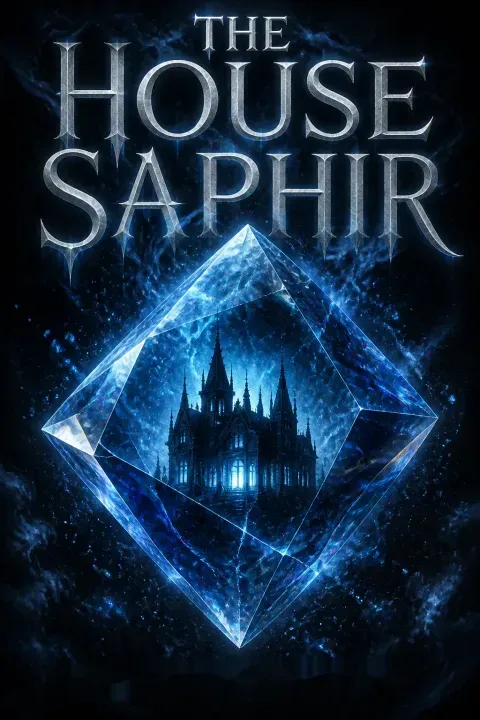


Plot Summary
The House Saphir Tour
Mallory Fontaine1 waits on a dark Morant street corner for her evening tour clients: a portly man, his shaven-headed sister, and a tardy third guest. She knows better than to meet strangers at night, which is why a dagger sits in her boot. She leads them through the abandoned House Saphir, reciting the story of Count Bastien Saphir, called Monsieur Le Bleu,4 who murdered his first three wives a century ago.
Throughout the tour, Mallory1 interacts with Triphine, the ghost of the first wife,6 who only she can see. When the final guest arrives late and startles her, Mallory1 flips him to the ground. He introduces himself as Axel Badeaux.2 His eyes are an uncanny sapphire blue, exactly like the murderous count4 in the portrait.
This opening establishes Mallory as a performer of macabre tales who hides genuine supernatural ability behind theatrical fraud. Her hypervigilance and concealed weapon reveal a young woman for whom the threat of violence is not abstract but expected. The irony is layered: she tells true stories of murdered wives while faking ghostly special effects, yet the real ghost stands beside her unseen by others. Axel's arrival and his familiar eyes introduce the central mystery of inheritance and identity that will drive the entire narrative.
The Heir Intervenes
The tour reaches the wine cellar where Mallory1 displays a fake wedding ring beneath glass and offers souvenir replicas for sale. Axel2 presses her about rumors that she can speak to spirits, but she deflects. Then the two clients drop their disguises: they are investigators Sophia Blaise and Louis Garneau, tracking the Fontaine sisters1 for fraud.
They shackle Mallory1's wrists, but Axel2 challenges her to prove her ability by asking Triphine6 what she held in her final portrait. Mallory1 relays the ghost's answer, her newborn son. Axel2 then reveals his true identity: Count Armand Saphir,2 sole heir2 to the estate. He grants Mallory1 permission to be there, forcing the investigators to release her and depart, though they promise to return.
This scene crystallizes the precariousness of Mallory's existence. Her livelihood depends on deception, yet her one genuine gift, ghost-sight, is what saves her. Armand's intervention reframes him from curious tourist to potential patron, but his motivation remains opaque. The investigators represent institutional consequence closing in, making Armand's offer of protection both a relief and a new dependency. The question Triphine answers also foreshadows the novel's central theme: what ties the dead to the living across generations.
Voirloup in the Dark
After the investigators leave, Mallory1 retrieves her real hidden valuables, including Triphine's actual sapphire wedding ring. Armand2 claims it belongs to his estate, but before they can argue, crashes echo from upstairs.
Investigating, they find a voirloup, a hulking wolf-like creature with yellow teeth. It attacks, biting Armand2's arm. Mallory1 stabs it with her dagger, and they flee to a bedroom. When Armand2 throws her silver coins at the beast, they pass uselessly through it.
They jump from a second-story window. On the ground, two young men emerge from the shadows. Constantino8 fires a single arrow that transforms the voirloup into a small glass figurine. His partner Fitcher7 hands Mallory1 a business card for their monster-hunting troupe.
The voirloup attack externalizes the predatory violence that has simmered in the house's history. Mallory's combat competence surprises even herself, yet it is the arrival of Fitcher's Troupe that introduces a world beyond petty fraud and ghost stories. Their casual, professional magic makes Mallory's amateur theatrics look shabby by comparison. The glass figurine transformation literalizes the idea that monsters can be contained, made small and decorative, a promise of mastery over chaos that will prove deeply deceptive as the story unfolds.
A Count's Desperate Offer
The next morning, Mallory1 discovers Armand2 threw her entire life savings at the voirloup. Their landlady threatens eviction. Then Armand2 appears at their shop. He explains that for seven years, the ghost of Bastien Saphir4 has haunted his country estate in Comorre, growing increasingly violent. Staff have been injured or driven away.
His vineyards suffer as workers refuse to stay. He needs the Fontaine sisters,1 whom he believes are genuine witches, to exorcise the spirit. He offers three thousand lourdes, half paid up front. Despite Anaïs3's protests that they possess no real magic, Mallory1 accepts. They pack hastily and ride with Armand2 to the countryside, leaving the investigators and their debts behind.
Armand's offer is Mallory's fantasy made literal: payment for expertise she does not possess, escape from poverty through performance. Her acceptance reveals a core aspect of her psychology: she will gamble on her own resourcefulness even when the odds are impossible. The figure of three thousand lourdes represents not just money but the promise of a new life. Armand's desperation is equally revealing. A count who drives his own carriage and cannot keep staff is a nobleman in name only, as hollowed out as his haunted mansion.
Ghosts at the Dinner Table
At the château, the staff is skeletal: stern Yvette the housekeeper,12 elderly Claude the butler, gruff Pierre the chef, and young Julie the maid.9 At dinner, Mallory1 sees the ghosts of Lucienne10 and Béatrice,11 the second and third wives, drinking wine and gossiping at the far end of the table.
Blood still drips from the stab wounds in their chests, and the words Le Bleu4 carved into their arms, trust and betrayal, remain vivid. In a window's reflection, Mallory1 also glimpses a man with vivid blue eyes and a dark beard: Bastien4 himself. He presses a finger to his lips before vanishing. That night, she sneaks out to steal a salamander carving from the courtyard fountain, but falls in when Armand2 catches her.
The dinner scene establishes the château as a space where the boundary between living and dead is permeable. The wives are not terrifying specters but tired, bored, trapped women whose murder is visible in every moment of their afterlife. The carved words on their arms literalize the novel's central thematic tension: trust offered and trust destroyed. Le Bleu's silent appearance and knowing gesture signal that he is aware of Mallory, watching her, waiting. Her attempted theft of the salamander reveals her as someone who copes with discomfort through acquisition and audacity.
Hot Chocolate and Confession
Armand,2 unable to sleep, finds Mallory1 soaked in the fountain. He leads her to the kitchen and prepares hot chocolate from scratch, adding elderberry syrup and a drop of royal skullcap extract to his own cup for sleep. He confesses he attended her tour not as a curious tourist but specifically to meet her, having heard rumors of the Fontaine sisters' power.
Raised by a distant aunt in this vast haunted house, he grew up lonely, finding companionship in the presence of the benevolent wives' ghosts. He admits he knows little of his family history because discussion of Le Bleu4 was forbidden. Mallory1 feels an unexpected pull toward him, though a shadow of Le Bleu4 appears behind Armand,2 reminding her of the danger.
This intimate scene establishes the emotional stakes beneath the supernatural plot. Both Mallory and Armand are orphans performing competence while nursing profound isolation. His elaborate hot chocolate preparation, his knowledge of medicinal herbs, his confession about loneliness: these details construct a character who is gentle, peculiar, and deeply unprepared for the role history has given him. The shadow appearing behind him visually prefigures the possession revelation to come. Mallory's growing attraction terrifies her because vulnerability has always been, in her experience, an invitation to exploitation.
The Cellar and the Demon
Mallory1 spends days performing fake exorcisms while exploring the estate. In the tower, feux follets nearly lure her off the ledge, but a barn swallow5 startles her back to safety. She finally meets Lucienne10 and Béatrice,11 who explain Le Bleu4's incomplete spell: five wives, five sacrifices, five rings. They cannot cross to Verloren until the spell is resolved.
Descending to the wine cellar, Mallory1 encounters Le Bleu4 himself. Unlike other ghosts, he is solid, warm. He presses his thumb to the scar at the base of her throat, causing searing pain. He reveals he is the demon4 she summoned seven years ago as a child, who stole her witchcraft and replaced it with death magic, the ability to see ghosts.
The cellar confrontation transforms the novel's stakes from a job to a personal reckoning. Le Bleu is not just an ancestral evil to be exorcised; he is Mallory's own summoned demon, intimately connected to her lost identity. The scar on her throat, which she hides beneath high collars, is not just a mark but a locked door where her magic was sealed away. The revelation that her ghost-sight is not a gift but a theft reframes her entire adult life as a compensation for childhood hubris. She came to banish him, but he has been waiting for her.
The Maid's Secret Marriage
Late one night, Julie9 comes to the sisters' room, desperate for a card reading. She reveals she has secretly married someone at the estate. On her finger sits a magnificent sapphire ring. Anaïs3 lays out the Wyrdith cards, drawing the Silver Stag, One Empty Coffin, the Untouched Feast, and Velos, god of death.
Despite the ominous spread, Anaïs3 tells Julie9 what she wants to hear: her marriage is blessed and true. A lou carcolh, a giant snail-like monster with tentacles, then erupts from the wardrobe and attacks.
Mallory1 fights it with a fireplace poker while Anaïs3 drives it off by dumping salt on its slimy flesh. Julie9 faints, but the sisters survive, shaken. Mallory1 later tries to summon Fitcher's Troupe7 using their magic card, but a salamander burns the paper moth before it can fly.
Julie's fortune reading represents the sisters' fraud at its most ethically compromised. Anaïs sees death in the cards and chooses to lie, prioritizing the comforting fiction over the dangerous truth, a decision that will haunt her. The lou carcolh attack literalizes the hidden threat that Julie has welcomed into her life through her secret marriage. The salamander destroying Mallory's message to Fitcher's Troupe is a small but symbolically potent failure: Mallory cannot rely on external rescue. She will have to find her own way through the coming crisis.
Julie's Body Found
Julie9 is discovered impaled on mounted antlers in the trophy hall, a sword through her chest. Her ring finger has been cut off. The words echtraus and greischt, trust and betrayal, are carved into her arms, exactly like Le Bleu's4 previous victims. The sword is Bastien's4 own, missing from its display. Mallory1 investigates, interviewing the staff.
She finds a pressed pinwheel crown flower from Armand's2 greenhouse hidden in Julie's9 prayer book. Searching Armand's2 room, she spies a ring on a hidden hook beneath his vanity. While shaving Armand2's face, she is overwhelmed by desire and they kiss passionately, but the sight of Julie's9 ring sends her fleeing. She is now convinced Armand2 himself is the killer, a new generation of Saphir monster.
Julie's murder transforms the novel from a ghost story into a whodunit with deeply personal stakes. Mallory's investigative instincts clash with her growing feelings for Armand. The discovery of the ring in his room seems to confirm her worst fear: that her attraction was always a setup for betrayal. Her simultaneous kiss and retreat embody the central conflict: she wants to trust him, but every piece of evidence screams otherwise. The pinwheel crown flower is a particularly intimate clue, suggesting a romance conducted within the space Armand loves most, his greenhouse.
Five Minutes of Resurrection
Desperate for the truth, Mallory1 begs Anaïs3 to use her Velos-given death magic. In the chapel, Anaïs3 touches Julie's9 corpse, and the dead maid opens her eyes. For five minutes, Julie9 speaks. She confirms she married Armand2 in secret, that he was tender and thoughtful at times, cold and distant at others. She believed his promises until the moment he drove the sword through her heart.
In the stables, Mallory1 and Anaïs3 prepare to flee. Armand2 finds them. His gentle demeanor vanishes; he wraps his hands around Mallory's1 throat, whispering cruelly about how glad he is she came. Anaïs3 knocks him unconscious with a shovel. The sisters ride into the night, only to be attacked by a cheval mallet, a demonic horse.
Julie's temporary resurrection is the novel's emotional nadir. The confirmation that Armand, the man Mallory was falling for, is a murderer seems absolute. Yet the contradictions in Julie's description, a man capable of both tenderness and murder, hint at the possession truth still hidden. The stable attack, where Armand's personality shifts so dramatically, is the clearest evidence of possession that Mallory misses because she is too terrified to analyze it. The cheval mallet's pursuit literalizes her sense of being hunted by forces beyond her control, with no safe ground ahead.
Gabrielle Savoy Appears
Fitcher's Troupe7 rescues the sisters from the cheval mallet. At their camp, the barn swallow5 from the tower transforms into a naked, wild-haired woman: Gabrielle Savoy.5 She reveals the truth: Le Bleu4 has been possessing Armand2 for seven years through the herb royal skullcap, which Armand2 takes for sleep.
Armand2 retains no memory of what Le Bleu4 does in his body. It was Le Bleu,4 not Armand,2 who wooed Julie,9 married her, and killed her. Le Bleu4 needs one final sacrifice of Savoy5 blood, Mallory1 or Anaïs,3 to complete his immortality spell and regain a physical body.
Gabrielle's revelation completely reorganizes the moral landscape of the novel. Armand is recast from villain to victim, his body a puppet for ancestral evil. The mechanism of possession through a medicinal herb adds tragic irony: Armand's attempt to heal his own trauma opened the door for greater harm. Gabrielle's existence as a woman who has lived for over a century in bird form, watching over descendants she cannot openly protect, introduces a maternal counterforce to Le Bleu's predatory patriarchy. The spell's completion now requires Mallory to choose: flee and leave Armand enslaved, or return and risk becoming the fifth sacrifice.
Rings from the Cellar
Returning to the château with Fitcher7 and Constantino8 disguised as acolytes, they drug the household during Julie's9 burial ceremony. Mallory1 enters Armand's2 room to find the wedding rings gone. Le Bleu4 attacks, causing the floor to collapse beneath them. They fall through two stories, landing in the kitchen as the house itself turns against them.
In the cellar, they find the rings arranged on a pentagonal table surrounded by the wives' bodies hanging from hooks. Le Bleu's4 illusions torment them until Julie's ghost9 awakens and attacks him. Mallory1 cuts the other wives free. Together the four ghost women drive Le Bleu4 back. Mallory1 collects the rings and escapes through a dumbwaiter shaft into the garden.
The cellar retrieval sequence is the novel's most overt horror set piece, drawing on Bluebeard's forbidden chamber. The wives' suspended bodies, the bleeding barrels, the message scrawled in blood: all are illusions, yet the terror they produce is real and effective. Julie's ghost attacking her murderer represents a crucial shift. Victims are no longer passive. The collective fury of wronged women becomes the force that enables Mallory's success. This scene also demonstrates Le Bleu's limitation: he can create terror but depends on human hosts for physical violence.
The Sister Betrayed
In the chapel, Gabrielle5 begins the ritual to bind Le Bleu's4 spirit to a candle. The wives' rings are placed around a pentagram. The candle flame burns blue. But Anaïs,3 who earlier drank the drugged wine, has been vulnerable. Le Bleu4 slipped into her during the chaos. Her eyes flash sapphire. She draws the sword and drives it through Gabrielle's5 back, killing her.
Then she walks to the blood-filled fountain, and Le Bleu4 emerges from her body, fully corporeal and immortal. He uses sorcery to restore the crumbling château to its original magnificence. Constantino8 shoots him with an arrow, but as a resurrected man rather than a monster, Le Bleu4 simply regenerates. He declares he will kill Armand2 and assume his identity.
Gabrielle's death at Anaïs's hands is the novel's cruelest twist. The woman who escaped Le Bleu a century ago is finally killed by him, using the body of her own descendant. The possession of Anaïs demonstrates that Le Bleu's predation is not limited to Armand; anyone who consumes skullcap becomes a potential vessel. His resurrection and restoration of the château literalize his worldview: beauty and order purchased through violence against women. Constantino's arrow failing drives home the escalation. This is no longer a monster to be captured and contained. This is an immortal sorcerer at the height of his power.
The Binding Pentagram
Mallory1 realizes the five murder sites form a pentagram around the estate. If she can bind Le Bleu4 to the house, he cannot escape. She and Armand2 descend to the cellar and smash every wine barrel, flooding the floors with fortified Ruby Comorre.
In the vestibule, Mallory1 draws sigils in chalk, adds three drops of Armand's2 blood, and recites the spell she memorized as a child. Her magic, locked away for seven years, surges back. A void opens. Le Bleu4 appears, but Mallory1 smashes a salamander figurine from Constantino's8 collection, releasing the fire-breathing creature.
She aims it at the wine-soaked carpet. The house ignites in an instant. Le Bleu4 is trapped. Mallory1 and Armand2 flee upward through the burning mansion, pursued by collapsing floors and the sorcerer's rage.
Mallory's magical reawakening is the novel's emotional and thematic climax. The spell she memorized as a hopeful child, the magic she thought was stolen forever, returns when she finally stops pretending and trusts her own lineage. Her choice to use wine, Armand's despised inheritance, as the accelerant for destruction is symbolically rich: the Saphir legacy, built on violence against women, is immolated by the woman who loves its innocent heir. The salamander, the creature she once tried to steal from the fountain, becomes her instrument of liberation rather than acquisition.
Into the Burning Sky
On the roof, flames consume the château below. As Mallory1 and Armand2 crawl toward a trellis, the wood splinters beneath him. He falls three stories, landing motionless in a lavender bed. Mallory1 dangles from a stone gargoyle, her strength failing. Le Bleu's4 voice seethes through the carving, offering to save her if she frees him. She refuses.
Gabrielle's5 ghost appears with the other wives, coaching Mallory1 through the bird transformation spell. Mallory1 recites the words and lets go. She falls, then flies, a barn swallow escaping the collapsing inferno. On the ground, she finds Armand2 alive but injured. The house burns to ash, Le Bleu4 screaming as the flames consume him. The wives' spirits, finally freed, drift into Verloren one by one.
The climax fuses the novel's two central forms of magic: Mallory's reclaimed witchcraft and the bond between women across generations. Gabrielle, even in death, completes her role as protector by teaching Mallory the spell she could not teach in life. The bird transformation, which Mallory once dismissed as impossible without her magic, becomes the physical manifestation of her reclaimed power and identity. Armand's survival, despite the fall, affirms that the innocent heir can outlive the corrupt legacy. The wives' passage to Verloren is the earned peace that a century of suffering has purchased.
A House Reborn
Months later, Mallory1 and Armand2 have restored the House Saphir in Morant. She runs legitimate ghost tours, aided by her real magic and the lingering presence of Triphine,6 who chose not to cross to Verloren. Armand2 works as an apothecary, selling medicinal herbs and tinctures from the conservatory he rebuilt.
They have sold the vineyards and winery, freeing themselves from the Saphir wine legacy. Anaïs3 travels with Fitcher's Troupe,7 sending letters from distant cities. Mallory1 wears an engagement ring from Armand:2 cheap brass beneath silver plating, the sapphire nothing but blue glass. No one else needs to know. The love is real, the trust unbreakable. She signs her reply to Anaïs3 with the news.
The epilogue reframes the entire novel through the lens of earned happiness. Mallory and Armand have not transcended deception but transformed it. The fake ring, an echo of the fraudulent jewelry Mallory once sold, becomes a symbol of authentic commitment. They chose each other knowing every secret. The Morant house, site of the original crime and the childhood séance gone wrong, is reclaimed as a space of legitimate work and domestic contentment. Triphine's choice to remain suggests that some ghosts stay not because they are trapped but because they have finally found a home.
Analysis
The House Saphir is a Bluebeard retelling that uses its fairy-tale skeleton to examine how predatory men construct the conditions for their predation. Count Bastien Saphir4 did not simply murder his wives; he selected women with few protectors, married them to gain legal ownership of their bodies, then killed them under cover of a spell that rendered their suffering invisible. The genius of the novel is that this pattern does not end with his death. A century later, the same man, now a ghost, continues his crimes by co-opting the body of his kindest descendant, Armand.2 The monster wears the face of a gentle man, and the victims cannot tell the difference because the system that enabled the original murders was never dismantled. Only the house burns. The spell is the patriarchy itself, transmitted through inheritance and maintained through silence. Yvette, the housekeeper,12 embodies this complicity. Her devotion to the Seven, her insistence on propriety and reputation, actively obstructs justice. She would rather believe two stranger women are witches and murderers than acknowledge what her beloved family produced. The novel also explores the economics of deception. Mallory1 and Anaïs3 are frauds because their mother died and left them with no inheritance but her reputation. They perform magic because the alternative is destitution. Armand2 is bankrupt because his family name is poison. Every character is trapped in a performance required by the systems they inhabit. Mallory1's arc is not about learning to trust but about learning to trust herself. Her magic was never stolen, only locked away by a demon4 who convinced her she was powerless without him. When she finally reclaims her witchcraft, she does so not by becoming someone new but by remembering who she was before the séance: a girl who believed she could summon the dead and change her sister's fate. The bird transformation is not just escape but self-reclamation. The novel's ending is subversively quiet. There is no grand restoration of the Saphir fortune, no elevation of Mallory1 to countess in a sparkling château. They sell the vineyards, run a small haunted house tour, and Armand2 becomes an apothecary. The fake engagement ring is a perfect symbol: genuine commitment expressed through a replica. Mallory1 has learned that the authentic and the fraudulent are not always opposites. Sometimes the thing you pretend to be is the thing you were always meant to become.
Review Summary
The House Saphir by Marissa Meyer garners mixed reviews averaging 3.92/5 stars. Readers praise Meyer's atmospheric gothic storytelling, vivid world-building, and engaging characters, particularly protagonist Mallory Fontaine, a ghost-seeing con artist. Many appreciate the Bluebeard retelling's dark humor, strong sister dynamics, and short chapters. However, criticisms include predictable plot twists, a slow middle section, formulaic elements recycled from Meyer's previous work Gilded, and underdeveloped romance between Mallory and Armand. Some reviewers found the villain underwhelming and questioned narrative choices regarding the fairy tale's original themes. Overall, it's deemed a solid, entertaining YA fantasy perfect for fall reading.
People Also Read


Characters
Mallory Fontaine
Fake witch, real ghost-seerA young woman in her late teens who lost her witchcraft at age ten when a botched Mourning Moon séance summoned the demonic spirit of Monsieur Le Bleu4. In exchange, she received the corrupted ability to see and speak with ghosts. She has spent the seven years since supporting herself and her sister3 through theatrical fraud: fake séances, forged god-relics, and sensationalist tours of the haunted House Saphir in Morant. Sharp-tongued, pragmatic, and deeply mistrustful, she carries a dagger in her boot and assumes everyone intends harm until proven otherwise. She has a crippling fear of heights and hides the scar at the base of her throat beneath high-necked dresses. Descended from Gabrielle Savoy5, she carries dormant witchcraft she believes is lost forever.
Count Armand Saphir
Heir to a murderous legacyThe current lord of the Saphir estate, a reclusive young count in his early twenties. He was raised by a distant aunt in the enormous, decaying château after his parents died in his infancy. He prefers botany, herbalism, and making his own hot chocolate to the winemaking business he inherited. His family is bankrupt; the ghost of his ancestor4 has driven away staff and business partners for seven years. He takes royal skullcap extract to sleep, unknowingly making himself susceptible to possession. Genuinely kind, socially awkward, and fascinated by Mallory's1 dark interests and unapologetic bluntness. He is not the monster his great-great-grandfather4 was, but he carries the weight of that legacy.
Anaïs Fontaine
Death-touched older sisterMallory1's older sister, marked at birth with the god-gift of Velos: she can temporarily resurrect the dead for five minutes. She considers this ability a vulgar curse, not a gift. She runs a fortune-telling shop using their mother's Wyrdith cards, though she possesses no real divination magic. Softer, prettier, and more charming than Mallory1, she has a weakness for theft, romance novels, and beautiful objects. She reluctantly agreed to Mallory1's childhood séance hoping to trade her death magic for petty witchcraft. She joins Fitcher's Troupe7 after the events at the château, finally embracing the adventure she always dreamed about.
Bastien Saphir (Monsieur Le Bleu)
Murderous immortal sorcererA 17th-century count and powerful dark sorcerer who murdered three of his five wives as part of a spell to achieve immortality. His hair and beard were so black they appeared blue, earning him the moniker Monsieur Le Bleu. His spirit was accidentally released from Verloren by Mallory1's childhood séance. He can possess living hosts who have consumed royal skullcap, controlling their bodies while erasing their memories of his actions. In ghost form, he can make himself briefly corporeal and manipulate the physical structure of his former home. Charming, cruel, and patient, he has spent seven years waiting to complete his spell with the blood of a Savoy5 descendant.
Gabrielle Savoy
Escaped wife turned guardianLe Bleu4's fourth wife, the one who got away. Over a century ago, when Bastien4 prepared to kill her, she used her witchcraft to transform into a barn swallow and fly to safety. She changed her surname to Fontaine and built a new life in Morant as a respected witch. After her daughter came of age, she transformed back into a bird and has lived in that form ever since, watching over her descendants. She can shift between bird and human form, but human time ages her. She carries a black-and-white tail feather that serves as a magical focus. Her wedding ring, passed down through the family, is worn by Anaïs3.
Triphine Maeng
First murdered wife, resident ghostLe Bleu4's first wife and the mother of his only child. She was stabbed through the heart and had her ring finger cut off in the Morant mansion's wine cellar. As a ghost, she is whiny, hypochondriacal, and perpetually aggrieved, yet unfailingly loyal to Mallory1. She appears in a blood-soaked nightgown and blue shawl. For over a century, she could not leave the Morant house, bound to her wedding ring. When Armand2 moved the ring to the Comorre estate, she was forcibly transported with it. Despite her complaints about every ailment imaginable, she proves brave when it matters and chooses to remain with Mallory1 even after being freed.
Fitcher
Cursed monster hunterThe leader of Fitcher's Troupe, a curse breaker and monster hunter. Every full moon, he transforms uncontrollably into an enormous ice bear. He is seeking individuals with god-gifts from all seven gods to break his curse. Stoic, cryptic, and dressed entirely in black, he carries a golden pocket watch that is not a timepiece but a magical compass. His true origins and the nature of his curse remain mysterious. He recruited Constantino8 for Tyrr's blessing and now seeks Anaïs3 for her Velos gift, Mallory1 for her corrupted Velos mark, and others yet unknown.
Constantino
Flamboyant monster-transformerFitcher7's partner, a young man from Stivale blessed by Tyrr. His arrows transform magical monsters into small glass figurines, effectively capturing them. He dresses in garish, colorful silks and speaks with theatrical charm, often calling Mallory1 stellina. He is vain, dramatic, and openly flirtatious, but his competence with a bow is undeniable. He carries a velvet pouch full of monster figurines and occasionally loses them to Anaïs3's light fingers. He left Stivale under unclear circumstances involving his brother. Despite his frivolous demeanor, he is deeply loyal to Fitcher7 and committed to their mission.
Julie
Star-crossed housemaidA young maid at the Saphir château, orphaned and alone in the world. She is easily flustered, romantic, and naive. She becomes infatuated with Armand2, not realizing that the man who returns her affection is actually Le Bleu4 possessing Armand2's body. Le Bleu4 marries her in secret, gives her a sapphire ring, and then murders her as the fourth sacrifice in his immortality spell. Her ghost is initially trapped and tormented until Mallory1 frees her to fight back against her killer.
Lucienne Tremblay
Boozy second wife ghostLe Bleu4's second wife, murdered a century ago. In life, she was considered an embarrassment due to her drinking. As a ghost, she is boisterous, irreverent, and rarely seen without a wineglass. She was stabbed in the conservatory. Her spirit is bound to the château by Le Bleu4's incomplete spell. She befriends Triphine6 and helps Mallory1 by staging a dramatic ghostly performance for Armand2's benefit.
Béatrice Descoteaux
Shy third wife ghostLe Bleu4's third wife, from an impoverished family grateful for the match. She is quiet, anxious, and melancholic. Her ghost manifests most often through somber piano music drifting through the halls. She reads old newspapers and follows royal gossip. Unlike Lucienne10, she is reluctant to frighten the living but will help when asked. She was stabbed in the tower.
Yvette
Devout and distrustful housekeeperThe aging housekeeper at the Saphir château who has served the family for decades. She is a strict follower of the Seven gods and deeply suspicious of petty magic and witchcraft. She resents Mallory1 and Anaïs3 from the moment they arrive, believing them to be frauds. Her loyalty to the Saphir family makes her protective of the estate's reputation, which puts her at odds with anyone who discusses Le Bleu4's crimes openly. Despite her hostility, she remains at the château when others flee, bound by duty and devotion.
Plot Devices
The Five Wedding Rings
Anchor spirits to the mortal worldEach of Le Bleu4's five marriages was sealed with a distinctive ring. The rings are enchanted through the marriage vows and the betrayal of murder. Where the rings go, the murdered wives' spirits must follow, trapped until the spell is completed or broken. The rings are needed to perform the binding ritual that traps Le Bleu4. Triphine6's sapphire ring was hidden in the Morant mansion and found by Mallory1. Lucienne10, Béatrice11, and Julie9's rings were stored in the Comorre château. Gabrielle5's emerald ring was passed down through the Fontaine family and worn by Anaïs3. The five rings placed at the points of a pentagram create the magical container for Le Bleu4's spirit.
Royal Skullcap
Enables spirit possession of hostsAn herb that grows wild in the Saphir forest. Armand2 has taken it as a sleep aid since childhood, when Le Bleu4 first began tormenting him with nightmares. The herb makes a person's mind permeable to spirit possession. Le Bleu4 exploited this to control Armand2 whenever he wished, entering his body while Armand2 retained no memory of what occurred. Le Bleu4 also used it to possess Anaïs3 briefly when she drank drugged wine at Julie9's burial. The herb represents how attempts to heal trauma can create new vulnerabilities.
God-Gifts (Velos and Tyrr)
Divine magic marks on chosen individualsWhen the veil between worlds fell nearly two decades ago, its dispersed magic marked certain children with gifts from the seven gods. Anaïs3 received Velos's gift: the ability to temporarily resurrect the dead for five minutes. Constantino8 received Tyrr's gift: arrows that transform monsters into glass figurines. Mallory1 received a corrupted version of Velos's mark from Le Bleu4 during the childhood séance, granting her ghost-sight but sealing away her natural witchcraft. Fitcher7 is seeking bearers of all seven god-gifts to break his own curse. The marks appear as golden tattoos on the bearer's skin, though Mallory1's is blackened and festering.
The Bird Transformation Spell
Witchcraft that allows flight and escapeA spell passed down through the Savoy5 bloodline that transforms the caster into a barn swallow. Gabrielle5 used it to escape Le Bleu4 a century ago and has lived primarily in bird form ever since. The spell was written in one of the Fontaine family's inherited grimoires, and Mallory1 memorized it as a child, fascinated by its lyrical words. She never dared attempt it because it requires a leap of faith, literally throwing oneself from a height while reciting the incantation. At the climax, Gabrielle5's ghost coaches Mallory1 through the recitation while she dangles from a burning tower, allowing her to transform and fly to safety.
The Glass Figurines
Captured monsters that can be releasedWhen Constantino8 shoots a magical creature with one of his Tyrr-blessed arrows, the monster transforms into a small, delicate glass figurine. These can be stored indefinitely, but if the figurine is broken, the original monster is released, alive and unharmed. Constantino8 carries dozens in a velvet pouch. Anaïs3 steals several from him. At the climax, Mallory1 smashes a salamander figurine to release the fire-breathing creature, using it to ignite the wine-soaked château. The figurines represent the precarious boundary between containment and catastrophe.
Download PDF
Download EPUB
.epub digital book format is ideal for reading ebooks on phones, tablets, and e-readers.








































