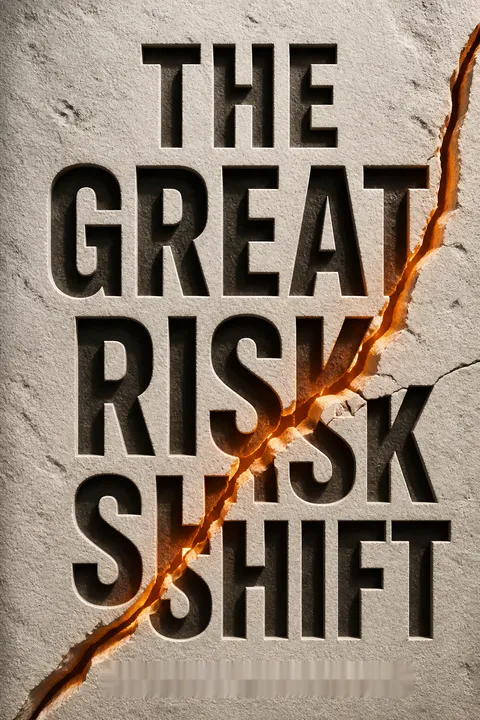

Key Takeaways
1. The Great Risk Shift: A Hidden Crisis of Economic Insecurity
Over the last generation, we have witnessed a massive transfer of economic risk from broad structures of insurance, including those sponsored by the corporate sector as well as by government, onto the fragile balance sheets of American families.
A profound transformation. The core argument is that the United States has undergone a "Great Risk Shift," a fundamental reordering of economic responsibility. This isn't just about the rich getting richer; it's about a systemic offloading of financial burdens from corporations and government onto individuals and families. This shift affects Americans across all walks of life, creating widespread anxiety and insecurity.
Beyond the headlines. While official economic statistics often paint a rosy picture of prosperity, most Americans feel a growing unease. This disconnect stems from the fact that traditional measures like GDP or unemployment rates don't capture the underlying volatility and risk that families now face. The Great Risk Shift is a "rising tide" of insecurity, affecting good times as well as bad, and it's often a private, hidden struggle.
A call to action. This transformation is not a natural occurrence but a consequence of deliberate corporate and political choices. Instead of reinforcing protections, leaders have often dismantled them in the name of "personal responsibility." The book aims to expose this shift, explain its causes, and propose a real alternative: an "insurance and opportunity society" where basic financial security is seen as the cornerstone of economic advancement.
2. Beyond Inequality: The Pervasive Rise of Financial Fragility
In fact, over the past generation the economic instability of American families has actually risen much faster than economic inequality—the growing gap between rich and poor that is often taken as a defining feature of the contemporary U.S. economy.
Income volatility skyrockets. While inequality (the gap between rich and poor) has certainly grown, the more striking and often overlooked trend is the dramatic increase in income instability. Family incomes now rise and fall much more sharply from year to year. At its peak in the mid-1990s, income instability was almost five times greater than in the early 1970s, and it remains significantly higher today.
Middle class vulnerability. This insecurity is not confined to the poor or uneducated. Educated, upper-middle-class Americans, like Andrea Case, are increasingly affected. The pace of increased instability has been similar across all education levels, meaning that even college-educated professionals now experience income swings comparable to less-educated workers in the 1970s.
The pain of loss. Drops in income are psychologically devastating, often more so than equivalent gains are pleasurable, a phenomenon known as "loss aversion." The chance of an average person experiencing a 50% or greater income drop has risen dramatically, making "falling from grace" a common experience. This leads to:
- Personal bankruptcy rates soaring fivefold since 1980.
- Mortgage foreclosure rates increasing fivefold since the early 1970s.
- Over half of American children experiencing poverty for at least a year by age eighteen.
3. The "Personal Responsibility Crusade" Undermines Collective Security
The core assertion embodied in the Personal Responsibility Crusade is that Americans are best off dealing with economic risks on their own, without the overweening interference or expense of wider systems of risk sharing.
An ideological revolution. The Great Risk Shift is driven by a powerful ideological movement: the "Personal Responsibility Crusade." This movement champions individual self-reliance and views broad risk-sharing mechanisms, especially government insurance, as inefficient and detrimental to economic growth. It argues that insurance creates "moral hazard," reducing incentives for prudence and wise choices.
From social insurance to "ownership." The New Deal era established "social insurance" – the idea that certain widespread risks (like old age, unemployment, sickness) are best managed by pooling costs across society. Today, the Crusade promotes an "ownership society" where individuals control their own health care, education, and retirement savings through individualized private accounts, often tax-subsidized.
Stealth strategies. Recognizing public resistance to direct attacks on popular programs, the Crusade employs subtle tactics. It promotes tax breaks for private accounts (like 401(k)s and HSAs) as "parallel systems" that gradually wean people off collective insurance. This strategy aims to:
- Shift risk onto individuals.
- Reduce government tax revenues.
- Create a constituency for private-sector alternatives.
- Ultimately transform public perception of government's role in security.
4. Workplace Security Erodes: The New "Free Agent" Contract
The greatest change in the relationship between workers and their employers is the transformation of the bargain that once governed their mutually beneficial but inherently uneasy relationship.
The old contract is dead. The traditional "work contract" where employers offered job security, generous benefits, and career progression in exchange for loyalty and specific skills has largely vanished. This shift is driven by intensified global competition and a corporate focus on short-term stock value, but its specific form was not inevitable.
Risk shifts to workers. The "new contract" pits workers against the "spot market" for labor, meaning their value is constantly reassessed based on current skills and economic conditions. This means:
- Increased involuntary job loss: Rates are now as high as during the severe recession of the early 1980s, even with low official unemployment.
- Higher costs of job loss: Workers who find new full-time jobs earn significantly less (e.g., 17% less in 2001-03) than before, especially educated professionals.
- Long-term unemployment: The share of workers unemployed for six months or more has tripled since the late 1960s, even during economic peaks.
The service sector's rise. The shift from manufacturing to a service-sector economy further exacerbates insecurity. Many service jobs offer low pay, limited benefits, and little security, forcing workers like Dennis Erksa to take drastic pay cuts and lose benefits when their manufacturing jobs disappear. The growth of part-time and temporary work also shifts costs and risks onto employees.
5. Families Under Strain: Two Incomes, More Risk, Less Savings
To most families, a second income is not a luxury but a necessity in a context in which wages are relatively flat and the cost of raising a family is high and rising.
The "risk bind." The rise of two-earner families, while seemingly a form of private risk-sharing, has paradoxically increased financial fragility. Women's entry into the workforce is often a necessity to maintain a middle-class standard of living, not a luxury. This leaves families highly leveraged and vulnerable to shocks.
Drowning in debt. American families are accumulating unprecedented levels of debt, while personal savings rates have plummeted to near zero. This isn't primarily due to reckless spending, but rather the "middle-class squeeze" where rising costs for essentials like housing, health care, education, and child care consume most income. Families are forced to leverage their futures through risky investments.
Children as economic risks. While bringing joy, children are now significant economic risks. Raising a child to age eighteen costs nearly $237,000 for a middle-income family. Events like childbirth or chronic illness can trigger poverty spells or bankruptcy. Parents, especially mothers, bear immense financial and time costs, often without adequate societal support like paid family leave.
6. Retirement's Gamble: The Perilous Shift to 401(k)s
Over the fifteen years between 1983 and 1998, the typical family approaching retirement saw the wealth earmarked for its retirement decline, not rise.
The 401(k) revolution. The 401(k) plan, initially an obscure tax provision, has become the dominant form of private retirement savings, replacing traditional defined-benefit pensions. This shift was appealing to employers because 401(k)s are "dirt cheap," transferring most of the cost and risk to employees.
Risk, not return, is the issue. While 401(k)s offer potential for high returns, they place all major risks on the individual:
- Market risk: Vulnerability to stock market downturns, as seen with Enron employees who lost most of their savings.
- Longevity risk: The danger of outliving one's savings, exacerbated by the difficulty and high cost of purchasing annuities.
- Poor investment choices: Many workers make common errors, like over-investing in company stock or investing too conservatively.
- Inadequate contributions: Roughly a third of eligible workers contribute nothing, and overall, 70% of assets are held by the richest fifth of Americans.
Social Security under siege. This shift in private pensions makes Social Security, the last guaranteed pension, even more vital. Yet, it too faces attacks from the Personal Responsibility Crusade, which advocates for "privatization" into individual accounts. This would replace guaranteed benefits with market-dependent returns, shifting even more risk onto individuals and exacerbating existing funding challenges.
7. Health Care's High Stakes: A Crumbling, Costly, and Insecure System
Among insured Americans, 51 million spend more than 10 percent of their income on medical care.
Pervasive health insecurity. The U.S. health care system, despite its advanced medical capabilities, is a major source of economic insecurity. It is enormously wasteful, inefficient, and expensive, yet fails to provide basic security. This affects:
- The uninsured: 46 million Americans lack coverage, with 82 million experiencing a period without insurance over two years.
- The insured: 51 million spend over 10% of their income on medical care, and 1 in 6 working-age adults carry medical debt, often with insurance.
Flawed markets. Health insurance markets are inherently problematic due to "adverse selection" (those most likely to need insurance are most likely to buy it), leading to fragmented coverage, high premiums, and exclusions. The employment-based system, a historical anomaly, is crumbling as employers cut benefits and costs skyrocket.
Medicare and Medicaid strains. Even public programs like Medicare and Medicaid are under pressure. Medicare, despite its popularity, is less generous than private plans and leaves seniors vulnerable to high out-of-pocket costs. Medicaid, while vital for the poor, is underfunded, complex, and faces constant threats of cutbacks, leaving many eligible families like the Combs's struggling to access care.
8. The Illusion of "Ownership": Accounts Fragment Risk Pools
While Health Savings Accounts became a near-theological aspiration of the Right, most policy experts remained skeptical.
HSAs: A new frontier of risk shift. Health Savings Accounts (HSAs) are the latest manifestation of the Personal Responsibility Crusade in health care. They encourage individuals to save for routine medical expenses and use high-deductible insurance for catastrophic costs. Proponents argue they promote "consumer-driven health care" and personal responsibility.
Undermining risk pooling. Critics, however, warn that HSAs primarily attract healthy, wealthy individuals who don't fear high out-of-pocket costs. This "adverse selection" can lead to a "death spiral" for traditional group insurance plans, as healthier individuals leave, driving up premiums for those remaining and further fragmenting risk pools.
Corporate adoption. Despite initial skepticism and low public enthusiasm, HSAs are gaining traction, with major employers like Wal-Mart considering them to reduce their own health care costs and risks. This move signals a culmination of the shift from collective employer-provided insurance to individualized, risk-bearing accounts.
9. The Cost of Inaction: A Tattered and Inadequate Safety Net
Tragically, our current system of unemployment insurance misses millions of the temporarily unemployed as well.
Eroding protections. As economic risks mount, America's social safety net has grown increasingly threadbare. Unemployment insurance, designed for temporary job loss, has seen its reach and generosity decline dramatically, covering less than 40% of eligible workers today, down from 80% in 1947. It fails to address long-term earnings reductions or the loss of benefits.
Gaps in coverage. The existing framework of social protection is ill-equipped for modern challenges:
- Age bias: Overwhelmingly focused on the aged, neglecting young adults and families with children who face significant economic strains.
- Short-term focus: Emphasizes temporary exits from the workforce, ignoring the growing problem of long-term job losses and skill obsolescence.
- Family strains: Based on antiquated notions of family structure, failing to support two-earner families balancing work and caregiving.
- Employment-based reliance: Assumes job-based private insurance can fill gaps, despite its clear inability to do so.
The "do no harm" principle. The current approach often causes more harm than good. Bankruptcy has become a de facto social insurance system, private charity a medical safety net, and credit cards a primary means for families to cope with hardship. These systems are not designed for such burdens and are prone to abuse and predation.
10. Reclaiming Security: An "Insurance and Opportunity Society"
Economic security is vital to economic opportunity, and economic insecurity is one of the greatest barriers between American families and the American Dream.
Security as a cornerstone of opportunity. The book argues for an "insurance and opportunity society," a vision where basic financial security is not opposed to, but rather the foundation of, economic opportunity. Just as businesses need protection to take risks, individuals and families need a safety net to invest in their future, change jobs, or start families.
Challenging the "ownership society." The "ownership society" ethos, which promotes individual management of risk, fails to address the systemic nature of modern economic insecurity. It exacerbates anxiety and hardship by placing undue burdens on individuals. The public's rejection of Social Security privatization shows a widespread desire for collective protection.
A new social bargain. This vision calls for a refashioned framework of economic security for the 21st century. It acknowledges that employers won't return to past models and that government faces fiscal constraints. However, it insists that government and employers must act as a help, not a hindrance, providing a robust safety net that allows Americans to pursue the American Dream without constant fear of economic loss.
11. Smart Modernization: Targeted Reforms for a Resilient Future
Providing security to expand opportunity—this is the key not only to undoing the Great Risk Shift but also to reclaiming the ideal of shared fate in the twenty-first century.
Restoring worker protections. Modernizing protections for workers means:
- Unemployment Insurance: Restore strong national standards, automatically extend benefits during high long-term unemployment, and offer retraining vouchers.
- Wage Insurance: Provide supplements for workers displaced into lower-paying jobs, regardless of cause.
- Family Leave: Expand the Family and Medical Leave Act to more workers and encourage states to provide paid leave for new parents.
- "Right to Request" laws: Allow parents to petition for altered work hours, as successfully implemented in Great Britain.
Securing retirement. To ensure retirement security:
- Universal Savings Accounts: Replace current tax breaks with a single, more progressive account.
- Strengthen Social Security: Close funding gaps through progressive adjustments, longevity indexing, and diversifying financing beyond payroll taxes.
- Universal 401(k)s: Available to all workers, with employer matches, professional management, default low-cost index funds, and automatic conversion to lifetime annuities at retirement.
Medicare Plus: Universal health security. The most ambitious proposal is to expand Medicare to all Americans without employer-provided insurance. This "Medicare Plus" system would:
- Give employers a choice: provide equivalent coverage or pay into Medicare.
- Enroll roughly half of Americans in Medicare, increasing its leverage to control costs.
- Broaden health security, link the fates of young and old, and make Medicare's future costs less sensitive to demographics.
- Introduce "Universal Insurance" as a stop-loss program for catastrophic income drops and budget-busting expenses, filling gaps in existing benefits.
People Also Read






Download PDF
Download EPUB
.epub digital book format is ideal for reading ebooks on phones, tablets, and e-readers.








































