

Key Takeaways
Treat sex as spiritual practice, not just pleasurable skin friction
The core thesis is provocative. Deida, who trained for decades in tantric and spiritual disciplines, argues that enlightenment and great sex spring from the same source: the willingness to open completely as love. Ordinary sex, in his framing, is a short cycle of building tension and releasing it, leaving you depleted and ready for sleep. Enlightened sex uses the same aroused energy to flood the whole body with feeling, dissolve the boundaries between lovers, and reveal a spacious, egoless openness he equates with the divine.
Most people sabotage this by bringing their baggage to bed: the stress of the day, past sexual failures, the need to be reassured. Rather than obstacles, these become the exact places to practice opening. Sex becomes a laboratory for love itself.
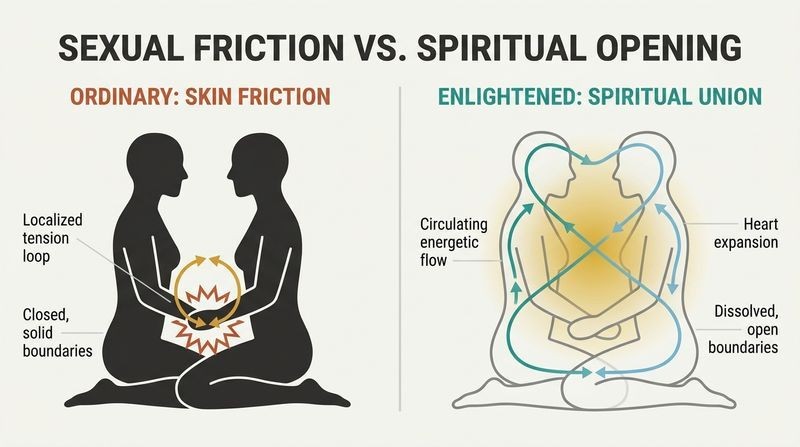
What's striking is how Deida positions physical technique as merely the scaffolding for a contemplative goal. This lineage runs through Tibetan and Hindu tantra, where sexual union symbolizes the merger of consciousness and energy. Modern research offers partial support: Jenny Wade's studies of transcendent sexual experiences document altered states, dissolution of self, and mystical union during ordinary lovemaking, suggesting these reports are not merely poetic. The obvious caution is that spiritualizing sex can also become a performance trap, a new standard to fail against. Deida's answer, that difficulty is the doorway rather than the barrier, is elegant, though it asks considerable emotional maturity of the reader.
Your breath is the master dial for arousal and surrender
Inhalation receives, exhalation releases. Deida assigns two distinct sexual jobs to breath. A full inhalation drawn down the front of the body into the belly and genitals builds arousal and energy. A long, complete exhalation lets you surrender and circulate that energy outward.
He then makes a clinical claim about weak breathers:
1. Weak inhalers struggle to receive energy, showing up as erection difficulty or vaginal dryness, and tend to be scattered or underpowered in daily life.
2. Weak exhalers cannot let go, so they ejaculate quickly, seek frequent superficial orgasms, and are prone to anger and compulsive eating.
The practical prescription: to raise arousal, emphasize deep belly inhalation; to slow down and deepen surrender, emphasize long, full exhalation, releasing all hold as if dying into bliss.
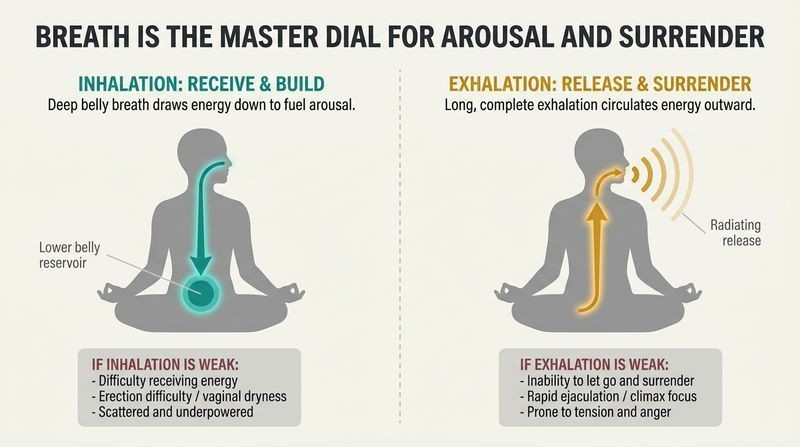
The mapping of breath to autonomic states is physiologically credible. Slow, extended exhalation activates the parasympathetic nervous system through vagal stimulation, lowering heart rate and reducing sympathetic arousal, which is precisely why paced breathing appears in treatments for premature ejaculation and anxiety. Deida intuited this decades before vagal tone became a wellness buzzword. Where he overreaches is the tidy personality typology (weak exhalers are angry overeaters), which reads more like archetype than data. Still, the actionable kernel is sound and testable tonight: shift your breathing pattern and watch your body respond. Few sex manuals give a lever this simple and physiologically grounded.
Circulate energy up the spine and down the front, not out the genitals
Picture your body as a hose. Deida's central mechanic is a loop: sexual energy should travel from the genitals up the spine, through the head, and back down the front of the body to the pelvic floor, over and over. Ordinary sex dumps this energy downward and out in a spasm. Enlightened sex recycles it, so your whole body becomes, in his phrase, one huge orgasmic circuit.
Two small body parts govern the flow:
1. The tongue tip resting on the roof of the mouth completes the circuit so head energy can descend the front. Break contact and energy stalls in the head as anxious thinking.
2. The eyes direct energy: a relaxed gaze lets it flow, while a strained love stare traps it behind the eyes. Turning the eyes upward helps energy climb the spine.
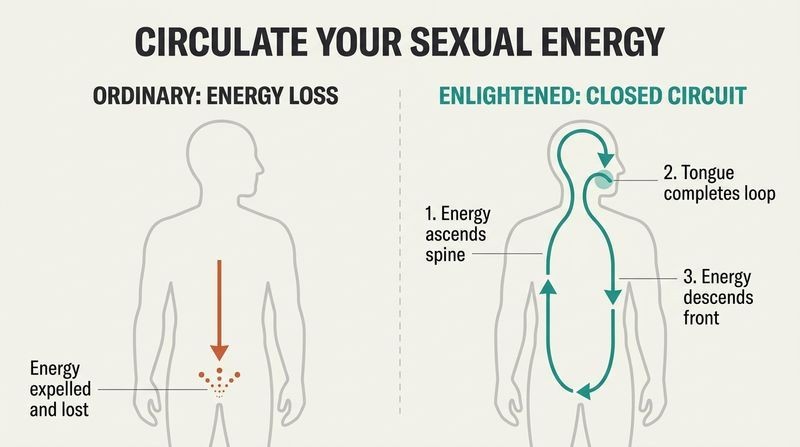
This is the microcosmic orbit of Taoist neigong, repackaged for Western bedrooms. Whether subtle energy literally circulates is unfalsifiable, but the instructions double as effective attention and relaxation techniques: tongue placement and soft gaze both reduce facial and jaw tension, and directing attention along the spine is a form of interoceptive focus that meditation research links to reduced rumination. The framework's real genius is giving distracted lovers something concrete to do with rising arousal besides rushing to climax. Skeptics can treat the energy talk as metaphor and still benefit. The claim that stalled energy becomes compulsive thinking is a memorable, if unprovable, reframe of post-arousal restlessness.
For men, ejaculation is a depleting habit worth bypassing
Relief is not the same as fulfillment. Deida argues the male ejaculatory orgasm feels good for a few seconds, then leaves depletion he calls relaxation only because there is less energy left to feel. He describes discovering this as a teenager: after masturbating without ejaculating he felt luminous and strong, but a single ejaculation dimmed the room, weakened his body, and flattened his breath.
Bypassing requires two things working together:
1. Technical practice: contracting the pelvic floor to bounce energy up the spine while breathing and softening the belly.
2. Feeling-sensitivity: actually opening as love rather than mechanically retaining semen.
Technique alone, he warns, makes you a non-ejaculatory robot. Only when love drives the process do you unlock the multiple, whole-body orgasms that fill rather than empty you.
The idea of orgasm without ejaculation has ancient pedigree in Taoist and tantric texts and a modern echo in reports of multi-orgasmic men who separate the two events. Physiologically, orgasm and ejaculation are distinct neural events, so the practice is not fantasy. The refractory period after ejaculation, driven by prolactin and other neurochemicals, plausibly maps onto Deida's felt depletion. What lacks evidence is that semen retention itself confers energy or health benefits, a claim the internet has since inflated into dubious territory. Deida's more defensible point is behavioral: reflexive, goal-driven climax narrows a man's attention and truncates intimacy, and slowing down expands both.
Match ejaculation frequency to your age, body, and depth of awareness
Ejaculation is an option, not a compulsion. Deida traces the male addiction to three roots: evolution rewarded fast, frequent impregnators; adolescent masturbation conditioned a stroke-and-spurt reflex; and daily habits of poor diet, shallow breath, and sexual fantasy build pressure that demands release. None of these, he insists, reflect true bodily need.
He treats the body like a battery drained by frequent ejaculation, cold weather, exhausting work, and poor diet, and recharged by non-ejaculatory sex, good food, and full breathing. His rough guide: a man in his twenties might ejaculate weekly and stay full, someone in his late thirties benefits from monthly, and men in their sixties may do best a few times a year. The truest gauge is not a schedule but whether you can still feel love through the ordinary events of your day.
The evolutionary logic is genuinely clever: rapid ejaculation was reproductively adaptive under predation and interruption, which reframes premature climax not as a defect but as an inherited default. That is a compassionate lens rarely offered elsewhere. The age-based frequencies, however, are folk prescription with no clinical backing, and some are contradicted by evidence that regular ejaculation correlates with lower prostate cancer risk in large cohort studies. Readers should hold the specific numbers loosely. The transferable insight survives regardless: distinguish authentic bodily signals from conditioned craving, the same discipline Deida models with his caffeine-withdrawal analogy, where cravings must clear before the body's real needs become legible.
Women have three orgasms: clitoral, vaginal, and cervical, each deeper
Most couples never get past the shallowest. Deida distinguishes three orgasmic depths, cautioning that women vary enormously and some are fully fulfilled without any orgasm at all.
1. Clitoral: quickest and most superficial, often involving tensing, held breath, and clamping down, closest to a male ejaculatory orgasm and achievable even mechanically with a vibrator.
2. Vaginal or G-spot: slower, taking thirty to forty minutes, involving the body opening rather than clenching, and requiring real trust.
3. Cervical: deepest, often needing forty-five minutes or more, described by women who experience it as a religious experience of total surrender and dissolution.
His point is not to rank women but to reveal a territory many never explore, leaving a lingering sense that something is missing despite plentiful clitoral orgasms.
This taxonomy is where Deida is on his shakiest empirical ground, and he candidly flags that as a man he cannot speak from inside the experience. Sexology has long debated whether the clitoral and vaginal orgasm are truly separate, with much research suggesting the clitoris (whose internal structure is far larger than the visible glans) is involved in most orgasms regardless of stimulation site. The very existence of a distinct G-spot remains contested. Yet many women do report qualitatively different, deeper orgasmic experiences with penetration and emotional surrender, which the anatomy-only debate fails to capture. Deida's framing usefully centers trust and time as prerequisites, which is empirically robust.
The vagina stores old trauma; patient massage can release it
Emotional residue lives in tissue. Deida claims the G-spot and cervical areas often hold the accumulated stress of past abuse, insensitive lovers, and years of unfulfilling sex, showing up as numbness or pain to the touch. Counterintuitively, sensitivity is a good sign: it reveals a responsive area that has shut down and can reopen.
His method is slow, verbal, and consensual. A trusted partner massages the area while the receiver gives constant instructions (slower, harder, move away). Unexpected anger, grief, or fear may surface. Rather than stopping, the receiver keeps breathing and feeling through the emotion, sometimes shouting or weeping, until the knot dissolves. This can take a single session or several months. Once relaxed, the tissue responds to pleasure that was previously blocked.
This anticipates the now-mainstream idea that trauma is stored somatically, popularized by Bessel van der Kolk's The Body Keeps the Score, and parallels practices like pelvic floor physical therapy and somatic experiencing. The nervous system does encode threat in guarding patterns, and the pelvic floor is a common holding site. Deida deserves credit for insisting on explicit, moment-to-moment verbal consent and for warning that intense emotional flooding is a reason to pause and be held. The serious caveat, which he does gesture at by recommending professional supervision, is that reliving trauma without a trained container can retraumatize. This is powerful terrain to enter carefully, not casually.
Sexual sameness kills desire; polarity between masculine and feminine ignites it
Deida learned this the hard way. As a teenager raised to treat everyone identically, he assumed sameness meant fairness. In a parked car his girlfriend showed him she wanted him to know her and lead; when he later threw the choice back on her (just be yourself, do what you want), she slammed the bathroom door. She wanted to surrender the lead, not carry it.
His framework: attraction runs on the tension between two forces, equal in power but opposite in flavor.
1. The masculine gift is trustable, directing consciousness, seeing the big picture and taking lovers somewhere.
2. The feminine gift is radiant, flowing life energy, untamed pleasure and devotion.
Either partner of any gender or orientation can play either pole, even alternating. But collapse the difference into neutral sameness and sex becomes friendly massage, not ravishment.
This is Deida's most famous and most polarizing idea. It resonates because it names something many couples feel after years together: comfort breeds companionship but drains erotic charge. Esther Perel's work on desire independently reaches a strikingly similar conclusion, that eroticism thrives on distance, mystery, and otherness rather than merged closeness. Deida decouples the poles from biological sex, which blunts the essentialist critique, though his heavily gendered vocabulary still invites it. The sharpest objection is that framing dominance and surrender as masculine and feminine can smuggle in stereotypes. Read functionally rather than literally, the insight stands: erotic energy needs a gap to leap across.
Feel your partner's energy instead of mentally decoding their moods
Deida's origin story is a bookstore. At twelve he was approached by an obese old man who had recovered from paralysis through visualized yoga. The man had the boy push on his shoulder; even balanced on one leg, he could not be budged. The lesson: true power is energetic, not muscular. When Deida resisted with muscle, his friend could bend his arm; when he felt energy flowing through it, the arm became immovable.
Years later this transformed his sex life. He had failed with girlfriends by trying to mentally figure out their contradictory moods. Once he learned to feel their shifting currents of energy and respond in real time (a gentle kiss here, a ravishing thrust there), their bodies opened. Their moods, he realized, had been tests of whether he could feel them rather than analyze them.
The distinction between analyzing and attuning maps onto the psychological concept of affect attunement, the moment-to-moment resonance a caregiver offers an infant that Daniel Stern identified as foundational to emotional bonding. Deida is essentially arguing that great lovers extend this preverbal attunement into adulthood. It also echoes findings on emotional attunement in couples therapy, where responsiveness to a partner's underlying feeling predicts relationship satisfaction far better than problem-solving does. The bookstore parable is almost certainly embellished, and the arm-strength demonstration is a known party trick exploiting biomechanics, not chi. But as a metaphor for presence over cognition, it lands with unusual force.
Make love for at least forty-five minutes to open the body's knots
Something shifts around the forty-five-minute mark. Deida observes that short sex tends to spill energy through orgasm before the deeper knots of tension can open. Sustained lovemaking lets urgency smooth out into a calmer, wider state that no quick climax delivers. Deep cervical orgasms, he notes, typically do not emerge until after forty-five minutes or more.
The knots are the point. Every fear and hurt of daily life (a stock market drop, a late child, a partner's threat to leave) tightens a knot of stored tension in the body. Short sex lets us dodge these by discharging quickly. Long sex forces us to breathe and feel through them, which can bring up nausea, panic, or the urge to shout strange things like I hate you. He recommends practicing at least one forty-five-minute session weekly for a month, with a clear way to signal stop.
The specific number is best read as a heuristic rather than a law, but the underlying physiology is plausible: extended arousal without climax keeps parasympathetic and oxytocin systems engaged far longer, deepening bonding and relaxation. The framing of sex as a place where suppressed emotion surfaces aligns with somatic psychology and even with the well-documented phenomenon of post-coital emotional release and unexpected crying. The instruction to establish a safeword and to keep breathing through difficult feeling is responsible and often absent from more mechanical guides. The risk is turning intimacy into an endurance test scored by the clock, which would betray Deida's own emphasis on love over performance.
Emotional closure is your own choice; open your heart even when hurt
This is the whole book distilled. Deida insists that no matter who abused, jilted, or ignored us, closing the heart is ultimately our own action in the present moment. Nothing outside us has the power to limit our capacity to love. We suppress this truth mainly by holding the breath and clenching the belly, tying ourselves into knots.
The final practice is deceptively simple: feel beyond your own body into your partner's, then beyond even your partner to the whole present moment. When your lover closes down, rejects, or betrays you, your heart reflexively closes to protect itself, but a protected heart cannot feel and is therefore a limit on love. The discipline is to reopen, again and again, in many short moments. Stub your toe, say ouch, then reconnect. Technique without this open-hearted feeling produces a mechanical robot, never a superior lover.
Ending a sex manual on radical responsibility for one's own openness elevates it above technique. The claim resonates with Stoic and cognitive-behavioral insight that events do not disturb us, our judgments about them do, and with attachment research showing that the capacity to stay open and non-defensive during conflict distinguishes secure bonds. The bold and debatable move is extending this to trauma and betrayal, where insisting the wound is a choice risks tipping into spiritual bypassing or blaming the injured. Deida partly guards against this by endorsing therapy and protection from abuse. Read charitably, the message is empowering: you are the author of your next moment of love or closure.
Analysis
David Deida's 2004 manual is a hybrid that resists easy shelving: part Taoist and tantric energy manual, part erotic memoir, part nondual spiritual teaching. Its structure moves from breath and energy circulation, through orgasm retraining, into physical variations, and finally into formal energy exercises like mula bandha and the microcosmic orbit. The animating thesis is that sex and enlightenment are the same project: the practice of opening completely as love rather than contracting into a defended self. Everything technical serves that end.
The book's genuine value lies in three places. First, it takes slowness, breath, and presence seriously as sexual skills, anticipating mainstream ideas about parasympathetic arousal, interoception, and somatic trauma storage by a decade or more. Second, its polarity theory, that erotic charge depends on maintained difference rather than merged sameness, independently converges with Esther Perel's influential work on desire and gives long-term couples a diagnostic for lost passion. Third, its closing insistence on self-responsibility for opening or closing the heart lifts the material from technique into ethics.
The weaknesses are equally clear. Deida's energetic and physiological claims are largely unfalsifiable and occasionally contradicted by evidence, particularly the notion that ejaculation is inherently depleting and the rigid age-based frequency prescriptions. The three-orgasm taxonomy enters contested sexological territory, which Deida honorably flags given his obvious epistemic limits as a male author. His heavily gendered masculine and feminine vocabulary, though explicitly decoupled from biological sex and orientation, still invites essentialist misreading.
What makes the book durable is its refusal to let technique stand alone. Deida repeatedly warns that mechanics without love produce a non-ejaculatory robot, and that the deepest orgasm changes nothing unless it becomes a doorway to everyday openness. That framing, more than any specific exercise, is why the work still circulates among readers seeking depth rather than performance.
Review Summary
The Enlightened Sex Manual receives mixed reviews. Many praise its spiritual approach to sexuality, focusing on energy circulation, breath work, and deepening intimacy. Readers appreciate Deida's insights on masculine/feminine polarity and practical exercises. Some find the book transformative, while others criticize its esoteric language and repetitiveness. Critics argue it lacks scientific backing and objectivity. The book explores topics like orgasms, ejaculation control, and emotional openness. Overall, it's seen as thought-provoking but potentially controversial, appealing more to those open to spiritual perspectives on sexuality.
People Also Read









FAQ
What's "The Enlightened Sex Manual" about?
- Comprehensive Guide: "The Enlightened Sex Manual" by David Deida is a comprehensive guide to enhancing sexual experiences through spiritual and emotional connection.
- Focus on Energy and Orgasm: The book emphasizes the importance of circulating sexual energy and understanding different types of orgasms for both men and women.
- Spiritual and Physical Union: It aims to transform physical intimacy into a spiritual practice, merging physical pleasure with emotional and spiritual depth.
- For All Relationships: The manual is designed for men and women, singles and couples, of every sexual orientation, providing a complete program for sustaining love's light in sexuality.
Why should I read "The Enlightened Sex Manual"?
- Enhance Sexual Skills: The book offers practical techniques to improve sexual skills, making you a superior lover.
- Spiritual Growth: It integrates spiritual growth with sexual intimacy, offering a path to deeper personal and relational fulfillment.
- Emotional Connection: The manual emphasizes the importance of emotional connection and open-hearted loving in sexual experiences.
- Universal Application: Its teachings are applicable to all types of relationships, making it a versatile resource for anyone interested in deepening their intimate connections.
What are the key takeaways of "The Enlightened Sex Manual"?
- Energy Circulation: Learn to circulate sexual energy throughout the body to enhance pleasure and intimacy.
- Types of Orgasms: Understand the different types of orgasms for men and women, and how to achieve them.
- Breath and Relaxation: Use breath and relaxation techniques to sustain high levels of energy and deepen sexual experiences.
- Emotional and Spiritual Openness: Embrace emotional and spiritual openness as a path to more fulfilling sexual and personal relationships.
How does David Deida suggest using breath in "The Enlightened Sex Manual"?
- Arouse and Relax Genitals: Use breath to both arouse and relax the genitals, enhancing sexual pleasure and control.
- Energy Circulation: Breath is a tool to circulate energy throughout the body, moving it from the genitals up the spine and down the front.
- Sustain Energy Levels: Proper breathing helps sustain high levels of energy during sexual activity, preventing premature ejaculation or energy depletion.
- Emotional Release: Deep breathing can also aid in emotional release, helping partners connect more deeply.
What are the different types of orgasms discussed in "The Enlightened Sex Manual"?
- Clitoral Orgasms: These are the most common and easiest to achieve, often involving direct stimulation of the clitoris.
- Vaginal Orgasms: These involve deeper stimulation, often requiring more time and emotional connection to achieve.
- Cervical Orgasms: Considered the most profound, these orgasms involve deep penetration and emotional surrender.
- Whole-Body Orgasms: Achieved through energy circulation, these orgasms involve the entire body and can be deeply rejuvenating.
How can men bypass ejaculation for greater pleasure according to "The Enlightened Sex Manual"?
- Energy Redirection: Learn to redirect sexual energy up the spine instead of releasing it through ejaculation.
- Breath Control: Use breath to manage and circulate energy, preventing the urge to ejaculate.
- Pelvic Floor Contraction: Practice contracting the pelvic floor to control and redirect energy.
- Emotional and Spiritual Focus: Shift focus from physical release to emotional and spiritual connection with your partner.
What is the role of the pelvic floor in "The Enlightened Sex Manual"?
- Energy Seal: The pelvic floor acts as a seal to prevent energy leakage, helping to circulate it throughout the body.
- Upward Contraction: Contracting the pelvic floor helps redirect energy up the spine, enhancing sexual experiences.
- Strengthening Exercises: Regular exercises can strengthen the pelvic floor, improving sexual control and pleasure.
- Emotional Release: A relaxed pelvic floor can also aid in emotional release, contributing to deeper intimacy.
How does "The Enlightened Sex Manual" address emotional and spiritual openness?
- Embrace Vulnerability: Encourages embracing vulnerability as a path to deeper emotional and spiritual connection.
- Open-Hearted Loving: Stresses the importance of open-hearted loving, where partners fully accept and understand each other.
- Emotional Healing: Sexual energy circulation can aid in emotional healing, helping partners overcome past traumas.
- Spiritual Union: The ultimate goal is to achieve a spiritual union, where physical intimacy becomes a form of spiritual practice.
What are some techniques for stimulating sexual energy in "The Enlightened Sex Manual"?
- Whole-Body Involvement: Involve the entire body in sexual experiences, not just the genitals, to enhance energy flow.
- Biting, Slapping, Pinching: Use these techniques to move stagnant energy and increase arousal.
- Lips, Nipples, Genitals: Focus on these areas to stimulate and circulate energy throughout the body.
- Breath and Movement: Coordinate breath with movement to enhance energy flow and deepen intimacy.
What are the best quotes from "The Enlightened Sex Manual" and what do they mean?
- "Sex can be enlightened - or not." This quote emphasizes the potential for sex to be a profound spiritual experience, not just a physical act.
- "Love's light wants to express itself through our bodies." Highlights the idea that sexual energy is a form of love's expression, seeking to manifest through physical intimacy.
- "Infinite love is who we really are and who we refuse to be." Suggests that our true nature is boundless love, but we often resist this openness due to fear or past experiences.
- "The primary purpose of enlightened sex is to live as love." Reinforces the book's central theme that sex should be an expression of love, transcending mere physical pleasure.
How does "The Enlightened Sex Manual" suggest dealing with sexual energy exercises?
- Regular Practice: Emphasizes the importance of regular practice to develop sensitivity and control over sexual energy.
- Personalization: Encourages personalizing exercises to suit individual needs and preferences for maximum effectiveness.
- Partner Involvement: Involves partners in exercises to enhance mutual understanding and deepen connection.
- Spiritual Growth: Exercises are not just for physical pleasure but also for spiritual growth and emotional healing.
What is the significance of the masculine and feminine energies in "The Enlightened Sex Manual"?
- Polarity and Attraction: The book highlights the importance of masculine and feminine polarity in creating sexual attraction and depth.
- Masculine Presence: The masculine energy is about providing direction and consciousness, helping to guide the sexual experience.
- Feminine Radiance: The feminine energy is about expressing love and pleasure, enhancing the emotional and spiritual connection.
- Balance and Play: Encourages partners to explore and balance these energies, allowing for a dynamic and fulfilling sexual relationship.
About the Author
Other books by David Deida







Download PDF
Download EPUB
.epub digital book format is ideal for reading ebooks on phones, tablets, and e-readers.








































