

Key Takeaways
You're probably turning princes into frogs without knowing it
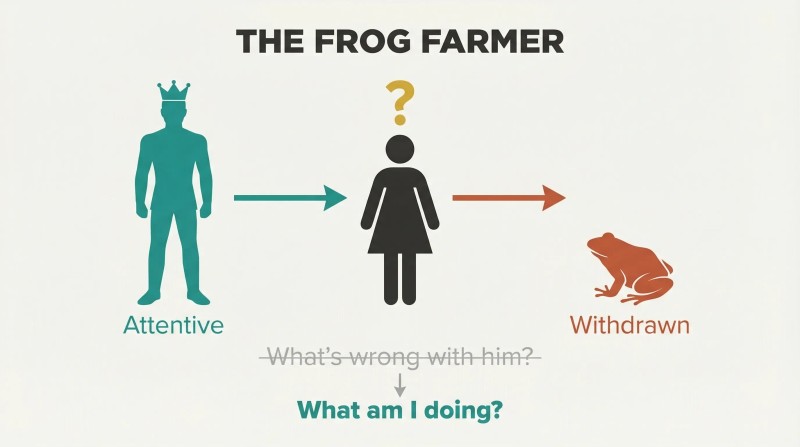
The Frog Farmer revelation. At a seminar, a speaker tells a frustrated woman she doesn't turn frogs into princes — she turns princes into frogs. Kimberlee, the book's protagonist, realizes every man she's dated started wonderful and ended distant. She'd assumed the prince was a facade and the frog was the truth. But what if she caused the change?
A Frog Farmer is a woman who unknowingly brings out the worst in men — turning attentive partners into withdrawn ones. The book argues Frog Farming is the norm, not the exception. But here's the liberating part: if you're the cause, you can stop. That's far easier than trying to change a man. The question shifts from "what's wrong with him?" to "what am I doing that transforms him?"
Stop measuring men against an idealized woman and calling it 'misbehavior'
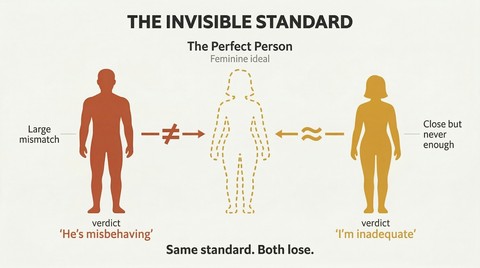
Women hold an invisible standard. The Perfect Person is an unconscious ideal based on feminine qualities — the perfect amount of the perfect qualities at the perfect time. Since women are naturally closer to this standard, men always fall short. They appear to be doing the wrong thing on purpose.
This triggers a destructive cascade:
1. He's misbehaving
2. Because he doesn't love, respect, or care enough
3. Because something is wrong with me
4. How do I know what's wrong? By comparing myself to the Perfect Person too
The Perfect Person attacks your self-esteem from both sides. It makes men seem defective and makes you feel inadequate — all because you're measuring a man against a standard designed for a woman.
Lay down your sword — emasculation destroys him and disempowers you
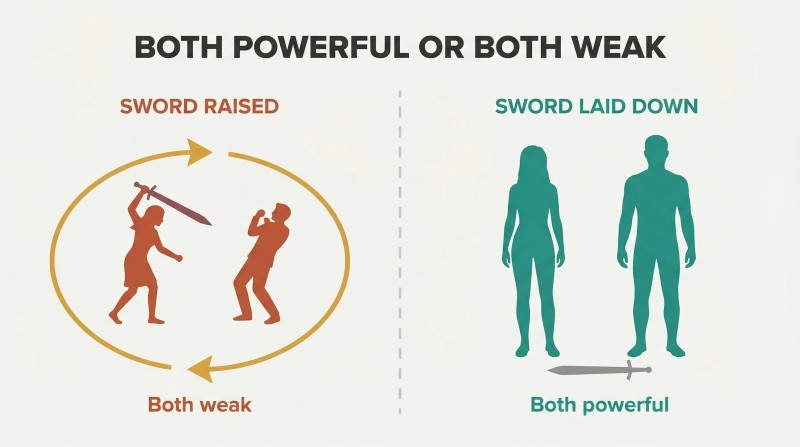
Emasculation is how Frog Farming works — "depriving men of strength, power, or efficiency" through criticism, rolled eyes, cold shoulders, withholding appreciation, and proving you don't need him. Long-term effects transform men's natural responses into their opposites: compete instead of cherish, distance instead of intimacy, suspicion instead of trust, disdain instead of respect, fear instead of love.
The foundational step of the Queen's Code is a vow: "I give up the right to castrate men forever." This doesn't mean you'll never slip — it's an old habit. But you stop justifying it and apologize when you catch yourself. Every time you diminish a man's power, you reinforce your own feelings of weakness. The vicious cycle can only break when someone lays down the sword.
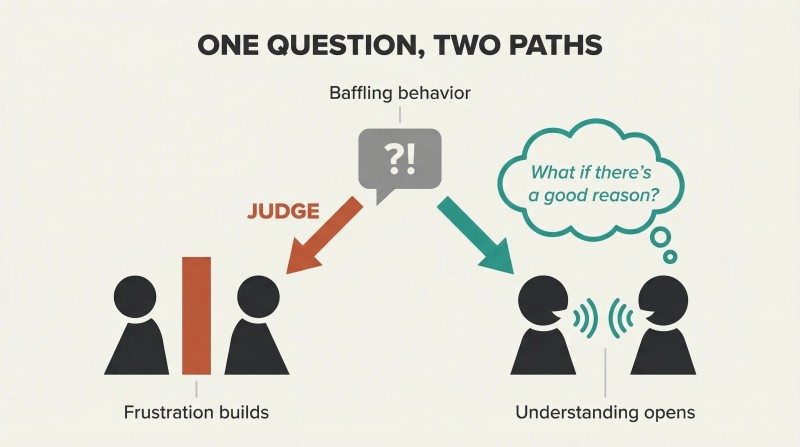
Replace judgment with 'What if there's a good reason for that?'
One question changes everything. Every time a man does something baffling or irritating, ask: "What if there's a good reason for that?" This interrupts the impulse to punish and opens genuine curiosity. When Kimberlee asked her boss Raul why he kept briefing her on corporate politics — assuming he was griping — she discovered he was grooming her as his successor. Years of frustration evaporated in one honest conversation.
To ask a man directly, start with: "I assume you have a good reason for everything you do. Would you be willing to tell me why?" Then wait. Don't rephrase the question. Don't offer multiple-choice options. Count to twenty at every pause. Men retrieve answers from deep storage — their treasures are yours if you can simply be patient enough.
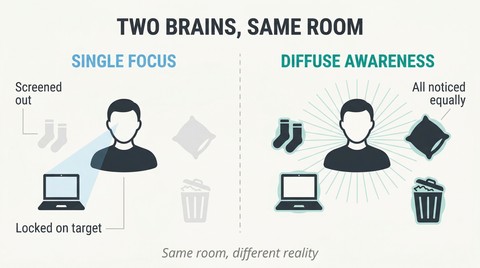
He's not ignoring the socks — his brain literally screened them out
Testosterone and estrogen wire different brains. The masculine brain has Single Focus — it locks onto one result and screens out everything irrelevant. The feminine brain has Diffuse Awareness — consciousness spread in every direction, aware of every crooked pillow, emotional state, and overflowing trash can. These aren't character flaws; they're neurological architecture.
This explains most daily friction. She sees socks on the floor and they "yell" at her to pick them up. He steps over them without registering they exist — because they're irrelevant to whatever he's committed to. She thinks he's ignoring her standards. He literally cannot perceive what she perceives. Neither is misbehaving. They're running different operating systems. Understanding this single distinction prevents a lifetime of misplaced resentment.
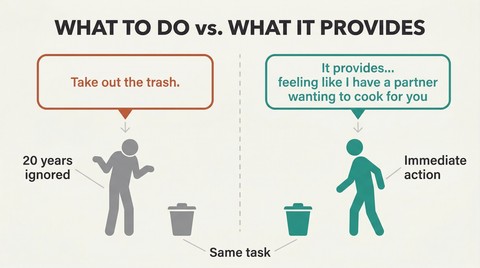
Tell a man what something will provide — not just what to do
"Provide" is the first word in the Language of Heroes — five terms that resonate with a man's deepest sense of purpose. Men don't care about tasks for their own sake. "To a man, nothing is worth doing, but much is worth providing." They need to know: How will this make her life better? What difference will it make?
The trash can proves the point. Karen nagged her husband Mike for twenty years to take out the kitchen trash. Nothing worked. When she told him what it would provide — feeling like she had a partner, wanting to cook for him, not feeling like a maid — he was stunned: "That would impress you?" He'd never resisted the task. He simply never knew it mattered. Tell a man what something provides, and the task becomes worth his undivided attention.
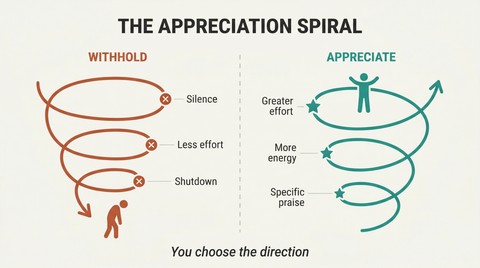
Appreciation is a man's fuel — stinginess shuts him down, not up
Men run on a point system. They measure their worth by the difference they make for someone they care about. A wife's or partner's points carry the highest value. When Karen told Mike specifically what his actions provided — safety, partnership, feeling ladylike — she was giving him points in the most valuable currency: concrete evidence he'd made her life better.
Withholding points backfires spectacularly. Many women think being stingy with appreciation will make men try harder. The opposite happens — it "prevents him from playing at all." Each specific acknowledgment gives a man energy to provide more. Each withheld one drains it. Men invest where they win the most points. The appreciation spiral goes up or it goes down. You choose the direction.
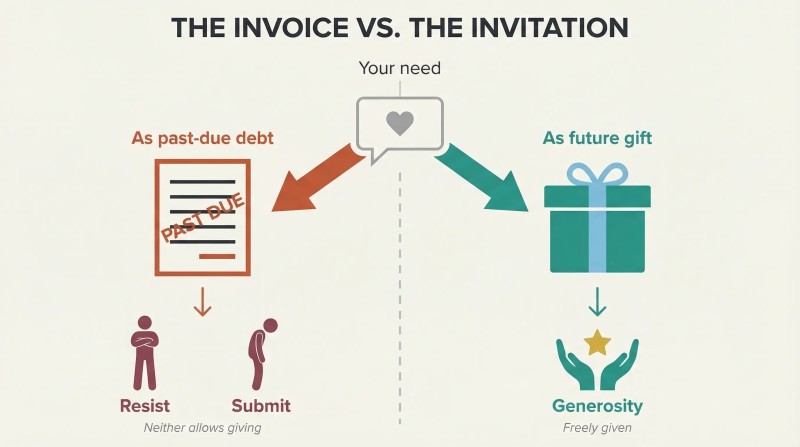
State your needs as future gifts, not past-due debts
Demanding doesn't work. Most women establish what they deserve by cataloging past sacrifices. But "deserve" is past tense — it turns a request into an invoice. There are only two responses to a demand: resist or submit. Neither allows generosity.
The Queen's alternative is a six-step Needs Conversation:
1. Ask for a time to talk about something you need
2. Thank him for what he already provides
3. State your need using the word "Need" with specifics
4. Tell him what receiving it would provide for you
5. Ask the Partner Question: "Is there anything you need to give me this?"
6. Ask how to show appreciation
This frames every request as a future gift rather than a past-due payment. You can't deserve a gift — that's what makes it one.
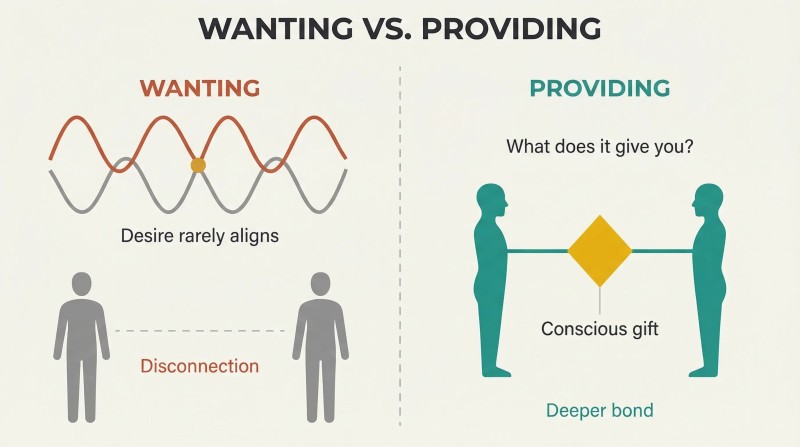
Base your sex life on providing, not on waiting to 'want' it
"Wanting" is too unreliable for something this important. Hormones fluctuate. Timing rarely aligns. If both partners must simultaneously desire sex for it to happen, it won't happen often enough for either person's wellbeing — or the relationship's survival. The book argues "providing" is a more sustainable foundation: having sex for what it gives your partner and your union, not just when desire strikes.
This requires one critical exchange: each partner shares what sex actually provides for them — physically, emotionally, spiritually. When Mike revealed that sex gave him vulnerability, safety, and spiritual connection, Karen was stunned. She'd assumed it was merely physical for him. Knowing what sex provides transforms it from an obligation into a conscious gift between two people who finally understand the stakes.
Call a man your hero and watch his shoulders square
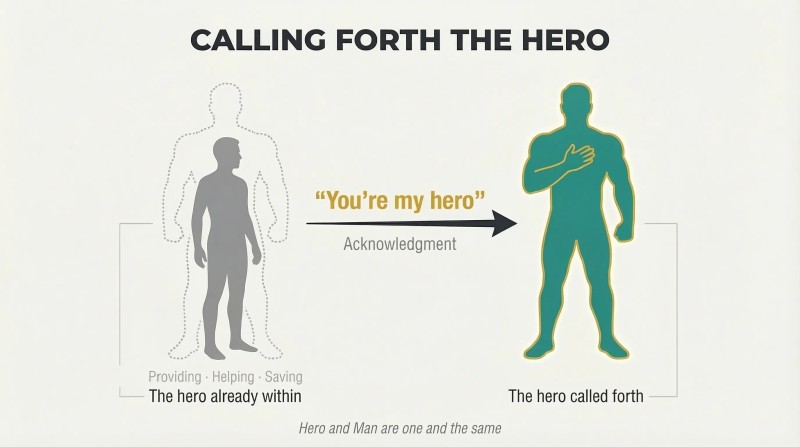
"Hero" is the fifth and final word in the Language of Heroes. From boyhood, males dream of saving the day. As men, they fulfill this through the other four words — Providing what's Needed, Helping when someone's overwhelmed, Saving from danger and drudgery. But heroism lives in the act; the word "Hero" lives in the acknowledgment. A queen's job is to see it and name it.
When Kimberlee told her boss Raul he was her hero, his hand went to his chest and his eyes teared up. He protested he didn't deserve the word — men often think heroism requires saving a life. The book's response: "I need you to receive this. What you did was heroic to me." Acknowledging a man's quiet heroics — believing in you, supporting your growth, worrying about you — calls forth the hero he already is.
Analysis
The Queen's Code occupies a peculiar position in relationship literature. Published in 2013, it predates the cultural moment when gender discussions became hyperpolarized, yet its core claims would be even more provocative today. Armstrong's central thesis — that women systematically diminish men through emasculation and would benefit from learning a 'Language of Heroes '— could be mistaken for retrograde gender essentialism. It is not.
What Armstrong constructs is closer to applied anthropology delivered through fiction. Her framework rests on neurobiological differences — Single Focus versus Diffuse Awareness, testosterone versus estrogen effects on brain architecture — rather than moral claims about which gender is superior. The five Hero words (Provide, Need, Help, Save, Hero) function as communication protocols, not submission rituals. They are the relationship equivalent of learning another culture's language rather than shouting louder in your own.
The book's most radical claim is also its most testable: that a single woman changing her behavior can unilaterally transform the men around her. Armstrong stacks narrative evidence — Kimberlee's workplace, Karen's marriage — to show cascading effects from one person's paradigm shift. This is psychologically sound; behavioral reciprocity is well-documented in social psychology. The mechanism she proposes (removing threat → removing defensive posture → revealing prosocial behavior) mirrors findings in attachment theory research.
The weaknesses are real. The fictional vehicle, while making dense material digestible, lets Armstrong control all outcomes. No man in the novel responds poorly to the new approach. Real relationships include personality disorders, addiction, and genuine incompatibility. Her acknowledgment of 'dangerous men' (roughly 3%) feels perfunctory given the weight placed on women's responsibility for men's behavior.
Still, the framework succeeds where most relationship advice fails: it gives women specific, immediately testable language changes — not just attitudes — that produce observable behavioral shifts. That makes it more engineering manual than self-help platitude.
Review Summary
The Queen's Code receives mixed reviews. Many praise its insights into male-female relationships and communication, finding it transformative. Critics argue it places too much responsibility on women and lacks accountability for men. The writing style is often criticized as poor or cheesy. Some find the content enlightening but struggle with the delivery. Positive reviewers appreciate the book's perspective on understanding men and improving relationships. Negative reviews cite concerns about gender stereotypes and outdated views. Overall, readers acknowledge valuable information but debate its presentation and broader implications.
People Also Read



Glossary
Frog Farming
Unknowingly bringing out men's worstA woman's pattern of unknowingly transforming men from their best selves ('princes') into their worst ('frogs') through emasculation, criticism, and comparing them to a female-based standard of perfection. The opposite of being a 'queen' who brings out the best in men. The term originates from a seminar speaker's observation that most women turn princes into frogs rather than vice versa.
The Perfect Person
Unconscious female-based ideal standardAn invisible, idealized standard of human behavior unconsciously based on feminine qualities — the perfect amount of the perfect qualities at the perfect time. Women use it to judge men (concluding they're misbehaving), then judge themselves (concluding they're inadequate). It drives both emasculation of men and erosion of women's self-esteem in a self-reinforcing cycle.
The Queen's Code
Honor code and communication systemA dual framework for women's relationships with men. As a code of honor, it centers on the vow to give up the right to emasculate men forever. As a 'secret code,' it comprises the Language of Heroes — five words that connect with men's deepest purpose. Developed over 500 years by women in the protagonist's family who studied men, it aims to replace adversarial gender dynamics with partnership.
Language of Heroes
Five words resonating with menFive specific words — Provide, Need, Help, Save, and Hero — that connect directly to a man's highest sense of purpose and identity. When spoken sincerely, these words resonate with men's core motivation as providers and protectors, functioning as calls to action. Each word requires a specific internal attitude from the speaker; without sincerity, the words become manipulative and counterproductive.
Single Focus
Masculine brain's one-thing-at-a-time wiringThe testosterone-shaped brain's tendency to commit attention to one result at a time, screening out everything deemed irrelevant. This explains why men don't notice socks on the floor, can't answer questions while focused on another task, and appear stubborn or unresponsive. It is neurological architecture, not willful ignorance. Women can operate in Single Focus but it depletes them faster due to lower testosterone.
Diffuse Awareness
Feminine brain's all-directions consciousnessThe estrogen-shaped brain's tendency to spread consciousness in every direction simultaneously, registering the mental, physical, and emotional states of all people and objects in the environment. This creates the experience of a messy room 'nagging' a woman, drives multitasking behavior, and explains why women can sense a partner's frustration even when nothing is said. It is virtually the opposite of Single Focus.
Breaking Point
When needs pierce Single FocusThe moment when a physical or emotional need — hunger, sleep, sex, stretching — breaks through a man's Single Focus and demands immediate attention. Because Single Focus screens out growing needs until they become critical, men often appear to go from zero to desperate instantly. This explains sudden food-grabbing, falling asleep anywhere, and the urgency with which men pursue sex — their awareness of the need only arrives at the crisis point.
Pumpkin Hours
Times when sex causes resentmentNamed after Cinderella's coach turning back into a pumpkin, these are the specific times or circumstances when a request for sex will create anger or resentment rather than pleasure — such as after a certain hour at night, during intense work projects, or when sleep-deprived. Partners must share their Pumpkin Hours explicitly to prevent hurt feelings from the right offer at the wrong time.
Cover Charge
Requirements for each intimacy levelWhat a person requires before engaging in each level of intimacy, from hand-holding to sex. Named after the fee to enter an establishment. The concept involves thinking through requirements in advance — what conditions, trust levels, or relationship milestones must be in place — and communicating them to a partner before they 'run into a barbed-wire fence' by overstepping an unstated boundary.
Let's Make a Deal
Process for negotiating conflicting needsA conflict resolution process where each partner states 'If I had it all my way...' describing their complete heart's desire (not choosing from a menu of what seems available), then explains what that would provide. After both sides are fully heard, creative problem-solving begins with the goal of giving the most while receiving the least needed to be happy. Deals must be written down because memory is tied to instinct and cannot retain these conscious partnership moments accurately.
The Partner Question
Asks what he needs to giveThe question 'Is there anything you need to give me what I need?' — asked after stating a need and what it would provide. This transforms a request from a one-way demand into a collaborative exchange, inviting the man to participate in solving the problem rather than merely complying. The answer often surprises women because men's requirements are typically simpler than expected.
Waiting for the Well
Listening by waiting through silencesA listening technique where, after asking a man a question, you wait silently for 20-30 seconds at each pause instead of rephrasing, offering multiple choice, or filling the silence. The metaphor imagines the man making trips to a deep vault where he keeps his treasures — each pause represents another trip, and each load of insight is yours if you can wait. Men will eventually say 'That's all' or 'I'm done' when finished.
Listening to Learn
Hearing values instead of agreeing/disagreeingA listening mode where, instead of evaluating whether you agree or disagree with someone's opinion, you listen with the internal question: 'What matters to this person?' or 'What is he showing me about himself?' Since a man's opinions are formed from his values plus trusted information, they are expressions of identity. Listening to Learn reveals who he is and creates understanding and intimacy, rather than the false connection of agreement or the anxiety of disagreement.
FAQ
What is The Queen’s Code by Alison A. Armstrong about?
- Relationship transformation: The book explores why women often feel frustrated with men and how misunderstandings arise in romantic and other relationships.
- Ancient wisdom: It introduces a 500-year-old tradition, the Queen’s Code, passed from mother to daughter, teaching women how to understand and inspire men.
- Story-driven learning: Through the journey of Kimberlee and Karen, readers are guided from frustration to empowerment, learning new ways to communicate and connect with men.
- Focus on partnership: The narrative emphasizes honesty, vulnerability, and mutual respect as the foundation for healthier, more fulfilling relationships.
Why should I read The Queen’s Code by Alison A. Armstrong?
- Unique perspective on men: The book challenges common assumptions about men’s behavior, offering a fresh lens that men are motivated differently, not misbehaving.
- Practical relationship tools: Readers gain actionable advice, including communication strategies and the “Language of Heroes,” to inspire men’s best selves.
- Empowerment and healing: The Queen’s Code helps women break cycles of emasculation and objectification, fostering mutual respect and love.
- Holistic approach: It addresses emotional, physical, and spiritual aspects of relationships, providing a comprehensive framework for lasting intimacy.
What are the key takeaways from The Queen’s Code by Alison A. Armstrong?
- Understanding men’s motivations: Men are primarily driven by the desire to provide and are wired for “Single Focus,” which shapes their actions and priorities.
- Communication is crucial: Using specific language and assuming good intentions can transform how women relate to men.
- Breaking harmful cycles: Recognizing and stopping patterns like emasculation and objectification is essential for healthy relationships.
- Receiving and appreciation: Women’s ability to receive graciously and express appreciation is vital for empowering men and deepening connection.
What is the concept of “Frog Farming” in The Queen’s Code by Alison A. Armstrong?
- Definition and metaphor: “Frog Farming” describes how women unintentionally bring out the worst in men, turning “princes” into “frogs” through negative behaviors and attitudes.
- Root of relationship issues: The book identifies Frog Farming as a major cause of frustration, emasculation, and withdrawal in men.
- Path to change: Recognizing this pattern empowers women to shift their approach, learning the Queen’s Code to inspire men’s best qualities.
- Foundation for transformation: Understanding and ending Frog Farming is presented as the first step toward healthier, more fulfilling partnerships.
What does it mean to “give up the right to castrate men forever” in The Queen’s Code by Alison A. Armstrong?
- Central commitment: Women are encouraged to stop emasculating men—criticizing, withholding appreciation, or diminishing their power.
- Progress, not perfection: The vow is about ending justifications for such behavior and sincerely apologizing when mistakes happen.
- Empowerment through respect: This commitment leads to relationships where men feel respected and empowered, and women feel safer and more connected.
- Breaking negative cycles: It helps end the cycle of punishment and withdrawal that damages intimacy and trust.
What is the “Language of Heroes” in The Queen’s Code by Alison A. Armstrong?
- Five key words: The Language of Heroes consists of Provide, Need, Help, Save, and Hero—words that resonate deeply with men’s sense of purpose.
- Empowering communication: Using these words with sincerity helps women express needs and appreciation in ways men understand and respond to.
- Requires genuine attitude: The effectiveness of this language depends on a woman’s authentic stance and intention.
- Foundation for partnership: Mastering this language is essential for inspiring men and building mutual respect.
How does The Queen’s Code by Alison A. Armstrong explain men’s motivation and behavior?
- Single Focus: Men are described as having brains wired to focus on one thing at a time, committing fully to a single result.
- Driven to provide: Their primary motivation is to provide for their partners, families, and communities, seeking meaningful impact.
- Misunderstood priorities: Men may overlook tasks women find urgent, leading to misunderstandings; the book teaches women to frame requests in terms of what actions “provide.”
- Breaking Point concept: Men often don’t notice needs until they become critical and urgent, acting immediately when they reach a “Breaking Point.”
What is the role of “providing” in men’s relationships according to The Queen’s Code by Alison A. Armstrong?
- Core masculine drive: Providing is central to a man’s identity, encompassing emotional, physical, and spiritual support.
- Sex as provision: The book reframes sex as an act of providing, nurturing connection and safety rather than fulfilling a duty or desire.
- Mutual exchange: Women provide by receiving and expressing appreciation, creating a dynamic of giving and receiving.
- Recognition and appreciation: Men seek acknowledgment for their providing, and generous appreciation encourages them to give more.
How does The Queen’s Code by Alison A. Armstrong redefine sexual desire and intimacy?
- Beyond “wanting”: The book argues that relying on physical desire alone is unreliable and can lead to misunderstandings.
- Sex as providing: Sex is reframed as an act of providing for the partner and the union, focusing on benefits rather than impulse.
- Creating desire: Couples can consciously “cause wanting” by understanding each other’s needs, signals, and “Jump Starts.”
- Spiritual connection: Sex is presented as a physical expression of spiritual intimacy, healing and strengthening the relationship.
What are “Sexy Tank Fillers” and “Pumpkin Hours” in The Queen’s Code by Alison A. Armstrong?
- Sexy Tank Fillers: Activities that prepare a person to be receptive to intimacy, such as rest, massage, or feeling connected.
- Pumpkin Hours: Times when a person is unavailable for intimacy due to exhaustion or stress, helping partners avoid hurt feelings.
- Communication tool: Sharing these concepts helps couples time invitations for intimacy and avoid misunderstandings.
- Foundation for desire: Understanding and honoring these needs helps shift sex from a matter of “wanting” to “providing.”
How does The Queen’s Code by Alison A. Armstrong suggest women should communicate their needs to men?
- Use the word “Need”: Explicitly stating needs using the word “need” ensures clarity and avoids misunderstandings.
- Schedule conversations: Because men are Single Focused, it’s important to make appointments for “Needs Conversations” when men can give full attention.
- Explain benefits: Women should articulate what receiving their needs would provide, linking requests to positive outcomes.
- Two-way communication: Women are encouraged to ask men what they need to give what’s requested and how they prefer appreciation.
What are the effects of emasculation and objectification in relationships according to The Queen’s Code by Alison A. Armstrong?
- Emasculation defined: Criticizing or withholding appreciation diminishes men’s power, causing withdrawal and emotional distance.
- Objectification explained: Men may reduce women to a single dimension to manage overwhelm, creating a cycle of mutual harm.
- Long-term damage: Both behaviors erode trust, intimacy, and connection, leading to resentment and disconnection.
- Breaking the cycle: The Queen’s Code teaches how to lay down “swords” and embrace mutual respect to heal relationships.
How does The Queen’s Code by Alison A. Armstrong address the challenges of teaching its principles to others?
- Covenant of secrecy: The book reveals a tradition of only teaching the Language of Heroes within trusted circles to prevent misuse.
- Readiness and responsibility: Women must give up the right to emasculate men and use the knowledge to build partnerships, not manipulate.
- Community support: Like-minded women are encouraged to support each other in sustaining these teachings and creating cultural change.
- Real-life application: Through Kimberlee and Karen’s experiences, the book illustrates the challenges and rewards of applying and sharing these principles responsibly.
About the Author
Other books by Alison A. Armstrong

Download PDF
Download EPUB
.epub digital book format is ideal for reading ebooks on phones, tablets, and e-readers.








































