


Key Takeaways
You are love itself, and fear is the only thing dimming your bliss
The core premise is radical. Deida argues that at your deepest level you are not a person seeking love but love itself, an openness that yearns to shine out and be seen. Everything that blocks sexual and spiritual fulfillment traces back to one thing: fear, defined here as the contraction that pulls openness behind protective walls. Fear is the refusal to open, the negation of love.
Bliss requires daily practice. Whether partnered or alone, he insists your joy withers like an unwatered plant without a regular dose of whole-body pleasure and heart-offering. The test is immediate: is your breath right now soft and open, as if a lover were pressed against you, or tense with thoughts of survival and separation? Openness, not a better partner, is the doorway.
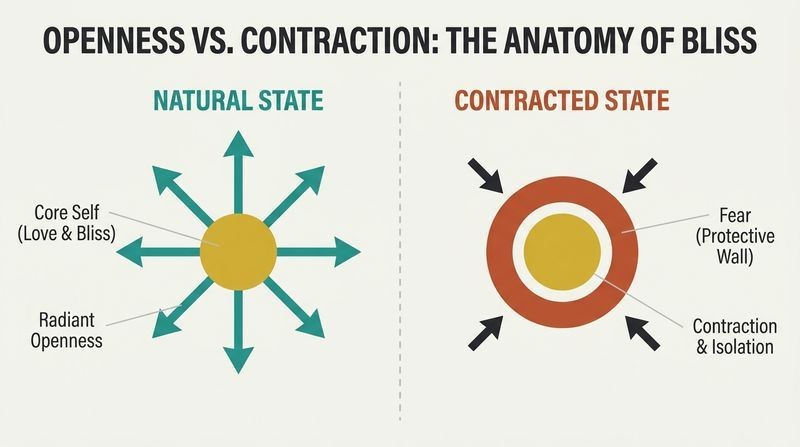
This reframes intimacy as a spiritual discipline rather than a transaction, echoing contemplative traditions from Rumi to Christian mysticism where the beloved is a portal to the divine. The claim that suffering is self-authored through contraction parallels Buddhist teaching on grasping and aversion. What's worth scrutinizing is the near-total attribution of relational dissatisfaction to internal fear. Attachment research and trauma studies suggest some closure is a rational response to genuine mistreatment, not merely fearful refusal. Deida's framework risks minimizing legitimate boundaries. Still, the invitation to locate agency in one's own openness, rather than waiting to be rescued, is psychologically empowering and consistent with modern therapeutic emphasis on internal locus of control.
Treat your deepest yearning as a doorway, not a defect to fix
Yearning is misread as neediness. Most people experience the ache in their chest as a problem: the need to be loved by a partner or by oneself. Deida reframes it entirely. That yearning is the very opening through which divine love flows into the world, what he calls the hole in your heart through which the boundless emerges. Trying to plug it with food, shopping, work, or shallow sex only buries the signal.
Yearning survives betrayal. He describes it as indestructible: no rejection can destroy your capacity to offer open love. Even anger, when it arises from frustration at a lover refusing to give their gifts, can be love's fiercest expression rather than its opposite. The practice is to keep yearning open in the midst of hurt instead of sealing it off.
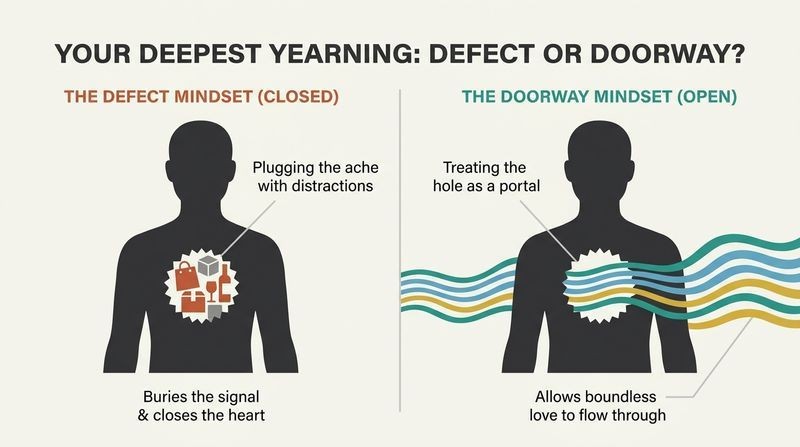
There is genuine wisdom in distinguishing longing from lack. Existential psychology, particularly Frankl, treats unfulfilled yearning as a call toward meaning rather than a symptom to medicate. Reframing desire as a spiritual aperture also resonates with Buddhist tantra, which channels craving rather than suppressing it. The provocative move is recasting anger as a form of love, which contradicts pop-psychology's tidy separation of the two. That has merit: contempt and indifference, not anger, are the true opposites of love in Gottman's marriage research. The caution is that romanticizing perpetual yearning could keep someone tethered to painful situations, mistaking chronic ache for spiritual depth rather than a signal to leave.
Your sexual essence, not your gender, determines what opens you
Essence is separate from anatomy. Deida claims each person has a core sexual essence, masculine or feminine, independent of their body's gender. A masculine essence identifies most deeply with the mission toward freedom: challenge, purpose, conquering odds. A feminine essence identifies with the ever-changing flow of love and life's radiance. A simple diagnostic: at the movies, do you weep more at love stories or thrill more at battles for justice and freedom?
Most women lean feminine, but not all. He argues many women bury a feminine essence under acquired masculine drive, becoming stressed and unravished even while professionally successful. The masculine wants to be trusted and followed; the feminine wants to be seen, cherished, and claimed. Neither is better, but confusing your surface competence for your core desire produces chronic emptiness.
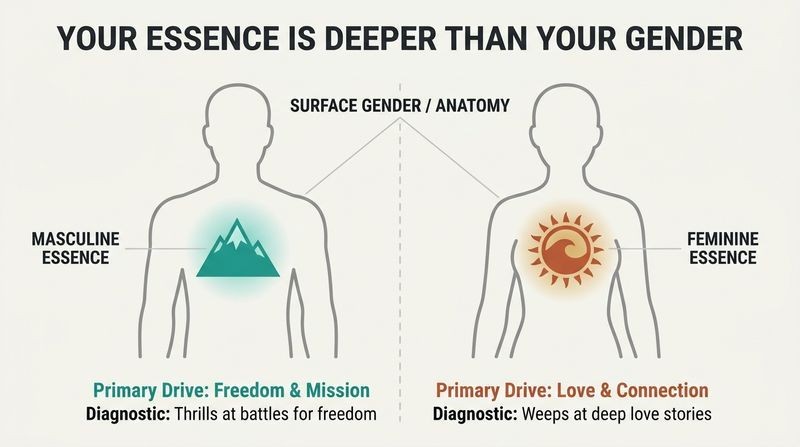
This is the book's most contested claim. Its strength is decoupling essence from biological sex, which allows for same-sex polarity and gender flexibility, ahead of its 2002 moment. It resonates loosely with Jung's anima and animus and with polarity dynamics some couples therapists observe: desire often thrives on differentiation, not sameness. The vulnerability is essentialism. Framing love-flow as feminine and freedom-mission as masculine imports cultural stereotypes as metaphysics, and empirical personality research finds enormous within-gender variation that swamps between-gender averages. Read as a flexible lens on polarity and attraction, it illuminates; read as fixed law about what women fundamentally want, it overreaches.
You always attract a partner exactly as open as you are right now
Reciprocity is the mirror. Deida's recurring law is that you attract and inspire a lover as deeply committed to opening as you are in this moment. An unsurrendered woman draws an unpresent man; a woman radiating devotional yearning evokes a man's fuller presence. His drifting attention and your closing down feed each other in a loop.
This is actionable, not fatalistic. If you complain all the good partners are taken, he says look at what you are actually offering. The remedy is to embody fullness now: breathe deeply through the whole body, feel outward from the heart to your lover, children, community, and the world, and receive the moment as if a divine lover were entering you. Something as small as how you pour a cup of tea can either invite depth or reinforce non-presence.
The insight that we co-create our partner's behavior through our own state has real support in systems theory and interpersonal neurobiology, where couples form self-reinforcing feedback loops and co-regulate each other's nervous systems. The tea-pouring example anticipates research on emotional contagion and mirroring. The danger is the flip side: taken literally, you attract your reciprocal can slide into victim-blaming, implying an abused or neglected person simply failed to radiate enough love. Deida is careful to frame it as inspiration rather than guarantee, but readers should hold it as a lens on their own agency, not a verdict on why someone else mistreated them. Responsibility for one's openness is not responsibility for another's cruelty.
Fear stacks shell upon shell around a heart crushed in childhood
Shells are layered armor. Deida describes how a naturally radiant feminine heart, ignored or belittled early in life, grows protective coverings he calls shells. A girl whose radiance went unseen builds a masculine shell of ambition (I'll prove I'm worthy through achievement). A teenager adds a feminine shell of surface glamour (unless I look right, boys won't notice me). An adult betrayed by a lover adds another masculine shell of independent-career self-reliance.
The shells neutralize each other. The result is confusion: simultaneous cravings for independence and rescue, for attention and protection from it. A partner then feels only your push and pull, not your gifts, and you attract someone equally shelled. Shells can even harden into physical tension and disease. The work is not to destroy them but to love them soft.
The layered-defense model maps neatly onto psychodynamic theory, where character armor (Wilhelm Reich's exact term) forms as chronic muscular and emotional defense against early wounding. It also echoes Internal Family Systems, which treats protective parts as adaptations to be understood rather than attacked, precisely Deida's love them soft rather than smash them. The developmental narrative, wound then compensation then further compensation, is plausible and humane. What it lacks is the recognition that some so-called shells are healthy skills: ambition and self-reliance can be authentic expressions, not always fear-armor. Deida concedes this, but the framing tempts readers to pathologize legitimate independence as mere defense, which could undercut hard-won autonomy.
Men are trains going somewhere; board one whose direction you trust
You cannot redirect a train without derailing trust. Choosing a partner, Deida says, is like boarding a train: you go where he goes spiritually and sexually, or you get off. A woman ready for deep surrender should choose a man whose heart-direction and integrity she trusts more than her own, not to become passive, but because leaning into trusted guidance frees her from always having to lead. If you must constantly steer him, he cannot ravish you open, and your body accumulates tension and resentment.
Leaving leaves a mark. When a relationship ends, the man who loved you most deeply imprints what Deida calls a him-shaped void, a lingering ache shaped like him that only a deeper love can fill. This is not weakness or sickness; it is simply the heart holding the shape of its deepest opening so far.
The train metaphor is vivid but provocative, and its gender-loaded framing (woman surrenders to man's navigation) will alienate readers committed to egalitarian partnership. Yet a defensible kernel survives translation: sustained desire often requires trusting a partner's competence in some domain and being able to relax control there, a dynamic couples therapists observe regardless of gender. The him-shaped void is the sharper contribution. It aligns with neuroscience of pair-bonding, where oxytocin and dopamine wire attachment to a specific person, explaining why breakups feel like withdrawal and why new, deeper bonds, rather than willpower, tend to dissolve the ache. Naming that void normalizes grief many people wrongly judge as pathetic.
Men chase freedom's emptiness because they fear the feminine's chaos
The masculine seeks release, not flow. Deida explains that a masculine-essence partner is oriented toward changeless freedom: the ah-hah of solving a problem, the killing of a business deal, the victory in sport, the emptiness of meditation. Emotional flux, the feminine's native ocean, feels foreign and threatening. So he tries to fix your feelings, resolve conversations into peace, or zone out into TV, work, or beer, which Deida calls pseudo-freedom.
Depth must be seduced, not demanded. A man who has not yet found real freedom in present consciousness will engage life shallowly or withdraw. The counterintuitive move is not nagging but worship: reflecting back the deep, fearless presence you sense in him even when he cannot feel it himself. Your radiant invitation, more than your criticism, draws his depth into the room.
The portrait of men fleeing emotional intensity into achievement or numbing rings true against research on stonewalling and physiological flooding, where men more often withdraw during conflict because their arousal spikes and takes longer to settle. Deida's prescription, invite depth through worship rather than pursuit, loosely mirrors the demand-withdraw literature: pursuing a withdrawer intensifies retreat. The reframe of goals and meditation as sometimes escapist is a bracing challenge to achievement culture. The blind spot is symmetry. Deida assigns emotional flow to the feminine and stoic freedom to the masculine, but plenty of men live richly in feeling and plenty of women retreat into work. The dynamic is real; its gendering is optional.
Love matures through three stages: neediness, self-reliance, devotion
Three stages describe how you love. Deida maps a developmental arc you move through both over a lifetime and moment to moment:
1. First stage: dependence, where you sacrifice your truth to be needed, tolerate poor treatment, and play doormat hoping to earn love.
2. Second stage: independence, where you armor your heart, build a self-reliant career and boundaries, and refuse to depend on anyone, but stay secretly unravished and dry.
3. Third stage: devotional surrender, where you open and offer love as a gift regardless of what you get back, trusting love itself rather than any person.
Trust love, not a man or yourself. The third-stage insight is that no individual is worthy of total trust, because everyone wavers. Only love, the openness yearning at every heart, deserves complete surrender. You can practice it alone, dancing or breathing everyone in and out of your heart.
The dependence to independence to interdependence arc is well-trodden developmental terrain, echoing Ken Wilber's integral stages (Deida was affiliated with the Integral Institute) and family therapy's differentiation model. Its practical value is diagnostic: naming whether you are being a doormat, a fortress, or a genuine giver clarifies a lot of relational confusion. The most philosophically interesting move is trust love, not a person, which sidesteps the impossible demand for a flawless partner and relocates security in a transpersonal source, much like secure attachment theory locates felt-safety in a reliable bond rather than a perfect caregiver. A fair critique: third-stage giving without reciprocity, if misapplied, can rationalize staying with someone who consistently gives nothing back.
Voice primary emotions instantly before they rot into secondary rage
Distinguish primary from secondary emotion. Deida separates the raw first feeling (hurt, fear, sadness) from what builds when you suppress it (typically anger). If your partner is absent and you swallow the hurt, it ferments into resentment. The hurt is primary and invites connection; the accumulated anger is secondary and repels. A weeping open woman is compelling; a weeping closed woman is not.
Amplify because he is energetically blind. Because a masculine-essence partner cannot read subtle signals, Deida advises exaggerating your genuine responses, never faking them. When his integrity is deep, show worship loudly. When he betrays his own depth, show wrath unmistakably. Both are gifts: worship draws him deeper, wrath functions like a slap that wakes him to an emergency he could not otherwise perceive. Spontaneous, connected expression beats a toxic later dump.
The primary-secondary emotion distinction is solid clinical psychology; emotion-focused therapy is built on exactly this, helping people access vulnerable primary feeling beneath reactive secondary defenses like anger or numbness. Expressing feeling in real time to prevent accumulation also aligns with research showing suppression raises physiological stress and erodes relationship satisfaction more than expression does. The amplify your signals advice is shrewd about the reality that partners genuinely differ in emotional perceptiveness. The risk is that endorsing loud wrath as a wake-up slap can, without the connected-open caveat Deida insists on, license verbal aggression. The crucial qualifier is that the heart stays open and connected throughout, which separates fierce honesty from contempt.
Your deepest wish is not just to open, but to be opened despite resistance
Ravishment means being taken deeper than you would go alone. Deida distinguishes opening yourself from being opened. A feminine essence, he claims, longs not merely to feel wide open but to have its resistances met and dissolved by a partner's persistent, humorous, loving presence. You test his love precisely by resisting, so you can feel whether he stays. Saying leave me alone can be a way of feeling him not leave.
This is the book's most delicate claim. He is careful to root ravishment in total trust and mutual consent within a committed bond, not domination. The point is that a partner who collapses at your first no cannot give you the experience of being claimed through your closure into your yes. What turns you on, he argues, is not just that he loves you but that his love persists through your storms.
This is the passage most easily misread and most in need of context. Framed carelessly, persist through her no is dangerous and contradicts everything modern consent culture rightly insists on. Deida's safeguard is that ravishment presupposes established trust, ongoing attunement, and a heart that both partners know is already saying yes underneath the play, closer to negotiated power exchange in kink communities than to coercion. Understood that way, it names something real: the erotic charge of surrender and of a partner who holds steady through emotional turbulence. Readers must supply the boundary Deida assumes, that genuine refusal is absolute and only pre-agreed resistance-play is being described. Without that frame, the teaching is hazardous.
Closing your own heart is self-abuse you inflict on yourself daily
You can be your own abuser. Deida draws a startling parallel: a friend trapped with a man who beats her then loves her passionately is choosing cycles of harm. But so, he argues, is the woman who stays safely independent while chronically closing her own heart. Every shallow breath, every contraction against love, trains your body to feel less. You do not need someone's fist to diminish you; you do it yourself, and it eventually feels normal.
Five practices keep you open mid-conflict. When you would rather slam shut, he prescribes:
1. Hold eye contact instead of looking away.
2. Breathe together, matching your partner's breath.
3. Relax the body's soft front, belly, throat, heart.
4. Extend heart-feelers into his heart even while furious.
5. Express spontaneously through the whole body, not bottled up.
Equating chronic self-protection with self-abuse is provocative and only partly fair. It powerfully names how habitual emotional shutdown becomes invisible and self-perpetuating, consistent with research on experiential avoidance, which predicts worse mental health precisely because it feels safe. But flattening the distinction between an actual battering relationship and a guarded single life risks trivializing physical violence and could shame trauma survivors whose closure is protective and wise. The five practices, by contrast, are concrete and evidence-friendly: eye contact and synchronized breathing promote co-regulation and vagal tone, and staying somatically relaxed during conflict counters the fight-or-flight flooding that derails hard conversations. Stripped of gendered packaging, they are usable by anyone in any relationship.
Analysis
Dear Lover is a spiritual-erotic manifesto written as a love letter, addressing the reader as the author's beloved. Its genre is unusual: part relationship manual, part devotional poetry, part nondual spiritual teaching. This hybrid form is both its power and its liability. The intimate second-person voice creates immersion rare in self-help, but the explicit, repetitive erotic passages and metaphysical vocabulary (God, divine, ravishment) can obscure the practical psychology underneath.
Structurally, the book circles one thesis from many angles: love is openness, fear is contraction, and sexual polarity is a vehicle for spiritual awakening. The most transferable ideas, sexual essence, the reciprocity law, the three stages, primary versus secondary emotion, and the five staying-open practices, stand on their own and connect credibly to attachment theory, emotion-focused therapy, polarity dynamics, and interpersonal neurobiology. Deida essentially spiritualizes what clinicians describe mechanically.
The book's central vulnerability is essentialism. By assigning love-flow to the feminine and freedom-mission to the masculine, Deida universalizes a gendered schema that empirical personality science does not support; within-sex variation dwarfs between-sex averages. He hedges by decoupling essence from anatomy, which rescues the framework as a flexible lens on polarity but not as biological law. Read prescriptively, it can reinforce stereotypes and, in the ravishment material, brush against consent concerns that a careful reader must actively supply boundaries around.
What endures is the reframe of desire. Deida treats yearning not as neediness but as a spiritual aperture, and treats one's own openness as the primary variable in relational life. That relocation of agency, from waiting to be rescued toward embodying fullness now, is genuinely empowering and countercultural. The book is best consumed as poetry and provocation rather than doctrine: mine the psychology, question the metaphysics, and never outsource your boundaries to any teacher's romantic ideal.
Review Summary
Reviews of Dear Lover are mixed. Some readers find it deeply insightful and transformative, praising Deida's understanding of feminine essence and relationships. Others criticize it as repetitive, sexist, and overly focused on spiritual sexuality. Positive reviews highlight the book's ability to validate and empower women, while negative reviews argue it promotes harmful gender stereotypes and lacks practical advice. Many readers note the poetic, sometimes erotic writing style, which some appreciate and others find off-putting. Overall, the book seems to resonate more with those open to spiritual and tantric perspectives on love and sexuality.
People Also Read









Glossary
Sexual essence
Core identity: love-flow or freedomA person's deepest sexual identity, independent of biological gender. A feminine essence identifies most with the ever-changing flow of love and radiance; a masculine essence identifies with the mission toward changeless freedom and purpose. Deida holds that anyone can have either essence, and that confusing your surface skills for your core essence produces chronic emptiness.
Shells
Layered armor of fearProtective coverings of tension and belief that accumulate around a heart wounded early in life. Deida describes them layering, for example a masculine shell of ambition, then a feminine shell of surface glamour, then a shell of defensive independence, each built from fear rather than authentic desire, neutralizing each other into confusion. The work is to love them soft, not destroy them.
Two-bodied devotion
Opening as love through partnershipThe practice of two lovers opening beyond self-enclosure into one shared field of love, where each is opened more deeply by the other than either could open alone. Deida contrasts it with one-bodied practice done solo, and frames it as training to eventually feel and breathe the love yearning at every being's heart.
Ravishment
Being taken open past resistanceBeing lovingly opened by a trusted partner deeper than you would go on your own, including having your resistances met and dissolved rather than obeyed. Deida roots it strictly in established trust, ongoing attunement, and consent within commitment, describing an eroticism of surrender rather than domination or coercion.
Him-shaped void
Imprint left by deepest loverThe lingering ache, shaped like a former partner, that remains after leaving the person who loved you most deeply so far. Deida says it is not weakness or sickness but the heart holding the shape of its deepest opening, and that only a new, deeper love, not willpower, dissolves it.
Three stages of loving
Dependence, independence, devotionDeida's developmental arc, experienced both across a lifetime and moment to moment. First stage: dependent neediness that tolerates poor treatment. Second stage: armored self-reliance and independence that stays unravished. Third stage: devotional surrender that offers love as a gift regardless of return, trusting love itself rather than any single person.
Primary and secondary emotions
Raw feeling versus fermented reactionDeida distinguishes the raw first feeling (hurt, fear, sadness) from the reactive emotion that builds when the first is suppressed (usually anger). Primary emotion, expressed openly and immediately, invites connection; secondary emotion, accumulated and dumped later, repels a partner and feels like toxic residue from the past.
Spiritual sexiness
Presence and radiance that attractDeida's account of what makes each essence attractive at a soul level. A masculine partner is spiritually sexy through free, undistracted presence and consciousness fully alive in the whole body. A feminine partner is spiritually sexy through the radiant light of love and devotional openness shining through the entire body.
FAQ
What's "Dear Lover: A Woman's Guide To Men, Sex, And Love's Deepest Bliss" about?
- Author's Intent: David Deida offers guidance to women on understanding men, sex, and love's deepest bliss. The book is written as if Deida is speaking directly to the reader as a lover.
- Core Themes: It explores themes of love, intimacy, and spiritual connection, emphasizing the importance of opening one's heart to divine love.
- Structure: The book is structured into chapters that address different aspects of love and relationships, from yearning and trust to the art of making love.
- Spiritual Element: Deida integrates spiritual teachings, suggesting that romantic love is a path to spiritual transformation and divine connection.
Why should I read "Dear Lover"?
- Deep Understanding: It provides insights into the dynamics of love and relationships, helping women understand their desires and how to fulfill them.
- Spiritual Growth: The book offers a spiritual perspective on love, encouraging readers to see relationships as a path to personal and spiritual growth.
- Practical Advice: Deida gives practical advice on how to open one's heart and body to love, making it relevant for those seeking deeper intimacy.
- Empowerment: It empowers women to embrace their feminine essence and use it as a source of strength and attraction.
What are the key takeaways of "Dear Lover"?
- Yearning as Openness: Yearning is not a problem but a divine pull to open as love's offering, which is central to experiencing deep intimacy.
- Trust and Surrender: Trusting a partner to open you to love is crucial, and this involves surrendering control and embracing vulnerability.
- Art of Loving: Love is a living art that requires practice and commitment to deepen intimacy and connection.
- Spiritual Sexiness: True sexiness is spiritual and involves being fully present and open, allowing love to flow through one's body and heart.
How does David Deida define "Spiritual Sexiness"?
- Beyond Physical Attraction: Spiritual sexiness transcends physical appearance and involves the radiance of love and openness.
- Presence and Depth: It is about being fully present with a partner, offering one's deepest heart and receiving theirs.
- Energy and Light: Love's energy and light should flow through one's body, making them irresistibly attractive to a deep partner.
- Devotional Surrender: It involves surrendering to love's flow and offering oneself as a gift of love's light.
What is the "Two-Bodied Play of Love" in "Dear Lover"?
- Mutual Openness: It refers to the practice of two partners opening beyond themselves to become one love, merging their energies.
- Deep Communion: The focus is on achieving deep communion, where both partners feel and breathe as one heart.
- Beyond Self-Enclosure: It encourages moving beyond self-centeredness to feel and offer love as a shared experience.
- Spiritual Practice: This concept is a spiritual practice that prepares individuals to open as love through all interactions.
How does "Dear Lover" address the concept of "Yearning"?
- Divine Pull: Yearning is seen as a divine pull to open as love, not a neediness to be filled by another.
- Heart's Openness: It is the heart's natural state of openness, inviting divine love to flow through.
- Emotional Expression: Yearning should be expressed through one's body and heart, allowing love to emerge fully.
- Invitation to Depth: It invites a partner to meet one's deepest heart, fostering a deeper connection and intimacy.
What advice does David Deida give on "Trusting Your Man to Open You"?
- Choosing Wisely: Choose a man whose depth and integrity you trust more than your own ability to open yourself.
- Surrender and Guidance: Trust involves surrendering to a man's guidance, allowing him to open you to love's depth.
- Reciprocal Worship: Both partners should worship each other's heart-depth, recognizing each other's ability to open them more than they can alone.
- Mutual Growth: Trusting a partner leads to mutual growth, where both individuals open more deeply than they would on their own.
What does "Offering or Betraying Your Heart" mean in "Dear Lover"?
- Heart's True Desire: It involves recognizing and offering one's heart's true desire for love and connection.
- Fear and Protection: Many people betray their hearts by building walls of fear and protection, blocking love's flow.
- Vulnerability and Openness: Offering one's heart requires vulnerability and openness, even in the face of potential hurt.
- Divine Expression: The heart's offering is a divine expression of love, meant to be shared with a partner and the world.
How does "Dear Lover" describe "Masculine Insensitivity"?
- Lack of Awareness: Men often lack awareness of the subtle energetic messages women give, requiring women to amplify their responses.
- Exaggerated Expression: Women are encouraged to express their pleasure and displeasure more overtly to be noticed by their partners.
- Deep Man's Response: A deep man will respond to a woman's exaggerated expressions with correction and deeper presence.
- Communication Challenges: The book addresses the communication challenges between men and women, emphasizing the need for clear and expressive communication.
What are the "Three Stages of Loving" according to David Deida?
- 1st Stage: Focuses on physical attraction and neediness, where love is often conditional and based on personal gain.
- 2nd Stage: Emphasizes independence and self-reliance, where love is more about partnership and equality.
- 3rd Stage: Involves devotional surrender and mutual worship, where love is a spiritual practice and an offering to the divine.
- Progression and Fluctuation: Individuals may progress through these stages or fluctuate between them, depending on their personal growth and relationship dynamics.
What are the best quotes from "Dear Lover" and what do they mean?
- "You Are Love": This quote emphasizes the idea that love is the essence of one's being, and the heart's deepest desire is to live open as love.
- "Yearning Is the Key to Love": It highlights the importance of embracing one's yearning as a divine pull to open and offer love fully.
- "Love Is a Living Art": This quote suggests that love is an ongoing practice that requires commitment and creativity to deepen intimacy.
- "Trusting Your Man to Open You": It underscores the significance of choosing a partner whose depth and integrity can guide one to love's fullest expression.
How does "Dear Lover" suggest handling "Ending Relationships and the Him-Shaped Void"?
- Recognizing Unfulfillment: Acknowledge when a relationship doesn't meet your heart's deepest desire and be willing to move on.
- Time Limit on Suffering: Set a time limit on enduring an unfulfilling relationship, allowing friends to help assess your growth.
- Him-Shaped Void: Understand that a void remains after leaving a relationship, which can only be filled by a deeper love.
- Attracting Deeper Love: Focus on opening your heart to attract a partner who can love you more deeply than before, filling the void with divine love.
About the Author
Other books by David Deida







Download PDF
Download EPUB
.epub digital book format is ideal for reading ebooks on phones, tablets, and e-readers.








































