
Key Takeaways
1. Bismarck's Legacy: An Authoritarian Foundation
It was here, rather than in the remote religious cultures and hierarchical polities of the Reformation or the ‘Enlightened Absolutism’ of the eighteenth century, that we find the first real moment in German history which it is possible to relate directly to the coming of the Third Reich in 1933.
A flawed unification. Otto von Bismarck's creation of the German Reich in 1871, while fulfilling nationalist dreams, embedded authoritarian structures that cast a long shadow. The new state, called the "German Reich" (evoking a thousand-year predecessor), lacked a declaration of human rights and civic freedoms, reserving vast powers for the Kaiser and the military. Government ministers answered to the monarch, not the parliament (Reichstag), which had limited legislative control.
Militarism entrenched. Bismarck ensured the army remained a "state within a state," largely independent of parliamentary oversight, with its budget approved only every seven years. This fostered a pervasive militaristic culture, where officers enjoyed social privileges, military service was compulsory, and former soldiers often filled state employment roles like police and postmen, instilling military codes of conduct in civilian life. The army's prestige, cemented by unification wars, legitimized the use of force for political ends.
Deepening divisions. Bismarck's campaigns against perceived "internal enemies" further fractured German society. His "struggle for culture" targeted Catholics, leading to mass arrests and the suppression of religious orders, which in turn solidified Catholic identity and political organization (Centre Party). The Anti-Socialist Law (1878) outlawed the burgeoning Social Democratic movement, driving it further left and fostering deep distrust between "bourgeois" parties and the working class, a divide that would persist for decades.
2. The Seeds of Hate: Rise of Racial Antisemitism
‘Religion’s all the same, it’s race that is to blame’, was one of his typically catchy slogans.
From religious to racial. Towards the end of the 19th century, a new, virulent form of antisemitism emerged in Germany and Austria, shifting from religious prejudice to racial hatred. Figures like Wilhelm Marr, who coined the term "antisemitism," and Houston Stewart Chamberlain, with his influential "The Foundations of the Nineteenth Century," propagated the idea of distinct "Germanic" and "Jewish" races locked in a cosmic struggle for supremacy. This ideology often fused with Social Darwinism, arguing for racial purity and the elimination of "inferior" elements.
Eugenics and "living-space." This racial thinking extended to eugenics, with figures like Wilhelm Schallmayer and Alfred Ploetz advocating for "negative selection" to improve the "Germanic race." They proposed measures ranging from discouraging the "unfit" from breeding to, in extreme cases, advocating the killing of the mentally ill and disabled. Concurrently, the concept of "Lebensraum" (living-space) gained traction, suggesting Germany needed to expand eastward at the expense of "inferior" Slavs, a vision of international politics as a racial struggle for survival.
Fringe ideas gain traction. While mainstream society largely rejected overt antisemitic violence, these radical ideas permeated the fringes of political and intellectual life. Figures like Dietrich Eckart and Julius Langbehn popularized antisemitic tropes, blaming Jews for societal ills and cultural "decadence." In Austria, Georg Ritter von Schönerer's Pan-Germanism and racial antisemitism, though politically marginal, introduced concepts like the "Heil!" greeting and the "Leader" (Führer) that would later be adopted by the Nazis, demonstrating how extremist thought could lay groundwork for future movements.
3. WWI and Weimar's Fragile Birth
The almost unimaginable financial expense of the war created a vast economic burden on the world economy which it was unable to shake off for another thirty years, and it fell most heavily upon Germany.
War's devastating legacy. Germany entered World War I with widespread enthusiasm, but the prolonged conflict and eventual defeat shattered national confidence. The "silent dictatorship" of generals Hindenburg and Ludendorff during the war established a precedent for authoritarian rule, curbing civil liberties and centralizing economic control. The war's immense human and financial cost, coupled with the shock of unexpected defeat, left a society ripe for radicalization.
The "stab-in-the-back" myth. The Armistice of November 1918 and the subsequent Treaty of Versailles were perceived as national humiliations. The myth that the undefeated German army was "stabbed in the back" by revolutionaries and Jews at home gained widespread currency, particularly among the right. This narrative, propagated by military leaders, deflected blame from military defeat and fostered deep resentment against the new democratic government.
Versailles' bitter terms. The Treaty of Versailles imposed severe penalties:
- Territorial losses (10% of population, 13% of territory, including Alsace-Lorraine and the Polish Corridor).
- Massive reparations payments.
- Severe military restrictions (100,000-man army, no tanks, heavy artillery, or air force).
- The ban on Austro-German union, despite the principle of self-determination, was seen as particularly unjust.
These terms fueled a grim determination across the political spectrum to overturn the settlement, further destabilizing the nascent Weimar Republic.
4. Democracy's Fatal Flaws: Instability and Disloyalty
The brutal fact was that, even in 1928, the, Republic was as far away from achieving stability and legitimacy as ever.
A compromised beginning. The Weimar Republic, born from the ashes of defeat, suffered from a fundamental lack of legitimacy. Its first President, Friedrich Ebert, a Social Democrat, made crucial compromises with the old order, notably retaining the fiercely monarchist officer corps, which he could have reformed. His extensive use of emergency powers (Article 48) set a dangerous precedent, often used against the left while right-wing threats went unchecked.
Fragile political landscape. The proportional representation system, while democratic, contributed to governmental instability by fostering numerous small parties and frequent coalition changes. More significantly, deep-seated political-cultural milieux, inherited from the Imperial era, prevented genuine cross-party cooperation. Even the "Weimar coalition" parties (Social Democrats, Democrats, Centre Party) struggled to maintain a parliamentary majority, leaving the Republic vulnerable to its numerous enemies on the extreme left and right.
Disloyal institutions. The army and civil service, largely unreformed from the Imperial era, harbored deep-seated monarchist and anti-democratic sentiments. The army, under figures like General Hans von Seeckt, operated as a "state within a state," actively circumventing Versailles restrictions and plotting against civilian governments. The judiciary, dominated by conservative judges, consistently showed leniency towards right-wing political offenders while harshly prosecuting the left, further eroding public trust in the Republic's impartiality and rule of law.
5. Economic Catastrophes: Inflation and Depression
The descent into chaos - economic, social, political, moral - seemed to be total.
Hyperinflation's ruinous impact. The Weimar Republic was plagued by unprecedented economic instability. The government's wartime borrowing and post-war reparations obligations led to rampant inflation, culminating in hyperinflation in 1923. Money lost its value almost completely, wiping out savings, stimulating a crime wave (theft convictions tripled), and fostering widespread cynicism and conspiracy theories, particularly targeting "Jewish financiers" and "profiteers."
The Great Depression strikes. Just as the economy stabilized, the Wall Street Crash of 1929 triggered the Great Depression. American banks recalled short-term loans, crippling German industry, which had become heavily reliant on foreign capital. Industrial production plummeted by 40% by 1932, and unemployment soared to six million (one in three workers), devastating families and creating immense social despair.
Austerity deepens misery. Chancellor Heinrich Brüning's deflationary policies, aimed at cutting government spending and proving Germany's inability to pay reparations, exacerbated the crisis. Cuts to unemployment benefits and welfare provisions pushed millions into destitution, while the fear of renewed inflation prevented currency devaluation. This prolonged suffering, coupled with the perceived failure of democratic governments to act, fueled public anger and drove desperate citizens towards extremist political solutions.
6. Hitler's Rise: From Fringe Agitator to Mass Leader
The personality of the Leader had me totally in its spell.
Exploiting post-war chaos. Adolf Hitler, an Austrian ex-corporal, emerged from the post-WWI chaos in Munich, capitalizing on widespread resentment and the "stab-in-the-back" myth. He discovered a powerful talent for demagogic oratory, using simple, emotive slogans to blame Jews and "Marxists" for Germany's misfortunes. His early political career was marked by a contempt for bourgeois convention and a belief in the necessity of violence.
Building the Nazi movement. Hitler joined the obscure German Workers' Party in 1919, quickly becoming its star speaker and transforming it into the National Socialist German Workers' Party (NSDAP). He surrounded himself with devoted followers like Rudolf Hess, Alfred Rosenberg, and Hermann Göring, and established the SA (Storm Division) paramilitary wing under Ernst Röhm, which engaged in street violence and intimidation. The failed Beer-Hall Putsch of 1923, though a setback, taught Hitler the need for a "legal" path to power and cemented his image as a nationalist hero.
Strategic expansion and mass appeal. After his release from prison, Hitler rebuilt the Party, consolidating his "dictatorial powers" and purging rivals like Ludendorff and Gregor Strasser. The Party strategically shifted its focus from urban workers to discontented rural Protestants, emphasizing "blood and soil" ideology and promising national unity. By the late 1920s, the Nazis had developed an elaborate organizational structure, including youth and women's groups, and a sophisticated propaganda machine, positioning themselves as a dynamic, catch-all party of protest against the failing Weimar Republic.
7. The Conservative Miscalculation: Handing Power to Hitler
‘Within two months,’ Papen confidently told a worried conservative acquaintance, ‘we will have pushed Hitler so far into a corner that he’ll squeak.’
Democracy's decline. The Great Depression shattered Germany's political stability, leading to the collapse of the Grand Coalition in 1930 and the end of parliamentary majority rule. Subsequent "cabinets of experts" under Chancellors Brüning, Papen, and Schleicher increasingly relied on President Hindenburg's emergency decrees, effectively dismantling democratic processes from above. The Reichstag became marginalized, and political power shifted to a small circle around the aging Hindenburg and the army.
The army's pivotal role. The military, under figures like General Kurt von Schleicher, saw the crisis as an opportunity to restore Germany's strength and rearm, believing an authoritarian regime was necessary. Schleicher, an ambitious intriguer, aimed to harness the Nazis' popular support while controlling their extremism. He underestimated Hitler's ruthlessness, believing the army could manipulate the Nazi movement for its own ends.
Conservative intrigue. Franz von Papen, a right-wing aristocrat appointed Chancellor by Hindenburg, further accelerated the move towards authoritarianism, notably by deposing the Prussian Social Democratic government in July 1932. Despite the Nazis' electoral surge in July 1932, Papen and Schleicher believed Hitler's party was in decline after the November 1932 election. Through a series of backstairs negotiations, they convinced Hindenburg to appoint Hitler as Chancellor on January 30, 1933, believing they could contain him within a conservative-dominated cabinet. This fatal miscalculation handed Hitler the keys to power.
8. The Blitzkrieg on Democracy: Terror and Legal Subversion
There will be no more mercy now; anyone who stands in our way will be butchered.
The "National Uprising" begins. Hitler's appointment as Chancellor was immediately followed by a massive torchlit parade in Berlin, orchestrated by Joseph Goebbels, symbolizing the "revival of the spirit of 1914." This public display of power was accompanied by a swift escalation of political violence, with SA and SS stormtroopers attacking Communist and Social Democratic offices and homes, often with the tacit or explicit approval of the police.
The Reichstag Fire and its aftermath. On February 27, 1933, the Reichstag building was set ablaze by Marinus van der Lubbe, a Dutch anarchist. The Nazis immediately blamed the Communists, despite evidence to the contrary. The next day, President Hindenburg, under pressure from Hitler and Göring, signed the "Reichstag Fire Decree," which suspended fundamental civil liberties—freedom of expression, press, assembly, and association—and allowed for indefinite "protective custody" without trial. This decree provided the pseudo-legal basis for mass arrests and widespread repression.
Dismantling opposition. The March 1933 election, held amidst this terror, saw the Nazi-Nationalist coalition gain a bare majority, but not the two-thirds needed to amend the constitution. Hitler, however, secured the "Enabling Act" on March 23, effectively bypassing the Reichstag and President, by intimidating deputies and securing the Centre Party's support with false promises. This act, combined with the ongoing violence and the systematic suppression of the Communist and Social Democratic parties and trade unions, swiftly transformed Germany into a one-party state.
9. Co-ordination of Society: Eliminating Dissent
The road to the total state. Our revolution has an uncanny dynamism.
Gleichschaltung: Total control. The Nazi regime embarked on a rapid and comprehensive process of "co-ordination" (Gleichschaltung), aiming to bring every aspect of German political, social, and associational life under Nazi control. This involved the forcible takeover of federated state governments, with Nazi Reich Commissioners dismissing existing ministers and installing loyalists. Local Nazi bosses, backed by stormtroopers, similarly seized control of town halls and municipal institutions.
Purging the civil service. The "Law for the Restoration of a Professional Civil Service" (April 7, 1933) provided legal cover for the dismissal of "non-Aryan" (Jewish) and politically "unreliable" civil servants, including judges, lawyers, and university staff. This purge, often pre-empted by local Nazi actions, led to a mass influx of opportunists into the Nazi Party, eager to secure their jobs and advance their careers.
Suppression of independent organizations. Trade unions were violently smashed on May 2, 1933, their leaders arrested, and assets confiscated, despite their attempts to compromise. Other political parties, including the Centre Party and the Nationalists, were pressured into "self-dissolution" by July 1933, often in exchange for hollow promises of protection. Paramilitary groups like the Steel Helmets were absorbed into the SA, eliminating any remaining independent power centers and consolidating the Nazi Party's monopoly on power.
10. Cultural Purge: Eradicating the "Un-German Spirit"
When I hear “culture”, I release the safety catch of my Browning!
Goebbels's propaganda machine. Joseph Goebbels, as Minister for Popular Enlightenment and Propaganda, spearheaded a "spiritual mobilization" to purge German culture of "alien" influences. He centralized control over all media—radio, film, press—and cultural institutions, ensuring they propagated Nazi ideology. This involved mass dismissals of Jewish, leftist, and modernist artists, writers, and musicians, often under the guise of combating "cultural Bolshevism."
Assault on modernism. The regime launched a comprehensive attack on modern art, music, and literature, which Hitler personally despised. Jewish conductors like Bruno Walter and Otto Klemperer were forced into exile, and "degenerate" art by figures like Paul Klee and Max Beckmann was removed from galleries. The infamous book burnings on May 10, 1933, orchestrated by Nazi students, symbolically consigned "un-German" literature to the flames, echoing earlier nationalist rituals.
Antisemitism in culture. The cultural purge was deeply intertwined with antisemitism. Jews were systematically excluded from all cultural professions, regardless of their artistic style or political leanings. The nationwide boycott of Jewish businesses on April 1, 1933, though economically limited, served as a stark public demonstration of the regime's intent to remove Jews from German society, fueling emigration and creating an atmosphere of continuous hostility and intimidation.
11. A Revolution of Destruction: The Nature of Nazi Power
For us, the revolution which shattered the Second Germany was nothing more than the tremendous act of birth which summoned the Third Reich into being.
A "legal" revolution. The Nazi "seizure of power" was a revolutionary overthrow, despite Hitler's claims of legality. While avoiding a direct military coup, the Nazis systematically subverted the Weimar constitution through emergency decrees, the Enabling Act, and widespread illegal violence. This "legal revolution" allowed civil servants and institutions to rationalize their compliance, creating an illusion of order amidst radical change.
Beyond conservative restoration. The Nazi revolution was not a conservative restoration of the Wilhelmine era, as many of Hitler's initial allies had hoped. Instead, it was a radical transformation aimed at creating a new, racially pure "German Reich." Hitler's contempt for traditional institutions, his focus on a charismatic "Leader" rather than a monarch, and his vision of a society united by race, not class, fundamentally diverged from conservative ideals.
A unique form of totalitarianism. The Nazi revolution, while sharing some characteristics with other European fascist movements (e.g., anti-communism, militarism, cult of personality), was distinct in its scale, ruthlessness, and genocidal intent. It aimed for a complete cultural and spiritual remaking of Germans, preparing the nation for a war of conquest and racial annihilation. The speed and totality of the "Gleichschaltung" demonstrated a new, unprecedented form of dictatorship, clearing the ground for the Third Reich's dynamic and intolerant maturity.
Review Summary
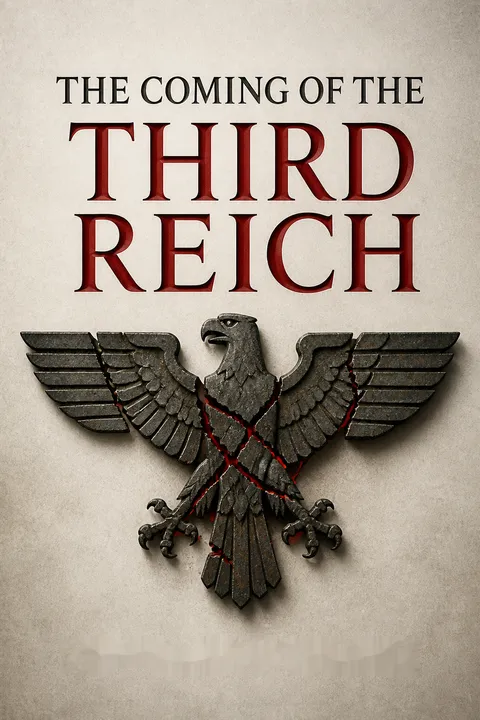
The Coming of the Third Reich by Richard J. Evans examines Nazi Germany's rise from 1870s unification through Hitler's 1933 appointment as Chancellor. Reviewers praise Evans's comprehensive, well-researched approach covering political, economic, and cultural factors rather than focusing solely on Hitler. The book details Weimar Republic's fragility, economic crises, propaganda tactics, and normalization of political violence. While some find it dense and academic, most appreciate its accessibility and relevance to understanding democratic decline. Critics note parallels to contemporary politics. Evans's expertise from the David Irving Holocaust denial trial adds credibility to this definitive scholarly work.
People Also Read



The History of the Third Reich Series Series
About the Author
Download PDF
Download EPUB
.epub digital book format is ideal for reading ebooks on phones, tablets, and e-readers.








































