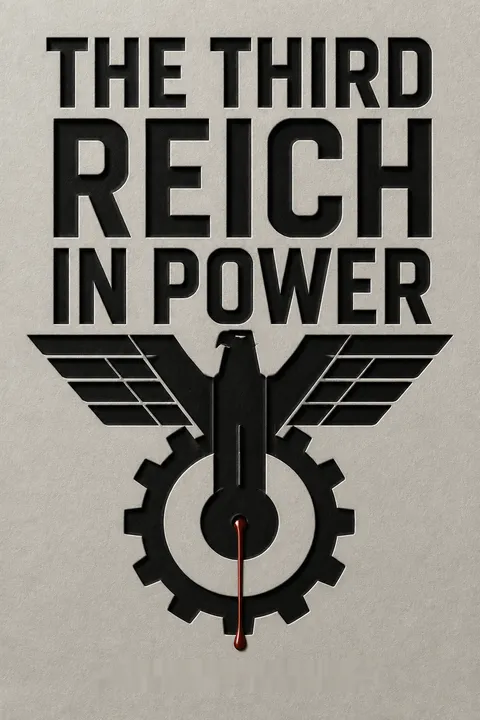

Key Takeaways
1. Hitler's Swift Consolidation of Power through Violence and Deception
By July, the Nazis had created virtually all the fundamental features of the regime that was to govern Germany until its collapse almost twelve years later, in 1945.
Rapid establishment. In the first half of 1933, Hitler's regime swiftly dismantled Germany's Weimar Republic, eliminating opposition and establishing a one-party state. This rapid consolidation was achieved through a combination of legal manipulation, such as the Reichstag Fire Decree and the Enabling Act, and widespread, brutal violence by Nazi paramilitaries. Opponents, particularly Communists and Social Democrats, were arrested, tortured, and sent to newly established concentration camps.
Suppression of dissent. The "Night of the Long Knives" in June 1934 further solidified Hitler's control by purging the SA leadership and eliminating conservative critics. This event, though illegal, was retroactively legalized, demonstrating the regime's disregard for the rule of law. The army, initially wary, was brought into line through promises of rearmament and the new oath of allegiance to Hitler personally, rather than the state.
Elimination of rivals. The systematic "co-ordination" (Gleichschaltung) extended to all aspects of German society, from political parties and trade unions to local clubs and state governments. Any organization not aligned with Nazi ideology was dissolved or brought under Nazi control, effectively silencing all forms of organized opposition and ensuring the regime's total dominance.
2. The All-Encompassing Cult of the Leader and Propaganda Machine
The Leader’s authority is subject to no checks or controls; it is circumscribed by no private preserves of jealously guarded individual rights; it is free and independent, overriding and unfettered.
Unquestioning authority. The cult of Adolf Hitler was meticulously crafted and propagated, presenting him as a messianic figure, above party and politics, embodying the nation's will. This image was reinforced through ubiquitous symbols like the swastika, compulsory "Heil Hitler" greetings, and grand public ceremonies designed to evoke mass hysteria and unwavering loyalty.
Goebbels's vision. Joseph Goebbels's Ministry of Popular Enlightenment and Propaganda orchestrated a "spiritual mobilization" of the German people, aiming for 100% ideological conformity. Propaganda was subtle yet pervasive, permeating all forms of media and culture, from film and radio to literature and art, often concealing its true purpose to be more effective.
Mass spectacle. Events like the annual Nuremberg Rallies, famously captured in Leni Riefenstahl's "Triumph of the Will," showcased vast, disciplined masses in choreographed displays of unity and power. These spectacles, along with cheap "People's Receivers" for radio broadcasts, aimed to immerse Germans in a manufactured reality of national rebirth and strength, intimidating dissenters into silence.
3. Racial Purity: The Scientific Foundation of Nazi Social Engineering
Applying the principles of racial hygiene to society meant sweeping away traditional Christian morality and replacing it with a system of ethics that derived good and bad solely from the imagined collective interests of the German race.
Eugenics as policy. Racial hygienists, long advocating for the "improvement of the race," found their ambitions realized with the Nazi regime. Hitler, influenced by these theories, believed Germany's strength depended on purging "degenerate elements" from the hereditary chain. This led to the Law for the Prevention of Hereditarily Diseased Offspring in July 1933.
Compulsory sterilization. This law mandated sterilization for individuals suffering from conditions like congenital feeble-mindedness, schizophrenia, or severe alcoholism.
- Over 360,000 people were sterilized by 1939.
- "Congenital feeble-mindedness" was a vague term, often applied to social deviants.
- The policy disproportionately affected inmates of mental hospitals and the underclass.
- It demonstrated the regime's willingness to intervene in the most intimate aspects of human life.
Beyond the physically ill. While physical handicaps were initially targeted, economic considerations and medical arguments shifted focus, with the physically handicapped later integrated into the workforce. However, the underlying principle remained: only the "racially sound" were deemed valuable, setting a chilling precedent for future, more extreme measures.
4. Systematic Persecution and Economic Plunder of German Jews
The enormous stresses and strains built up in the German economy between 1933 and 1939 could, Hitler himself explicitly argued on several occasions, ultimately only be resolved by the conquest of living-space in the east.
Economic marginalization. The Nazi regime systematically targeted Germany's Jewish community, initially through boycotts and discriminatory laws like the Civil Service Law of April 1933. This "Aryanization" process aimed to remove Jews from economic life, transferring their businesses and assets to non-Jewish Germans, often at drastically undervalued prices.
Nuremberg Laws. The 1935 Nuremberg Laws formalized racial segregation, defining citizenship by "German or kindred blood" and prohibiting marriages and sexual relations between Jews and non-Jews. These laws, though initially met with mixed public reactions, deepened the isolation of Jews and provided a legal framework for further persecution.
"Kristallnacht" and intensified terror. The pogrom of November 1938, known as "Kristallnacht," marked a dramatic escalation of violence. Orchestrated by Goebbels and Hitler, it involved widespread destruction of synagogues and Jewish businesses, mass arrests of Jewish men, and their incarceration in concentration camps. This act of terror aimed to force Jewish emigration and signaled the regime's readiness for more extreme measures.
5. Economy Subordinated to War: The "Battle for Work" as Rearmament
The next 5 years in Germany must be devoted to the rearmament of the German people. Every publicly supported job creation scheme must be judged by the criterion of whether it is necessary from the point of view of the rearmament of the German people.
Rearmament as priority. Hitler's primary economic goal was rapid rearmament, disguised initially as job creation. Schemes like motorway construction and the "People's Car" project, while presented as public works, were fundamentally geared towards military infrastructure and industrial capacity. This led to a dramatic reduction in official unemployment figures, though often through statistical manipulation and the removal of women from the workforce.
Autarky and resource control. The Four-Year Plan (1936) intensified the drive for economic self-sufficiency (autarky) to reduce reliance on foreign imports, particularly for raw materials like oil, rubber, and metals. This involved massive state investment in synthetic production and strict controls over industry, often overriding private business interests.
Financial strain and plunder. Rearmament led to soaring state expenditure and a ballooning national debt, which Hjalmar Schacht, the Reichsbank president, warned was unsustainable. Hitler dismissed such concerns, believing the debts would be paid by future territorial conquests. The systematic plunder of Jewish assets, accelerated after 1938, became a crucial source of funding for the war machine.
6. Erosion of Traditional Institutions and Social Norms
The whole thing has been taken over by the military spirit, and by drill.
Assault on the Churches. The Nazis sought to undermine the influence of both Protestant and Catholic Churches, viewing their international allegiances and traditional morality as obstacles to national unity and racial purity. While the "German Christians" attempted to Nazify Protestantism from within, the "Confessing Church" resisted, leading to arrests of pastors like Martin Niemöller. The Catholic Church faced intense pressure, including propaganda campaigns against alleged sexual scandals and the forced closure of denominational schools.
Education militarized. The education system was transformed to indoctrinate youth with Nazi ideology, emphasizing physical fitness, military discipline, and racial consciousness over academic learning.
- Teachers were purged, and the National Socialist Teachers' League became compulsory.
- The Hitler Youth became a near-totalitarian organization, replacing traditional youth groups.
- Elite schools like "Napolas" and "Adolf Hitler Schools" aimed to train a new, ideologically pure leadership.
Professions under control. Professions like law and academia saw their autonomy eroded, with Jewish members expelled and curricula politicized. While some fields, like medicine, benefited from state support for racial hygiene research, all professionals faced increasing state interference and pressure to conform, leading to a decline in academic standards and a "demoralization" of the teaching profession.
7. Aggressive Foreign Policy: From Revisionism to European Domination
The German Reich is a major power, and no one can or will try to interfere when it puts things in order at its borders.
Breaking Versailles. Hitler's foreign policy, driven by a long-term vision of German domination, began with a series of calculated risks to dismantle the Treaty of Versailles. Germany withdrew from the League of Nations in 1933 and signed a non-aggression pact with Poland in 1934, temporarily securing its eastern flank. The Saarland's return to Germany in 1935, followed by the reintroduction of conscription and the remilitarization of the Rhineland in 1936, were met with little international resistance.
Axis formation and Spanish Civil War. The Abyssinian crisis and the Spanish Civil War (1936-1939) provided opportunities for Hitler to forge alliances with Fascist Italy and test Germany's new military capabilities. The "Condor Legion" in Spain demonstrated the devastating potential of air power, while the "Rome-Berlin Axis" and "Anti-Comintern Pact" with Japan solidified a bloc of expansionist powers.
Anschluss and Czechoslovakia. The annexation of Austria in March 1938, achieved through intimidation and popular support, created "Greater Germany." This was followed by the dismemberment of Czechoslovakia, culminating in the Munich Agreement of September 1938, which ceded the Sudetenland to Germany. These bloodless victories, though causing anxiety among some Germans, significantly boosted Hitler's prestige and convinced him of Western democracies' weakness.
8. The "Dual State": Competing Powers and Administrative Chaos
There was nothing neat about the administration of the Third Reich, and the idea that it was a smoothly functioning, completely centralized state has long since been abandoned by historians.
Fragmented authority. Despite the outward appearance of a monolithic dictatorship, the Third Reich was characterized by a "dual state" structure, with constant overlap and competition between the traditional state bureaucracy ("normative state") and the Nazi Party's extra-legal apparatus ("prerogative state"). This led to administrative chaos and power struggles among Hitler's subordinates.
Personalized rule. Hitler's irregular working habits and preference for verbal communication over written directives meant that direct access to him became a crucial source of power. Figures like Martin Bormann, who controlled access to Hitler, gained immense influence, often bypassing official ministries. This fostered a system of patronage and personal loyalty rather than clear lines of authority.
Corruption and self-enrichment. The lack of accountability and the personalized nature of power fueled widespread corruption at all levels of the regime. Nazi officials, from top leaders like Göring and Ley to local Block Wardens, exploited their positions for personal gain, enriching themselves through confiscated Jewish property, inflated salaries, and illicit schemes. This undermined public trust but was largely tolerated as long as loyalty to Hitler remained.
9. Widespread Acquiescence Driven by Fear and Perceived Stability
The truth is that far from Nazi terror being levelled exclusively against small and despised minorities, the threat of arrest, prosecution and incarceration in increasingly brutal and violent conditions loomed over everyone in the Third Reich...
Fear as a tool. While overt terror was often directed at specific minorities, the pervasive threat of arrest, imprisonment, and concentration camps instilled fear across German society. Denunciations, whether politically motivated or personal, contributed to a climate of suspicion, making public dissent extremely risky.
Economic stability. For many ordinary Germans, the regime's perceived success in overcoming the Great Depression and restoring order was a powerful factor in securing their acquiescence. The "battle for work" and the promise of national unity resonated with a population weary of Weimar's political instability and economic hardship.
Limited opposition. Despite widespread grumbling about shortages, corruption, and the incessant demands of Nazi organizations, organized opposition was effectively crushed by 1935. The majority of Germans, even those who disliked aspects of the regime, prioritized stability and personal well-being over active resistance, especially given the high price of dissent.
Review Summary
The Third Reich in Power receives overwhelmingly positive reviews (4.36/5) for its detailed examination of Nazi Germany from 1933-1939. Readers praise Evans's thematic rather than chronological approach, covering how Hitler consolidated power through propaganda, cultural control, economic manipulation, and systematic persecution. Reviewers highlight the book's meticulous research, accessible writing, and insights into how democracy was dismantled in under two months. Some note its length and density, with occasional dry sections. Many consider it the definitive English-language work on pre-war Nazi Germany, essential for understanding totalitarianism's mechanisms.
People Also Read


The History of the Third Reich Series Series
About the Author

Download PDF
Download EPUB
.epub digital book format is ideal for reading ebooks on phones, tablets, and e-readers.








































