
Key Takeaways
1. Fantasy and Failure: Hitler's Aimless Youth
I had honoured my father, but loved my mother.
A Troubled Childhood. Adolf Hitler's early life was marked by a comfortable, albeit turbulent, middle-class existence in provincial Austria. His father, Alois, a strict and authoritarian customs official, clashed frequently with the young Adolf, who found solace in the smothering affection of his mother, Klara. This dynamic fostered a rebellious, sullen teenager with an aversion to conventional work.
Artistic Aspirations. Despite his father's desire for him to enter the civil service, Hitler harbored grandiose dreams of becoming a great artist. His school performance, initially good, deteriorated significantly in secondary school, reflecting his disdain for formal education and his growing conflict with his father. He spent his time drawing, painting, and fantasizing, convinced of his artistic genius.
Rejection and Drift. His artistic ambitions were shattered by two rejections from the Vienna Academy of Fine Arts in 1907 and 1908. This failure, coupled with his mother's death in 1907, plunged him into a period of parasitic idleness and poverty in Vienna. He drifted aimlessly, supported by a dwindling inheritance and an orphan's pension, his grand artistic visions unfulfilled.
2. Vienna's Crucible: Forging Prejudices, Not a Worldview
Wherever I went, I began to see Jews, and the more I saw, the more sharply they became distinguished in my eyes from the rest of humanity.
A City of Contradictions. Hitler's five years in Vienna (1908-1913) were formative, exposing him to a city of imperial grandeur and cultural brilliance, but also stark poverty and intense political tensions. He was repelled by the "conglomeration of races" and the perceived decay of German culture, developing a lasting contempt for parliamentarism and a deep fear of organized labor.
Influences of Mass Politics. He admired figures like Karl Lueger, Vienna's antisemitic mayor, for his populist rhetoric and ability to mobilize the masses, and Georg von Schönerer for his radical German nationalism. These influences deepened his existing prejudices:
- Anti-parliamentarism: Witnessing chaotic parliamentary sessions fueled his disdain for democratic processes.
- Anti-Marxism: The rise of Social Democracy instilled a fear of organized labor and its internationalist ideals.
- Antisemitism: While not initially pathological, the pervasive antisemitic atmosphere, particularly in the gutter press, solidified his anti-Jewish sentiments, linking Jews to both capitalism and socialism.
Personalized Hatred. Despite his later claims of a sudden "conversion" to racial antisemitism, evidence suggests a more gradual process. His personal failures and degradation in Vienna likely fueled a search for scapegoats, with Jews becoming a convenient target for his frustrations. However, his pathological hatred, as later expressed, was not yet fully formed, and he maintained pragmatic, even friendly, relations with Jewish art dealers.
3. War as Salvation: Purpose in the Trenches
Overpowered by stormy enthusiasm, I fell down on my knees and thanked Heaven from an overflowing heart for granting me the good fortune of being permitted to live at this time.
A Godsend for a Drop-out. The outbreak of the First World War in 1914 was a transformative event for Hitler. At 25, still an aimless drop-out, the war offered him purpose, comradeship, discipline, and a sense of belonging that had been absent from his life. He enthusiastically volunteered for the Bavarian army, despite being an Austrian citizen.
Dedicated Soldier. Hitler served as a dispatch runner in the List Regiment on the Western Front, displaying commitment and physical courage. He was promoted to corporal and awarded the Iron Cross, Second Class, and later the Iron Cross, First Class—a rare achievement for his rank. His superiors held him in high regard, though his comrades found him peculiar for his ascetic lifestyle and lack of interest in women or typical soldierly pursuits.
Embitterment and Radicalization. His experiences on leave in Germany in 1916 and 1917, witnessing declining morale and growing discontent, intensified his political prejudices. He became incensed by talk of revolution and blamed "Marxists" and "Jews" for undermining the war effort. The news of Germany's defeat and the November Revolution in 1918, received while he was recovering from a mustard gas attack, was a profound trauma, solidifying his belief in a "stab-in-the-back" and fueling a deep hatred for those he held responsible.
4. Discovery of Demagoguery: The Beerhall Agitator
I was offered an opportunity of speaking before a larger audience; and the thing that I had always presumed from pure feeling without knowing it was now corroborated; I could “speak”.
Post-War Disorientation. Returning to Munich in November 1918, Hitler was still without a career or prospects. He remained in the army, which had become his home, and witnessed the tumultuous Bavarian Revolution, including the short-lived Communist "Councils Republic." His initial actions during this period were opportunistic, even serving as an elected soldiers' representative for the revolutionary government.
Reichswehr's "Discovery." His deep antagonism to the revolutionary Left, however, led to his selection by Captain Karl Mayr of the Reichswehr's Information Department. Mayr tasked him with attending "anti-Bolshevik courses" and training as a propaganda agent. It was during these courses, speaking to soldiers, that Hitler discovered his extraordinary talent for public speaking.
Joining the DAP. In September 1919, while observing a meeting of the German Workers' Party (DAP) for the army, Hitler's passionate intervention in a debate impressed the party's founder, Anton Drexler. He joined the tiny party, becoming member number 555 (not the mythical 7th). His oratorical skills quickly made him the party's star speaker, drawing crowds to Munich's beerhalls and rapidly increasing membership.
5. The "Drummer" and the Rise of the Führer Cult
I am nothing but a drummer and rallier.
Propaganda as Politics. In the early 1920s, Hitler saw himself primarily as a "drummer" for the nationalist cause, not yet the ultimate leader. His talent lay in ceaseless mass mobilization and propaganda, which he considered the highest form of political activity. He consciously honed his theatrical speaking style, using simple, repetitive slogans to tap into public anger and resentment.
Building the Party. Hitler's dynamism contrasted sharply with the cautious approach of the DAP's early leaders, Anton Drexler and Karl Harrer. He pushed for larger, more frequent meetings, culminating in the proclamation of the party's 25-Point Program in February 1920. His aggressive tactics, including orchestrating confrontations with political opponents, generated publicity and swelled party ranks.
The Führer Cult's Genesis. The "March on Rome" by Mussolini in October 1922 provided a powerful model for Hitler's followers, who began to project a "heroic leader" image onto him. This nascent Führer cult, fueled by adulation and Hitler's own growing self-importance, became a crucial integrating mechanism for the fragmented völkisch movement, laying the groundwork for his later absolute dominance.
6. The Putsch and Imprisonment: Lessons in Power
Not from modesty did I want at that time to be the drummer. That is the highest there is. The rest is unimportant.
The Beerhall Putsch. By 1923, amidst hyperinflation and political turmoil, Hitler felt compelled to act. On November 8, he launched the Beerhall Putsch, attempting to seize control of the Bavarian government and march on Berlin. The poorly planned coup, however, collapsed in chaos, ending in a bloody confrontation with police and the arrest of Hitler and other leaders.
Propaganda Triumph. His subsequent trial for high treason in March 1924, however, became a propaganda triumph. Allowed to use the courtroom as a stage, Hitler defiantly justified his actions, portraying himself as a patriotic hero. The lenient sentence and comfortable imprisonment in Landsberg reflected the political bias of the Bavarian judiciary and the sympathy he garnered from conservative circles.
Strategic Reassessment. The putsch's failure taught Hitler a crucial lesson: power could not be seized against the will of the army. He resolved to pursue a "legal path" to power, emphasizing mass mobilization and propaganda over paramilitary coups. This period of reflection also solidified his self-image, transforming him from a "drummer" to the destined "Leader" in his own mind.
7. Mein Kampf and the Consolidation of Ideology
The combination of theoretician, organizer, and leader in one person is the rarest thing that can be found on this earth; this combination makes the great man.
Landsberg as "State-Paid University." Hitler's imprisonment in Landsberg (1924) provided him with the time and isolation to consolidate his "world-view" and write Mein Kampf. This book, dictated to Rudolf Heß, became a foundational text for Nazism, outlining his core beliefs and establishing his unique claim to leadership.
Core Ideological Tenets:
- Racial Struggle: History as a Manichaean battle between the "Aryan" and the "parasitic Jew."
- Destruction of "Jewish Bolshevism": Linking Jews to both international finance capital and Soviet Communism.
- Lebensraum: The necessity of acquiring "living-space" in Eastern Europe, primarily at Russia's expense, for the German "master race."
- Leader Principle: The belief in a single, infallible leader embodying the nation's will, combining the roles of theoretician, organizer, and agitator.
Self-Proclaimed Messiah. Mein Kampf cemented Hitler's self-perception as Germany's destined savior, uniquely qualified to lead the nation to rebirth. This messianic self-belief, fueled by the adulation he received, became a powerful driving force, transforming his personal prejudices into an unalterable, comprehensive ideology that would guide his future actions.
8. Mastery Over the Movement: A Leader Party Emerges
I subordinate myself without further ado to Herr Adolf Hitler. Why? He has proved that he can lead; on the basis of his view and his will, he has created a party out of the united national socialist idea, and leads it.
Rebuilding from Disarray. Upon his release in December 1924, Hitler faced a fragmented völkisch movement. His first priority was to lift the ban on the NSDAP and re-establish his absolute authority. He achieved this by refusing to compromise with rival factions and demanding unconditional loyalty, effectively imposing a "pax Hitleriana."
Crushing Internal Dissent. The "leaderless time" of 1924 had demonstrated his indispensability. He systematically eliminated challenges to his leadership, notably from Gregor Strasser and his "Working Community" in northern Germany, who advocated a more "socialist" and programmatic approach. The Bamberg meeting in 1926 solidified Hitler's position, reaffirming the unalterable 25-Point Program and subordinating programmatic debate to the Leader's will.
The Führer Principle. The NSDAP was transformed into a "Leader Party," where Hitler's person became synonymous with the "idea" of National Socialism. This cult of personality, actively fostered by figures like Joseph Goebbels, provided the crucial adhesive for a movement prone to factionalism. By 1929, Hitler's mastery over the party was complete, positioning it for future expansion.
9. Weimar's Collapse: The Nazi Electoral Breakthrough
I had lost all I possessed through adverse economic conditions. And so, early in 1930, I joined the National Socialist Party.
The Great Depression's Impact. The Wall Street Crash of October 1929 plunged Germany into an unprecedented economic crisis, leading to mass unemployment, widespread misery, and a profound crisis of confidence in the Weimar Republic. This created fertile ground for radical political movements, particularly the Nazis.
Exploiting Discontent. Hitler's party capitalized on the widespread anger and frustration, presenting itself as the only force capable of rescuing Germany from the "system" that had failed. Their propaganda, centrally organized by Goebbels, was relentless and dynamic, offering a vision of national unity and rebirth that transcended class divisions.
Electoral Landslide. The September 1930 Reichstag election marked a political earthquake. The NSDAP's vote share soared from 2.6% to 18.3%, making it the second-largest party. This breakthrough, fueled by votes from disillusioned middle-class citizens, farmers, and even some workers, demonstrated the party's ability to mobilize a broad protest constituency. Hitler's public declarations of a "legal path" to power, notably during the Leipzig Reichswehr trial, further reassured potential voters.
10. Levered into Power: Elite Miscalculation and Hitler's Ascent
We’ve hired him.
Political Stalemate. Despite the Nazi electoral gains, Hitler was repeatedly denied the Chancellorship by President Hindenburg, who viewed him as a "Bohemian corporal" unfit for leadership. The political landscape in late 1932 was characterized by a stalemate, with no stable parliamentary majority and successive governments ruling by presidential decree.
Conservative Intrigues. A small circle of conservative elites, including former Chancellor Franz von Papen and General Kurt von Schleicher, sought to establish an authoritarian regime. They believed they could "tame" Hitler by incorporating him into a conservative-dominated cabinet, using his mass appeal to legitimize their counter-revolutionary agenda while controlling his radical tendencies.
The Final Deal. Papen, eager to regain influence after being ousted by Schleicher, secretly negotiated with Hitler. Despite Hitler's party losing votes in the November 1932 election, Papen convinced Hindenburg that a Hitler-led government, with Papen as Vice-Chancellor and only a few other Nazis in key ministries, was the only viable option to prevent a left-wing takeover or civil war. On January 30, 1933, Hindenburg reluctantly appointed Hitler as Chancellor, believing he could be controlled.
11. The Making of the Dictator: Dismantling Democracy (1933-1934)
In nine months, the genius of your leadership and the ideals which you have newly placed before us have succeeded in creating, from a people inwardly torn apart and without hope, a united Reich.
Pseudo-Legal Revolution. Hitler's first months in power saw a rapid dismantling of Weimar democracy through a combination of pseudo-legal measures, state-sponsored terror, and propaganda. The Reichstag Fire in February 1933 provided the pretext for the "Decree for the Protection of People and State," suspending civil liberties and enabling mass arrests of political opponents.
Consolidating Power:
- Enabling Act (March 1933): The Reichstag voted itself out of existence, granting Hitler dictatorial powers.
- "Coordination" (Gleichschaltung): All institutions, from trade unions to political parties, were brought under Nazi control, often through voluntary "self-coordination."
- Elimination of Opposition: Trade unions were dissolved, and all opposition parties were banned, leaving the NSDAP as the sole legal party.
The Night of the Long Knives. The SA, Hitler's party army, with its revolutionary rhetoric and military ambitions, became a threat to the army and the conservative establishment. In June 1934, Hitler, under pressure from the Reichswehr, Göring, and Himmler, ruthlessly purged the SA leadership, murdering Ernst Röhm and other rivals. This act solidified his control over the military and eliminated internal dissent.
12. "Working Towards the Führer": The Engine of Radicalization
I go with the certainty of a sleepwalker along the path laid out for me by Providence.
Personalized Rule. After Hindenburg's death in August 1934, Hitler combined the offices of President and Chancellor, becoming "Führer and Reich Chancellor." His rule became increasingly personalized and unbureaucratic, with cabinet meetings ceasing and decision-making often informal and arbitrary. This style fostered intense competition among subordinates.
Cumulative Radicalization. The principle of "working towards the Führer" became the driving force of the regime. Subordinates, anticipating Hitler's broad ideological goals (racial purity, expansionism), took radical initiatives without direct orders, seeking to gain favor and advance their own power. This led to a "cumulative radicalization" of policy, particularly in the "Jewish Question" and rearmament.
Foreign Policy Triumphs. Hitler's diplomatic successes, such as the reintroduction of conscription (1935) and the remilitarization of the Rhineland (1936), greatly boosted his prestige and belief in his own infallibility. These bold moves, often against the cautious advice of his military and diplomatic staff, were met with popular euphoria and further cemented his image as a national savior, leading Germany down a path of aggressive expansion.
Review Summary
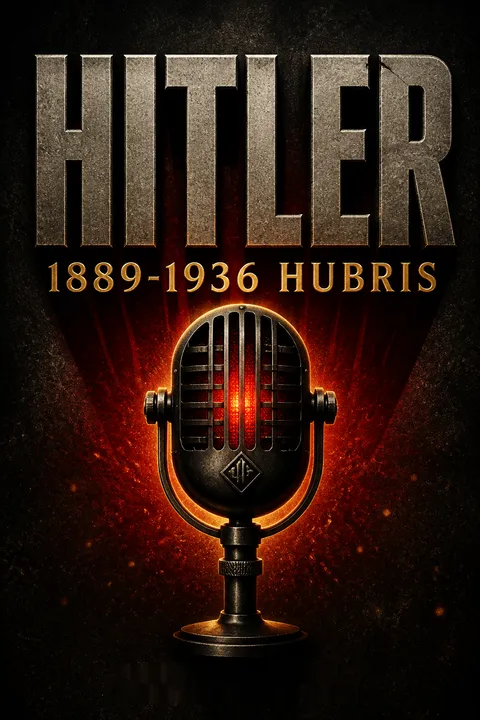
Hitler by Ian Kershaw receives strong praise for its meticulous research and political analysis of Hitler's rise to power. Readers appreciate Kershaw's "structural" approach, examining the societal and political forces that enabled Hitler rather than focusing on psychological speculation. The book is described as dense and detailed, sometimes dry, covering Hitler's life from 1889 to 1936. While some find the writing style challenging with long sentences and excessive detail, most consider it the definitive Hitler biography, offering crucial insights into how democracy collapsed and fascism emerged in Germany.
People Also Read


Hitler Series
Download PDF
Download EPUB
.epub digital book format is ideal for reading ebooks on phones, tablets, and e-readers.








































