

Key Takeaways
Fix your map before doubling your speed
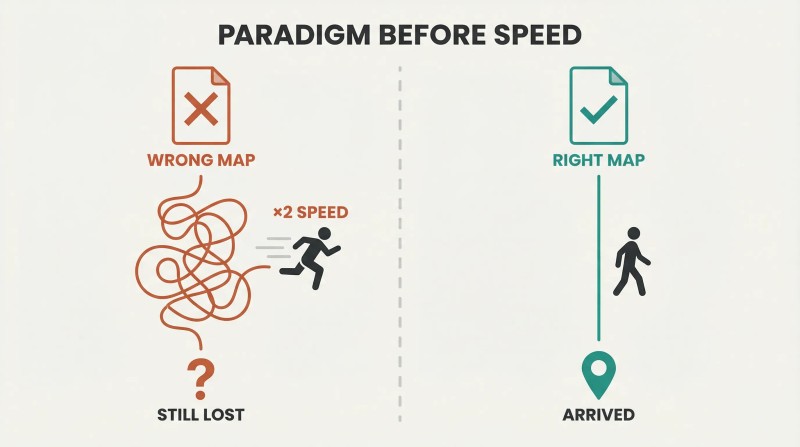
Covey studied 200 years of success literature and found a seismic shift. The first 150 years emphasized what he calls the Character Ethic — integrity, humility, courage, patience. After WWI, a Personality Ethic took over, prioritizing techniques, public image, and positive mental attitude. The difference is like navigating Chicago with a map of Detroit: no amount of better attitude or extra effort compensates for the wrong paradigm. Covey calls his alternative the "inside-out" approach — change how you see, and behavior follows naturally.
He illustrates this with a story from a New York subway. A man's children were running wild, disturbing everyone. Covey felt irritated — until the man whispered they'd just come from the hospital where their mother had died an hour ago. Same situation, different paradigm, completely different response.
Protect the goose — don't just grab the golden eggs
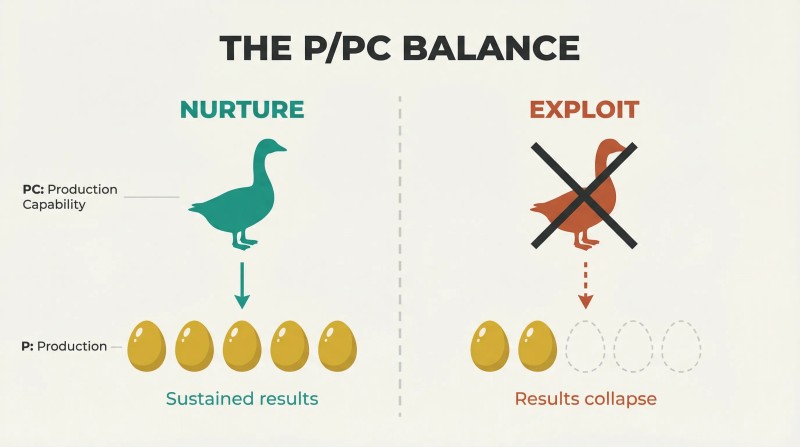
Covey's core effectiveness principle is the P/PC Balance, drawn from Aesop's fable. A farmer discovers a goose that lays golden eggs. Greedy for more, he kills the goose — and gets nothing. P is Production (desired results); PC is Production Capability (the asset producing those results). This balance applies across three asset types:
1. Physical (neglect your car or body, face expensive breakdowns)
2. Financial (spend principal to boost lifestyle, erode your earning base)
3. Human (demand results while neglecting relationships, watch trust evaporate)
A restaurant owner who watered down his popular clam chowder to cut costs watched customers vanish within months. Short-term profits spiked, then collapsed. In organizations and marriages alike, overemphasizing golden eggs destroys the goose that produces them.
Between stimulus and response, rewrite your own script
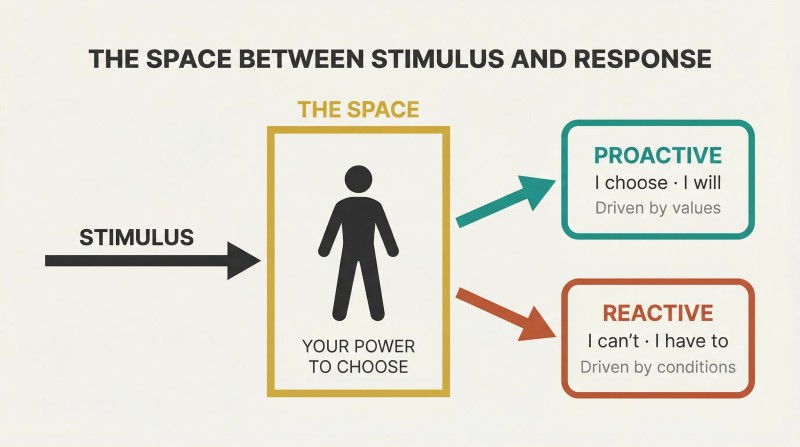
Viktor Frankl discovered this principle in Nazi death camps. Stripped of everything, he realized his captors could control his environment but not his response. Between any stimulus and our reaction lies a space — and in that space is our power to choose. This is Habit 1: Be Proactive. Proactive people are driven by values; reactive people are driven by feelings, weather, and other people's moods. Reactive language says "I can't" and "I have to"; proactive language says "I choose" and "I will."
Focus energy on your Circle of Influence — things you can actually affect — rather than your Circle of Concern. When a man told Covey he didn't love his wife anymore, Covey replied simply: "Love her." Love is a verb — a choice you enact through sacrifice and service — not a feeling that happens to you.
Write a personal constitution before life writes one for you
Everything is created twice: first mentally, then physically. A house begins as a blueprint; a business begins as a plan. Habit 2 says take charge of the first creation — your life's blueprint — or other people's agendas, social pressures, and old scripts will do it for you. Covey opens with a powerful exercise: imagine your funeral three years from now. Four speakers describe your life. What do you want them to say? That answer reveals your deepest values.
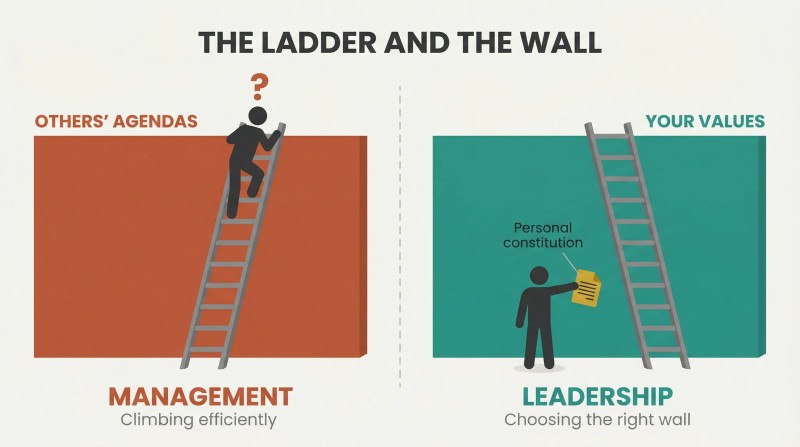
Your personal mission statement becomes your constitution — a fixed standard for daily decisions amid constant change. Covey distinguishes leadership (choosing the right wall for the ladder) from management (climbing efficiently). Without leadership, you may reach the top only to discover it was the wrong wall entirely.
Spend your best hours on what's important, not urgent
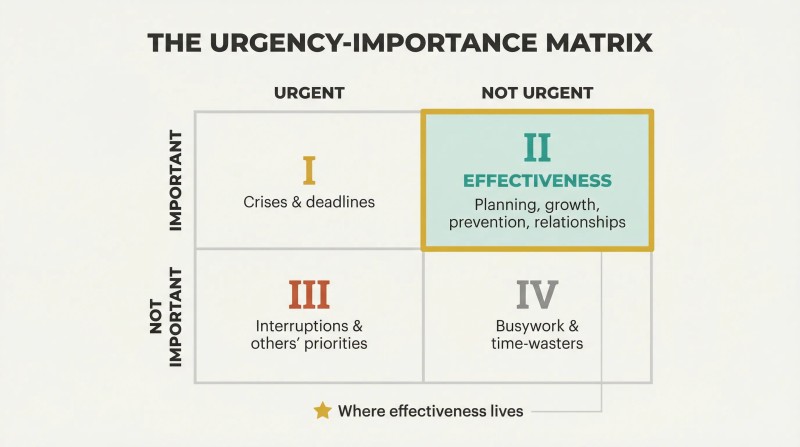
Covey's Time Management Matrix sorts activities into four quadrants. Quadrant I is urgent and important (crises). Quadrant III is urgent but not important (other people's priorities). Quadrant IV is neither (time-wasting escape). Quadrant II — important but not urgent — is where effectiveness lives: relationship building, planning, exercise, prevention, and personal development. Most people neglect it because nothing in Quadrant II screams for attention.
Shopping center managers discovered they spent less than 5% of their time building relationships with tenants — the one activity all agreed would most impact results. Consumed by Quadrant I crises, they never invested in prevention. When they shifted to 20%, revenue and satisfaction soared. The secret to saying "no" to the urgent is having a bigger "yes" burning inside — your mission and values.
Delegate results and trust people to find the method
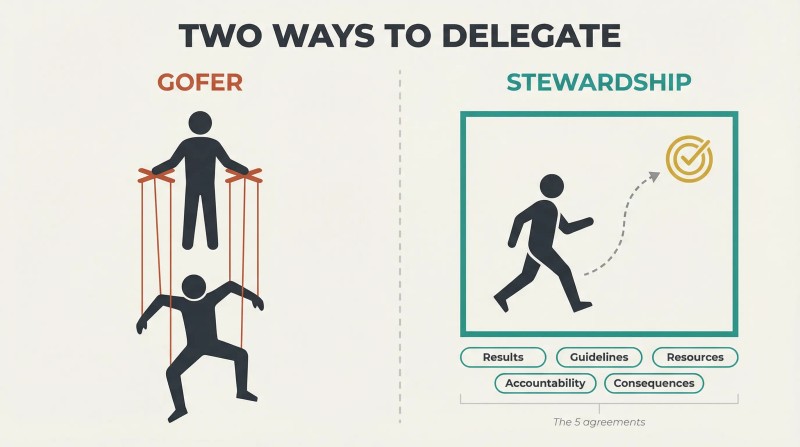
Covey contrasts two delegation styles. "Gofer delegation" micromanages every step — "Go do this, tell me when it's done." Stewardship delegation focuses on results and leaves methods to the person. It requires five clear agreements:
1. Desired results (what "done" looks like)
2. Guidelines (boundaries and failure paths to avoid)
3. Resources (people, budget, tools available)
4. Accountability (how and when progress is measured)
5. Consequences (what happens based on results)
Covey trained his seven-year-old son to manage the yard using just two words: "green and clean." He showed the boy what green looked like (the neighbor's yard) and what clean meant (no messes). The boy initially did nothing for days — but once he owned the walk-through, he maintained that yard better than Covey ever had.
Build trust deposits before you need withdrawals
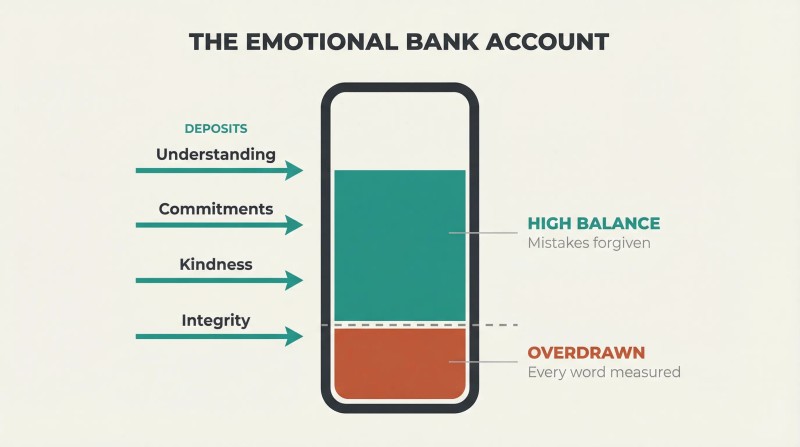
The Emotional Bank Account is Covey's metaphor for the trust level in any relationship. With a high balance, communication flows easily and mistakes are forgiven. With an overdrawn account, every word is measured and misinterpreted. Covey identifies six major deposits:
1. Understanding the individual (what matters to them, not you)
2. Attending to little things (a father's coat draped over a sleeping child)
3. Keeping commitments (broken promises are the biggest withdrawals)
4. Clarifying expectations (ambiguity breeds disappointment)
5. Showing integrity (loyalty to the absent builds trust with those present)
6. Apologizing sincerely when you make a withdrawal
Ongoing relationships need ongoing investment. Unlike old friendships where earlier deposits still hold, your spouse, children, and daily colleagues require constant, deliberate deposits.
Win/Win demands more courage, not less
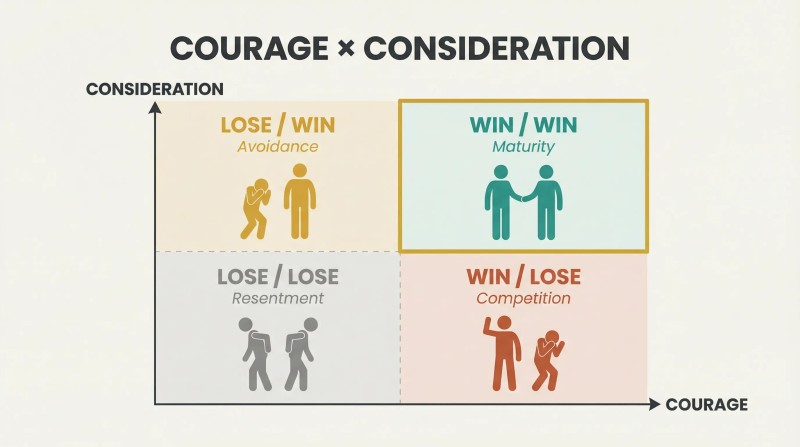
A company president preached cooperation while displaying a chart showing which manager would "win" a trip to Bermuda. He watered one flower and expected another to grow. Win/Win isn't naive idealism — it requires both courage (asserting your needs) and consideration (valuing others' needs equally). Covey calls this balance maturity. Most people default to Win/Lose (scripted by competition since childhood) or Lose/Win (conflict avoidance that breeds buried resentment).
Win/Win or No Deal is the safety valve: if both parties can't find a mutually beneficial solution, they walk away rather than compromise into resentment. A software company president returned an $84,000 contract when a new bank president was uncomfortable — and three months later signed a $240,000 deal. In interdependent reality, anything less than Win/Win eventually becomes Lose/Lose.
Diagnose before you prescribe in every conversation
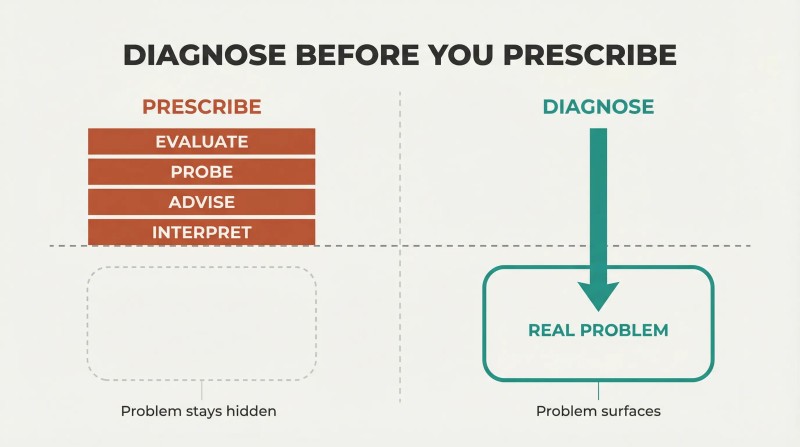
Imagine an optometrist who hands you his own glasses without examining your eyes: "They've worked great for me!" That's how most people communicate — prescribing before diagnosing. Empathic listening means entering another person's frame of reference, not projecting your autobiography. Only 10% of communication is words; 30% is tone; 60% is body language. Covey identifies four autobiographical responses that block understanding: evaluating, probing, advising, and interpreting.
In a powerful example, a father whose teenage son says "school is for the birds" cycles through all four — advising, lecturing, evaluating — never discovering the real issue: the boy reads at a fourth-grade level and is terrified. With empathic listening, the real problem surfaces. Covey calls this giving people "psychological air" — the emotional oxygen they need before they can think or change.
Value differences — that's where synergy hides
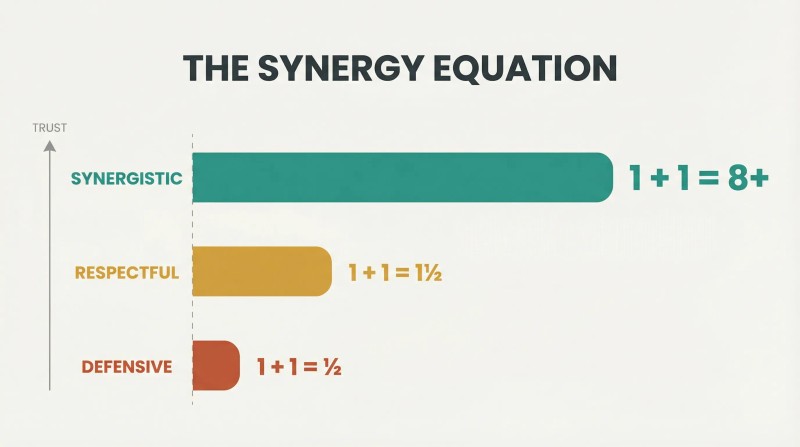
Synergy means the whole exceeds the sum of its parts — not as a platitude but as a practical phenomenon. In nature, two plants grown close together develop stronger roots than either alone. In human interaction, synergy occurs when trust enables genuine sharing, producing solutions neither person imagined alone. Covey maps three levels of communication:
1. Defensive (low trust): produces Win/Lose — 1+1=½
2. Respectful (moderate trust): produces compromise — 1+1=1½
3. Synergistic (high trust): produces breakthroughs — 1+1=8 or more
A husband wants fishing; a wife wants to visit her ailing mother. Compromise splits them apart or leaves one resentful. Synergy — fueled by the Emotional Bank Account, Win/Win thinking, and empathic understanding — produces a third alternative neither proposed: a family trip near the mother's home that meets everyone's deepest needs.
Invest one hour daily in renewing your four dimensions
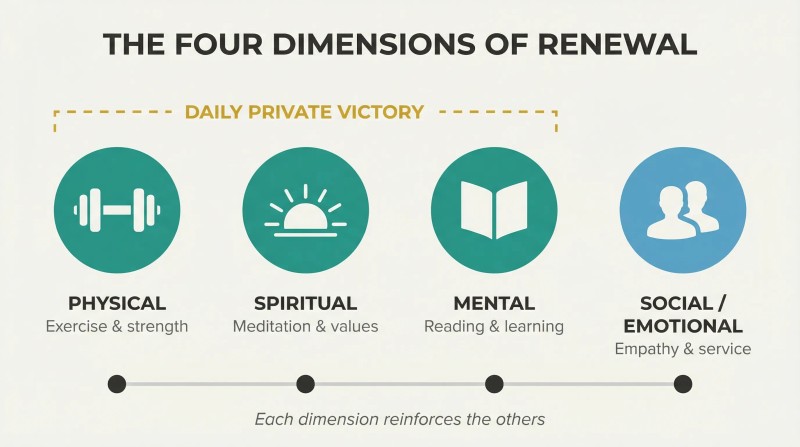
Habit 7 sustains all other habits by renewing the four dimensions of your nature:
1. Physical: exercise for endurance, flexibility, strength (30 minutes minimum, every other day)
2. Spiritual: meditation, nature, great literature — reconnecting with core values and mission
3. Mental: reading, writing, organizing — Covey recommends at least a book per month
4. Social/emotional: practicing Habits 4-6 in daily interactions and through meaningful service
Covey calls the first three dimensions the "Daily Private Victory" — one hour each morning on physical, spiritual, and mental renewal. He argues no other hour yields comparable returns. Each dimension reinforces the others synergistically: physical discipline builds proactivity, spiritual renewal deepens personal leadership, and mental sharpening improves self-management. Neglecting any dimension drags down the rest.
Analysis
Published in 1989 — the same year the Berlin Wall fell — The 7 Habits has sold over 25 million copies and remains the foundational architecture of the personal development genre. What accounts for its durability while hundreds of contemporaries have vanished?
The answer lies in Covey's structural decision to operate at the paradigm level rather than the practice level. Where most self-help books offer actionable tips ('five ways to listen better'), Covey argues that tips are worthless unless the underlying character supports them. The Personality Ethic produces short-term social gains that collapse under pressure; the Character Ethic compounds. This distinction maps neatly onto modern research on psychological safety, intrinsic motivation, and trust — domains that barely existed as academic fields when Covey was writing.
The book's developmental sequence — dependence to independence to interdependence — mirrors what developmental psychologists from Piaget to Kegan have described. What remains radical is Covey's insistence that independence, the holy grail of American culture, is a waypoint, not a destination. This was counterintuitive in 1989 and arguably more so today, as the self-optimization movement often glorifies lone-wolf productivity over collaborative creation.
The framework's weakness is its idealism. Covey's anecdotes resolve almost too neatly — the proactive executive always gains respect, the empathic listener always closes the deal. Power asymmetries, systemic injustice, and personality disorders receive no sustained attention. The book implicitly assumes that principled behavior is eventually rewarded, which is aspirational but incomplete as a model of how the world actually works.
Still, several contributions are genuinely durable. The P/PC Balance reframes every resource allocation decision in life. The Emotional Bank Account remains arguably the most useful metaphor for trust in popular psychology. And the Character Ethic versus Personality Ethic distinction has become more prescient with each passing year of social media, personal branding, and performative authenticity. Covey diagnosed the disease of superficial success before most people had the vocabulary for it.
Review Summary
The 7 Habits of Highly Effective People receives mixed reviews. Many readers find it transformative, praising its practical advice and universal principles for personal development. They appreciate Covey's emphasis on character, proactivity, and interdependence. Critics argue the book is repetitive, outdated, and filled with platitudes. Some find it condescending or overly religious. Despite criticisms, many readers consider it a classic self-help book that offers valuable insights on productivity, relationships, and personal growth. The book's enduring popularity is evident in its millions of copies sold and numerous translations.
People Also Read





Glossary
Character Ethic
integrity-based success foundationThe approach to success that dominated the first 150 years of American self-improvement literature, emphasizing foundational character traits—integrity, humility, fidelity, temperance, courage, justice—as the basis for lasting effectiveness. Covey contrasts it with the Personality Ethic and argues it must serve as the root from which all techniques and skills grow.
Personality Ethic
technique-based success approachThe approach to success that emerged after World War I, prioritizing social image, communication techniques, positive mental attitude, and influence strategies over character development. Covey argues it produces short-term results but ultimately fails because it lacks the foundation of genuine integrity. Quick fix solutions, charm, and manipulation all fall under this category.
P/PC Balance
results vs. capacity balanceCovey's core effectiveness framework derived from Aesop's goose and golden egg fable. P stands for Production (desired results, the golden eggs) and PC for Production Capability (the asset or relationship that produces results, the goose). True effectiveness requires balancing both—overemphasizing results destroys the capacity to produce them, while overinvesting in capability without producing results is equally ineffective.
Maturity Continuum
dependence to interdependence pathCovey's developmental framework describing three stages of growth: Dependence (you take care of me), Independence (I take care of myself), and Interdependence (we accomplish more together). Habits 1-3 move a person from dependence to independence (Private Victory); Habits 4-6 build effective interdependence (Public Victory). Habit 7 renews all stages. Interdependence is the most mature stage, not independence.
Circle of Influence
what you can controlThe subset of a person's concerns over which they have actual control or influence—their own behavior, attitudes, choices, and direct relationships. Covey argues that proactive people focus energy here, which causes the circle to expand over time. By contrast, reactive people focus on their broader Circle of Concern and feel increasingly powerless as their influence shrinks.
Circle of Concern
what you cannot controlThe full range of issues a person worries about, including things beyond direct influence—the weather, other people's behavior, global events, or the past. Covey warns that focusing energy here produces blaming and reactive attitudes while causing the Circle of Influence to shrink. Proactive people acknowledge these concerns but invest their energy where they can actually make a difference.
Emotional Bank Account
trust level in relationshipsA metaphor for the amount of trust built up in any relationship. Deposits include genuine understanding, keeping commitments, clarifying expectations, showing integrity, attending to small kindnesses, and unconditional love. Withdrawals include discourtesy, broken promises, betrayed trust, and unclear expectations. A high balance enables easy communication and forgiveness; an overdrawn account creates defensiveness and tension.
Quadrant II
important but not urgentThe quadrant in Covey's Time Management Matrix containing activities that are important but not urgent—relationship building, long-range planning, exercise, personal development, prevention, and writing a personal mission statement. Covey calls it the heart of effective personal management because these high-leverage activities create the greatest long-term results but are easily neglected in favor of urgent demands from Quadrants I and III.
Stewardship Delegation
results-focused trust-based delegationA delegation approach that specifies desired results, guidelines, resources, accountability standards, and consequences—but leaves the choice of methods to the person doing the work. Covey contrasts it with 'gofer delegation,' which micromanages every step. Stewardship delegation builds ownership, competence, and trust in the delegate, and frees the manager to focus on higher-leverage activities.
Abundance Mentality
enough for everyone paradigmThe paradigm that there is plenty of success, recognition, profit, and opportunity for everyone. It flows from deep internal security and enables genuine celebration of others' achievements, sharing of credit, and collaborative decision-making. Covey contrasts it with the Scarcity Mentality and identifies it as one of three essential character traits for Win/Win thinking, alongside integrity and maturity.
Scarcity Mentality
fixed-pie zero-sum thinkingThe belief that life offers only a limited amount of success, recognition, and resources—so one person's gain necessarily means another's loss. People with this mentality struggle to share credit, feel threatened by others' success, and default to competition rather than collaboration. Covey identifies it as a deeply scripted paradigm that undermines Win/Win relationships and synergistic outcomes.
Inside-Out
change self before circumstancesCovey's foundational approach to effectiveness. It means starting with one's own paradigms, character, and motives rather than trying to change external circumstances, other people, or surface-level behaviors. The principle holds that private victories (self-mastery through Habits 1-3) must precede public victories (effective relationships through Habits 4-6). Covey contrasts it with the outside-in approach that creates victimhood and blame.
Empathic Listening
understanding-first listening approachCovey's term for the deepest level of listening—seeking to understand another person from within their own frame of reference, emotionally and intellectually. Distinguished from 'active listening' or 'reflective listening,' which Covey considers technique-based and often manipulative. Empathic listening involves hearing with ears, eyes, and heart—attending to feeling, meaning, and behavior, not just words. It is the skill behind Habit 5.
FAQ
What's "The 7 Habits of Highly Effective People" about?
- Core Focus: The book by Stephen R. Covey is centered on personal and professional effectiveness, offering a principle-centered approach to solving problems.
- Seven Habits Framework: It introduces seven habits designed to help individuals achieve personal and interpersonal effectiveness, divided into Private Victory, Public Victory, and Renewal.
- Inside-Out Approach: Covey emphasizes that change starts from within, focusing on character ethics rather than personality ethics for lasting success.
Why should I read "The 7 Habits of Highly Effective People"?
- Personal Growth: The book provides a framework for self-improvement, helping readers become more effective in their personal and professional lives.
- Universal Principles: It is based on timeless principles applicable across various life aspects, making it relevant regardless of changing circumstances.
- Proven Success: Many readers and leaders have found success by applying the habits, making it a trusted resource for personal development.
What are the key takeaways of "The 7 Habits of Highly Effective People"?
- Be Proactive: Focus on what you can control and take responsibility for your actions and decisions.
- Begin with the End in Mind: Define clear personal and professional goals to guide your actions.
- Put First Things First: Prioritize important tasks over urgent but less important ones to achieve long-term goals.
What is the "Inside-Out" approach in "The 7 Habits of Highly Effective People"?
- Focus on Self: Emphasizes starting with self-improvement and personal change before trying to change external circumstances.
- Character Over Personality: Prioritizes character development over superficial personality traits, suggesting true effectiveness comes from within.
- Foundation for Habits: This approach is foundational for developing the seven habits, requiring a shift in mindset and perspective.
How does "The 7 Habits of Highly Effective People" define effectiveness?
- P/PC Balance: Effectiveness is the balance between production (P) and production capability (PC), ensuring long-term success.
- Principle-Centered: Involves aligning actions with correct principles, which are unchanging and universal.
- Holistic Success: True effectiveness encompasses personal integrity, character strength, and the ability to work well with others.
What is the "Emotional Bank Account" concept in "The 7 Habits of Highly Effective People"?
- Trust Metaphor: Represents the amount of trust built up in a relationship, indicating the feeling of safeness with another person.
- Deposits and Withdrawals: Positive actions like courtesy and honesty are deposits, while negative actions like discourtesy are withdrawals.
- Communication and Trust: A high balance facilitates easy communication, while a low balance leads to tension and misunderstandings.
How does "Think Win/Win" work in practice according to "The 7 Habits of Highly Effective People"?
- Mutual Benefit: Seeks mutual benefit in all interactions, ensuring agreements are satisfying for all parties.
- Abundance Mentality: Based on the belief that there is plenty for everyone, encouraging collaboration and shared success.
- Application in Negotiations: Approach negotiations with the mindset of finding solutions that benefit all parties involved.
What is the significance of "Seek First to Understand, Then to Be Understood" in "The 7 Habits of Highly Effective People"?
- Empathic Listening: Emphasizes listening with the intent to understand, not just to reply, involving ears, eyes, and heart.
- Building Trust: Understanding others builds trust and opens the door to effective communication.
- Influence and Persuasion: Understanding others' perspectives enhances your ability to communicate your ideas effectively.
What does "Synergize" mean in the context of "The 7 Habits of Highly Effective People"?
- Creative Cooperation: Synergy is the principle where the whole is greater than the sum of its parts, valuing differences and building on strengths.
- Teamwork and Innovation: Encourages teamwork and creating new solutions better than individual efforts, finding the "third alternative."
- Application in Groups: Transforms group interactions, leading to innovative solutions and improved relationships through openness and trust.
How does "Sharpen the Saw" contribute to personal effectiveness in "The 7 Habits of Highly Effective People"?
- Continuous Renewal: Involves regular renewal in four dimensions: physical, spiritual, mental, and social/emotional.
- Balanced Life: Emphasizes a balanced life, taking time for self-care and personal development.
- Long-term Success: Regular renewal increases your ability to handle challenges and maintain high effectiveness levels.
What are the best quotes from "The 7 Habits of Highly Effective People" and what do they mean?
- "Begin with the end in mind": Stresses the importance of having a clear vision of your goals before taking action.
- "Put first things first": Highlights the need to prioritize important tasks that align with your values and long-term objectives.
- "Seek first to understand, then to be understood": Underscores the value of empathetic listening and understanding others before expressing your views.
How can I apply the principles of "The 7 Habits of Highly Effective People" in my daily life?
- Daily Reflection: Regularly reflect on your personal mission statement and align your actions with long-term goals.
- Prioritize Quadrant II Activities: Focus on important but not urgent tasks that contribute to growth.
- Practice Empathy: Develop Habit 5 by actively listening to others and seeking to understand their perspectives before responding.
About the Author
Other books by Stephen R. Covey




Download PDF
Download EPUB
.epub digital book format is ideal for reading ebooks on phones, tablets, and e-readers.








































