
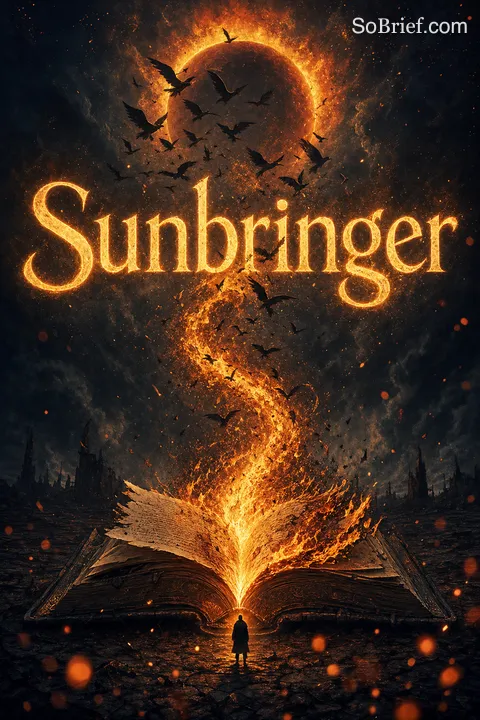


Plot Summary
A King of Ash Reborn
Arren,5 ruler of Middren, hides a terrible secret: a hearth god named Hestra11 lives where his heart should beat, sustaining him since a war wound cracked his ribs. When Hestra11 briefly crawls out of his chest, mourning the death of Hseth16 the fire god, Arren5 begins dying alone in a locked room. His loyal knight commander Peta20 breaks in and sees the void in his chest.
Rather than let himself be exposed as weak, Arren5 reframes it: he claims he willingly gave his life to save Middren from the gods. Hestra11 returns, reigniting him. The awed guards kneel and name him Sunbringer. Arren5 realizes he no longer needs Hseth's16 stolen power. He needs faith, a nation, and to become a god himself.
Kaner opens with the villain's origin as an act of narrative alchemy: Arren converts shame into scripture. The scene dramatizes how myth is manufactured, faith bound to hope and love until it becomes power. His near-death is less physical than existential, the terror of being the unloved son, the lucky prince. By choosing the story over the truth, Arren discovers that perception outweighs fact, a chillingly modern insight about propaganda and personality cults. Hestra's contempt frames a codependent, transactional intimacy between god and host. The chapter also seeds the book's central question: whether godhood is granted by the divine or seized by those ruthless enough to demand worship.
The Widow's Empty Doorway
After twenty-three days fleeing across mountains, Inara Craier,3 the disgraced knight Elogast,2 and Skediceth,4 the small winged god of white lies, reach the Lesscian smithy where Kissen's1 sisters wait.
Inara3 insists on delivering the news herself: Kissen1 fell into the sea alongside the fire god16 and drowned. Yatho,8 the smith, and her deaf archivist wife Telle7 break under the loss. Elo2 confesses the harder truth, that he summoned the god who killed Kissen16 while trying to save the king who had betrayed him.5
Yatho8 orders him from her home. Inara,3 twelve years old and orphaned twice over, refuses to let the household shatter, pleading that they first prove who truly cursed Elo.2 Shared grief and blame knot these survivors into a fragile, wounded family.
This chapter grounds an epic in intimate mourning. Kaner studies grief as a social act: who gets to tell it, who is allowed to absorb it. Skedi's instinct to soften truth with comforting lies collides with Inara's insistence on honesty, establishing the moral tension that will define his arc. Elo's confession is an act of masochistic accountability, offering himself as villain because guilt is easier to carry than ambiguity. Telle and Yatho's fury humanizes the cost of the previous book's heroics. Most poignant is Inara's precocious refusal to collapse, a child weaponizing purpose against sorrow, foreshadowing how trauma will accelerate her from ward into avenger.
Saved by the Sea God
Kissen,1 the one-legged godkiller everyone believes drowned, wakes in the arms of Osidisen,12 the sea god of her childhood, deposited half a world from home. He exacts a price for her rescue: she must heed his warning. War will arrive with summer, carried by Talicia, and though Hseth16 is dead, her faithful will drag her back to life within a single season.
Kissen1 scoffs until she watches Talician priests chain children to a molten statue, pouring bridhid-laced metal to reforge the fire god16 through blood and agony. She sees briddite cages sunk into the water to imprison Osidisen12 and a hidden fleet of Talician and Restish warships. The ritual confirms his prophecy: Hseth16 is returning, not as warmth, but as a god of war.
Kissen's survival relocates the trauma at her core. Returning to the shore where Hseth murdered her family, she is forced to relive the fire that shaped her hatred of gods. Kaner stages worship as horror: faith here demands the burning of children, indicting any ideology that sanctifies suffering as love. The imprisonment of Osidisen literalizes a broader theme, that gods are only as strong as the reach of their believers, and can be caged like beasts. Kissen's grudging pity for the god she once resented marks the beginning of her softening. The scene reframes the entire book, shifting stakes from palace intrigue to civilizational annihilation.
The Innkeeper's Buried Curse
In Lesscia, Elo2 and Inara3 hunt down Canovan,9 the tattooed innkeeper who once summoned Lethen, god of lost ways, to curse Elo.2 A brawl erupts and Canovan9 calls his god, but Inara3 freezes the deity mid-strike with her uncanny will while Skedi's lies calm the onlookers. They discover Canovan9 connects a rebel network and that Telle7 has been smuggling outlawed god-texts.
Elo2 offers his sword to fight King Arren,5 but the rebels, teachers and inkers led by Naia10 and Ariam, want no war. Inara3 begs to join, insisting the fight is hers after the king5 burned her home and family. Elo2 refuses to lead a child to slaughter and sends her away. His rejection wounds her, hardening her hunger to prove her worth.
Two philosophies of resistance collide here: Elo's warrior pragmatism and the rebels' pacifist idealism, a debate Kaner refuses to resolve cheaply. Canovan emerges as Elo's dark mirror, a man whose bond with a god runs through blood and rage rather than duty. Crucially, Inara witnesses another human channeling divine power, planting the seed of self-recognition. Elo's protective refusal, however loving, replicates the very silencing that Inara's mother imposed, and the child reads it as abandonment. The chapter interrogates paternalism: adults deciding what a traumatized girl can bear only deepens her sense of powerlessness and pushes her toward reckless autonomy.
One Shrine at a Time
Refusing to run home, Kissen1 dismantles Hseth's16 shrines across Talicia, hauling one bronze statue off a cliff with stolen horses. Everywhere she finds a nation arming for invasion: granaries stuffed, garrisons marching with the thaw, children sold for sacrifice.
Ambushed on an icy ledge by a squadron captain and her terrified boy recruits, Kissen1 fights to escape, but a sudden shrieking wind flings a young soldier onto her blade. For the first time she kills a person, and the act hollows her.
The wind reveals itself as Faer,14 the mountain god, who scatters her attackers and relays a summons from Aan,13 the river god. Bloodied, grieving, and shaken, Kissen1 turns toward Aan's13 distant source, no longer certain her vengeance means anything at all.
Kissen's identity has always rested on a moral boundary: she kills gods, not people. Kaner shatters that line with a devastating accident, forcing the godkiller to carry the same guilt Elo bears. The dead boy, barely older than Inara, collapses her comforting distinction between monstrous deities and innocent humans, revealing that faith turns children into weapons on every side. Her shrine-breaking crusade is exposed as futile, a spitting at wildfire, deepening the book's meditation on the impotence of individual violence against systemic belief. Faer's capricious rescue underscores a recurring motif: gods aid mortals for their own inscrutable reasons, never simple kindness.
Locking the City Gates
While the rebels dither, Elo2 shaves off his exile and walks into Lord Yether's17 marble manor, warning that Arren5 intends not to visit Lesscia but to seize it entirely. Yether,17 shrewd and unbowed, tests Elo2 with barbs before agreeing to shut his gates and demand the king halve his army.
Yether's17 fanatical son Beloris,18 intoxicated by king-worship, tries to have Elo2 arrested, but the captain Faroch19 sides with his lord. Meanwhile Arren5 launches a gilded victory march from Sakre, crowning himself Sunbringer with antlers and a chest split open to display his flaming heart, his commanders Peta,20 Risiah, and the pompous Antoc at his flanks. The board is set: a city of knowledge preparing to resist, and Elo2 privately resolving to get close enough to kill the king.5
Kaner frames politics as chess, and Elo, trained by his strategist mothers, thinks in pieces and moves. Yether embodies old power's cynical survival instinct, willing to gamble only when convinced inaction is deadlier. Beloris introduces the horror of ideological conversion within a family, faith curdling filial loyalty into betrayal. Arren's theatrical self-mythologizing, the antlers stolen from the war god he defeated, reveals a ruler consuming symbols to manufacture divinity. The march itself is choreography, spectacle as statecraft. Beneath Elo's tactical calm runs an unresolved grief: killing Arren means killing the man he loved, a private wound disguised as a public campaign.
The God in the Vault
Determined to understand herself, Inara3 talks her way into the cloche archives alongside Telle,7 then breaks alone into the forbidden god-vaults. There she disturbs Scian,15 the fading patron god of the city, born from the tomb of a murdered woman.
Scian15 helps them search the records, revealing that Skedi4 once traveled with Yusef, the great god of safe haven, and hinting at a buried connection to House Craier. At the archivists' public forum, Telle7 courageously speaks against the king's5 tightening censorship.
The crowd fractures, the king's knights storm in against forum rules, and an apprentice is crushed and killed in the panic. Branded dissidents, Inara3 and Telle7 flee into hiding at the archivist Solom's house, their trespass having lit a fuse under a fearful city.
Kaner links knowledge and mortality: Scian is a god of truths kept alive only by being read, a poignant allegory for institutional memory under authoritarianism. The archives themselves dramatize how regimes erase the past, first by locking texts away, then by criminalizing them. Inara's quest for origins fuses the personal and political; she seeks identity while the state seeks amnesia. Telle's decision to speak, using a hearing girl as her voice, is an act of profound vulnerability that turns fatal, illustrating how nonviolent dissent still bleeds. The chapter also advances the trilogy's central mystery, that Inara's power may be something no ledger has ever recorded.
Fight Fire With Fire
Kissen1 reaches Aan's13 frozen mountain source and is nursed back to strength by the hermit Doric. Aan,13 genuinely frightened, explains what no god has witnessed before: godhood and nationhood welded into a single weapon. Hseth16 will return within the season, reborn as war itself, and only a power greater than hers can stand against it.
That power, Aan13 insists, is the king who yearns to become a god.5 Kissen,1 who despises Arren5 for burning the Craiers and hunting gods, is commanded to save him rather than let Elo2 kill him, because a broken Middren cannot repel invasion. Reluctantly she agrees, sacrificing her last briddite sword to Aan13 and Faer14 so the wind god will carry her home to warn everyone.
This is the ideological hinge of the novel, forcing Kissen to invert her entire worldview. The godkiller who believes people need no gods must now preserve a would-be god to save her people. Aan articulates a terrifying geopolitical thesis: faith is infrastructure, and toppling a hated king may simply clear the field for something worse. Kaner refuses moral simplicity, staging survival as a choice between evils. Doric offers a quiet counterpoint to Kissen's rugged self-reliance, suggesting humility before forces larger than the self. Kissen's surrender of her last weapon symbolizes a deeper disarmament, trading vengeance for the harder, humbler labor of prevention.
Blood on Scian's Day
On the festival night, Elo2 leads rebels and Yether's17 guards to disarm the king's knights before the army arrives, seizing the barracks and the western gate with disciplined precision. But Canovan,9 grief-mad and vengeful, carves Lethen's rune into his own flesh and sacrifices a goat, drowning the fighters in a berserk illusion.
Naia10 and the inkers butcher surrendering knights without seeing the blood on their hands, and Ariam dies shielding Canovan9 from a spear. Elo2 halts the frenzy and severs Canovan's9 finger as punishment for the slaughter.
Instead of Lethen answering the call, the reborn city god Scian15 herself walks the candlelit streets, soothing her faithful. The night vindicates Elo's2 grim warning that war unleashes horrors no commander can fully restrain.
Kaner refuses to let rebellion be clean. The illusion magic literalizes how ideology dissolves individual conscience, ordinary people becoming instruments of atrocity while feeling righteous. Ariam's death, a pacifist killed by the violence his own side summoned, is the chapter's tragic irony. Elo's mutilation of Canovan is discipline as horror, echoing the wartime cruelties he confesses to Naia, exposing the machinery by which leaders convert fear into obedience. The unexpected appearance of Scian, tenderness answering where a vengeance-god was invoked, offers a fragile hope: that faith can console rather than destroy. The scene is Kaner's clearest statement that means contaminate ends.
Dropped in the Wrong City
Faer14 betrays Kissen,1 hurling her not to Lesscia but into a Sakre pigsty, days from her friends. Captured by mysterious besiegers assaulting the king's fortress, the Reach, she is dragged before their commander and discovers the impossible: Lessa Craier,6 Inara's mother,3 faked her death and raised an army of disaffected Houses.
Kissen1 relays Aan's13 warning of a Talician and Restish invasion, but Lessa6 refuses to abandon her vengeance or trust a filthy godkiller. When Kissen1 reveals she has protected Inara,3 Lessa6 panics. Pressed and threatened, Kissen1 names the child's deepest secret: her father is a god, Yusef of safe haven. Lessa,6 terrified the truth will make her daughter a hunted thing, imprisons Kissen1 rather than free her.
The reveal recontextualizes the entire narrative: Inara's grief was built on a lie, and her mother's love expressed itself as absence and secrecy. Lessa is a study in maternal ferocity twisted by fear, willing to besiege a nation and silence an ally to shield a child she cannot embrace. Kaner explores how protection and abandonment can be the same act. The disclosure of Inara's divine parentage answers the book's simmering mystery while raising graver ones: if gods and humans can bear children, what taxonomy of being does Inara belong to, and what does a god-hunting regime do with her? Faith, blood, and lineage fuse into existential threat.
Summoning a City of Gods
As the king's5 golden parade winds toward the cloche, betrayal strikes: Beloris18 murders his own father, Lord Yether,17 to hand the city to Arren,5 forcing Elo2 and Naia10 to flee. Inara,3 having reconciled with Skedi4 after nearly severing their bond in anger, discovers she can call gods across vast distances by making offerings.
She saws off the long braid she wore like her mother6 and casts it to the wind, waking rose-gods, canal-gods, inker-gods, and Lethen's shadows to flood the streets and scatter the invading soldiers. Meanwhile Telle,7 Solom, and the archivists persuade the fading Scian15 to surrender her heart so her knowledge can escape the doomed city, and the grateful god walks her streets one last time to bless their flight.
Inara's power crystallizes into identity: she is haven, a sanctuary for gods, able to summon the divine that shrines alone once bound. Cutting the braid is a rite of severance, shedding her borrowed maternal self to claim her own dangerous nature. Kaner threads two acts of preservation, Inara defending the living city and the archivists preserving its memory, arguing that resistance means saving both bodies and stories. Beloris's patricide is the ideology of Sunbringer taken to its logical conclusion, faith devouring family. Scian's final walk transmutes death into legacy: knowledge, unlike flesh, can be carried onward, a fragile answer to authoritarian erasure.
The Blade Through the King
Amid burning rose-briars, Elo2 finally faces Arren5 blade to blade in the plaza before the cloche, while Naia's10 white-robed singers ring the archives in nonviolent protest and veiga drag out Scian15 in briddite chains. Inara,3 perched in the dome, shoots a godkiller to buy Elo2 his opening, though she cannot save Scian,15 who is beheaded and scatters to dust.
Elo2 runs his sword clean through Arren's5 chest, only to grasp the horror: this Arren5 is a double of kindling and flame, crafted by Hestra.11 The true king never left Sakre. As Elo's2 hard-won victory dissolves into ash, Hestra's11 fire blooms around them and drags Elo,2 Inara,3 and Skedi4 through smoke and destruction across the entire country.
Kaner delivers a masterful reversal: the climactic duel Elo has bent his whole being toward is fought against an effigy, rendering vengeance literally hollow. The emotional devastation lands harder than any wound; Elo grieves killing a man who was never there, and confronts that his love for Arren was aimed at a phantom long dead. Scian's death, despite every sacrifice, insists that not everything can be saved, refusing triumphalist catharsis. The flame-double weaponizes faith itself as logistics, a god enabling omnipresence. The chapter dismantles the reader's expectation of resolution, converting the anticipated climax into a trap and relocating the true confrontation elsewhere entirely.
Mercy for a Burning King
Hurled into the Reach at Sakre, Elo,2 Inara,3 and Skedi4 wake beside the true Arren,5 his twig-heart smoldering, just as Lessa's6 rebels blast through the fortress wall. Everyone converges: Kissen,1 freed after breaking her own thumb to escape her chains, reunites with Inara,3 and Lessa6 faces the daughter she abandoned. Inara3 seizes Hestra11 with her will and nearly kills the king, believing he burned Daesmouth.
Kissen1 begs her to stop, unguarding her own heart and making a blood offering to Aan,13 whose waters reveal the real catastrophe: Talician and Restish fleets already torching Middren's coasts. Choosing to spare Arren,5 Inara3 releases the god.11 The enemy king survives, because a fractured land cannot withstand the fire god's16 return alone.
The convergence resolves the trilogy's threads into a single agonizing choice, and Kaner grants mercy not as forgiveness but as strategy. Inara, holding a god's life in her grip, must relinquish personal vengeance for collective survival, completing the maturation the whole book has driven. Kissen's blood offering, from the woman who refused all faith, marks her total transformation; she now begs, offers, and believes when the stakes demand it. The reunion of mother and daughter is deliberately cold, love strangled by years of secrecy. Sparing Arren is the bitterest triumph: preserving a tyrant because the alternative is extinction, a devastatingly adult verdict on power.
Epilogue
Across the Bennite mountains and the eastern coast, villages burn as Talician invaders ride the spring floods. Blenraden and Daesmouth fall, blue banners torn down and replaced with the bell of Hseth,16 and each fire is an offering paid in blood, cattle, and children.
Within the rising flames a woman takes shape, her ribs bright as lightning, her feet scorching black prints into the earth. In her chest a heart of briddite, blood, and flame already beats. Hseth,16 the fire god, has returned exactly as promised, no longer the warmth of cold nights but a god of war and empire. The reckoning Middren feared has only begun.
The epilogue confirms every prophecy the mortals ignored while consumed by their internal war. Kaner closes on cosmic dread: the human drama of kings, rebels, and vengeance shrinks against a returning god forged from atrocity. Hseth's rebirth as war incarnate fulfills Aan's warning and validates the novel's grimmest argument, that faith fed on death produces monsters no politics can contain. The imagery of a briddite heart, the very metal that kills gods now beating inside one, signals a foe uniquely armored against its own destruction. It reframes the preceding climax as a mere prelude, ensuring the trilogy's final movement will be apocalyptic reckoning.
Analysis
Sunbringer is a novel about how power converts belief into weaponry, and how the vulnerable resist a world that treats them as pieces on a board. Kaner braids five perspectives into a single argument: that faith, whether religious or political, is infrastructure, capable of sustaining kingdoms or incinerating them. Arren's5 transformation into the Sunbringer is a chilling anatomy of the cult of personality, a wounded man who mistakes worship for love and manufactures divinity from shame. Against him stands a fractured found family whose loyalties, griefs, and secrets are far more compelling than any throne. The book's structural masterstroke is its refusal of catharsis: the climactic duel is fought against a flame effigy, vengeance revealed as hollow, and the anticipated liberation deferred so that a fragile land can survive a greater horror. Kaner repeatedly stages the paradox that toppling a tyrant may only clear ground for something worse, forcing her characters into the bitter adult calculus of choosing the lesser catastrophe. Threaded through the geopolitics is intimate psychological study. Kissen's1 arc dismantles her rigid identity, the godkiller who trusts nothing learning to pity, bargain, and finally beg. Elo2 confronts whether love aimed at a phantom can ever be requited. Inara3 embodies the acceleration of a traumatized child into an avenger, and her question, who am I before I decide what to do, drives the trilogy's mystery of gods and humans making life together. Skedi's4 yearning to be more than a lie interrogates whether any being can change its nature. The novel's moral center, voiced through Naia10 and Elo's2 clashes, is that means contaminate ends: rebellion curdles into massacre, protection becomes silencing, and the fire meant to warm becomes the fire that devours. Ultimately, Kaner insists that stories, preserved in ink or bound to a girl's heart, are what survive the burning.
Review Summary
People Also Read

Characters
Kissen
Grieving godkillerA one-legged godkiller born in Talicia, orphaned when the fire god16 burned her family, Kissen has spent her life hunting deities for coin and hating the faith that ruined her. Fierce, foul-mouthed, and relentlessly self-reliant, she measures her existence in pain endured and battles survived. Her armored exterior conceals a fierce protectiveness, especially toward the child she reluctantly adopted3 and the sisters who smuggled her to freedom as a girl. Kissen believes people should need no gods and trust only themselves, yet her journey repeatedly forces her to bargain with, pity, and even beg the divine. Her defining tension is between vengeance and love, between the wall she builds around her heart and the family that keeps breaching it.
Elogast (Elo)
Guilt-ridden knight-bakerOnce the king's5 most trusted commander, the Lion who won the war, Elo abandoned court for a quiet bakery until his oldest friend's5 betrayal dragged him back to violence. Half Irisian, trained by strategist mothers, he thinks in chess moves and leads by breath, discipline, and quiet authority. Beneath the tactician lies a man hollowed by war trauma and heartbreak, haunted by the friend he loved5 and the god's hand scarred into his chest. Elo carries the weight of others' deaths like dough folded into his gut, and he wields protectiveness as both virtue and cage. His central struggle is whether he can kill the man he once adored5, and whether the best of people truly comes with their freedom.
Inara Craier
Orphaned noble girlTwelve years old, heir to a burned noble House, Inara can see the colors of emotion and command gods with her will, a power no ledger has recorded. Sharp, stubborn, and prematurely hardened by grief, she chafes against the adults who insist on protecting her from a war that has already devoured her home, mother6, and guardian1. Her hunger to be useful, to matter, to avenge, pushes her toward reckless courage. Bonded since childhood to a small god she both loves and resents for once overriding her4, Inara wrestles with trust, abandonment, and the terror of losing everyone. Her arc traces a child forced to discover what she is before she can decide what to do with it.
Skediceth (Skedi)
God of white liesA small winged god shaped like an antlered hare, Skedi has no shrine but Inara3 herself, making him wholly dependent on her love to exist. Anxious, proud, and yearning to be more than a forgotten trickster, he soothes pain by softening truths, a gift that becomes moral quicksand when honesty is needed. His longing for worshippers and independence wars against his devotion to the girl who has hidden and protected him since childhood3. Skedi's arc explores whether a being defined by lies can grow, whether gods can change, and what it means to choose love over power when offerings finally start to make him feel real.
Arren
King who would be godRuler of Middren and self-proclaimed Sunbringer, Arren survives only because a hearth god11 beats where his heart was destroyed in the war. Once the unloved, mocked youngest of the royal children, he channels lifelong insecurity into a ravenous appetite for power, faith, and adoration. Quick-witted, decisive, and terrifyingly capable of reframing shame into glory, he treats people as pieces to be sacrificed for the board. Yet beneath the gold and antlers flickers genuine, wounded feeling for the friend he betrayed2. Arren's tragedy is a man who cannot believe he is worthy of love without dominion, mistaking worship for the intimacy he was denied as a child.
Lessa Craier
Inara's formidable motherA noblewoman of hawkish beauty and iron composure, Lessa leads a coalition of disaffected Houses with a curved seafarer's blade and ruthless strategic calm. Fiercely intelligent and utterly controlled, she matches every barb and hides her emotions like armor. Her every choice, however cold, orbits a single fierce devotion: shielding her daughter3 from a secret that could make the girl a hunted thing. Lessa embodies love expressed as concealment and sacrifice.
Telle
Deaf archivist rebelKissen's1 sister-in-law and Yatho's8 wife, Telle is a deaf archivist whose scarred face and quiet manner hide fierce conviction. Raised in poverty by an abuser, she found her first true belonging in the cloche and risks everything to preserve outlawed knowledge of the gods. Brave, principled, and desperate to be heard, she believes what is lost in fire can live forever in ink.
Yatho
Inventive smith sisterKissen's1 fierce, loving sister, a wheelchair-using worksmith whose experimental briddite craft is worth a fortune. Practical, protective, and grief-stricken by loss, she anchors her found family with blunt warmth. Her marriage to Telle7 is tested by secrets and differing convictions about how to survive a tyrant, revealing how love endures through conflict.
Canovan
Vengeful demigod innkeeperA tattooed, muscular innkeeper and secret demigod, the son of Lethen, god of lost ways, Canovan summons shadow and illusion through blood sacrifice. Grieving a lost wife and courting violence, he connects the rebel network while nursing a bone-deep hatred of god-killers and knights. Dangerous, unpredictable, and driven by fury, he is Elo's2 dark reflection and Inara's3 unsettling kin.
Naia
Pacifist rebel teacherAn eloquent Irisian teacher and pamphleteer, Naia represents the rebellion's nonviolent conscience, believing gods balance access to power for the poor and the different. Principled and sharp-tongued, she resists Elo's2 push toward bloodshed while proving a natural leader. Her insistence on peace is repeatedly tested against the brutal arithmetic of war.
Hestra
Hearth god in the kingThe ancient hearth god who lives where Arren's5 heart should beat, sustaining his life in exchange for the faith he can offer. Bitter, wounded, and reduced to few shrines, she mourns the fallen fire god16 and taunts her host mercilessly. Her fragile, transactional dependence on Arren5 mirrors his own hunger for worship.
Osidisen
Sea god of childhoodAn old sea god of the north waters, once lover to Kissen's1 father and protector of her family. Bound by an old promise, he saves Kissen1 and delivers the first warning of invasion before being caged by briddite.
Aan
River god of prophecyAn ancient river god spanning Talicia and Middren who reads the world through her waters. Frightened by Hseth's16 rise, she summons Kissen1 and issues the novel's central command: save the king5 to save the land.
Faer
Capricious mountain windA wild goat-legged god of the mountain wind, ancient and mischievous. He rescues Kissen1 from ambush and carries her across the country, though he delights in dropping her in the wrong city.
Scian
Fading god of knowledgeThe patron god of Lesscia, born from a murdered woman's tomb and sustained only by readers and prayers. A god of truths that change and kill, she is diminished, forgotten, and tied forever to the city built upon her bones.
Hseth
Returning fire godThe great Talician fire god who murdered Kissen's1 family, killed during the previous conflict. Her death-bent worship threatens to resurrect her as a god of war and empire, the looming catastrophe behind every plot.
Lord Yether
Shrewd city lordThe wealthy, unbowed lord of Lesscia, a shrewd elder who loved gods before the war and refuses to show his belly to tyrants. His decision to defy the king5 pivots the city's fate.
Beloris
Fanatical king-worshipper heirLord Yether's17 resentful son, consumed by worship of the Sunbringer. His zealotry curdles into betrayal, embodying how faith in Arren5 dissolves even the bonds of family.
Faroch
Pragmatic guard captainCaptain of Yether's17 guard, a half-noble soldier loyal to his lord and uneasy about gods and politics. He wants only his city intact, and is forced into impossible choices between loyalty and survival.
Peta
Loyal knight commanderArren's5 aged, fiercely devoted knight commander, one of few generals who never fled the war. Her awe rather than disgust at the king's5 secret helps birth the Sunbringer myth.
Plot Devices
Faith Economy of Gods
Belief as divine powerGods in Middren exist through faith, prayers, offerings, and shrines; myths bind hope and love into worship that gives deities shape and strength. Deities die when abandoned and can be reborn if believers persist, though usually without memory. This system underpins every conflict: Arren5 manufactures a myth to become a god, Hseth's16 followers reforge her through mass sacrifice, and Scian15 fades because no one prays. Kaner uses the mechanic to explore propaganda, institutional memory, and how ideology feeds on emotion. Offerings must cost the giver something loved, making generosity and grief literal currencies. The device turns theology into political economy, where controlling belief means controlling power itself.
Inara's Haven Power
Commanding and calling godsInara3 can see emotions as colors and impose her will upon gods, freezing, unraveling, or binding them, an ability tied to her being part haven. Through offerings she learns to summon deities across great distances, drawing forgotten gods from hidden shrines to act at her command. Introduced quietly when she halts Lethen and Skedi4, the power escalates until she can raise a city of gods and grip a hearth god's life11 in her hand. It marks her as something unprecedented, neither wholly human nor god. Kaner uses it to dramatize the terror and responsibility of inherited power, and the moral weight of a child able to command the divine.
Briddite
God-killing metalBriddite, forged from bridhid ore and iron, is uniquely deadly to gods and painful to their flesh, the essential tool of veiga like Kissen1. Weapons, chains, cages, and arrows made of it can wound, imprison, or destroy deities. Talicia deploys it on a massive scale to cage the sea god12 and clear invasion routes, while the crown's godkillers use it to hunt shrines. Its scarcity and the skill required to work it make each blade precious. Kaner uses briddite to level the cosmic playing field, granting mortals real leverage against the divine and making the wars over faith physically winnable, and losing it repeatedly raises the stakes for the protagonists.
The Hearth-Heart
God sustaining the kingAfter a war axe shattered his ribs, Arren5 survives because the hearth god Hestra11 lives in the cavity where his heart should be, her fire warming his blood. The bond is fragile and transactional: she can abandon him to die, and he must feed her the faith she craves. He hides the void as shame, then reveals it as glory to birth the Sunbringer myth. Beyond keeping him alive, Hestra11 grants him the power to project a living double of kindling and flame and to be moved through fire across vast distances. The device fuses the king's political survival with his physical one, making his heart a literal altar.
Skedi's White Lies
Concealment and persuasionAs the god of white lies, Skedi4 can plant gentle falsehoods in minds, hiding his companions, soothing suspicion, and nudging crowds, but only lies meant to protect or comfort, never cruel ones. This power carries the fugitives safely across Middren and slips them past guards and into forbidden places. Its limits define its cost: he cannot soothe true grief, and heavy use, without offerings, exhausts and injures him. Kaner uses the device to interrogate the ethics of comforting deception, contrasting Skedi's4 kindly manipulation with Inara's3 insistence on truth, and asking whether protection through lies is care or control, mercy or cowardice, throughout their evolving bond.
Fallen Gods Series
About the Author
Other books by Hannah Kaner

Download PDF
Download EPUB
.epub digital book format is ideal for reading ebooks on phones, tablets, and e-readers.








































