

Plot Summary
Prologue
Bleeding from a beast's claws, Paisley1 staggers through Weatherstone's halls, her blood soaking into the carpet, the monster's scrape echoing close behind. The wound has torn flesh and magical essence alike, and she is fading fast. With nowhere left to run, she reaches the one door she has always refused: the minotaur-carved entrance of her supposed enemy.
Logan Kingston2 opens it before she can knock. He catches her as she collapses, his fury aimed not at her but at whoever did this. As darkness takes her, she wonders whether the monster behind her or the warlock holding her2 will decide whether she lives. Then the story rewinds six months to explain how she arrived, broken, at his threshold.
The flash-forward frames the entire novel as a question of trust: is the enemy who haunts her dreams a savior or a predator? By opening on the wound that is both physical and magical, the book signals that Paisley's deepest threat is internal as much as external. The minotaur door, the blood she leaves as a mark, and Logan's protective rage establish the central paradox of the enemies-to-lovers arc. Eve uses the in medias res hook to seed dread and desire simultaneously, ensuring that every gentle gesture and cruel word that follows carries the weight of this image: a dying girl choosing the monster she knows over the one she does not.
Acceptance and a Father's Terror
Paisley Hallistar,1 twenty-two and the only one of five magical siblings still without an affinity, receives her letter to Weatherstone, the most prestigious magic college in America, where her father teaches. She doubts she belongs after scraping barely passing entrance scores.
At the campus office, a clerk relays that Rafael Kingston's14 son Logan2 is transferring in. Tom Hallistar5 goes white and tries to drag his daughter straight back home.
He finally confesses a buried history: Rafael14 was once his closest friend until Rafael's wife Isabel died in the forest, and Rafael blamed Beth,6 Paisley's mother, sealing a blood oath against the whole family. Logan,2 a formidable spellcaster, may have come to fulfil it. Paisley1 refuses to surrender the only real shot at a future she has ever had.
The inciting incident fuses two anxieties: inadequacy and inherited danger. Paisley's lifelong sense of being the unremarkable runt collides with a vendetta she never knew existed, framing her coming-of-age as a negotiation between safety and self-actualization. Eve establishes the magical world's brutal meritocracy, where coven placement dictates one's entire economic and social future, raising the stakes of belonging. The blood oath functions as Chekhov's gun, while Beth's magical silence quietly foreshadows trauma. Tom's panic, uncharacteristic for a powerful warlock, signals that the threat is real and personal, transforming an ordinary campus arrival into a story about whether a girl can claim a life her parents fear will kill her.
The Enemy With Arctic Eyes
Paisley1 settles into Florence Wing while her siblings rally protectively around her: type-A nature-sprite twins Jenna9 and Alice,10 hot-tempered fire elemental Trevor,7 and water-calm Jensen.8 Their reunion fractures when they cross paths with Logan Kingston2 and his hulking, silent companion Noah4 in an intersecting corridor.
Glacially gorgeous, Logan2 mockingly calls Paisley1 his best friend and christens her Precious, weaponizing courtesy into threat. Trevor7 wants to fight; Jenna9 forbids provoking a spellcaster.
Fragmented memories surface for Paisley:1 a golden-skinned boy2 standing over her after she fell in a park. That night her recurring erotic dreams of a faceless warlock abruptly acquire Logan's2 pale green eyes, collapsing the wall between terror and longing and leaving her unsettled by her own traitorous body.
The first confrontation establishes the enemies-to-lovers engine through linguistic dominance: Logan controls Paisley not with violence but with naming, repeatedly deploying her full name and the proprietary Precious. His affability is more frightening than rage because it is unreadable. The intrusion of his eyes into her dreams introduces the novel's recurring motif of permeable boundaries between conscious hostility and unconscious desire. Eve also positions the Hallistar siblings as a defensive collective, dramatizing family as both shelter and cage. Paisley's frustration at her own attraction stages the central psychological tension: a young woman whose newly bloomed magic floods her with passion she cannot yet channel or trust.
Dragged Into the Depths
During Professor Mordock's water class, Paisley1 dives deep and feels her caged magic flicker awake, light spilling briefly from her hands. Then a vise clamps her ankles and drags her toward the lakebed.
Oxygen-starved and drowning, she glimpses a leathery, alien-faced creature gripping her, though each flash of her light reveals empty water. As consciousness fails, lightning erupts through the lake and Logan,2 impossibly fast, pulls her up and forces the water from her lungs. He coldly insists he saved her and that she now owes him a debt.
Mordock swears nothing in the lake could drag a student down so quickly. Tom5 is convinced Logan2 was the attacker; Paisley1 cannot reconcile rescuer with would-be murderer, yet uses the rescue to win her father's grudging permission to stay.
The near-drowning inaugurates the novel's pattern of attacks that defy explanation, training the reader to distrust appearances alongside Paisley. The hallucinatory monster, dismissed as oxygen deprivation, plants the central mystery while exploiting the unreliability of trauma-warped perception. Logan's paradoxical role, saving the girl he supposedly should destroy, deepens his enigma and keeps both Paisley and the reader suspended between gratitude and suspicion. Crucially, Paisley's magic stirs precisely at the moment of mortal threat, hinting that her power and her peril are entwined. Eve weaponizes the lake's history as a former battlefield to thread necromantic dread through what should be a simple swimming lesson.
A Bag Over the Head
Paisley1 befriends fierce redheaded water elemental Belle3 after saving her from a bathroom bully,16 gathering easygoing Sara17 and bookish Haley18 into her circle too. At the first full-moon party, Belle3 is struck by an iron spell, and Trevor7 escorts her to the healers.
Walking alone, Paisley1 is hooded and air-zipped to the Weatherstone graveyard by a beady-eyed warlock she dubs Weasel,15 who slams her into the ground again and again, swearing she will not be missed and that Kingston2 will thank him.
Students interrupt; healers mend her broken ribs and internal bleeding. Inexplicably, the attacker, Walter Allomore,15 is expelled and disappears before she even reports him. Logan2 visits her recovery room, drapes his hoodie over her shoulders, and flatly disowns Walter15 as no friend of his.
The graveyard beating escalates the threat from ambiguous to undeniably human, yet the swift, unexplained removal of Walter compounds the mystery rather than resolving it. Weasel's invocation of Kingston seems to indict Logan, but the convenient erasure of the attacker suggests an unseen protector. The hoodie becomes a transitional object, a tactile symbol of Paisley's growing, shameful comfort in her enemy's presence. Eve uses Belle's bullying subplot to mirror Paisley's victimhood and to forge the friendship that anchors the novel's emotional core. The chapter interrogates how women's bodies become battlegrounds for men's grievances, with Paisley repeatedly punished for a feud she did not choose.
The Power That Shouldn't Exist
In Logan's2 mandatory spellcaster lecture, Belle3 volunteers Paisley1 to be magically read. Logan2 locks her in stasis, probes her essence, and finds an affinity unlike anything he knows. When he grips her arms, wind, water, and fire erupt around them both, drenching and dazzling the room.
Suspecting she is a hidden spellcaster faking weakness, he later corners her in the library and accuses her of lying. He reveals he knows her intimately, that her father's5 pet name Gem actually comes from him once calling her Precious Gem in childhood.
Her uncontrolled magic involuntarily slaps him across the face. Instead of anger, Logan2 grows fascinated. Paisley1 flees, shaken, certain now that some forgotten shared past explains a pull that neither hatred nor distance can sever.
This sequence reframes Paisley's perceived deficiency as concealed potency, a classic ugly-duckling reversal that recodes her insecurity as buried power. The combustion of all elements through Logan's touch literalizes their magical compatibility, suggesting a bond predating memory. The library confrontation shifts their dynamic from predator-prey to mutual investigation; Logan's accusation of deception ironically reveals how little she understands herself. The pet-name revelation, fusing paternal affection with romantic claim, unsettles the boundary between protection and possession. Eve dramatizes the unreliability of childhood memory as a vault holding the story's true engine, positioning Paisley as a mystery she must excavate within her own past.
A Classmate Torn Apart
After weeks of Logan2 ghosting her and a persistent crawling sense of being watched, a snake-bodied beast ambushes Paisley1 in the graveyard; her classroom defense spell, flung with ash and incantation, barely repels it.
Then a praying-mantis monster invades Aura Hall during a dorm gathering and slices a third-year named Gerard Donovan in half before horrified students. Paisley1 recognizes the same ash-and-sulfur reek and the warning tingle racing down her spine.
As she tries to reach the creature with her thorn weapon, Logan2 knocks her clear and disintegrates the monster with a blast of blinding power. The college locks down in mourning. A student's death transforms Paisley's private, dismissed terror into an undeniable campus-wide crisis with no explanation and no suspect in sight.
The first on-page death raises the existential stakes and validates the dread Paisley has carried alone, a vindication shadowed by guilt. The escalating bestiary, each monster distinct, builds a taxonomy of horror that resists the magical world's tidy categories of affinity, hinting at energies outside sanctioned magic. Logan's intervention cements his function as the only force capable of countering the threat, deepening Paisley's dependence on the man she distrusts. Eve stages the kill in a communal space to puncture Weatherstone's veneer of prestige and safety, exposing how institutions prioritize reputation over student lives, a critique that sharpens as the administration's responses grow more self-interested.
Crystals, Ash, and a Grandmother's Notes
Headmaster Gregor12 mourns Gerard and promises a magical blanket to suppress strong energy. Paisley,1 Belle,3 Sara,17 and Haley18 raid the library, learning only that summoning such monsters requires forbidden dark magic drawn from a plane no affinity can touch.
They craft a potent thorn weapon and vow never to travel alone. Visiting her sisters' familiars, the sheep Simon and bear Morris, reminds Paisley1 what home truly means. On a weekend home she unearths her late grandmother Helena's box: crystals, photographs annotated with magical instructions, and unopened letters her mother has never read.
Recalling that she wore a crystal the night she survived the graveyard, Paisley1 begins to suspect gemstones may unlock her stubborn, half-caged power, and she resolves to start stalking Logan2 for the answers he keeps withholding.
This investigative interlude converts passive victimhood into agency, with Paisley assembling a found family of researchers. The crystal motif crystallizes here, recasting her childhood obsession as latent magical instinct and tying her power to maternal inheritance through her grandmother's relics. The unopened letters function as a literal repository of suppressed family history, mirroring Beth's refusal to use magic and foreshadowing buried truths. Eve uses the familiars and home visit to reassert the warmth that grounds Paisley's stakes, contrasting domestic tenderness with institutional danger. The decision to stalk Logan marks a shift from reactive survival to proactive pursuit, the protagonist seizing narrative initiative.
To the Enemy's Door
Stalking Logan2 at midnight, Paisley1 is attacked by an antlered, single-eyed beast that flickers in and out of existence and rips open her side. Her thorn spell only wounds it. Bleeding out, she stumbles to Logan's2 minotaur-marked door, which opens before she even knocks.
He catches her, demanding to know who hurt her. In his room he pours searing power into her wounds, and when her crystal necklaces spark against his hand, the healing transmutes into overwhelming desire.
He brings her to climax with his mouth, knitting her body whole through their merged energy, then coldly dismisses it as a mere manifestation of power. Before she leaves, Logan2 offers a chilling clue: the monsters are not being created at all. They are being called from somewhere beyond any affinity's reach.
This is the prologue fulfilled, the structural fulcrum where physical peril and erotic awakening become inseparable. The healing-as-sex device literalizes how their magic refuses the boundaries their fathers' feud demands, the body overruling enmity. Logan's clinical detachment afterward weaponizes intimacy, protecting himself while wounding her, a defensive cruelty that complicates simple romance. The crystal's spark reinforces the gemstone thread, and his revelation that the beasts are summoned, not made, redirects the mystery toward origin rather than method. Eve fuses vulnerability and ecstasy to dramatize the danger of desiring one's enemy: surrender heals and humiliates in the same breath, leaving Paisley more bound and more confused.
Two Fathers, Two Warnings
Logan2 quietly reports the latest attack so the school casts its energy-suppressing blanket, then orders Paisley1 to train with him and Noah.4 At parents' weekend, Belle's father, the cold councilman Elder Monroe,13 sneers at Paisley1 but points her toward forbidden texts: The Reapers of Purgatory, the witch massacres of 1859, and the chilling term demon-witch, insisting such a witch can only be stopped by beheading.
At the gates, Rafael Kingston,14 an icy and genuinely terrifying spellcaster, ambushes Beth6 and Tom,5 reviving his grief and accusations over Isabel's death and needling Beth6 about her abandoned magic.
Paisley1 shields her shaken mother6 and sends her parents home. The confrontation confirms the Kingston vendetta still burns, and seeds the central question of what a demon-witch actually is.
The parallel paternal antagonists expand the novel's web of menacing fathers, contrasting Monroe's bureaucratic coldness with Rafael's volcanic grief. Both men deploy knowledge and power to intimidate a young woman, dramatizing patriarchal authority as a recurring threat. Monroe's cryptic reading list operates as deliberate breadcrumbing, the demon-witch terminology functioning as the master key to the novel's mythology. Rafael's unhealed mourning humanizes the vendetta even as it terrifies, complicating any clean villainy. Eve uses the public confrontation to expose how trauma metastasizes across decades and generations, with Beth's compassion only inflaming a man who cannot forgive. The chapter braids personal grief, institutional power, and looming revelation.
Dreams Made Flesh
Forced into brutal gym sessions and affinity drills, Paisley1 discovers Logan's2 touch unlocks her magic and that her grandmother's crystals amplify it, finally letting her cast active spells, once even hoisting Logan2 upside down into a tree.
Then the erotic dreams intensify until Logan2 appears at her door one storming night, sweat-soaked and half-feral, demanding to know why she haunts his sleep. They realize they have been sharing the same dreams for months.
Pent-up hunger ignites, and they have sex on the windowsill and bed as their powers crash and merge. She wakes alone, wrapped in yet another of his hoodies, aching and no closer to understanding the bond. The consummation binds her tighter to a warlock she still cannot trust or explain.
The shared-dream revelation reframes desire as fate rather than weakness, externalizing the attraction so neither party can dismiss it as mere lust. Logan arriving undone, stripped of his usual control, momentarily levels their power imbalance and exposes his own helplessness before the bond. The crystals' confirmed amplification advances Paisley's competence arc, her magic blooming through tools her bloodline left her. Yet waking alone preserves the romance's central ache: physical union without emotional security. Eve stages the windowsill encounter amid a literal storm, the weather mirroring elemental forces beyond either lover's command, and uses the recurring hoodie to track Paisley's deepening, reluctant attachment to the body she keeps claiming to hate.
Wine, Fire, and a Father's Fall
At the Blue Harvest Moon festival, bootlegged witch wine is smuggled in disguised as ordinary drinks. Tom,5 on chaperone duty, notices Paisley's1 cup but lets the celebration continue. A drunken Paisley1 is carried to bed by Logan2 as fire erupts behind them: the chapel burns, injuring students and scorching the library.
Days later Tom5 is suspended without pay, reported by a highly ranked figure who demands every Hallistar be expelled. The family faces losing their coven and the tithe that sustains them.
Headmaster Gregor12 admits the blanket will lift after graduation despite no culprit being found. Logan2 later hints the true betrayer is far closer to home than his father,14 steering Paisley's1 suspicion toward Belle's father, Elder Monroe,13 and the daughter who unwittingly fed him information.3
The chapel fire externalizes the novel's mounting chaos and triggers the family's economic catastrophe, grounding fantasy stakes in the concrete dread of losing livelihood and community. Tom's lenient choice, born of wanting his daughter to enjoy youth, becomes the lever for his ruin, a poignant study of how kindness is punished within rigid systems. The demand to expel all Hallistars reveals the vendetta operating through institutional channels rather than overt violence. Logan's redirection of blame complicates Paisley's most trusted friendship, introducing the painful possibility that intimacy itself is a vector of betrayal. Eve sharpens her critique of a magical aristocracy where reputation and tithe outrank both safety and justice.
The Monsters Were Always Hers
After passing her assessment as a confirmed spellcaster, Paisley1 meets Logan2 at the graveyard on Halloween once the blanket lifts. He shows her his family grave, admits his father14 wants him to destroy her, and that their endgame was written when she was four.
As her fury spikes, monsters materialize one by one, and Logan2 reveals the devastating truth: Paisley1 herself has been calling them all year, her emotions summoning beasts from a forbidden plane. Their combined power and her crystals finally disintegrate the horde.
Then Beth6 appears, drawn by her daughter's call, and Logan2 names her a demon-witch. Beth6 begs for one month to teach Paisley1 before others come for her; Logan2 grants it, claims Paisley1 as his and vows to kill anyone who takes her, and Beth6 spirits her home toward long-delayed answers.
The climax executes a triple reversal: the hunted is the source, the safe mother is the secret, and the enemy is the claimant. Recasting Paisley as the unwitting summoner reframes the entire novel as a story of repressed power and unexamined self, her uncontrolled emotions literally birthing the dangers she fled. The demon-witch revelation retroactively explains Beth's magical silence and the family's evasions, exposing love as a structure built on protective concealment. Logan's possessive vow crystallizes the romance's danger and devotion alike. Eve closes on threshold rather than resolution, the granted month and unread book promising a reckoning, leaving Paisley poised between inherited identity and the man who has always known what she is.
Analysis
Spellcaster operates as a dark-academia fantasy that disguises a story of repressed identity beneath an enemies-to-lovers romance. Its governing irony, withheld until the final pages, is that the heroine spends a year hunting an external monster that originates within her own ungoverned power. Eve uses Paisley's1 locked magic as a sustained metaphor for self-estrangement: a young woman taught to see herself as the unremarkable runt cannot access her strength precisely because she has internalized inadequacy. The crystals, the dreams, and Logan's2 catalytic touch all function as external keys to a self she has been trained not to recognize, dramatizing how trauma and family silence can wall a person off from their own essence. The novel is acutely interested in inheritance, not only of magic but of grief and secrecy. Beth's6 abandoned power, the blood oath, the unopened letters, and Rafael's14 metastasized mourning all illustrate how unprocessed loss is passed down like a tithe the children never agreed to pay. Weatherstone itself, built on a battlefield of ten thousand dead, literalizes a culture feeding on buried bodies, and the administration's repeated willingness to sacrifice student safety for prestige sharpens a critique of institutions that protect reputation over people. The romance refuses easy comfort: Logan2 heals and humiliates Paisley1 in the same breath, his tenderness inseparable from possession, staging the genuine danger of desiring someone whose claim on you predates your consent. By ending on threshold rather than resolution, with a granted month, an unread book, and a mother finally forced to confess,6 Eve frames coming into power as inseparable from coming into painful knowledge. The lesson is unsettling and modern: the self we most fear to meet is often the one others have spent our lives hiding from us.
Review Summary
People Also Read
Characters
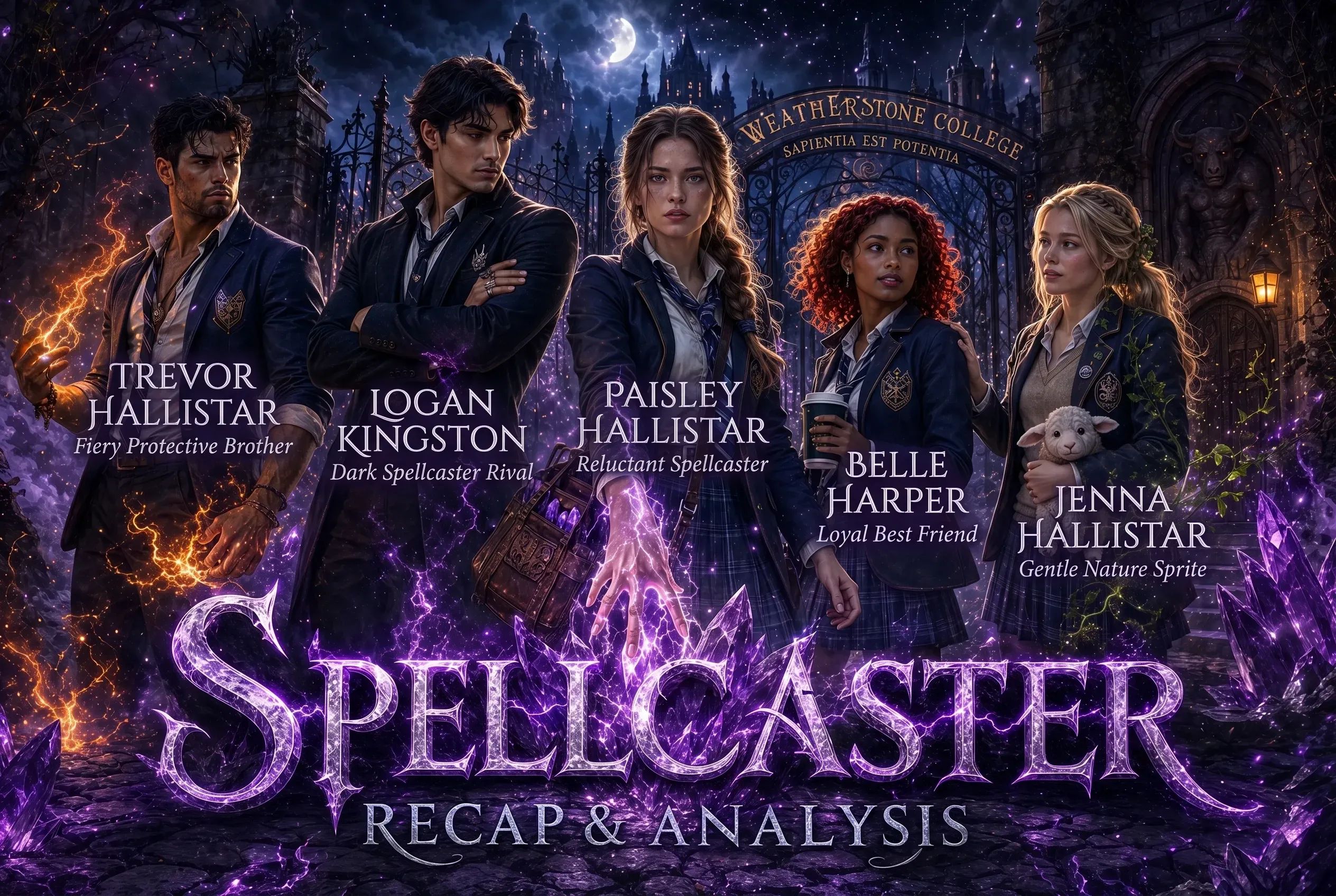
Paisley Hallistar
Late-blooming spellcaster heroineThe youngest of five gifted siblings, Paisley enters Weatherstone convinced she is the unremarkable one, her magic bloomed late and stubbornly locked away. A crystal-collecting dreamer with a quick tongue and deep loyalty, she masks chronic self-doubt with sass and the reflexive insistence that everything is fine. Her newly awakened power floods her with passion she cannot channel, manifesting as vivid dreams and volatile emotion. Driven by a fierce need to claim a future her family takes for granted, she refuses to be defined by fear or fragility. Beneath her bravado lies a perceptive, protective nature: she throws punches for bullied strangers and would die for her siblings. Her central struggle is learning to trust her own buried strength and to distinguish genuine danger from her own untamed magic.
Logan Kingston
Powerful, glacial spellcasterThe transfer student at the heart of the blood oath, Logan is among the strongest spellcasters alive, with golden skin, arctic green eyes, and tattoos he keeps hidden under his uniform. He weaponizes politeness, turning the endearment Precious into a blade, and conceals every emotion behind unreadable calm. Disciplined to the point of asceticism, he refuses magical shortcuts and runs his power like clockwork. Yet his cruelty is inconsistent: he repeatedly saves Paisley1, heals her, and shields her from threats he claims not to care about. Raised as a dutiful son to a terrifying father14, Logan carries the weight of obligations and a past he understands far better than Paisley does. His possessiveness and tenderness coexist uneasily, making him the novel's most magnetic riddle.
Belle
Loyal hyperactive best friendA vibrant red-haired water elemental who never sleeps, Belle becomes Paisley's1 fiercest friend after being rescued from a bathroom bully16. Daughter of a cold, powerful councilman13, she rebels through confidence and chaos, topping classes while pursuing situationships and hexcraft. Quick to defend Paisley1 against anyone, including herself, Belle hides the ache of a distant father behind relentless cheer and blunt honesty.
Noah
Logan's silent giant allyA linebacker-sized warlock with a buzzed cut and an unsettling stillness, Noah shadows Logan2 everywhere and speaks only when necessary. Calculating and accentless, he radiates coiled menace yet shows flashes of dry humor and even concern toward Paisley1. Bound to Logan2 as a brother in all but blood, he guards secrets about Rafael14 and the Kingston world.
Tom Hallistar
Protective professor fatherPaisley's1 imposing fire-and-air elemental father, a tenured Weatherstone professor who walks every room like he owns it. Once Rafael's14 best friend, he carries the blood oath like a wound and is consumed by fear for his youngest child. Loving and stubborn, he hides softness beneath sternness and would sacrifice anything, including her education, to keep her safe.
Beth Hallistar
Mother who abandoned magicPaisley's1 warm, fair-haired mother, a powerful witch who has refused active magic for nearly two decades since the forest tragedy that ended her friendship with Isabel. Calming and fiercely loving, she raised five children while living almost as a human. Her serenity conceals deep grief and carefully guarded secrets she has never been willing to share.
Trevor
Hotheaded fire-elemental brotherThe brawny, dark-haired Hallistar brother, a strong fire elemental crowned Weatherstone's hottest warlock, who jokes constantly and itches to incinerate anyone who threatens his family. Beneath the swagger and sarcasm lives a devoted protector who blames himself whenever his sister1 is harmed.
Jensen
Calm water-elemental brotherEighteen months older than Paisley1 and closest to her, a primary water elemental who reads her moods better than anyone. Easygoing and intuitive, he urges her to lean on family rather than face danger alone.
Jenna
Bossy eldest twin sisterA driven, type-A nature sprite bonded to her bear familiar Morris, Jenna leads the sibling hierarchy with practical command and unwavering loyalty, organizing transport, seating, and survival plans alike.
Alice
Gentle empath twin sisterThe softer nature-sprite twin, bonded to her sheep familiar Simon, who reads emotions with uncanny tenderness and offers comfort. Sweet but quietly fierce when family is threatened.
Marcus
Fellow emerging spellcasterA handsome, blue-eyed classmate who shows aptitude across multiple elements, marking him as a possible spellcaster. Drawn to Paisley1 early, he retreats when he reads mixed signals, citing past hurt. Kind and perceptive, he becomes a tentative ally with hints of deeper resources, offering friendship and help even after she gently declines romance.
Headmaster Gregor
Bookish necromancer headmasterThe wiry, graying necromancer who governs Weatherstone, presenting as a mild librarian while wielding dark power. Reputedly tough but fair, he resolves crises with unsettling speed and prioritizes the college's prestige, leaving Paisley1 uneasy about what his affability conceals.
Elder Monroe
Belle's cold councilman fatherA thin, slick-haired council elder with dead eyes and a sociopathic calm, capable of suppressing all emotion. Cruel and calculating toward Paisley1 while doting selectively on his daughter3, he dispenses cryptic, threatening guidance about forbidden history and demon-witches, his motives shrouded in menace.
Rafael Kingston
Grief-twisted enemy patriarchLogan's2 father, an immensely wealthy and terrifying spellcaster radiating icy darkness. Once Tom's5 closest friend, he was broken by his wife Isabel's death and has nursed the blood oath against the Hallistars for eighteen years. His unhealed grief makes him both pitiable and genuinely dangerous.
Walter Allomore
Vengeful air-elemental attackerA beady-eyed warlock Paisley1 nicknames Weasel, who ambushes and brutally beats her in the graveyard, blaming her family for his father's ruin. He vanishes mysteriously soon after, his fate a lingering question.
Annabeth
Early bathroom bullyAn air-elemental witch who torments Belle3 over a fired father, attacking her in the showers and later at a party. Her cruelty triggers the friendship between Paisley1 and Belle3 before she is expelled.
Sara
Bubbly affinity-less friendA dark-haired, outgoing witch born in Romania who bonds with Paisley1 over their shared lack of an early affinity. Flirtatious and warm, she pushes Paisley1 toward romance and adventure.
Haley
Bookish introvert friendA pale, brilliant nature sprite and devoted reader who smuggles e-readers and paperbacks into the magic-warped college. Tech-savvy and shy, she converts Paisley1 into a fellow book lover and aids the monster research.
Plot Devices
Grandmother's Crystals
Hidden key to her magicPaisley's1 lifelong obsession with gems is recast as buried magical instinct when she inherits her late grandmother Helena's annotated crystals and photographs. Amethyst, moonstone, quartz, jade, and aquamarine each carry penned instructions about boosting, warding, and calling power. Wearing them against bare skin amplifies Paisley's1 stubborn energy, letting her finally cast active spells and survive attacks she otherwise could not. The crystals spark dramatically against Logan's2 spellcaster power, signaling their potency. Functioning as both inheritance and instrument, they tie Paisley's1 abilities to maternal bloodlines and to secrets her family has hidden, transforming a childhood quirk into the literal mechanism by which she begins to unlock the affinity everyone insists she possesses.
The Shared Dreams
Fated desire made literalBeginning just after her magic blooms, Paisley1 suffers vivid erotic dreams of a faceless warlock who claims her. Once she meets Logan2, the dreamer acquires his arctic eyes, collapsing the wall between terror and longing. The dreams escalate relentlessly, waking her mid-climax and exhausting her, until the night Logan2 arrives at her door half-feral and they discover they have been sharing the same visions for months. The device externalizes attraction as something neither lover controls, reframing desire as fate rather than weakness. It also functions as a slow-burn engine, ratcheting tension across the year and finally driving the enemies into bed when the dreams become impossible to dismiss as mere fantasy.
The Warning Tingle and Monsters
Recurring danger and central mysteryThroughout the year Paisley1 feels a distinct creeping tingle down her spine, a warning system that precedes encounters with impossible beasts: an alien lake creature, a snake-bodied horror, a praying mantis that kills a student, an antlered flickering monster. The monsters reek of ash and sulfur and seem to be called from a forbidden plane no affinity can touch, defying the magical world's tidy categories. They drive the investigative subplot, the research sessions, the thorn weapon, and the campus lockdown. The device sustains dread and propels Paisley1 toward Logan2 again and again, while quietly accumulating clues pointing back toward the true, devastating source of the summonings revealed at the climax.
The Magical Blanket
Suppresses power and stakesAfter a student dies, Weatherstone's administration casts a blanket of energy across the campus to suppress any magic stronger than basic spells, hoping to prevent further monster attacks while they investigate. The blanket presses against Paisley's1 power like a cage and grants the school a fragile, uneasy safety. Crucially, the elders agree to lift it after graduation despite never identifying a culprit, prioritizing students' developing abilities and the college's reputation over their lives. The device structures the novel's middle and end, providing temporary respite and then removing it at the climactic Halloween, when the unleashed energy of All Hallows' Eve and the lifted blanket combine to force the story's final, explosive confrontation in the graveyard.
The Blood Oath
Inherited vendetta engineThe unbreakable magical oath sworn between Rafael Kingston14 and Tom Hallistar5 after Isabel's death anchors the entire conflict. It transforms a childhood friendship into a generational feud, the reason Tom5 panics at Logan's2 arrival, the reason Beth6 abandoned magic, and the explanation Paisley1 clings to whenever Logan2 saves rather than harms her. The oath frames Logan2 as a destined destroyer even as his actions contradict that role, fueling the enemies-to-lovers tension. It operates as the lens through which Paisley1 misreads nearly everything, attributing attacks and rescues alike to the Kingston grudge. Its full meaning, and the endgame supposedly written when Paisley1 was four, becomes the question driving the novel toward its revelations.
Download PDF
Download EPUB
.epub digital book format is ideal for reading ebooks on phones, tablets, and e-readers.








































