


Key Takeaways
You never outperform the mental blueprint you carry of yourself
The core discovery: every person carries an unconscious mental picture called the self-image, a conception of "the sort of person I am," assembled from past successes, failures, humiliations, and how others treated us. Once a belief enters this picture, we treat it as fact and act accordingly.
All your actions, feelings, and even abilities stay consistent with this image, and you literally cannot behave otherwise through willpower alone. A boy convinced he is "dumb in math" finds his report card confirms it. A salesman certain he is a "$5,000-a-year man" earned exactly that in a rich territory and a poor one alike. Maltz, a plastic surgeon, noticed some patients kept feeling ugly after flawless surgery. Change the inner picture, he found, and behavior transforms without effort.
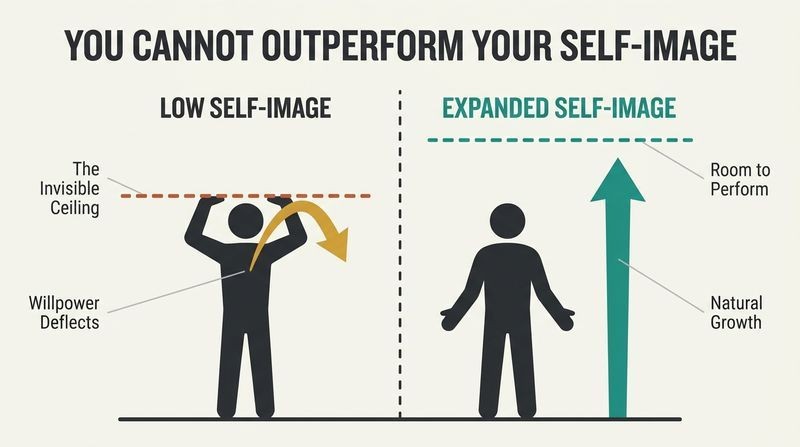
Maltz anticipated ideas now central to psychology: Carol Dweck's fixed-versus-growth mindset, Albert Bandura's self-efficacy research, and cognitive behavioral therapy's insight that beliefs drive feelings. What is striking is that a 1960 cosmetic surgeon arrived at these through clinical observation rather than controlled trials. The weakness is testability. "Self-image" is broad enough to explain any outcome after the fact, which risks unfalsifiability. Still, the practical reframe holds up: durable change targets identity, not just behavior. Modern habit research echoes this, arguing lasting change comes from asking who you wish to become, not merely what you wish to do.
Your nervous system can't tell vivid imagination from real experience
Maltz's most consequential claim: the brain and nervous system react identically to a genuine experience and one imagined in vivid detail. Tell a hypnotized subject your finger is a hot poker and their skin can blister. Picture yourself calm and skilled, and your body rehearses it as real.
The evidence is striking for its era. In one basketball study, students who only imagined shooting free throws for 20 minutes daily improved 23%, nearly matching the 24% gain of those who physically practiced, while a no-practice group improved zero. Chess champion Alekhine trained by playing only in his mind. Golfer Ben Hogan "felt" each shot before swinging. This is why mental rehearsal, done vividly with sensory detail, builds real skill.
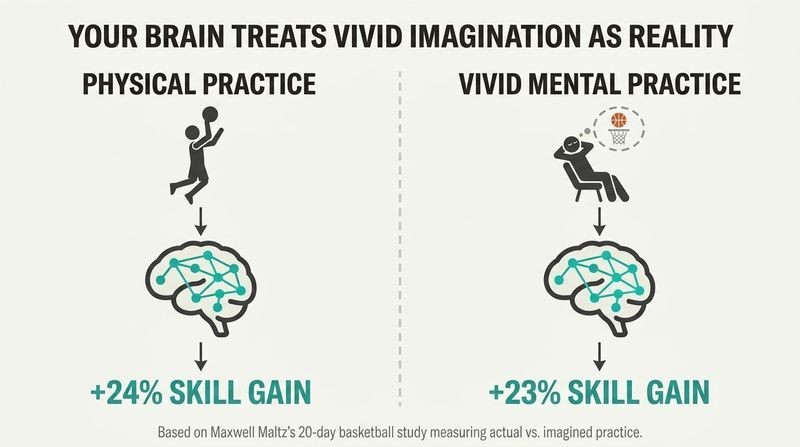
Sports psychology has since validated the mechanism: motor imagery activates overlapping brain regions with actual movement, and elite athletes use visualization routinely. Neuroscience confirms mental practice strengthens neural pathways. But Maltz overstates when he says the nervous system cannot tell the difference "in either case." Imagined practice without physical practice plateaus fast, and the free-throw study has replication concerns. The honest version: vivid imagery is a powerful supplement that primes the automatic system, not a full substitute for reps. The blister claim reflects genuine psychosomatic phenomena but represents an extreme edge case, not everyday cognition.
Rehearse your best moments to prime the machine for success
Maltz calls the brain a servo-mechanism, an automatic goal-seeking device like a self-guided torpedo that reaches its target through constant course correction. He named applying these principles to humans Psycho-Cybernetics. Feed it a clear goal-image and it supplies the means; feed it failure images and it delivers failure just as faithfully.
The practical technique: set aside quiet time daily, relax, and replay a genuine past success in rich sensory detail (the sounds, smells, and feelings present). This reactivates the "winning feeling." Then project that same confident feeling onto a future goal, experiencing it as already accomplished. The size of the remembered success is irrelevant. Tying your shoe or writing your name for the first time works, because what matters is the feeling of having succeeded.
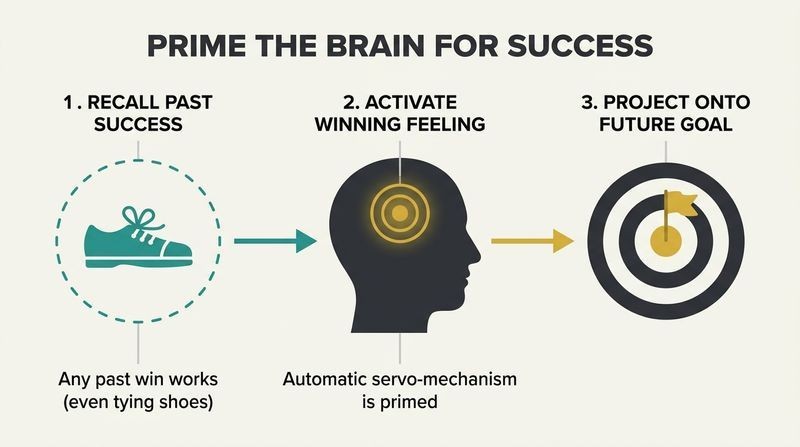
The cybernetics framing was cutting-edge in 1960, borrowing from Norbert Wiener's engineering work, and it usefully demystifies the subconscious as a mechanism rather than a Freudian battleground. The "winning feeling" resembles what modern performance coaches call emotional state priming, and there is real evidence that recalling past mastery boosts self-efficacy and subsequent performance. One caveat: the machine metaphor can flatten human agency and emotional complexity. Grief, trauma, and depression rarely yield to replaying a happy memory. The technique works best for skill-confidence and situational nerves, less so for clinical conditions, a boundary the enthusiastic prose tends to blur.
You are hypnotized by false beliefs you never chose
Any idea you accept as true, from a parent, teacher, ad, or your own repeated self-talk, holds the same power over you as a hypnotist's command. A hypnotized weightlifter told he cannot lift a pencil genuinely cannot, because contrary muscles fire against his will. He is not weakened; his available strength is simply blocked by belief.
Maltz's point: roughly 95% of people are handicapped by inferiority feelings, not because they are actually inferior, but because they measure themselves against someone else's yardstick, where they always lose. The cure is not to become superior but to see that the comparison itself is false. You are not inferior or superior; you are simply you, unique and incomparable, like a snowflake with no standard to match.
The hypnosis analogy is rhetorically vivid and psychologically shrewd: it externalizes limiting beliefs, making them feel removable rather than intrinsic. This maps neatly onto cognitive therapy's core move of identifying and disputing automatic thoughts. The comparison trap Maltz describes is now amplified by social media, where curated highlight reels supercharge the false-yardstick problem, a striking validation of his 1960 warning. Where he oversimplifies: not all inferiority feelings are illusory, and some comparison drives healthy improvement. Adler, whom Maltz cites, saw striving to overcome inferiority as the engine of growth, not merely a trap. The nuance is that the yardstick, not comparison itself, is the culprit.
Try less: strain jams the creative machinery you're forcing
Maltz distinguishes the forebrain (the "operator" that sets goals and gathers facts) from the automatic Creative Mechanism that actually solves problems. The forebrain cannot do the creative work; it can only pose the problem. When we try to force results through conscious effort, we jam the mechanism, like the self-conscious person who calculates every social move and comes across as stiff.
Insights arrive after you stop straining. Edison napped when stumped. Darwin got his breakthrough riding in his carriage after months of failed conscious effort. The rule: do intense preparation, then release the problem and "sleep on it," letting the subconscious work. Coue's Law of Reversed Effort captures it: when will and imagination conflict, imagination always wins.
This is arguably the book's most counterintuitive and durable insight, now backed by incubation research in creativity science: stepping away from a problem lets the default mode network make novel associations, which is why solutions surface in the shower. Csikszentmihalyi's flow state similarly requires the absence of self-conscious effort. Athletes call over-thinking "the yips," exactly Maltz's purpose tremor. The tension worth flagging: "try less" presumes you have already done the hard preparation. Released effort without prior mastery is just wishful drifting. Maltz knows this (he demands intense study first), but the seductive "relax and let it happen" framing can be misread as permission to skip the work.
Happiness is a decision you make, not a reward you earn
Maltz treats happiness medically, not morally: it is "a state of mind in which our thinking is pleasant a good share of the time," and it functions like medicine. Cheerful people see, taste, and hear better, heal faster, and their internal organs function better. He inverts the usual formula. We say "be good and you'll be happy," but it's truer that being happy makes us kinder, healthier, and more successful.
Most unhappiness is habitual over-reaction to small ego-threats: a honking driver, an ignored comment. We react like an audience obeying an "applause" sign. Epictetus's line anchors the cure: people are disturbed not by events but by their opinions of events. Losing $200,000 is a fact; being "ruined and disgraced" is an opinion you added.
This is Stoicism repackaged for a mid-century American audience, and it holds up remarkably well against modern findings. Positive psychology confirms that mood broadens cognition (Barbara Fredrickson's broaden-and-build theory) and that gratitude practices measurably lift wellbeing. The idea that happiness precedes rather than follows success is now a research finding, not just a slogan. The limitation is scope: framing happiness as a pure "decision" can shade into toxic positivity, dismissing legitimate grief, injustice, or clinical depression as mere bad opinion. Epictetus works for traffic and financial setbacks; it is cruel counsel for trauma. The everyday applications, though, are sound and immediately usable.
Spell SUCCESS: the seven traits of a winning personality
Maltz offers a diagnostic acronym for the success-type personality:
1. Sense of direction (always have a goal to move toward, like a bicycle that stays upright only while moving forward)
2. Understanding (see situations as they are, seek truth even when it's bad news)
3. Courage (act on your best guess; a wrong step beats standing still)
4. Compassion (regard for others raises your own self-regard)
5. Esteem (appreciate your own worth as a creation, not egotism)
6. Self-Confidence (built by remembering successes and forgetting failures)
7. Self-Acceptance (accept your actual, imperfect self as your only working vehicle)
The failure personality spells FAILURE: Frustration, Aggressiveness (misdirected), Insecurity, Loneliness, Uncertainty, Resentment, Emptiness, each originally adopted as a mistaken solution to a problem.
The acronyms are mnemonic scaffolding, more memorable than rigorous, but each element maps onto validated constructs: sense of direction resembles what purpose researchers link to longevity, self-acceptance anticipates self-compassion work by Kristin Neff. The sharpest insight buried here is that failure traits are not moral defects but failed coping strategies, which dissolves shame and enables change, echoing modern trauma-informed therapy. The bicycle metaphor for security through forward motion is genuinely useful against the illusion that safety comes from standing still. The weakness is the tidiness: real personalities do not decompose cleanly into two seven-letter words, and the framework risks implying success is a checklist rather than a dynamic process.
Confidence is built by remembering hits and deleting misses
Your automatic mechanism learns like an electronic mouse in a maze: it makes many errors, but once it finds the successful path, it remembers the hits and forgets the misses. A horseshoe player misses far more than he scores, yet improves because the brain reinforces successful attempts, not failures.
Most people do the reverse: they burn failures into memory with shame and remorse (both, Maltz notes, highly self-centered emotions) while discounting successes. This destroys confidence. The fix is deliberate: use errors as course-correction feedback, then dismiss them; and consciously replay past wins before a new challenge. Charles Kettering told aspiring scientists to expect 99 failures for one success and suffer no ego damage from them. Babe Ruth held the strikeout record alongside the home-run record.
This is a precise behavioral prescription with strong empirical backing. Negative events are stored more vividly than positive ones (the negativity bias documented by Roy Baumeister), so Maltz's advice to deliberately over-weight successes counteracts a real cognitive default. Skill acquisition research confirms that reinforcing correct performance, not dwelling on errors, accelerates learning. The subtle danger is selective memory taken too far: some failures carry diagnostic information you should retain, not delete. Maltz threads this needle correctly, keep the error's lesson, drop the emotional self-flagellation, which is exactly how deliberate practice and modern performance psychology treat feedback. The distinction between learning from a mistake and identifying as a mistake is the whole game.
Forgiveness is surgery that removes emotional scars, not a favor
Just as skin forms tough scar tissue after a cut, we form emotional scars after being hurt, walling ourselves off not just from the offender but from everyone. These scars produce a marred self-image and chronic loneliness. The only remedy is therapeutic forgiveness, which Maltz treats as surgical excision, not moral generosity.
Crucially, real forgiveness is not a weapon or proof of superiority. The wife who "forgives" her husband's affair but reminds him of it forever has not forgiven; she has re-infected the wound. True forgiveness cancels the debt because you recognize the debt was never valid, and then you forget it. Maltz points out Jesus never actually "forgave" the adulterous woman; he simply declined to condemn her in the first place.
The reframe of forgiveness as self-directed medicine rather than a gift to the offender is now standard in therapeutic practice, and forgiveness research (Robert Enright, Everett Worthington) links it to reduced anxiety, depression, and even blood pressure. Maltz's insistence that remembered forgiveness is fake forgiveness pre-empts the common trap of using magnanimity as covert revenge. His radical move, that ideally there was nothing to condemn, aligns with acceptance-based therapies. One limitation: some psychologists argue premature forgiveness can bypass legitimate anger that needs processing, and forgiveness should not be confused with reconciling with an ongoing abuser. The surgical metaphor, though, powerfully conveys that half-measures leave the wound festering.
Let the telephone ring: you don't have to answer every stimulus
Maltz offers do-it-yourself tranquilizers built on one image: when the phone rings, you feel compelled to answer, but you can simply let it ring. Most anxiety, anger, and fear are over-responses to stimuli we've become conditioned to obey, like Pavlov's dog salivating at a bell long after the food is gone. Non-response, not effort, is the cure, because you literally cannot feel fear or anger while your muscles stay fully relaxed.
Two practical tools: delay the response (Scarlett O'Hara's "I'll think about that tomorrow," or genuinely counting to ten while relaxing) to break the automatic reflex, and build a "quiet room" in your mind, a vividly imagined retreat you enter for a few minutes to depressurize and clear emotional carry-over between tasks.
The "let it ring" metaphor is a small masterpiece of practical psychology, capturing the core insight of modern mindfulness: the space between stimulus and response is where freedom lives (a line often attributed to Viktor Frankl). Delaying reaction to disrupt a conditioned reflex is validated by research on emotion regulation and the physiological refractory period of anger. The muscle-relaxation claim connects to Edmund Jacobson's progressive relaxation and today's understanding that the parasympathetic nervous system cannot fire alongside fight-or-flight. The "quiet room" is essentially a guided-imagery safe place used in clinical settings. In an age of buzzing notifications, this chapter reads as more urgent now than in 1960.
Treat a crisis as a challenge and it hands you power
The same high-pressure moment breaks one person and elevates another; the difference is learned reaction, not innate talent. Maltz's three rules for the "money player":
1. Practice without pressure so skills become automatic before the stakes rise (fire drills, Corbett's 10,000 mirror jabs, Gene Tunney shadowboxing an imaginary Dempsey for years)
2. React aggressively toward the goal, keeping your positive target in mind rather than the menace
3. Right-size the threat by asking, "What is the worst that can realistically happen?"
Crucially, the pre-crisis jitters are not fear but raw excitement, extra emotional steam that you can direct toward fight or flight. Jack Dempsey was too nervous to shave before fights and used that charge to power his punches. Interpret the tingle as strength, not weakness.
Reappraising arousal as excitement rather than anxiety is now a validated intervention: Alison Wood Brooks's research shows that saying "I am excited" before a stressful task improves performance more than trying to calm down, because both states share the same physiological signature. Maltz nailed this decades early. The "practice without pressure" principle matches deliberate-practice theory and the military axiom that you fall to the level of your training. The worst-case-scenario exercise is textbook Stoic negative visualization and modern CBT decatastrophizing. The one caution: reframing works for challenge stress where you have the skills, but genuine threat stress (facing something you truly cannot handle) needs preparation, not just relabeling.
Build a nostalgia for the future to keep yourself young
Maltz argues, drawing on Hans Selye's research on adaptive energy (a finite life force consumed by coping with stress), that the failure mechanism, chronic frustration and resentment, literally ages us by burning that energy faster, while goal-striving replenishes vitality. His rapid-healing surgical patients shared one trait: they were optimists with a compelling reason to recover fast.
The prescription: never retire from life, only from a job. Men often die within a year or two of retirement, killed not by inactivity but by the loss of anything to look forward to. Creative workers who keep future goals live and produce longer (Michelangelo painting past 80, Grandma Moses starting at 79). Cultivate a "nostalgia for the future," a forward-tilted expectation of good things, to keep receiving more life.
This closing argument has aged into hard science. The book cites Selye's stress model, and modern telomere research (Elizabeth Blackburn's Nobel-winning work) confirms chronic stress shortens the cellular clocks governing aging, exactly the mechanism Maltz intuited. Purpose in life predicts longevity and lower mortality in longitudinal studies, and the retirement mortality effect is documented, though selection bias complicates it (unhealthy people retire earlier). Maltz's "adaptive energy" as a literal depletable substance is dated; Selye's specific reserve theory did not fully survive scrutiny. But the practical wisdom, that having a future to lean into is protective, is one of the most robust findings in longevity science today.
Analysis
Psycho-Cybernetics (1960) is a hinge point in self-help history, the book that gave the visualization industry its intellectual scaffolding. Its author, Maxwell Maltz, was a plastic surgeon, and the book's origin story is its most credible feature: he noticed that patients with corrected faces often kept their old feelings of ugliness, while some never even perceived the physical change. This clinical puzzle led him to the self-image as the true operative variable, an insight that predates and parallels cognitive behavioral therapy, self-efficacy theory, and growth mindset research by decades.
The book's central conceit, borrowing Norbert Wiener's cybernetics to model the mind as a goal-seeking servo-mechanism, was genuinely innovative for its era and remains a useful demystification. Instead of a mysterious Freudian unconscious, Maltz offers a mechanical, impersonal guidance system you program with images and feelings. This engineering metaphor is both the book's strength (it makes change feel doable and non-pathological) and its weakness (it can flatten human emotional complexity and imply that grief, trauma, and depression yield to mental rehearsal, which they often do not).
Methodologically, the book is of its time: it leans on anecdote, cherry-picked studies (the famous free-throw visualization study has replication issues), hypnosis demonstrations, and inspirational quotation rather than controlled evidence. "Self-image" is broad enough to risk unfalsifiability. Yet an unusual number of its claims have since been vindicated: arousal reappraisal, incubation effects in creativity, the negativity bias, purpose and longevity, stress and cellular aging, and forgiveness as self-directed healing.
The updated edition's Matt Furey commentary adds practical coaching but also promotional and paranormal material (ESP, telepathy) that dilutes credibility. Read critically, Psycho-Cybernetics is best treated as a pre-scientific field guide whose intuitions were often right, whose mechanisms were sometimes wrong, and whose core prescription, target the inner picture, rehearse the feeling of success, release strain, still delivers real value to anyone willing to practice it daily for the 21 days Maltz requested.
Review Summary
Psycho-Cybernetics is widely regarded as a groundbreaking self-help book that has stood the test of time. Readers praise its practical approach to changing one's self-image and achieving success. Many consider it the foundation for modern self-improvement literature, citing its influence on subsequent works. While some find the writing style dated, the core concepts remain relevant and impactful. Numerous readers report significant positive changes in their lives after applying the book's principles.
People Also Read








FAQ
What's Psycho-Cybernetics about?
- Self-Image Focus: Psycho-Cybernetics by Maxwell Maltz emphasizes the importance of self-image as a key to personal success and happiness. It explains how our beliefs about ourselves shape our actions and outcomes in life.
- Creative Mechanism: The book introduces the "Creative Mechanism," an automatic guidance system within us that helps achieve our goals based on the mental images we hold.
- Changing Beliefs: Techniques are provided to change negative beliefs and self-definitions, allowing individuals to unlock their potential and lead more fulfilling lives.
Why should I read Psycho-Cybernetics?
- Proven Success: With over 35 million copies sold, the book has transformed countless lives by helping individuals achieve their goals and improve their self-image.
- Practical Techniques: Maxwell Maltz offers practical exercises and methods that readers can apply immediately to start seeing changes in their lives.
- Timeless Wisdom: The principles are rooted in psychology and remain relevant in today’s self-help landscape, offering enduring insights into personal development.
What are the key takeaways of Psycho-Cybernetics?
- Self-Image is Crucial: The self-image is the foundation of personality and behavior; changing it can lead to significant improvements in life.
- Imagination's Role: Imagination is a powerful tool that can be used to visualize success and create a mental blueprint for achieving goals.
- Relaxation and Trust: Learning to relax and trust your Creative Mechanism allows it to work effectively, leading to spontaneous and natural actions toward your goals.
What are the best quotes from Psycho-Cybernetics and what do they mean?
- Happiness in the Journey: “You can be happy now as well as every single day you are working toward achieving your goals.” This emphasizes that happiness is not solely tied to achieving goals but can be experienced in the journey itself.
- Self-Image's Importance: “The self-image is the key to human personality and human behavior.” This highlights the central theme that our self-perception dictates our actions and outcomes.
- Goal Necessity: “You must have a goal or ‘target.’” This underscores the importance of having clear objectives to guide the Creative Mechanism in achieving success.
How does the self-image affect my life according to Psycho-Cybernetics?
- Behavior Consistency: Your actions, feelings, and behaviors are always consistent with your self-image. If you see yourself as a failure, you will act in ways that reinforce that belief.
- Limitations on Success: The self-image sets boundaries on what you believe you can achieve. Expanding your self-image can lead to greater accomplishments and opportunities.
- Change is Possible: The book asserts that anyone can change their self-image, regardless of age or past experiences, leading to a new and improved life.
What is the Creative Mechanism in Psycho-Cybernetics?
- Automatic Guidance System: The Creative Mechanism is described as an automatic, goal-seeking device within each person that operates based on the mental images we create.
- Functionality: It works by processing the information and beliefs we feed into it, steering us toward our goals or away from them based on our self-image.
- Importance of Goals: For the Creative Mechanism to function effectively, it must have clear goals or targets to aim for, which can be visualized through imagination.
How can I change my self-image using techniques from Psycho-Cybernetics?
- Visualization Exercises: The book recommends using visualization techniques to create a mental picture of the self you want to become. This involves vividly imagining yourself acting and feeling as your ideal self.
- Daily Practice: Consistent practice of these visualization exercises is essential, as it takes time for the new self-image to take root and influence behavior.
- Positive Reinforcement: Focus on past successes and positive experiences to reinforce the new self-image, while consciously dismissing negative beliefs and failures.
What role does imagination play in achieving success according to Psycho-Cybernetics?
- Setting Goals: Imagination is crucial for setting clear goals and visualizing the desired outcomes. It acts as the blueprint for the Creative Mechanism to follow.
- Mental Rehearsal: The book discusses the power of mental rehearsal, where imagining successful performances can lead to actual improvements in skills and confidence.
- Overcoming Limitations: By using imagination constructively, individuals can overcome self-imposed limitations and fears, allowing them to act more freely and confidently.
How does Psycho-Cybernetics suggest I deal with negative beliefs?
- Identify and Challenge: The book encourages readers to identify negative beliefs and challenge their validity. This involves asking critical questions about the origins and truth of these beliefs.
- Replace with Positive Thoughts: Once negative beliefs are recognized, they should be replaced with positive affirmations and thoughts that align with the desired self-image.
- Practice Rational Thinking: Utilizing rational thinking to evaluate situations and beliefs can help in overcoming the emotional weight of negative thoughts.
What is the significance of relaxation in Psycho-Cybernetics?
- Enhances Performance: Relaxation is essential for allowing the Creative Mechanism to function optimally. Stress and tension can inhibit its ability to guide actions effectively.
- Promotes Clarity: A relaxed state of mind promotes clarity and focus, enabling better decision-making and problem-solving.
- Daily Practice: The book emphasizes the importance of daily relaxation practices to cultivate a calm mindset, which can lead to improved overall well-being and success.
How does the Failure Mechanism affect us according to Psycho-Cybernetics?
- Negative Feedback Loop: The Failure Mechanism is characterized by negative beliefs and self-doubt that create a cycle of failure, leading to feelings of inadequacy and frustration.
- Emotional Scars: Emotional scars from past experiences can perpetuate the Failure Mechanism, distorting self-image and leading to self-sabotaging behaviors.
- Overcoming Failure: Understanding the Failure Mechanism is crucial for breaking free from its grip. By recognizing and challenging these negative patterns, individuals can reprogram their self-image and foster a more positive outlook.
What role does forgiveness play in Psycho-Cybernetics?
- Healing Emotional Scars: Forgiveness is presented as a crucial step in healing emotional wounds. True forgiveness involves letting go of past grievances and moving forward.
- Self-Compassion: Forgiving oneself is essential for personal growth. By releasing self-blame, individuals can foster a healthier self-image and emotional well-being.
- Empowerment Through Forgiveness: Forgiveness empowers individuals to take control of their lives, allowing them to break free from the chains of resentment and negativity.
About the Author


Download PDF
Download EPUB
.epub digital book format is ideal for reading ebooks on phones, tablets, and e-readers.








































