

Key Takeaways
Remove the mediocre players before you remove the rules
Talent density is the foundation. In 2001, Netflix laid off a third of its staff during the dot-com crash, keeping only its 80 best performers. Instead of collapsing, morale and productivity soared. Hastings discovered that talented people make each other better, while even one or two adequate performers drag down an entire team.
A University of New South Wales study by Will Felps proved this: teams with one planted actor playing a slacker, jerk, or pessimist performed 30 to 40% worse. Bad behavior spread like a virus. The lesson: a great workplace is not free sushi or gyms, it is being surrounded by "stunning colleagues." Every subsequent Netflix freedom (no vacation policy, no expense approvals) only works because the workforce is dense with high performers who need few controls.
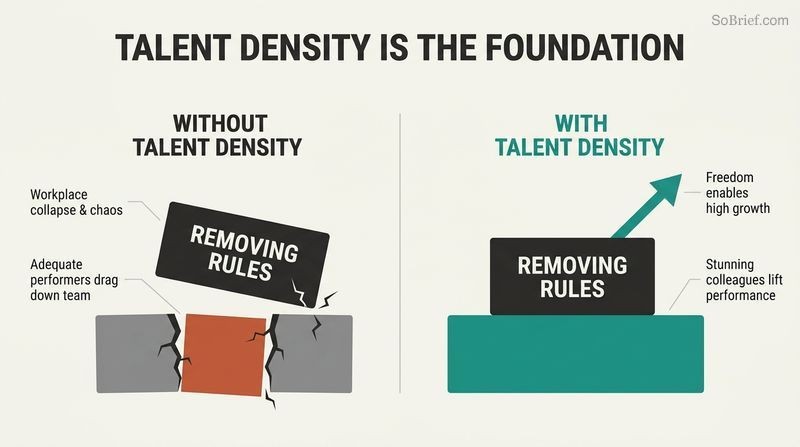
What's striking is the causal ordering Hastings insists on: density first, freedom second. This inverts the common startup fantasy that removing rules alone breeds creativity. The claim aligns with research on the "bad apple effect," yet it deserves scrutiny. Ranking humans as "adequate" versus "stunning" risks conflating fit, luck, and manager bias with intrinsic ability. Organizational psychologists note that context often determines performance more than the person. Google's Project Aristotle found psychological safety, not raw talent, predicted team success. Netflix's model may work spectacularly in creative, high-margin industries while proving cruel or counterproductive in fields where trust and tenure compound value.
Say only what you'd say to someone's face, always
Candor multiplies performance. Once talent is dense, Netflix layers on radical honesty. The rule: never say anything about a colleague you wouldn't say directly to them. Withholding useful feedback is treated as disloyalty because you could have helped and chose not to.
Hastings traces his own conversion to marriage counseling, which taught him transparent feedback saved his relationship. At work, feedback is formalized through the 4A model:
1. Aim to Assist (positive intent)
2. Actionable (focus on what they can change)
3. Appreciate (fight the urge to defend)
4. Accept or Discard (the receiver decides)
A Zenger Folkman survey found people believe corrective feedback improves performance more than praise by roughly three to one. Leaders must solicit criticism first, responding with "belonging cues" (warmth, gratitude) so employees feel safe telling the emperor he has no clothes.
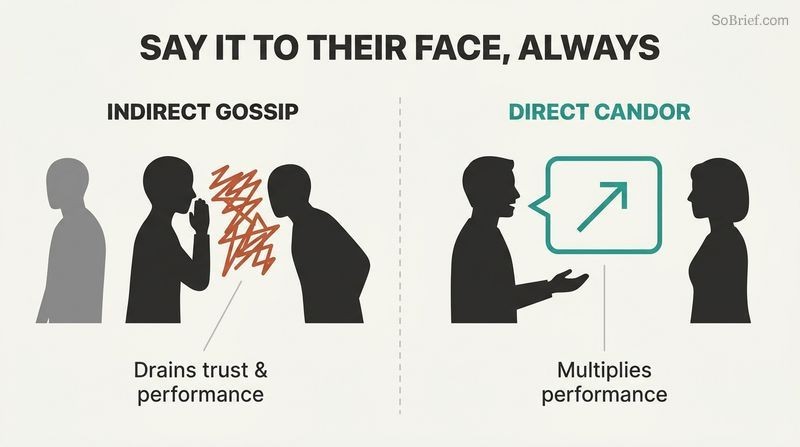
The 4A framework is genuinely useful because it separates the giver's obligations from the receiver's autonomy, defusing the fear that candor means compliance. Yet the "disloyal to stay silent" framing can weaponize honesty. The book's own examples (the "brilliant jerk" who claims she was "just being candid") show how easily radical candor curdles into cover for cruelty. Kim Scott's Radical Candor makes the same point: candor without genuine care becomes "obnoxious aggression." Cultural research complicates it further. What reads as helpful directness in Amsterdam reads as a slap in Tokyo, a tension Netflix itself later confronts head-on.
Scrap vacation tracking, but make leaders take long holidays loudly
Freedom needs modeling and context. Netflix eliminated its vacation policy entirely: no allotted days, no tracking, no approvals. The logic was that if nobody counts your hours, why count your days off? But two safeguards prevented chaos.
First, leaders must take big, visible vacations. When a CEO takes only two weeks, employees feel unfree. Hastings takes six weeks and talks about it. His deputy Greg Peters even got a Tokyo office of famously overworked Japanese staff to vacation like Europeans, purely by modeling it.
Second, managers must set context: the accounting team cannot all vanish during January close. Without policy, the boss's example and explicit guidance fill the vacuum. Interestingly, a journalist investigating the policy found no scandal: employees vacationed about the same amount, but felt trusted and free.
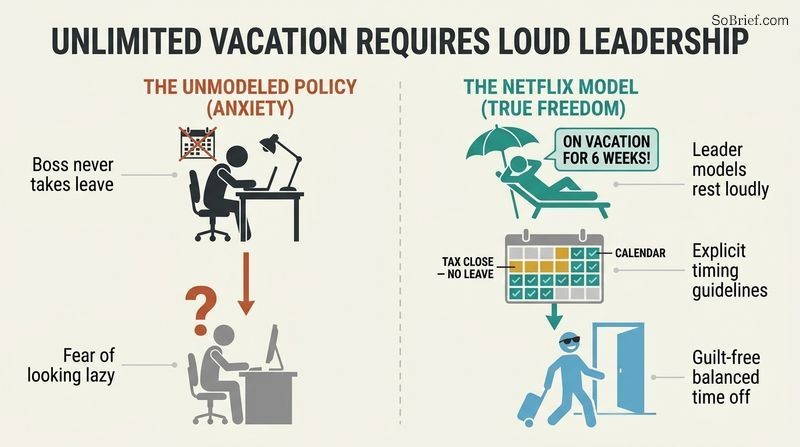
The counterintuitive finding, echoed by companies like Mammoth whose staff took roughly the same fourteen days under unlimited policies, exposes a paradox: unlimited vacation can suppress time off via loss aversion, since there is nothing to "lose" by not using it. The real product is not more rest but signaled trust. This connects to self-determination theory, where autonomy fuels intrinsic motivation. The vulnerability is dependence on leadership hygiene. When managers model overwork, the policy silently mutates into a no-vacation culture, as the burned-out marketer "Donna" demonstrates. Freedom delegated without modeling becomes a quiet trap dressed as a perk.
Replace expense rules with five words: act in the company's best interest
Simple principles beat detailed policies. Netflix scrapped travel and expense approvals. After trying "spend company money as if it were your own" (which failed because frugal and lavish people spent wildly differently), they settled on "act in Netflix's best interest."
Counterintuitively, some employees spend less without rules. A manager named Claudio, freed from Viacom's "one bottle of wine" rule, ordered modest meals because a clear limit had previously invited him to spend up to it. When you tell people to use judgment, they order salads, not lobster.
The safeguards: managers set context up front and finance audits a portion of receipts. Abusers get fired loudly, so everyone learns. Yes, roughly 10% more gets spent on business-class flights, but the speed gains dwarf it: a junior engineer once bought a $2,500 TV overnight to save a crucial press review.
The insight that rules can raise spending by anchoring behavior to the limit is behaviorally sharp and underappreciated. Clear ceilings become targets, a cousin of Goodhart's Law, where a measure becomes a goal that distorts behavior. The frugality-through-freedom result mirrors studies on "crowding out," where explicit incentives and controls erode intrinsic ethical motivation. The vulnerability is scale and verifiability. The $100,000 Taiwan fraud case shows detection lag can be years. Netflix accepts this loss as cheaper than bureaucracy, a calculated bet that assumes high enough margins and honest enough people to absorb the occasional cheater without institutional panic.
Pay one exceptional person top-of-market instead of ten adequate ones
The rock-star principle. A 1968 study of programmers found the best coder outperformed the worst by 20x. Hastings concluded that in creative roles the best isn't twice as good, but ten or a hundred times as good. So Netflix hires one "rock star" at top of personal market rather than a crowd of average performers.
Two radical compensation choices follow:
1. No performance bonuses. Dan Ariely's research showed large bonuses actually worsen performance on cognitive tasks. Netflix rolls that money into salary, which paradoxically attracts more talent.
2. Pay top of personal market and adjust proactively. Employees are encouraged to take recruiter calls and report what they learn. Rather than punishing disloyalty, Netflix raises salaries before people leave, treating your market value as your own and your boss's shared responsibility.
The distinction between operational and creative roles is the load-bearing pillar here. In operational work (driving, scooping ice cream), output is capped; in creative work, upside is unbounded, justifying superstar pay. This echoes economist Sherwin Rosen's "economics of superstars." The anti-bonus stance is bolder and more contrarian than most executives dare, and Ariely's data supports it for cognitive labor. Yet the model quietly assumes a liquid, transparent talent market where "market value" is knowable, which the book's own example (a lawyer with a unique role no recruiter could price) undermines. Encouraging recruiter calls is elegant but presumes managers can always match rising offers.
Open the books completely, even the secrets that could jail employees
Transparency generates ownership. Inspired by Jack Stack's open-book management, Netflix shares financial and strategic information most companies lock away. Even as a public company, it shares quarterly numbers internally before Wall Street sees them, despite insider-trading risk. When leaks happen (and one did), Netflix deals with the individual and doubles down rather than clamping controls on everyone.
Hastings applies a "whisper wins, shout mistakes" rule: leaders should downplay successes and loudly own failures. He publicly confessed to hiring and firing five sales directors in five years. Research by Brené Brown and Anna Bruk confirms vulnerability builds trust. But the "pratfall effect" adds nuance: mistakes make competent people more likable and incompetent people less so. So sunshine your errors only after you've proven your competence.
The pratfall caveat is the intellectually honest heart of this section. Elliot Aronson's 1966 experiment showed a blunder endeared the skilled candidate but sank the mediocre one, meaning vulnerability is a privilege earned through demonstrated competence, not a universal trust hack. This should temper the current corporate fashion for performative CEO vulnerability. The open-books practice connects to agency theory: information asymmetry breeds distrust and slow decisions, so radical disclosure functionally flattens hierarchy. The genuine risk, underexplored, is that total transparency about layoffs or restructuring (the "Isabella" story who gave up a house over a job that never disappeared) can inflict real anxiety for uncertain futures.
Kill the approval pyramid; let the informed captain decide
Dispersed decision-making drives speed. Netflix's motto: "Don't seek to please your boss. Seek to do what's best for the company." Employees don't need approval to move forward, even when the boss disagrees. Sheryl Sandberg once shadowed Hastings all day and marveled that he made zero decisions.
New hires are told they hold a stack of chips to place bets. They're judged on the collective outcome, not any single failure. To make good bets, they follow an Innovation Cycle:
1. Farm for dissent (actively solicit disagreement)
2. Socialize the idea (stress-test it widely)
3. Test it if it's big
4. Place the bet as informed captain
5. Celebrate wins, sunshine failures
The "farm for dissent" habit was born from Qwikster, Netflix's disastrous 2011 split that cost millions of subscribers because managers privately doubted it but stayed silent.
The chip metaphor reframes failure as portfolio variance rather than personal deficiency, a subtle but powerful mental shift borrowed from venture capital and poker. It counters loss-aversion paralysis. "Farm for dissent" is the crucial guardrail preventing dispersed authority from becoming reckless autonomy, and it echoes research on groupthink (Irving Janis) and the Abilene Paradox, where teams collectively pursue decisions no individual endorses. Qwikster is a textbook case. The model's dependence on judgment is also its fragility: it presumes captains reliably solicit dissent rather than rubber-stamp their own instincts, and that "sunshining" failures never quietly damages careers regardless of official reassurances.
Ask the Keeper Test: would you fight to keep each employee?
Be a team, not a family. Families keep members regardless of performance; championship sports teams field the best player at every position. Netflix embraces the team metaphor and rejects the family one, which Hastings argues breeds tolerance of mediocrity (illustrated by an NPR engineer whose kind attitude couldn't offset weak work the team endlessly compensated for).
The Keeper Test asks managers: if this person quit tomorrow, would I fight to keep them, or feel relief? If relief, offer generous severance now (four to nine months' pay) and find a star. This replaces humiliating performance improvement plans. "Adequate performance gets a generous severance."
To reduce fear, employees can ask the Keeper Test Prompt: "How hard would you work to change my mind if I were leaving?" Netflix avoids stack-ranking, which pits employees against each other and destroys collaboration.
The team-not-family metaphor is Netflix's most quoted and most contested idea. It is refreshingly honest about the transactional nature of employment, puncturing the hypocrisy of companies that preach "family" then conduct mass layoffs. Yet critics note real sports teams offer guaranteed contracts and unions, protections Netflix employees lack. The distinction from stack-ranking (Microsoft's abandoned "rank and yank") is important: Netflix claims no fixed quota, so one person's success needn't cause another's firing. Still, the book concedes the Keeper Test breeds documented anxiety, employees who don't unpack boxes for months. Psychological safety research suggests chronic job insecurity can suppress the very risk-taking the culture prizes.
When someone does something dumb, ask what context you failed to set
Lead with context, not control. In a high-talent, innovation-focused, loosely coupled organization, bosses should not approve decisions. They should set context so good decisions happen without them. When director Adam Del Deo debated bidding a record $4.6 million for the documentary Icarus, Ted Sarandos refused to decide, instead asking only whether it was "the one." It won an Oscar.
Context-setting flows like a tree, not a pyramid: the CEO at the roots sets the North Star ("international growth is our priority"), and each layer adds context until the "informed captain" at the branch tip decides. A manager acquiring the Indian kids' show Mighty Little Bheem made a multimillion-dollar bet aligned with context from four leaders above him. It became one of Netflix's most-watched animated series.
Control suits safety-critical work (hospitals, airlines). Context suits creativity.
The reframe "what context did I fail to set" shifts blame from subordinate to leader, a discipline that echoes Toyota's root-cause thinking and W. Edwards Deming's insistence that most errors are system failures, not individual ones. The tree-versus-pyramid image usefully distinguishes decentralized decisions from decentralized alignment: you loosen who decides while tightening shared direction, captured in "highly aligned, loosely coupled." The honest boundary-setting is valuable: Netflix explicitly says context fails in error-critical domains. The unexamined assumption is that alignment can scale infinitely through memos and quarterly meetings. As organizations grow past thousands, maintaining genuine shared context (versus the illusion of it) becomes exponentially harder.
Export freedom globally, but add a fifth A to feedback: adapt
Culture is relative. As Netflix expanded to 190 countries, it found freedom traveled everywhere (everyone likes controlling their own work), but candor did not. Using Erin Meyer's Culture Map framework, Netflix mapped its corporate culture against national cultures across dimensions like directness of feedback and deference to authority.
The Netherlands proved even blunter than Netflix; Japan far more indirect. A Japanese lawyer cried when first asked to critique her boss. A Singaporean employee found a factual American text message "aggressive." The fixes:
1. In indirect cultures, schedule formal feedback moments and let people prepare.
2. Discuss cultural differences openly.
3. Add a fifth A to the feedback model, Adapt, adjusting delivery to the listener's culture.
Direct cultures use "upgraders" ("absolutely," "totally") while indirect ones use "downgraders" ("kind of," "a bit").
This chapter is the book's most self-aware, admitting that a culture engineered by California engineers cannot be copy-pasted onto Tokyo or Sao Paulo. The Culture Map's evaluating scale (upgraders versus downgraders) gives managers a concrete linguistic toolkit, more actionable than vague "be culturally sensitive" advice. The Japanese preparation insight is subtle and true to organizational reality: what looks like reticence often reflects unset expectations, not incapacity. A fair critique is that Netflix's solution still treats American directness as the default to be softened at the edges, rather than genuinely decentering it. National-culture generalizations also risk stereotyping individuals, a limitation the framework's own creators acknowledge.
Analysis
No Rules Rules is a business-memoir hybrid, part management manifesto, part corporate autobiography, structured as an escalating spiral: three levers (talent density, candor, control-removal) revisited through three deepening cycles, then stress-tested globally. Its distinctive method is dialogic. Hastings makes bold, often uncomfortable claims; Meyer, an outside academic, interrogates them with research and skepticism. This built-in tension is the book's intellectual engine and its chief defense against reading as self-congratulation.
The core thesis is genuinely contrarian: most management orthodoxy (bonuses, approvals, vacation tracking, performance reviews, stack-ranking) exists to manage the mediocre, and if you simply refuse to employ mediocre people, the entire apparatus becomes not just unnecessary but actively harmful to speed and innovation. The sequencing matters enormously. Freedom is not the starting point but the reward for first achieving density and candor. Readers who cargo-cult the perks without the prerequisites will get chaos.
The deeper argument is contingent, not universal, and the book is admirably clear about this. The jazz-versus-symphony closing metaphor draws the boundary: this operating system suits creative, high-margin, error-tolerant industries and would be reckless in surgery, aviation, or nuclear power. That scoping saves the book from overreach.
The honest weaknesses are three. First, survivorship bias: we hear Netflix's triumph, not the graveyard of firms that removed controls and imploded. Second, selection effects: Netflix pays top-of-market and hires globally elite talent, so its findings may not generalize to organizations that cannot buy their way to density. Third, the human cost. The documented culture of fear, employees terrified daily of the Keeper Test, is treated as a manageable side effect rather than a moral question about the kind of workplace worth building. The book's greatest value is not as a blueprint to copy but as a provocation: which of your rules protect the company, and which merely insult your best people?
Review Summary
No Rules Rules provides an inside look at Netflix's unique company culture centered on freedom and responsibility. Readers were divided - some found it inspiring and innovative, while others saw it as toxic and self-congratulatory. The book details Netflix's approach to talent density, candid feedback, and removing controls. Many praised the insights but questioned if the culture could work elsewhere. Overall, it was seen as an engaging read that sparked debate about modern workplace practices, even if not universally applicable.
People Also Read






Glossary
Talent Density
Concentration of high performers per employeeThe average level of talent per employee, rather than total talent. Netflix increases it by hiring only exceptional performers and removing adequate ones, on the theory that stunning colleagues make each other more effective while even a few mediocre performers drag down an entire team's output, morale, and standards.
Keeper Test
Would you fight to keep them?A management prompt: if a given employee said they were leaving for a similar job elsewhere, would the manager fight hard to keep them or feel relief? If relief, the employee should be given generous severance immediately and replaced with someone the manager would fight to keep. Used to continually maintain high talent density.
Freedom and Responsibility (F&R)
Trust employees, remove controlsNetflix's overarching culture, in which the company grants unusual freedom (no vacation, expense, or approval policies) in exchange for employees behaving responsibly. The premise is that freedom and accountability reinforce each other: giving people control over their work generates ownership rather than chaos, provided talent density and candor are established first.
4A Feedback Guidelines
Rules for giving/receiving feedbackNetflix's model for constructive candor. For giving: Aim to Assist (positive intent) and Actionable (focus on changeable behavior). For receiving: Appreciate (resist defensiveness) and Accept or Discard (the receiver decides whether to act). A fifth A, Adapt, was added for cross-cultural feedback, adjusting delivery to the listener's national culture.
Informed Captain
Single accountable decision-makerThe person responsible for a given decision at Netflix, who gathers input widely but does not need approval from anyone, including their boss. They own the outcome entirely and even sign contracts themselves. This disperses decision-making across all levels rather than concentrating it at the top of a hierarchy.
Lead with Context, Not Control
Set direction, not directivesA leadership approach where managers provide all the information, strategy, and assumptions employees need to make good decisions independently, rather than approving or directing their actions. Coined by Leslie Kilgore, it suits innovation-focused, loosely coupled, high-talent organizations, whereas control-based leadership suits safety-critical, error-prevention environments.
Farming for Dissent
Actively soliciting disagreementA step in Netflix's Innovation Cycle where an employee proposing an idea deliberately seeks out opposing views, often by circulating a memo or spreadsheet inviting colleagues to rate and critique the idea. Born from the Qwikster disaster, where managers privately doubted a decision but stayed silent, it makes withholding disagreement a form of disloyalty.
Rock-Star Principle
One elite beats many averageThe idea, rooted in a 1968 programmer study showing the best coder outperformed the worst by roughly 20x, that in creative roles the best performer delivers ten to a hundred times more value than an average one. Netflix therefore hires a single exceptional person at top-of-market pay instead of many adequate ones.
Sunshining
Openly broadcasting failures and mistakesNetflix's practice of speaking loudly and publicly about failed bets and personal mistakes, through memos or meetings, so the whole organization learns and so risk-taking stays psychologically safe. Paired with the maxim "whisper wins and shout mistakes," though effective only for leaders who have already demonstrated competence.
We Are a Team, Not a Family
Perform to keep your spotNetflix's core metaphor rejecting the family model (which tolerates underperformance out of loyalty) in favor of a championship sports team, where every position holds the best available player and members are respectfully swapped out when they are no longer the best fit, receiving generous severance rather than lifetime security.
FAQ
What's No Rules Rules about?
- Focus on Culture: No Rules Rules by Reed Hastings and Erin Meyer explores Netflix's unique corporate culture, emphasizing "Freedom and Responsibility" as a framework for innovation and adaptability.
- Key Concepts: The book outlines strategies for building a high-performance workplace, such as increasing talent density, fostering candor, and removing unnecessary controls.
- Real-Life Examples: Hastings shares anecdotes from Netflix's evolution, illustrating the practical application of their cultural principles in transitioning from DVD rentals to a leading streaming service.
Why should I read No Rules Rules?
- Innovative Insights: The book offers valuable insights into creating a corporate culture that prioritizes employee autonomy and accountability, challenging traditional management practices.
- Proven Success: It presents Netflix's culture as a case study for remarkable growth and success, with principles applicable across various industries.
- Expert Collaboration: Co-authored by business thinker Erin Meyer, it combines firsthand experience with academic research on organizational behavior, making it a compelling read for leaders.
What are the key takeaways of No Rules Rules?
- Talent Density is Crucial: Hiring and retaining top talent is emphasized, as high performers elevate the performance of those around them, creating a culture of excellence.
- Foster Candor: A culture of open feedback is advocated, where employees are encouraged to "say what you really think (with positive intent)," leading to improved performance and innovation.
- Remove Controls: The authors suggest eliminating unnecessary policies, allowing employees to make decisions in the company's best interest, fostering ownership and responsibility.
What is the "Freedom and Responsibility" culture in No Rules Rules?
- Core Philosophy: This culture is built on the idea that employees should have the freedom to make decisions without excessive oversight, paired with the expectation of acting responsibly.
- Implementation: Netflix has removed traditional controls, such as vacation policies, to empower employees, encouraging innovation and quick decision-making.
- Positive Outcomes: This approach has led to increased employee satisfaction and engagement, resulting in higher productivity and creativity.
How does No Rules Rules suggest increasing talent density?
- Hire Top Performers: The book advocates for hiring the best talent available, even if it means paying higher salaries, to attract and retain exceptional employees.
- Eliminate Mediocrity: Removing underperformers is emphasized, as they can negatively impact team performance, with the principle "adequate performance gets a generous severance."
- Create a High-Performance Environment: Surrounding employees with high achievers fosters a culture where everyone is motivated to excel, leading to increased collaboration and innovation.
What role does candor play in Netflix's culture according to No Rules Rules?
- Encouraging Open Feedback: Employees are encouraged to "only say about someone what you will say to their face," promoting honesty and transparency within the organization.
- Improving Performance: Candid feedback leads to higher performance levels, as employees learn from one another and hold each other accountable, reducing office politics.
- Building Trust: A culture of feedback builds trust among employees, enhancing collaboration and driving innovation.
What are some specific methods for removing controls discussed in No Rules Rules?
- Eliminate Vacation Policies: Netflix removed its vacation policy, allowing employees to take time off as needed, signaling trust and encouraging work-life balance management.
- No Expense Approvals: Employees are empowered to make spending decisions without prior approval, with the guideline "Act in Netflix’s best interest," speeding up processes.
- Decentralized Decision-Making: Employees focus on what is best for the company rather than pleasing their boss, allowing for quicker decision-making and greater innovation.
What is the "Keeper Test" mentioned in No Rules Rules?
- Performance Evaluation Tool: The Keeper Test assesses whether managers would fight to keep an employee if they decided to leave, maintaining high talent density.
- Focus on Talent Density: It ensures that only the best performers remain, with the question, "If a person on your team were to quit tomorrow, would you try to change their mind?"
- Encourages Tough Decisions: This test promotes a culture where performance is prioritized over personal relationships, encouraging managers to make difficult personnel decisions.
What is the "Netflix Innovation Cycle"?
- Four-Step Process: The cycle includes farming for dissent, testing the idea, placing your bet as the informed captain, and celebrating or sunshining the outcome.
- Farming for Dissent: Seeking differing opinions to refine ideas before implementation is crucial, as it is disloyal to Netflix to disagree with an idea and not express it.
- Learning from Outcomes: Emphasizes learning from both successes and failures, with teams encouraged to "sunshine" failures, discussing what went wrong for future initiatives.
How does No Rules Rules address the challenges of transparency in the workplace?
- Open Communication: Advocates for sharing information openly with employees, as transparency builds trust and fosters a sense of ownership.
- Handling Sensitive Information: Balances transparency with individual privacy, recommending candor about workplace issues while respecting personal struggles.
- Encouraging a Culture of Trust: Promoting transparency encourages employees to feel safe sharing thoughts and concerns, leading to a more engaged workforce.
What does No Rules Rules say about failure and mistakes?
- Embracing Failure: Failure is seen as essential to innovation, with rapid recovery and learning from mistakes emphasized.
- Sunshining Failures: Encourages openly discussing and analyzing failures, helping teams learn without fear of retribution.
- Learning Opportunities: Each failure is viewed as a learning opportunity, with the belief that "rapid recovery is the best model" in a creative business.
What are the best quotes from No Rules Rules and what do they mean?
- "A great workplace is stunning colleagues.": Highlights the impact of high talent density on employee performance and satisfaction, fostering a dynamic work environment.
- "Don’t seek to please your boss. Seek to do what is best for the company.": Emphasizes independent decision-making and prioritizing organizational success over personal approval.
- "Freedom and Responsibility.": Summarizes Netflix's core philosophy, balancing employee autonomy with the expectation of responsible decision-making.
Download PDF
Download EPUB
.epub digital book format is ideal for reading ebooks on phones, tablets, and e-readers.








































