

Key Takeaways
Your output as a manager is your team's output, not your own
The one sentence that reframes the job. Grove insists a manager's output equals the output of the organizations under their supervision plus the neighboring organizations they influence. A surgeon's output is a healed patient, not the hours spent suturing. A brilliant marketing analyst's output is the decisions their analysis shifts across the company. This means personal brilliance is worth nothing until it moves the team.
Know-how counts too. Grove deliberately widens "manager" to include specialists with no direct reports: engineers, lawyers, teachers, anyone who acts as a node feeding knowledge into a network. A process engineer sitting on a coordinating council raises the output of every plant, not just her own. The test of any activity becomes brutally simple: did it increase what your people produced?
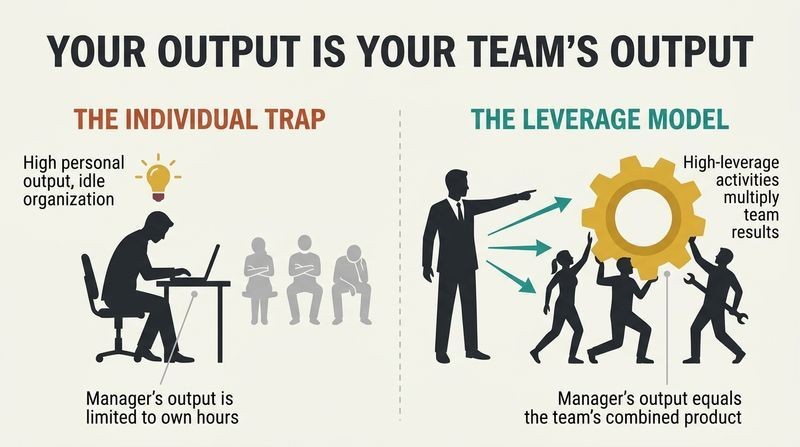
What's striking is how this collapses the ego of management into arithmetic. The claim anticipates modern debates about "individual contributor" versus "manager" tracks in tech, where the best engineers wonder why they must manage to advance. Grove's answer, that leverage can come from know-how alone, validates the staff-engineer path decades early. The framing also resembles economist theories of the firm: value is created at interfaces, not in silos. A fair challenge: measuring a knowledge worker's true contribution to team output remains notoriously slippery, which is precisely why so many organizations still reward visible activity over invisible influence.
Hunt for leverage: some activities ripple through hundreds of people
Managerial output is leverage times activity. Grove argues productivity rises not by working faster but by shifting your mix toward high-leverage acts. Three signatures mark them:
1. Many people are affected by one manager's action.
2. A brief intervention shapes someone's behavior for a long stretch.
3. A single person supplies a unique piece of knowledge that unlocks a large group.
Leverage cuts both ways. A manager who defines a planning process in advance guides two hundred people cleanly; the same manager arriving unprepared to a meeting drains everyone. Grove names the negative kinds too: waffling on a decision freezes a whole organization, and meddling teaches subordinates to stop taking initiative. Delegation is leverage, but only with follow-through and monitoring, sampled like a quality-assurance check rather than inspecting everything.
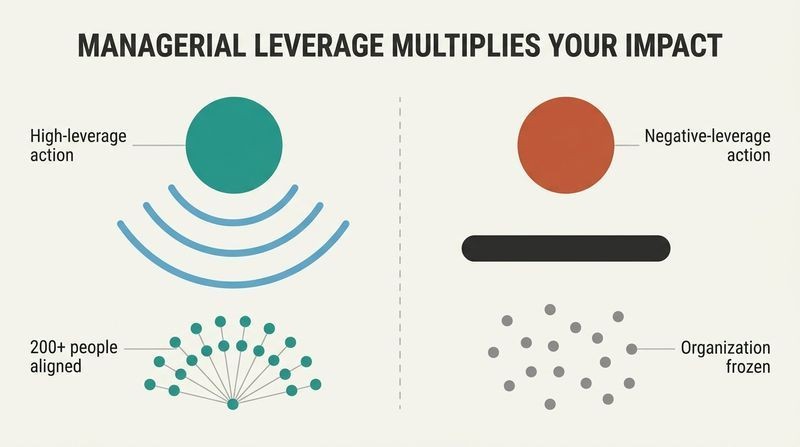
The leverage equation is essentially a portfolio-optimization mindset applied to a calendar. It rhymes with Pareto thinking and with what later productivity writers call "deep work," but Grove's version is sharper because he insists timing changes leverage: the same act done early is worth tenfold what it is worth late. His warning about "insincere delegation" is psychologically astute; research on autonomy and motivation shows that surveillance masquerading as trust erodes ownership. The one gap: Grove assumes managers can accurately estimate leverage in advance. In fast-moving environments, the highest-leverage move is often invisible until hindsight reveals it, making his art-versus-science caveat essential.
Run knowledge work like a factory: find and protect the limiting step
The three-minute egg lesson. Grove opens with a waiter delivering a soft-boiled egg, toast, and coffee simultaneously. The egg takes longest, so you build the entire schedule backward from it. This limiting step (the longest, most expensive, or most sensitive stage) governs everything else through time offsets. He applies it everywhere: college recruiting is scheduled around the costly plant visit; a criminal justice system that lets jail-cell scarcity, not conviction, become the bottleneck wastes over a million dollars per conviction.
Reject defects at their cheapest stage. Value accumulates as material moves through a process, so catch the rotten egg at delivery, screen the weak candidate before the plane ticket. Grove treats a business as a "black box" you improve by cutting windows into it to see problems coming.
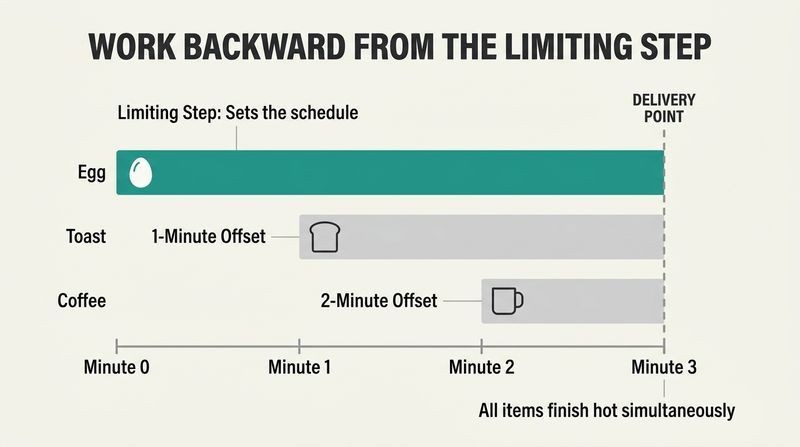
Grove's genius here is transposing industrial engineering onto white-collar and even civic work at a time when "soft professions" were assumed immune to such rigor. The criminal-justice example prefigures systems thinking popularized by Goldratt's Theory of Constraints, which independently argued that any chain has exactly one binding constraint and optimizing elsewhere is waste. The "reject early" principle underlies modern practices from code review to shift-left testing in software, where fixing a bug in design costs a fraction of fixing it in production. A caveat worth flagging: over-standardizing creative work can suppress the very variance that produces breakthroughs, a tension Grove's factory metaphor underplays.
Never trust a single metric; pair it with its opposite
Indicators steer you like a bicycle. You go where you look, so measuring inventory alone drives it dangerously low. Grove's fix is paired indicators: track inventory levels alongside shortage incidents, track vouchers processed alongside error rates, track square footage cleaned alongside a quality rating. Each number is checked against its natural counter-effect, keeping you in the optimum middle.
See the future before it arrives. Leading indicators and linearity charts flag a missed hiring target in April instead of June, while there is still time to act. Grove's favorite tool is the stagger chart, a forecast reissued monthly and laid beside prior forecasts so the trend of your changing outlook becomes visible. He half-jokes that economists should be forced to publish their predictions this way so their track records could finally be judged.
This is a compact theory of measurement that predates and outperforms much of today's dashboard culture. Goodhart's Law, that a measure ceases to be good once it becomes a target, is exactly the failure Grove designs against with counter-metrics. Modern operations teams reinvent his logic constantly: pairing speed with quality, growth with churn, output with burnout. The stagger chart is subtler than a trend line because it exposes the volatility of the forecaster's own judgment, a form of accountability rare even now. The limitation: paired indicators help balance known trade-offs but cannot surface the unmeasured variable that quietly becomes the real constraint.
Meetings are the medium of management, not a waste of it
Stop apologizing for meetings. Grove pushes back on the cliche that meetings are wasted time. Since a manager's core work is gathering information, giving it, nudging, and deciding, and since these happen face to face, meetings are simply where the work occurs. The real question is whether each meeting is the highest-leverage medium for the task.
Two families of meetings. Process-oriented meetings are regularly scheduled to exchange information: one-on-ones, staff meetings, and operation reviews. Mission-oriented meetings are ad hoc and produce a specific decision. For the latter, the chairman does most of the work before it starts: defining the objective, capping attendance around six to eight, sending a real agenda, enforcing punctuality (a two-hour meeting of ten managers burns roughly $2,000), and circulating crisp minutes afterward.
Grove's reframe (meeting as medium rather than activity) is a quietly radical distinction that most meeting-hygiene advice still misses. The dollar-cost framing anticipates Bezos-era practices like the two-pizza rule and the six-page memo, both attempts to force preparation and discipline onto expensive collective attention. His claim that ad hoc mission meetings above 25 percent signal malorganization sharpens Drucker's original. The blind spot for a remote, asynchronous era: Grove assumes co-location and synchronous presence, and much of what he assigns to meetings now migrates to documents, chat, and recorded video, which arguably raises leverage further by letting information reach many people without gathering them at once.
The one-on-one belongs to your subordinate, not to you
Flip the ownership. At Intel the one-on-one is the primary channel between supervisor and subordinate, and Grove insists the subordinate owns it: they prepare the outline, set the agenda, and walk the boss through the issues. The subordinate prepares once; a boss with eight reports would otherwise prepare eight times. Both take notes, because writing something down signals commitment like a handshake.
Ask one more question. The supervisor's job is to draw out what nags the subordinate, especially intangible worries, by prompting past the first answer. Frequency is set by task-relevant maturity: weekly for someone new to a task, every few weeks for a veteran. Ninety minutes every fortnight can shape roughly eighty hours of a subordinate's work, making the humble one-on-one an extraordinarily high-leverage habit.
Grove essentially invented the modern tech one-on-one, and the detail that the subordinate owns the agenda is the piece most managers still get wrong, treating it as a status update they run. Coaching research supports his "ask one more question" instinct: the quality of managerial listening predicts subordinate performance more than the quality of advice. Tying cadence to task-relevant maturity rather than a fixed calendar is elegant and rarely practiced. One tension: Grove frames the one-on-one heavily around information and coaching, while contemporary employees increasingly expect these sessions to address career growth and psychological safety, dimensions his production-era framing touches only lightly.
Debate freely, decide clearly, then demand support even from dissenters
The ideal decision has three stages. Free discussion where every view is aired without deferring to rank, a clear decision framed without mealy-mouthed hedging, and full support from everyone even those who disagree. Support is not agreement; it is the commitment to back the outcome. Grove wants decisions made at the lowest competent level, blending technical knowledge with hard-won judgment.
Beware the peer-group syndrome. When equals meet without a senior person, they often circle endlessly, waiting for consensus nobody will voice, afraid of sounding dumb or being overruled. Grove's fix is peer-plus-one: bring in one more senior person to give the group confidence. Before calling any decision meeting, settle six questions: what decision, by when, who decides, who is consulted, who ratifies or vetoes, and who must be informed.
This model married knowledge power and position power decades before flat organizations became fashionable, and Grove's insistence that egalitarian dress and open cubicles were survival tactics, not affectation, reveals the deeper logic: status symbols choke the flow of information you need from junior experts. His "disagree and commit" formulation later became an explicit Amazon leadership principle. The peer-group syndrome maps neatly onto social-psychology findings about pluralistic ignorance and the Abilene paradox, where groups collectively endorse what no individual wants. The six questions function as a lightweight RACI matrix. The risk: peer-plus-one can quietly slide into deference if the senior person forgets to withhold their view during free discussion.
Today's crisis is a planning failure from months ago
Plan like a fire department. You cannot predict where the fire will be, so you build a team ready to respond. Grove's planning has three steps borrowed from the factory: establish environmental demand (what your customers and world will need a year out), establish present status (what you will produce if you change nothing), then close the gap. The output of planning is not a bound volume nobody reads; it is the set of actions you take today.
Fill the tank before you run dry. Grove's sharpest line: people scramble to make a decision that closes today's gap, but today's gap is the residue of planning failed in the past. Management by objectives supplies the near-term version, answering only two questions: where do I want to go, and what milestones tell me I am on track?
The fire-department metaphor is a sophisticated answer to a real critique of strategic planning: the future is unforecastable, so why plan? Grove's reply, that planning builds responsive capacity rather than predictions, aligns with Eisenhower's "plans are useless, but planning is indispensable" and with modern scenario planning. His Columbus illustration of MBO, where every key result was hit yet the stated objective (a route to Asia) was missed, is a shrewd warning against mechanical scorekeeping: Columbus still made Spain rich. This foreshadows the culture around OKRs that Google inherited from Intel, and the same caution applies today, that treating objectives as contracts rather than compasses breeds gaming and timidity.
Big organizations need hybrid structures and dual reporting to work
Neither pure form survives. Grove says every sizable organization becomes a hybrid: mission-oriented units (the business divisions that stay close to the market) supported by functional groups (manufacturing, finance, sales that deliver economies of scale). Choosing one extreme sacrifices either responsiveness or leverage, so the only workable answer is a blend held together by dual reporting, where a person answers to two bosses, such as a plant manager for daily work and a functional expert for standards.
Three invisible modes control behavior. Free-market forces govern simple priced exchanges (buying tires). Contractual obligations govern work whose value is hard to price (an employment agreement, stopping at a red light). Cultural values take over when the environment's complexity, uncertainty, and ambiguity (the CUA factor) is high and no contract could anticipate every case, and here trust and shared values do the steering.
Grove's "Grove's Law" that all large purpose-driven organizations end up hybrid is essentially an argument that matrix structures are not a management fad but a structural inevitability, echoing organizational theorists like Galbraith. His three modes of control draw explicitly on Williamson's markets-and-hierarchies economics and Ouchi's Theory Z, translating transaction-cost theory into managerial practice: you reach for culture precisely when contracts get too expensive to write. The CUA insight, that you should give new hires low-ambiguity jobs and promote them into high-CUA roles only as shared experience accumulates, is a compelling case for promote-from-within. The honest weakness Grove concedes: dual reporting makes life ambiguous, and most people dislike ambiguity, which is why so many firms keep relapsing toward tidy but ineffective pure structures.
There is no best management style; match it to task-relevant maturity
Style follows the subordinate, not your personality. Grove reports that researchers could never prove one leadership style superior, and Intel's own manager rotations showed high output came from particular manager-and-group combinations, not from inherently great managers. The governing variable is task-relevant maturity (TRM): how much experience and readiness a person has with the specific task at hand, not their age or general competence.
Three styles for three maturities.
1. Low TRM: structured, tell them what, when, and how.
2. Medium TRM: two-way communication, support, mutual reasoning.
3. High TRM: minimal involvement, agree on objectives and monitor.
TRM is task-specific: a star salesman moved to run a factory saw his TRM crash and needed hands-on direction again. Whatever the maturity, always monitor enough to avoid surprises, because the difference between delegating and abdicating is monitoring.
Grove adapts Hersey and Blanchard's situational leadership but adds a crucial refinement: maturity is task-specific and can collapse overnight when the job changes, like an expert country driver dropped onto a crowded freeway. This dismantles the seductive myth of the naturally "great manager" and the equally lazy assumption that a promoted star will thrive anywhere. His refusal to moralize (a structured style is not worse, only sometimes more effective) is bracing in an era that romanticizes empowerment and hands-off leadership. The memorable ethical point, that letting a novice "learn from his own mistakes" charges the tuition to unsuspecting customers, reframes hands-off management as sometimes a dereliction rather than a virtue.
Turn work into a sport to unlock limitless self-actualization
Can't or won't. When someone underperforms, Grove says there are only two causes: they can't do it (a training problem) or won't (a motivation problem). His test: if their life depended on it, could they? A manager's only two levers are therefore training and motivation. Motivation cannot be injected; you can only build an environment where motivated people flourish.
Climb Maslow toward the boundless. Lower needs (physiological, safety, social, esteem) extinguish themselves once satisfied. Only self-actualization, the drive to reach your personal best, motivates without limit. To trigger it, treat the workplace like competitive sport: give people a racetrack and a way to measure themselves. When Intel simply scored building upkeep and compared buildings, cleanliness jumped with no extra pay. At the self-actualized level money stops being a necessity and becomes a scoreboard, which is why a wealthy venture capitalist still chases the next ten million.
Grove's "can't versus won't" diagnostic is disarmingly practical and survives in modern performance-management frameworks. His sports analogy anticipates the entire gamification movement and self-determination theory, which identifies competence and autonomy as intrinsic drivers, closely matching his competence-driven and achievement-driven paths. The building-czar experiment is a clean natural demonstration that feedback and comparison can outperform financial incentives, echoing findings that visibility and status often motivate more cheaply than cash. A worthwhile critique: manufactured competition can corrode collaboration and, as Grove himself notes with the sales-contest example, misaligned scoreboards produce exactly the self-interested behavior managers then complain about. The racetrack is powerful precisely because it is dangerous when pointed at the wrong finish line.
Deliver reviews to improve performance, and never delegate training
The review has one true purpose: better future performance. Not to justify raises or vent grievances, but to raise skill and motivation. Grove's three L's: level (be totally frank), listen (use every sense to confirm your message landed, like a good teacher reading the room), and leave yourself out (it is the subordinate's day, not a purge of your own anxieties). Give the written review before the discussion so it can be digested. Counterintuitively, spend more effort improving your stars than your laggards, since improving high performers yields disproportionate output.
Training is the highest-leverage act, and it is your job. Four lectures costing twelve hours, taught to ten people who work twenty thousand hours a year, need only a one percent improvement to repay themselves many times over. Grove insists the manager teach personally, because only a practicing authority can be a credible role model.
Grove's stance that training belongs to the boss, not a training department, remains contrarian; most organizations still outsource it, precisely the disconnect he warns produces demoralized employees taught practices their company does not follow. His leverage math is a persuasive rebuttal to managers who claim they are too busy to teach. On reviews, the insistence that a manager's rating cannot exceed the rating of their organization (rejecting the "great manager, weak results" excuse) is a rigorous defense against confusing form with substance. The counterintuitive advice to invest in aces over strugglers aligns with talent-density research, though it sits in some tension with equity concerns and with the reality that neglected weak performers can quietly poison a team's output.
Analysis
High Output Management is a thesis-driven operations manual disguised as a management book, and its durability comes from a single move: Grove treats management as an engineering discipline with measurable output rather than a soft art of leadership. Written in 1983 by Intel's president, it reads as the field notes of a physicist who backed into management and refused to accept that white-collar work was immune to the rigor of a production line. The breakfast-factory conceit, limiting steps, black boxes, paired indicators, is not a cute framing device but the load-bearing argument that egg-boiling, chip fabrication, and college recruiting obey the same laws.
What makes the book hard to summarize is that it operates on three planes at once: production mechanics, individual psychology (Maslow, task-relevant maturity, the sports analogy), and organizational architecture (hybrid structures, dual reporting, modes of control). Grove braids them so that a lesson about inventory becomes a lesson about scheduling your calendar, and a lesson about factory inspection becomes a lesson about monitoring delegation.
The intellectual lineage is richer than it appears: Williamson's transaction-cost economics, Ouchi's Theory Z, Hersey-Blanchard situational leadership, and Drucker all surface. Yet Grove's synthesis is original in its insistence on leverage as the master variable and on output over activity as the moral core.
The book's limits are those of its era and author. It assumes co-located, synchronous work, stable hierarchies, and a manufacturing-inflected view of value that undersells emotional labor, diversity of motivation, and knowledge work's non-linearity. Its confidence that leverage can be estimated in advance sits uneasily with genuine uncertainty. Still, the through-line, that a manager exists solely to multiply the output of others, remains the most useful one-sentence definition of the job ever written, which is why Silicon Valley still treats this as scripture.
Review Summary
High Output Management receives mostly positive reviews as a management classic, praised for its practical advice and enduring relevance. Readers appreciate Grove's engineer-like approach to management, focusing on productivity and team output. The book covers topics like meetings, decision-making, and employee motivation. Some criticize its dated examples and lack of emphasis on modern workplace values. Many reviewers, particularly in Silicon Valley, consider it essential reading for managers, though opinions vary on its overall impact and applicability across industries.
People Also Read



FAQ
What's High Output Management about?
- Management Principles Focus: High Output Management by Andrew S. Grove centers on effective management techniques, especially for middle managers, emphasizing the understanding of production processes.
- Real-World Applications: The book uses relatable analogies, like preparing breakfast, to explain complex management concepts and improve productivity.
- Team Dynamics: It underscores the importance of teamwork, stating that a manager's output is the output of the organizational units they supervise or influence.
Why should I read High Output Management?
- Timeless Insights: Written in 1983, its principles remain relevant, especially in fast-paced business environments, offering insights applicable across industries.
- Practical Framework: Provides actionable advice on leveraging time, resources, and team dynamics to enhance productivity.
- Expert Perspective: As a former CEO of Intel, Grove shares his extensive experience, making it a valuable resource for both aspiring and current managers.
What are the key takeaways of High Output Management?
- Output-Oriented Management: Emphasizes focusing on team performance, with a manager's output equating to the output of their organization and neighboring organizations.
- Managerial Leverage: Highlights the impact of a manager's actions on their team's output, prioritizing high-leverage activities to enhance productivity.
- Effective Meetings: Advocates for structured, purposeful meetings that facilitate decision-making and information sharing.
What is the concept of "managerial leverage" in High Output Management?
- Definition of Leverage: Managerial leverage is the output generated by specific managerial activities, linking managerial output to organizational output.
- High-Leverage Activities: Activities affecting many people or having long-term impacts, like training, are considered high-leverage.
- Shifting Focus: Managers should prioritize tasks with the highest leverage to maximize effectiveness.
How does Andrew S. Grove suggest managing time effectively in High Output Management?
- Identify Limiting Steps: Focus on the most time-consuming task to optimize workflow and improve efficiency.
- Batch Similar Tasks: Group similar tasks to minimize setup time and increase productivity, reducing fragmentation.
- Use a Calendar Strategically: Plan and allocate time for high-value activities, managing time effectively and avoiding overcommitment.
What is the "black box" concept in High Output Management?
- Definition of the Black Box: Represents the production process where inputs are transformed into outputs, simplifying complex operations.
- Inputs and Outputs: Inputs include resources like raw materials and labor, while outputs are the final products or services.
- Monitoring Performance: Analyzing the black box helps identify inefficiencies and areas for improvement, enhancing productivity.
What does Andrew S. Grove mean by "task-relevant maturity"?
- Definition of Task-Relevant Maturity: Refers to an employee's experience and capability in performing a specific task.
- Impact on Supervision Style: Managers should adjust their supervision style based on the maturity level of their team members.
- Importance of One-on-Ones: Regular meetings assess task-relevant maturity and provide tailored support, aiding employee development.
How does High Output Management define Management by Objectives (MBO)?
- Clear Objectives: MBO focuses on defining clear objectives for individuals and teams, ensuring alignment with organizational goals.
- Key Results: Emphasizes setting measurable key results to track progress and make necessary adjustments.
- Feedback Mechanism: Provides a structured way to give feedback, helping employees understand their performance and areas for improvement.
What is dual reporting, and why is it important according to High Output Management?
- Definition of Dual Reporting: A structure where employees report to two managers—one for functional expertise and another for project oversight.
- Benefits of Dual Reporting: Enhances communication and collaboration, allowing for better resource allocation and problem-solving.
- Challenges: Can create ambiguity in authority and responsibility, requiring clear communication and trust among managers.
What are the modes of control discussed in High Output Management?
- Free-Market Forces: Operates on self-interest, where individuals act based on market dynamics and personal gain.
- Contractual Obligations: Involves formal agreements defining roles, responsibilities, and expectations, ensuring accountability.
- Cultural Values: Emphasizes shared values and trust, fostering a collaborative environment prioritizing group interests.
How does Andrew S. Grove suggest managers motivate their subordinates in High Output Management?
- Create a Supportive Environment: Focus on intrinsic motivation rather than external rewards, allowing motivated individuals to thrive.
- Understand Individual Needs: Tailor the approach to meet specific needs and aspirations, recognizing that motivation varies among individuals.
- Encourage Self-Actualization: Provide opportunities for growth and development, helping employees reach their full potential.
What are some best practices for conducting one-on-one meetings according to High Output Management?
- Preparation is Key: Both manager and subordinate should prepare an agenda, ensuring important topics are covered.
- Focus on the Subordinate: Meetings should be subordinate-driven, empowering employees and encouraging open communication.
- Regular Scheduling: Schedule meetings regularly, adjusting frequency based on task-relevant maturity to maintain alignment and support development.
About the Author
Other books by Andrew S. Grove

Download PDF
Download EPUB
.epub digital book format is ideal for reading ebooks on phones, tablets, and e-readers.








































