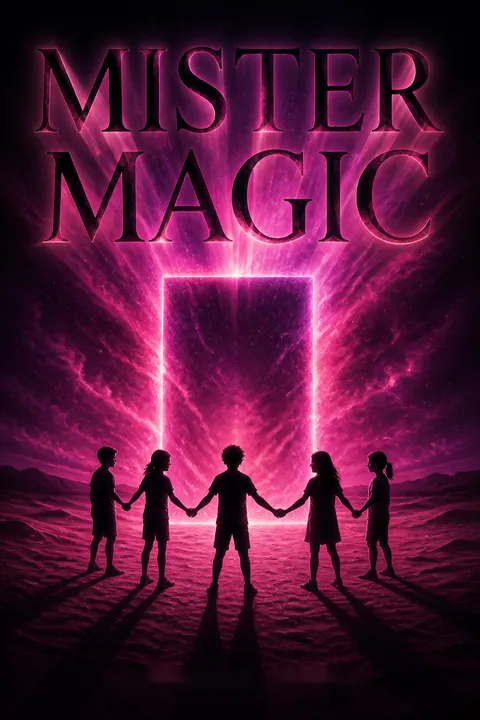

Plot Summary
The Forgotten Circle
Valentine "Val" has lived a life of isolation, her childhood a blank slate except for a persistent sense of unease and a handful of rhyming songs stuck in her head. She runs a ranch with her ailing father, haunted by the feeling that she's hiding from something. When her father dies, Val is left with more questions than answers, especially about her past and the mysterious children's show she once starred in—Mister Magic. The show is infamous for its lack of surviving footage and the way it lingers in the collective memory of a generation, more as a feeling than a fact. The only thing everyone remembers is the circle of friends, the magic words, and the sense that something went terribly wrong.
Open Doors, Closed Memories
After her father's death, Val is approached by three strangers—Isaac, Javi, and Marcus—who claim to be her childhood friends from Mister Magic. They remember her as the leader of their group, but Val has no memory of them or the show. The men invite her to a reunion organized by Jenny, another former cast member, and Val impulsively agrees, desperate for answers about her past and the mother she thought was dead. As they travel together, Val's sense of self is shaken by the realization that her entire life has been shaped by secrets, fear, and the doors she's kept firmly closed in her mind.
Reunion in the Desert
The group arrives at a bizarre, isolated house in the Utah desert, where Jenny and a podcaster await. The house is unsettling—six stories tall, each floor eerily identical, and filled with humming, doorless rooms. The friends are assigned floors, and the reunion is revealed to be more than a simple get-together: it's a podcast recording, an oral history, and perhaps something more sinister. Val's memories remain locked away, but the presence of her old friends stirs feelings of belonging and dread. The house itself seems to watch and wait, amplifying the sense that the past is not as distant as it seems.
The House That Waits
Inside the house, the group is drawn into a web of nostalgia, suspicion, and supernatural unease. Each floor has a television that glows with a black, almost sentient light. The basement is off-limits, reserved for interviews with the mysterious podcaster, whose voice is both familiar and unsettling. Val is plagued by nightmares and a persistent itching in her scarred palm, as if something is trying to break through her skin. The house becomes a character in its own right, a vessel for the secrets and traumas of the past, and a stage for the unfinished business of the circle of friends.
Rules, Rhymes, and Rhythms
The friends reminisce about the show's strange rules and rhymes, realizing how deeply they've been imprinted on their lives. Songs about cleanliness, obedience, and happiness echo in their minds, shaping their adult anxieties and relationships. Val learns that she was the leader, the one who set the rules and kept Mister Magic at bay. The group's dynamic is both comforting and fraught, as old wounds resurface and the true nature of their childhood experiences comes into question. The rules that once kept them safe now feel like chains, binding them to a past they can't fully remember or escape.
The Missing Sister
A devastating revelation shatters Val: she had a younger sister, Kitty, who was also on the show and is now gone. The others remember Kitty, but Val's mind recoils from the truth. Guilt and grief overwhelm her as she realizes she may have been responsible for Kitty's fate. The group's memories of the show's abrupt end are fragmented and contradictory, but all agree that something terrible happened to Kitty. Val's quest for answers becomes a quest for redemption, as she seeks to uncover what really happened to her sister and why her memories have been so thoroughly erased.
The Show That Wasn't
Val and her friends search for evidence of Mister Magic, but find only rumors, conspiracy theories, and a Wikipedia page full of redactions. The show's legacy is a patchwork of collective memory, urban legend, and internet speculation. No footage exists, and those who claim to remember the final episode recall only chaos, fear, and the sense that the magic failed. The group realizes that their experiences were not just entertainment, but part of something larger and more insidious—a system designed to shape and control children, and to erase those who didn't fit.
The Podcast Trap
The podcast interviews become a psychological gauntlet, drawing out the friends' deepest fears and regrets. The interviewer, a shifting presence on a screen, manipulates their memories and emotions, pushing them toward a reenactment of the original circle. Deals are made, songs are sung, and the line between performance and reality blurs. The friends begin to suspect that the reunion is not just about closure, but about reopening the circle and restarting the magic—for the benefit of the town of Bliss and its secretive, cult-like community. The past is not dead; it is being resurrected.
The Truth About Kitty
A clandestine meeting with Isaac's mother provides Val with a forbidden VHS tape—evidence of what really happened on the show. Watching the tape, Val sees herself as a child, leading the circle, keeping Mister Magic at bay, and ultimately failing to protect Kitty. The final episode plays out in horrifying detail: the circle breaks, the magic fails, and Kitty is swallowed by the darkness. The friends are left with the unbearable truth that they were both victims and participants in a system that demanded perfection and punished deviation with erasure.
The Gala and the Gatekeepers
At a town gala, Val confronts the leaders of Bliss, who reveal their intention to restart the show and use the children of the former cast as the new circle. The town's power structure is built on the promise of perfect children, shaped by the magic of the show and the sacrifice of those who don't fit. Val realizes that the reunion was a trap, designed to lure her and her friends back into the circle and to perpetuate the cycle of control and loss. The community's smiling facade hides a legacy of abuse and complicity.
The Tape in the Blanket
Val's possession of the tape becomes a catalyst for confrontation and revelation. The friends watch the footage together, each seeing their own complicity and trauma reflected back at them. The tape is both proof and curse, a record of what was done to them and what they did to each other. The group is forced to reckon with the reality that their memories were not just suppressed, but actively manipulated by the forces that controlled the show. The tape is a key, but it cannot unlock the doors that each of them must open for themselves.
The Basement Interview
Val descends into the basement for her interview, facing the podcaster—now revealed as a manifestation of Kitty, or what remains of her. The interview is a ritual, a demand for Val to remember, to take responsibility, and to make a choice. The basement is a liminal space, a threshold between memory and oblivion, where the rules of the show and the rules of reality collide. Val is offered a deal: sing the song, reform the circle, and bring back the magic—or refuse, and risk losing everything. The choice is hers, but the cost is shared.
The Circle Reforms
The group decides to face the darkness together, reforming the circle not as children, but as adults who have survived and changed. They realize that the only way to break the cycle is to confront the magic on their own terms, to refuse the roles they were assigned, and to demand a future for themselves and for Kitty. The circle is both a prison and a source of power, and by reclaiming it, they reclaim their right to define themselves. The act of remembering becomes an act of resistance, and the circle becomes a space of healing rather than harm.
Into the Dark Again
The friends enter the magical space of the show, reliving their childhoods and confronting the forces that shaped them. They see the origins of Mister Magic, the deals that were made, and the ways in which their innocence was weaponized against them. Val discovers that the magic is not inherently evil, but has been twisted by the desires and fears of the adults who wielded it. The only way out is through: by opening all the doors, facing all the memories, and refusing to let the past define their future.
Childhood Unraveled
Inside the magic, the friends see the truth of their experiences: the show was a system of control, designed to produce perfect children at the expense of their individuality and agency. The rules and rhymes were tools of conformity, and the magic fed on their futures, leaving them hollow and lost. Kitty, trapped in the magic, is both victim and vessel, a reminder of what is lost when children are forced to perform rather than live. The friends must choose between perpetuating the cycle or breaking it forever.
The Final Door
Val realizes that the only way to save Kitty and the other lost children is to become Mister Magic herself, to take on the burden of the magic and to use it to open the doors for others. She sends her friends back to the real world, locking the doors behind them so that no one else can be trapped. In doing so, she breaks the cycle of sacrifice and control, offering the possibility of healing and new beginnings. The cost is high, but the future is finally open.
Becoming Mister Magic
Val embraces her role as the new Mister Magic, not as a tool of conformity, but as a guardian of possibility and change. She creates a space where children can be themselves, where feelings are honored and individuality is celebrated. The magic is no longer a weapon, but a source of healing and connection. Val's sacrifice is not the end, but the beginning of a new story—one in which the doors are open, the circle is unbroken, and the magic belongs to everyone.
Epilogue: New Magic
In the aftermath, the friends build new lives, free from the rules and roles that once defined them. The show is reborn as something different, a space of imagination and acceptance, led by Kitty and watched over by Val. The children of the former cast are safe, loved, and free to be themselves. The magic endures, not as a tool of control, but as a celebration of change, growth, and the infinite possibilities of the future. The doors are open, and the story continues.
Analysis
Mister Magic is a haunting meditation on the power of memory, the dangers of nostalgia, and the cost of enforced perfection. Kiersten White uses the framework of a lost children's show to explore the ways in which families, communities, and cultures shape—and sometimes shatter—individual identity. The story interrogates the seductive appeal of returning to a simpler, happier past, revealing the violence and erasure required to maintain that illusion. Through Val and her friends, the novel examines the psychological scars left by systems that demand conformity and punish difference, and the ways in which trauma can be both a prison and a source of strength. The narrative's use of unreliable memory, ritual, and liminal space invites readers to question the stories they tell themselves about childhood, happiness, and belonging. Ultimately, Mister Magic is a call to open the doors we have closed, to honor the messiness of real life, and to create new magic out of the broken pieces of the past. The lesson is clear: true healing comes not from forgetting or performing, but from remembering, reclaiming, and rewriting our own stories.
Review Summary
Mister Magic by Kiersten White receives polarizing reviews (3.55/5 average). The horror novel follows former child stars reuniting 30 years after their mysterious show ended, with no evidence it existed. Readers praise the creepy premise, atmospheric tension, and multimedia elements like message boards. Many appreciate its exploration of religious trauma and cult dynamics, particularly after reading the author's note. However, critics cite confusing execution, juvenile dialogue for middle-aged characters, heavy-handed messaging, and a disappointing ending. Some found it brilliant and cathartic; others called it boring and poorly written. The abstract, symbolic nature divides readers.
People Also Read


Characters
Valentine "Val" (Mister Magic)
Val is the protagonist, a woman whose childhood was stolen and rewritten by trauma, secrecy, and the supernatural influence of Mister Magic. As a child, she was the leader of the circle, the one who set the rules and kept the magic in check. Her stubbornness is both her strength and her curse, allowing her to protect her friends but also isolating her from them. Val's relationship with her father is fraught with unspoken guilt and fear, while her connection to her sister Kitty is the emotional core of her journey. Psychologically, Val is defined by her refusal to ask for help, her tendency to close doors on painful memories, and her desperate need for redemption. Her development is a journey from self-imposed isolation to self-acceptance and sacrifice, culminating in her decision to become Mister Magic and to use her power to free others.
Isaac
Isaac is the oldest member of the circle, the one who always felt responsible for the others. As a child, he was the protector, the one who found Val when she hid and comforted the others when they were afraid. His adult life is marked by loss, addiction, and a longing for connection—especially with his daughter, Charlotte. Isaac's guilt over failing to save Kitty and losing Val shapes his every decision, making him vulnerable to manipulation by the forces behind the show. His relationship with Val is deeply intimate, rooted in shared trauma and mutual understanding. Psychologically, Isaac is driven by a need to atone, to be the caretaker he never had, and to break the cycle of sacrifice. His development is a movement from self-blame to self-forgiveness, and from passive protector to active participant in his own healing.
Jenny
Jenny is the heart of the circle, the one who always wanted to be included and loved. As a child, she was the sidekick, the helper, the one who followed the rules and sought approval from Mister Magic and her peers. Her adult life is defined by motherhood, self-sacrifice, and a deep sense of inadequacy. Jenny's relationship with her father (the original Mister Magic) and her role in the show's legacy are sources of both pride and pain. Psychologically, Jenny is torn between her longing for the magic of the past and her need to be seen as a person in her own right. Her development is a struggle to assert her own desires, to break free from the roles assigned to her, and to find value in herself beyond her usefulness to others.
Javi
Javi is the rebel of the group, the one who challenged the rules and introduced chaos into the circle. As a child, he was the instigator, the prankster, the one who tested boundaries and paid the price for it. His adult life is marked by privilege, pain, and a complicated relationship with his family and identity. Javi's humor masks a deep vulnerability and a fear of not belonging. Psychologically, he is driven by a need to prove himself, to resist control, and to protect those he loves from the systems that hurt him. His development is a journey from cynicism to commitment, from self-sabotage to solidarity with his friends.
Marcus
Marcus is the artist of the circle, the one who brought their imaginary worlds to life. As a child, he was the dreamer, the creator, the one who painted the sets and characters of their adventures. His adult life is shaped by loss, identity struggles, and the pressure to conform. Marcus's creativity is both a gift and a burden, making him sensitive to the needs of others but also vulnerable to erasure. Psychologically, Marcus is haunted by the fear of standing out, of being too much, and of losing himself in the roles others assign him. His development is a movement toward self-expression, authenticity, and the courage to love and be loved.
Kitty
Kitty is Val's younger sister, the youngest member of the circle, and the central mystery of the story. As a child, she was the innocent, the one everyone wanted to protect. Her disappearance is the trauma that haunts the group, the wound that never heals. In the magical space of the show, Kitty becomes both victim and vessel, a symbol of what is lost when children are forced to perform rather than live. Psychologically, Kitty represents the cost of perfection, the price of obedience, and the tragedy of innocence sacrificed for the sake of control. Her development is a journey from erasure to reclamation, as Val fights to bring her back and to honor her memory.
Debra (Val's Mother)
Debra is Val and Kitty's mother, a woman broken by loss, disappointment, and the demands of the community. Her relationship with Val is defined by resentment, avoidance, and a refusal to confront the past. Debra's psychological profile is one of dissociation, self-pity, and a desperate clinging to the illusion of control. She represents the generational transmission of trauma, the ways in which parents can fail their children by refusing to see them as individuals. Her development is static, a cautionary example of what happens when the doors to memory and feeling are kept closed.
Mister Magic
Mister Magic is both a character and a force, the personification of the rules, lessons, and expectations imposed on the children. He is never fully seen, always shifting, always present. As a narrative device, he represents the seductive power of conformity, the promise of safety at the cost of individuality. Psychologically, Mister Magic is the internalized voice of authority, the superego that demands obedience and punishes deviation. His development is a cycle of creation and destruction, as he is summoned, contained, and ultimately replaced by Val.
The Mayor and Bliss Community
The mayor and the town of Bliss are the antagonists, the architects of the system that created and sustained Mister Magic. They are driven by a desire for control, a belief in the possibility of perfect children, and a willingness to sacrifice those who don't fit. Psychologically, they represent the dangers of groupthink, the violence of enforced conformity, and the seductive appeal of nostalgia. Their development is a warning against the cost of denying change, difference, and the messiness of real life.
The Lost Children
The lost children are the shadows that haunt the magical space, the ones who were consumed by the magic and forgotten by the world. They are both victims and reminders, the price paid for the illusion of perfection. Psychologically, they represent the parts of ourselves that are sacrificed to fit in, the memories and feelings that are locked away to survive. Their development is a call to remember, to honor what is lost, and to refuse to let the cycle continue.
Plot Devices
Memory as Magic and Prison
The central plot device of Mister Magic is the interplay between memory and magic. The show's power lies in its ability to shape, erase, and rewrite the memories of its participants and viewers. The circle of friends is both a literal and metaphorical construct, a space where the rules of reality are suspended and the past can be relived or rewritten. The narrative structure uses flashbacks, interviews, and found footage to blur the line between past and present, performance and reality. Foreshadowing is woven through the recurring songs, rhymes, and rules, which serve as both comfort and control. The story's climax hinges on the opening and closing of doors—psychological, physical, and magical—as Val and her friends choose to confront their memories, reclaim their agency, and break the cycle of sacrifice.
The Unreliable Narrator
The story is told through Val's perspective, but her memory is unreliable, her sense of self fractured by trauma and manipulation. The use of interviews, internet posts, and multiple points of view creates a tapestry of competing narratives, each with its own version of the truth. The lack of surviving footage, the contradictions in the friends' memories, and the shifting nature of the magical space all reinforce the theme that reality is constructed, not given. The reader is invited to question what is real, what is imagined, and what is imposed by those in power.
Ritual and Repetition
The structure of the show—and the story itself—is built on ritual: the formation of the circle, the singing of the song, the making of deals, the summoning of Mister Magic. These rituals are both sources of comfort and tools of control, binding the characters to roles they cannot escape. The repetition of these elements throughout the narrative creates a sense of inevitability, but also the possibility of change. By reclaiming the rituals and rewriting the rules, the characters are able to break free from the cycle and create something new.
The House as Liminal Space
The house in the desert is more than a backdrop; it is a liminal space, a threshold between past and present, memory and oblivion, safety and danger. Its doorless rooms, humming walls, and impossible architecture reflect the psychological state of the characters and the supernatural forces at play. The basement, in particular, is a site of confrontation and transformation, where the boundaries between self and other, real and imagined, are dissolved. The house is both a prison and a portal, a place where the story can be rewritten—or repeated.
About the Author
Other books by Kiersten White

Download PDF
Download EPUB
.epub digital book format is ideal for reading ebooks on phones, tablets, and e-readers.








































