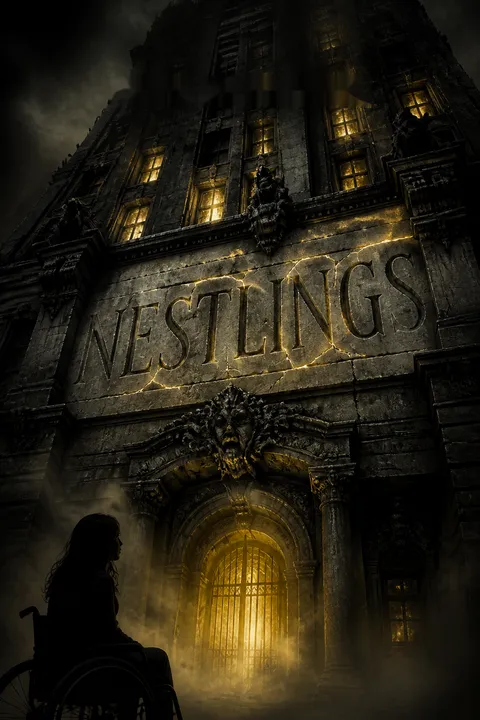

Plot Summary
Lottery's Unwelcome Gift
Ana and Reid, new parents reeling from Ana's postpartum paralysis, win a housing lottery for a luxury apartment in the iconic Deptford building. The win feels like a cruel joke: the apartment is on a high, inaccessible floor, and Ana's wheelchair makes the move daunting. Yet, desperate for a fresh start after a year of trauma, they accept. The building's grandeur is shadowed by unease—strange histories, secretive staff, and the ever-present, leering gargoyles. Ana's sense of not belonging grows, but hope for a new beginning keeps them moving forward, even as the city outside seems to echo their own battered resilience.
The Deptford's Hidden Hunger
As Ana, Reid, and baby Charlie settle in, the Deptford's oddities multiply. The staff are unsettlingly attentive, the other tenants invisible, and the building's history is shrouded in rumor. Ana's unease deepens when she learns the building's famous gargoyles are said to protect it, and that the Deptford has always reserved apartments for "outsiders." The family's joy is undercut by the sense that the building itself is watching, waiting. The hunger beneath the surface—literal and metaphorical—begins to stir, and the family's luck feels more like a trap than a blessing.
Moving In, Moving Down
The move is frantic and isolating. Ana's disability makes the high floor a daily challenge, and Charlie becomes increasingly unsettled, crying and refusing to sleep. Reid, exhausted by work and the move, finds solace in a rare book about the Deptford's dark past. Ana's friend Georgia tries to help, but even her support can't dispel the building's oppressive atmosphere. The family's old traumas—Ana's injury, postpartum depression, and financial strain—are magnified by the Deptford's claustrophobic embrace. The sense of being outsiders, both in the city and in their own lives, grows heavier.
Cracks in the Nest
As Ana struggles with motherhood and her own body, the building's strangeness intensifies. Charlie's behavior becomes erratic, and Ana's attempts to connect with neighbors reveal only more silence and closed doors. The apartment's accessibility modifications feel like a mockery, and Ana's sense of failure deepens. Reid's obsession with the Deptford's history grows, and he uncovers tales of disappearances, suicides, and a mysterious event called "the Plummet." The family's unity begins to crack under the weight of secrets, exhaustion, and the building's insidious influence.
The Music No One Hears
Ana becomes fixated on a strange, almost musical hum that seems to permeate the apartment. Charlie is the first to react, growing agitated whenever they return home. Ana's attempts to record the sound reveal nothing to adult ears, but children sense it—a frequency that unsettles and entrances. The building's atmosphere grows more oppressive, and Ana's mental state frays. She fears she's losing her grip on reality, haunted by dreams of falling, monstrous faces at the window, and the sense that something in the Deptford is feeding on her family's pain.
Neighbors and Nightmares
Ana's desperate search for connection leads her to a neighbor, Mrs. Jacobs, whose own descent into madness mirrors Ana's fears. Mrs. Jacobs, tormented by her own baby, tries to escape but is dragged back by the building's staff. Ana's empathy turns to horror as she realizes the building preys on vulnerable families, especially those with infants. The encounter leaves Ana shaken, convinced that the Deptford is not just haunted by the past, but actively consuming the present. The line between nightmare and reality blurs, and Ana's isolation deepens.
The Courtyard's Secret Heart
Seeking solace, Ana takes Charlie into the building's lush courtyard, only to become lost in its unnatural thicket. The ground is warm, alive, and teeming with translucent spiders. Ana's fall and injury are overshadowed by the terror of losing Charlie, who seems drawn to the heart of the courtyard. When Ana finds her, Charlie is changed—cheerful, but with a hunger for something Ana cannot name. The courtyard's secret is a living, pulsing presence beneath the building, and Ana senses that her child has been marked by it.
The Building Provides
Reid, struggling with job loss and feelings of inadequacy, is drawn into the orbit of Camilla Varné, a glamorous, ageless tenant who offers him work as her assistant. The building's elite residents—artists, politicians, and celebrities—welcome him, but their interest in Charlie is unsettling. Camilla's charm masks a predatory intent, and Reid is seduced by the promise of belonging, stability, and healing for Ana. The building provides, but always at a price. The family is drawn deeper into the Deptford's web, their vulnerabilities exploited by those who feed on hope and despair.
The Plummet's Shadow
Reid's research uncovers the truth behind the Plummet: a mass suicide or ritual sacrifice that echoes the building's current hunger for new blood. The Deptford's history is one of cycles—outsiders lured in, consumed, and replaced. The building's monstrous residents are not vampires in the traditional sense, but ancient, eusocial predators who require new hosts to survive. The family's suffering is not unique, but part of a pattern. The past is never dead in the Deptford; it is always waiting to be fed.
Party on the Precipice
Charlie's first birthday party is a brief respite, filled with friends and laughter. But beneath the surface, tensions simmer—Ana and Reid's marriage is strained, and Charlie's odd behavior unsettles the guests. When Charlie bites another child, the illusion of normalcy shatters. The bite is not just a child's aggression, but a sign of transformation. The party becomes a precipice, and the family teeters on the edge of disaster. The building's true nature is about to be revealed, and no one will leave unchanged.
The Bite and the Bargain
As Charlie's condition worsens and another child falls ill, Ana and Reid's desperation grows. Camilla offers a terrible bargain: Charlie can be saved, but only by joining the Deptford's monstrous family. Reid, seduced by promises of healing for Ana and a place for himself, agrees. Ana, locked away for her own "protection," realizes too late that the building's gifts are curses. The family is torn apart by betrayal, and the price of survival is the loss of their child's humanity.
Descent and Betrayal
Ana escapes confinement and confronts Reid, who has become complicit in the building's predation. Their confrontation is brutal, both physically and emotionally, as years of resentment and pain erupt. Ana chooses action over despair, hurling herself and Reid down the stairs in a desperate bid for freedom. Reid is left paralyzed, and Ana begins a harrowing crawl through the building's depths, pursued by the Deptford's monstrous residents. The descent is both literal and symbolic—a mother's refusal to accept the fate chosen for her child.
Mother's Gift, Mother's Grief
Ana reaches the heart of the building, where the monstrous queen—once a chosen child herself—rules over a hive of parasites. The building's human and inhuman residents gather, offering Ana a final, impossible choice: leave Charlie and save her life, or take her and doom them both. Ana's grief is overwhelming, but she recognizes that Charlie, now transformed, is happy among her new family. Motherhood, she realizes, is an endless series of sacrifices and goodbyes. In a final act of defiance, Ana wounds the queen, disrupting the building's power and triggering its collapse.
The Crawl to Salvation
Ana's escape is a trial of endurance and will. She battles monsters, both literal and psychological, and is aided by the very tools of her disability—her wheelchair becomes her salvation. The building's collapse mirrors Ana's own breaking and remaking. She is helped by a stranger, and as the Deptford's monstrous facade crumbles, Ana emerges into the city, forever changed. The cost of survival is the loss of her family, but also the reclamation of her own agency and identity.
The Queen Below
In the basement, Ana confronts the queen—a grotesque, living wall of flesh, the source of the building's power. The queen is both victim and monster, a former child transformed by the building's hunger. Ana learns that the Deptford's cycle is endless: outsiders are lured, children are chosen, and the hive endures. The queen's song is the music that haunts the building, and her gifts are the golden parasites that create new monsters. Ana's act of violence against the queen is both vengeance and mercy, breaking the cycle for a moment.
Sacrifice and Survival
Ana's confrontation with the building's residents is a reckoning. She is offered everything she ever wanted—healing, belonging, a place for Charlie—but at the cost of her child's humanity. Ana chooses to let Charlie go, recognizing that her happiness is more important than her own pain. The act is both a sacrifice and an act of love, and it shatters the building's power. The Deptford collapses, its monstrous secrets buried, and Ana is left to rebuild her life from the ruins.
After the Fall
In the aftermath, Ana must explain the disappearance of her husband and child. She crafts a story of abandonment and loss, choosing to carry the truth alone. The city moves on, the Deptford is just another old building, and Ana finds a new purpose in helping others with disabilities. The pain of loss never leaves, but it becomes part of her—a scar, not a wound. The memory of Charlie is both a blessing and a curse, and Ana learns that survival is not about forgetting, but about carrying on.
The Shape of Moving On
Years later, Ana has found a measure of peace. She works to support others with spinal cord injuries, and her own mobility has improved, though she still loves her wheelchair. She visits a new building, sensing the presence of her daughter, now the queen of her own hive. The city is full of haunted places and haunted people, but Ana has learned to live with her ghosts. Movement is movement, no matter how it is achieved, and love endures in the spaces between loss and hope.
Analysis
Nestlings is a harrowing meditation on trauma, motherhood, and the predatory nature of systems that promise belonging while feeding on the vulnerable. Nat Cassidy reimagines the haunted house as a living, eusocial organism—one that lures outsiders with the promise of opportunity, only to consume them and their children in endless cycles. The novel's horror is both supernatural and deeply psychological, rooted in the realities of postpartum depression, disability, and the isolating pressures of modern parenthood. The Deptford is a metaphor for the city, for family, for history itself: beautiful, alluring, and hungry. The book interrogates the costs of survival—what we are willing to sacrifice for safety, love, or a sense of home—and the ways in which trauma is inherited, transformed, and sometimes weaponized. Ultimately, Nestlings offers no easy answers or redemptions. Its lesson is that survival is not about defeating monsters, but about carrying on in the aftermath—scarred, changed, and still moving. The final image—of Ana, years later, finding peace in her own body and in the knowledge that her daughter endures, however changed—suggests that hope is found not in victory, but in adaptation, resilience, and the refusal to let grief define the shape of one's life.
Review Summary
Nestlings by Nat Cassidy is a chilling horror novel set in a mysterious New York City apartment building. Readers praise its atmospheric tension, compelling characters, and fresh take on vampire mythology. The story follows a couple struggling with disability and new parenthood as they encounter supernatural horrors. While some found the pacing slow at times, many appreciated the psychological depth and social commentary. Cassidy's writing style and character development received high marks, with comparisons to classic horror works like Rosemary's Baby and Salem's Lot.
People Also Read

Characters
Ana Greene
Ana is a former dancer and personal trainer whose life is upended by a rare childbirth injury that leaves her paraplegic. Her relationship with her body, her husband Reid, and her infant daughter Charlie is fraught with pain, resentment, and fierce love. Ana's psychological journey is one of survival—through postpartum depression, disability, and the supernatural predation of the Deptford. She is fiercely protective, yet plagued by guilt and self-doubt, especially after a near-tragic episode with Charlie. Ana's arc is defined by her refusal to surrender to despair, her willingness to fight for her child, and ultimately, her acceptance of loss as part of motherhood. Her struggle is both physical and existential, embodying the book's themes of adaptation, sacrifice, and the search for belonging.
Reid Greene
Reid is Ana's husband, a failed musician turned office worker, whose sense of self-worth is battered by financial strain, caretaking duties, and the loss of his mother. He is drawn to the Deptford's promise of a new start, but his need for validation and stability makes him vulnerable to the building's predatory allure. Reid's psychological complexity lies in his oscillation between love and resentment, hope and despair. His desire to "provide" leads him to make a Faustian bargain, sacrificing his family's safety for the illusion of control. Reid's arc is tragic: his attempts to save his family only hasten their destruction, and his final paralysis is both literal and symbolic—a man trapped by his own choices.
Charlie Greene
Charlie is the infant daughter of Ana and Reid, born into trauma and transformed by the Deptford's hunger. Initially a source of joy and anxiety, Charlie becomes the focal point of the building's predation. Her transformation—from fussy baby to eerily contented, then to something inhuman—mirrors the family's descent into horror. Charlie's role is both victim and vessel: she is chosen by the building's queen to become the next "mother," a fate that offers her happiness at the cost of her humanity. Charlie's arc is a meditation on innocence, adaptation, and the unknowable future of our children.
Camilla Varné
Camilla is an ageless, glamorous resident of the Deptford, a former actress who serves as both seductress and gatekeeper. She embodies the building's allure—offering comfort, healing, and belonging, but always at a price. Camilla's psychological depth lies in her weariness and longing for connection; she is both monster and mother, nurturing and consuming. Her relationship with Reid is manipulative yet oddly sincere, and her ultimate role as Charlie's new "mother" is both a gift and a curse. Camilla's arc is one of power, loss, and the endless cycle of predation.
Vera
Vera is the building's broker and a human acolyte to the Deptford's monstrous residents. She is desperate for approval, envious of those chosen, and complicit in the building's predation. Vera's psychological profile is marked by self-loathing, envy, and a willingness to do anything for a taste of power. Her role is to facilitate the building's cycle, vetting new tenants and ensuring the supply of vulnerable families. Vera's arc ends in madness and violence, a warning about the dangers of complicity and the hunger for belonging.
Georgia O'Keefe
Georgia is Ana's physical therapist and confidante, a no-nonsense Texan with her own history of family trauma. She pushes Ana to fight for her recovery, but also respects her boundaries. Georgia's psychological insight and dry humor provide a counterpoint to Ana's despair. Her fate—disappearing into the building's labyrinth—serves as a reminder of the dangers lurking beneath the surface, and the limits of even the strongest support.
Mrs. Jacobs
Mrs. Jacobs is a fellow tenant whose descent into madness and victimization by the building foreshadows Ana's own potential fate. Her relationship with her own monstrous child is a dark mirror of Ana's fears. Mrs. Jacobs's arc is one of isolation, despair, and ultimate consumption, embodying the book's themes of motherhood, loss, and the predatory nature of the Deptford.
The Concierge ("Smiler")
The concierge is the building's smiling, inhumanly calm frontman, orchestrating the Deptford's cycles and ensuring the compliance of both tenants and staff. His psychological profile is one of cold efficiency, masking monstrous intent behind a veneer of hospitality. He is the face of the building's predation, and his fate—crushed by a falling gargoyle—symbolizes the collapse of the old order.
The Queen ("Mother")
The queen is the living, fleshy mass at the heart of the Deptford, a former chosen child transformed into the building's reproductive engine. She is both victim and monster, embodying the book's themes of motherhood, sacrifice, and the inescapable cycles of predation. Her song is the music that haunts the building, and her gifts are the parasites that create new monsters. The queen's arc is one of endless giving and endless hunger.
Frank
Frank is Ana and Reid's former landlord, a racist, sexist, and anti-Semitic bully whose pursuit of the family into the Deptford ends in his own destruction. Frank's psychological profile is one of resentment, entitlement, and violent nostalgia. He represents the old world's refusal to die, and his fate—devoured by the building's children—serves as a grim reminder that the past is never truly gone.
Plot Devices
The Deptford as Living Organism
The Deptford is not just a setting, but a character—a living, breathing organism that lures vulnerable families, especially those with infants, to sustain its monstrous hive. The building's architecture, history, and staff all serve its predatory cycle. The use of the building as a plot device allows for a seamless blending of psychological and supernatural horror, with the family's personal traumas mirrored and magnified by the Deptford's hunger. The building's "gifts"—accessibility, opportunity, healing—are always double-edged, and its cycles of predation are foreshadowed by the stories of past tenants, the Plummet, and the ever-present music that only children can hear.
Motherhood as Horror and Sacrifice
The novel uses motherhood as both a source of terror and transcendence. Ana's journey through postpartum depression, disability, and the loss of her child is paralleled by the Deptford's cycle of consuming and transforming mothers and children. The queen below is both a warning and a promise: motherhood is an endless series of sacrifices, goodbyes, and transformations. The book's horror is rooted in the fear of failing one's child, of being unable to protect or even love them, and of the ways society preys on the vulnerable.
The Unheard Music
The strange, musical hum that permeates the building is a recurring motif, symbolizing the inescapable influence of the Deptford and the ways in which trauma, history, and predation are passed down. Only children and the vulnerable can sense it, and it serves as both a warning and a lure. The music is the queen's song, calling new hosts to the hive, and its presence foreshadows the transformations to come.
Cycles of Betrayal and Complicity
The novel's structure is built on cycles—of trauma, predation, and survival. Characters are forced to choose between complicity and resistance, and even acts of love become acts of betrayal. The building's residents, both human and monstrous, are trapped in their own patterns, and the only escape is through sacrifice. The use of foreshadowing, unreliable memory, and shifting perspectives deepens the sense of inevitability and doom.
The Plummet and the Past
The story of the Plummet—a mass suicide or failed transformation—serves as both a warning and a prophecy. The past is never dead in the Deptford; it is always waiting to be repeated. The building's history is a palimpsest of suffering, and the family's story is just the latest layer. The use of historical documents, rumors, and the rare book about the Deptford creates a sense of depth and inevitability, as if the characters are trapped in a story that has already been written.

Download PDF
Download EPUB
.epub digital book format is ideal for reading ebooks on phones, tablets, and e-readers.








































