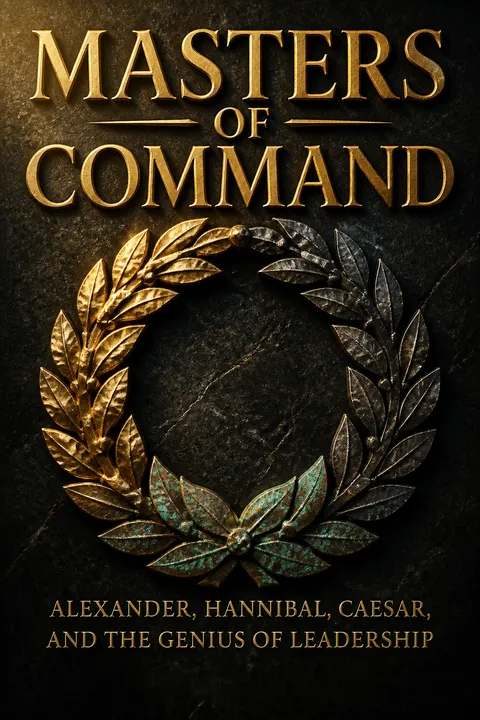

Key Takeaways
1. Ten Qualities Define Successful Commanders
The story of these three supreme commanders is as fresh today as it was two thousand years ago.
Beyond the Battlefield. Alexander, Hannibal, and Caesar weren't just skilled tacticians; they were soldier-statesmen who understood that war extended far beyond the battlefield. They had to decide whom to fight, why to fight, and when to stop, envisioning a new world order that would bring stability and lasting power. This required a unique blend of military prowess and political acumen.
The Imperfect Conquerors. Despite their military genius, all three commanders fell short as statesmen. Alexander died young without securing his succession, Hannibal lost his war against Rome, and Caesar was assassinated before he could fully implement his vision. Their stories serve as both lessons and warnings for leaders in any field.
Ten Keys to Success. These commanders shared ten key qualities that underpinned their wartime success: ambition, judgment, leadership, audacity, agility, infrastructure, strategy, terror, branding, and the elusive quality of Divine Providence. These qualities, both admirable and not, defined their approach to war and conquest.
2. Ambition Fuels the Conqueror's Fire
They could no more stop conquering than lions can stop hunting.
The Love of Honor. The Greeks called it "philotimia," the love of honor, and it burned fiercely within Alexander, Hannibal, and Caesar. They possessed an insatiable drive for distinction, a "megalopsychia" or greatness of soul, that propelled them to seek ever-greater conquests. This ambition, though lofty, was often intertwined with egotism and injustice.
Beyond Lofty Aims. Alexander sought to conquer an empire, not to right a wrong. Hannibal rejected negotiation to rival Alexander's conquests. Caesar overturned the republic to become the first man in Rome. Their ambition was a force of nature, driving them to achieve what others deemed impossible.
The Conqueror's Drive. These commanders were not content with incremental gains or limited objectives. They were driven by a relentless pursuit of new worlds to conquer, a thirst for glory that consumed them and shaped their actions. This ambition, though inspiring, often came at a great cost to themselves and others.
3. Judgment Navigates the Fog of War
When faced with a new situation, each could draw from past experience and come up with the right answer.
Strategic Intuition. More than just intelligence, these commanders possessed strategic intuition, the ability to draw from past experience and make sound decisions even with imperfect information. They were unflappable under pressure, thinking creatively and effectively in the face of chaos. They knew war, but they also knew people.
Learning from Experience. Alexander and Hannibal learned at the feet of their warrior fathers, while Caesar honed his skills through politics and conquest. By the time they embarked on their great campaigns, they were already masters of the art of war.
Blind Spots. Despite their competence, each commander had a blind spot: Alexander ignored navies, Hannibal ignored sieges, and Caesar barely knew logistics. These disabilities, though significant, did not ultimately derail their ambitions.
4. Leadership Inspires Loyalty and Obedience
I didn’t follow the cause. I followed the man—and he was my friend.
Iron Souls and the Common Touch. The great commanders were decisive, forceful, and assured, yet they also possessed the common touch, inspiring loyalty and obedience through personal connection. They were skilled actors, able to ignite or quell passions as needed.
Masters of Reward and Punishment. They used honors and cash prizes to foster bravery, paid their troops well, and ensured benefits for widows and orphans. But they also wielded the fear factor, punishing disobedience with beatings, executions, and even crucifixions.
Beyond Friendship. While personal qualities mattered, these commanders did not rely on friendship alone. They were skilled at managing their armies, using both reward and punishment to maintain discipline and inspire their troops.
5. Audacity Dares the Impossible
Because he loved honor, he loved danger.
Scaling Mount Everest. Alexander, Hannibal, and Caesar dared to do what couldn't be done, confronting empires with far larger armies and resources. They risked everything for victory, believing in their invincible destiny and good fortune.
Leading from the Front. They fought in the thick of things, sharing their men's risks and winning their hearts. This boldness, though dangerous, was also effective, inspiring their troops and demonstrating their commitment to the cause.
Calculated Risks. While bold, they also calculated the odds, securing their base before racing out in front. They were risk-takers, but not reckless, knowing when to be audacious and when to exercise caution.
6. Agility Adapts to Changing Tides
They were soldiers for all seasons.
Retooling for Change. The great commanders were soldiers for all seasons, adapting to changing conditions on the battlefield. Alexander switched to counterinsurgency in Central Asia, Hannibal shifted between set battles and ambushes, and Caesar excelled in both battlefield and urban warfare.
Speed and Mobility. Speed was their watchword, mobility their hallmark. Alexander's heavy cavalry, Hannibal's light horsemen, and Caesar's lightning infantry thrusts were the agents of success. They traveled light, living off the land and mastering multitasking.
Limits of Agility. Agility had its limits, however. Alexander was nearly stymied by the Persian fleet, Hannibal struggled with sieges, and Caesar nearly starved his army during the siege of Dyrrachium. Nor did agile warriors necessarily make good politicians.
7. Infrastructure Sustains the War Machine
To win a war takes certain material things: arms and armor, ships, food, money, money, and more money.
Material Resources. Winning a war requires material resources: arms, armor, ships, food, and money. With enough money, you can buy the rest, even manpower. But money can't buy synergy.
Building Synergy. The great commanders inherited dazzling instruments and honed them into something even sharper and more deadly. They built combined-arms forces trained to fight together as a coherent whole, welded to their leader.
Inherited Excellence. Philip II built the Macedonian army, and Alexander added the crowning touch. Hannibal inherited the men who had carved out a new Carthaginian empire in Spain. Caesar took the Roman legions and made them his own.
8. Strategy Charts the Course to Victory
Great commanders must master them all.
Mastering All Levels. Strategy encompasses everything from battle tactics to war strategy and grand strategy. Great commanders must master them all, from the battlefield to the political arena.
Hannibal's Mastery of Surprise. Hannibal, in particular, was the master of surprise, leaving the enemy breathless with his march over the Alps and his array of unheard-of tricks. However, he failed at long-term thinking.
Long-Term Vision. Alexander and Caesar turned the tables on Hannibal when it came to war strategy. They thought ahead and were dogged, knowing that military victory does not equal political success.
9. Terror and Branding Shape Perceptions
They were willing to kill innocents and everyone knew it.
The Power of Fear. The great commanders were willing to kill innocents, and everyone knew it. This too was a secret of their success, instilling fear in their enemies and deterring resistance.
Chameleons and Populists. They were chameleons, playing the populist and crafting grand causes and clear symbols. Alexander began as an avenger and ended as a demigod. Hannibal stood for vengeance and liberation. Caesar fought for the rights of the Roman people and his own good name.
The Art of Branding. They were masters of branding, shaping perceptions and co-opting the conquered. Alexander declared himself king of Asia, Hannibal rallied Italians to his cause, and Caesar combined the carrot of pardons with the stick of military force.
10. Divine Providence Guides Destiny
Although the previous nine factors were necessary, Divine Providence was essential.
Beyond Luck. Napoleon asked for generals who were not only good but also lucky. But only Divine Providence, and not mere luck, can explain the guidance and protection needed to reach the heights they did.
The Hand of Fate. Divine Providence guided the steps of young men born to be conquerors, like Alexander and Hannibal, and also the steps of a middle-aged politician who turned out to be the greatest general of all—Caesar.
Man Plans, God Laughs. Only Divine Providence can lead a man's foes off the cliff. Without having to lift a finger, Alexander saw his worst enemy die suddenly. The Romans played into Hannibal's hands by launching their biggest army against him at Cannae.
11. The Five Stages of Warfare: A Timeless Rhythm
Success is not only a matter of the ten qualities just discussed, but of knowing when to deploy them.
A Universal Pattern. The wars of Alexander, Hannibal, and Caesar followed a similar pattern, consisting of five stages: attack, resistance, clash, closing the net, and knowing when to stop. This model fits not just ancient wars but more recent conflicts as well.
Beyond a Three-Stage Process. Most people think of war as a three-stage process: attack, fight, win or lose. But that model is wrong because it simplifies and distorts the nature of war. We cannot understand war without allowing for its unpredictability and its fundamentally political nature.
The Great Commanders' Understanding. The great commanders knew this. They didn't just plan to win. They anticipated failure and they knew how to rebound from it. They put battlefield success into context. They knew that you could win a battle and still lose the war. They also understood that military victory does not equal political success.
Review Summary
Masters of Command receives mostly positive reviews for its engaging comparison of Alexander, Hannibal, and Caesar as military leaders. Readers appreciate Strauss's accessible writing style and insightful analysis of the generals' strengths and weaknesses. Some criticize the book's organization and attempts to apply ancient lessons to modern business. Overall, reviewers find it an informative and thought-provoking examination of leadership in the ancient world, though opinions vary on its depth and effectiveness in drawing broader conclusions about military genius.
FAQ
What’s Masters of Command by Barry S. Strauss about?
- Comparative study of leaders: The book analyzes the leadership, military genius, and political strategies of Alexander the Great, Hannibal, and Julius Caesar.
- Focus on war and governance: It explores how these commanders won battles and the challenges they faced in consolidating and governing their empires.
- Modern relevance: Strauss draws lessons from their successes and failures that apply to leadership, strategy, and statecraft today.
Why should I read Masters of Command by Barry S. Strauss?
- Deep leadership insights: The book offers a nuanced look at what makes a great leader, examining both strengths and weaknesses of three iconic figures.
- Lessons beyond history: Strauss connects ancient campaigns to timeless principles of leadership and strategy, making it valuable for readers in business, military, and politics.
- Engaging and accessible: The narrative combines vivid storytelling with scholarly analysis, making complex historical events compelling and easy to understand.
What are the key takeaways from Masters of Command by Barry S. Strauss?
- Leadership is multifaceted: Great commanders blend ambition, audacity, judgment, and political skill, but also possess flaws that can undermine their achievements.
- War is unpredictable and political: Success on the battlefield must be matched by political acumen and the ability to secure lasting peace.
- Knowing when to stop: The inability to end campaigns at the right time often leads to overextension and collapse, a recurring theme among the three leaders.
What are the ten qualities of successful commanders in Masters of Command by Barry S. Strauss?
- Ambition and drive: Commanders are fueled by a desire for honor, conquest, and distinction.
- Judgment and intuition: They make sound decisions under pressure, combining experience, education, and creativity.
- Audacity and risk-taking: Boldness and willingness to share danger with troops are central to their leadership.
- Agility and adaptability: Rapid response to changing conditions, multitasking, and effective time management are crucial.
- Other qualities: Infrastructure, strategy, terror, branding, leadership, and belief in divine providence round out the list, each playing a role in their success and legacy.
What are the five stages of war described in Masters of Command by Barry S. Strauss?
- Attack: The initial decision to go to war and the execution of the opening plan.
- Resistance: The attacker faces obstacles and must adapt to overcome them.
- Clash: Decisive battles that determine control of the battlefield.
- Closing the Net: Pursuing, besieging, or blockading the enemy to force surrender and consolidate gains.
- Knowing When to Stop: Ending the conflict in a way that secures political objectives and postwar stability.
How does Barry S. Strauss describe Alexander the Great’s leadership and strategy in Masters of Command?
- Military innovation: Alexander excelled in combined-arms tactics, using elite cavalry and phalanx infantry for shock attacks and rapid maneuvers.
- Inspirational leadership: He led by example, sharing hardships with his men and inspiring fierce loyalty.
- Governance challenges: Alexander struggled with administration, integration of cultures, and knowing when to halt his conquests, leading to a fragile empire.
What strategic mistakes did Hannibal make according to Masters of Command by Barry S. Strauss?
- Failure after Cannae: Hannibal did not march on Rome after his greatest victory, missing a critical opportunity.
- Weakness in siegecraft: His army excelled in battle but lacked the ability to capture fortified cities, limiting his strategic options.
- Insufficient support: Hannibal suffered from a lack of reinforcements and political backing from Carthage, underestimating Rome’s resilience.
How does Masters of Command by Barry S. Strauss analyze Julius Caesar’s military and political leadership?
- Strategic mastery: Caesar combined audacity with careful planning, excelling in both battlefield tactics and political maneuvering.
- Reform and clemency: He enacted significant reforms and practiced clemency toward enemies, which won popular support but alienated the aristocracy.
- Downfall from arrogance: Caesar’s disregard for the Senate and overconfidence led to his assassination, highlighting the dangers of unchecked ambition.
What does “closing the net” mean in Masters of Command by Barry S. Strauss, and why is it important?
- Definition: Closing the net is the phase after a battlefield victory where a commander must consolidate gains, pursue the enemy, and secure lasting success.
- Execution differences: Alexander and Caesar excelled at this, while Hannibal failed, allowing his enemies to recover.
- Complexity and necessity: This stage requires agility, resource management, and political skill, often determining the ultimate outcome of a campaign.
How does Masters of Command by Barry S. Strauss explain the importance of “knowing when to stop” in leadership and war?
- Critical leadership trait: Recognizing when to end a campaign is essential for securing peace and stability.
- Historical failures: Alexander, Hannibal, and Caesar all struggled with this, leading to overextension, mutiny, or political collapse.
- Lasting consequences: The inability to stop at the right time often resulted in the fragmentation of empires and the downfall of the leaders’ legacies.
What are the most memorable quotes from Masters of Command by Barry S. Strauss, and what do they mean?
- On ambition and danger: “Because he loved honor, he loved danger” (Plutarch on Caesar) highlights the fearless drive of great commanders.
- On missed opportunities: “Vincere scis, Hannibal, victoria uti nescis” (“You know how to win, Hannibal, but not how to use your victory”) warns against failing to capitalize on success.
- On war and peace: Winston Churchill’s “Those who can win a war well can rarely make a good peace…” encapsulates the tension between military conquest and political stability.
What modern leadership lessons can be drawn from Masters of Command by Barry S. Strauss?
- Blend of virtues and vices: Effective leaders must balance ambition, audacity, and judgment with humility and restraint.
- Limits of power: Military success does not guarantee political stability; knowing when to stop is crucial.
- Enduring relevance: The stories of Alexander, Hannibal, and Caesar offer both inspiration and caution for leaders in any field, emphasizing the importance of timing, adaptability, and self-awareness.
About the Author
Download PDF
Download EPUB
.epub digital book format is ideal for reading ebooks on phones, tablets, and e-readers.








































