
Key Takeaways
1. Judea: A Strategic Crossroads and a People Divided
Caught in the middle, both geographically and politically, was the cauldron of tiny Judea—home of Rome’s most determined insurgencies and the soil from which the seedlings of both rabbinic Judaism and Christianity would begin to grow.
Geopolitical Crucible. For two centuries, from 63 BCE to 136 CE, Judea found itself a volatile land, strategically positioned between the burgeoning Roman Empire to the west and the formidable Parthian Empire to the east. This precarious location made it a constant battleground for imperial dominance, forcing its inhabitants to navigate shifting alliances and enduring hostilities with their neighbors. The era was marked by intense intrigue, messianic fervor, and a cycle of violence that profoundly shaped the region's future.
Internal Discord. Beyond external pressures, Judea was plagued by deep internal divisions. The Jewish people, the dominant group, were far from unified, often clashing over power, influence, and differing interpretations of a holy life. This internal strife, coupled with ethnic conflicts within its borders—between Jews, Greeks, and Samaritans—created a volatile environment, making the region a "cauldron" of unrest even before direct Roman intervention.
A Unique Resistance. Despite its small size and internal fragmentation, Judea distinguished itself as Rome's most persistent source of rebellion. Unlike other conquered peoples, Jews revolted not once, but three major times against the mighty Roman Empire. This unparalleled record of resistance stemmed from a profound commitment to their religion, their identity as a people, and their yearning for national sovereignty, setting the stage for centuries of conflict and eventual transformation.
2. Rome's Iron Grip and Herod's Ambitious Client State
For we lost our freedom, and became subject to the Romans….
Pompey's Conquest. In 63 BCE, the Roman general Pompey the Great conquered Jerusalem, ending Judea's hard-won independence and transforming it into a Roman client state. This act was met with deep resentment by many Jews, who saw it as a profound loss of freedom. Pompey's actions included imposing tribute, stripping Judea of much of its territory, freeing Greek cities from Jewish rule, and even entering the Holy of Holies in the Temple, an act of sacrilege that horrified the Jewish people.
Herod the Great. Rome eventually installed Herod the Great as king of Judea (37–4 BCE). An ambitious, tyrannical, and often murderous ruler, Herod sought to make Judea Rome's most loyal client state. He embarked on massive building projects, including the magnificent rebuilding of the Temple in Jerusalem, and constructed Roman-style cities and fortresses throughout his kingdom. However, his excessive concessions to Rome and Greek culture, coupled with his Idumean (convert) background, fueled widespread Jewish opposition.
Parthian Interlude. The geopolitical rivalry between Rome and Parthia offered a brief window of opportunity for Jewish independence. In 40 BCE, a Parthian prince, Pacorus, invaded the Roman Near East and, with Jewish support, installed a pro-Parthian king, Antigonus, on the throne of Judea. This fleeting restoration of a Jewish monarchy, albeit under Parthian suzerainty, demonstrated the enduring hope among some Jews for liberation from Roman rule, a hope that would persist for centuries.
3. The Seeds of Revolt: Messianism and Roman Misrule
This school agrees in all other respects with the opinions of the Pharisees, except that they have a passion for liberty that is almost unconquerable, since they are convinced that God alone is their leader and master.
Herod's Legacy of Unrest. Herod's death in 4 BCE plunged Judea into chaos. His incompetent successor, Archelaus, faced widespread revolts, which were brutally suppressed by the Roman governor of Syria, Varus, through mass crucifixions. This period saw the rise of messianic pretenders like Judah the Galilean, Simon of Perea, and Athronges the shepherd, who rallied followers with promises of divine intervention and liberation from Roman oppression, often seen as the "messiah" in a purely human sense.
Rome's Direct Rule. In 6 CE, Rome formally annexed Judea, transforming it into a Roman possession governed by a prefect. The imposition of a census and direct taxation sparked the "Tax Revolt" led by Judah the Galilean and Zadok, who founded the "Fourth Philosophy." This movement asserted that God alone was the master of the Jews, rejecting any earthly ruler, especially Rome. This ideology laid the groundwork for future, more widespread rebellions.
Pilate and Caligula's Provocations. Despite periods of relative peace, Roman misrule continued to fuel resentment. Pontius Pilate, prefect from 26–36/37 CE, earned a reputation for harshness, culminating in the crucifixion of Jesus of Nazareth. Later, Emperor Caligula's demand (39/40 CE) to erect his statue in the Jerusalem Temple nearly ignited a full-scale war, only averted by the diplomatic efforts of the Syrian governor and the emperor's assassination. These incidents underscored the deep religious and political chasm between Roman imperial demands and Jewish monotheistic beliefs.
4. The Great Revolt: A Nation's Fury and Internal Strife
This was the beginning of the war against the Romans.
Florus's Incitement. The Great Revolt (66–74 CE) erupted due to a combination of long-simmering resentment and the egregious misrule of Procurator Gessius Florus. His avarice, theft from the Temple treasury, and brutal massacres of Jewish civilians in Jerusalem, coupled with his favoritism towards Greeks in inter-ethnic disputes, pushed the Jewish population to its breaking point. The decisive act was Eleazar son of Ananias, a priest, stopping the daily sacrifices for the emperor, a clear declaration of theological and political independence.
Cestius's Humiliation. The Roman governor of Syria, Cestius Gallus, marched on Jerusalem with a large army to quell the rebellion. After initial successes, his forces suffered a catastrophic defeat at the Beth Horon Pass in 66 CE, losing thousands of men and much of their equipment. This unexpected Jewish victory emboldened the rebels, convincing many moderates to join the cause and leading to the formation of a revolutionary government in Jerusalem.
Civil War in Jerusalem. Despite their initial success against Rome, the Jewish rebels in Jerusalem quickly descended into violent internal strife. Factions led by figures like John of Giscala, the Zealots (led by Eleazar son of Simon), and Simon son of Giora, fought each other for control of the city. This "Jewish civil war" led to immense casualties, destruction of vital food supplies, and a weakening of Jerusalem's defenses, tragically paving the way for the eventual Roman conquest.
5. Titus's Siege and the Temple's Cataclysmic Fall
I say that it was civil strife that subdued the city, and the Romans the civil strife, and civil strife was a foe far mightier than the city’s walls.
Titus Takes Command. In 70 CE, Emperor Vespasian's son, Titus, took command of the Roman forces besieging Jerusalem. With a massive army, including his chief of staff, the Jewish turncoat Tiberius Julius Alexander, Titus launched a methodical and brutal assault. Despite initial Jewish successes in skirmishes and impressive defensive ingenuity, the Romans systematically breached the city's formidable walls.
Famine and Desperation. The internal Jewish civil war, which had destroyed much of Jerusalem's food supply, combined with Titus's circumvallation wall, led to a horrific famine within the city. Josephus vividly describes the suffering, with people scavenging for scraps and mass crucifixions of those caught outside the walls. This starvation severely weakened the defenders, making their eventual defeat inevitable.
The Temple's Destruction. The capture of the Antonia Fortress, which guarded the Temple Mount, was the turning point. Despite Josephus's claims that Titus wished to spare the Temple, Roman soldiers, driven by ferocity and the lure of plunder, set it ablaze in August 70 CE. The destruction of the Temple, the heart of Jewish religious life, was a devastating blow, symbolizing Rome's ultimate victory and the end of an era for Judaism. The Arch of Titus in Rome still stands as a testament to this conquest, depicting the menorah and other Temple treasures carried in the Roman triumph.
6. The Diaspora Revolts: A Wider Front Against Rome
The Jews also were assisted by many of their countrymen from the region round about and by many who professed the same religion, not only from the Roman empire but also from beyond the Euphrates.
Trajan's Parthian Ambition. In 114 CE, Emperor Trajan launched Rome's most ambitious military campaign in 150 years: an invasion of the Parthian Empire. He conquered Armenia and Mesopotamia, even capturing the Parthian capital of Ctesiphon. However, this overextension of Roman power, coupled with the harshness of the occupation, sparked widespread resistance from the diverse populations of the newly conquered territories, including a significant Jewish insurgency.
A Coordinated Uprising. While Trajan's legions were bogged down in Parthia, a series of violent Jewish revolts erupted across the Roman Empire's eastern provinces, from Cyrenaica (Libya) and Egypt to Cyprus and Mesopotamia (116–117 CE). These "Diaspora Revolts" were likely coordinated, aiming to cut Rome's vital grain supply from Egypt and exploit the empire's military distraction. Messianic leaders, such as Lukuas/Andreas in Cyrenaica and Artemion in Cyprus, rallied rebels with promises of liberation and a return to the Land of Israel.
Parthian Proxy War? The timing and scale of these revolts suggest a possible, though unconfirmed, Parthian involvement. Parthia had a history of encouraging Rome's enemies and possessed a large, militarily capable Jewish population in Mesopotamia. While direct evidence is scarce, the uprisings served Parthian interests by diverting Roman resources and weakening Trajan's hold on his conquests. The Roman response was brutal, with massacres and confiscations, effectively wiping out significant Jewish communities in Egypt, Cyrenaica, and Cyprus for over a century.
7. Bar Kokhba: The Messiah-Warrior's Last Stand
When Rebbi Akiva saw Bar Koziba he said, this is King Messiah.
Hadrian's Provocations. Fifteen years after the Diaspora Revolt, a third major Jewish rebellion, the Bar Kokhba War (132–136 CE), erupted in Judea. Emperor Hadrian's decision to rebuild Jerusalem as a pagan Roman colony, Aelia Capitolina, and possibly to ban circumcision, was a profound insult to Jewish religious and national identity. This dashed hopes for rebuilding the Temple and solidified Roman control over the Holy City, sparking outrage among Jews who considered it "intolerable."
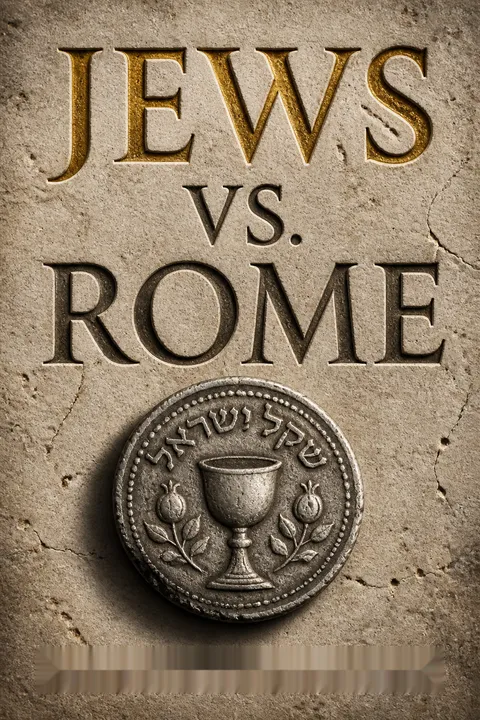
Bar Kokhba's Leadership. The revolt was led by Simon Bar Koseva, known as Bar Kokhba, "Son of a Star," a messianic title. He was a charismatic, stern, and innovative warrior, recognized by prominent rabbis like Akiva as the Messiah. Bar Kokhba established an independent state, issued coins proclaiming "Freedom of Israel" and "Redemption of Jerusalem" in archaic Hebrew, and implemented a sophisticated guerrilla strategy, utilizing hundreds of underground hideouts and tunnels to ambush Roman forces.
Rome's Brutal Response. The rebels initially caught the Romans by surprise, inflicting heavy casualties and possibly destroying one of the two legions stationed in Judea. Hadrian responded by dispatching his strongest general, Julius Severus, from Britannia, along with massive reinforcements from across the empire. Severus employed a slow, methodical counterinsurgency strategy, systematically starving and grinding down the rebels, culminating in the siege and fall of Betar, Bar Kokhba's last stronghold, in 135 CE.
8. The Price of Defeat: Devastation and Transformation
Fifty of their most important outposts and nine hundred and eighty-five of their most famous villages were razed to the ground. Five hundred and eighty thousand men were slain in the various raids and battles, and the number of those that perished by famine, disease and fire was past finding out.
Unprecedented Devastation. The Bar Kokhba War resulted in catastrophic losses for the Jewish people, far exceeding those of the Great Revolt. Historical accounts, supported by archaeological evidence, describe hundreds of villages razed, hundreds of thousands killed in battle, and countless more perishing from famine, disease, and fire. The scale of destruction was so immense that it left much of Judea desolate, a stark testament to Rome's brutal pacification policy.
Enslavement and Exile. The surviving Jewish population faced widespread enslavement, with so many captives that the price of a slave plummeted. While Jewish life continued in Galilee and some peripheral areas, the historic heartland of Judah, including Jerusalem, was largely emptied of its Jewish inhabitants. This forced displacement fundamentally reshaped the demographic and geographic distribution of Jewish communities within the Land of Israel.
Cultural Annihilation. Hadrian's victory was followed by a deliberate policy of cultural suppression. Judea was renamed Syria Palaestina, erasing its Jewish identity from the map. Jews were forbidden from entering Aelia Capitolina (Jerusalem) except for one day a year to mourn. Roman persecution targeted Jewish religious practices, prohibiting observance of the Sabbath, teaching of the Torah, and circumcision, and leading to the martyrdom of prominent sages like Rabbi Akiva. These measures aimed to crush Jewish national and religious aspirations once and for all.
9. Resilience and Reinvention: The Rise of Rabbinic Judaism
The Torah may well have been all that remained to the Jews after the destruction of Jerusalem and the Temple, but it was the single most important thing in Judaism, its essence and its real strength, which ultimately even proved to be stronger than Rome.
Adapting to Loss. The destruction of the Temple and the devastation of the revolts forced Judaism to undergo a profound transformation. With the Temple gone and the priesthood diminished, a new form of religious leadership emerged: the rabbis. Figures like Rabbi Johanan ben Zakkai, who famously escaped besieged Jerusalem, established academies like the one at Jabneh, laying the groundwork for rabbinic Judaism. This movement focused on adapting Jewish law and practice to a world without a central sanctuary.
Spiritual Armor. The rabbis understood the futility of armed resistance against the Roman Empire. Instead, they advocated for spiritual resilience, emphasizing the study of Torah, prayer, and communal life as the means for national survival. Rabbi Judah the Prince, a wealthy and influential leader in Galilee, compiled the Mishnah around 200 CE, a foundational text that codified Jewish oral traditions and became the bedrock of later Judaism, including the Palestinian and Babylonian Talmuds.
A New Relationship with Rome. Rabbi Judah, likely appointed as the first Jewish Patriarch by the Romans, fostered a new, pragmatic relationship with the imperial power. While maintaining Jewish identity and believing in the eventual fall of Rome, he advocated humility and cooperation with the ruling authorities. This shift from a martial ethos to a spiritual one, though not universally accepted, proved to be a successful strategy for preserving Jewish identity and culture for millennia.
10. The Enduring "Holy Fire" and the Long Road to Survival
Ancient Jewry is one of history’s great examples of how a people can lose on the battlefield and yet prevail.
The Unquenchable Spirit. Despite centuries of Roman occupation, three devastating revolts, and immense suffering, the "holy fire" of Jewish national and religious identity never truly died. While the rabbis successfully steered the Jewish people away from armed rebellion for centuries, the desire for sovereignty and the messianic hope for redemption persisted, occasionally flaring into smaller uprisings like the Gallus Revolt in 351–352 CE, and even aligning with Persian invaders in 614 CE.
Survival Against All Odds. The Jewish people's ability to survive and thrive, even without a state or a central temple, stands as a testament to their extraordinary resilience. This endurance was forged through a unique combination of cultural strength, dedicated leadership, and robust institutions centered on the Torah. The shift from military might to spiritual fortitude allowed Judaism to adapt to dispersion, persecution, and assimilation, preserving its essence for two thousand years.
A Modern Postscript. The long arc of Jewish history, marked by the tragic failures of the ancient revolts and the strategic wisdom of the rabbis, finds a modern echo in the reestablishment of a sovereign Jewish state in its ancestral homeland. The discovery of artifacts like the gold menorah medallion near the Temple Mount, dating to a brief period of Jewish return to Jerusalem in the 7th century, symbolizes the enduring hope and commitment to Zion. The modern state of Israel, combining both spiritual heritage and military strength, represents the ultimate fulfillment of the ancient dream of freedom and redemption.
Review Summary
Readers largely praise Jews vs. Rome: Two Centuries of Rebellion Against the World's Mightiest Empire as an engaging, accessible, and well-researched military history covering Jewish-Roman conflicts from 63 BCE to 135 CE. Many highlight Strauss's balanced perspective, rich character portrayals, and valuable geopolitical context. Recurring criticisms include occasional repetition, broad brush strokes given the sweeping timeline, and difficulty tracking numerous historical figures. Several readers note the book's relevance to understanding modern Jewish identity, Christianity's origins, and contemporary Middle Eastern politics.
People Also Read






About the Author


Download PDF
Download EPUB
.epub digital book format is ideal for reading ebooks on phones, tablets, and e-readers.








































