
Key Takeaways
1. The Unlikely Leader: A Gladiator's Rise
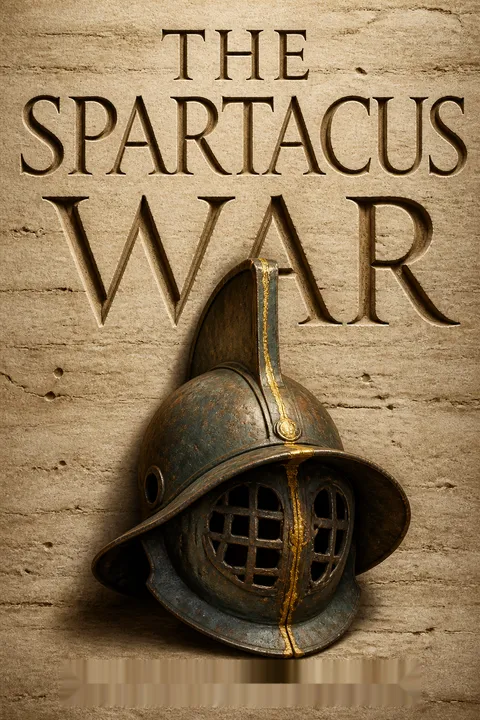
Spartacus was a heavyweight gladiator called murmillo.
A unique background. Spartacus, a Thracian of "enormous strength and spirit," was around thirty when he led the revolt. His past was a blend of Roman auxiliary soldier, bandit (latro), and finally, a gladiator. This diverse experience gave him an unparalleled understanding of both Roman military tactics and the art of guerrilla warfare, combining Thracian speed and stealth with Roman organization.
Gladiatorial life. As a murmillo, Spartacus was a formidable fighter, accustomed to wielding a gladius and a large shield, carrying 35-40 pounds of armor. Gladiators, though slaves, were often well-fed and received medical care, but their life expectancy was short, with many dying before age 35. This brutal reality, coupled with the humiliation of fighting for Roman entertainment, fueled the desire for freedom.
Charisma and prophecy. Spartacus's authority stemmed not just from his prowess but also from his charisma and a powerful prophecy. His unnamed Thracian companion, a priestess of Dionysus, interpreted a snake wrapped around his face as a sign of "great and fearful power." This divine mission, linking him to Dionysian liberation theology, resonated deeply with his multi-ethnic followers, including Thracians, Celts, and Germans, many of whom were also ex-soldiers or victims of Roman expansion.
2. Vesuvius: The Spark of a Nation-Shaking Revolt
What began as a prison breakout by seventy-four men armed only with cleavers and skewers had turned into a revolt by thousands.
The desperate breakout. The revolt ignited in Capua, a city known for its gladiatorial schools. A plot by 200 gladiators in Lentulus Vatia's ludus was betrayed, forcing 74 men, including Spartacus, Crixus, and Oenomaus, to fight their way out with kitchen utensils. They quickly seized a cart of gladiatorial weapons, transforming from desperate fugitives into an armed band.
Vesuvius as a fortress. Their strategic choice of Vesuvius, then a dormant volcano, provided a natural fortress and abundant resources. Its thick woods offered game, and the surrounding fertile plains, dotted with large slave-run estates (latifundia), provided food and potential recruits. The mountain's inaccessibility made it an ideal base for a nascent insurgency.
Early recruitment and Roman terror. On Vesuvius, Spartacus's forces swelled with "many runaway slaves and certain free men from the fields," particularly hardy shepherds and cowherds. This growing force, though initially seen by Romans as mere "bandits," began to spread "terror servilis" – the fear of slaves – among the wealthy landowners, signaling a problem far greater than a simple police action.
3. Roman Humiliation: Praetors Fall to a "Rabble in Arms"
For the third time in a few months, a force of gladiators and fugitives had defeated an army led by a Roman senator.
Underestimating the enemy. Rome initially dismissed the revolt as a "tumultus of slaves," not a serious war. They sent Caius Claudius Glaber, a praetor with 3,000 inexperienced militia, to contain the "nuisance." This underestimation proved disastrous, as Glaber chose to besiege Spartacus on Vesuvius rather than attack directly.
Ingenious tactics. Spartacus, leveraging local knowledge, had his men weave ropes from wild vines to descend an unguarded, steep side of Vesuvius. They then launched a surprise night attack on Glaber's camp, overwhelming the Romans and seizing their weapons. This victory, achieved through cunning and daring, marked the first of many Roman humiliations.
A string of defeats. Glaber's defeat was followed by a series of routs for other Roman commanders. Publius Varinius, another praetor, and his subordinates Lucius Furius and Lucius Cossinius, suffered repeated losses. Cossinius was even caught bathing and killed. Spartacus's men captured Roman camps, arms, and even Varinius's horse and fasces, symbols of Roman authority, further eroding Roman morale and boosting rebel confidence.
4. The Strategic Divide: Alps or Italian Plunder?
Spartacus was right but he was outvoted.
A clash of visions. After a string of victories, Spartacus's army grew to tens of thousands, but internal divisions emerged. Spartacus advocated for a strategic retreat north to the Alps, aiming to disperse his men to their homelands in Gaul or Thrace, recognizing that Rome's full military might would eventually crush them in Italy.
Desire for loot and revenge. Crixus, however, and the majority of Celtic and German followers, preferred to remain in Italy, driven by a desire for more loot, revenge, and a belief in their invincibility. Many of these "barbarians" had been born in Italy and saw it as their home, making the idea of crossing the Alps less appealing.
Compromise and continued rampage. Despite his foresight, Spartacus was outvoted. A compromise was reached: they would continue plundering but prepare for future battles. The army turned south into Lucania, a land of pastures and slaves, where they rampaged through towns like Forum Annii, doubling their numbers with new recruits, primarily herdsmen, and forging weapons from melted-down slave chains.
5. Crassus: The Decimator's Ruthless Efficiency
Rome’s new general wanted his men to fear him more than they feared Spartacus. His name was Marcus Licinius Crassus.
A new Roman resolve. By autumn 72 BC, Rome, no longer merely ashamed but afraid, appointed Marcus Licinius Crassus with a special proconsular command. Crassus, one of Rome's wealthiest and most ambitious men, understood the need for brutal discipline. He revived decimation, a rare and ancient punishment, executing 50 Roman soldiers who had fled battle, making himself "more fearful than the enemy."
Crassus's strategy. With an army of approximately 45,000 legionaries, Crassus adopted a strategy of "location, isolation, and eradication," reminiscent of Scipio's siege of Numantia. He aimed to herd Spartacus into a trap, cut off his supplies, and then destroy him. His experience fighting unconventional warfare in Spain and his knowledge of southern Italy's terrain made him a formidable opponent.
Early setbacks and renewed discipline. Crassus's initial efforts were not without flaws. His legate, Mummius, disobeyed orders and engaged Spartacus, suffering a humiliating defeat. This setback only reinforced Crassus's resolve, leading to the decimation and a renewed emphasis on discipline. He then engaged a detachment of Spartacus's army, inflicting heavy casualties, and forced Spartacus to retreat further south.
6. The Sicilian Gambit: A Pirate's Betrayal
Once the Cilicians had made an agreement with him [Spartacus] and taken gifts, they tricked him and sailed off.
A desperate escape plan. Driven to the toe of Italy, Spartacus conceived his most daring plan: to cross the narrow Strait of Messina to Sicily. The island, a rich source of grain and cattle, had a history of slave revolts and offered a potential temporary base or a stepping stone to North Africa.
Pirate negotiations. Spartacus sought the aid of Cilician pirates, who had terrorized the Mediterranean and shared Rome as a common enemy. He offered them "gifts" (bribes) to ferry 2,000 of his elite fighters as an advance party to Sicily, with the intention of bringing over the rest of his army later.
Betrayal and failure. Despite the agreement, the pirates, after taking Spartacus's gifts, "tricked him and sailed off." This betrayal, possibly influenced by Roman governor Verres or Crassus, left Spartacus stranded. His subsequent attempt to build rafts to cross the treacherous strait also failed, as the makeshift vessels became entangled in the strong currents, forcing him to abandon the Sicilian expedition.
7. The Great Escape: Breaking Crassus's Wall
Spartacus had paid a price in blood but he had broken free.
Crassus's trap. Crassus, anticipating Spartacus's movements, constructed a massive defensive line across the Bruttian peninsula, effectively walling off Spartacus in the Aspromonte Mountains. This "Tuna Trap" aimed to starve the rebels into submission, forcing them to attack heavily fortified Roman positions.
Spartacus's defiance. Trapped and running low on supplies, Spartacus made a defiant gesture, crucifying a Roman prisoner between the armies to show his men the fate awaiting them if they failed. He also offered Crassus a peace treaty, a request for fides (protection), which Crassus disdainfully rejected, unwilling to grant dignity to a slave.
The daring breakout. Leveraging a severe snowstorm, Spartacus launched a surprise night attack. His cavalry spearheaded the charge, and his men filled a section of the trenches with earth, wood, branches, and even the bodies of executed prisoners and cattle. Despite heavy casualties, Spartacus managed to extricate most of his army, breaking free from Crassus's seemingly impenetrable trap.
8. The Final Stand: A Hero's Death at the Silarus
Spartacus was wounded in the thigh by a short javelin. He got down on one knee, thrust his shield before him and continued to fight off those who were attacking him, until he himself and the large number of men around him were surrounded and fell.
A forced confrontation. After the breakout, Spartacus's army, now diminished but still formidable, faced renewed internal divisions. A large contingent of Celts and Germans, led by Castus and Cannicus, broke away, only to be crushed by Crassus at Cantenna. Spartacus, realizing the inevitability of a decisive battle, turned to confront Crassus in the valley of the Upper Silarus River.
The general's sacrifice. Before the final battle, Spartacus made a dramatic gesture, slaughtering his own horse and declaring that if he won, he would have many horses, but if he lost, he would need none. This act, a Thracian ritual and a powerful morale booster, committed him to fighting on foot in the front lines, a rare and dangerous position for a general.
A duel to the death. Spartacus's strategy was to target Crassus directly, pushing through Roman lines "through many weapons and wounds." He killed two centurions in hand-to-hand combat but never reached Crassus. Wounded in the thigh by a javelin, he fought on his knee, surrounded by his loyal men, until he fell. His body was never found, lost in the carnage of a battle fought "sine missione – to the death."
9. The Road of Crosses: Rome's Brutal Deterrence
Crassus had in mind a punishment that the Roman world considered ‘terrible’, ‘infamous’, ‘utterly vile’ and ‘servile’. He planned to crucify all 6,000.
Mass crucifixion. After Spartacus's death, Crassus pursued the remaining rebels, capturing 6,000. As a chilling display of Roman justice and a warning to all slaves, he ordered their mass crucifixion along the Appian Way, stretching 75 miles from Capua to Rome. This horrific spectacle, possibly the largest recorded mass crucifixion in antiquity, served as a stark reminder of the consequences of rebellion.
Deterrence and political theater. The purpose of this extreme punishment was not merely revenge but deterrence. Romans, terrified by the "terror servilis" and the devastation of their countryside, wanted peace of mind. The sight of thousands of rotting corpses, hanging for days, was meant to be burned forever into the minds of Italy's slave population, ensuring no future uprisings of such magnitude.
Cost and controversy. Crucifying 6,000 people was an expensive and logistically complex undertaking, requiring vast amounts of lumber, nails, and guards. While it cemented Crassus's image as a ruthless enforcer of order, it also represented a significant financial loss for slave owners and sparked debate among those who might have preferred to re-enslave the rebels.
10. Pompey's Political Coup: Stealing Crassus's Glory
Crassus had defeated the runaway slaves in open battle but he, Pompey, had torn up the very roots of the war.
Pompey's timely arrival. As Crassus was mopping up the last of Spartacus's forces, Pompey, returning victorious from Spain after defeating Sertorius, intercepted and annihilated a group of 5,000 fleeing rebels in Etruria. This opportune intervention allowed Pompey to claim a significant role in ending the war.
A calculated insult. Pompey, Crassus's chief political rival, immediately sent a letter to the Senate, famously stating that while Crassus had won the main battle, he, Pompey, had "torn up the very roots of the war." This clever political maneuver diminished Crassus's achievement and positioned Pompey as the ultimate savior of Rome.
Triumphs and ovations. Both Crassus and Pompey sought the consulship for 70 BC, which they achieved. However, Crassus was denied a full triumph, the highest military honor, because his victory was over slaves, not a foreign enemy. He had to settle for a lesser "ovatio," though he successfully lobbied to wear a laurel wreath, a symbol of triumph, instead of the traditional myrtle. Pompey, along with other generals, celebrated grand triumphs, further overshadowing Crassus's hard-won victory.
11. The Enduring Legend: Spartacus's Immortal Legacy
Spartacus was larger than life; he was whatever people made of him.
A lasting impact. Though Spartacus failed to achieve his ultimate strategic goal of leading his men out of Italy, his rebellion left an indelible mark on Roman society. It exposed Rome's vulnerability, forced a re-evaluation of gladiators' revolutionary potential, and contributed to the political instability that eventually led to the end of the Republic.
The myth of resistance. Spartacus's name echoed through Roman history for centuries, cited by figures like Caesar and Cicero. To the Roman elite, he was a terrifying symbol of chaos and servile revolt. To the downtrodden, however, he became a figure of resistance and hope, a reminder of Rome's Achilles' heel, with whispers of his memory possibly lingering in amulets or local folklore.
A symbol for the ages. The "Spartaks" fresco in Pompeii, depicting a gladiator named Spartaks, hints at his popular memory, perhaps even as a local hero or a symbol of defiance against Roman colonists. From Karl Marx to modern revolutionaries, Spartacus transcended his historical reality to become a universal icon of freedom, inspiring movements and artists across millennia, far outliving the memory of his Roman conquerors.
Review Summary
The Spartacus War receives generally positive reviews (3.9/5), with readers praising Barry Strauss's scholarly approach despite limited historical sources. Reviewers appreciate his balanced treatment between academic rigor and accessible narrative, though some criticize excessive speculation and repetition. Many highlight the book's detailed military analysis and vivid geographical descriptions, noting Strauss personally visited battle sites. Readers value his honest acknowledgment of historical gaps and reasonable conjectures. Common criticisms include lack of depth on Spartacus's character and heavy reliance on Roman perspectives. The concise 200-page length receives mixed reactions—some appreciate its brevity while others desire more contextual background.
People Also Read

About the Author
Download PDF
Download EPUB
.epub digital book format is ideal for reading ebooks on phones, tablets, and e-readers.








































