
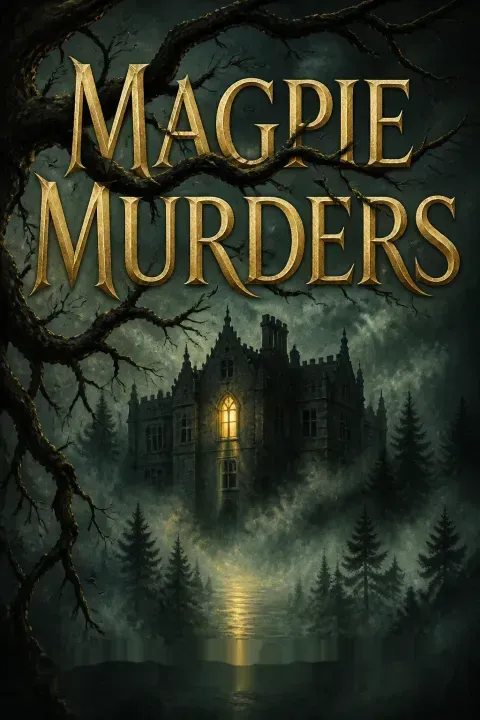


Plot Summary
Prologue
Susan Ryeland,1 an editor at Cloverleaf Books, settles in for a quiet evening to read the ninth Atticus Pünd2 novel by her bestselling author Alan Conway.3 She warns the reader directly: this typescript, Magpie Murders, will upend her entire life.
She has no idea yet that the manuscript is missing its final chapters, or that within days her own world will collide with the fictional village of Saxby-on-Avon, forcing her to become a detective herself rather than merely an editor of them.
The prologue establishes the book's central conceit: a novel inside a novel, narrated by a reader turned investigator. Susan's direct address ('you have been warned') signals unreliable comfort and primes us for a story that will blur the line between fiction and reality. Her professional identity as an editor, someone trained to find flaws in narrative, foreshadows her eventual role as amateur sleuth. The prologue's cozy domestic details (wine, crisps, an empty flat) contrast deliberately with the violence to come, embodying the novel's thesis that murder mysteries are consumed as comfort even as they conceal real cruelty.
A Housekeeper Falls Down Stairs
In the fictional village of Saxby-on-Avon, housekeeper Mary Blakiston7 is found dead at the foot of the stairs at Pye Hall, apparently tangled in her own Hoover cord. The funeral draws the whole village, including her estranged son Robert5 and his fiancee Joy Sanderling,6 who overhear ugly gossip: everyone recalls Robert5 publicly telling his mother7 he wished she would drop dead, just days before she did.
Sir Magnus Pye,8 her wealthy employer, is conspicuously absent, still on holiday in France. A mysterious hatted stranger watches the burial from a distance, then vanishes, while a tree full of magpies looks down on the mourners.
Horowitz opens with classic Christie machinery: a death disguised as accident, a village thick with buried resentments, and an ominous nursery-rhyme motif (magpies, 'one for sorrow') signaling hidden secrets. The funeral functions as a character parade, introducing the entire suspect pool at once. Robert's overheard threat plants doubt efficiently, while Sir Magnus's absence hints that money and class insulate the powerful from immediate scrutiny, a theme the whole village drama will interrogate.
A Dying Detective Says No
In London, private detective Atticus Pünd2 receives a terminal diagnosis: an inoperable brain tumor leaves him perhaps three months. That same afternoon, Joy Sanderling6 arrives uninvited, begging him to clear Robert Blakiston5's name before village gossip destroys their engagement.
Pünd,2 weighing his mortality, initially refuses, arguing there is no real crime to investigate and that rumor cannot be fought with reason. Joy6 leaves disappointed but resolves to defend Robert5 herself, posting a public notice swearing she was with him all night when his mother7 died, a rash act that will only fuel village suspicion rather than quiet it.
The pairing of Pünd's death sentence with Joy's plea establishes the novel's meditation on mortality and legacy: a man with nothing left to lose chooses restraint, while a desperate young woman chooses exposure. Pünd's initial refusal also demonstrates his rigor, he will not manufacture a mystery, which makes his later reversal feel earned rather than convenient once a real crime materializes.
A Head Rolls at Pye Hall
Days later, Sir Magnus Pye8 is found decapitated in his hallway, killed with a sword pulled from a suit of armor, on the very night he received a scrawled death threat over his plan to bulldoze the beloved local woodland, Dingle Dell, for new housing.
His wife Frances15 discovers the body after returning from London, glimpsing a green car speeding away. Reading of the murder in The Times, Pünd2 recognizes the connection to Joy Sanderling6's visit and, newly motivated by an unfinished debt to her, travels to Saxby-on-Avon with his assistant James Fraser9 to work alongside Detective Inspector Chubb.14
The escalation from a plausible accident to a spectacularly violent murder collapses Pünd's earlier caution; a coincidence too large to ignore forces him back into action despite his illness. The beheading, theatrical and personal, signals that this crime is about intimate rage rather than opportunistic burglary, seeding the eventual revelation that the killer knew the household's every corner.
Clues in the Flower Bed
Pünd2's inspection of Pye Hall yields a cluster of anomalies: a stranger's handprint pressed into a flower bed, a portrait of Lady Pye15 missing from the wall, a cryptic note reading 'Ashton H, Mw, a girl,' and a scrap of bloodstained paper burned in the study fireplace.
He also learns the estate was burgled days earlier, its Roman silver treasure stolen and, oddly, later found dumped in the lake rather than sold. Pünd2 deduces the killer knew Sir Magnus Pye8 personally, since the murder weapon lay deeper in the house than any casual intruder would risk retrieving.
This forensic accumulation is pure genre craft: each clue is a locked box whose key arrives only in the final confession. The burglary that discards rather than profits from stolen goods is the tell that something symbolic, not mercenary, is happening, an early signal that the true crime concerns concealment rather than greed.
Everyone Has Something to Hide
As Pünd2 interviews the village, secrets cascade: Lady Pye15 is having an affair with Jack Dartford and stands to inherit little under the family entail; antique dealer Johnny Whitehead17 is a former London fence hiding a criminal past that Mary Blakiston7 had discovered; Clarissa Pye,16 Sir Magnus Pye8's overlooked twin sister, admits she stole poison from the surgery contemplating suicide over her diminished life; and the vicar and his wife conceal an embarrassing secret about their nighttime walks through Dingle Dell. Mary Blakiston7's private diary, recovered by Chubb,14 reveals she had been quietly cataloguing everyone's sins for years.
The diary functions as a village-wide confession booth, exposing how much surveillance and moral judgment a single 'busybody' housekeeper wielded. This section dramatizes the whodunnit convention of universal guilt, everyone lies about something, which both multiplies suspects and comments on how communities police each other through gossip rather than justice.
The Father Who Came Back
Pünd2 and Fraser9 track down Matthew Blakiston,13 Robert's father, long estranged after the drowning death of his younger son Tom years earlier. Matthew13 confesses he secretly attended Mary7's funeral in disguise and, days later, drove to Pye Hall to confront Sir Magnus8 about a possible pension for Robert,5 only to be turned away and to return later to find Magnus8 already dead, his head separated from his body.
Terrified of being blamed, given his obvious motive and the tragic history at the estate's lake, Matthew13 fled without alerting police, inadvertently leaving a handprint in the flower bed as he steadied himself in shock.
Matthew's testimony retroactively explains the handprint and introduces the crucial detail of a second visitor arriving after him, narrowing the murder window to a precise gap of minutes. His account also deepens the tragedy of the Blakiston family, suggesting grief and blame have metastasized across two generations rather than resolving with time.
The Manuscript Has No Ending
Back in London, Susan Ryeland1 reaches the final pages of Magpie Murders only to discover the last chapter is missing entirely, no solution, no culprit. Furious, she calls her boss Charles Clover,4 only to learn that Alan Conway3 has died, apparently falling from the tower of his Suffolk home, Abbey Grange.
A handwritten letter arrives at the office the next morning, addressed to Charles,4 in which Alan3 apologizes for his behavior at their recent dinner and reveals he has terminal cancer, seemingly confirming suicide. Susan,1 needing the finished manuscript for publication, resolves to travel to Framlingham to search Alan3's house for the missing pages.
The frame narrative's inciting incident mirrors the embedded novel's: a death that looks accidental but withholds crucial information. The missing chapter is a literal absence functioning as a MacGuffin, giving Susan's search a professional pretext that will gradually curdle into genuine murder investigation, just as Joy's plea gave Pünd his.
A Suicide Note That Doesn't Add Up
At Abbey Grange, Susan Ryeland1 meets James Taylor,10 Alan Conway3's much younger ex-partner, who has inherited everything because Alan3 died one day before signing a new will. Solicitor Sajid Khan confirms he found the body and reveals Alan3 had been about to disinherit James10 entirely.
Rereading the suicide letter, Susan1 notices its final, decisive page reads oddly formally, unlike Alan3's usual voice, and that the handwritten letter arrived in a typed envelope, an exact inversion of a clue from within Magpie Murders itself. She cannot yet explain the discrepancy, but the coincidence unsettles her professional instincts as an editor trained to spot inconsistency.
This section plants the frame narrative's central clue in plain sight, mirroring the fictional Pünd's own methodology. Susan's editorial expertise, normally used to polish other people's prose, becomes a detective skill: she can recognize when a voice has been forged. The unsigned will introduces financial motive into the frame story just as inheritance motives structured the embedded mystery.
A Waiter With a Grudge
Susan Ryeland1's investigation widens across Suffolk: Alan Conway3's sister Claire Jenkins12 insists he would never have killed himself without warning her first; a waiter named Donald Leigh19 reveals Alan3 plagiarized his unpublished novel's murder method for an earlier Atticus Pünd2 book; television producer Mark Redmond admits Alan3 was blocking a lucrative adaptation deal and lied about leaving Framlingham that fatal weekend; and neighbor John White, a hedge fund manager, had lost millions in a soured investment with Alan3 and was photographed grappling with him atop the tower shortly before his death. Each suspect has motive, means, and something to lose from Alan3's book deals or grudges.
Susan's amateur investigation replicates Pünd's structure of interviewing wronged parties, demonstrating how murder mysteries function as morality plays about resentment accumulated over years. The proliferation of suspects also deliberately misdirects both Susan and the reader toward the most 'obvious' culprits, exactly the trap Pünd himself warns against within the embedded text.
Nine Titles Spell an Insult
Poring over the series titles, Susan Ryeland1 realizes the first letters of all nine Atticus Pünd novels form an anagram, one that spells a crude insult aimed at his own detective.2
She learns from Alan Conway3's ex-wife Melissa Conway20 that she originally pushed him toward writing accessible mysteries instead of literary fiction, a compromise he never forgave, and that Alan3 had recently told his publisher Charles Clover4 he planned to reveal this secret joke publicly on a radio show, humiliating the franchise that made him famous. This discovery reframes Alan3 not as a victim of despair but as a man plotting one final act of contempt against the readers and colleagues who depended on his success.
The anagram operates as the novel's most audacious formal trick, a puzzle buried across a decade of publishing that recontextualizes every prior clue about Alan's resentment. It reveals authorship itself as an act of concealed aggression, and suggests that commercial success without artistic respect curdles into self-sabotage aimed outward rather than only inward.
A Chance Meeting at Paddington
Susan Ryeland1 runs into Jemima, Charles Clover4's recently dismissed secretary, who casually mentions that the Magpie Murders manuscript actually arrived by post days before the dinner where Charles4 claimed to have first received it, and that Charles4 had seemed distressed by its contents before ever meeting Alan Conway3 for that final meal.
This timeline contradicts everything Charles4 told Susan1 and the police. Riding the train home, Susan1 finally deciphers the deeper anagram embedded not in the titles but in the character name Atticus Pünd2 itself, and recognizes that only someone who had read the complete manuscript before the radio interview was scheduled would have had reason to silence Alan3 permanently.
This is the classic whodunnit reversal delivered through incidental testimony rather than dramatic confrontation, mirroring how Mary Blakiston's gossip once cracked open the village's secrets. The revelation that Charles lied about his reading timeline transforms him from sympathetic colleague into prime suspect entirely through Susan's accumulated editorial attention to sequence and detail.
Charles Clover Confesses in His Office
Susan Ryeland1 breaks into Charles Clover4's locked desk drawer and finds the missing final chapters hidden inside, exactly where he stashed them. Confronted, Charles4 admits everything: having read the anagram joke before their dinner, he understood Alan Conway3 intended to publicly humiliate the entire franchise and destroy the company Charles4 had spent eleven years building.
He drove to Abbey Grange, found Alan3 alone after a scuffle with neighbor John White, then pushed him from the tower and fabricated a suicide letter using a stray page from within the manuscript itself, exploiting its uncanny formal resemblance to Alan3's authentic apology.
Charles's confession completes the novel's argument that publishing, like the aristocratic estates of Saxby-on-Avon, protects its assets through violence when profit is threatened. His justification, that he acted to preserve livelihoods and beloved fiction, echoes every murderer's rationalization throughout the embedded story, collapsing the distinction between fictional and real-world crime the novel has maintained until now.
Fire in the Office
Rather than surrender, Charles Clover4 strikes Susan Ryeland1 with a literary award, knocking her to the floor, then sets the office ablaze with matches to destroy both her and the recovered pages, breaking her ribs with a final kick before fleeing into the night.
Choking on smoke and barely conscious, Susan1 is saved when her partner Andreas Patakis,11 who had come to surprise her after their earlier argument, breaks in and drags her from the burning building, snatching the precious manuscript pages from the desk at her insistence before the flames consume the rest of Cloverleaf's offices.
The frame narrative's climax finally supplies the physical danger the embedded cozy mystery never allowed its detective to face directly, converting literary theory into bodily risk. Andreas's rescue, arriving from a domestic quarrel about relocating to Crete, resolves the novel's romantic subplot at the exact moment it resolves its central crime, binding Susan's personal and professional reckonings together.
The Boy Who Found the Gold
Gathering the suspects, Atticus Pünd2 reveals that Mary Blakiston7's death truly was an accident, a fall while rushing to answer a ringing telephone. But he unveils that years earlier Robert Blakiston5 had drowned his younger brother Tom in a jealous rage during a treasure hunt, a secret his mother7 witnessed and recorded in a letter locked away with Sir Magnus Pye8 in case anything ever happened to her.
When she died and gossip turned against Robert,5 he broke into Pye Hall searching for that letter, then returned later and beheaded Sir Magnus8 with the ancestral sword to permanently silence the only proof of his childhood crime, all to protect his engagement to Joy Sanderling.6
The solution retroactively transforms a story about village gossip and inheritance into a study of protective maternal secrecy: Mary's coldness toward Joy was never snobbery but terror of exposing a killer she loved. Robert's crime, motivated by love rather than greed, deliberately parallels Charles's justification in the frame story, suggesting that devotion, not malice, is fiction's most dangerous motive.
An Editor Becomes a Landlord
Charles Clover4 is imprisoned for murder and arson, and Cloverleaf Books folds entirely, with the industry oddly blaming Susan Ryeland1 for exposing her own mentor rather than praising her. Jobless and half-blinded by lingering injury from the fire, Susan1 accepts Andreas Patakis11's earlier proposal and relocates to Crete, investing her savings in his small hotel, Polydorus.
Magpie Murders is eventually published elsewhere to strong reviews despite — or because of — the scandal surrounding its author's3 death, and Susan1 closes her account by admitting that seeing Alan Conway3's photograph on a beachgoer's copy stirs something closer to satisfaction than grief.
The epilogue refuses tidy vindication: solving the murder costs Susan her career and community standing, inverting the genre convention that truth restores social order. Her final admission of near-pleasure at Alan's death completes her transformation from passive reader to active moral agent willing to tolerate ambiguity, a far more unsettling resolution than any village fete could offer.
Epilogue
Two years after the fire, Susan Ryeland1 runs a small hotel in Agios Nikolaos with Andreas Patakis,11 having sold her London flat to buy into Polydorus. Magpie Murders was eventually published by another house and became a bestseller amid publicity over Alan Conway3's real death.
Walking the beach one day, Susan1 spots a stranger reading a copy with Alan3's photograph on the back, and feels a flash of vindictive pleasure imagining herself, not Charles Clover,4 pushing him from that tower. She reflects that she has swapped being the detective for something closer to the murderer's satisfaction, and finds she prefers it.
The epilogue's closing confession, that Susan enjoys imagining herself as Alan's killer, is a startling final inversion of the whodunnit's usual moral clarity. Rather than restoring comfortable order, Horowitz leaves his narrator morally implicated, suggesting that prolonged exposure to murder mysteries, real and fictional, corrodes the boundary between justice and vengeance. It reframes the entire novel as a study in how consuming crime fiction reshapes the reader's own capacity for violence and satisfaction.
Analysis
Magpie Murders operates as a double helix: a cozy 1950s village mystery wrapped inside a contemporary publishing thriller, each structure illuminating the other's mechanics. Horowitz's deepest achievement is making the artificiality of whodunnits visible without draining their pleasure — Atticus Pünd2's case is 'solved' through the same forensic attentiveness that Susan Ryeland1 brings to manuscript editing, suggesting detection and editorial judgment are the same skill applied to different material. The novel interrogates the moral economy of commercial fiction: Alan Conway3 despises the genre that made him wealthy, Charles Clover4 kills to protect a franchise built on formulas he privately profits from, and even Robert Blakiston5's crime stems from protecting a curated fiction — his happy engagement — from an inconvenient truth. Every character, in effect, is editing their own story to survive. Thematically, the book is preoccupied with inheritance and entitlement: both the Pye family's ancient entail and the publishing industry's talent economy distribute rewards according to arbitrary birthright and market timing rather than merit, and violence erupts precisely at the seams where that unfairness becomes intolerable. Susan Ryeland1's transformation from passive reader to implicated near-avenger is the novel's most unsettling contribution to the genre: rather than restoring comfortable order, her discovery costs her career, community, and moral certainty, ending not in vindication but in exile and ambiguous satisfaction. The book ultimately argues that murder mysteries function as a controlled outlet for aggression we're not supposed to admit we enjoy, and that anyone who reads enough of them, or edits enough of them, eventually risks becoming fluent in that aggression themselves.
Review Summary
Magpie Murders is a cleverly crafted mystery within a mystery that pays homage to classic whodunits. Readers praise Horowitz's skillful writing, intricate plotting, and engaging characters. The book features two intertwined stories: a 1950s-style murder mystery and a contemporary investigation involving the fictional author's death. Many reviewers enjoyed the literary references, puzzles, and Golden Age detective fiction elements. While some found the second half slightly less engaging, most considered it a highly entertaining and unique read that keeps readers guessing until the end.
People Also Read

Characters
Susan Ryeland
Editor turned detectiveSusan is Cloverleaf Books' head of fiction, a wry, self-aware editor who has spent decades polishing other people's murder mysteries without ever expecting to live inside one. Practical, curious, and quietly lonely despite her long relationship with Andreas Patakis11, she approaches Alan Conway3's death first as a professional inconvenience—a missing manuscript—before her editorial instinct for inconsistency curdles into genuine suspicion. Her narration is candid about her own flaws: impatience, a taste for gossip, a tendency to romanticize detective fiction even as she distrusts its neat resolutions. Her arc traces a movement from passive consumer of crime stories to an active participant willing to risk her career, relationships, and safety to expose the truth.
Atticus Pünd
Dying fictional detectivePünd is the beloved detective hero of Alan Conway3's novels, a courteous, meticulous German-Greek refugee and Holocaust survivor who solves crimes through patient observation rather than flamboyance. Diagnosed with a terminal brain tumor at the story's opening, he approaches his final case with unusual serenity, treating death as an old, familiar companion. His gentleness toward suspects, especially the young lovers Robert Blakiston5 and Joy Sanderling6, reveals a deep empathy earned through his own history of loss. As a character created specifically to be secretly resented by his author3, Pünd embodies the novel's meditation on how fictional creations can outgrow and outlive the intentions of their creators.
Alan Conway
Author, apparent suicideAlan is the wildly successful but deeply embittered author of the Atticus Pünd2 series, a man who wanted to write serious literary fiction but achieved fame instead through commercial whodunnits he privately despised. Cold, controlling, and quietly cruel to those who depended on him, from his sister Claire Jenkins12 to his young partner James Taylor10, he channeled decades of resentment into hidden puzzles buried within his own bestsellers. His looming death from cancer becomes entangled with his final act of professional sabotage, an intended public humiliation of his own legacy, making him simultaneously victim and instigator of the frame narrative's central crime.
Charles Clover
Publisher and mentorCharles is the urbane, longtime CEO of Cloverleaf Books and Susan Ryeland1's boss and mentor of eleven years, a man who built his career and reputation entirely on Alan Conway3's success. Warm, fatherly, and seemingly incapable of violence, he represents the publishing industry's genteel surface concealing ruthless self-interest underneath. His eventual willingness to kill and then to turn on Susan1 herself reveals how thoroughly professional survival can override personal loyalty, making him a chilling mirror to the embedded novel's own killer5, who acted from a similarly distorted sense of protective love.
Robert Blakiston
Engaged mechanic, prime suspectRobert is a quiet, withdrawn car mechanic in Saxby-on-Avon, raised in the shadow of his younger brother's childhood death and his mother Mary Blakiston7's suffocating overprotection. Engaged to Joy Sanderling6, he desperately wants an ordinary, happy life free of his family's tragedies, yet is haunted by unresolved rage from his difficult upbringing. His strained relationship with his mother7, marked by public arguments, initially makes him the village's obvious suspect, while his tenderness toward Joy6 complicates any simple reading of his character as villain or victim.
Joy Sanderling
Devoted fiancee, catalystJoy is a warm, determined young nurse's receptionist whose love for Robert Blakiston5 drives the entire embedded plot into motion when she seeks Atticus Pünd2's help to silence village gossip. Practical and fiercely loyal, she takes drastic public action to defend her fiance's5 reputation, even at cost to her own family's respectability. Her unwavering belief in Robert5's innocence, and her refusal to abandon him despite mounting suspicion, makes her the emotional heart of the Saxby-on-Avon story, embodying love's capacity to both illuminate and obscure the truth.
Mary Blakiston
Housekeeper, secret-keeperMary is Sir Magnus Pye8's watchful, disapproving housekeeper and Robert Blakiston5's mother, a woman whose death opens the story. Known throughout the village as an interfering busybody, she secretly kept a detailed diary cataloguing everyone's sins, using knowledge as a form of quiet power. Her coldness toward Joy Sanderling6 and fierce overprotection of Robert5 initially seem like ordinary maternal possessiveness, but conceal a far darker motive rooted in something she witnessed involving her sons years earlier.
Sir Magnus Pye
Murdered landownerSir Magnus is the wealthy, entitled owner of Pye Hall, a man whose plan to demolish beloved local woodland for housing development earns him the village's collective resentment. Careless with money, cruel to his estranged sister Clarissa Pye16, and unfaithful to his wife Frances Pye15, he nonetheless maintained a genuine, protective fondness for Mary Blakiston7 and her son Robert Blakiston5. His brutal beheading, discovered by his returning wife15, sets the embedded mystery's central investigation in motion and exposes decades of buried family and village grievances.
James Fraser
Pünd's loyal assistantFraser is Atticus Pünd2's affable, somewhat oblivious personal secretary, a failed actor who provides comic contrast to his employer's precision. Genuinely fond of Pünd2 despite rarely understanding his methods, Fraser's obliviousness is deliberately engineered by Alan Conway3 to mislead readers, and his real-world counterpart, James Taylor10, reveals just how consciously Alan3 mined his own life for fictional material.
James Taylor
Alan's young ex-partnerJames is Alan Conway3's much younger former partner, an ex-rent-boy turned aspiring actor who inherited Abbey Grange after Alan3 died before signing a new, disinheriting will. Charming, wounded, and financially transformed overnight, he becomes both a suspect and a source of intimate insight into Alan3's private cruelties and creative process.
Andreas Patakis
Susan's Greek partnerAndreas is a Greek teacher turned prospective hotelier, Susan Ryeland1's long-term but non-cohabiting partner, whose plan to buy a small hotel in Crete forces Susan1 to confront the direction of her own life. His hidden history with Alan Conway3's ex-wife Melissa Conway20, and his blunt disdain for Alan3's books, add unexpected tension to his role as Susan1's eventual rescuer.
Claire Jenkins
Alan's grieving sisterClaire is Alan Conway3's devoted, lonely sister, who insists he would never have killed himself without warning her. Her long written account of their harsh boarding-school childhood reveals the roots of Alan3's ambition and cruelty, while her own resentment over unpaid labor for him complicates her insistence on his innocence of self-destruction.
Matthew Blakiston
Estranged fatherMatthew is Robert Blakiston5's estranged father, exiled from the family after blaming himself and his wife Mary Blakiston7 for their younger son's drowning years earlier. His secretive return to Saxby-on-Avon for Mary7's funeral, and his later visit to Pye Hall the night of Sir Magnus Pye8's murder, make him a crucial witness whose testimony reshapes the investigation's timeline.
Detective Inspector Chubb
Pragmatic local policemanChubb is the good-humored, unglamorous Bath detective who partners with Atticus Pünd2, providing procedural grounding and comic relief through his running mispronunciation of Pünd2's nationality. His discovery of Mary Blakiston7's diary supplies crucial background on village secrets that Pünd2 alone could never have accessed.
Frances Pye
Unfaithful widowFrances is Sir Magnus Pye8's imperious, unhappy wife, conducting an affair with Jack Dartford while trapped in a loveless marriage and an unfavorable inheritance entail. Her discovery of her husband's8 body, and her evasions about her whereabouts that night, make her a persistent suspect throughout the investigation.
Clarissa Pye
Overlooked twin sisterClarissa is Sir Magnus Pye8's twin sister, displaced from her birthright by an ancient inheritance entail and a decades-old lie about which twin was born first. Her quiet bitterness, confession of stealing poison, and unexpected reversal of fortune make her one of the mystery's more poignant figures.
Johnny Whitehead
Antique dealer, ex-conJohnny runs the village antique shop with his wife Gemma, concealing a past as a London criminal fence that Mary Blakiston7 discovered and threatened to expose, giving him a plausible motive within the village's web of secrets.
Neville Brent
Solitary groundsmanBrent is Pye Hall's taciturn, friendless groundsman, present at both deaths and fired by Sir Magnus Pye8 shortly before the murder, making him a persistent but ultimately peripheral suspect whose isolation the village readily misreads as guilt.
Donald Leigh
Wronged aspiring writerDonald is a London waiter and failed novelist who accuses Alan Conway3 of stealing his unpublished murder plot for an earlier Atticus Pünd2 novel, giving Susan Ryeland1 a plausible motive to investigate outside the publishing house itself.
Melissa Conway
Alan's pragmatic ex-wifeMelissa is Alan Conway3's former wife, who originally suggested he abandon literary ambition for commercial mystery writing, an act of practical love Alan3 never forgave, revealing the personal cost behind his professional success.
Plot Devices
The Magpie Nursery Rhyme
Foreshadowing and title motifThe old counting rhyme about magpies, 'one for sorrow, two for joy,' recurs throughout as an ominous refrain, first when a flock of magpies watches Mary Blakiston7's funeral. It structures the novel's atmosphere of folk superstition and hidden meaning, reinforcing that the village's placid surface conceals genuine darkness. The rhyme's reference to secrets 'never to be told' directly names the final chapter's title, tying the embedded mystery's resolution to a tradition of oral warning that the characters themselves largely ignore.
The Missing Final Chapter
Frame narrative's inciting mysteryAlan Conway3's completed manuscript arrives at Cloverleaf Books missing its climactic solution chapters, creating the professional pretext for Susan Ryeland1's investigation. The absence initially seems like a production error but is gradually revealed to be a deliberate act of concealment, since the missing pages were repurposed to construct a forged suicide letter. The device elegantly links the two mysteries—the reader wants the fictional solution just as urgently as Susan1 wants to know why it vanished.
Mary Blakiston's Diary
Village secrets, red herringsRecovered by Inspector Chubb14, Mary Blakiston7's private diary catalogues years of petty village transgressions—affairs, thefts, and old grudges—that she observed in her role as housekeeper and inveterate busybody. It supplies Atticus Pünd2 with crucial background on nearly every suspect while also multiplying red herrings, since almost every entry suggests a plausible motive for murder that ultimately proves irrelevant to the true crime.
The Anagram Titles
Hidden authorial confessionThe first letters of all nine Atticus Pünd2 novel titles, when combined, spell out a secret insult Alan Conway3 embedded against his own famous detective, a joke he planned to reveal publicly before his death. Discovered by Susan Ryeland1 through careful attention to publishing chronology, this device reframes years of bestselling fiction as an elaborate, contemptuous private message, and supplies the true motive for his murder3.
The Forged Suicide Letter
Murder weapon disguised as evidenceCharles Clover4 fabricates Alan Conway3's suicide note by grafting a genuine apologetic letter onto a formally worded page lifted directly from within the Magpie Murders manuscript, exploiting its eerie stylistic resemblance to Alan3's real voice. The mismatch between handwritten letter and typed envelope becomes Susan Ryeland1's crucial clue, mirroring an identical clue planted earlier within the embedded novel itself.
FAQ
Synopsis & Basic Details
What is Magpie Murders about?
- Story within a story: Magpie Murders presents two intertwined mysteries: the first is a classic 1950s whodunit novel titled "Magpie Murders" by fictional author Alan Conway, featuring detective Atticus Pünd investigating a death in a quaint English village.
- Editor becomes detective: The second mystery unfolds in the present day (2015) when Susan Ryeland, the editor of Conway's novel, receives the manuscript only to discover the crucial final chapters are missing, leading her to investigate Conway's apparent suicide and the disappearance of the ending.
- Blurring fiction and reality: The novel cleverly blurs the lines between the fictional world of Atticus Pünd and Susan's reality, suggesting that the clues and characters within Conway's book may hold the key to solving both the fictional murder and the real-life mystery of the missing manuscript and Conway's death.
Why should I read Magpie Murders?
- Meta-fictional delight: Readers who enjoy clever narrative structures will appreciate the novel-within-a-novel format, which offers two distinct mysteries and narrative styles that comment on each other.
- Homage to Golden Age: It's a loving and intricate tribute to classic detective fiction, particularly Agatha Christie, filled with red herrings, village secrets, and a brilliant, albeit troubled, detective figure in Atticus Pünd.
- Engaging modern mystery: Susan Ryeland's contemporary investigation provides a compelling frame story, exploring the publishing world, the complex relationship between authors and editors, and the human cost of ambition and secrets.
What is the background of Magpie Murders?
- Post-war English village setting: The fictional "Magpie Murders" is set in the seemingly idyllic English village of Saxby-on-Avon in 1955, a period often romanticized in crime fiction, allowing for classic tropes like hidden pasts, social hierarchies, and limited technology.
- Contemporary publishing world: Susan Ryeland's narrative is set in the modern (2015) London publishing industry, contrasting the slower pace and social dynamics of the 1950s mystery with the commercial pressures and personal complexities of contemporary life.
- Author's personal history woven in: The book subtly incorporates elements of Anthony Horowitz's own life and experiences, including his relationship with editors, his views on the crime genre, and details from places he knows (like Orford and Woodbridge), blurring the lines between author, narrator, and character.
What are the most memorable quotes in Magpie Murders?
- "This book changed my life.": Susan Ryeland's opening line immediately signals the profound impact the manuscript will have on her, setting the stage for the disruption of her seemingly stable existence and serving as a powerful hook for the reader.
- "Seven for a secret, Never to be told.": This line from the magpie nursery rhyme, referenced early in the fictional novel, becomes a recurring motif and a central thematic element, hinting at the numerous hidden truths and unspoken secrets driving both mysteries.
- "He used to hide things...": James Taylor's casual remark about Alan Conway's habit of embedding hidden messages and codes in his writing proves to be a crucial clue, revealing the author's playful yet complex relationship with language and secrets, and guiding Susan's investigation.
What writing style, narrative choices, and literary techniques does Anthony Horowitz use?
- Metafiction and nested narratives: The primary technique is the story-within-a-story structure, presenting Alan Conway's manuscript embedded within Susan Ryeland's first-person narrative, constantly shifting perspective and challenging the reader's perception of reality and authorship.
- Homage and pastiche: Horowitz employs a writing style in the "Magpie Murders" manuscript that deliberately imitates the tone, pacing, and tropes of Golden Age detective fiction, while Susan's narrative is more contemporary, conversational, and self-aware.
- Unreliable narration and misdirection: Both narratives feature elements of unreliability; Conway's manuscript contains deliberate red herrings and misdirection inherent to the genre, while Susan's personal biases, emotional state, and limited perspective in her real-world investigation can lead her (and the reader) to incorrect conclusions.
Hidden Details & Subtle Connections
What are some minor details that add significant meaning?
- The Handprint in the Soil: The handprint found outside Pye Hall after Sir Magnus's murder initially seems like a minor detail, possibly from the gardener, but Pünd notes its odd placement ("just to the left of the door") and later Susan connects it to Matthew Blakiston's fall after seeing the body, revealing his presence at the scene ("I felt myself falling and I thought I was going to faint").
- The Dog Collar: The small dog collar found in the locked room at the Lodge House, inscribed with the name "Bella," seems like a sad relic of a lost pet, but it becomes a crucial piece of evidence linking Robert Blakiston to the death of his younger brother, Tom, and revealing Mary's knowledge of the event ("Why else had she kept the collar?").
- The Typed Envelope: The seemingly innocuous detail that Alan Conway's handwritten suicide letter arrived in a typed envelope is initially overlooked, but Susan realizes it mirrors the typed death threat sent to Sir Magnus in a handwritten envelope, revealing a deliberate manipulation and pointing towards Charles Clover's involvement in faking the suicide note.
What are some subtle foreshadowing and callbacks?
- The Vicar's Bloodstain: Henrietta Osborne noticing a bloodstain on her husband Robin's sleeve after Sir Magnus's murder is a fleeting detail, but it subtly foreshadows the vicar's bicycle being used by Robert Blakiston to escape the scene, transferring blood from the murder weapon onto the handlebars and subsequently onto the vicar's clothes.
- The Locked Room's View: The fact that Mary Blakiston's locked sewing room is the only one with a view of the lake is a subtle detail that foreshadows her having witnessed the drowning of her son Tom, explaining her subsequent overprotectiveness of Robert and her guilt.
- The Magpie Rhyme: The full seven-line magpie nursery rhyme is introduced early in the fictional novel, with the final line "Seven for a secret, Never to be told" directly foreshadowing the central, hidden truth about Robert's actions and Mary's knowledge that drives the plot of the inner story.
What are some unexpected character connections?
- Andreas and Melissa Conway: Susan's discovery that her Greek boyfriend, Andreas, had a significant relationship ("a huge fling") with Alan Conway's ex-wife, Melissa, years before Susan met either of them, is a completely unexpected connection that adds a layer of personal history and potential motive (jealousy) to the real-world mystery, previously unknown to Susan.
- Alan Conway and Tom Robeson: The revelation that Alan Conway and the vicar, Tom Robeson (an anagram of Robin Osborne), knew each other from their childhood at Chorley Hall prep school is an unexpected link that explains the vicar's conflicted feelings at the funeral and hints at a shared, potentially damaging past involving photographs and bullying.
- Donald Leigh and Alan Conway: The waiter at the Ivy Club, Donald Leigh, is revealed to have a deep, unexpected connection to Alan Conway, having attended a writing course where Conway allegedly stole the plot for Night Comes Calling, providing Leigh with a powerful motive for revenge against the successful author.
Who are the most significant supporting characters?
- Mary Blakiston: Though deceased early in the fictional narrative, Mary's character and her actions (keeping a diary, her relationship with Robert and Sir Magnus) are central to unraveling the mystery in Saxby-on-Avon, as her secrets and motivations drive much of the plot.
- James Taylor: Alan Conway's young partner is a significant figure in Susan's investigation, providing insights into Alan's life, personality, and relationships, while also being a primary suspect due to his financial gain from Alan's death.
- Charles Clover: Susan's boss is a crucial supporting character in the real-world mystery, initially guiding Susan but later revealed to be the antagonist, his actions driven by the commercial value of the Atticus Pünd series.
Psychological, Emotional, & Relational Analysis
What are some unspoken motivations of the characters?
- Mary Blakiston's Guilt: Mary's overbearing control of Robert and her decision to stay at Pye Hall despite the painful memories are driven by her unspoken guilt over witnessing Tom's drowning and knowing Robert was responsible, a secret she carries and attempts to control through her diary and the letter to Sir Magnus.
- Robert Blakiston's Desperation: Robert's violent actions, both as a child (killing Tom) and an adult (killing Sir Magnus), stem from a deep-seated, unspoken desperation to control his life and relationships, particularly his fear of losing Joy and being exposed for his past crimes, which manifests in sudden, explosive violence.
- Charles Clover's Pragmatism: Charles's ultimate motivation for murder is not personal hatred but a cold, calculated pragmatism rooted in protecting his business and legacy, viewing Alan Conway's life and the Atticus Pünd series purely in terms of commercial value and acting decisively when that value is threatened.
What psychological complexities do the characters exhibit?
- Alan Conway's Self-Loathing: Alan exhibits complex psychological conflict, despising the popular success of his Atticus Pünd series while craving literary recognition, leading to a deep self-loathing that manifests in spiteful behavior, hidden messages in his work, and a desire to destroy the very thing that made him famous.
- Mary Blakiston's Trauma Response: Mary's character is psychologically complex due to her response to trauma; the loss of one son and the knowledge of the other's violent nature warp her personality, turning her into a controlling, secretive, and seemingly malicious figure, though her actions are rooted in a desperate attempt to manage an unbearable truth.
- Susan Ryeland's Identity Crisis: Susan's journey reveals her psychological complexity as she grapples with her identity, questioning her career choices, her relationship status, and her place in the world, finding unexpected purpose and self-awareness by stepping out of her role as editor and into that of a detective.
What are the major emotional turning points?
- Susan Receiving the Manuscript: The initial emotional turning point for Susan is receiving the "Magpie Murders" manuscript, which shifts her from a state of comfortable routine and mild dissatisfaction ("I'd deliberately allowed standards to slip") to one of intrigue and ultimately, profound disruption ("This book changed my life").
- Dr. Rennard's Confession: Dr. Rennard's deathbed confession about falsifying the Pye twins' birth order is a major emotional turning point within the fictional narrative, revealing a decades-old injustice that fuels Clarissa's bitterness and provides a potential motive for murder, shifting the reader's understanding of the Pye family dynamics.
- Susan's Discovery of the Anagram: Susan's emotional turning point in solving Alan's murder is the sudden realization of the anagram hidden in the book titles ("AN ANAGRAM"), which shifts her perspective from viewing Alan's death as a suicide to understanding it as a deliberate message and a key to the real killer's motive.
How do relationship dynamics evolve?
- Susan and Andreas: Their relationship evolves significantly throughout Susan's investigation, moving from a comfortable but somewhat detached arrangement ("We didn't see each other regularly enough") to a point of crisis and potential separation due to Andreas's plans and Susan's obsession with the case, ultimately culminating in a deeper commitment after the fire.
- Robert and Joy: Their relationship is tested and ultimately redefined by the revelations of Robert's past actions; Joy's initial unwavering support ("I know Robert had nothing to do with it") is challenged by the truth, leading to a painful emotional distance between them despite Robert's declaration that he acted for her.
- Susan and Charles: Their long-standing professional relationship, built on mutual respect and shared goals ("Charles and I spend so much time together that people assume we must once have been lovers"), undergoes a dramatic and irreversible evolution, transforming from mentor-mentee/boss-editor to adversary and victim after Charles attempts to murder Susan.
Interpretation & Debate
Which parts of the story remain ambiguous or open-ended?
- The Fate of Robert and Joy: While Robert is arrested for Sir Magnus's murder, the ultimate outcome of his trial and whether Joy remains with him are left open-ended, allowing readers to debate the future of their relationship and the consequences of Robert's past actions.
- The Full Extent of Alan Conway's Secrets: Despite Susan's investigation, the full depth of Alan Conway's hidden life, his motivations for his cruel games, and the complete list of people he may have wronged remain somewhat ambiguous, hinted at through various character testimonies but never fully cataloged.
- The Future of Susan and Andreas: Although Susan moves to Crete with Andreas and invests in the hotel, the long-term success of their relationship and her adjustment to a completely new life are presented as a new beginning with inherent uncertainties, leaving their future open to interpretation.
What are some debatable, controversial scenes or moments in Magpie Murders?
- Robert's Childhood Actions: The revelation that Robert Blakiston, as a child, killed his younger brother Tom is a controversial and debatable point, forcing readers to confront the nature of childhood violence and whether his later actions are a continuation of this inherent darkness or a desperate attempt to protect his future.
- Alan Conway's Treatment of Others: Alan's deliberate cruelty, such as stealing Donald Leigh's plot, basing characters on people he disliked (like Robeson/Osborne and White/Whitehead), and his general disdain for his successful work, presents a controversial portrayal of an author, sparking debate about the ethics of using real people in fiction and the nature of creative integrity.
- Charles Clover's Justification: Charles's argument that he murdered Alan Conway to protect the Atticus Pünd franchise and the livelihoods of his staff is a highly debatable and controversial justification, prompting readers to weigh the value of commercial success and literary legacy against the sanctity of human life.
Magpie Murders Ending Explained: How It Ends & What It Means
- The fictional murder solved: Atticus Pünd reveals that Robert Blakiston killed Sir Magnus Pye to prevent the letter Mary Blakiston left with Sir Magnus (detailing Robert's murder of his brother Tom as a child) from being discovered, and that Mary's death was an accident caused by the telephone ringing while she was vacuuming.
- The real-world murder revealed: Susan discovers that Charles Clover murdered Alan Conway by pushing him off his tower. Charles did this to prevent Alan from publicly revealing the anagram hidden in the book titles ("Atticus Pünd" = "A Stupid C***"), which would have destroyed the lucrative Atticus Pünd franchise and Cloverleaf Books.
- Meaning and consequences: The ending highlights the destructive power of secrets and the blurred lines between fiction and reality. It suggests that the "secret never to be told" from the nursery rhyme applies to both mysteries. Susan's survival and move to Crete signify a break from her old life and the corrupting influence of the publishing world, while Charles's downfall underscores the moral cost of prioritizing profit over integrity.
Susan Ryeland Series
About the Author
Other books by Anthony Horowitz



Download PDF
Download EPUB
.epub digital book format is ideal for reading ebooks on phones, tablets, and e-readers.








































