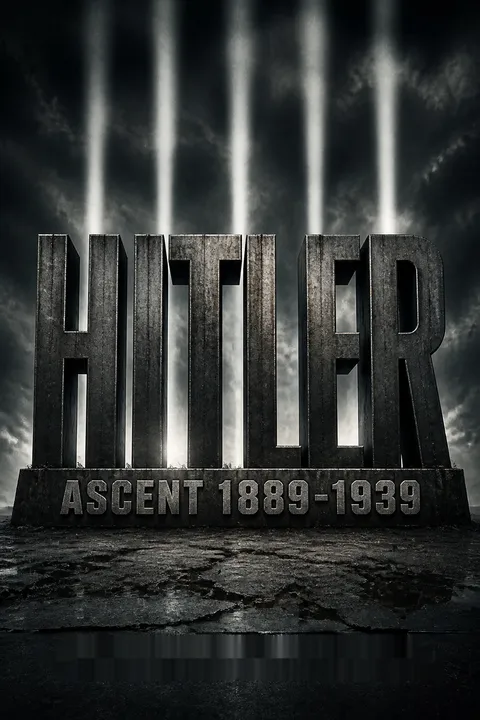

Key Takeaways
1. Formative Years: Vienna's Crucible of Ideology and Failure.
"I came to the city half a boy and left it as a quiet, serious adult."
Uncertain origins. Adolf Hitler's early life was marked by an uncertain paternal lineage, a strict father, and a doting mother whose early death deeply affected him. His school performance was poor, leading to an early departure from formal education and a sense of being misunderstood. These early experiences fostered an exaggerated self-confidence and a disinclination to exert himself in areas he found unpleasant.
Artistic aspirations dashed. His dreams of becoming an artist were repeatedly crushed by rejections from the Academy of Fine Arts in Vienna. This period of poverty and disappointment, from 1908 to 1913, was crucial for his ideological development. He immersed himself in self-study, consuming Germanic myths, architectural histories, and anti-Semitic pamphlets, which laid the groundwork for his later worldview.
Vienna's influence. Fin-de-siècle Vienna, a city of stark social contrasts and intense nationalist conflicts, exposed Hitler to radical anti-Semitic and pan-Germanic sentiments. While he initially maintained some Jewish acquaintances, the pervasive anti-Jewish rhetoric, particularly from figures like Karl Lueger and Georg Ritter von Schönerer, began to shape his prejudices, though his fanatical hatred would fully crystallize later.
2. War's Transformation: From Outsider to Political Catalyst.
"Everything previous paled into nothingness compared to the events of this giant struggle."
Liberation from idleness. The First World War was a defining experience for Hitler, offering him an escape from his aimless existence and a sense of belonging. He volunteered for the Bavarian army, serving as a dispatch runner in the List Regiment, and found purpose in the camaraderie and discipline of military life, which he preferred to civilian society.
Brutal realities. His "baptism of fire" at the First Battle of Ypres and subsequent trench warfare exposed him to the brutal realities of mass killing. This experience hardened his social Darwinist beliefs: only the strong survive, and weakness must be overcome. He saw the war as a struggle for national survival, both against external enemies and internal "internationalism."
Political awakening. While recovering from a mustard gas attack in 1918, news of Germany's defeat and the November Revolution profoundly shocked him. He blamed "November criminals"—Jews and Social Democrats—for the "stab-in-the-back," a myth propagated by right-wing propaganda. This period marked a decisive shift, solidifying his anti-Semitic and anti-Marxist convictions and leading to his decision to enter politics.
3. Oratorical Power: The Rise of the Beer-Hall Demagogue.
"I talked for thirty minutes, and what I used to sense internally without really knowing it was now confirmed by reality: I could speak well."
Discovery of talent. Hitler's political career began in Munich, where he was recruited by the Reichswehr to give anti-Bolshevik lectures. It was during these sessions, and later at early German Workers' Party (DAP) meetings, that he discovered his extraordinary oratorical abilities, which provided him with the affirmation and recognition he had long craved.
Master of the masses. His speeches, meticulously prepared yet delivered with fervent passion, captivated audiences. He employed a flexible voice, dramatic gestures, and a language that resonated with the anxieties and resentments of post-war Germans. He skillfully tapped into their fears, prejudices, and hopes, creating an intoxicating atmosphere of collective fervor.
Propaganda and symbolism. Hitler's rise was fueled by effective propaganda, including the adoption of the swastika, the "Heil" greeting, and the staging of meetings as theatrical spectacles. He relentlessly attacked the Treaty of Versailles, the Weimar Republic, and "Jewish Bolshevism," promising national rebirth and a unified "ethnic community," thereby transforming the DAP into a significant political force.
4. Mein Kampf: Blueprint for a Dictatorship.
"If at the beginning and over the course of the [First World] war we had subjected twelve to fifteen thousand of these Hebraic corrupters of the people to the same poison gas that hundreds of thousands of our best productive Germans had to endure in the field, then the sacrifice of millions of lives at the front would not have been in vain."
Landsberg's "university." Imprisonment after the failed Beer Hall Putsch in 1923 provided Hitler with an unexpected opportunity to reflect and write "Mein Kampf." This period, which he called his "state-paid university," allowed him to systematize his fragmented ideas into a coherent, albeit fanatical, worldview.
Ideological core. The two-volume work laid out his core beliefs:
- Racial purity: Humanity divided into Aryan "masters" and "inferior" races.
- Anti-Semitism: Jews as a parasitic "global plague" and the incarnation of all evil, whose "removal" from German society was paramount.
- Lebensraum: The necessity of conquering "living space" in Eastern Europe, primarily at the expense of the Soviet Union, for Germany's expanding population.
Strategic revelations. "Mein Kampf" was not merely a personal narrative but a political manifesto, openly detailing his intentions to dismantle Weimar democracy and pursue aggressive expansionism. Despite its clear articulation of future atrocities, many contemporaries dismissed it or failed to grasp its full implications, contributing to the myth of Hitler as an "unread bestseller."
5. The Great Depression: Catalyst for Mass Mobilization.
"The German economy is on its deathbed."
Economic despair. The onset of the Great Depression in 1929 plunged Germany into unprecedented economic and social crisis, with unemployment soaring to millions. This widespread despair eroded faith in democratic institutions and fueled a longing for a "strong man" to lead the country out of misery.
Nazi electoral surge. The NSDAP, positioning itself as the dynamic protest party, capitalized on this disillusionment. Its electoral support skyrocketed from 2.6% in 1928 to 18.3% in September 1930, and further to 37.3% in July 1932, making it the largest party in the Reichstag. This success was driven by:
- Broad appeal: Attracting voters from all social strata, including disillusioned middle classes, farmers, and some workers.
- Crisis rhetoric: Blaming the "Weimar system" and "Jewish capitalism" for Germany's woes.
- Promise of salvation: Offering a vision of national rebirth and an "ethnic community."
Presidential rule's unintended consequences. The collapse of the Müller government in 1930 led to a shift towards presidential cabinets ruling by emergency decree, undermining parliamentary democracy. This weakened the political center and inadvertently created a vacuum that the Nazis were poised to fill, despite their initial exclusion from government.
6. Intrigue and Opportunity: The Path to Chancellorship.
"Herr Hitler was a defeated man when he was given victory."
Political stalemate. By late 1932, the NSDAP's electoral momentum had stalled, suffering losses in the November Reichstag election. Hitler's "all-or-nothing" strategy, demanding the chancellorship, led to political isolation and a deep crisis within the party, with rivals like Gregor Strasser advocating for compromise.
Papen's machinations. Former Chancellor Franz von Papen, seeking revenge against his successor Kurt von Schleicher, initiated secret negotiations with Hitler. Papen, believing he could "tame" Hitler, aimed to install a conservative-dominated cabinet with Hitler as chancellor, leveraging his influence with President Hindenburg.
Hindenburg's capitulation. Despite his initial disdain for Hitler, Hindenburg was swayed by Papen and his inner circle, who presented Hitler as a necessary evil to counter Schleicher and the perceived threat of communism. On January 30, 1933, Hitler was appointed Chancellor, a decision born not of popular mandate but of backroom intrigue and miscalculation by conservative elites.
7. Totalitarian Revolution: Dismantling Weimar Democracy.
"The measures taken on 30 June and 1 and 2 July to put down treasonous acts against the nation and states are a legal form of emergency government defence."
Rapid power grab. Hitler's chancellorship began with a swift and ruthless dismantling of democratic institutions. The Reichstag Fire Decree, issued after the Reichstag fire in February 1933, suspended civil liberties and enabled the suppression of political opponents, particularly Communists and Social Democrats.
Enabling Act. The Enabling Act of March 1933, passed with the crucial support of the Centre Party, effectively transferred legislative power to Hitler's cabinet, allowing him to rule by decree and bypass the Reichstag. This act, initially limited to four years, became the constitutional basis for his dictatorship.
Gleichschaltung. The regime systematically brought all aspects of German society "into line" (Gleichschaltung):
- States: Regional governments were dissolved and replaced by Reich governors.
- Unions: Trade unions were crushed and replaced by the German Labour Front.
- Political parties: All opposition parties were banned, establishing a one-party state.
This swift consolidation of power, often accompanied by terror and violence, met with little resistance and was widely accepted by a populace yearning for order and stability.
8. Purge and Consolidation: The Night of the Long Knives.
"Mutinies are broken according to never-changing laws. If someone tries to criticise me for not enlisting the regular courts, I can only say: in that hour, I was responsible for the fate of the German nation and was therefore the supreme judge of the German people."
SA's challenge. By mid-1934, the SA, under Ernst Röhm, had grown into a massive paramilitary force, challenging the Reichswehr's monopoly on arms and demanding a "second revolution." This posed a direct threat to Hitler's authority and his alliance with the military.
Hitler's decisive strike. In a calculated move, Hitler orchestrated the "Night of the Long Knives" on June 30, 1934. Röhm and hundreds of SA leaders, along with conservative critics like Kurt von Schleicher and Edgar Julius Jung, were brutally murdered. This purge eliminated internal opposition and solidified Hitler's absolute power.
Military's complicity. The Reichswehr, relieved to see Röhm neutralized, swore an oath of personal loyalty to Hitler after Hindenburg's death in August 1934. This act cemented the military's subservience to the dictator and made it an accomplice in his criminal regime, paving the way for future aggression.
9. Deception and Expansion: Eviscerating Versailles.
"It was only by constantly emphasising Germany’s peaceful desires and intentions that I was able, bit by bit, to liberate the German people and give them the arms that were the necessary precondition of the next step."
Strategic dissimulation. Hitler's foreign policy aimed to dismantle the Treaty of Versailles and restore Germany's military might. He employed a strategy of deception, publicly proclaiming peaceful intentions while secretly pursuing aggressive rearmament and presenting the international community with "faits accomplis."
Key diplomatic coups:
- Withdrawal from League of Nations (1933): Asserting German sovereignty and rejecting international oversight.
- Reintroduction of conscription (1935): Openly defying Versailles, expanding the army to 550,000 men.
- Anglo-German Naval Agreement (1935): Undermining the Stresa Front and gaining British acceptance of German naval rearmament.
- Remilitarization of the Rhineland (1936): A risky gamble that succeeded due to Western inaction, further eroding the Versailles system.
Exploiting weaknesses. Hitler skillfully exploited the pacifism and internal divisions of Western democracies, particularly Britain and France, who were reluctant to risk another war. His anti-Bolshevik stance also garnered sympathy from conservative European elites. These successes bolstered his domestic popularity and convinced him of his infallibility.
10. Führer Cult: The Mystical Bond with the Nation.
"When we meet here, we are suffused with wonder at our coming together. Not all of you can see me, and I cannot see all of you. But I can feel you, and you can feel me."
Charismatic authority. Hitler cultivated an unprecedented cult of personality, presenting himself as a messianic leader chosen by Providence to save Germany. This image resonated deeply with a populace yearning for a strong leader after years of crisis and disillusionment.
Propaganda's embrace. The regime's propaganda machinery, led by Joseph Goebbels, meticulously crafted and disseminated the Führer myth:
- Mass spectacles: Nuremberg rallies, with their elaborate choreography and pseudo-religious rituals, glorified Hitler as the embodiment of national unity.
- Media control: Radio broadcasts, films (like Leni Riefenstahl's "Triumph of the Will"), and omnipresent imagery reinforced his god-like status.
- Personalized appeal: Portraying Hitler as a selfless, ascetic leader sacrificing his private life for the nation, while deflecting criticism onto his subordinates.
Popular adoration. This cult fostered an intense, often emotional, bond between Hitler and millions of Germans. His perceived successes in economic recovery and foreign policy fueled widespread adoration, with many believing he was above reproach and genuinely working for their welfare, even as the regime grew increasingly brutal.
11. Racial State: Exclusion, Persecution, and Eugenics.
"If international finance Jewry inside and outside Europe once again succeeds in plunging various peoples into a world war, the result will not be the Bolshevisation of the world and the triumph of Jewry, but the annihilation of the Jewish race in Europe."
Racial hygiene. Hitler's vision of a "Volksgemeinschaft" (ethnic-popular community) was inherently racist, excluding anyone deemed "alien to the community." This included not only Jews but also the physically and mentally disabled, "antisocials," and other marginalized groups.
Discriminatory legislation:
- Compulsory sterilization (1933): The Law for the Prevention of Genetically Ill Offspring legalized forced sterilization for various "genetic deficiencies," a precursor to later euthanasia programs.
- Nuremberg Laws (1935): Stripped Jews of German citizenship, prohibited marriages and sexual relations between Jews and "Aryans," and further segregated them from society.
- Aryanization: Systematically dispossessed Jews of their businesses and assets, driving them into poverty and forced emigration.
Kristallnacht and its aftermath. The November 1938 pogrom, orchestrated by Hitler and Goebbels, unleashed unprecedented violence against Jews, destroying synagogues and businesses, and leading to the arrest of over 30,000 Jewish men. This event, while publicly condemned by some, signaled to the Nazi leadership that they could escalate persecution without significant internal or international resistance.
12. Road to War: Aggression and the Quest for Lebensraum.
"It is my irrevocable decision to break up Czechoslovakia through military action."
Shift to expansionism. By late 1937, Hitler's foreign policy transitioned from merely revising Versailles to actively pursuing territorial expansion. His impatience, fueled by fears of dying young, drove him to accelerate his plans for conquering "living space" in Eastern Europe.
Conquest of Austria. The Anschluss in March 1938, achieved through intimidation and welcomed by many Austrians, significantly strengthened Germany's strategic position and economic resources. This bloodless triumph further convinced Hitler of his infallible judgment and the West's unwillingness to intervene.
Dismantling Czechoslovakia. Hitler's next target was Czechoslovakia. He incited Sudeten German demands for autonomy, leading to the Munich Agreement in September 1938, where Britain and France appeased him by ceding the Sudetenland. Despite his public assurances, Hitler viewed this as a temporary setback, quickly moving to occupy the remaining Czech territory in March 1939, creating the Protectorate of Bohemia and Moravia. This blatant violation of the Munich Agreement finally awakened Western powers to the true nature of his aggressive ambitions, setting the stage for World War II.
Review Summary
Readers overwhelmingly praise Hitler: Ascent 1889-1939 as a comprehensive, meticulously researched, and surprisingly readable biography. Many consider it the definitive modern account of Hitler's rise, surpassing even Kershaw's acclaimed work. Reviewers appreciate Ullrich's effort to "humanize" Hitler without excusing him, making him appear more horrifying through nuanced analysis. Several readers draw parallels to contemporary political figures, particularly Trump. The book's exploration of Hitler's personality, relationships, and the conditions enabling his rise are consistently highlighted as especially illuminating and cautionary.
People Also Read



Adolf Hitler Series Series
Download PDF
Download EPUB
.epub digital book format is ideal for reading ebooks on phones, tablets, and e-readers.








































