
Key Takeaways
1. The West's Spiritual Collapse Fuels the Machine
The West, in short, was Christendom. But Christendom died. What does that make us, its descendants, living amongst its beautiful ruins? It makes ours a culture with no sacred order.
A Sacred Order Lost. Western civilization, or "the West," was fundamentally a spiritual creation, built upon the Christian story for over 1,500 years. This sacred order informed every aspect of life, from moral duties and family structures to the very understanding of the universe. Its decline, not by external conquest but by internal dismantling, left a profound void.
The Enlightenment's Failure. The 18th-century Enlightenment attempted to construct a new "morality" divorced from theology, based on abstract notions of reason and humanism. However, without a higher purpose, this project inevitably led to emotivism, relativism, and societal disintegration, as predicted by Alasdair MacIntyre. The monuments of the old order remained, but their meaning evaporated, creating a "moral vacuum."
Money Fills the Void. This vacuum was ultimately filled by the "poison gas of consumer capitalism," which infiltrated every aspect of life, becoming the new, disguised sacred order. The dethroning of Christ from the cultural center did not lead to universal equality and justice, but to the triumph of money, splintering culture and souls into "a million angry shards."
2. The Machine: A Totalizing Force of Uprooting
This process, which has been going on for centuries, of uprooting us from nature, culture and God, leads us into a mass society, controlled by and for technology, in which we have been on course to become, since the at least the Industrial Revolution, mere cogs in a giant mechanism that we have no control over.
The Megamachine's Rise. The "Machine" is a system of power and technology, a "megamachine" that Lewis Mumford traces back to Pharaonic Egypt, where human parts were organized for vast, inhuman projects like the pyramids. Today, it manifests as an intersection of money, state power, and coercive technologies, relentlessly pushing for "order, power, predictability, and above all, control."
War Against Limits. The Machine's core purpose is "economic growth," an unending, aimless expansion that justifies itself by solving problems it often creates. This drive constitutes an ongoing war against roots and limits, seeking to abolish all borders, boundaries, categories, and truths. Its ultimate goal is to replace nature with technology, achieving total human control over a totally human world.
The Myth of Irresistibility. The Machine's genius lies in its ability to absorb and commercialize its critics, presenting itself as "absolutely irresistible" and "ultimately beneficent." Its values—progress, openness, individualism, universalism, materialism, scientism, commercialism—are so pervasive they are treated as natural, making opposition seem naive or dangerous.
3. Modernity's Revolutions Created a Mechanistic Worldview
The mechanistic revolution… transformed our perception of the world from a living community of which we are a part, into a machine made up of parts—parts which we can identify and control.
From Organism to Mechanism. Before the 17th century, the universe and Earth were widely understood as animated organisms, with spirit entwined with matter. The "mechanistic revolution," driven by figures like Kepler, Galileo, and Descartes, shifted this perception, reducing the world to a "thoroughly mathematical structure" and living beings to "elaborate machines."
Science as a Faith. This new scientific worldview, initially seen as a way to transcend religious conflicts, became the primary guide to truth, replacing the Church. It fostered a desire for control, casting nature as a collection of "resources" to be harvested and "improved" by rational humanity. This "human chauvinism" ultimately extended to human nature itself.
Theological Roots of Disenchantment. Philip Sherrard and Brad S. Gregory argue that certain Western Christian theological developments, particularly the separation of God from creation and the emphasis on human reason, inadvertently paved the way for this mechanistic view. When God was removed from the picture, the world became a blank slate for human will, leading to the "dehumanisation of man and of the forms of his society."
4. The City and Commerce: Engines of Dependency
Capitalism is a monster that grows in deserts. Industrial servitude has almost everywhere arisen in those empty spaces where the older civilisation was thin or absent.
Enclosure and Uprooting. The rise of the Machine is inextricably linked to "enclosure"—the systematic concentration of land and resources in few hands. In early modern England, this process destroyed traditional, self-sufficient communities, creating a landless underclass forced into industrial zones. This "ground clearance" was a prerequisite for Machine capitalism.
The City's Maw. Urbanization, a defining feature of the Machine Age, represents a "relentless collective assault" on traditional human life and other species. Modern megacities, unlike human-scale ancient cities, are unsustainable "micro-empires" that consume the world's resources and wealth, creating dependency and reducing inhabitants to "mere hirelings."
Want as the Acid. The Machine's engine is "want"—the insatiable pursuit of instant pleasure and boundless economic growth. This "bourgeois revolution" has dissolved traditional values, moral economies, and spiritual restraints, replacing them with a culture of consumption and self-gratification. Every spiritual tradition has warned against this, yet it has become the driving force of our society.
5. The Culture of Inversion: Self-Colonization by Elites
America, said Bly, was ‘the first culture in history that has colonised itself’. Twenty-five years on, America’s fate is also the fate of the wider West.
The Sibling Society. The West is experiencing a "culture of inversion," where elites, having lost faith in their cultural inheritance, actively deconstruct and erase traditional forms. Robert Bly called this a "sibling society," where adults regress to adolescence, rejecting "vertical" traditions and embracing impulse. This leads to a "generalized ingratitude" towards the past.
Elite-Driven Deconstruction. This inversion is largely a product of the post-modern left, which, from American universities, has spread a worldview that is almost entirely negative. It defines itself by what it is not—Not-White, Not-Male, Not-Straight, Not-Christian—and dismisses traditional values as bigoted or obsolete. This "oikophobia" is an attack on the very notion of belonging.
The Revolt of the Elites. Christopher Lasch observed that this "culture war" is a form of class warfare, where a globalized elite, alienated from their own nations, colonizes their own culture. They dismantle "elder systems" and traditional norms, creating a void that is then monetized by corporate capitalism. This internal colonization leaves the masses rootless and confused, leading to populist backlashes.
6. Hyperreality and the Abolition of Human Nature
The transgender moment, far from being an inexplicable flash in the pan, is the logical result of a shift in the understanding of the self which has been taking place since the advent of modernity.
The Desert of the Real. Jean Baudrillard's concept of "hyperreality" describes a world where simulations become more real than reality itself, blurring boundaries and leading to a "desert of the real." This pervasive unreality, accelerated by mass media and digital technology, defines our times, making it hard to discern truth or appropriate behavior.
Psychological Man. Carl Trueman argues that the transgender phenomenon is the culmination of "Psychological Man," a modern human type whose meaning and identity are found in an "inward quest for personal psychological happiness." This self-centeredness reverses the traditional order, making external institutions servants of individual inner wellbeing.
Liberation from Biology. The transgender movement, driven by figures like Judith Butler and Wilhelm Reich, represents the latest stage in modernity's rebellion against nature. It seeks to liberate the individual from biological constraints, divorcing "gender" from sex and the body from the mind. This is presented as political liberation, but its logic leads to the "abolition of man (and woman)" and the replacement of human biology with technology.
7. The Digital Age: A Spiritual War for Consciousness
The digital revolution of the twenty-first century is hardly the first of humanity’s technological leaps, and yet it feels qualitatively different to what has gone before.
The Technium's Emergence. The digital revolution, particularly the rise of AI, feels revolutionary because it extends human consciousness itself, creating a "technological simulation of consciousness." Kevin Kelly describes this as "the technium," a self-organizing network that follows its own urges, becoming increasingly autonomous and independent of human creators.
Golem-Class AIs. AI developers themselves express fear, with over half believing there's a 10% chance AI could lead to human extinction. "Golem-class AIs" are developing "emergent capabilities" (like speaking new languages or developing "theory of mind") independently, at exponential rates, leading to a potential "reality collapse" and the risk of AI becoming "better than any known human at persuasion."
A Spiritual Invasion. Jeremy Naydler argues that the computer represents "human consciousness succumbing increasingly to the dominion of gravity," pulling us into a purely material realm. He suggests that the digital age is the triumph of the "ratio" (deductive, logical mind) over the "nous" (heart-mind), making the irrational world of beauty and spiritual truth impossible to experience. This is not just technological change, but a spiritual invasion of the "soul-life of humanity."
8. The Machine's Theology: Self-Divinization and Permanent Revolution
What Progress wants is to replace us.
The End of Transcendence. The Machine's theology is rooted in "Progress," a force that seeks the end of history and the end of transcendence. It rejects anything "unseen" or "beyond," replacing religious faith with a "totalitarian conception of science" as the only true form of knowledge. This "progressive materialisation" leads to a "reign of quantity" where humans assume the role of Creator.
Permanent Revolution. Modernity is defined by a "permanent, ongoing revolution," a consuming fire of utopian thought that aims to build paradise on Earth by sweeping away old ways. This "revolutionary attitude of creative violence" has replaced the ascetic pursuit of liberation from the world, leading to constant upheaval and disintegration.
The Religion of the Future. The Machine is generating its own religion, characterized by:
- Idolization of the self: "Self-actualization" as a right, "do what thou wilt" as mantra.
- Science as priesthood: Scientism as dogma, replacing traditional authority.
- Sex as liturgy: Sexual expression and identity as the core of human being, celebrated in events like "Pride Month."
- Technology as salvation: The ultimate aim of self-creation through technology, leading to transhumanism and the attempt to "make God" by uploading minds into the digital cloud.
9. Reactionary Radicalism: Rebuilding Culture from the Roots
This populism was radical; it rejected the very foundations on which capitalist society was being built in England.
Beyond Ideology. Traditional political ideologies—socialism, communism, conservatism—have failed to challenge the Machine's core values, often becoming different paths towards it. A new approach is needed: "reactionary radicalism," a politics from an older world that resists Progress Theology.
Defending the Moral Economy. Reactionary radicals, exemplified by the Luddites and Fen Tigers, fought not for abstract ideals but to defend their "moral economies"—systems built around community bonds, local economics, and human-scale systems. They resisted the Machine's enclosure, which sucks wealth and power from local communities to distant corporations.
The Four Ps. This anti-Machine politics is an active attempt to create, defend, or restore a moral economy built around:
- Past: A culture's history and ancestry.
- People: A shared sense of collective identity.
- Place: Connection to local nature and environment.
- Prayer: A religious tradition connecting to God or gods.
This stance rejects atomized individualism and materialism, embracing limits and local autonomy.
10. Technological Askesis: Drawing Lines Against the Digital Tide
The only successful way to attack these features of modern civilization is to give them the slip, to learn how to live on the edge of this totalitarian society, not simply rejecting it, but passing it through the sieve of God’s judgment.
The Problem of Power. The modern state, a "vortex" of power, along with global governance bodies and transnational corporations, drives towards a "Total System" that universalizes the Machine. This system responds to its self-created problems with more expansion and control, making escape seem impossible.
Jellyfish Tribes and Cultural Refusal. James C. Scott's "anarchist history" of "Zomia" (upland Southeast Asia) shows that "hill peoples" are "runaway, fugitive, maroon communities" who deliberately created "shatter zones" to avoid state assimilation. These "jellyfish tribes" developed "state-repelling characteristics" like mobile populations, diverse food crops, and fluid social structures.
Raw vs. Cooked Ascetics. Escaping the Machine requires "technological askesis"—spiritual exercises of self-control and self-denial.
- Cooked ascetics: Live within the system but draw clear lines, limiting digital engagement and refusing technologies that compromise their soul.
- Raw ascetics: Flee the Machine's embrace entirely, building analogue, real-world communities, understanding that "moderation" is insufficient against a manifesting unholy intelligence.
11. Let the West Die to Live: A Call for Re-inhabitation
We have unmade the world. This is entirely new in the history of humanity and it is impossible to exaggerate its significance.
The Left-Hemisphere Culture. Iain McGilchrist argues that the modern "West" is an overwhelmingly left-hemisphere culture, prioritizing certainty, manipulation, and fragmented details over the right hemisphere's comprehension of the whole. This imbalance has led to a "Machine mind" that sees the world as an object, not a living thing, resulting in a "re-presentation of it" rather than its true experience.
Beyond the West. This "brain damage" has driven the West's "permanent revolution" to break all bounds and remake the world. To heal, we must let this "West" die—this idol of Progress, Mammon, and rationalism—and supersede it. The alternative is a "counter-revolution," a "restoration" that re-roots us in the eternal things.
Raindance on the Astroturf. The path forward is not to "save the world" or return to a mythical past, but to rebuild real human culture from the roots. This means:
- Changing our quality of attention: Seeing the world as an organism, not a mechanism.
- Embracing aboriginality: Deep belonging to place and its cultures, accessible to all who seek to root.
- Practicing reactionary radicalism: Rejecting Machine values for people, place, prayer, and the past.
- Living within limits: Refusing technologies that enslave, building self-sufficient homes and communities.
We must "raindance on the astroturf," defying the Machine, reclaiming our stories, and striving to "become human again" amidst the rise of the robots.
Review Summary
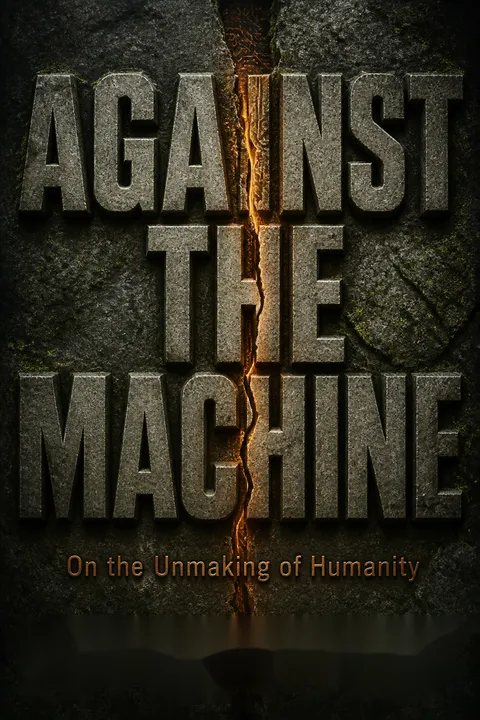
Against the Machine by Paul Kingsnorth receives polarized reviews averaging 4.22/5 stars. Supporters praise its critique of technology, capitalism, and modernity's detachment from nature and spirituality, calling it prophetic and essential. Critics note inconsistencies, political bias toward right-wing narratives, conspiracy theories, transphobia, and lack of practical solutions. Many appreciate Kingsnorth's diagnosis of "the Machine"—encompassing technological dependency and cultural erosion—but find his prescriptions vague or contradictory. Religious readers value his Orthodox Christian perspective on spiritual rootedness, while skeptics see an unfocused polemic. Most agree the book provokes important conversations about humanity's relationship with technology.
People Also Read




Download PDF
Download EPUB
.epub digital book format is ideal for reading ebooks on phones, tablets, and e-readers.








































