

Key Takeaways
Most companies never become great because good is comfortable enough
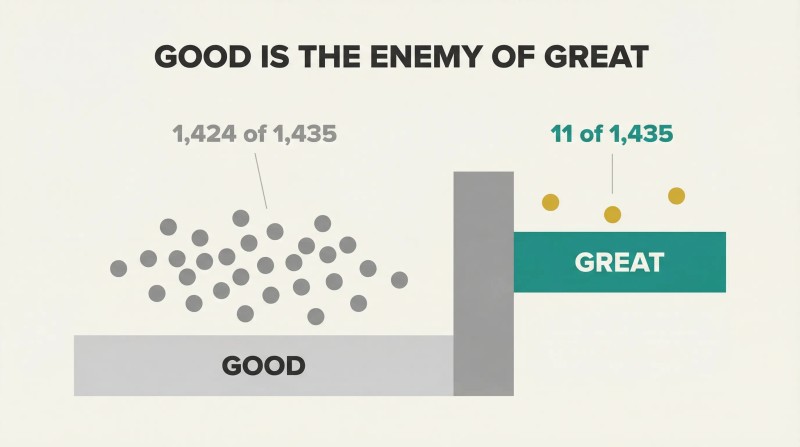
Collins' team spent five years on this. From an initial universe of 1,435 Fortune 500 companies (1965 – 1995), they identified just 11 that leaped from sustained mediocrity to sustained greatness — defined as cumulative stock returns at least three times the general market over fifteen years. The eleven weren't glamorous names: Walgreens, Kroger, Kimberly-Clark, Nucor. Yet a dollar invested across all eleven in 1965 would have multiplied 471 times by 2000, versus 56 times for the market.
The framework is what matters. Five of the eleven companies operated in bad or terrible industries. Greatness wasn't about circumstance, luck, or a single breakthrough innovation. Collins' team compared each good-to-great company against a carefully matched comparison that had similar resources and opportunities but failed to make the leap, then asked: what was different?
The best CEOs are humble plow horses, not celebrity show horses
Level 5 Leadership is Collins' most surprising finding. It describes leaders who blend extreme personal humility with fierce professional will — more Lincoln than Patton. Darwin Smith, a shy in-house lawyer who became Kimberly-Clark's CEO, sold the company's century-old paper mills and bet everything on consumer products. He fought cancer for 25 years while transforming his company to beat Procter & Gamble in six of eight product categories.
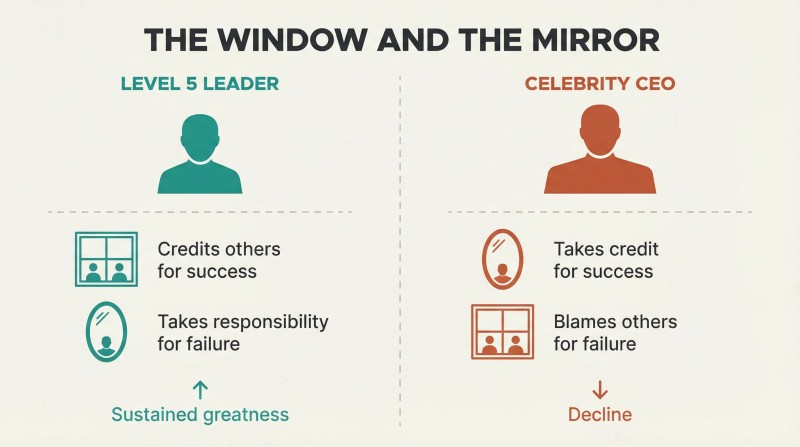
The data demolished the celebrity CEO myth. Ten of eleven good-to-great CEOs came from inside the company; comparison companies hired outside saviors six times more often — and failed. Two-thirds of comparison companies had leaders whose gargantuan egos contributed to decline. Level 5 leaders use what Collins calls the Window and the Mirror: they look out the window to credit others for success, and into the mirror to accept blame for failure.
Fill the bus with the right people before deciding where to drive it
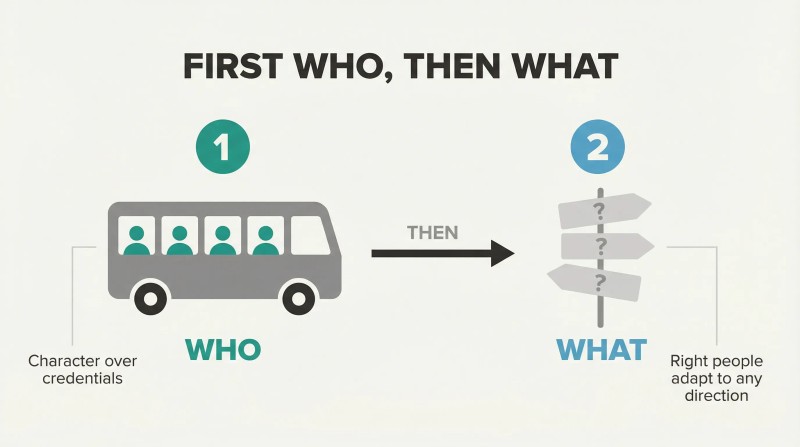
Good-to-great leaders chose 'who' before 'what.' They assembled outstanding teams first, then figured out strategy. Dick Cooley built Wells Fargo's management team in the 1970s by hiring brilliant people without specific jobs in mind. When banking deregulation hit unpredictably, no bank adapted better — because Cooley already had the right people on the bus. David Maxwell at Fannie Mae interviewed all officers while the company lost one million dollars every business day, making clear only A-players who wanted an A-plus challenge would stay.
Compensation was irrelevant to the leap. After 112 analyses, Collins found no link between pay structure and transformation. Good-to-great executives actually earned slightly less than comparison counterparts a decade post-transition. Character and work ethic mattered more than credentials — one executive hired a manager whose only qualification was escaping capture twice during World War II.
Hold unwavering faith while confronting the most brutal facts
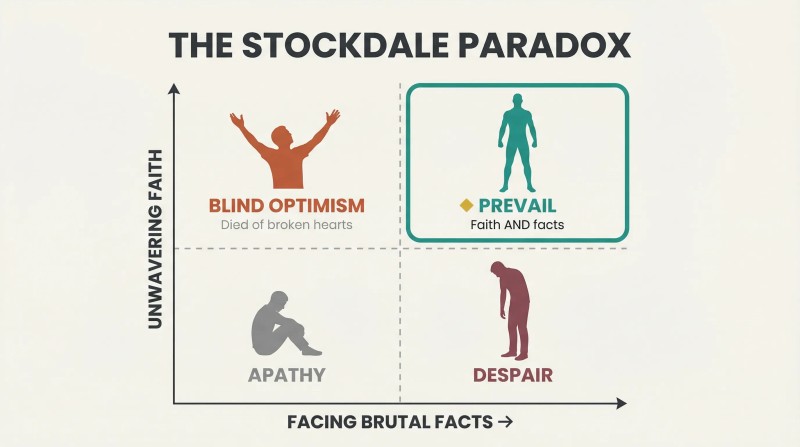
Collins named this the Stockdale Paradox. Admiral Jim Stockdale survived eight years of torture in a Vietnamese prison camp. When Collins asked who didn't make it out, Stockdale answered: the optimists — those who kept expecting release by Christmas, then Easter, then Thanksgiving, dying of broken hearts when reality crushed each expectation. The lesson: never confuse faith that you will prevail with denial of your current reality.
Every good-to-great company embodied this duality. Kroger confronted the fact that its entire grocery store model was obsolete and spent decades rebuilding every single location. Fannie Mae faced $56 billion in underwater loans yet refused to merely survive — it reinvented itself as a world-class capital markets player. Meanwhile, A&P ran a test store that revealed the future, then closed it because executives didn't like the answer.
Lead with questions, not answers, to create a truth-telling climate
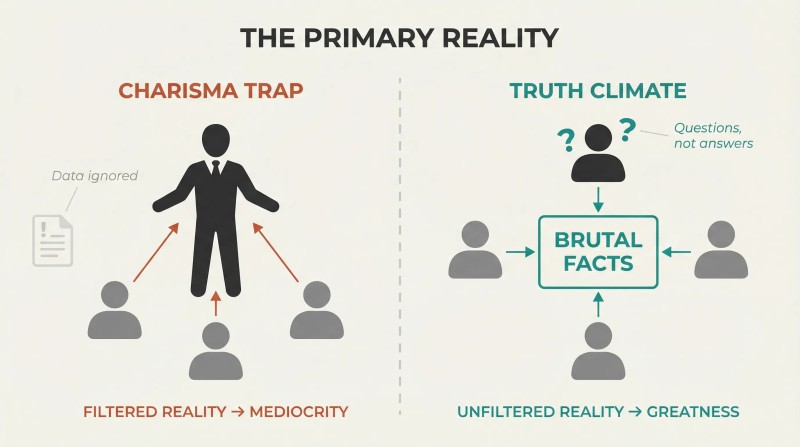
Charisma can be a liability. When a leader's personality becomes the dominant force, people filter bad news to protect the boss's feelings. The good-to-great companies built climates where truth surfaced through four practices:
1. Lead with questions, not answers — Circuit City's CEO was called "the prosecutor" for relentlessly asking why
2. Engage in genuine dialogue and debate — Nucor meetings got so heated people "almost went across the table at each other"
3. Conduct autopsies without blame
4. Build red flag mechanisms that force attention to uncomfortable data
Churchill grasped this instinctively. Despite his towering personality, he created a separate Statistical Office to feed him completely unfiltered brutal facts throughout World War II, because he feared his own charisma would cause people to sugarcoat reality.
Discover what you can be best at — not merely what you're good at
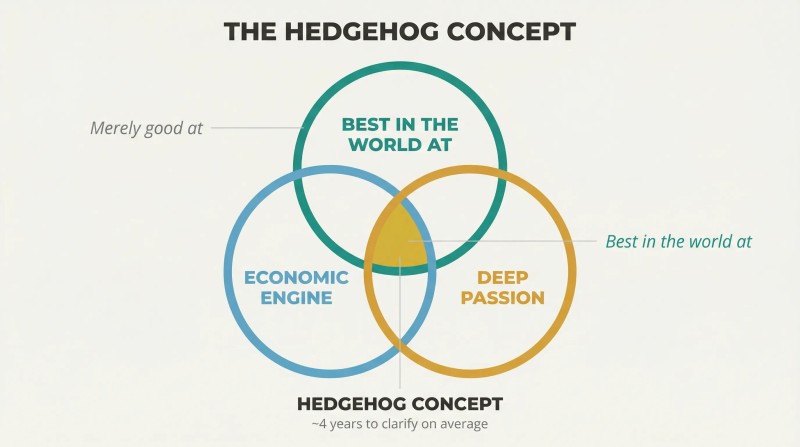
Collins' Hedgehog Concept is the book's core strategic framework. Named after Berlin's parable — the fox knows many things, but the hedgehog knows one big thing — it requires finding the intersection of three circles: (1) what you can be best in the world at, (2) what drives your economic engine, and (3) what ignites deep passion. Abbott Laboratories realized it couldn't out-research Merck in pharmaceuticals despite 99% of revenues from drugs, so it pivoted to cost-effective health care products and beat the market 4.5 to 1.
Each company found a key economic denominator. The insight was identifying a single ratio — profit per x — with the greatest impact. Walgreens shifted from profit per store to profit per customer visit, unlocking its convenience-clustering strategy of nine stores within a single mile. It took four years on average to clarify a Hedgehog Concept.
Build a culture of discipline so bureaucracy becomes unnecessary
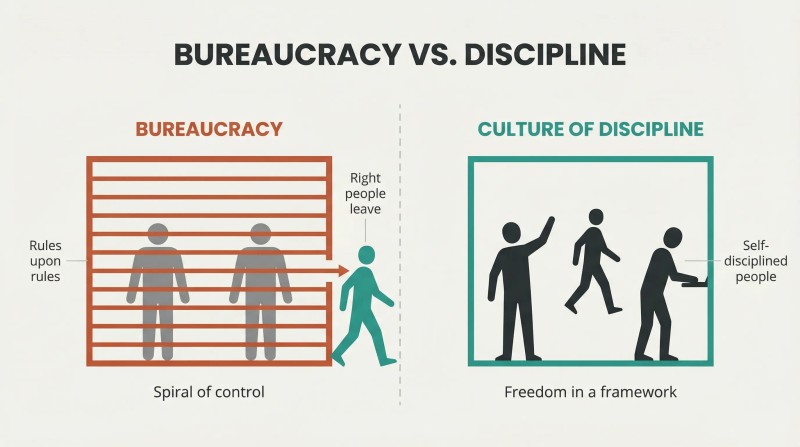
Discipline replaces hierarchy. Most companies build rules to manage wrong people, which drives away right people, requiring more rules — a vicious cycle. Good-to-great companies hired self-disciplined people and managed the system, not individuals. Abbott Labs created Responsibility Accounting, holding every manager accountable for ROI with investor-level rigor — yet simultaneously derived up to 65% of revenues from new products, rivaling 3M for innovation. Freedom and responsibility within a framework.
Tyrannical discipline fails spectacularly. Rubbermaid under Stanley Gault and Chrysler under Lee Iacocca achieved remarkable short-term results through sheer personal force. When the disciplinarian departed, both companies collapsed. The difference: good-to-great companies built enduring cultures where discipline was embedded in the system, not dependent on a single enforcer.
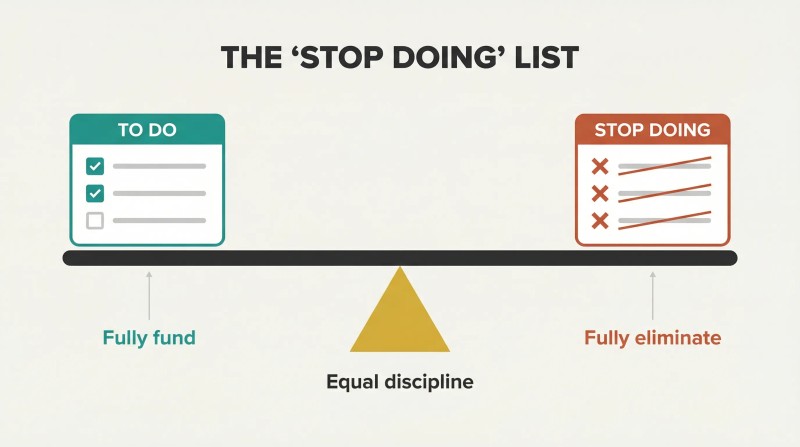
Keep a 'stop doing' list that rivals your 'to do' list
Kimberly-Clark sold its paper mills. When Darwin Smith realized the company couldn't be world-best at coated paper, he didn't gradually wind down — he eliminated the entire century-old business and channeled everything into consumer products like Huggies and Kleenex. Kroger invested over $9 billion replacing virtually every store. Walgreens exited profitable food-service operations, including restaurants named after the CEO himself.
Budgeting should be elimination, not allocation. From a good-to-great perspective, budgets don't determine how much each activity gets — they determine which arenas should be fully funded and which should receive nothing at all. The good-to-great companies showed remarkable courage to pour everything into what fit their Hedgehog Concept and the discipline to say no to everything else, however lucrative it appeared.
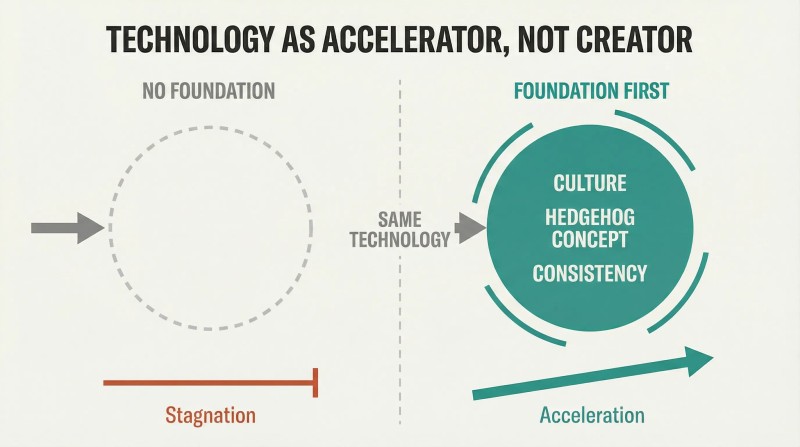
Technology accelerates momentum but never creates it
Walgreens exemplifies the pattern. When drugstore.com launched in 1999 at a $3.5 billion valuation, Walgreens didn't panic. It took a deliberate "crawl, walk, run" approach — experimenting, debating how the Internet fit its Hedgehog Concept, then building a sophisticated platform. Within a year, drugstore.com had lost nearly all its value while Walgreens' stock nearly doubled. Every good-to-great company became a technology pioneer — but only after clarifying its three circles, and only with technologies that directly connected to them.
Even Nucor's CEO downplayed technology. Widely celebrated for pioneering mini-mill steel manufacturing, Nucor was a textbook case of technology-driven transformation. Yet Ken Iverson didn't include technology in his top five factors, citing culture and consistency instead. Great companies are driven by a compulsion for excellence; mediocre ones react from fear of being left behind.
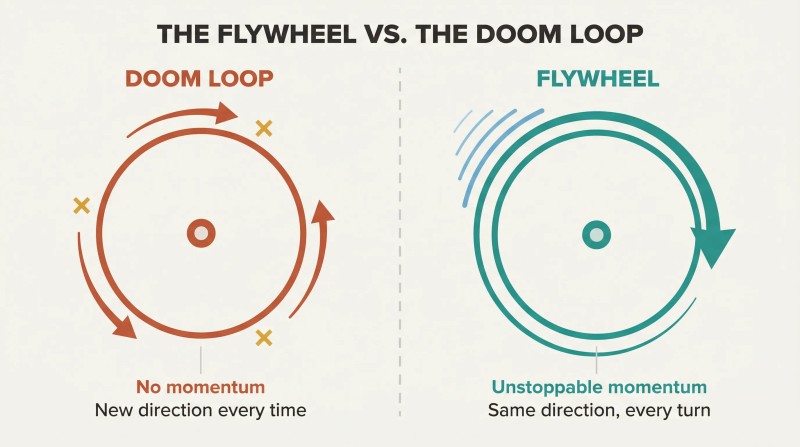
Greatness is a thousand flywheel turns, never one miracle moment
Collins' flywheel metaphor captures the entire process. Imagine pushing a 5,000-pound metal disk — each push barely moves it, but after thousands of consistent turns the momentum becomes unstoppable. That's how good-to-great transformations happen. Circuit City spent nine years in buildup before breakthrough. The companies had no name, tag line, or launch event — many executives didn't realize the magnitude of their transformation until years later.
The doom loop is the deadly anti-pattern. Comparison companies like Warner-Lambert lurched between five different strategic directions over twenty years, each new CEO stopping the flywheel to start fresh. They tried to skip buildup through splashy acquisitions and dramatic restructurings — three major ones at Warner-Lambert, shedding 20,000 people. Collins found that two big mediocrities joined together never make one great company.
Analysis
Collins' methodology — studying the entire population of qualifying companies rather than sampling, using matched comparison pairs, and building theory from data rather than testing hypotheses — gives Good to Great unusual empirical authority for a business book. The 'compared to what?' principle eliminates many attribution errors that plague management literature. You don't learn much studying only gold medalists; you need the athletes who also had coaches but never won.
The most radical finding is Level 5 Leadership, which directly challenges the American cult of the charismatic CEO. At a time when boards were paying record premiums for celebrity leaders, Collins showed these hires were negatively correlated with sustained transformation. This finding has aged well; organizational psychology increasingly confirms that narcissistic leadership produces short-term spikes followed by long-term decay.
The book's most significant vulnerability is temporal survivorship bias. Several of the eleven companies later stumbled badly: Circuit City filed for bankruptcy in 2008, Fannie Mae required a $190 billion government bailout, and Wells Fargo's fake accounts scandal revealed deep cultural rot. Collins argues these failures occurred when companies abandoned the framework — and in several cases the evidence supports him. But it raises a question the framework doesn't fully address: how to make principles self-sustaining across leadership transitions when Level 5 leaders are, by definition, rare.
The Stockdale Paradox may be the book's most universally applicable insight. It resolves the false binary between toxic positivity and defeated realism that plagues organizations and individuals alike. Its utility extends far beyond business into personal resilience, partly explaining why the book resonates with an audience far broader than its corporate target.
What distinguishes Good to Great from most management literature is its insistence on 'dogs that didn't bark' — executive compensation, strategy per se, technology, and change management programs all turned out to be irrelevant to the leap. These negative findings contain more practical insight than the positive ones, because they challenge the expensive consulting industry built on precisely these levers.
Review Summary
Good to Great is widely regarded as a seminal business book, offering insights on how companies transition from mediocrity to excellence. Readers appreciate Collins' research-based approach and practical principles, such as Level 5 Leadership and the Hedgehog Concept. However, some criticize the book's hindsight bias and question the longevity of its case studies. While many find the concepts valuable for both business and personal growth, others argue the advice is common sense repackaged. Despite its age, the book remains influential in management literature.
People Also Read

Glossary
Level 5 Leadership
Humility plus fierce professional willThe highest level in Collins' five-tier hierarchy of executive capabilities. Level 5 leaders combine extreme personal humility with intense professional will—they are ambitious first and foremost for the company, not themselves. They channel ego into building something larger and more lasting than their own reputation. Every good-to-great company had Level 5 leadership during the pivotal transition years. Ten of eleven came from inside the company.
First Who . . . Then What
People before strategy decisionsThe principle that good-to-great leaders first assembled the right team—getting the right people on the bus, the wrong people off, and the right people in the right seats—before determining strategy or direction. This stands in contrast to the conventional approach of setting a vision first and then recruiting people to execute it. The principle extends to hiring for character over credentials.
Stockdale Paradox
Faith and brutal facts simultaneouslyNamed after Admiral Jim Stockdale, a Vietnam POW for eight years. The paradox holds that you must maintain unwavering faith that you will prevail in the end, while simultaneously having the discipline to confront the most brutal facts of your current reality. The optimists in Stockdale's camp—who kept predicting release by specific dates—died of broken hearts. Every good-to-great company embodied this psychological duality.
Hedgehog Concept
Simplified strategic clarity frameworkA simple, crystalline concept that flows from deep understanding about the intersection of the Three Circles. Named after Isaiah Berlin's parable—the fox knows many things but the hedgehog knows one big thing. Good-to-great companies operated like hedgehogs, translating complex realities into one unifying idea that guided all decisions. It is an understanding of what you can be best at, not a goal or intention. It took four years on average to clarify.
Three Circles
Best-at, economic engine, passionThe three intersecting dimensions of the Hedgehog Concept: (1) what you can be the best in the world at (and equally important, what you cannot), (2) what drives your economic engine (identified through a single denominator—profit per x), and (3) what you are deeply passionate about. A fully developed Hedgehog Concept requires alignment across all three circles. Anything outside the intersection is pruned away.
Flywheel
Cumulative momentum-building processCollins' central metaphor for the good-to-great transformation. Like pushing a massive 5,000-pound disk that builds momentum through thousands of consistent turns in one direction until breakthrough occurs. No single push causes the breakthrough—it is the accumulation of effort over time. Good-to-great companies followed this buildup-to-breakthrough pattern, with no miracle moment, no launch event, and often no awareness of the magnitude of change until years later.
Doom Loop
Reactive strategic lurching patternThe anti-pattern to the Flywheel, observed in comparison companies. Instead of consistent pushing in one direction, these companies lurched between strategies, launched dramatic programs, pursued misguided acquisitions to skip buildup, and replaced leaders who stopped the flywheel to start over. Warner-Lambert exemplified this with five different strategic directions over twenty years and three major restructurings—one per CEO.
Window and the Mirror
Credit and blame attribution patternA behavioral pattern distinguishing Level 5 leaders from comparison leaders. Level 5 leaders look out the window to credit external factors, other people, and good luck when things go well, and look in the mirror to accept personal responsibility when things go poorly. Comparison leaders do the opposite: they preen in the mirror to take credit for success and point out the window to blame others for failure.
The Council
Iterative strategic dialogue groupA standing group of five to twelve people who participate in dialogue and debate guided by the Three Circles, iteratively and over time. The Council is assembled by the leading executive, consists of people with deep knowledge who argue for understanding rather than ego, and does not seek consensus. It meets regularly, operates informally (no formal org chart listing), and the final decision remains with the leader.
Rinsing Your Cottage Cheese
Extreme diligence and superdisciplineCollins' metaphor for the fanatical consistency displayed by good-to-great companies, named after six-time Ironman champion Dave Scott, who rinsed his cottage cheese to remove extra fat despite burning 5,000+ calories daily in training. The point is not that any single act of discipline is decisive, but that relentless small steps of superdiscipline—added together consistently—create the conditions for greatness.
FAQ
What's "Good to Great" about?
- Transformation from good to great: "Good to Great" by Jim Collins examines why some companies successfully transition from being good to great, while others do not.
- Research-based insights: The book is based on a five-year research project comparing companies that made the leap to greatness with those that did not.
- Key principles: It introduces key concepts such as Level 5 Leadership, the Hedgehog Concept, and the Flywheel, which are essential for understanding how companies achieve sustained greatness.
Why should I read "Good to Great"?
- Proven strategies for success: The book offers strategies and insights that can help organizations and individuals achieve exceptional results.
- Timeless principles: It presents principles that remain relevant regardless of changes in the business environment, making it a valuable resource for leaders and managers.
- Inspiration and guidance: "Good to Great" provides practical guidance for those seeking to transform their organizations and achieve long-term success.
What are the key takeaways of "Good to Great"?
- Level 5 Leadership: Great companies have leaders who combine personal humility with professional will, focusing on the success of the organization.
- First Who, Then What: Successful transformations begin by getting the right people on the bus and the wrong people off, before deciding on the direction.
- Hedgehog Concept: Companies must identify what they can be the best in the world at, what drives their economic engine, and what they are deeply passionate about.
What is Level 5 Leadership according to Jim Collins?
- Blend of humility and will: Level 5 Leadership is characterized by a paradoxical blend of personal humility and professional will.
- Ambition for the company: These leaders are ambitious for the company, not themselves, and set up successors for success.
- Workmanlike diligence: They focus on results and take responsibility for failures while attributing success to others.
What is the Hedgehog Concept in "Good to Great"?
- Three intersecting circles: The Hedgehog Concept arises from understanding what you can be the best at, what drives your economic engine, and what you are deeply passionate about.
- Not a goal or strategy: It is an understanding of what the organization can truly excel at, guiding all decisions and actions.
- Focus and simplicity: This concept ensures that the company remains focused on its core strengths and opportunities.
How does "Good to Great" define the Flywheel and the Doom Loop?
- Flywheel effect: The Flywheel represents the cumulative effect of many small initiatives that lead to a breakthrough and sustained momentum.
- Doom Loop: In contrast, the Doom Loop is characterized by reactionary decisions and lack of consistent direction, leading to mediocrity or decline.
- Consistent effort: Great companies achieve success through consistent effort and disciplined action, gradually building momentum over time.
What role does technology play in "Good to Great"?
- Accelerator, not creator: Technology is seen as an accelerator of momentum, not a creator of it.
- Disciplined application: Great companies apply technology in a disciplined manner, ensuring it aligns with their core strengths.
- Avoiding the technology trap: The book warns against chasing new technologies without understanding their relevance to the core business.
What is the significance of "First Who, Then What" in "Good to Great"?
- Right people first: The principle emphasizes getting the right people on the bus and the wrong people off before deciding on the company's direction.
- Adaptability and flexibility: By focusing on who first, companies can more easily adapt to changes and challenges.
- Self-motivated individuals: The right people are self-motivated and do not need to be tightly managed, allowing the organization to focus on strategic decisions.
How does "Good to Great" address the fear of change?
- Confronting brutal facts: Companies must confront the brutal facts of their reality without losing faith in their ability to prevail.
- Stockdale Paradox: This involves maintaining unwavering faith while acknowledging the current challenges.
- Balanced perspective on technology: Great companies maintain a balanced perspective on technology, avoiding reactionary changes driven by fear.
What are the best quotes from "Good to Great" and what do they mean?
- "Good is the enemy of great." This quote highlights that settling for good often prevents achieving greatness.
- "You must maintain unwavering faith..." Known as the Stockdale Paradox, it emphasizes balancing optimism with a realistic assessment of challenges.
- "The right people don’t need to be tightly managed..." This underscores the value of having the right people in an organization.
How can the concepts in "Good to Great" be applied to personal development?
- Identify your Hedgehog Concept: Individuals can identify their unique strengths, passions, and economic drivers to guide their growth.
- Focus on disciplined action: Apply principles of disciplined thought and action to personal goals, ensuring efforts are consistent and aligned with long-term objectives.
- Surround yourself with the right people: Like great companies, individuals benefit from surrounding themselves with supportive, motivated, and like-minded people.
About the Author
Other books by Jim Collins

Download PDF
Download EPUB
.epub digital book format is ideal for reading ebooks on phones, tablets, and e-readers.








































