

Key Takeaways
Human behavior follows predictable formulas — learn them to direct any interaction
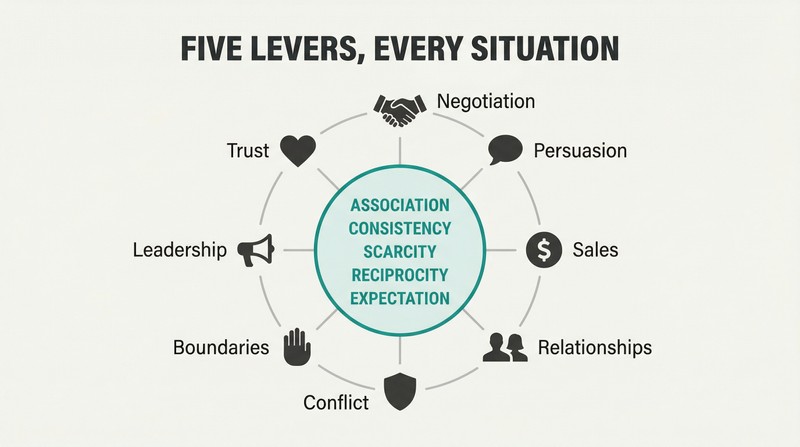
This book's radical premise: people don't respond to you randomly — they respond to psychological triggers you can deliberately activate. Whether you want someone to like you, take your advice, follow through on a promise, or forgive you, the outcome depends less on who you are and more on which laws of human behavior you engage. Association, consistency, scarcity, reciprocity, and expectation are the primary levers.
Lieberman argues these aren't tricks that work on some people sometimes. They're universal principles governing how humans process trust, desire, and motivation. The entire book is organized as forty scenario-specific playbooks — from negotiations to romantic relationships to handling rude people — each built on the same underlying psychology. Master the formulas, and the specific situations become variations on a theme.
Likability flows from how you make others feel, not how impressive you seem
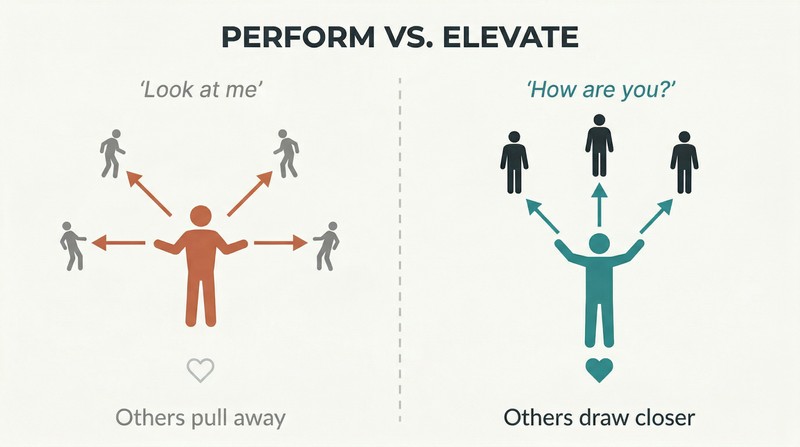
Stop performing; start elevating. Nine laws govern whether someone likes you, and none of them involve showing off. Familiarity breeds fondness, not contempt — even letters in our own name are perceived as more attractive. Reciprocal affection means gradually letting people know you admire them. Similarity creates bonds. And a positive attitude is magnetic.
The most counterintuitive law: getting someone to do YOU a small favor makes them like you more than if you did something for them. Cognitive dissonance forces their brain to rationalize: "I must like this person, otherwise why would I help?" Meanwhile, self-deprecating humor signals genuine confidence. The bragging, image-obsessed person reveals insecurity. The one laughing at her own mistakes signals she's secure enough not to care.
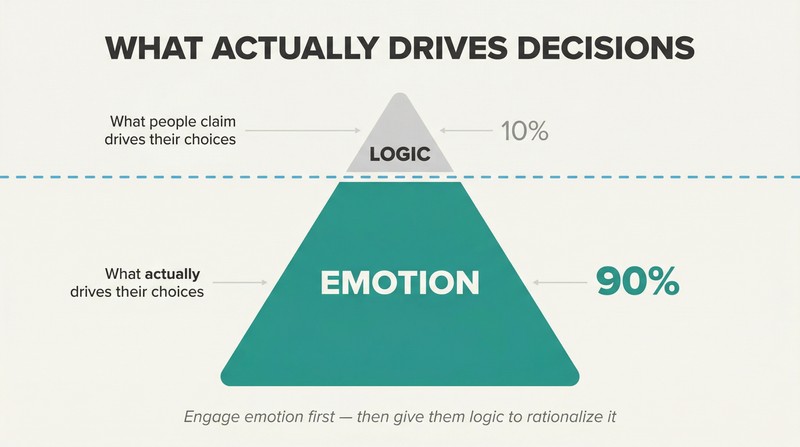
Persuade through emotion first, then hand them logic to justify it
Facts alone rarely move people. A sweepstakes company changed its slogan from "You can be a winner" to "You may already be a winner" and response rates surged — because the new phrasing triggered fear of losing something already possessed, which is far more powerful than hope of gaining something new.
Three ingredients for effective persuasion:
1. Arouse emotions — translate facts into feeling-based statements
2. Provide a specific game plan with clear steps forward
3. Emphasize what they'll prevent or avoid, not just what they'll gain
Potential loss consistently outperforms potential reward as a motivator. And if you come across as a know-it-all, credibility drops. Show some humility — "This is something I know I know" — and people listen harder.
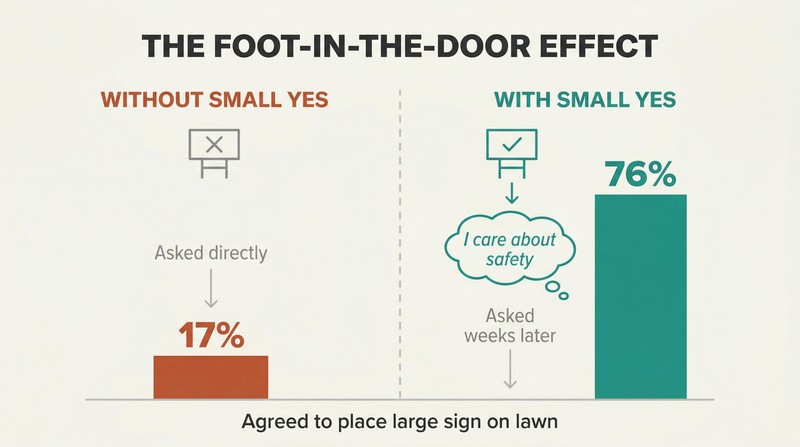
A tiny first yes rewires self-concept toward dramatically larger compliance
The foot-in-the-door technique is among the most replicated findings in social psychology. Freedman and Fraser (1966) asked homeowners to place a massive DRIVE CAREFULLY sign on their lawns — only 17% agreed. But residents first asked to display a tiny 3-inch window sign nearly all said yes. Weeks later, when asked about the huge sign, 76% consented. The small commitment reshaped their identity: "I'm someone who cares about driver safety."
Newton's law applies to people too. Objects in motion stay in motion. Break large requests into easy first steps. Effective fundraisers know the rule: the easiest donor to get is one who's given before. Start small, build momentum, and consistency does the heavy lifting.
Wrap requests in their identity — "you're the kind of person who…"
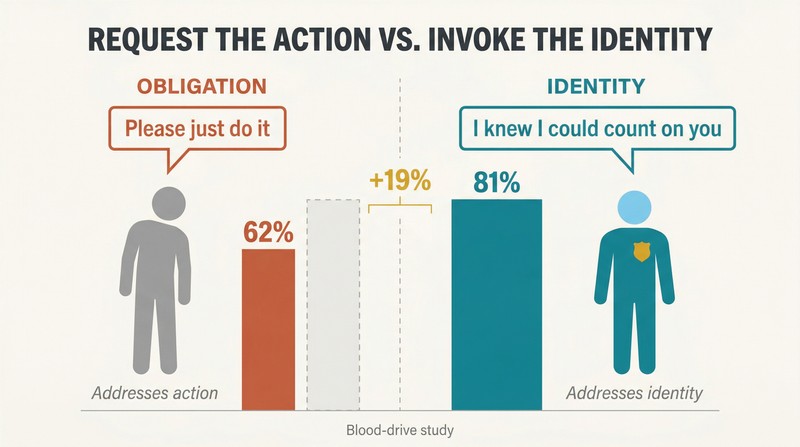
Identity beats obligation. When you say "I knew I could count on you — you always follow through," you weave the person's self-concept into the task. Abandoning it now means questioning who they are, not just disappointing you. Compare this with "Come on, please just do it" — which addresses actions, not identity, and invites the ego to generate excuses.
A blood-drive study found that ending reminder calls with "We'll count on seeing you then, okay?" and pausing for a response boosted show-up rates from 62% to 81%. One sentence, one verbal confirmation, a 20% increase. You can also invoke generic values — friendship, decency, loyalty — to raise the stakes. Now it's not just an isolated task; it defines the relationship.
The word "because" triggers near-automatic compliance
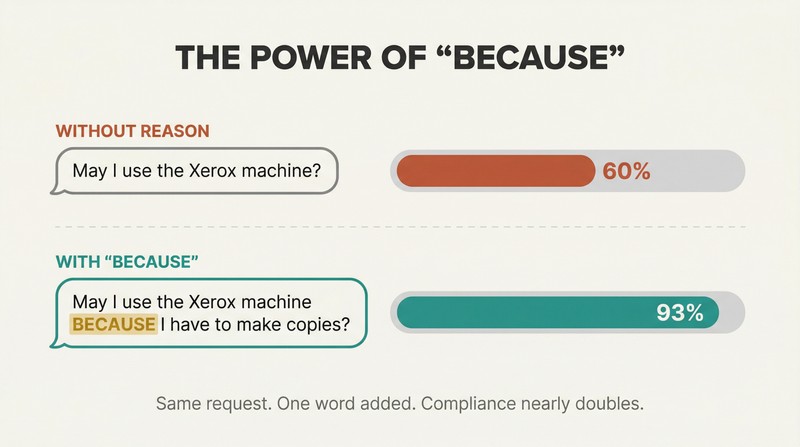
Even nonsensical reasons work. Psychologist Ellen Langer asked people at a copy machine "May I use the Xerox machine?" and just over half agreed. But "May I use the Xerox machine because I have to make copies?" — a completely circular reason — achieved near-universal compliance. The word "because" triggers an unconscious Pavlovian acceptance that a valid justification is coming.
Pair this with reverse reciprocity to decline requests guilt-free. When someone asks a favor you can't grant, say no with a "because," then immediately ask THEM for something they can't do. You say no, they say no, and the psychological ledger feels balanced. The conversation ends with zero hard feelings — and you never had to cave.
Remove all doubt from a relationship and passion dies instantly
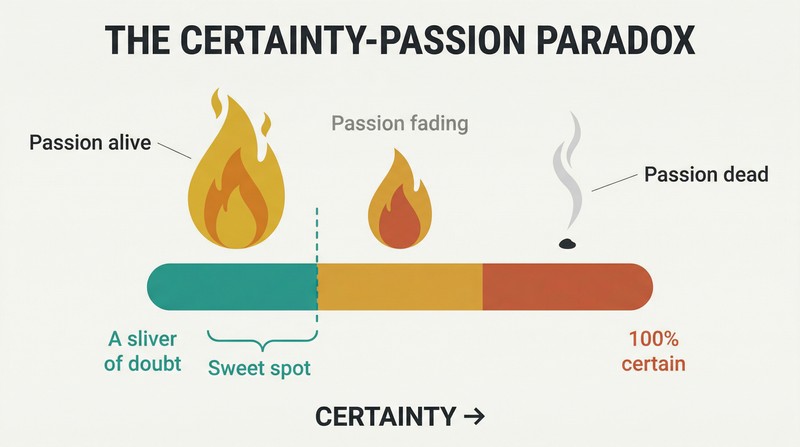
Certainty extinguishes desire. You never think about your hearing until a doctor suggests you might lose it. The same applies to relationships: when someone feels 100% secure that you'll always be there, appreciation evaporates. Passion requires a sliver of doubt.
Four leverage points prevent being taken for granted:
1. Availability — constant accessibility diminishes your value through the law of scarcity
2. Perspective — derive meaning from multiple sources so one person isn't your whole world
3. Doubt — introduce just enough uncertainty to reignite appreciation
4. How you make them feel — compliment who they are, but never declare "you're my entire world"
These are courtship-phase tactics rooted in ego. Once genuine love takes root, the author notes, more openness and availability actually deepen the bond.
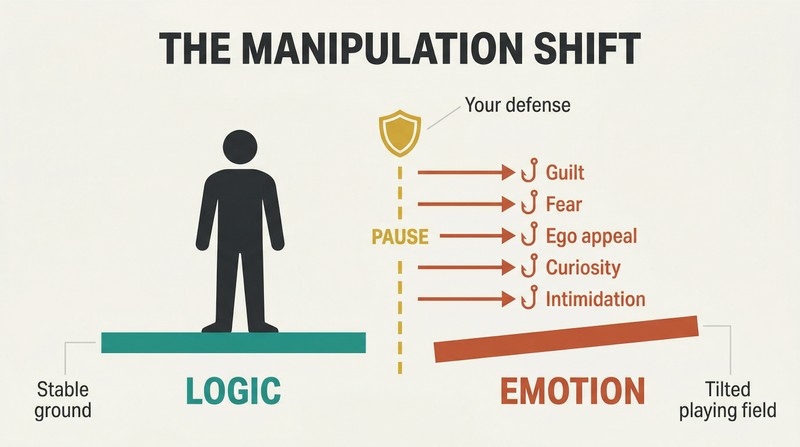
Spot manipulation by watching for guilt, fear, ego appeal, and curiosity plays
Seven deadly manipulators are the tools of anyone who can't win on facts alone: guilt ("I'm hurt you don't trust me"), intimidation ("Can't you make a decision?"), ego appeal ("You're too smart to miss this"), fear ("This is your last shot"), curiosity ("You only live once"), desire to be liked ("Everyone's counting on you"), and love ("If you loved me, you wouldn't question me").
The detection rule is simple: whenever an emotional pull replaces logical evaluation, pause. The manipulator knows the facts don't support their position, so they target your feelings instead. Temporarily suspend your emotions, examine both the message and the messenger, and never act quickly when these triggers fire.
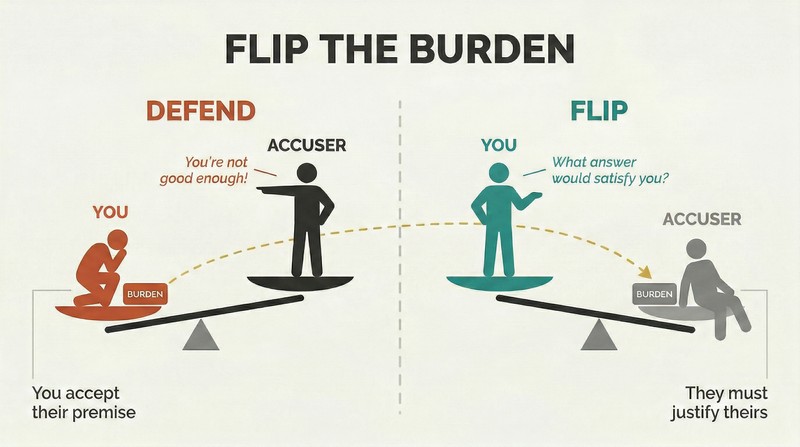
Never defend yourself — make the accuser justify their premise
"What answer would satisfy you?" is the most disarming phrase in any argument. The moment you defend yourself, you implicitly accept the accusation as worth addressing — and fight uphill from there. Worse, you've adopted their premise as the starting point of the debate.
Flip the burden instead. If someone says "You're not old enough for this," don't explain why you are. Ask: "How old would you like me to be?" Now they must defend a specific, often absurd claim. Each request for specifics weakens their position further. And if you're truly cornered, redirect entirely: "I think what you're really saying is..." then substitute an easier question. You answer the new version, never looking back — and never appearing to have dodged anything.
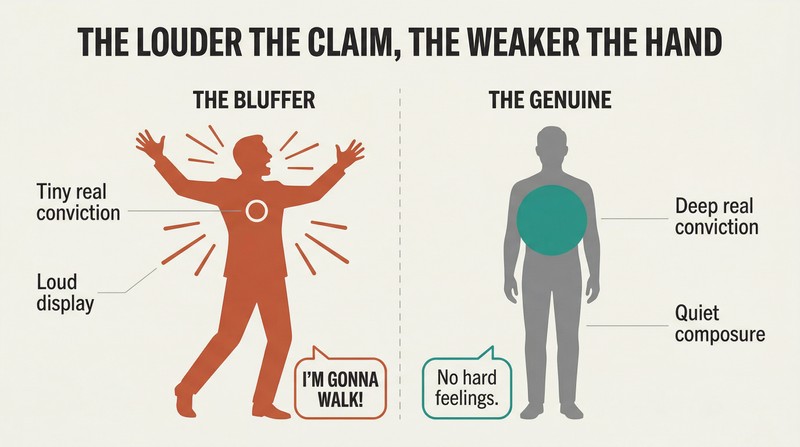
Real confidence is quiet — bluffers always overcompensate
Watch how someone performs certainty. A poker player who bets fast is trying to project fearlessness — which usually means he's bluffing. If he actually held great cards, he'd pause, pretending to deliberate. The same pattern governs negotiations: someone who keeps announcing "I'm gonna walk" is almost certainly staying. Bluffers create false impressions by overacting in the opposite direction of how they truly feel.
Genuine commitment sounds reluctant, not theatrical. A lawyer who sincerely plans to leave if denied a case appears solemn, even regretful — not bombastic. Phrases like "I'm sorry you feel that way" and "No hard feelings" signal real conviction. Overcompensation in any direction — too confident, too casual, too dramatic — is the universal tell that someone's position is hollow.
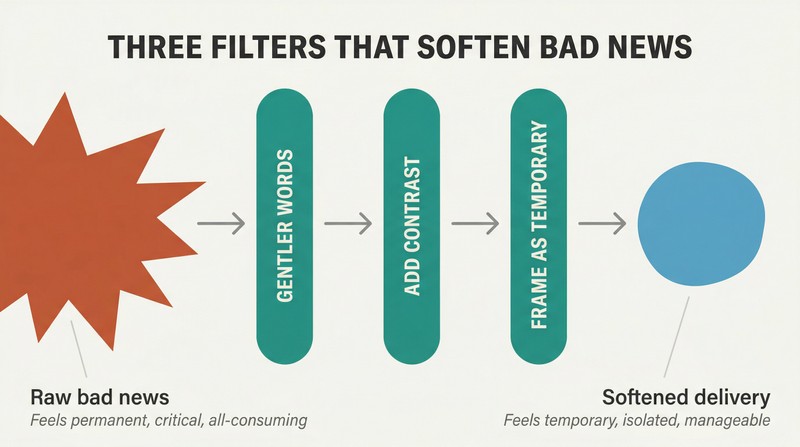
Soften bad news by choosing gentler words, adding contrast, and framing it as temporary
Words literally shape emotional reactions. Heaven's Gate cultists called their bodies "containers" — making self-destruction psychologically possible. Military jargon softens "civilian deaths" into "collateral damage." The principle works ethically too: a doctor who says "a variance in blood sugar levels" before introducing the word "diabetes" delivers the same facts with dramatically reduced psychological shock.
Three beliefs amplify distress:
1. The problem feels permanent
2. It feels critical — bigger than it really is
3. It feels all-consuming — invading every life area
Deflate all three by framing news as temporary, isolated, and manageable. Then add contrast — "it could have been much worse" — to automatically shift perspective. The calmer and more assured you appear delivering the news, the calmer the recipient will be.
Analysis
Lieberman's book occupies the space between Robert Cialdini's academic rigor in 'Influence' and Dale Carnegie's warmth in 'How to Win Friends and Influence People.' It's broader than both — spanning forty scenarios from boardroom negotiations to romantic relationships to physical self-defense — but necessarily thinner on any single topic. The strength lies in its formula-based approach: each principle reduces to step-by-step processes accessible to readers seeking immediate application over deep theoretical understanding.
The book draws on legitimate social psychology research — Freedman and Fraser's foot-in-the-door study, Langer's 'because' experiment, Zimbardo's deindividuation research — but packages it with promotional language that occasionally oversells. 'Get Anyone to Do Anything' is a bold title, and some techniques work better in controlled conditions than in the messiness of actual human relationships. The cognitive dissonance and consistency principles are well-applied; the relationship advice veers closer to game-playing territory that modern readers may find manipulative or dated.
The ethical framework deserves scrutiny. Lieberman frames influence as 'bringing out people's natural desires,' which holds for rapport-building but strains credibility for techniques designed to exploit reactance or engineer jealousy. The book is most valuable as a defensive tool: understanding the seven manipulators, spotting bluffs through overcompensation, and recognizing when someone is shifting you from logic to emotion are genuinely empowering skills that hold up two decades later.
The central insight — that behavior follows predictable laws which can be triggered through specific words and actions — remains the book's enduring contribution. Consistency, reciprocity, and scarcity are foundational principles of behavioral science that subsequent research has only strengthened. Where Lieberman excels is in the sheer density of practical applications; where he falls short is in acknowledging the limits of formulaic thinking when applied to complex, emotionally layered human beings.
Review Summary
Get Anyone to Do Anything and Never Feel Powerless Again receives mixed reviews. Some praise its practical psychological insights and everyday applicability, while others criticize it as manipulative or overpromising. Positive reviewers find the book helpful for understanding human behavior and improving social interactions. Critics argue the techniques are common knowledge or potentially deceptive. The book's straightforward style and short format are appreciated by many readers. Overall, opinions are divided on whether the book offers valuable persuasion tactics or oversimplifies complex social dynamics.
People Also Read









Glossary
Conundrum
Alibi-testing via false evidenceA lie-detection technique where you introduce a fabricated piece of evidence about a situation the person claims to have been part of. If innocent, they correct you instantly. If lying, they hesitate—unsure whether to confirm or deny something they can't verify—revealing deception through their delayed or incorrect response.
Similar Scenario
Verbal Rorschach for hidden behaviorA technique for discovering if someone is hiding something without making a direct accusation. You describe a parallel situation involving a third party and observe the person's reaction. If guilty of similar behavior, they become visibly uncomfortable and may defensively deny involvement. If innocent, they engage with interest and offer advice freely.
Foot-in-the-door technique
Small request enables larger complianceA persuasion method where agreeing to a small initial request dramatically increases willingness to comply with a much larger subsequent request. Based on Freedman and Fraser's 1966 study where homeowners who first agreed to a tiny window sign later consented to a huge lawn sign at a rate of 76% versus 17% for those asked directly.
Reactance
Resistance from restricted freedomA psychological phenomenon where people resist or do the opposite of what is asked when they feel their freedom is being limited or taken away. Identified by Rhodewalt and Davison (1983), reactance explains why hard-sell tactics backfire and why prohibitions often increase desire for the forbidden behavior or object.
The Crowbar
Test for true closed-mindednessA technique to gauge how open-minded someone really is about a request. You propose a seemingly impossible challenge—like guessing a number they've written down—and ask them to agree to your request if you succeed. If they refuse even this remote bet, they're truly immovable. If they accept, they've shifted from 'no' to 'maybe,' subtly adjusting their belief system.
Primacy Effect
First impressions filter everything afterThe psychological process whereby a first impression causes all subsequent information about a person to be interpreted through that initial lens. Demonstrated by Harold Kelley's 1950 study where students given the word 'warm' versus 'cold' as the first descriptor of a guest lecturer formed dramatically different impressions despite identical remaining descriptions.
Globalizing
Broadening an offensive remark's targetA damage-control technique for recovering from an inadvertently offensive statement. Instead of apologizing or defending, you immediately expand the comment to include a larger group, diluting its personal impact. For example, after calling a coworker incompetent, adding '…along with everyone else in the damn company' shifts the comment from personal attack to general frustration.
FAQ
What's "Get Anyone to Do Anything" about?
- Overview: "Get Anyone to Do Anything" by David J. Lieberman is a guide to using psychological techniques to influence and control various situations in life. It aims to empower readers by providing strategies to handle interpersonal interactions effectively.
- Purpose: The book is designed to help readers feel less powerless by teaching them how to detect deceit, change minds, and control situations using psychological principles.
- Structure: It is divided into sections that cover topics like getting people to like you, avoiding manipulation, taking control of situations, winning competitions, and making life easier.
- Application: The techniques are presented as easy-to-follow formulas that can be applied to real-life scenarios, making them accessible to anyone looking to improve their social interactions.
Why should I read "Get Anyone to Do Anything"?
- Empowerment: The book offers tools to help you feel more in control of your interactions and relationships, reducing feelings of powerlessness.
- Practical Techniques: It provides actionable strategies that can be applied immediately to improve your ability to influence others and navigate social situations.
- Wide Applicability: Whether you're dealing with personal relationships, professional environments, or competitive situations, the book offers insights that can be universally applied.
- Psychological Insights: It delves into human behavior and psychology, offering a deeper understanding of why people act the way they do and how you can use this knowledge to your advantage.
What are the key takeaways of "Get Anyone to Do Anything"?
- Influence and Control: Learn how to influence others and control situations using psychological tactics that are based on human behavior principles.
- Avoid Manipulation: The book teaches you how to recognize and avoid being manipulated by others, ensuring you maintain control over your decisions.
- Effective Communication: It emphasizes the importance of communication skills in influencing others and provides techniques to improve your interactions.
- Self-Improvement: By understanding and applying these psychological strategies, you can improve your personal and professional relationships, leading to a more successful and fulfilling life.
How can I get anyone to like me, according to David J. Lieberman?
- Law of Association: Pair yourself with positive stimuli to create favorable associations in others' minds, making them more likely to like you.
- Repeat Exposure: Increase your interactions with someone, as familiarity tends to breed fondness rather than contempt.
- Reciprocal Affection: Show that you like and respect the person, as people tend to like those who like them.
- Rapport Building: Match the person's gestures, speech patterns, and interests to create a sense of similarity and connection.
What strategies does "Get Anyone to Do Anything" suggest for avoiding manipulation?
- Recognize Manipulation Tactics: Be aware of common manipulation tactics like guilt, intimidation, and appeal to ego, and learn to identify them in interactions.
- Stay Objective: Focus on the facts and avoid letting emotions cloud your judgment when dealing with potential manipulators.
- Set Boundaries: Clearly define your limits and communicate them to others to prevent being taken advantage of.
- Trust Your Instincts: If something feels off, trust your gut and take a step back to reassess the situation before making decisions.
How does David J. Lieberman suggest taking control of any situation?
- Limit Options: Narrow down choices to make decision-making easier and faster for others, increasing the likelihood of them taking action.
- Set Deadlines: Create a sense of urgency by giving clear deadlines, motivating people to act promptly.
- Use Inertia: Start with small requests to build momentum and increase the likelihood of compliance with larger requests.
- Expect Compliance: Act confidently and expect others to follow your lead, as people often respond to perceived authority.
What are the best quotes from "Get Anyone to Do Anything" and what do they mean?
- "People want what they can’t have." This quote highlights the psychological principle of scarcity, which suggests that people value things more when they perceive them as rare or difficult to obtain.
- "The fastest way to lose leverage is to make yourself completely available." This emphasizes the importance of maintaining a sense of mystery and not being overly accessible to maintain interest and influence.
- "Confidence in one’s position usually speaks for itself." This suggests that true confidence doesn't require constant validation or defense, and that genuine self-assurance is often self-evident.
- "We like people who are similar to us." This reflects the principle of similarity, which states that people are more likely to be attracted to and influenced by those who share their interests and values.
How can I win at any competition, according to "Get Anyone to Do Anything"?
- Home Field Advantage: Whenever possible, compete in familiar surroundings to increase your comfort level and decrease your opponent's.
- Social Facilitation: Use the presence of others to enhance your performance if you are skilled, but avoid audiences if you lack confidence.
- Surprise and Deception: Employ unexpected tactics to catch your opponent off guard and gain a strategic advantage.
- Mental Preparation: Focus on your objective, rehearse mentally, and have a backup plan to ensure you're ready for any outcome.
What does David J. Lieberman say about making a fantastic first impression?
- Smile: A genuine smile conveys confidence, happiness, and acceptance, making a positive first impression.
- Primacy Effect: The first impression sets the tone for future interactions, so make sure it's favorable to influence subsequent perceptions.
- Accessibility and Priming: Use positive language and imagery to create a favorable mental association before meeting someone.
- Be Prepared: Have a clear understanding of what you want to convey and be ready to adapt to the situation to ensure a strong first impression.
How can I get someone to follow through on a commitment, according to "Get Anyone to Do Anything"?
- Invoke Internal Consistency: Remind the person of their past reliability and the importance of following through to maintain their self-image.
- Create a Sense of Obligation: Let them know that you are counting on them and that their commitment is important to you.
- Verbal Confirmation: Secure a verbal agreement to reinforce their commitment and increase the likelihood of follow-through.
- Offer Support: Provide assistance or resources to help them fulfill their commitment, making it easier for them to follow through.
How does "Get Anyone to Do Anything" suggest handling difficult questions or arguments?
- Avoid Defensiveness: Do not get defensive or accept the premise of a negative question, as this puts you at a disadvantage.
- Ask for Clarification: Request specifics about the question or statement to shift the focus and gain control of the conversation.
- Redirect the Question: Change the question to one you can answer confidently, allowing you to steer the conversation in a more favorable direction.
- Use Conversation Stoppers: Employ phrases that cause the other person to pause and reconsider, giving you time to regroup and respond effectively.
What are the psychological secrets of leadership according to David J. Lieberman?
- Identification with Others: Effective leaders align their interests with those they lead, showing genuine care and concern for their well-being.
- Humility: Leaders who demonstrate humility and avoid ego-driven behavior are more likely to gain trust and respect from their followers.
- Simplicity and Clarity: Clear, simple, and organized communication is essential for inspiring and guiding others effectively.
- Charisma through Respect: Charismatic leaders make others feel valued and important, fostering loyalty and cooperation among their followers.
About the Author
Other books by David J. Lieberman




Download PDF
Download EPUB
.epub digital book format is ideal for reading ebooks on phones, tablets, and e-readers.








































