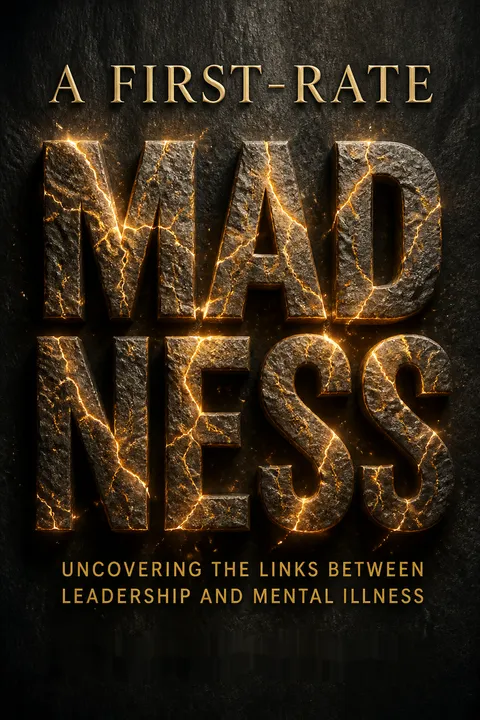

Key Takeaways
1. The Inverse Law of Sanity: Crisis Leaders Thrive on Mental Abnormality
When our world is in tumult, mentally ill leaders function best.
Counterintuitive truth. We instinctively believe sanity produces good results and insanity is a problem. However, in times of crisis, the opposite is often true: mentally ill or abnormal leaders are better equipped to navigate turmoil than their mentally healthy counterparts. This challenges our fundamental assumptions about leadership and mental well-being.
Leadership for context. Different situations demand different leaders. While mentally healthy individuals excel in stable, peaceful times, their idealism and optimism can be detrimental during crises. Crisis leaders, often tested by adversity and less conventional, are uniquely suited for turbulent periods.
Historical precedent. This idea isn't new; Aristotle first speculated on the link between genius and madness 2,500 years ago. While some, like Francis Galton, argued for "sanity = genius," this book aligns with Cesare Lombroso's view that "insanity = genius," albeit with crucial qualifications.
2. Mental Illness Bestows Four Critical Leadership Traits
Four key elements of some mental illnesses—mania and depression—appear to promote crisis leadership: realism, resilience, empathy, and creativity.
Specific advantages. These aren't vague character traits but scientifically studied qualities. The book argues that depression enhances realism and empathy, while mania (or hyperthymia, a milder form) boosts creativity and resilience. These traits are often absent or underdeveloped in mentally healthy individuals during crises.
Beyond common sense. The book uses these terms in their scientific, not commonsense, meanings. For instance, "realism" in depression refers to a clearer perception of reality, not just pessimism. "Empathy" is a neurobiological fact, not just a feeling.
Not all illnesses. It's important to note that these benefits are primarily associated with mood disorders like depression and bipolar disorder, not other conditions like schizophrenia or anxiety disorders. The specific nature of these illnesses, with their episodic nature and intense experiences, can leave a lasting legacy of these advantageous traits.
3. Mania Fuels Creativity and Unyielding Drive
Creativity, then, involves finding novel problems and solving them. Following the thinking of Aristotle and the nineteenth-century psychiatrist Cesare Lombroso, I believe that mental illness—and specifically mania—is a fine advantage in this process.
Divergent thinking. Mania, characterized by "flight of ideas," hyperactivity, and rapid thought, naturally fosters divergent thinking—the ability to generate many unusual solutions to a problem. Manic individuals often see connections between disparate things that others miss, leading to "integrative complexity."
Unconventional solutions. This creative energy allows leaders to identify and solve problems in novel ways, often by reframing the problem itself.
- William Tecumseh Sherman: Faced with a stalemate in traditional warfare, Sherman conceived of "total war"—destroying the South's economic and moral heart to break its will, rather than just its armies. His manic energy fueled his relentless "March to the Sea."
- Ted Turner: Instead of competing in traditional media, Turner saw the untapped potential of cable. He launched CNN with audacious financial risks, preempting competitors by creating CNN2 (Headline News) almost spontaneously.
Double-edged sword. While mania can lead to groundbreaking innovation, it can also create new problems. Sherman's strategy, though effective, set a precedent for targeting civilians. Turner's 24-hour news cycle, while revolutionary, also ushered in an era of endless punditry.
4. Depression Cultivates Profound Realism and Empathy
Depression reveals the truth of empathy, and empathy, in turn, engenders unexpected powers of leadership.
"Sadder but wiser." Research on "depressive realism" shows that depressed individuals often perceive reality more accurately than mentally healthy people, who tend to harbor "positive illusions" about their control and optimism. This realism is especially pronounced when stakes are high.
Empathy through suffering. Depression, particularly its intense emotional identification with suffering, can deepen a leader's empathy. This isn't just cognitive understanding but a visceral "feeling into" another's experience, fostering a profound sense of interdependence.
- Abraham Lincoln: His lifelong battles with depression (including suicidal ideation) cultivated a realism that allowed him to understand the complexities of slavery and the necessity of war, alongside an empathy that evolved to embrace racial equality. His Second Inaugural Address, "with malice toward none, with charity for all," reflected this blend.
- Mahatma Gandhi & Martin Luther King Jr.: Both suffered severe depressive episodes and attempted suicide as teenagers. They pioneered a "politics of radical empathy," believing that understanding and goodwill, even for adversaries, could transform conflict. Their non-violent resistance was "aggressive spiritually," channeling anger into courage to suffer rather than inflict harm.
Limits of empathy. While powerful, empathy has its limits. Gandhi's attempts to appeal to Hitler's humanity were politically naive, and his vision of non-violence ultimately failed to prevent Hindu-Muslim partition, as his followers lacked his profound empathic capacity.
5. Hyperthymic Personality and Adversity Forge Resilience
Like a mental vaccine, resilience develops when, under certain circumstances, we experience harmful events, we survive, and then prosper.
The "steeling effect." Resilience is the ability to achieve good outcomes despite serious threats. It's not just innate but can be developed through exposure to hardship, acting like a "mental vaccine" that prepares individuals for future stresses.
Hyperthymia as immunity. A hyperthymic personality—characterized by high energy, sociability, optimism, and openness to experience—acts as an "innate immunity" to trauma. These individuals are often witty and charismatic, drawing social support that further enhances their resilience.
- Franklin D. Roosevelt: Despite being paralyzed by polio at 39, FDR's hyperthymic temperament (boundless energy, sociability, humor, intellectual curiosity) allowed him to not only survive but thrive. His illness, though devastating, "purged the slightly arrogant attitude he had displayed" before, deepening his empathy and making him uniquely suited to lead through the Great Depression and World War II.
- John F. Kennedy: Battling life-threatening Addison's disease and other ailments since childhood, JFK's hyperthymic traits (high libido, energy, charm, wit, risk-taking) enabled him to push through constant physical crises. His repeated near-death experiences, as his father noted, made him fearless and resilient.
Growth from trauma. The paradox of trauma is that it can lead to "post-traumatic growth." Individuals with some, but not excessive, life traumas often report the highest subjective well-being, suggesting that overcoming adversity can make one stronger.
6. Psychotropic Treatments Can Dramatically Alter Leadership Outcomes
The great physician William Osler once said that all medicines are toxic; it is how they’re used that makes them therapeutic.
A double-edged sword. Medications, especially psychoactive ones, can profoundly influence a leader's behavior, either enhancing their strengths or exacerbating their weaknesses. The art of medicine lies in knowing how and when to use them.
Kennedy's "psychochemical success." John F. Kennedy's presidency saw a shift from early failures (Bay of Pigs, weak Vienna summit) to later successes (Cuban Missile Crisis, civil rights advocacy). This transformation coincided with a "medical coup d'état" that brought his steroid and amphetamine abuse under control.
- Initial misuse: Kennedy initially self-medicated with excessive anabolic steroids and amphetamines, contributing to erratic judgment and hypersexuality.
- Regulated treatment: Once his physicians regulated his regimen, the drugs, combined with his hyperthymic personality, pharmacologically enhanced his natural resilience and decisiveness, leading to his later triumphs.
Hitler's "spectacular disaster." Adolf Hitler, likely suffering from bipolar disorder, experienced a catastrophic decline in leadership after 1937, when he began daily intravenous amphetamine abuse.
- Exacerbated illness: The amphetamines worsened his manic and depressive episodes, leading to increasingly unrealistic, overoptimistic, and inflexible decision-making.
- Psychotic-like states: This drug-induced cycling, combined with his underlying bipolar disorder, likely pushed him into paranoid and near-psychotic states, contributing to the world's destruction.
7. "Homoclite" (Mentally Healthy) Leaders Often Fail in Crisis
The best crisis leaders are either mentally ill or mentally abnormal; the worst crisis leaders are mentally healthy.
The "normal" problem. "Homoclites" are statistically average, mentally healthy individuals who are stable, efficient, and conformist. While excellent in peacetime, their very normality can be a liability during crises, leading to poor judgment and inflexibility.
Peacetime success, wartime failure.
- Neville Chamberlain: An eminently sane, competent administrator, Chamberlain excelled in domestic policy and economic stewardship. However, his optimistic "appeasement" of Hitler, rooted in a rational but unrealistic belief that tyranny could be confronted with logic, proved disastrous. His sanity blinded him to the impending war.
- George McClellan: A brilliant peacetime officer and successful businessman, McClellan was promoted to lead the Union Army. His unwavering self-confidence and inability to adapt to the brutal realities of Civil War (e.g., refusing to attack, blaming others) led to repeated failures against Robert E. Lee.
- George W. Bush & Tony Blair: Both were successful homoclite leaders in peacetime, known for their amiability, moderate politics, and religious conviction. However, their responses to 9/11—a straightforward "attack them, invade them" logic—lacked the integrative complexity, empathy, and realism needed for the ensuing geopolitical crisis, leading to prolonged and costly wars based on flawed premises.
Conformity's cost. Homoclites, by nature, tend to conform to prevailing opinions and struggle to admit error, making them ill-suited for situations demanding radical shifts in perspective or strategy.
8. The "Hubris Syndrome": Power Magnifies Illusions in the Sane
I believe that power magnifies positive illusion into the Hubris syndrome.
Power's corrupting influence. While normal people possess "positive illusions" (a healthy overestimation of self and optimism), prolonged exposure to power can magnify these into "Hubris syndrome." This disorder of power makes leaders unwilling or unable to accept criticism, interpret events objectively, or appreciate dissenting views.
Symptoms of hubris. Leaders afflicted with Hubris syndrome often:
- Become unresponsive to opposing views.
- Speak in the royal "we."
- Presume the beneficial judgment of history or God.
- Ignore public opinion and demean dissent.
- Rigidly hold beliefs against contrary evidence.
Blair's transformation. Tony Blair, initially a thoughtful and receptive politician, exhibited this transformation. David Owen observed that by 2002, embroiled in Iraq war planning, Blair had become "messianic," no longer listening to challenging viewpoints and prioritizing "doing what was right" over "being in touch" with opinion. His initial rationale for war evolved into blaming Islam itself, demonstrating a rigid adherence to a flawed premise.
Antidotes to hubris. Term limits and checks and balances are designed to curb hubris, but they are not always effective. A leader who is not too mentally healthy, particularly one with depressive realism, might be naturally inoculated against this syndrome.
9. Overcoming Stigma is Crucial for Recognizing Leadership Potential
Our leaders cannot be perfect; they need not be perfect; their imperfections indeed may produce their greatness.
Deep-seated bias. The stigma against mental illness is profound, often surpassing racism or sexism. It leads us to instinctively view mental illness as "other" and purely negative, preventing us from recognizing its potential benefits.
Challenging conventional morality. We often conflate "good character" (kindness, self-control, moral rectitude) with effective leadership. However, this book argues that personal vices (hypersexuality, alcoholism, dishonesty, arrogance, recklessness)—often linked to mood disorders—can be inseparable from the strengths that make great leaders.
- Lincoln's vices: His depression and occasional ruthlessness.
- Churchill's vices: His alcoholism and aggressive temperament.
- Kennedy's vices: His hypersexuality and risk-taking.
- Gandhi's vices: His coldness towards family and occasional arrogance.
The "Eagleton effect." The political fallout from Senator Thomas Eagleton's admission of depression in 1972 illustrates how deeply ingrained this stigma remains. Modern politics often favors "no drama" leaders, psychologically moderate and middle-of-the-road, rather than the charismatic, emotional, or "abnormal" individuals who often become great crisis leaders.
A call for re-evaluation. We must move beyond simplistic, Manichean judgments. Recognizing that "abnormal" personal character traits, especially those linked to mental illness, can indicate better political leadership for abnormal challenges is a crucial step towards a more objective and fair understanding of mental illness and leadership.
Review Summary
A First-Rate Madness explores the controversial idea that mentally ill leaders perform better in crises than mentally healthy ones. Reviews are mixed, with some praising its engaging writing and thought-provoking thesis, while others criticize its cherry-picked examples and loose definitions of mental illness. Many readers found the historical anecdotes interesting but questioned the scientific validity of the author's claims. Some appreciated the destigmatizing approach to mental illness, while others felt the book oversimplified complex issues of leadership and psychology.
People Also Read


Download PDF
Download EPUB
.epub digital book format is ideal for reading ebooks on phones, tablets, and e-readers.








































