

Key Takeaways
Replace moral posturing with data — surprising truths emerge
Freakonomics is economics unchained. The book argues economics isn't about stock markets or GDP — it's about how people respond to incentives. Levitt and Dubner identify three flavors: economic (fines and bonuses), social (peer pressure and shame), and moral (guilt and altruism). The anti-smoking campaign deploys all three simultaneously: sin taxes, restaurant bans, and linking cigarettes to terrorism.
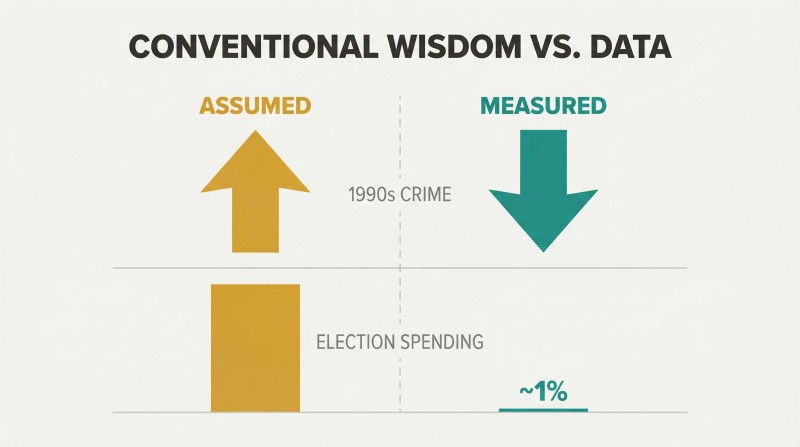
The core premise: strip away moral posturing, measure what actually happens, and conventional wisdom — those comfortable, convenient beliefs — often collapses. Crime experts unanimously predicted a 1990s apocalypse; crime plummeted. Everyone assumed money won elections; data from nearly 1,000 Congressional rematches showed doubling spending shifted votes by just 1%. The right question, paired with data, beats any expert's gut.
A tiny, misdesigned incentive can destroy the moral one it replaces
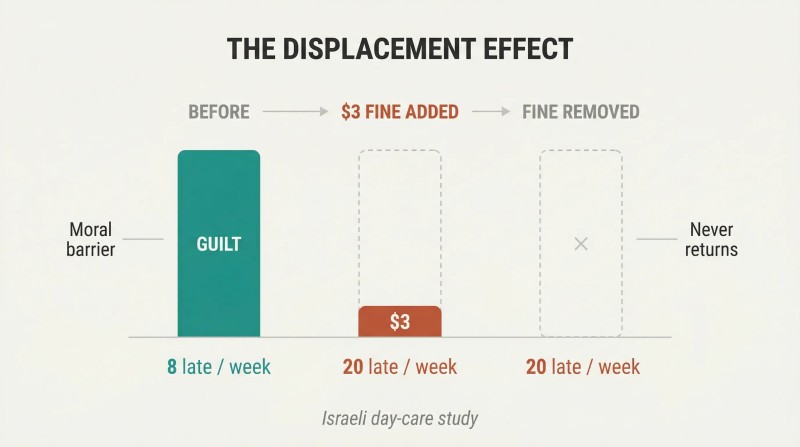
Small prices erase big guilt. When Israeli day-care centers imposed a $3 fine for late pickups, tardiness more than doubled — from 8 incidents per week to 20. The fee was too cheap to deter anyone but expensive enough to erase parents' guilt. They'd effectively bought the right to be late. When the fine was later removed, lateness stayed high — the moral incentive had been permanently displaced.
The same pattern emerged with blood donors. When researchers offered small payments for donating blood instead of relying on altruism, donations fell. The lesson extends broadly: layering a cheap financial incentive on top of a moral one doesn't create a double deterrent — it creates a permission slip. Once you put a price on virtue, virtue exits the building.
Your real-estate agent profits by selling your house fast, not well
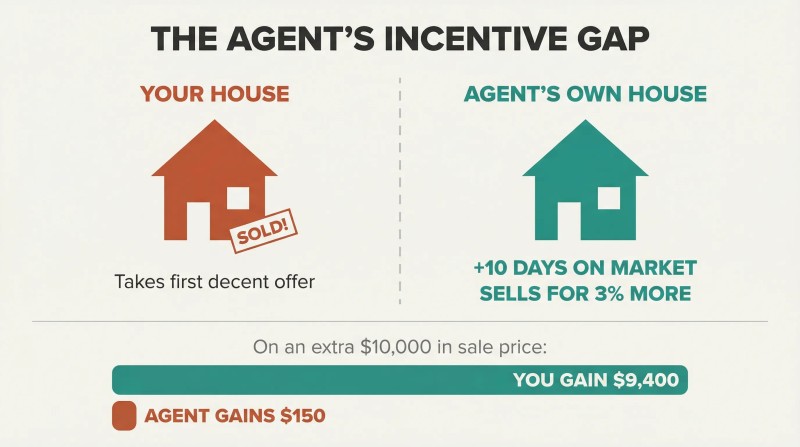
The commission math is damning. On a $300,000 home, a typical 6% commission yields $18,000 — but after the buyer's agent and the agency each take their cut, your agent pockets just 1.5%, or $4,500. If she could sell your home for $310,000, you'd gain an extra $9,400 — but she'd gain only $150. That's not enough incentive to hold out for a better deal.
Data from nearly 100,000 Chicago home sales confirms the conflict. Agents keep their own homes on the market an average of 10 extra days and sell them for over 3% more — roughly $10,000 on a $300,000 house. Even their ad language shifts: selling your house, agents use vague terms like "charming" (code for old); selling their own, they emphasize specifics like "granite" and "maple."
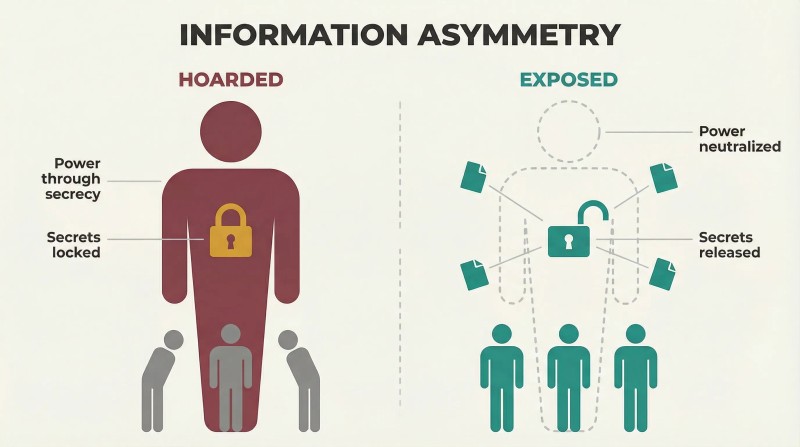
Expose a group's hoarded secrets to neutralize its power
The KKK's power came from secrecy. In the 1940s, activist Stetson Kennedy obtained inside information about the Klan — its passwords, rituals, and ridiculous hierarchy (the "Chief Ass Tearer," the "Kloran") — largely through an infiltrator named John Brown. Kennedy fed these secrets to the Superman radio show and journalist Drew Pearson, turning the Klan's mystique into a national joke. Membership and attendance dropped.
The same principle toppled commercial experts. Economists call it information asymmetry — one party knowing far more than the other. It's what gives funeral directors, car dealers, and insurance companies their edge. When comparison websites for term life insurance launched in 1996, consumers could suddenly see competing prices side by side. Premiums dropped by $1 billion per year almost overnight. Secrecy is fragile; transparency is lethal.
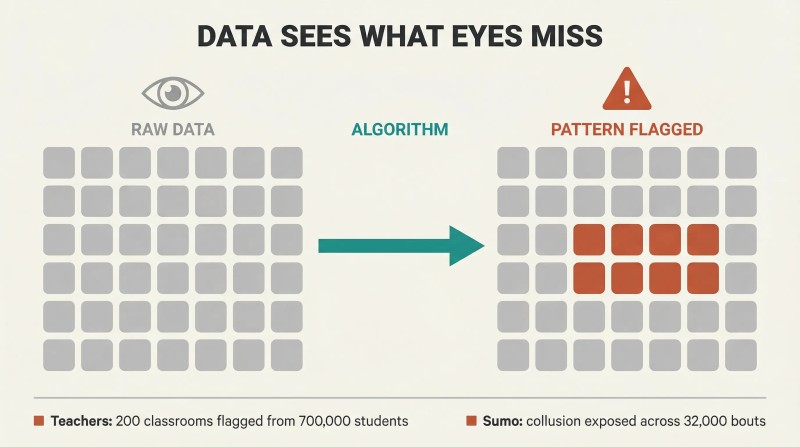
Data catches cheaters that human eyes miss
Chicago's teacher-cheating algorithm analyzed 100 million test answers across 700,000+ students. It flagged classrooms where blocks of identical correct answers appeared among struggling students — especially on hard, late-exam questions — followed by dramatic score drops the next year. About 200 cheating classrooms (~5%) were identified annually. When suspected rooms were retested under independent supervision, scores plunged a full grade level. A dozen teachers were fired, and cheating fell over 30%.
Sumo wrestling told the same story. Among 32,000 bouts, wrestlers needing one more win (7-7 record) beat opponents with nothing at stake (8-6 record) nearly 80% of the time — far above the expected 50%. In rematches, that figure dropped to 40%, suggesting quid pro quo deals across the sport.
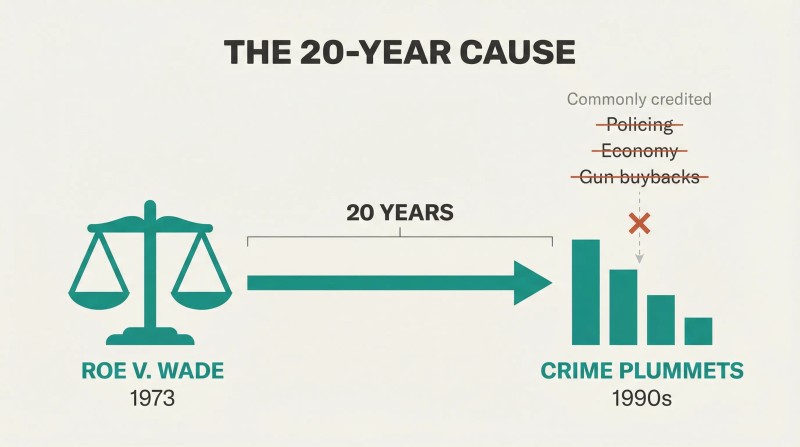
Legalized abortion — not policing — drove the 1990s crime drop
The book's most provocative claim. Every criminologist predicted crime would surge in the 1990s. Instead, it plummeted. The commonly credited explanations were mostly wrong: the economy has virtually no link to violent crime; NYC's policing strategies coincided with a 45% expansion of its police force, and accounting for that hiring, NYC's drop was merely average; gun buybacks prevented less than one-tenth of one homicide per program.
The real cause was 20 years old. After Roe v. Wade (1973), millions of women — disproportionately poor, unmarried, and teenage — chose not to carry unwanted pregnancies to term. Their unborn children would have entered crime-prone years in the early 1990s. The five states that legalized abortion before Roe saw crime decline earlier. States with the highest 1970s abortion rates experienced the greatest 1990s crime drops.
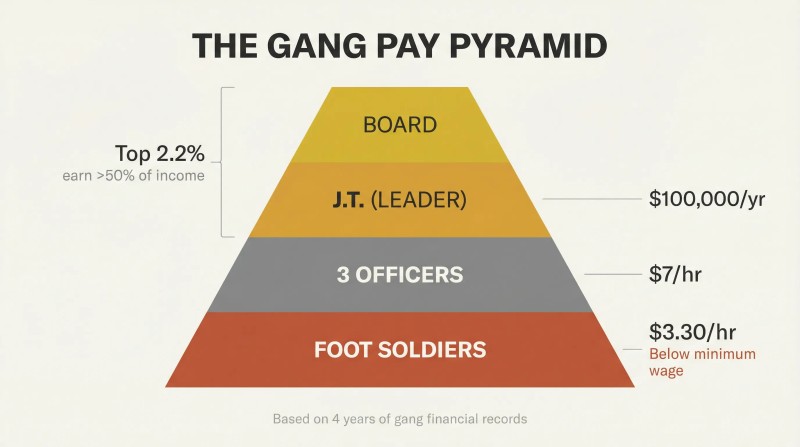
Crack gangs pay like McDonald's: $3.30/hour at the bottom
Sociologist Sudhir Venkatesh spent six years embedded with a Chicago crack gang and obtained four years of its financial ledgers. The gang operated like a franchise: a local leader (J.T.) paid roughly 20% of revenues to a "board of directors" for exclusive selling territory. J.T. earned ~$100,000/year. His three officers made about $7/hour. Street-level foot soldiers earned $3.30/hour — below minimum wage. Most held legitimate side jobs.
The economics mirror a tournament. Just as aspiring actors endure waitressing for a shot at stardom, foot soldiers accepted terrible pay and a 1-in-4 chance of being killed over four years — worse odds than Texas death row — for the slim hope of climbing the pyramid. The top 120 leaders (2.2% of membership) captured more than half the gang's total income.
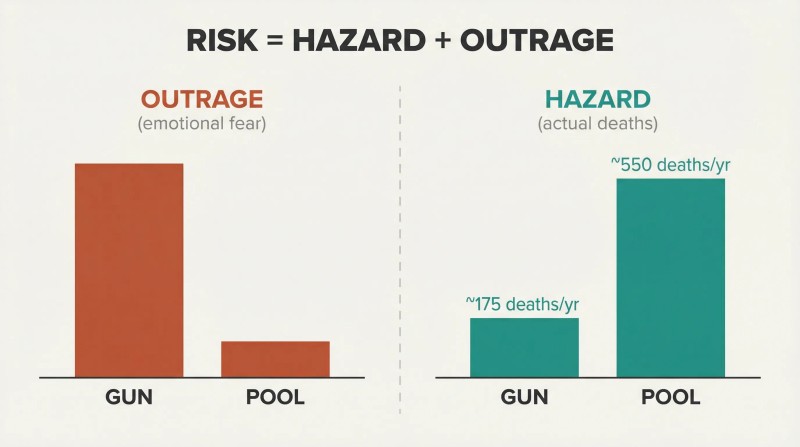
A swimming pool is 100x more deadly to children than a gun
Parents routinely ban playdates at homes with guns while sending children to homes with pools. The data says this is backward. There is one child drowning per 11,000 residential pools (~550 under-ten deaths per year) versus one child killed by a gun per 1 million-plus guns (~175 deaths). Yet a gun death is dramatic and horrifying; a drowning is quiet and familiar.
Risk consultant Peter Sandman distills the problem: Risk = hazard + outrage. When outrage is high but hazard low, we overreact (mad-cow disease, terrorism). When hazard is high but outrage low, we underreact (pools, kitchen pathogens). The same logic explains why we fear flying more than driving despite roughly equal per-hour death rates. Experts exploit this gap — fear is a short-term play in a world impatient with long-term processes.
Parenting technique is overrated — who you are matters more
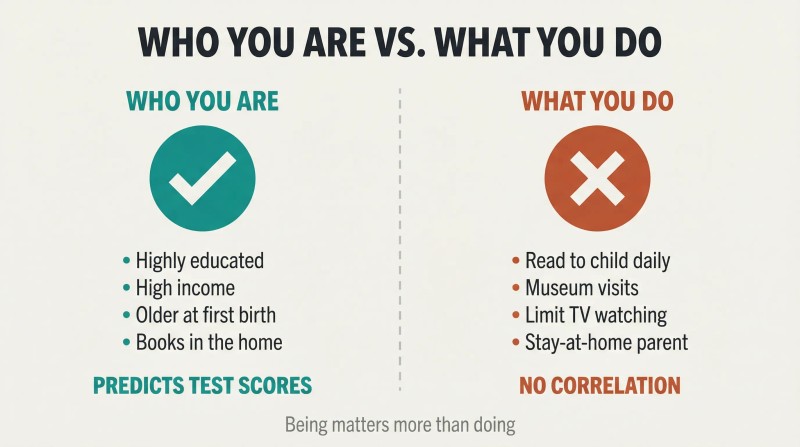
The Early Childhood Longitudinal Study (ECLS) tracked 20,000+ children from kindergarten through fifth grade. Eight factors correlated with strong test scores:
1. Highly educated parents
2. High socioeconomic status
3. Mother 30+ at first birth
4. English spoken at home
5. Parents in the PTA
6. Many books in the home
7. Child not adopted
8. Child not low birthweight
Eight factors showed no correlation: intact family, move to a better neighborhood, stay-at-home mom, Head Start, museum visits, spanking, TV watching, and being read to daily.
The pattern is stark. Factors that matter describe who parents are — education, age, economic standing. Factors that don't matter describe what parents do — museum trips, bedtime stories, TV rationing. Technique, it turns out, is highly overrated compared to the identity you've already built.
Names signal parental background, not a child's destiny
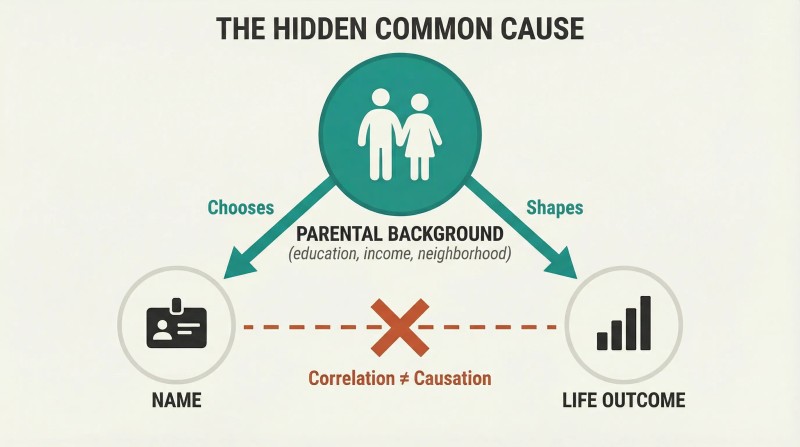
Winner Lane racked up three dozen arrests. His brother Loser became a police detective and sergeant. Their father named them to test whether names shape destiny. The data's answer: they don't.
California birth-certificate data spanning 16 million births shows that people with distinctively black names — DeShawn, Imani — do have worse average life outcomes than those named Jake or Molly. But controlling for neighborhood and family circumstances, the gap vanishes. DeShawn's name doesn't cause disadvantage; it reflects the socioeconomic conditions of parents who choose it. The same logic explains why children surrounded by books test better — not because books are magic, but because parents who buy them tend to be educated. Confusing indicators with causes is one of the most common errors in everyday reasoning.
Analysis
Freakonomics arrived in 2005 as a Trojan horse. Packaged as pop entertainment — sumo scandals, crack dealers' budgets — it smuggled in a genuinely radical epistemological argument: that most expert knowledge about social phenomena is really conventional wisdom laundered through credentials and media repetition. The book's deepest contribution isn't any single finding; it's the demonstration that a handful of analytical principles — follow incentives, distinguish correlation from causation, exploit natural experiments — can overturn decades of received wisdom.
The book essentially invented a genre. Before Freakonomics, the idea that an economist might study sumo wrestling or baby names was considered trivial. Levitt's work helped legitimize an empirical, question-driven approach to social science that prioritized clever identification strategies over grand theory. This 'credibility revolution' in economics has since transformed the discipline, with natural experiments now considered the gold standard.
The book has aged unevenly. The abortion-crime thesis remains hotly debated — subsequent scholars have both supported and challenged the findings, and the authors themselves had to correct an error identified by Foote and Goetz while arguing their corrected results still held. The real estate agent study anticipated the broader collapse of trust in expert intermediaries that platforms like Zillow would accelerate. The parenting chapter's emphasis on 'who you are' over 'what you do' presaged the behavioral genetics revolution that has only strengthened the case for genetic influence.
What's most striking in retrospect is the book's studied amorality — its insistence that economics describes how the world works without prescribing how it should. This gives intellectual freedom but sometimes reads as evasion. The abortion-crime chapter carefully avoids policy recommendations, leaving readers with a powerful statistical relationship and no guidance on what to do with it. That tension — between the power of data to reveal uncomfortable truths and the inadequacy of data alone to resolve moral questions — remains the book's most productive provocation.
Review Summary
Freakonomics receives mixed reviews, with praise for its interesting topics and unconventional approach to economics, but criticism for oversimplification and lack of nuance. Some readers find it thought-provoking and entertaining, while others view it as self-congratulatory and biased. The book explores various subjects, including crime rates, parenting, and social phenomena, using economic principles and data analysis. Reviewers appreciate the book's ability to challenge conventional wisdom but question the validity of some conclusions and the authors' selective use of statistics.
People Also Read






Glossary
Freakonomics
Economics applied to offbeat questionsThe authors' coined term for applying microeconomic tools—particularly incentive analysis, regression analysis, and natural experiments—to unconventional questions about everyday life. Rather than studying monetary policy or stock markets, Freakonomics investigates topics like cheating teachers, drug-dealing gangs, and baby names to reveal how the world actually works beneath its surface of conventional wisdom.
Conventional wisdom
Comfortable beliefs, not necessarily trueA term coined by economist John Kenneth Galbraith in The Affluent Society (1958) to describe beliefs widely accepted not because they are true, but because they are simple, convenient, comfortable, and comforting. Levitt and Dubner treat conventional wisdom as the primary target of their investigations, arguing it is 'often shoddily formed and devilishly difficult to see through'—as when crime experts unanimously predicted a 1990s surge that never materialized.
Information asymmetry
One party knows much moreAn economics term for situations where one party in a transaction has significantly better information than the other. In Freakonomics, this concept explains how experts—real-estate agents, doctors, funeral directors, financial advisors—leverage superior knowledge to serve their own interests. The book argues the Internet has dramatically reduced many information asymmetries by making previously hoarded data accessible to consumers, as when term life insurance comparison sites saved buyers $1 billion per year.
Broken window theory
Small disorder invites bigger crimeA criminological theory proposed by James Q. Wilson and George Kelling arguing that minor crimes and visible disorder, if left unchecked, signal that an area is unmonitored and invite escalating criminal behavior. Adopted as the basis for New York City's policing strategy under Commissioner William Bratton in the mid-1990s, it led police to aggressively pursue minor infractions like turnstile jumping. Levitt argues this strategy received far more credit for crime reduction than the data supports.
Tournament
Low-odds competition for top prizesA labor economics concept describing industries where large numbers of participants accept low pay and harsh conditions for the chance to reach a lucrative top tier. In Freakonomics, it explains why crack foot soldiers earning $3.30/hour endured a 1-in-4 chance of death: like aspiring actors or NFL hopefuls, they were competing in a tournament where the few winners (gang leaders earning $100,000+) made the gamble seem worthwhile for everyone below them.
Early Childhood Longitudinal Study (ECLS)
Federal study tracking 20,000+ studentsA U.S. Department of Education project measuring the academic progress of more than 20,000 children from kindergarten through fifth grade. The study collected extensive data on test scores, family structure, parenting practices, and socioeconomic status. Levitt and Dubner use its data to show that factors describing who parents are (education, income, age) correlate strongly with children's test scores, while factors describing what parents do (museum visits, reading aloud, TV limits) show no measurable effect.
FAQ
What's "Freakonomics" about?
- Exploration of hidden side: "Freakonomics" by Steven D. Levitt and Stephen J. Dubner explores the hidden side of everyday life by applying economic theory to diverse subjects.
- Challenging conventional wisdom: The book challenges conventional wisdom and reveals surprising truths about human behavior.
- Unorthodox questions: It asks unconventional questions like "What do schoolteachers and sumo wrestlers have in common?" to uncover unexpected connections and insights.
- Data-driven insights: By analyzing data, the book provides a fresh perspective on topics such as crime, parenting, and economics.
Why should I read "Freakonomics"?
- Unique perspective: "Freakonomics" offers a unique perspective on familiar topics by using economic principles to analyze human behavior.
- Challenging assumptions: The book encourages readers to question what they think they know about the world.
- Engaging storytelling: With engaging storytelling and real-world examples, the authors make complex economic concepts accessible and entertaining.
- Thought-provoking content: It provides insights into human behavior and decision-making, relevant for understanding societal complexities.
What are the key takeaways of "Freakonomics"?
- Incentives matter: Incentives are a powerful force in shaping human behavior, crucial for solving modern life's riddles.
- Conventional wisdom is often wrong: The book demonstrates that widely accepted beliefs are frequently incorrect.
- Data reveals hidden truths: By analyzing data, the authors uncover hidden truths about various topics, offering new insights into how the world works.
- Hidden connections: It reveals unexpected links between seemingly unrelated topics, such as the impact of legalized abortion on crime rates.
How do Levitt and Dubner use data in "Freakonomics"?
- Data-driven analysis: The authors use data to challenge conventional wisdom and reveal hidden truths.
- Regression analysis: They employ regression analysis to identify correlations and causations, providing a deeper understanding of complex issues.
- Real-world examples: By examining real-world data, such as crime statistics and school test scores, the authors illustrate how data can uncover surprising insights.
- Empirical evidence: The book relies on empirical evidence to support its claims, making complex topics accessible and engaging.
What is the "abortion-crime link" discussed in "Freakonomics"?
- Legalized abortion and crime rates: The authors argue that the legalization of abortion in the 1970s contributed to a drop in crime rates in the 1990s.
- Unwantedness and crime: They suggest that unwanted children are more likely to become criminals, and abortion reduced the number of unwanted births.
- Controversial but data-driven: This theory is supported by data but remains controversial due to its moral and ethical implications.
How do Levitt and Dubner explain the role of incentives in human behavior?
- Incentives as motivators: The book highlights how incentives drive human actions, whether financial, social, or moral.
- Examples across contexts: From real estate agents to drug dealers, the authors show how incentives influence decisions in various fields.
- Understanding incentives: By understanding incentives, readers can better predict and influence behavior in personal and professional settings.
What surprising insights about parenting does "Freakonomics" offer?
- Nature vs. nurture: The book suggests that who parents are matters more than what they do in terms of child outcomes.
- Parental influence: Factors like parental education and socioeconomic status have a significant impact on children's success.
- Challenging parenting myths: It challenges common parenting beliefs, such as the importance of reading to children or taking them to museums.
How do Levitt and Dubner address the concept of "conventional wisdom"?
- Challenging accepted beliefs: The authors argue that conventional wisdom is often wrong and should be questioned.
- Data over assumptions: They emphasize the importance of relying on data rather than assumptions to understand the world.
- Examples of misguided beliefs: The book provides examples, such as the myth of campaign spending's impact on election outcomes, to illustrate how conventional wisdom can be misleading.
What role does information asymmetry play in "Freakonomics"?
- Information as power: The book discusses how having more information than others can create power imbalances.
- Examples in real estate and crime: It explores how real estate agents and criminals use information asymmetry to their advantage.
- Reducing asymmetry: By understanding and reducing information asymmetry, individuals can make more informed decisions.
What are some surprising insights from "Freakonomics"?
- Crime and abortion link: One of the book's most controversial insights is the link between legalized abortion and the drop in crime rates.
- Real-estate agent incentives: The book reveals how real-estate agents may not always act in their clients' best interests due to misaligned incentives.
- Parenting myths debunked: "Freakonomics" challenges common parenting beliefs, showing that factors like parental education and socioeconomic status have a greater impact on a child's success.
What are the best quotes from "Freakonomics" and what do they mean?
- "Morality, it could be argued, represents the way that people would like the world to work—whereas economics represents how it actually does work." This quote highlights the difference between idealistic views and the practical realities of human behavior.
- "Incentives are the cornerstone of modern life." This quote emphasizes the importance of understanding incentives to comprehend human actions and motivations.
- "The conventional wisdom is often wrong." This quote underscores the book's central theme of challenging accepted beliefs and seeking out the truth through data.
How does "Freakonomics" address the topic of crime?
- Crime drop analysis: The book analyzes the unexpected drop in crime rates in the 1990s, exploring various explanations and revealing the impact of legalized abortion.
- Incentives and crime: It examines how incentives, such as harsher prison sentences and increased policing, influence criminal behavior.
- Data-driven insights: By using data, the authors debunk myths about crime and offer new perspectives on its causes and solutions.
Freakonomics Series
About the Author
Other books by Steven D. Levitt
Download PDF
Download EPUB
.epub digital book format is ideal for reading ebooks on phones, tablets, and e-readers.








































