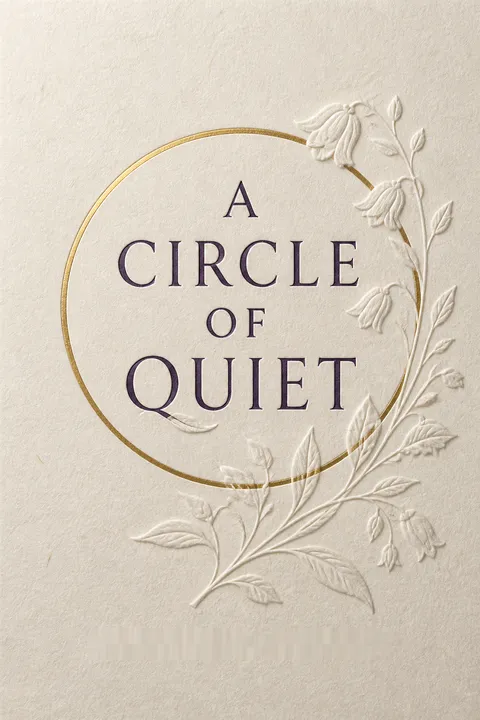

Key Takeaways
1. The Essential Need for a "Circle of Quiet"
If I sit for a while, then my impatience, crossness, frustration, are indeed annihilated, and my sense of humor returns.
Finding sanctuary. L'Engle emphasizes the critical need for a personal "circle of quiet"—a physical and mental space free from the demands of daily life—to regain perspective and nurture the inner self. For her, this is a small brook in a green glade, a place where no visible sign of human beings exists, allowing her to escape the overwhelming demands of a busy household and a large family. This retreat is not an escape from love, but a necessary withdrawal to sustain it.
Reclaiming balance. In this quiet space, L'Engle engages in simple, meditative activities like hanging sheets or watching flames, which help burn away negative feelings. However, for true recalibration, she often needs complete removal from her loved ones and responsibilities. This solitude allows her to shed the "prickliness, selfishness, in-turnedness" that accumulate, enabling her to return to her essential self and restore her sense of humor.
A universal need. The concept of a "circle of quiet" extends beyond a physical location; it represents a mental discipline for all individuals, especially artists, to connect with their deeper being. It's a reminder that even in the most loving and fulfilling environments, periodic solitude is vital for mental and spiritual health, preventing disproportion and fostering a renewed capacity for joy and engagement with the world.
2. Embracing Ontology: The Essence of Being
Ontology: the word about the essence of things; the word about being.
Beyond superficiality. L'Engle introduces "ontology" as her "word for the summer," signifying a deep exploration into the essence of things and being, rather than mere existence or superficial appearance. She contrasts her understanding of "isness" with Sartre's, finding hope and meaning in the inherent perfection of a blueberry bush or an oak tree, which simply is without pride or selfish choices. This perspective suggests that true being is found when we shed our "deadwood" and align with our intended selves.
Self vs. self-image. The author critiques the modern obsession with "self-image," arguing it's a Madison Avenue construct that substitutes images for reality, leading to manipulation and a diminished sense of self. Instead, she advocates for a true "self," which is not static or given, but constantly "becoming." This authentic self is understood intuitively, full of paradox and contradiction, and revealed through genuine connection and humility, rather than through external validation or predefined roles.
The burning bush. The metaphor of the burning bush, alive with flame yet not consumed, symbolizes this ontological truth. It represents a state of perfect being, where only the essential remains. L'Engle strives to reach this state by burning away her "prickliness, selfishness, in-turnedness," believing that this process reveals her true, essential self—what she is meant to be—a state of being that is real and connected to a divine purpose.
3. Creativity as an Act of Unself-Conscious Humility
When we can play with the unself-conscious concentration of a child, this is: art: prayer: love.
Unself-conscious immersion. L'Engle posits that true creativity, like a child's play, requires complete, unself-conscious concentration. In this state, the artist is "outside time" and "outside himself," fully immersed in the act of creation. This "throwing ourselves away" is the essence of creativity, allowing one to escape self-consciousness and share in the act of creating, whether it's painting, singing, or writing.
Humility in creation. The author connects this unself-consciousness to humility, contrasting it with "hubris"—pride that puts oneself at the center of the universe and often leads to self-annihilation. She argues that the act of creating is inherently humble, as it demands a complete focus on something or someone else, rather than on one's own ego or perceived talent. This is exemplified by:
- A child discovering their fingers with total concentration.
- An artist lost in their work, incapable of producing pornography (which is self-gratification).
- Playing a Bach fugue, where the music itself is all that matters, transcending the pianist's inadequacy.
The work takes over. For L'Engle, the creative process is not about personal credit or striving for perfection, but about allowing the work to "knock self-consciousness out of the way." She finds that her best writing emerges when she is fully absorbed, and even praise or criticism only matters after the work is done. This humble surrender to the creative impulse is what allows the work to be done, regardless of external validation or personal doubts.
4. The Power of Personal Identity Over Impersonal Systems
To be known by name is terribly important, though I tend, as usual, to carry my feeling for the name to disproportionate lengths.
The significance of a name. L'Engle deeply values the importance of being known by name, seeing it as fundamental to a person's being and identity. She illustrates this with her frustration over impersonal systems that reduce individuals to numbers or generic labels, such as:
- Being a patient in a hospital where one is a "number and a case first."
- Her check bouncing because it lacked "magnetic gibberish," despite her valid signature and funds.
Rebellion against dehumanization. Her act of signing checks with names like Emily Brontë, Jane Austen, and Elizabeth Barrett Browning is a playful yet profound rebellion against the machine's attempt to invalidate her personal identity. It's a statement that her name, her unique being, holds intrinsic value beyond any cybernetic requirement. This defiance highlights the ongoing battle between individual personhood and the dehumanizing tendencies of modern systems.
Authenticity in a generic world. This theme extends to her critique of "self-image" and the "jargon" that obscures true meaning. She argues that a true self is not an image to be "given" or constructed, but an inherent reality to be discovered and honored. By insisting on the power of names and personal identity, L'Engle champions authenticity and the recognition of each individual's unique "isness" in a world that often seeks to generalize and categorize.
5. Growth Through Paradox and the Acceptance of Contradiction
The deeper and richer a personality is, the more full it is of paradox and contradiction.
Embracing complexity. L'Engle argues that paradox and contradiction are not flaws but essential characteristics of deep, rich personalities and great works of art. She challenges the notion of a "perfect person" or a "flawless book," finding beauty and truth in the unwieldy structure of The Brothers Karamazov or the enigmatic character of Hamlet. This acceptance of complexity is crucial for understanding ourselves and the world.
Beyond fuzzy thinking. While advocating for the acceptance of contradiction, L'Engle clarifies that this is "no excuse for fuzzy thinking." We must use our minds to their fullest extent, yet acknowledge their limitations. She tells her students that she will "undoubtedly contradict myself, and that I will mean both things," encouraging an open-minded approach to truth that embraces multiple perspectives rather than rigid, singular answers.
Learning from failure. Her own journey as a writer, marked by years of rejection and self-doubt, is a testament to this principle. She found her true calling not in success, but in the "moment of failure" on her fortieth birthday, realizing that writing was an ontological necessity, not a choice. This experience taught her that growth often emerges from struggle and that accepting one's own imperfections is vital for authentic being.
6. Compassion and Love: Found in the Particular, Not the General
Compassion is particular; it is never general.
The specificity of care. L'Engle profoundly illustrates that true compassion and love are not abstract sentiments but concrete, particular acts directed towards specific individuals. She contrasts general, detached sympathy with the deep, personal involvement that defines genuine care. This is powerfully demonstrated through:
- Grandma's unwavering loyalty and offer to give up the organ for L'Engle during a church crisis.
- The village's collective response to the Brechsteins' house fire, where old and new residents united in specific acts of help, transcending previous animosities.
- Her own struggle to feel compassion for distant tragedies until they are brought "close at home," affecting a particular child or family.
Love as action, not feeling. She challenges the common understanding of love as merely a feeling, quoting Hugh Bishop: "Love is not an emotion. It is a policy." This perspective allows her to act lovingly even when her feelings are "unlovely," especially in the demanding context of a large family. This policy of love is a conscious commitment to the welfare of others, even those who are difficult or unlikable, as seen in her eventual pity for the Brechsteins.
Incarnation of love. The ultimate example of particular love is the Incarnation, where God's love is made visible and tangible in a specific person. L'Engle argues that an "aloof, general god is useless" and that unless "we, too, are in that burning car," our compassion is ineffective. This emphasizes that love requires presence, vulnerability, and a willingness to suffer with others, not just for them, making it a transformative force.
7. Beyond Intellect: The Enduring Truth of Mystery and Myth
The fairest thing we can experience is the mysterious. It is the fundamental emotion which stands at the cradle of true art and true science.
The limits of logic. L'Engle champions the mysterious as essential to true art, science, and faith, arguing that the rational intellect alone cannot grasp ultimate truths. She finds that science itself, through figures like Einstein and Hoyle, acknowledges the limits of provable fact and turns to imagination and myth to express ideas "too big, too violent, too brilliant to be rendered directly." This perspective suggests that truth often resides beyond logical explanation.
Myth as iconic truth. For L'Engle, myths, fairy tales, and parables are not mere fictions but "iconic truths" that transcend time and space, offering glimpses of reality that direct experience cannot. She sees the Bible's Genesis account as "amazingly accurate" in its order of evolution, not despite but because it operates on a deeper, mythical level. This language of imagination is crucial for understanding:
- The "burning bush" experience.
- The "mystery of the word made flesh."
- The "darkness of nothingness, of hate, of evil."
Embracing the unknown. Her own "agnostic faith" is not a lack of belief but an acceptance of mystery, a willingness to live with unanswerable questions. She contrasts this with those who seek "instant meditation" or try to explain away the supernatural, thereby "snuffing out" the candle of wonder. By valuing the mysterious, L'Engle encourages a journey beyond the intellect, into a "wilder, freer place" where deeper truths can be apprehended.
8. Maturity as Fulfillment: Redeeming Adulthood and Commitment
We must make it evident that maturity is the fulfillment of childhood and adolescence, not a diminishing; that it is an affirmation of life, not a denial; that it is entering fully into our essential selves.
Challenging youth's rejection. L'Engle addresses the common rejection of adulthood by youth, arguing that this often stems from adults failing to embody true maturity. She asserts that adulthood should be a fulfillment, not a decline, and that parents who prioritize being "pals" or avoid aging gracefully inadvertently teach their children to fear growing up. Her own "amiable, myopic giraffe" appearance and acceptance of her age stand in contrast to the "raddled thirty" she disdains.
The value of promises. She strongly advocates for the importance of commitment and promises, particularly in marriage, as a "saving grace" that allows relationships to deepen over time. She acknowledges that without the promises made in youth, she and Hugh might have "quit" during difficult times. This commitment provides the structure within which true freedom and growth can occur, transforming initial youthful blindness into profound, enduring love.
Discipline and structure. L'Engle connects this to the idea of discipline and structure as liberating, not imprisoning. Just as a sonnet's strict form allows for complete poetic freedom, or a skeleton enables dance, so too do rules and boundaries provide the security for children to become "truly free." She critiques parents who abdicate their roles, leaving children to seek structure and commitment in potentially destructive subcultures, emphasizing that "loving discipline" is essential for a child's development of self.
9. The Integrity of Language: Precision, Meaning, and Impact
If our language is watered down, then mankind becomes less human, and less free—though we may buy more of the product.
Preserving linguistic richness. L'Engle passionately defends the integrity and richness of language, arguing that its misuse and dilution diminish humanity itself. She critiques "Madison Avenue" for manipulating language to sell products, weakening words like "like" and reducing vocabulary to control thought. For her, language is a vital tool for thinking, communicating, and expressing truth, and its impoverishment leads to a loss of freedom and individuality.
"Violence to language." She reinterprets the phrase "doing violence to language" not as using complex words, but as breaking through platitudes and jargon to speak honestly and directly about "ultimate things that really matter." This includes being unafraid of silence, allowing words to be "born anew" from profound stillness. She also laments the blunting of "good, bawdy, Anglo-Saxon four-letter words" through overuse, rendering them meaningless and leaving us without impactful expressions in times of crisis.
The writer's responsibility. As a writer, L'Engle feels a deep responsibility to use language with precision and respect. She insists on the importance of knowing grammar and punctuation rules before breaking them, and on "showing" rather than "telling" in fiction, building stories on concrete sensory details. This commitment to linguistic integrity is not merely academic; it is an ontological act, a way of affirming meaning and reality in a world prone to linguistic decay.
10. Kairos: The Ontological Dimension of Time
In kairos we are, we are fully in isness, not negatively, as Sartre saw the isness of the oak tree, but fully, wholly, positively.
Beyond chronological time. L'Engle introduces the Greek concept of kairos as a profound, ontological dimension of time, distinct from chronos (measurable, sequential time). While chronos marks aging, decay, and the inevitable passage of events, kairos represents moments of qualitative, eternal "isness"—times when one is fully present, unself-conscious, and deeply connected to the essence of being.
Moments of profound presence. Kairos breaks through chronos, offering glimpses of truth and joy that transcend the ordinary. These are moments when:
- A child is completely absorbed in play.
- An artist is lost in creation.
- Friends share deep conversation around a dinner table.
- A mother holds her newborn baby.
- Moses encounters the burning bush.
The enduring self. In chronos, L'Engle might be reduced to a social security number or a rejection slip. But in kairos, she is "known by name: Madeleine," fully herself. This distinction provides comfort and meaning, especially as she confronts her own aging and the impermanence of life. It's a reminder that while the physical body and external circumstances are subject to chronos, the essential self can experience timeless, joyful being.
Review Summary
Most readers deeply appreciate A Circle of Quiet for its warm, conversational tone as L'Engle reflects on writing, family, faith, and ontology. Many find it inspiring and relevant despite its 1972 origins. Highlights include her candid observations on the writing life, creativity, and raising children at Crosswicks. Some critics note her theology feels vague or inconsistent, and a few find the book rambling or dated. Overall, fans of memoir, writing craft, and L'Engle's fiction tend to treasure it most.
People Also Read





Crosswicks Journals Series

About the Author




Download PDF
Download EPUB
.epub digital book format is ideal for reading ebooks on phones, tablets, and e-readers.








































