
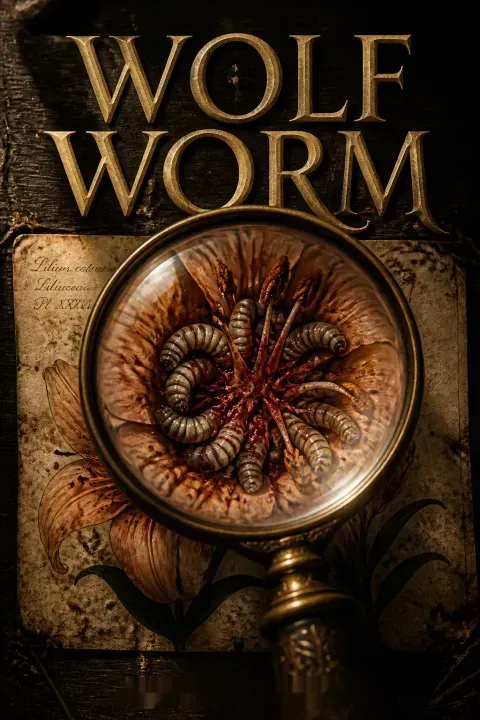


Plot Summary
The Weevil-Like Employer
Sonia Wilson1 steps off the train at Siler Station in April 1899, clutching a cardboard suitcase containing all her worldly possessions. No one has come to meet her. A gaunt farmer named Asa Phelps5 offers her a ride, warning during the journey that the Devil walks these woods.
She dismisses his talk of the Devil's Tramping Ground as superstition. At Halder's2 mansion, the housekeeper Rose Kent4 greets her with surprise: the doctor2 forgot to mention her arrival. The next morning, Sonia1 meets Dr. Matthias Halder,2 a faded, weevil-like man obsessed with parasitic insects.
He shows her illustrations completed by a previous artist,6 exquisite watercolors of burying beetles so masterful they make Sonia's heart stutter. He expects her to match them. Desperate for the position, she hides her terror and accepts the challenge.
This opening establishes the novel's central tension between scientific rationalism and folkloric dread. Sonia defines herself as a trained observer, yet she is economically trapped, forced to suppress her anxiety to survive. Halder's insectile appearance foreshadows his moral parasitism: like the creatures he studies, he consumes others for his own purposes. The magnificent illustrations left by the previous artist become the ghost that haunts the narrative, a vanished woman whose story Sonia will slowly uncover. The mansion itself, grand but decaying, mirrors the rot beneath its surface.
Following the Lantern
Late one night, unable to sleep, Sonia1 watches fireflies from her studio window and notices something wrong: a light bobbing through the trees, too steady to be an insect. She follows it into the woods and discovers Halder2 carrying a lantern toward a small, windowless building secured with a heavy padlock.
He does not carry a collecting net or any scientific equipment. He unlocks the metal door, steps inside, and stays only a few minutes before returning to the house, muttering to himself about being kept out of the Megatherium Club.
The building has no chimney, no windows, and its door is framed like a ship's bulkhead. Curious, Sonia1 returns by daylight and is startled by Phelps,5 who claims the shed stores gunpowder and blasting supplies. She does not believe him for a moment.
Sonia's compulsion to investigate despite her anxiety reveals her true nature: curiosity overrides self-preservation. The shed becomes the novel's central Gothic symbol, a sealed chamber hiding unspeakable secrets beneath ordinary ground. Phelps's lie about gunpowder introduces the conspiracy between Halder and his accomplice. The detail about the Megatherium Club, the scientific society that rejected Halder, hints at the resentment that has curdled his ambition into cruelty. Sonia's training as a naturalist makes her an ideal detective, yet also primes her to rationalize away what she will later discover.
Staked Through the Heart
Chickens begin vanishing from Rose Kent's4 henhouse with no blood, no feathers, no sign of forced entry. When Sonia1 asks Jackson7 about strange happenings in the woods, he tells her a grim story. Years earlier, animals and people were found dead, drained of blood, draped in trees with their wrists and throats bitten open.
A woman named Martha Glint was discovered half-clothed, as if someone had unbuttoned her collar before feeding. The killings stopped after Phelps5 and Halder2 joined a mob that caught two young strangers living rough in the woods, a brother and sister draining a deer.
The mob hanged them, drove stakes through their bodies, and buried them deep. Jackson7 adds that when the graves were later opened, the woman appeared to have been digging her way out through the red clay.
The blood thief legend introduces the novel's supernatural element through the filter of oral history, allowing both belief and skepticism to coexist. The detail about unbuttoning a collar before feeding transforms the killers from mindless beasts into something more unsettling: creatures that understand human clothing and perhaps human dignity. Jackson's story positions Halder not merely as a witness to violence but as an active participant, foreshadowing his capacity for atrocity. The buried woman clawing through clay becomes a recurring nightmare image that will haunt Sonia's subconscious.
Scratching at the Glass
Sonia1 wakes to scratching at her bedroom door. Smiley the cat10 is already on her bed, so whatever is outside is something else. She investigates and finds a possum standing on its hind legs, pawing at the doorknob. When it jumps and catches the knob in both paws, the door begins to open.
Sonia1 slams it shut and throws the bolt. The creature batters itself against the glass doors of the studio, over and over, until she blocks them with a heavy trunk. In the morning, she finds the possum dead on the balcony, three deflated warbles on its body.
Halder2 dissects it with wild excitement and discovers a botfly larva has burrowed through the skull and into the brain. He declares this unprecedented and rushes to Raleigh with the specimen, leaving his household unsupervised.
The possum scene marks the moment domestic safety collapses. An animal that should fear humans instead pursues one with desperate, mindless determination, its behavior hijacked by the parasite within. This is the first concrete evidence that something has gone terribly wrong with the local botfly population. Halder's ecstatic response to scientific novelty, over any horror at what it implies, reveals the moral vacuum at his core. His abrupt departure creates the power vacuum that will allow Sonia to finally satisfy her curiosity about the shed.
The Man on the Wire Table
When Phelps5 accidentally leaves the padlock unlatched, Sonia1 seizes her chance. She descends the stairs below the shed into a room lined with damp burlap. On a wire-mesh table, spread-eagled and manacled at wrists and ankles, lies a desiccated body so skeletal it seems mummified.
But botfly warbles hang beneath the corpse in pale clusters like diseased grapes, and when Sonia1 accidentally extinguishes her candle, she hears the man3 speak. Her panicked flight is interrupted by realizing a black-and-yellow botfly has landed on her neck.
Back at the house, she scrubs herself raw with boiling water, terrified that larvae have already been laid in her skin. The fever that follows, though diagnosed as malaria, leaves her uncertain whether any of what she saw was real.
This is the novel's most horrific revelation, a Gothic chamber of horrors rendered through the precise observational language of a naturalist. The man's living death, trapped between starvation and parasitic consumption, represents the ultimate perversion of Halder's scientific inquiry. Sonia's immediate impulse to rationalize away what she witnessed speaks to the human mind's protective mechanisms, the desperate need to believe the world cannot contain such atrocities. The botfly landing on her neck makes the threat personal and visceral, transforming her from observer to potential victim.
Fever and Self-Deception
Sonia1 collapses with bilious fever and spends days in delirium. Ma Kersey,8 summoned by the Kents, nurses her through the crisis. When Sonia1 wakes, she convinces herself the horrors in the shed were fever dreams: no body could be that mummified in damp clay, no man could speak who looked so dead, and botflies cannot infest dead tissue anyway.
Her rational mind constructs an alternative explanation involving dermestid beetles stripping a chicken carcass. This carefully built denial allows her to continue working for Halder2 without confronting the moral implications.
She even consults Ma Kersey8 about medicinal plants and learns more about the 'three-month babies,' twin blood thieves born after an impossibly short gestation with mouths full of needle-sharp milk teeth, whose grandfather kept them chained in a shed.
Sonia's self-deception is psychologically acute and morally devastating. The trained observer chooses not to observe, privileging economic survival over truth. The 'three-month babies' story, introduced alongside her denial, plants the seeds of explanation she will later need. Ma Kersey's account of the children, born wrong and raised in chains, creates a parallel to Saul's imprisonment that Sonia cannot yet recognize. The novel here examines how complicity with evil often begins not with conscious choice but with the quiet decision not to look too closely.
Phelps Springs His Trap
While Halder2 is away, Phelps5 approaches Sonia1 in the garden and produces the half-burned candle she abandoned in the underground room. His gaunt face is haggard, and he keeps scratching at a bandage on the back of his head.
When she tries to bluff, he grabs her arm and drags her through the woods to the shed, declaring that he cannot let the Devil take him. He thrusts her inside and locks the door, promising to wire Halder2 for instructions. A beekeeper's veil hangs on a peg, meant to protect against the flies.
Sonia1 is left alone in the dark with the dying man,3 who is no longer dying. The man has flesh on his bones now, though still monstrously thin, and Phelps5 has apparently been feeding him somehow. His fingernails have grown into long, curling claws.
Phelps's betrayal transforms the narrative from mystery into survival horror. The candle, that mundane object, becomes proof of Sonia's curiosity and her doom. Phelps's compulsive scratching and his religious terror reveal that he too is a victim, though he does not yet understand how. The beekeeper's veil, a practical object left by Halder, underscores the clinical nature of the atrocities committed here: Halder treated this underground chamber as a laboratory, complete with safety equipment for the researcher. Sonia is now trapped in the very nightmare she tried to dismiss.
The Squirrel's Sacrifice
A scrabbling sound announces a new arrival through a burrow in the clay wall: a squirrel with a botfly warble distorting its skull. It climbs onto the wire table and presses itself against the prisoner's3 face. Sonia1 watches in frozen horror as he bites into the creature, crunching through fur and bone, drinking its blood.
The squirrel makes no attempt to flee. The man, who reveals himself as Saul Gregor,3 Louisa's6 lover, explains the grotesque ecology: the botflies that fed on his inhuman flesh have mutated, reproducing faster and developing the ability to control hosts.
Now they drive infected animals to the shed to feed him, preserving the host that sustains their own parasitic life cycle. Saul3 has been chained here, he estimates, for over a year, kept alive by Halder's2 experiments and now by the flies themselves.
This scene is the novel's conceptual fulcrum. The botflies, mere insects, have evolved a symbiotic relationship with their inhuman host, driving prey animals to him with the same mechanism that drove the possum to Sonia's door. The horror here is ecological: human cruelty has accidentally engineered a new parasitic system. Saul's confession that he has been imprisoned for over a year contradicts everything Sonia knows about human survival, forcing her to accept that he is not human. The flies, in their mindless drive to preserve their host, have become both torturers and caretakers.
Samson Brings the Temple
Phelps5 returns with food and a gun, his condition visibly deteriorated. The bandage on his head has slipped, revealing a dark larval breathing hole at the base of his skull. Under the larva's compulsion, he is being dragged toward Saul3 against his will, weeping and quoting scripture.
He manages to confess the truth: years ago he shot a blood thief girl raiding his hog pen, dumped her body in the woods, and later recognized her among the two killers the mob destroyed. She asked if he was going to shoot her again.
Now the botfly is using him the way the infected animals were used, driving him to feed his fellow host. Phelps5 fights the compulsion long enough to cry out about Samson bringing down the temple, then stumbles forward. Saul's3 pharyngeal jaws extend from his throat and tear into Phelps's5 neck, drinking him dry.
Phelps's death is the novel's tragic center. The man who tried to kill monsters became one, not through moral failure but through biological invasion. His biblical ramblings frame his death as sacrifice and punishment simultaneously. The revelation that he killed the same blood thief girl twice closes the loop on the earlier legend, showing that the supernatural beings in this world are terrifyingly resilient. Saul's feeding, grotesque as it is, becomes an act of mercy and self-defense. The botfly has transformed both men into nodes in its parasitic network, erasing the boundary between predator and prey, sinner and saint.
Halder's Last Observation
After Phelps's5 death, Sonia1 uses the forceps Halder2 once used to extract screwworms to pull the nails from Saul's3 forearms and shins, nails driven through flesh into wood to prevent escape. When Saul3 sits up, the flesh that grew through the wire mesh tears away, leaving his back a flayed ruin.
They stagger up the stairs together into evening light, only to find Halder2 waiting with a revolver. He offers Sonia1 a chance to join his work, explaining his theory that Saul's species is a parasitic mimic of humanity that reproduces by depositing children in human women who then die as the infants consume them.
As Halder2 lectures, Sonia1 pretends to waver, drawing his attention while Saul3 lunges. Saul3 bites Halder's2 wrist, injecting paralytic saliva, then tears out his throat. Rose Kent4 arrives moments later with a shotgun.
Halder's death is an act of narrative justice executed by the very 'test subject' he dehumanized. His final monologue reveals the ideological framework that justified his atrocities: by classifying Saul's species as parasites, he exempted himself from moral consideration. The parasitologist becomes the parasite's prey. Sonia's role as decoy completes her character arc from passive observer to active participant in her own salvation. Rose's arrival with the shotgun, practical and unsurprised, grounds the supernatural horror in the mundane solidarity of women who have long known what kind of man Halder was.
Louisa Comes Home
The four of them, Sonia,1 Saul,3 Rose,4 and Jackson,7 fabricate a story for the sheriff: Halder2 was keeping a dangerous animal in the shed that escaped and savaged him and Phelps.5 The authorities accept it.
In the following weeks, Sonia1 removes residual botfly larvae from Saul's3 healing body and cuts off her own hair in a panic, needing to feel her scalp for any sign of infestation. Ma Kersey,8 who knows more than she says, sends word to Louisa Halder.6 When Louisa arrives at the mansion, she is not beautiful but radiates such warmth that Sonia1 immediately understands why Saul3 loves her.
Louisa6 proposes they finish Halder's2 book under a different scientist's name, with her own illustrations and Sonia's1 credited prominently, while her late husband becomes a dismissive footnote. The two women, bound by shared trauma and artistic passion, agree to collaborate.
The cover-up sequence explores how survivors reconstruct narrative after atrocity. The sheriff's willingness to accept the animal-attack story reflects a community that prefers comfortable lies to uncomfortable truths. Sonia's compulsive hair-cutting is a somatic response to invisible threat, the body remembering what the mind tries to bury. Louisa's return transforms the mansion from Gothic prison to feminist household, reclaiming the space her money built. The plan to publish Halder's work without his name is a posthumous revenge more satisfying than mere death: the erasure of the legacy he valued above all human connection.
Epilogue
Eleven months after Halder's2 death, Sonia1 still lives in the mansion. The book Observations on the Habits of Parasitic Insects is published under a young entomologist named Ainsley, with plates credited to Sonia Wilson1 and Louisa Gregor.6 Halder2 appears only in a brief author's note.
Saul3 and Louisa6 have married; Rose4 and Jackson7 have moved to their own home nearby, liberated from years of bitter obligation. The shed has been demolished, its timbers pulled down so that rain filled the excavation, leaving a pond where chorus frogs now sing.
Saul3 has hunted the woods for botfly-infected animals and found none since winter: the mutated strain apparently died out when deprived of its inhuman host. Sonia1 still flinches at black-and-gold flies. She does not walk in the woods alone. Yet she stays, working on a book of medicinal plants with Ma Kersey's8 knowledge, living alongside people who know what she survived.
The epilogue offers resolution without easy comfort. The frogs reclaiming the shed's excavation suggest nature's capacity to absorb and transform horror, yet Sonia's lingering fears acknowledge that some wounds do not fully heal. The book's publication is a quiet triumph that reverses the expected power dynamic: the women artists receive credit while the male scientist becomes a footnote. Saul's marriage to Louisa, a union between human and inhuman that defies Halder's parasitic model, proposes an alternative to predation. But the final image, Sonia watching the woods for flies she knows are probably gone, admits that knowledge cannot always silence fear. Survival, the epilogue suggests, is not the absence of damage but the daily choice to continue living alongside it.
Analysis
Wolf Worm inverts the Gothic tradition by making its monster a sympathetic victim and its human villain the true horror. Halder2 represents science stripped of ethics, curiosity divorced from compassion. His experiments on Saul3 are not aberrations but logical extensions of a worldview that classifies certain beings as legitimate objects of study rather than subjects deserving moral consideration. The novel suggests this is not merely Halder's2 pathology but a tendency latent in scientific inquiry itself: the impulse to observe can become the impulse to control, and the controlled can become the expendable. Sonia's1 arc traces the painful journey from complicity to resistance. She is not a hero by nature but becomes one through necessity, her curiosity and her conscience finally aligning when she can no longer rationalize away what she has witnessed. The botflies function as a metaphor for interconnectedness: parasite and host, predator and prey, human and inhuman are all bound together in ecological relationships that defy simple moral categories. Saul's3 species, obligate parasites on humanity, chooses restraint while Halder,2 a human with every capacity for ethical behavior, chooses predation. The novel ultimately argues that monstrosity is defined not by what one is but by what one does, and that survival sometimes requires accepting that the world contains horrors that cannot be explained away, only endured and, with effort, partially healed.
Review Summary
Wolf Worm receives strong praise for its slow-burn atmospheric dread, compelling protagonist Sonia Wilson, and genuinely unsettling insect-based body horror. Reviewers consistently highlight T. Kingfisher's signature blend of witty, relatable characters with creeping gothic tension. Many note the pacing feels slow initially but intentionally so, with the payoff proving worthwhile. The historical 1899 setting and themes of scientific obsession and exploitation add depth. Common critiques include predictability and some rushed elements. The audiobook narration by Mary Robinette Kowal receives near-universal acclaim. Overall rating: 4.23/5.
People Also Read








Characters
Sonia Wilson
Scientific illustrator and narratorA thirty-three-year-old spinster and trained botanical illustrator, Sonia narrates the story with wry self-awareness and scientific precision. The daughter of a deceased naturalist, she inherited his observational skills and his precarious economic position. Years of teaching at a girls' school have taught her to suppress visible emotion while her internal monologue crackles with anxiety and dark humor. She copes with terror by analyzing it through the lens of watercolor technique, mentally mixing pigments to render whatever horror confronts her. Her defining conflict is between curiosity and self-preservation: she cannot stop investigating even when every rational instinct screams at her to look away. She is not conventionally brave but possesses the rarer courage of someone who acts despite being terrified.
Dr. Matthias Halder
Entomologist consumed by obsessionA reclusive scientist described as resembling a weevil, with thinning colorless hair and enormous spectacles. Halder has devoted his life to studying parasitic and necrophagic insects, a passion that has corroded into monomania. His bitterness stems from rejection by the scientific establishment, particularly the Megatherium Club, a slight that festers alongside his failed marriage. He possesses genuine brilliance but no ethical constraints whatsoever, viewing living beings as experimental substrates rather than subjects with moral claims. His cruelty is distributed equally: he treats his wife6, his employees, and his test subjects3 with the same cold disregard. What makes him terrifying is not sadistic pleasure but absolute indifference, the conviction that scientific progress justifies any atrocity.
Saul Gregor
Louisa's lover and Halder's prisonerA drifter who came to Chatham County investigating rumors of blood thieves, only to fall in love with Halder's wife6. Saul belongs to a species that appears human but possesses extraordinary healing, pharyngeal jaws that extend from the throat, and a hunger for blood and viscera. He is capable of great restraint, choosing to minimize harm despite his nature, and speaks of his condition with weary irony. His year of imprisonment under Halder's2 experiments has left him with a dark sense of humor and a complicated relationship with the parasitic flies that both feed on and feed him. He loves Louisa6 with a devotion that transcends species, and his moral code, while alien, is genuine: he hunts down those of his kind who prey on humans.
Rose Kent
Housekeeper bound by circumstanceA tall, lean Black woman with young features and old hands, Rose manages Halder's2 decaying household with ferocious competence. She stayed in his employ for years because her mother was dying of dementia and could not be moved, a trap she resents but accepted. She is married to Jackson Kent7 despite laws against interracial marriage, a secret she guards from white neighbors. Her friendship with Louisa Halder6 was deep, and she witnessed Halder2 shoot Saul3, a trauma she carries silently. Rose expresses care through cooking and practical action rather than words, and her moral clarity is absolute: she knows Halder2 is a monster but has learned to survive in his orbit. Her departure from the estate after his death represents liberation long deferred.
Asa Phelps
Religious zealot and reluctant accompliceA tall, gaunt farmer who found radical religion after encountering the supernatural. Phelps killed a blood thief girl raiding his hog pen, saw her return from death, and helped destroy her and her brother when the mob caught them. His faith is grim and Old Testament, preoccupied with damnation. He assists Halder2 in maintaining the secret prison out of a tortured sense of duty, believing that containing the Devil requires unsavory alliances. He is not cruel by nature but is capable of cruelty when convinced of righteousness. His tragic arc is driven by the botfly larva that infects his brain, transforming him from jailer into victim of the same parasitic control he helped facilitate.
Louisa Halder
Escaped wife and master illustratorHalder's2 wife and the artist whose exquisite beetle illustrations intimidate Sonia1. Broad-hipped and plain-faced, Louisa possesses a smile so radiant that people feel more alive in her presence. She married Halder2 young, brought her family money to the marriage, and spent fifteen years painting insects for his research while enduring his cold contempt. Her love affair with Saul Gregor3 gave her the courage to flee, though the escape was marred by Halder2 shooting Saul3. She vanished into Ma Kersey's8 network of connections and survived independently for over a year. Her return transforms the household, her warmth and generosity offering Sonia1 the friendship and professional partnership she has long lacked. She knows what Saul3 is and loves him without reservation.
Jackson Kent
Handyman and storytellerRose's4 husband, a wiry white man of Scottish descent with a talent for spinning tales and making moonshine. Jackson handles odd jobs and heavy labor around the estate, including hauling Halder's2 insect cabinets. His grandmother's folk stories about blood-drinking creatures give him a framework for understanding the horrors in the woods, though his wife discourages him from frightening the staff. He is genial and warm, his affection for Rose4 evident in every interaction, and his moral compass is steadier than his easy manner suggests. He participates in the cover-up without hesitation, understanding that official justice would serve no one.
Ma Kersey
Lumbee wise woman and midwifeAn elderly Lumbee woman wrapped in layers of bright shawls, with two gold teeth and eyes that miss nothing. She delivered the 'three-month babies' decades ago and recognized their inhuman nature when she later saw the female blood thief's corpse with its mouth full of needle teeth. She serves as the community's repository of knowledge: herbal remedies, family histories, and secrets that official records omit. Her network of connections extends across the state, which is how she smuggled Louisa6 to safety and later summoned her back. She speaks in pronouncements that sound like folk wisdom but contain precise observations, and she trusts Sonia1 enough to share her most dangerous knowledge.
Sally
Young maid with local superstitionsA small white girl, probably in her mid-teens, who helps Rose4 with housework. She genuinely believes in blood thieves and warns Sonia1 not to walk in the woods at night. Her family lives nearby but insists she sleep at the house for safety, a precaution that proves more warranted than anyone realizes.
Smiley (Smilodon)
Halder's orange house catA large orange tomcat named for the saber-toothed cat, with slightly overgrown canines that inspired the name. He ignores Halder2 completely, stalks Sonia's1 paint water, and sleeps on her bed. His presence offers small comforts amid mounting horror, a reminder that ordinary life continues even in monstrous circumstances.
Plot Devices
Botfly Larvae (Wolf Worms)
Parasitic organisms that mutate through inhuman hostCuterebra botflies, called wolf worms locally, are parasitic insects whose larvae burrow into the flesh of living mammals to feed on lymphatic fluids. Under normal conditions, they form warbles beneath the skin and emerge after about two weeks without killing the host. Halder's2 experiments involve infesting Saul Gregor3 with multiple botfly species. Because Saul's inhuman physiology heals rapidly and resists death, the flies complete their life cycles in his flesh repeatedly. Over months and generations, this selective pressure produces a mutated strain: the larvae grow larger, reproduce faster, penetrate bone into brain tissue, and develop the ability to manipulate host behavior, driving infected animals toward Saul3 to sustain the shared host. They become unwitting caretakers, feeding Saul3 so he can continue feeding them.
The Underground Laboratory
Hidden prison where Halder conducts experimentsA windowless building disguised as a gunpowder storage shed, with a metal door sealed like a ship's bulkhead and heavy oilcloth drapes to contain insects. Stairs descend six feet to a room excavated from red clay, lined with burlap and boards. The central fixture is a wire-mesh table with iron manacles and long nails driven through the prisoner's3 limbs into the wooden frame. The room floods during rain, leaving inches of standing water. A burrow in the clay wall, dug by infected animals, provides the only alternative entrance. The space functions simultaneously as prison, laboratory, and ecosystem, a closed system where Halder's2 scientific curiosity created a nightmare he could observe but never fully control.
Saul's Inhuman Physiology
Regenerative abilities enabling endless experimentationSaul3 belongs to a species that mimics human appearance while possessing profound biological differences. His body heals from injuries that would kill ordinary humans, including gunshot wounds, flaying, and massive parasitic infestation. He has pharyngeal jaws, secondary teeth that extend from his throat to deliver a paralytic bite. His metabolism requires blood and raw flesh, though he can consume ordinary food. His species reproduces by implanting fetuses in human women who die as the rapidly developing infants consume them, a reproductive strategy that makes them obligate parasites on humanity. The accelerated gestation, as little as three months, produces infants with sealed eyelids and mouths full of sharp milk teeth. His blood and lymphatic fluids, when consumed by botflies over many generations, triggered the parasites' accelerated evolution.
Louisa's Sketchbooks
Revealing the previous artist's identity and relationshipsSeveral volumes of sketches left in the studio trunk, ranging from 1893 to 1897. They contain gesture drawings of Halder2, Rose4 and Jackson Kent7, Asa Phelps5, and a man with a long angular face identified as Saul Gregor3. There are no insects in the books, only plants, faces, hands, and the orange cat Smiley10 as a kitten. The first page bears the name Louisa Halder6 and a plea for return if found. The sketchbooks reveal the emotional life of the woman whose paintings haunt Sonia1: her fondness for Rose4, her irritation with Halder2, her tenderness toward Saul3. They prove Louisa6 was Halder's2 wife, not merely his employee, and that she loved the man Halder2 tried to kill. Sonia1 studies them obsessively, searching for moral absolution she cannot find.
The Beekeeper's Veil
Protective gear for working near the infested prisonerA hat with fine mesh netting that hangs on a peg just inside the shed door. Halder2 kept it there to protect himself from botflies when tending to Saul3, a clinical precaution that reveals how methodically he approached his atrocities. Sonia1 uses it when locked in the shed, tucking the gauze into her collar to prevent flies from crawling into her nose or mouth. The veil becomes a symbol of Halder's2 detachment: he treated the underground room as a laboratory requiring safety equipment, never acknowledging that the experiment's subject was a thinking being. For Sonia1, the veil offers minimal protection against both physical infestation and the psychological horror of proximity to Saul's3 suffering.
Download PDF
Download EPUB
.epub digital book format is ideal for reading ebooks on phones, tablets, and e-readers.








































