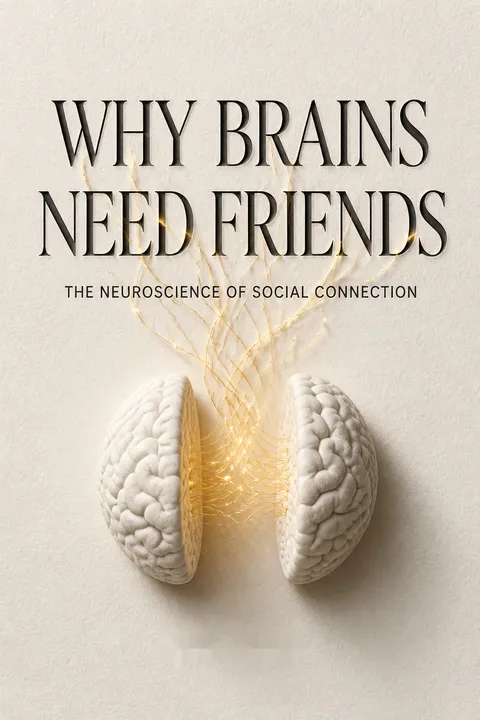

Key Takeaways
1. Social Connection is a Biological Imperative for Brain Health and Longevity.
As a neuroscientist studying the biology of social behavior, I believe that interpersonal connections are just as important as other pillars of health like exercise, sleep, and nutrition.
Vital for well-being. Social interactions are natural mood-boosters, reducing stress and increasing overall well-being. Studies show that people consistently report better moods and less stress after conversations, with effects compounding over time for greater happiness. This isn't just anecdotal; it's a scientifically supported remedy for sour moods.
Profound health benefits. Beyond mood, strong social connections are linked to a lower risk of serious health issues, including dementia, heart failure, diabetes, depression, and anxiety. Social support also reduces vulnerability to stress and increases pain tolerance. Conversely, social isolation is a strong predictor of suicide and significantly increases the risk of death from any cause, making it twice as detrimental as obesity and four times as bad as living in a highly polluted area.
Evolutionary wiring. Our brains are wired for social reward because, in ancient times, survival depended on group living. This innate drive for togetherness is mediated by neurotransmitters like oxytocin, serotonin, and dopamine, which create pleasant feelings during social interaction, reinforcing the behavior. This "social reward system" ensures we seek connection, a fundamental need that persists even in a modern world where social contact is receding.
2. Our Brains Make Bad Social Predictions, Often Hindering Connection.
We tend to underestimate how much we’ll enjoy conversations.
Underestimating enjoyment. Our brains frequently miscalculate the positive impact of social interactions. Studies show people consistently underestimate how much they will enjoy conversations, especially with strangers, only to find themselves much happier than expected afterward. This "Bad Prediction No. 1" often leads us to avoid potentially rewarding social opportunities.
Fear of rejection. Another significant barrier is the unfounded fear of rejection. Research indicates that people vastly overestimate the likelihood of being turned down when initiating conversations with strangers, with actual rejection rates often being 0%. This "Bad Prediction No. 2" prevents us from reaching out, despite others often being receptive to connection.
Misjudging conversational flow. We also tend to wrongly assume that conversations will become less enjoyable over time, leading us to disengage prematurely. In reality, enjoyment often remains steady. Furthermore, many people underestimate their own conversational skills, a "Bad Prediction No. 4" that can erode confidence. Recognizing these internal shortcomings allows us to push past them and embrace more fulfilling interactions.
3. Empathy is a Powerful, Yet Selective, Evolutionary Tool.
Empathy lets us understand and share someone’s emotions without speaking a single word.
Emotional contagion. Emotions are surprisingly "contagious," spreading between individuals through subconscious facial mimicry and body language. When we automatically imitate another's expression, feedback from our own face can make our brain believe we are experiencing the same emotion, leading to a shared emotional state. This process is fundamental to understanding others.
Two forms of empathy. Empathy manifests in two distinct ways: cognitive empathy, which is understanding another's thoughts and emotions, and emotional empathy, which is feeling those emotions oneself. Both are crucial for group survival, allowing us to quickly assess situations and motivate helping behaviors, as demonstrated by our ancestors' ability to sense a comrade's pain and respond.
Selective application. Despite its power, empathy is not uniformly applied; it's highly context-dependent and selective. We tend to feel more empathy for those we are closer to or perceive as similar to ourselves (self-other overlap). This tribal instinct, while advantageous in ancient times, can be problematic in today's diverse world, leading to apathy towards out-group members and exacerbating social divisions.
4. Animals Demonstrate Profound Empathy and Compassion, Often Exceeding Humans.
The rats did the nicest thing possible. They opened both containers and then shared the chocolate.
Beyond human capacity. While humans pride themselves on empathy and compassion, many animal species exhibit these traits, sometimes in ways that challenge our self-perception. Studies show mice can experience the "social transfer of pain," taking on the hypersensitivity of distressed peers, a phenomenon linked to empathy-related brain areas in humans.
Compassion in the animal kingdom. Compassion, defined as empathy coupled with a desire to help, is observed across diverse species.
- Zebra fish console distressed peers, a behavior blocked by inhibiting oxytocin.
- Prairie voles console partners and siblings after stress, also oxytocin-dependent.
- Rats will free trapped companions and even share chocolate altruistically, often preferring generosity over selfish gain.
- Dolphins show generosity, especially towards offspring and potential mates, suggesting a desire to model good behavior.
- Elephants display complex empathy, comforting young and protecting vulnerable members, demonstrating theory of mind.
- Chimpanzees reconcile with kisses, avoid harming others for rewards, and show theory of mind by helping peers.
A call for reflection. These findings suggest that kindness and compassion are fundamental biological defaults, predating humanity. Our advanced intellect, while powerful, sometimes leads us away from these basic prosocial instincts, creating unnecessary division. Recognizing this, we are challenged to re-evaluate our own humanity and strive to embody the altruistic tendencies seen in simpler forms of life.
5. Virtual Interactions Fall Short of In-Person Connection and Can Foster Hostility.
The brain on social media is like a horse-drawn carriage on the autobahn.
Evolutionary mismatch. Our brains evolved over millions of years for face-to-face interaction, equipped with tools like white sclerae for eye-gaze detection and expressive eyebrows for emotional communication. Modern virtual interactions, from texting to video calls, strip away many of these crucial social cues, leaving our ancient brains struggling to process incomplete information.
Reduced social reward. Less "lifelike" interactions (texts, phone calls) lead to feelings of loneliness, sadness, and reduced affection compared to in-person contact. While online interaction is better than none, it fails to activate the brain's social reward systems as potently, offering diminished boosts in mood and social support. Even leaving a phone on the table during an in-person interaction (phubbing) reduces enjoyment and connection.
The virtual disengagement hypothesis. Social media, despite its name, often has a net negative effect on well-being, increasing loneliness and sadness. This is partly due to the "virtual disengagement hypothesis": the lack of real-time social cues online reduces empathy, making users more prone to hostility, cyberbullying, and aggressive behavior. Replayed videos, in particular, engage empathy-related brain areas less strongly than live interactions.
6. Deep Relationships (Love, Touch, Family) Offer Unique Neural and Health Benefits.
In five out of the nine cancers they examined, being married had a stronger influence on someone’s survival chances than receiving chemotherapy did.
Love's neurochemistry. Romantic love is profoundly linked to oxytocin release, which acts as a "neural glue" fostering deep bonds and sustained feelings of reward. This oxytocin surge, present in both new and long-term happy relationships, is not just pleasant but also confers significant health benefits, including reduced stress and anxiety, anti-inflammatory effects, neuroprotection, and enhanced wound healing.
The power of touch. Physical touch, a cornerstone of intimate relationships, offers immense therapeutic value. Massages and hugs regulate cortisol, reduce pain, and alleviate depression and anxiety, largely through oxytocin release. Crucially, the social nature of touch matters; human touch is more pleasurable and oxytocin-inducing than robot touch, especially when there's a desire to bond with the person delivering it.
Parent-child bonds. These relationships are neurologically potent, characterized by copious oxytocin release in both parent and child during interaction. This oxytocin not only forms an unbreakable bond but also plays a vital role in protecting the infant's brain during the turbulent process of birth. The brain's "love network" shows significant overlap for both romantic and parent-child love, highlighting their shared biological importance.
7. Likability is a Learnable Skill That Enhances Social Success and Well-being.
In many domains of life, it helps to be likable. So why not work on ourselves a bit to deepen our connections and attract more success?
The neuroscience of impression. Our brains, particularly the prefrontal cortex (vmPFC and dmPFC), constantly compute how likable others are. This judgment, crucial for social survival, is influenced by both uncontrollable factors like name and appearance (the "halo effect") and controllable behaviors. Being well-liked leads to numerous real-world benefits, from better job prospects to more persuasive communication.
Controllable likability factors: While some traits are innate, many aspects of likability can be cultivated:
- Body language: Subconscious mimicry of others' posture and movements fosters affiliation.
- Touch: Friendly, non-invasive physical contact drives oxytocin release and builds bonds.
- Eye contact: Sustained eye contact (or focusing on the mouth) increases respect, affection, and interbrain synchrony.
- Facial expressions: Smiling and laughter signal friendliness and approachability.
- Conversation style: Speaking more (within reason), asking follow-up questions, and finding commonalities (homophily) enhance engagement.
- Avoiding phubbing: Putting away phones during interactions significantly improves connection quality.
- Emotional expressiveness: Clearly conveying emotions makes one easier to understand and relate to.
Overcoming the liking gap. People often underestimate how much others like them, a phenomenon called the "liking gap." This self-doubt can hinder genuine connection. By understanding the science of likability and practicing authentic, considerate behaviors, individuals can improve their social interactions and foster deeper, more rewarding relationships.
8. Drugs Can Profoundly Manipulate Our Social Brains, for Better or Worse.
Everything you experience boils down to a pattern of chemicals in your brain.
Altering perception. Since all our experiences are electrochemical signals, drugs that interact with these chemical systems can profoundly alter our social perceptions and behaviors. These substances "speak" the brain's language, tinkering with neurochemistry to influence how we connect with others.
Alcohol's double-edged sword. Alcohol, a nervous system depressant, enhances GABA signaling, reducing brain activity and blunting the amygdala. This lowers social anxiety and mutes emotional responses to negative social cues, leading to uninhibited, sometimes reckless, behavior. While it can feel like a social lubricant, chronic use can impair empathy and interbrain synchrony.
Painkillers and empathy. Surprisingly, common painkillers like acetaminophen can reduce social pain and blunt empathy for both positive and negative experiences. By temporarily suppressing pain-processing brain areas, they make it harder to relate to others' suffering. Similarly, anxiety medications (anxiolytics) can limit altruistic acts by reducing the distress we feel when witnessing others struggle.
Empathogens and connection. Conversely, drugs like MDMA and psilocybin, which primarily act on serotonin systems, can dramatically enhance social connection.
- MDMA (ecstasy/molly) boosts empathy, social interest, and euphoria by driving serotonin release in the nucleus accumbens, potentially breaking down tribal barriers.
- Psilocybin (psychedelic mushrooms) activates serotonin 2A receptors, leading to "ego dissolution" (a sense of oneness), reduced feelings of exclusion, enhanced emotional empathy, and increased altruism.
- SSRIs (antidepressants) also enhance serotonin signaling, promoting extroversion, reducing hostility, and boosting affiliative behaviors.
9. Dogs Are "Hairy Babies" That Provide Unique Health and Social Benefits.
When dogs and their caregivers look at each other, they both show a significant rise in oxytocin levels.
An ancient, unique bond. The human-dog partnership spans 27,000 to 40,000 years, a bond so deep that our genomes have converged due to shared environmental pressures. Dogs evolved from wolves, adapting traits like "puppy eyes" (via a unique muscle) and eye-watering to hijack our oxytocin system, fostering a parent-child-like attachment.
Oxytocin hyperloop. Dogs view their owners as a "secure base," much like infants view their mothers. This bond is reinforced by an "oxytocin hyperloop": mutual gaze between dogs and owners triggers a significant rise in oxytocin in both, strengthening their connection and making their presence profoundly rewarding. This isn't just a dog's scheme; they genuinely feel the love.
Profound health and social benefits. Interacting with dogs offers numerous physiological and psychological advantages:
- Physiological: Lowers blood pressure, reduces cortisol, increases oxytocin, dopamine, and endorphins. Long-term ownership is linked to lower risk of cardiovascular disease, lower heart rates, and improved cardiac activity.
- Emotional: Reduces anxiety, boosts mood, and provides comfort, making them valuable emotional support animals.
- Developmental: Children with pets show lower rates of conduct problems, more prosocial behaviors, and higher levels of empathy, learning to interpret nonverbal cues and care for vulnerable beings.
- Social: Dogs make humans more likable and generous, even influencing strangers to offer help or money.
10. Choosing Connection Over Division is Humanity's Most Vital Act.
I think that love, social connection, and relationships are why we’re here.
The meaning of life. Love, social connection, and relationships are not merely pleasant aspects of life; they are fundamental to our existence and provide the motivation to live. The profound joy derived from social bonds, particularly with family and close friends, acts as a powerful antidote to despair, with loneliness being a significant predictor of suicide.
Overcoming internal and external barriers. In a world increasingly driven by technology and polarization, we face both external forces and internal brain shortcomings that push us towards division. Our ancient tribal instincts, while once adaptive, now hinder empathy for those different from us. However, our advanced intellect allows us to recognize these biases and deliberately choose connection.
A call to action. We must actively prioritize and nurture our social lives. This means making conscious choices:
- Engage: Pick up the phone, initiate conversations with strangers, and don't flake on plans.
- Be present: Put away devices during in-person interactions.
- Cultivate empathy: Practice understanding others' perspectives, especially those unlike us.
- Be kind: Offer compliments, express gratitude, and extend grace, remembering that even small acts benefit both giver and receiver.
- Cherish deep bonds: Invest in romantic partners, children, and close friends, recognizing their unique neural and health benefits.
- Embrace animals: Spend time with pets, especially dogs, for their profound health and social contributions.
By consciously choosing unity, empathy, and connection, we can counteract the divisive forces of modern life, safeguard our brain health, and collectively build a more compassionate and fulfilling future.
People Also Read





Download PDF
Download EPUB
.epub digital book format is ideal for reading ebooks on phones, tablets, and e-readers.








































