
Key Takeaways
1. The Ancient & Ongoing Quest for Replacement Parts
At its most basic, progress is simple chronology: one thing following on the next.
A timeless human endeavor. From the earliest civilizations, humans have sought to replace lost or failing body parts, driven by necessity, vanity, and the relentless march of time. This quest began with rudimentary external devices, like the Victorian masticator for pre-chewing food or Tycho Brahe's brass nosepiece, evolving into more integrated, internal solutions. These early attempts, though often crude and uncomfortable, laid the groundwork for future innovations.
Early replacements were often ornamental. Dentures, for instance, have existed since the 1700s, but for centuries, they were more about appearance than function. George Washington famously struggled with ill-fitting false teeth, which were "almost useless for eating" and caused his grim facial expression in portraits. This highlights a recurring theme: the gap between the desire for replacement and the practical limitations of available technology.
The allure of "better than before." The idea of not just replacing, but improving upon natural parts, has long captivated humanity, epitomized by fictional figures like "The Six Million Dollar Man." This aspiration fuels continuous innovation, pushing scientists and surgeons to overcome the immense challenges of biological replication and integration, even when the path is long and uncertain.
2. The Body's Unrivaled Complexity Defies Easy Replication
Blame instead the overwhelming complexity of the human body.
Evolutionary mastery. The human body, a product of millions of years of natural selection, possesses an astonishing level of complexity that few centuries of medicine and engineering can hope to match. This inherent intricacy makes truly replicating even seemingly simple parts, like a joint or a tear film, an immense challenge. Scientists often find that what makes intuitive sense in design doesn't always pan out in biological reality.
Unpredictable biological reactions. Materials that perform well in a lab or even in initial trials can fail spectacularly when introduced into the dynamic, reactive environment of a living body.
- John Charnley's early Teflon hip sockets, for example, caused severe immune reactions and tissue destruction.
- Silicone injections for cosmetic enhancement led to inflammation, infections, and migrating droplets.
- Even the seemingly simple tear film, with its intricate layers and specialized proteins like lubricin and glycocalyx, has no effective lab-made replacement.
Beyond simple mechanics. A replacement part must not only fit and move correctly but also integrate seamlessly with surrounding tissues, avoid immune rejection, resist infection, and often perform complex biological functions. This often requires understanding and mimicking cellular-level interactions and environmental cues that are still largely mysterious.
3. Medical Progress: A Lurching, Not Marching, Journey
For every step forward, three go nowhere. Progress doesn’t march, it lurches.
Hype versus reality. The media often sensationalizes scientific breakthroughs, leading to grabby headlines about "lab-grown brains" or "head transplants" that rarely materialize into clinical practice quickly, if ever. The journey from a promising lab discovery to a widely available medical treatment is typically a decade-long process of rigorous testing, finessing, and scaling.
Unforeseen complications. Even when initial results are positive, long-term issues frequently emerge.
- Composite tissue allotransplantations (like face or hand transplants) often lead to chronic rejection episodes, infections, and kidney damage from immunosuppressive drugs, sometimes requiring removal or re-transplantation.
- Early metal-on-metal hip implants generated wear debris that caused inflammatory reactions and implant failure.
- Xenotransplantation, while preventing hyperacute rejection, has faced challenges with pig viruses and unexpected organ growth.
The humbling nature of biology. Researchers, despite dazzling achievements, are often humbled by the body's ability to "win no matter what you do." This constant battle against biological complexity and unforeseen side effects means that progress is often incremental, marked by numerous failures and pivots, rather than a smooth, linear march forward.
4. The Body's Adaptability: Repurposing Parts for New Functions
Here we have an organ that evolved for a specific purpose being drafted into service for a wholly unrelated one.
Creative surgical solutions. When direct replication of a body part is too difficult or impossible, surgeons often turn to the body's inherent adaptability, repurposing existing tissues for entirely new functions. This ingenuity highlights the remarkable plasticity of human anatomy. The intestinal tract, in particular, proves surprisingly versatile.
Intestines as versatile stand-ins.
- Colons are used to create neovaginas, serving as bladders, or even replacing sections of the esophagus.
- The appendix has been drafted as urethral tissue or to rebuild a voice box.
- This repurposing leverages the body's own tissues, reducing the risk of immune rejection compared to foreign materials.
Unexpected challenges and adaptations. Even repurposed tissues come with their own set of unique challenges. A colon-derived neovagina, for example, may still peristalse and produce mucus, requiring patients to douche with half-and-half to prevent complications. Similarly, using a patient's middle finger to reconstruct a penis, while providing rigidity, requires careful consideration of nerve connections and the ability to "crook" the new phallus for practical purposes.
5. The Immune System: The Ultimate Gatekeeper of Replacement
The cells of zoografts—or xenografts, as they are called today—are surfaced with foreign proteins. Why wouldn’t the patient’s immune system reject them?
The body's vigilant defense. The immune system is a formidable barrier to any foreign tissue, whether from another human (allograft) or another species (xenograft). Its primary job is to identify and destroy anything perceived as "not self," leading to rejection. This is why autografting (using one's own tissue) is always the ideal scenario.
Hyperacute and chronic rejection.
- Unmodified pig organs, for instance, trigger "hyperacute rejection" within minutes due to a surface protein called alpha-gal, causing the organ to turn black.
- Even with genetic modifications to remove alpha-gal, longer-term rejection remains a significant issue, often leading to organ failure within weeks or months.
- Composite tissue allografts (like face or hand transplants) require lifelong immunosuppressive drugs, which carry severe side effects like increased risk of infections, cancers, and kidney damage.
The elusive "stealth" cell. The quest for "stealth" cells—genetically engineered cells that can evade the immune system—is a multi-billion-dollar endeavor. If successful, these cells could revolutionize transplantation by eliminating the need for immunosuppression, but the FDA remains cautious about creating cells that can bypass the body's natural defenses.
6. Beyond Biology: The Profound Human Impact of Replacement
How does a person—and their surgeon—decide that it’s time to cut off an underperforming foot and replace it with a prosthetic?
The psychological weight of choice. The decision to replace a body part, especially through elective amputation or extensive reconstructive surgery, carries immense psychological and emotional weight. Patients often grapple with societal biases for "wholeness," even when a damaged limb causes chronic pain and limits their life.
Stigma and acceptance. Conditions like ostomy, which involve surgically created openings for waste, face profound social stigma, leading to isolation and shame. Organizations like the United Ostomy Associations of America actively work to "flush the stigma" through awareness campaigns and by fostering open dialogue within the community.
- Patients with ostomies often face ignorance and prejudice, even being questioned about using public swimming pools.
- The term "artificial anus" highlights the societal discomfort with bodily functions and surgical alterations.
Identity and quality of life. For many, replacement surgery is not just about physical function but about reclaiming identity and improving quality of life. Transgender individuals seeking gender-affirming surgeries, for example, often prioritize the psychological relief of aligning their physical appearance with their internal identity, even if it means foregoing certain functional aspects or enduring ongoing maintenance.
7. Regenerative Medicine: Promise, Hype, and Practical Hurdles
When it comes to regenerating entire complex body parts, however, it is a wide brink, with plenty of open terrain for hype.
The "ghost heart" and beyond. The concept of decellularization—washing away cells to leave a collagen scaffold—and recellularization sparked immense excitement, promising whole, immune-compatible organs. However, the practical challenge of getting millions of intact cells to flow into and correctly populate a microscopic capillary network proved "very difficult."
3D bioprinting: building from scratch. The new frontier is 3D bioprinting, which aims to build tissues and organs layer by layer using bio-inks containing live cells and extracellular matrix.
- Challenges include printing delicate, malleable structures without collapse (solved by printing in a gel support bath).
- Ensuring proper cell alignment for functional tissues (e.g., helical arrangement for heart muscle).
- Developing vasculature to feed the printed tissue, as capillaries cannot be printed individually.
The long road to clinical reality. While impressive feats like beating heart muscle constructs and hair follicles grown on mice have been achieved, implanting entire functional bioprinted organs into humans is still decades away. The complexity of replicating nerves, valves, and the precise cellular architecture of a full organ remains a monumental task, requiring significant funding and continued innovation.
8. Simplicity Often Trumps High-Tech in Real-World Care
If the cost of high-tech medical care makes it inaccessible to all but those who can afford to travel elsewhere, then low-tech care isn’t inferior at all.
Accessibility over advancement. In many parts of the world, particularly developing nations, the most advanced medical technologies are simply out of reach due to cost, infrastructure, and lack of trained personnel. In these contexts, simpler, more accessible solutions often provide the greatest benefit to the most people.
Cataract surgery: a case study. While Western ophthalmology embraces phacoemulsification (ultrasound-based cataract removal), manual small-incision cataract surgery remains the standard in rural areas like Mongolia.
- It's low-cost and easier to teach.
- Requires minimal equipment (six handheld instruments).
- Has fewer complications that are easier to manage in resource-limited settings.
- This approach allows local doctors to restore vision to thousands, preventing avoidable blindness, even if it's not the "latest" technique.
Negative-pressure ventilation's quiet comeback. Modern ICUs rely on positive-pressure ventilators, which can damage delicate lung tissue and require sedation. However, older negative-pressure ventilation, like the iron lung, breathed more naturally and caused less harm. Newer, abbreviated negative-pressure devices are being developed, offering a simpler, gentler, and more affordable alternative for chronic breathing issues or in resource-poor settings.
9. The Unseen Foundation: Donors, Caregivers, and Unsung Roles
As the beneficiaries of this kind of passion and dedication, we owe our scientists a lot.
The generosity of donation. The entire system of body part replacement, from life-saving organs to life-enhancing tissues, fundamentally relies on the generosity of donors and their families. The process of tissue recovery, often hidden from public view, is a meticulous, respectful, and highly regulated operation, far removed from sensationalized imaginings.
Behind-the-scenes dedication. Unsung professionals, like tissue recovery coordinators, anesthesiologists, and lab technicians, perform critical, often tedious, tasks that ensure the safety and efficacy of transplants and regenerative research.
- Tissue coordinators conduct detailed risk assessments with grieving families, navigating sensitive questions about medical history and social behaviors.
- Lab staff spend months meticulously culturing and differentiating cells, often working weekends and holidays, acting as "cell moms."
- Anesthesiologists perform high-stakes intubations, ensuring patients breathe safely during surgery, a procedure they still get nervous about after years of practice.
The human cost and reward. These individuals, driven by passion and a commitment to humanity, often work in demanding environments, facing setbacks and long hours. Their dedication, whether in a sterile OR or a quiet lab, is the bedrock upon which medical miracles are built, transforming lives one part at a time.
Review Summary
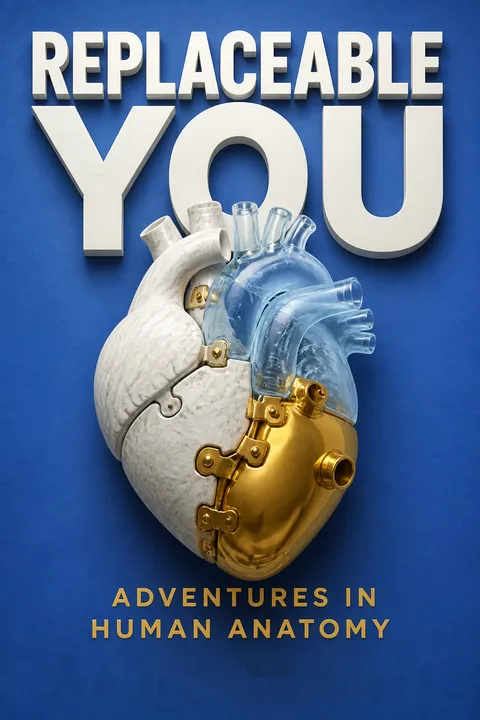
Replaceable You by Mary Roach receives mostly positive reviews (4.11/5 stars) for its engaging exploration of body part replacement science. Readers praise Roach's signature humor, curiosity, and ability to make complex medical topics accessible and entertaining. The book covers prosthetics, organ transplants, cosmetic surgery, and emerging technologies like 3D-printed organs. Reviewers appreciate her footnotes, adventurous research methods, and respectful approach to sensitive subjects. Some critics note the humor occasionally feels inappropriate or that the book doesn't match earlier works like Stiff. Most find it educational and laugh-out-loud funny.
People Also Read









Download PDF
Download EPUB
.epub digital book format is ideal for reading ebooks on phones, tablets, and e-readers.








































