
Key Takeaways
1. Empires Rise from Metaethnic Frontiers
Groups with high asabiya arise on metaethnic frontiers.
Fault-line origins. Empires are not born in isolation but emerge from regions where distinct cultures collide. These "metaethnic frontiers" are zones of intense competition and conflict, fostering cooperation and collective action within the nascent imperial nation. The constant pressure from external threats and the allure of potential gains drive the formation of cohesive, expansionist societies.
Examples of frontier origins:
- Russia: Shaped by centuries of conflict with steppe nomads
- America: Forged through the struggle between European settlers and Native Americans
- Rome: Emerged from the clash between Etruscan civilization and Italic tribes, and later, the Gauls.
The frontier effect. The frontier environment acts as a crucible, weeding out weak and fragmented groups while nurturing those capable of cooperation and resilience. This process leads to the development of unique cultural traits and institutions that enable the frontier society to build large and powerful states.
2. Cooperation is the Bedrock of Imperial Power
Within-group cooperation is the basis of inter-group conflict, including its extreme versions such as war and even genocide.
Beyond self-interest. The dominant theories in social and biological sciences often emphasize self-interest as the primary driver of human behavior. However, the rise of empires hinges on the ability of individuals to cooperate and act collectively, even at personal cost. This capacity for cooperation, or asabiya, is essential for building and maintaining large, complex societies.
Cooperation and oppression. Cooperation is not always benevolent; it can also be the foundation for oppression. Dominant groups require internal cohesion to exert control over others, highlighting the paradoxical relationship between cooperation and conflict.
Examples of cooperation:
- Ermak's Cossacks: United by a shared Orthodox Christian faith and a desire for loot
- The Mongols: Known for their unparalleled discipline and coordination in warfare
- Muscovite Russia: Unified by the need to defend against Tatar raids
3. The Cycle of Imperial Rise and Fall: A Delicate Balance
So peace brings warre and warre brings peace.
Dynamic processes. Empires are not static entities but dynamic systems that undergo cycles of growth, stability, and decline. These cycles are driven by complex interactions between demographic, economic, and social factors.
The seeds of decline. The very stability and internal peace that empires impose contain the seeds of future chaos. Prosperity leads to population growth, which in turn strains resources and exacerbates inequality. This creates discontent and strife, ultimately undermining the empire's foundations.
The cycle's phases:
- Integrative phase: Characterized by stability, prosperity, and cooperation
- Disintegrative phase: Marked by overpopulation, inequality, and conflict
4. The Matthew Principle: Inequality's Corrosive Influence
The growing disparity between the rich and the poor puts the social consensus under strain.
Unequal distribution. As empires expand and prosper, wealth tends to concentrate in the hands of a small elite, leading to growing inequality. This process, known as the Matthew principle, undermines social cohesion and erodes the asabiya of the imperial nation.
Consequences of inequality:
- Increased social unrest and conflict
- Erosion of trust and cooperation
- Decline in military effectiveness
The Matthew principle's impact. The growing disparity between the rich and the poor puts the social consensus under strain. At the same time, the gap in the distribution of wealth grows not only between the aristocrats and commoners, but also within each social group. Intra-elite competition for diminishing resources results in faction and undermines national solidarity.
5. Cliodynamics: A Mathematical Approach to History
Historical dynamics can be understood as a result of competition and conflict between groups, some of which dominate others.
A new science. Cliodynamics is a new field that applies the principles of nonlinear dynamics and statistical mechanics to the study of history. It seeks to identify patterns and cycles in historical processes, such as the rise and fall of empires.
Borrowing from natural sciences. Cliodynamics draws heavily from statistical mechanics, focusing on groups rather than individuals, and from nonlinear dynamics, modeling societies as dynamic systems with feedback loops.
Limitations of prediction. While cliodynamics can help explain past events and identify potential risks, it cannot accurately predict the future due to the chaotic nature of complex systems, the influence of free will, and the occurrence of unpredictable events.
6. The Power of Symbolic Markers in Group Identity
Ethnicity is the group use of any aspect of culture to create internal cohesion and differentiation from other groups.
Defining "us" and "them." Ethnic identity plays a crucial role in shaping group cohesion and differentiating between "us" and "them." Symbolic markers, such as language, religion, and customs, are used to define group boundaries and foster a sense of shared identity.
Multiple identities. Individuals often have multiple ethnic identities nested within each other, ranging from local affiliations to broader metaethnic communities. The broadest groupings of people that unite many nations are usually called civilizations, but I prefer to call such entities metaethnic communities.
The frontier's integrative role. On metaethnic frontiers, the presence of a distinct "other" can facilitate cooperation among groups on the same side of the fault line, as differences within the group pale in comparison to the cultural gap across the frontier.
7. The Frontier's End: A Turning Point for Empires
The very stability and internal peace that strong empires impose contain within them the seeds of future chaos.
Removing the pressure. The success of an imperial nation at territorial expansion results in the movement of frontiers far away from its core, thus removing an important force holding up the growth of inequality.
The loss of cohesion. As the frontier recedes, the integrative forces that once bound the imperial nation together weaken. Internal divisions and competition for resources intensify, leading to a decline in asabiya.
The Matthew principle. Imposition of peace results in population growth, and overpopulation brings with it the impoverishment of peasant masses. As the poor grow poorer, the rich grow richer—this process is called the Matthew principle.
8. The Enduring Influence of Culture and Geography
Many historical processes are dynamic—empires rise and fall, populations and economies boom and bust, world religions spread or wither.
Beyond simple determinism. While geography and environment play a significant role in shaping societies, they do not determine their fate. Culture, institutions, and human agency also play crucial roles in shaping historical trajectories.
The interplay of factors. The interaction between geography, culture, and social structure creates a complex web of influences that shapes the rise and fall of empires. Understanding these interactions is essential for a comprehensive understanding of history.
The importance of culture. The long exposure to the frontier conditions resulted in a profound change in the Russian culture. The general social mechanism responsible for this change is discussed later; for now, I only want to establish the reality of the cultural shift.
9. The Role of Leadership in Shaping Imperial Trajectories
The leading men take counsel over minor issues, the major ones involve them all; yet even these decisions that lie with the commons are considered in advance by the elite.
The influence of individuals. While cliodynamics emphasizes the importance of collective forces, it does not deny the role of individual leaders in shaping history. Charismatic and capable leaders can mobilize populations, inspire cooperation, and guide their societies through periods of crisis.
The limits of power. However, even the most powerful leaders are constrained by the social, economic, and cultural forces at play in their societies. They cannot simply impose their will on the population but must work within the existing framework.
The importance of leadership. The ability of an empire to expand territory and to defend itself against external and internal enemies is determined largely by the characteristics of its imperial nation, especially its asabiya.
10. The Modern World: Echoes of Empires Past
So Peace Brings Warre and Warre Brings Peace
The persistence of cycles. Despite the profound changes brought about by industrialization and globalization, the fundamental forces that drive the rise and fall of empires continue to operate in the modern world.
New forms of conflict. While traditional territorial empires may be in decline, new forms of power and influence are emerging, such as economic dominance, cultural hegemony, and technological superiority.
The future of empires. The future of empires remains uncertain, but understanding the lessons of history can help us navigate the challenges and opportunities of the twenty-first century.
Review Summary
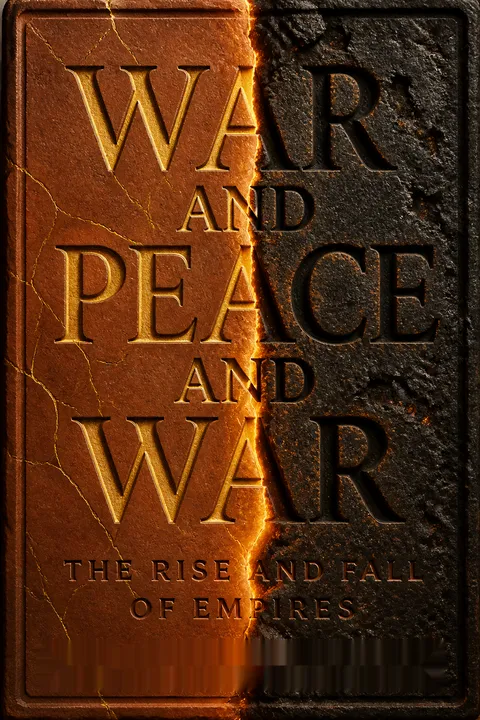
War and Peace and War by Peter Turchin explores the rise and fall of empires through a scientific lens. Turchin introduces "cliodynamics," applying mathematical models to historical patterns. The book focuses on the concept of "asabiya" (social cohesion) and how it influences empire formation and decline. Reviewers praise Turchin's interdisciplinary approach and engaging writing style, though some criticize his limited geographical scope and overreliance on his theory. Many find the book thought-provoking and valuable for understanding historical dynamics, despite occasional oversimplifications and controversial claims.
People Also Read







FAQ
What is War and Peace and War: The Rise and Fall of Empires by Peter Turchin about?
- Comprehensive theory of empires: The book investigates why empires rise and fall, focusing on the interplay of social cohesion (asabiya), cooperation, and conflict across centuries.
- Scientific approach to history: Turchin introduces cliodynamics, a method that applies mathematical and scientific principles to analyze historical processes as dynamic systems.
- Empirical case studies: The narrative is grounded in detailed historical examples, including the Roman Empire, medieval France and England, and the Russian conquest of Siberia.
- Interdisciplinary analysis: The book synthesizes insights from history, sociology, economics, and evolutionary biology to explain the life cycles of empires.
Why should I read War and Peace and War by Peter Turchin?
- Provocative new perspective: The book challenges traditional, anecdotal narratives by offering a scientific, theory-driven explanation for the rise and fall of empires.
- Relevance to modern issues: Turchin draws parallels between historical patterns and contemporary challenges, such as inequality, elite competition, and the decline of social capital in modern societies.
- Interdisciplinary insights: Readers gain tools from multiple disciplines—biology, economics, political science—to better understand complex social systems.
- Accessible yet rigorous: The book is written for both lay readers and scholars, making complex theories understandable without sacrificing depth.
What are the key takeaways from War and Peace and War by Peter Turchin?
- Cycles of empire: Empires experience long-term cycles of integration (growth and cohesion) and disintegration (decline and fragmentation), driven by internal social dynamics.
- Centrality of cooperation: The capacity for collective action (asabiya) is crucial for empire-building and maintenance, while its decline leads to instability and collapse.
- Elite overproduction and inequality: Rising numbers of elites and growing economic inequality undermine social cohesion and fuel political crises.
- Lessons for today: Understanding these historical patterns can inform responses to current societal challenges, such as polarization and declining trust.
What is the concept of asabiya in War and Peace and War and why is it important?
- Definition and role: Asabiya is the collective capacity for cooperation and social solidarity within a group, essential for large-scale collective action like warfare and governance.
- Driver of empire dynamics: High asabiya enables empires to expand and maintain cohesion; its decline leads to fragmentation and collapse.
- Modern analogues: Turchin relates asabiya to social capital—trust, norms, and networks that facilitate cooperation in modern societies.
- Long-term influence: Asabiya changes slowly over centuries, shaped by historical memory, external threats, and social institutions.
How does Peter Turchin’s metaethnic frontier theory explain the rise of empires in War and Peace and War?
- Definition of metaethnic frontiers: These are zones where distinct civilizations or ethnic groups meet and conflict, creating intense pressure that forges strong group identity and cooperation.
- Source of high asabiya: Competition and conflict on these frontiers nurture high social cohesion, enabling the formation of powerful, expansionist states.
- Historical examples: The Roman, Carolingian, and Russian empires all arose on metaethnic frontiers, where the need to unite against a threatening “other” was paramount.
- Integration across differences: Groups on the same side of a frontier often overcome internal differences to cooperate against external threats.
What is cliodynamics, and how does Peter Turchin use it in War and Peace and War?
- Scientific study of history: Cliodynamics is Turchin’s interdisciplinary approach that uses mathematical models and empirical data to analyze historical dynamics.
- Focus on social mechanisms: It seeks to identify and quantify the impersonal social forces—like asabiya, elite competition, and demographic cycles—that drive historical change.
- Predictive limitations: While cliodynamics can identify patterns and crisis points, it acknowledges the unpredictability of specific events due to chaos and external shocks.
- Contrast with psychohistory: Unlike Asimov’s fictional psychohistory, cliodynamics is a real scientific discipline grounded in data and testable models.
How does War and Peace and War by Peter Turchin explain the cyclical rise and fall of empires (secular cycles)?
- Secular cycles defined: Empires undergo long (2-3 century) cycles of integration (prosperity, population growth) and disintegration (inequality, elite overproduction, crisis).
- Nested cycles: Shorter “fathers-and-sons” cycles (40-60 years) of civil conflict and peace are embedded within these longer secular cycles.
- Internal drivers: The cycles are primarily driven by internal social, economic, and demographic feedback loops, not just external shocks.
- Empirical support: Turchin tests these cycles with data from Rome, France, and England, showing recurring patterns of growth, crisis, and renewal.
What is the Matthew principle, and how does it relate to inequality in War and Peace and War by Peter Turchin?
- Definition: The Matthew principle is the idea that “the rich get richer and the poor get poorer,” leading to increasing economic inequality over time.
- Mechanisms of inequality: Inheritance, economic exchange, and demographic factors cause wealth to concentrate in fewer hands, even from equal starting points.
- Historical evidence: Turchin documents rising inequality in societies like medieval England, where land and wealth became concentrated among elites.
- Consequences for empires: Growing inequality undermines social cohesion, fuels elite competition, and contributes to political instability and collapse.
What is elite overproduction, and why is it significant in War and Peace and War by Peter Turchin?
- Definition: Elite overproduction occurs when the number of individuals aspiring to elite status outpaces the available resources and positions.
- Consequences: This leads to increased intra-elite competition, factionalism, civil wars, and political instability.
- Historical examples: Fourteenth-century France and England experienced elite overproduction, resulting in social crises and violent “pruning” of the elite class.
- Cycle resolution: Civil wars and crises eventually reduce elite numbers, restoring balance and enabling a new integrative phase.
How does War and Peace and War by Peter Turchin challenge the myth of self-interest in social science?
- Experimental evidence: Behavioral experiments show that people often cooperate and punish defectors even at personal cost, contradicting pure self-interest models.
- Types of individuals: Societies contain “knaves” (self-interested), “saints” (unconditional cooperators), and “moralists” (conditional cooperators who punish defectors), with moralists sustaining cooperation.
- Evolutionary explanations: Kin selection, reciprocal altruism, and cultural group selection explain the evolution of cooperation despite individual incentives to defect.
- Neuroeconomic findings: Punishing cheaters activates reward centers in the brain, indicating that moralistic punishment is emotionally and biologically ingrained.
How does War and Peace and War by Peter Turchin relate social capital to asabiya, and why does it matter today?
- Social capital as modern asabiya: Turchin equates social capital—trust, norms, and networks facilitating cooperation—with asabiya in contemporary societies.
- Empirical studies: Research like Robert Putnam’s work on Italian regions shows that high social capital correlates with better governance and economic performance.
- Consequences of low social capital: Societies with low social capital experience distrust, weak cooperation, and the rise of criminal organizations, undermining development.
- Modern relevance: Maintaining and enhancing social capital is crucial for economic growth, effective governance, and resilience in modern states and organizations.
What lessons does War and Peace and War by Peter Turchin offer for understanding modern empires like the U.S., China, and the European Union?
- U.S. as a modern empire: The U.S. fits the definition of a large, multiethnic empire with high asabiya, but recent declines in social capital may threaten its cohesion.
- China’s rise: China is identified as a growing imperial power, with expanding economic and military influence that could challenge U.S. dominance.
- European Union’s uniqueness: The E.U. is described as a consensual, peaceful empire whose long-term cohesion depends on sustaining asabiya among diverse members.
- Geopolitical challenges: Ongoing conflicts on metaethnic frontiers and the impact of technology on social cohesion are critical tests for the resilience of modern empires.
About the Author

Download PDF
Download EPUB
.epub digital book format is ideal for reading ebooks on phones, tablets, and e-readers.








































