

Key Takeaways
Political collapse follows recurring patterns you can measure and forecast
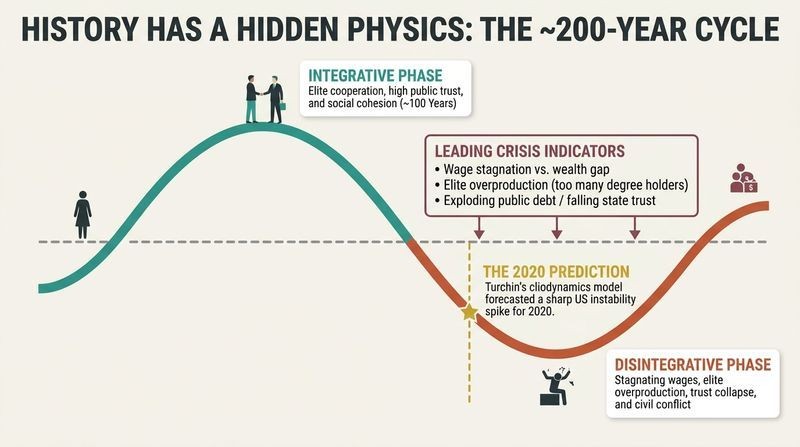
History has a hidden physics. Peter Turchin, an ecologist turned historian, founded cliodynamics: the use of Big Data and mathematical models to find recurring patterns across ten thousand years of complex societies. He rejects the idea that history is chaos or driven solely by great men. Instead, states cycle through integrative phases (roughly a century of internal peace and elite cooperation) and disintegrative phases (violence, civil war, fragmentation). No society he studied stayed integrated beyond about two hundred years.
The 2020 prediction. In 2010, Turchin published a forecast in Nature: judging from US patterns, a sharp instability spike would hit by the early 2020s. Stagnating wages, widening inequality, too many advanced-degree holders, falling public trust, and exploding debt all turned ominous starting in the 1970s. These indicators, he argues, are dynamically linked leading indicators of crisis.
What's striking is Turchin's provenance: he spent decades modeling beetle and lemming boom-bust cycles before turning to human societies. That biological lens gives his work a distinctive rigor and a distinctive blind spot. Critics note that treating history as data risks smoothing over contingency and culture. Yet the approach echoes Jared Diamond and Jack Goldstone, who also found demographic patterns beneath political upheaval. The falsifiable 2010 forecast is the boldest move here. Whether the 2020s validate it or not, publicly betting on a testable prediction is exactly what separates science from punditry, and it deserves credit regardless of outcome.
Too many rich aspirants competing for power is society's deadliest fault line
Elite overproduction is the master variable. Elites are simply power holders, those with wealth, coercive force, bureaucratic authority, or persuasive influence. When their numbers balloon faster than the positions available, you get frustrated aspirants who turn into counter-elites willing to break the rules. Turchin illustrates with a rigged game of musical chairs: keep the chairs fixed at ten but keep adding players. Double the players and frustrated losers rise tenfold, an amplification effect.
The American numbers. US households worth $10 million or more (in constant dollars) grew from 66,000 in 1983 to 693,000 by 2019, a tenfold jump. Meanwhile the cost of a winning Senate campaign rose from $3.9 million in 1990 to $27 million in 2020. More wealthy aspirants chase the same fixed number of offices, and the norms governing elections fray.

This is the book's most original and unsettling claim: not poverty but a surplus of privileged, credentialed, ambitious people drives collapse. It inverts intuition. Turchin's evidence spans Qing China's failed examination candidates (Hong Xiuquan launched the Taiping Rebellion after failing four times) and antebellum American lawyers. The idea resonates with sociologist Randall Collins on credential inflation and with modern anxieties about law-school and PhD gluts. A fair challenge: quantifying who counts as an aspirant is slippery, and correlation between elite numbers and instability could mask other drivers. Still, the amplification math is genuinely illuminating and hard to unsee once grasped.
Stagnant wages secretly power a wealth pump enriching elites and breeding crisis
Follow the relative wage. Turchin's key metric is the relative wage: typical worker pay divided by GDP per capita. When workers stop sharing in economic growth, the surplus flows upward through what he calls the wealth pump, transferring income from labor to elites. Between 1976 and 2016 the US relative wage lost nearly 30% of its value. Real wages for workers without four-year degrees (64% of the population) actually shrank in absolute terms.
Immiseration is biological, not just economic. As wages stagnated after the 1970s, average American height stopped rising (uniquely among wealthy nations) and life expectancy fell for three consecutive years before COVID, the first such decline since 1933. Deaths of despair (suicide, alcoholism, overdose) quadrupled among less-educated whites. The same pattern preceded the Civil War: relative wages halved from the 1820s to 1860s while urban riots exploded.
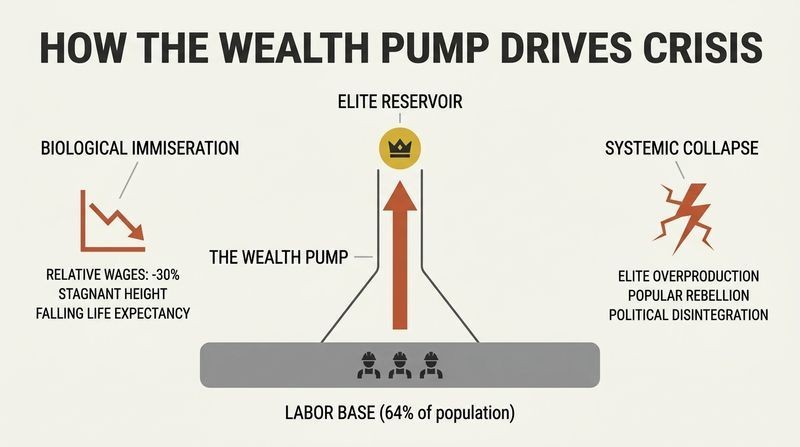
The wealth pump reframes inequality as a dynamic mechanism rather than a static gap, which is analytically powerful. Turchin's insistence on biological indicators (height, mortality) as honest measures of well-being is a genuine contribution, drawing on Nobel laureate Robert Fogel and economists Anne Case and Angus Deaton. It cuts through the Steven Pinker optimism that global metrics keep improving. His point: people compare themselves to their parents, not to Chad. One nuance worth adding: Turchin himself credits nonmarket forces (eroded unions, falling minimum wage, austerity) over pure automation, aligning with Stansbury and Summers on declining worker power.
Crises need immiserated masses plus a cadre of frustrated elite rebels
Two ingredients, one explosion. Popular immiseration alone produces suffering, not revolution. Elite overproduction alone produces palace intrigue. Combine them and you get a combustible mix: immiserated masses supply raw energy, while frustrated counter-elites supply organization and leadership. Marx was wrong, Turchin argues; immiserated proletarians rarely run successful revolutions. The dangerous revolutionaries are educated aspirants with training, connections, and grievance.
Lawyers make revolutions. Robespierre, Lenin, Castro, Lincoln, and Gandhi were all lawyers. Hong Xiuquan and Mao were teachers. Turchin tracks American law-graduate salaries splitting into two humps around 2000: about 20% land $190,000 jobs while most earn $45,000-$75,000 saddled with $160,000+ in debt. This credentialed precariat, people sold a lottery ticket that didn't pay off, becomes the seedbed of radicalization.
The claim that revolutions are led by disappointed elites, not the desperate poor, has deep pedigree, from Crane Brinton's Anatomy of Revolution to Goldstone's demographic-structural theory. It explains why economic booms sometimes precede unrest: they mint aspirants faster than slots. The bimodal lawyer-salary data is a vivid, verifiable proxy. A useful extension: today's social media lowers organizing costs, potentially letting smaller counter-elite cadres punch above their weight, a dynamic Turchin treats cautiously. The framework also carries a quiet warning to societies expanding higher education without expanding elite positions, a policy tension few governments openly confront.
America is a plutocracy, and that is measurable science, not conspiracy
Who actually rules. Drawing on sociologist G. William Domhoff and political scientist Martin Gilens, Turchin argues the US is ruled by a coalition of the wealthy 1% and credentialed 10%. Gilens analyzed nearly 2,000 policy questions from 1981 to 2002 and found that once you account for the preferences of the affluent and business lobbies, the influence of average voters is statistically indistinguishable from zero.
Science versus conspiracy. This is not a shadowy cabal theory. Conspiracy theories assume secret plans, implausible motives, and one hidden mastermind. The class-domination theory assumes transparent motives (the wealthy want more wealth), verifiable mechanisms (lobbying, campaign finance, revolving doors, media ownership), no central command, and public data. In 2021, 12,000 lobbyists spent $3.7 billion. The immigration puzzle proves the point: mandatory E-Verify would cheaply curb illegal hiring, but the money-cutting solution is never adopted. Cui bono.
The Gilens finding is one of the most cited and contested in political science. Defenders and critics have volleyed for a decade; Turchin acknowledges the debate but stands by the core. What distinguishes his treatment is the four-point conspiracy-versus-science test, a genuinely useful epistemic tool for readers drowning in both real corruption and paranoid fantasy. The immigration argument, borrowed from Angela Nagle and economist George Borjas, is provocative and will anger many, since immigration's wage effects remain fiercely disputed among economists. Turchin honestly flags this uncertainty in his footnotes. The steelman: regardless of exact magnitude, both elites and workers believe immigration suppresses wages, creating political reality.
Ruling classes once voluntarily shut the wealth pump; America did it before
The Great Compression proves reform is possible. Between roughly 1870 and 1900 (the first Gilded Age), US inequality soared. Then, alarmed by the violent 1910s-1920s (the Battle of Blair Mountain saw up to 15,000 armed miners; the 1919 Red Summer killed around a thousand), prosocial elites chose reform over revolution. The Progressive Era and New Deal legalized unions, raised the minimum wage, taxed top incomes above 90%, and restricted immigration to tighten labor supply.
Elites actually sacrificed. The richest American's fortune, measured in worker-wage multiples, fell from Rockefeller's 2.6 million annual wages in 1912 to Daniel Ludwig's 93,000 in 1982. For two postwar decades the very rich handed over nine-tenths of top income to the government. No revolution forced this; a prosocial faction persuaded its peers that fear of Bolshevism made compromise wise.
This is the book's hopeful core, and its most politically loaded. Turchin insists the New Deal bargain excluded Black Americans, a devil's deal with Southern segregationists that he refuses to whitewash. Heather McGhee and Heather Cox Richardson supply the racial analysis: the American working class could be divided by race in ways homogeneous Denmark could not, which is why the US diverged from Nordic social democracy. The lesson cuts against fatalism (Walter Scheidel's grim thesis that only catastrophe levels inequality). Turchin claims Scheidel is 90% right, meaning peaceful exits are rare but real. That 10% is where political agency lives.
States collapse when the ruling network implodes, not when rebels storm gates
The Nero moment. In AD 68, Emperor Nero woke to find his guards, servants, and even his poison gone. Abandoned by his power network, the ruler of an empire became a nonentity and cut his own throat. Turchin's point: rulers are far weaker than we imagine. Power lives in the network, not the person. Batista fled Cuba by plane before rebels reached Havana; Afghanistan's government evaporated in 2021 before the Taliban entered Kabul; Russia's Provisional Government was abandoned before the Winter Palace was stormed.
Cohesion decides survival. Compare post-Soviet states. Ukraine's feuding oligarchs abandoned each other repeatedly, producing two revolutions and state collapse. Belarus, with a cohesive military-administrative elite and no oligarchs, weathered mass 2020 protests intact. Same culture, opposite outcomes, explained by elite cohesion.
The insight that collapse is implosion rather than conquest reframes how we read revolutions. It aligns with Theda Skocpol's structural view that regimes fall when states lose coercive coherence, not when crowds grow angry. Turchin's critique of Barbara Walter's How Civil Wars Start is pointed: predictive models built only on post-1955 data mistook ethnic factionalism for a universal driver and missed the Arab Spring entirely. The deeper claim, that you must map interest groups, their power, and their cohesion rather than count crowds, is methodologically sound. The Belarus-versus-Ukraine natural experiment is the book's cleanest causal illustration, holding culture roughly constant while varying elite structure.
It's too late to dodge the 2020s crisis, but the 2070s are still preventable
Multipath forecasting. Turchin built a prototype model (MPF) treating radicalization like an epidemic: naive people catch the virus of radicalism from radicals or from exposure to violence, while moderates dampen it. The wealth pump drives the whole engine. Running it forward, the model shows the 2020s peak is baked in; too much inertia remains to avoid it.
The fork ahead. The only durable fix is shutting the wealth pump by raising relative wages until upward and downward mobility balance. But this must be sustained; a balanced society is like riding a bicycle, requiring constant effort against the iron law of oligarchy (powerful groups inevitably use power selfishly). Do nothing and the pattern repeats every fifty to sixty years, matching the two-generation rhythm where grandsons repeat grandfathers' mistakes.
Presenting a crisis as unavoidable yet the next one as preventable is rhetorically shrewd, converting fatalism into urgency. The epidemiological model of radicalization is elegant and testable, echoing how network scientists model contagion of behaviors, not just diseases. The power-law point matters: political violence, like earthquakes and wildfires, follows fat-tailed distributions where rare catastrophes dominate, so a 10% chance of civil war deserves the seriousness of a 10% chance of personal extinction. The honest limitation Turchin concedes is that his MPF is a prototype, a morality tale more than a precision instrument. Its value is scenario reasoning, not point prediction.
Polygamy and geography quietly set how fast societies boil over
Marriage rules shape cycle length. Because elite overproduction depends on how fast elites reproduce, the number of wives a powerful man can have matters. Christian monogamy in France and England slowed elite breeding, yielding long cycles of 200-300 years. Islamic and steppe societies, where men took multiple wives and concubines, churned out aspirants far faster. The medieval historian Ibn Khaldun noticed dynasties there lasted about four generations, roughly a century. All four Mongol successor dynasties collapsed within a hundred years, confirming the prediction.
Geography exports instability. England delayed its own crises during the Late Medieval period by shipping surplus elites across the Channel to plunder France. When France recovered around 1450 and expelled them, battle-hardened, impoverished nobles flooded home and ignited the Wars of the Roses (which inspired Game of Thrones).
These are the book's most testable micro-predictions, and they hold up impressively across independent civilizations, which is what gives cliodynamics its scientific texture. Linking a demographic variable (polygamy) to a political outcome (cycle length) via elite reproduction is the kind of mechanism-plus-data argument that distinguishes it from vague cyclical history. The Ibn Khaldun connection is especially elegant, reviving a fourteenth-century Arab thinker as a data point rather than a curiosity. A caution: the England-exports-instability story is harder to isolate from confounds, since Anglo-French warfare was near-continuous for centuries. But the polygamy finding, drawn from Turchin's cross-cultural CrisisDB, is a rare quantitative bridge between anthropology and political history.
Watch counter-elites hijack a mainstream party as the legal route to power
Revolution through the ballot box. A successful revolution needs large-scale organization, and America's coercive apparatus makes building an underground party nearly impossible (the FBI even had to organize the far-right plot to kidnap Michigan's governor). So Turchin argues the real threat is counter-elites capturing an existing party. He sees the Republican Party potentially transforming from the vehicle of the 1% into a right-wing populist party.
Two counter-elite routes. Turchin profiles figures who took either the wealth route (Trump, born rich, channeling working-class rage) or the credential route (Steve Bannon, Harvard MBA turned self-described Leninist wanting to bring everything crashing down). He flags Tucker Carlson as a possible crystallization point for a coherent New Right ideology, and Yale-Law-educated populists like J.D. Vance as prototypical American counter-elites funded by billionaires.
Written before the 2024 election, this section reads as a live hypothesis about American realignment, and its framing (counter-elites preferring legal capture to armed insurrection) has aged into eerie relevance. The observation that so many American counter-elites hold elite law degrees, from Yale especially, sharpens the elite-overproduction thesis: the system's own credentialing machine manufactures its challengers. Turchin resists moralizing, treating Trump, Bannon, and Vance as products of structural forces rather than villains. That analytic detachment is both the method's strength and its provocation. Skeptics will argue it underweights ideology and individual agency; Turchin would counter that ideologies are fluid weapons, and it is the fragmentation itself, not any creed, that signals crisis.
Constrain your elites rather than abolish them, and demand they serve everyone
The bicycle must keep moving. Turchin's closing counsel rejects both utopian elite-abolition and cynical resignation. Complex societies need elites: rulers, administrators, thought leaders. The task is constraining them to act for collective benefit. History shows this equilibrium is unstable, forever threatened by the iron law of oligarchy, so it demands constant vigilance from the 99%.
Variation is the laboratory. Not all democracies are sliding. Since 1980 the top 1% income share hit 19% in the US but France pushed it back below 10%, and Austria held near 10%. Denmark, however, drifted up toward 13%. These divergent national trajectories prove policy choices matter and give social scientists the variation needed to test what actually works. America is the cautionary outlier, not the inevitable destiny.
The ending resists the doomerism the subject invites. By showing France and Austria bending inequality back down while the US did not, Turchin locates agency precisely where fatalists deny it exists. This comparative move is methodologically important: cross-national variation is the closest social science gets to controlled experiment. The framing also quietly rebukes American exceptionalism, positioning the US as an extreme case rather than the model. One might push further: the iron law of oligarchy (coined by Robert Michels in 1911 studying political parties) implies eternal recurrence, which sits in tension with Turchin's hope for durable reform. His honest answer is that there is no permanent solution, only perpetual maintenance.
Analysis
End Times is history written by an ecologist, and that origin explains both its power and its friction. Peter Turchin imports population-dynamics thinking (boom-bust cycles, nonlinear feedback, big-data proxies) into the study of states, producing cliodynamics. The book's spine is a two-factor structural-demographic theory: popular immiseration plus elite overproduction, both powered by a wealth pump that redistributes income upward. When too many wealthy or credentialed aspirants chase too few elite slots, frustrated counter-elites organize the immiserated masses, and instability follows.
The intellectual lineage matters. Turchin builds explicitly on Jack Goldstone's demographic-structural theory of revolutions and G. William Domhoff's class-domination sociology, extending both with quantitative databases (Seshat, CrisisDB) spanning millennia. This is his genuine innovation: converting historical narrative into testable data, then falsifying rival theories rather than cherry-picking supportive anecdotes. The 2010 Nature forecast of a 2020s crisis is the boldest expression of this scientific ambition.
The strongest material is comparative and quantitative: the polygamy-cycle-length prediction confirmed across Mongol dynasties, the Belarus-Ukraine natural experiment, the bimodal lawyer-salary distribution, the biological well-being data. These resist ideological dismissal. The weakest points are where measurement gets fuzzy (defining who counts as an elite aspirant) and where contested empirics get leaned on hard (Gilens on plutocracy, immigration's wage effects, which Turchin honestly flags as disputed).
What elevates the book above cyclical-history pop science is its refusal of both great-man theory and fatalism. Turchin insists impersonal forces dominate yet leaves room for prosocial elite factions to choose reform, as they did in the Progressive Era and New Deal. The unresolved tension is between the iron law of oligarchy (which implies eternal recurrence) and his hope for durable rebalancing. His answer, that equilibrium requires constant maintenance like riding a bicycle, is intellectually honest if less satisfying than a permanent cure. The result is unusually rigorous, humane, and unsettling.
Review Summary
End Times explores the cyclical nature of societal crises, focusing on elite overproduction and popular immiseration as key drivers of instability. Turchin's cliodynamics approach analyzes historical data to predict future unrest. While some readers praise the book's insights and scientific approach, others criticize its methodology and political biases. Many find the theories thought-provoking but question their predictive power. The book's analysis of inequality, elite competition, and societal collapse resonates with readers observing current political tensions, though opinions vary on its ultimate significance and accuracy.
People Also Read







FAQ
What's End Times about?
- Focus on Political Disintegration: End Times by Peter Turchin examines cycles of political stability and instability, particularly in the United States, highlighting elite overproduction and popular immiseration as key factors.
- Cliodynamics Framework: Turchin introduces cliodynamics, a scientific approach using data analysis to identify historical patterns, allowing predictions about future political crises.
- Historical Context: The book draws parallels between current events and historical crises, suggesting the U.S. is on a path similar to past societies that faced upheaval.
Why should I read End Times?
- Understanding Current Events: The book provides a framework for understanding political and social turmoil in contemporary America, relevant for those interested in current affairs.
- Scientific Approach to History: Turchin's use of cliodynamics combines history with quantitative analysis, appealing to readers who appreciate data-driven arguments.
- Lessons from the Past: It encourages learning from historical patterns to anticipate and mitigate future crises, empowering informed choices.
What are the key takeaways of End Times?
- Cycles of Stability and Instability: Turchin posits that complex societies experience cycles of political integration and disintegration, typically lasting around a century.
- Elite Overproduction and Popular Immiseration: The book highlights how excess elite aspirants and economic decline of the working class create social tension.
- Historical Precedents: Turchin uses examples like the fall of the Roman Empire to illustrate how similar conditions have led to societal collapse.
What is cliodynamics, as defined in End Times?
- Scientific Study of History: Cliodynamics combines history with quantitative analysis to identify patterns in societal behavior over time.
- Predictive Modeling: It involves creating mathematical models to predict future societal trends based on historical data.
- Interdisciplinary Approach: Cliodynamics draws on sociology, economics, and ecology to provide a comprehensive understanding of societal dynamics.
How does End Times explain elite overproduction?
- Definition of Elite Overproduction: Turchin defines it as a situation where the number of individuals aspiring to elite positions exceeds available positions, creating competition and conflict.
- Historical Context: The book illustrates how elite overproduction has historically led to instability, using examples from various societies.
- Consequences for Society: As competition among elites intensifies, it can lead to a breakdown of social cohesion and trust in institutions.
What role does popular immiseration play in End Times?
- Definition of Popular Immiseration: Turchin describes it as the decline in economic well-being of the working class, characterized by stagnating wages and increasing inequality.
- Connection to Political Instability: The book argues that popular immiseration, combined with elite overproduction, creates a volatile environment ripe for conflict.
- Historical Examples: Turchin draws parallels between contemporary America and historical instances of popular immiseration leading to revolutions.
What is the "wealth pump" in End Times?
- Economic Inequality Mechanism: The "wealth pump" refers to the redistribution of wealth from the working class to the elites, occurring when labor supply exceeds demand.
- Impact on Social Stability: As relative wages decline, it creates a cycle of immiseration among common people, leading to social unrest.
- Connection to Elite Overproduction: The wealth pump contributes to elite overproduction, further destabilizing society as elites compete for limited positions.
How does Turchin connect historical events to current American society in End Times?
- Historical Parallels: Turchin identifies similarities between current U.S. political tensions and past crises, highlighting the cyclical nature of history.
- Data-Driven Analysis: The book uses quantitative data to show how economic and social indicators have shifted over time, providing a framework for understanding current American society.
- Implications for the Future: By examining historical patterns, Turchin suggests the U.S. may be on a path toward significant political instability.
What is "multipath forecasting" in End Times?
- Predictive Modeling Approach: "Multipath forecasting" explores various potential futures based on different societal interventions.
- Input from Historical Data: The model uses historical data to simulate scenarios, identifying interventions that may lead to positive outcomes.
- Application for Policymakers: Turchin suggests this method can help policymakers navigate current crises by understanding potential outcomes.
What are the best quotes from End Times and what do they mean?
- “History is not just one damn thing after another.”: Emphasizes Turchin's belief that history follows discernible patterns, not randomness.
- “When a state has stagnating or declining real wages...”: Highlights the interconnectedness of economic factors leading to political instability.
- “The social pyramid has grown top-heavy.”: Reflects the idea that too many aspiring elites without sufficient positions can destabilize society.
How does End Times address the future of democracy in America?
- Current Crisis of Democracy: Turchin argues the U.S. is experiencing a crisis characterized by polarization and distrust in institutions.
- Potential Outcomes: The book explores scenarios including civil unrest or a return to cooperative governance, emphasizing the importance of addressing underlying issues.
- Call to Action: Turchin advocates for social cooperation and equitable resource distribution as essential for democracy's survival.
How can the insights from End Times be applied to improve society?
- Addressing Economic Inequality: Turchin emphasizes the need to shut down the wealth pump to prevent crises, promoting fair wages and reducing income inequality.
- Encouraging Elite Responsibility: The book advocates for elites to recognize their role in maintaining social stability by addressing common populace needs.
- Proactive Policymaking: Turchin's multipath forecasting model encourages policymakers to consider long-term consequences of actions to prevent future crises.
About the Author


Download PDF
Download EPUB
.epub digital book format is ideal for reading ebooks on phones, tablets, and e-readers.








































