

Key Takeaways
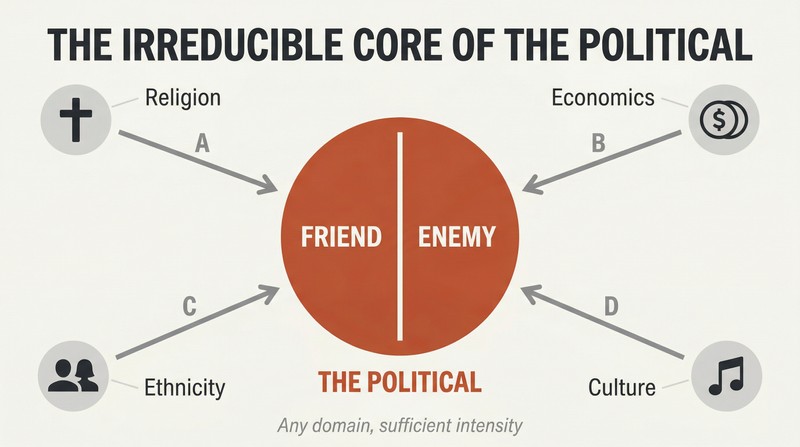
The political exists wherever groups ask: who is our enemy?
Schmitt's foundational thesis. The "friend-enemy distinction" is to politics what good/evil is to morality and beautiful/ugly is to aesthetics. But unlike those other domains, the political isn't a separate "province of culture" sitting alongside economics or art — it's the authoritative dimension that can emerge from any arena. "Enemy" here means the public enemy: not a personal rival you despise, but a collectively identified group with a real possibility of armed conflict.
What makes this radical: Without this existential distinction, you may have culture, commerce, law, and entertainment — but you don't have genuine politics. Any issue — religious, economic, ethnic — becomes political the moment it reaches the intensity where groups organize around friend-enemy lines. The friend-enemy distinction is the irreducible core.
The political creates the state, not the other way around
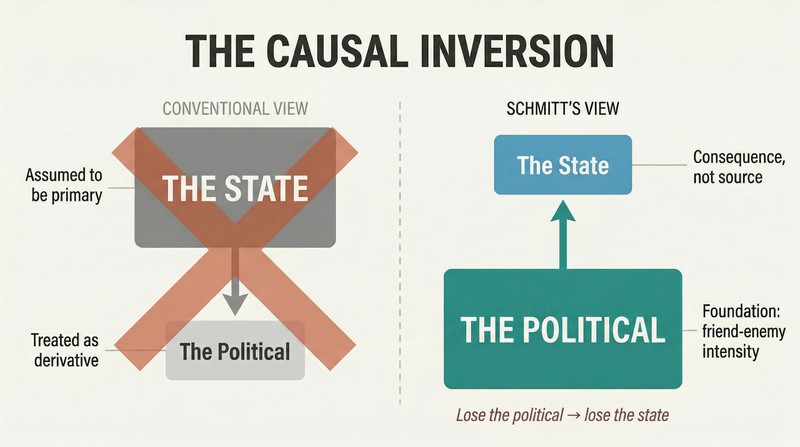
A reversal of conventional thinking. Most political science begins with the state and works outward. Schmitt inverts this: "the concept of the state presupposes the concept of the political." The state exists because groups of people already identify enemies and organize for collective defense. The state is a consequence of the friend-enemy grouping, not its source.
This has a brutal corollary. When a nation loses the will to make the existential distinction between friend and enemy — when it abandons the intensity required for self-preservation — it doesn't make politics disappear. It makes that nation disappear. The political migrates to other, more vital groups who still possess the energy for self-assertion. A people that surrenders the political doesn't create peace; it creates a vacuum others fill.
Liberalism didn't end conflict — it censored our honesty about it
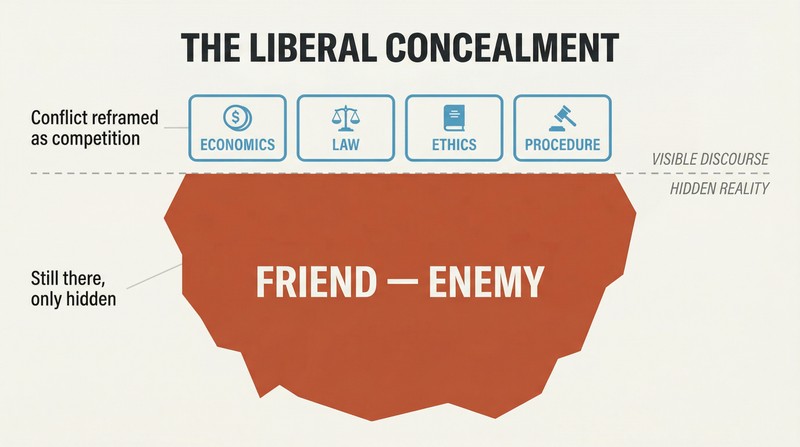
Liberalism's sleight of hand. Schmitt argues that the liberal tradition sought to dissolve the political into safer domains: economics, law, ethics, parliamentary procedure. Every potential conflict gets reframed as a market competition, a legal dispute, or a moral question. The result isn't the elimination of friend-enemy groupings but their concealment behind antipolitical modes of discourse.
The 19th-century liberal state called itself stato neutrale ed agnostico — a neutral, agnostic state whose legitimacy came precisely from claiming not to take sides. But Schmitt insists this neutrality is illusory: a state that declares itself neutral on political questions has simply renounced its claim to rule while real decisions get made elsewhere, by those who haven't abandoned the friend-enemy distinction.
Every century's 'neutral ground' became the next battlefield
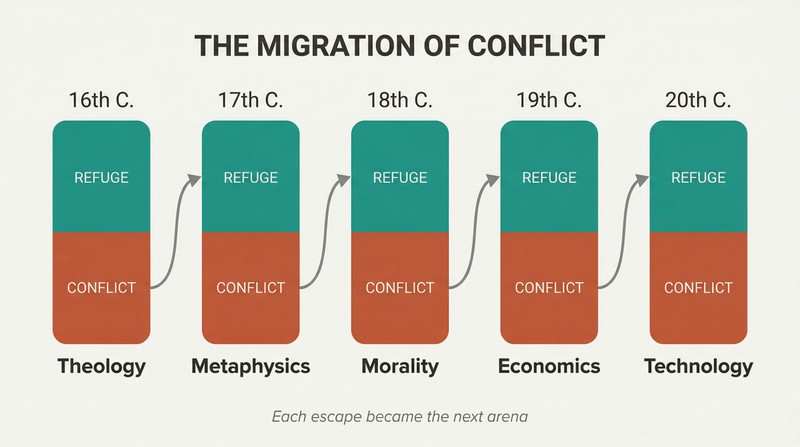
Schmitt's five-century framework. In his 1929 Barcelona lecture, Schmitt maps five central domains across modern European history:
1. Theology (16th century)
2. Metaphysics (17th century)
3. Humanitarian morality (18th century)
4. Economics (19th century)
5. Technology (20th century)
Each transition followed the same logic. After devastating religious wars, Europeans sought a domain where reasonable people could agree without bloodshed — first natural science, then ethics, then economics. But each "neutral" domain immediately became the new arena of conflict. Religious wars gave way to national-cultural wars, then economic wars. The vocabulary of peace became the instrument of the next struggle. What looked like escape from conflict was merely its relocation.
Whatever idea dominates an era redefines all other questions
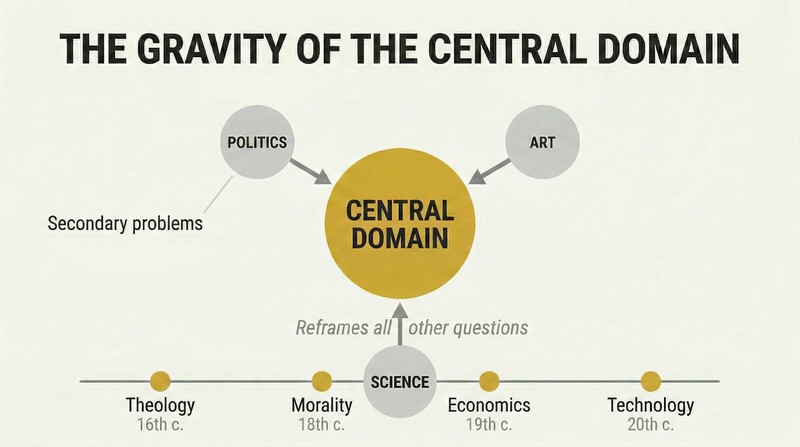
The central domain reshapes everything. When theology was paramount, all problems were theological — other questions would resolve themselves once God's order was understood. When economics became central, moral progress became a mere by-product of economic growth. Even the meaning of "progress" itself transforms: in the moral age, progress meant perfecting virtue; in the technical age, it means faster machines.
The intellectual elite shifts too. Schmitt's concept of the clerc — each era's defining type of intellectual leader — illustrates this. The theologian of the 16th century gave way to the systematic scholar of the 17th, the Enlightenment author of the 18th, the economic expert of the 19th. The unsettling question for Schmitt: can the age of technology produce any clerc at all, or does it eliminate the need for intellectual leadership entirely?
Technology serves everyone, which is exactly why it's not neutral
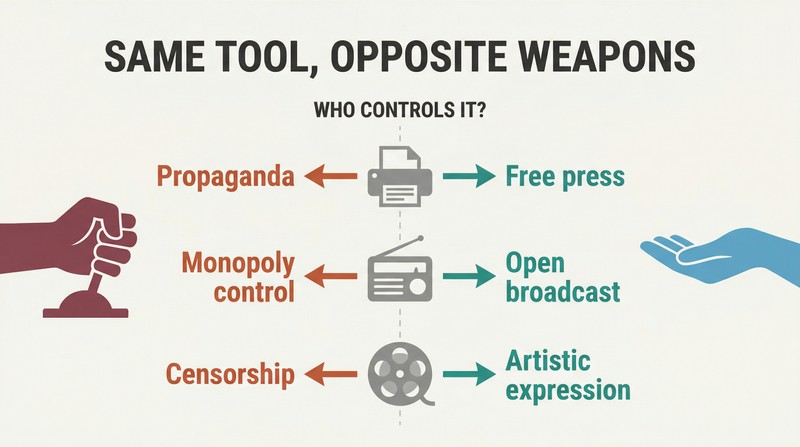
Technology's false promise. The appeal of technology as the latest central domain is that it seems finally to deliver genuinely neutral ground. Unlike theological or moral questions, purely technical problems are "refreshingly factual." Every nation, class, and religion uses the same technology. What could be more neutral?
But neutrality is the illusion. Technology is always an instrument and a weapon, serving opposite purposes across eras. The printing press produced freedom of the press in one century and mass propaganda in the next. Radio belongs to whoever controls the broadcasting monopoly. Film serves the censor. No political conclusion can be derived from technology itself — yet every political actor wields it. Schmitt insists the real question is never whether technology is neutral but which type of politics will master it.
Crusading for eternal peace produces the most inhuman wars
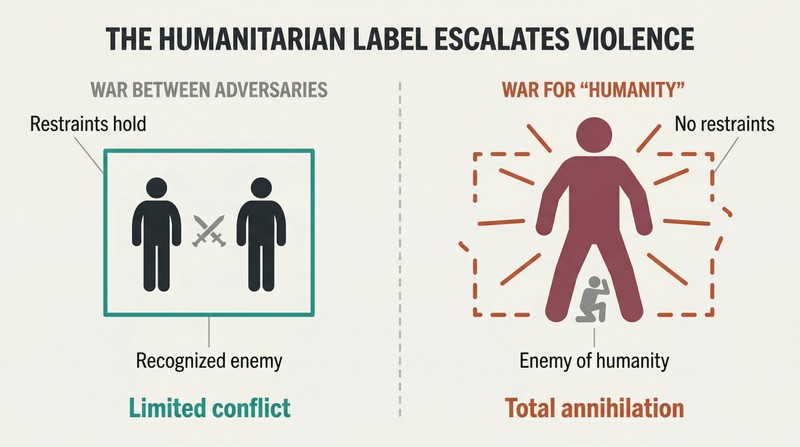
The pacifism paradox. If pacifists want to eliminate war, they must organize politically — which means grouping humanity into friends (fellow pacifists) and enemies (warmongers). A "war to end all wars" becomes necessarily the most extreme and inhuman conflict because the enemy isn't treated as a legitimate opponent but as an inhuman monster that must be "definitively annihilated."
This isn't a pro-war argument. Schmitt's point is structural: any movement powerful enough to eliminate the political must itself become intensely political. Wars fought in the name of all humanity are more savage than wars between recognized adversaries, because declaring your enemy the enemy of humanity removes every restraint. The humanitarian label escalates violence rather than limiting it.
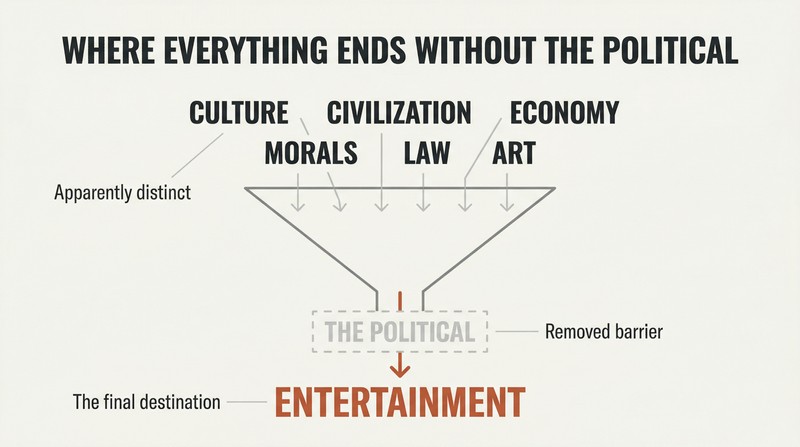
Strip away political stakes and all that remains is entertainment
Schmitt's most revealing word. Leo Strauss, in his penetrating commentary on Schmitt, notices something in Schmitt's list of what remains after politics disappears: "weltanschauung, culture, civilization, economy, morals, law, art, entertainment, etc." Schmitt buries "entertainment" in the series and follows it with "etc." to disguise that entertainment is the final destination — the finis ultimus — of a depoliticized world.
The "perhaps" is the tell. Schmitt concedes a world without politics might be "very interesting" — full of competitions and intrigues. But "interesting" is precisely the problem. A world where nothing is worth dying for is a world where nothing is genuinely serious. The political is the last guarantee against a civilization of pure spectacle.
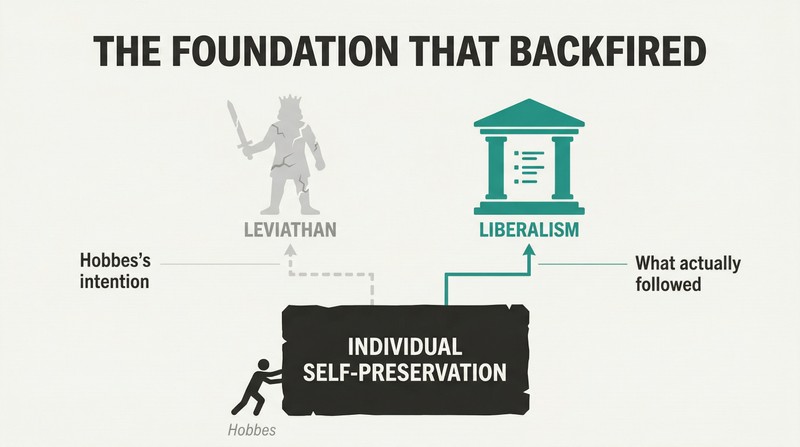
Hobbes built liberalism's cage while trying to tame human nature
The irony of political philosophy. Hobbes described humans in the state of nature as dangerous — beasts driven by hunger, fear, and desire. His solution: the Leviathan state, built on the individual's right to self-preservation as the supreme principle. If death is the greatest evil, then the state exists solely to protect life. Hobbes even denied courage the status of a virtue, since risking life contradicts the state's entire purpose.
But this foundation made liberalism inevitable. If individual self-preservation is the ultimate right — prior to and above the state — then every right the individual claims against the state follows logically: inalienable human rights, the separation of state and society, the primacy of individual freedom. Schmitt returns to Hobbes not to revive him but to expose the root of liberal thinking at its point of origin, then strike at it.
Analysis
Schmitt's 1932 essay remains the most dangerous book in political theory — dangerous because it is largely correct about a problem it cannot solve. The friend-enemy distinction, whatever one thinks of Schmitt's catastrophic personal politics (he joined the Nazi Party in 1933), functions as an X-ray machine for political rhetoric. When technology platforms insist they are 'neutral' or when nations wage 'humanitarian interventions,' Schmitt's framework exposes the political content masked by depoliticizing vocabulary. The thesis that technology is not neutral because it serves everyone reads as if written about algorithmic content moderation rather than 1920s radio broadcasting.
But the book's most underappreciated contribution is its history-of-ideas architecture: the five central domains thesis. Every generation believes its organizing principle — currently technology and data — is the final, neutral arbiter that will dissolve all prior conflicts. Schmitt shows this is a recurring pattern, not a destination. The theological age believed the same about scripture; the economic age believed the same about markets. Each 'solution' merely relocated the battlefield.
Leo Strauss's included notes are indispensable and arguably more philosophically rigorous than Schmitt's own text. Strauss identifies what Schmitt conceals from himself: that the affirmation of the political is, at bottom, an affirmation of moral seriousness against a civilization that confuses comfort with justice. This reading rescues the argument from crude bellicosity while revealing that Schmitt remains trapped within the liberal horizon he attacks — unable to name the positive vision that would replace it. Strauss traces this impasse to Schmitt's reliance on Hobbes's 'innocent evil' rather than genuine moral baseness, showing that the critique of liberalism cannot be completed on liberal premises.
The book's unresolvable tension is biographical. Schmitt's framework diagnoses liberalism's self-deceptions with surgical precision, but it provides no guardrail against the conclusion its author actually drew. The reader must wield the diagnostic tool while remaining alert to where the diagnostician went catastrophically wrong — a challenge that makes reading Schmitt an education in intellectual responsibility itself.
Review Summary
The Concept of the Political by Carl Schmitt is a controversial work that defines politics as the distinction between friend and enemy. Readers find Schmitt's analysis of liberalism and critique of pacifism insightful, though his Nazi associations are troubling. The book explores the nature of political entities, sovereignty, and the friend-enemy dynamic in international relations. While some praise Schmitt's clear thinking, others criticize his binary worldview and potential justification for authoritarianism. The work remains influential in political theory, sparking ongoing debates about its relevance and implications.
People Also Read




Glossary
Friend-enemy distinction
Criterion defining the politicalSchmitt's core concept: the specifically political distinction, analogous to good/evil in morality or beautiful/ugly in aesthetics. 'Enemy' means the public enemy (hostis, not inimicus)—a collectively identified group with a real possibility of armed conflict. This grouping is what constitutes any situation as genuinely political, regardless of the substantive issue (religious, economic, ethnic) that triggers it.
The political (das Politische)
Existential intensity of group conflictNot a separate domain alongside economics, morality, or culture, but the authoritative dimension that can emerge from any domain when an issue reaches the intensity of friend-enemy grouping. Schmitt insists the political precedes and underlies the state. It is constituted by reference to the real possibility of physical killing, and any attempt to eliminate it generates its most extreme forms.
Central domains
Era-defining intellectual focus areasSchmitt's framework for understanding the last five centuries of European intellectual history. Each century organized itself around a dominant domain of thought—theology (16th c.), metaphysics (17th c.), humanitarian morality (18th c.), economics (19th c.), technology (20th c.)—which determined what counted as evidence, who constituted the elite, and how all other problems were understood. Each transition was driven by the search for neutral ground.
Neutralization
Shifting conflict to 'neutral' groundThe recurring European pattern of abandoning a contentious central domain (e.g., theology after the religious wars) in favor of a supposedly neutral one where agreement seemed possible. Schmitt argues each neutralization merely relocated conflict rather than resolving it, and the cumulative result is depoliticization—the progressive draining of existential seriousness from public life.
Clerc
Each era's intellectual leader typeBorrowed from Julien Benda but redefined by Schmitt: the representative intellectual/spiritual figure whose characteristics are determined by the era's central domain. The theologian (16th c.) gave way to the systematic scholar (17th c.), the Enlightenment author (18th c.), and the economic expert (19th c.). Schmitt questions whether the age of technology can produce a clerc at all, since technical thinking seems incompatible with intellectual leadership.
Cujus regio ejus religio
Ruler decides the organizing principleOriginally a maxim from the religious civil wars meaning 'whose territory, his religion'—the ruler decides the faith of the territory. Schmitt shows this principle migrates across central domains: it becomes cujus regio ejus natio (nationality) and then cujus regio ejus oeconomia (economic system), as demonstrated by the Soviet state's insistence that capitalism and communism cannot coexist within one territory.
Status naturalis
Pre-political condition of human groupsSchmitt reclaims Hobbes's concept of the 'state of nature' but transforms it fundamentally. For Hobbes, it was a war of all individuals against all, meant to be overcome. For Schmitt, it is the natural condition of group relations—always potentially conflictual—that must be affirmed as the permanent foundation underlying all culture and civilization, not negated or escaped.
FAQ
What is "The Concept of the Political" by Carl Schmitt about?
- Central Thesis: The book explores the nature and definition of the political, arguing that the core of politics is the distinction between friend and enemy.
- Critique of Liberalism: Schmitt critiques liberalism for its attempts to neutralize and depoliticize public life, claiming that true politics cannot be eliminated.
- Historical Context: Written in the interwar period, the book reflects on the crisis of parliamentary democracy and the rise of new political forms.
- Expanded Edition: This edition includes Schmitt’s 1929 essay "The Age of Neutralizations and Depoliticizations," Leo Strauss’s critical notes, and a foreword by Tracy B. Strong.
Why should I read "The Concept of the Political" by Carl Schmitt?
- Foundational Political Theory: The book is a cornerstone of 20th-century political thought, influencing debates on sovereignty, democracy, and the limits of liberalism.
- Contemporary Relevance: Schmitt’s analysis of the friend-enemy distinction and critique of liberalism remain pertinent in understanding modern political conflicts.
- Intellectual Debate: The book is widely discussed and critiqued by major thinkers, including Leo Strauss, Jacques Derrida, and Chantal Mouffe.
- Insight into Political Identity: Schmitt’s work challenges readers to reconsider the seriousness and stakes of political life, especially in times of crisis.
What are the key takeaways from "The Concept of the Political" by Carl Schmitt?
- Friend-Enemy Distinction: The essence of the political is the grouping of people into friends and enemies, which can lead to existential conflict.
- Limits of Liberalism: Liberalism’s attempt to depoliticize society is both impossible and dangerous, as it ignores the inherent conflicts in human nature.
- Central Domains of History: Schmitt traces how Western societies have shifted their central concerns from theology to metaphysics, morality, economics, and finally technology.
- Politics as Destiny: The political is an inescapable aspect of human life, rooted in the potential for conflict and the need for decision.
How does Carl Schmitt define "the political" in "The Concept of the Political"?
- Friend vs. Enemy: Schmitt defines the political by the distinction between friend and enemy, which is more fundamental than moral, aesthetic, or economic distinctions.
- Public, Not Private: The enemy is always a public enemy, representing a real possibility of conflict between groups, not individuals.
- Existential Stakes: The political involves the potential for physical conflict, even war, making it a matter of life and death.
- Not Just Another Sphere: Schmitt argues that the political is not just one domain among others but is foundational to the existence of the state.
What is Schmitt’s critique of liberalism in "The Concept of the Political"?
- Negation of the Political: Schmitt claims that liberalism seeks to eliminate the political by promoting neutrality, compromise, and endless discussion.
- Inadequacy in Crisis: He argues that liberalism is unable to deal with existential threats or make decisive choices when faced with real enemies.
- Hidden Politics: Liberalism does not abolish conflict but merely hides it, leading to insincerity and a lack of genuine political engagement.
- Liberalism’s Failure: Schmitt sees the collapse of liberalism as opening the way for new, more decisive forms of politics.
What is the "friend-enemy" distinction and why is it central in "The Concept of the Political"?
- Defining Politics: The friend-enemy distinction is the criterion that defines the political, according to Schmitt.
- Group Identity: It is about collective identities, where groups define themselves in opposition to others.
- Potential for Conflict: This distinction implies the ever-present possibility of conflict, including war, as the ultimate expression of political antagonism.
- Beyond Morality: Schmitt insists this is not a moral or ethical distinction, but an existential one that determines the fate of groups and states.
How does Schmitt describe the historical process of "neutralizations and depoliticizations" in Western society?
- Shifting Central Domains: Schmitt outlines a progression from theological, to metaphysical, to moral, to economic, and finally to technical domains as the focus of Western societies.
- Search for Neutral Ground: Each shift represents an attempt to find a neutral, conflict-free domain to resolve disputes.
- Failure of Neutrality: Every new "neutral" domain eventually becomes another arena for conflict, showing the impossibility of true depoliticization.
- Age of Technology: In the 20th century, technology is seen as the ultimate neutral domain, but Schmitt argues it too becomes a tool for political struggle.
What is the significance of "The Age of Neutralizations and Depoliticizations" (1929) included in this edition?
- Contextual Expansion: This essay provides historical and philosophical context for Schmitt’s main argument by tracing the evolution of central domains in European thought.
- Critique of Technological Society: Schmitt warns that the rise of technology as a central domain leads to the loss of personal decision and sovereignty.
- Political Implications: The essay reinforces the idea that attempts to neutralize politics only shift conflict to new arenas, rather than eliminating it.
- Call for Renewal: Schmitt ends with a call for the West to recognize and confront the new forms of conflict arising from technological and political changes.
How does Leo Strauss critique and interpret Schmitt’s arguments in his "Notes on The Concept of the Political"?
- Polemic Against Liberalism: Strauss highlights that Schmitt’s argument is fundamentally a polemic against liberalism and its depoliticizing tendencies.
- The State of Nature: Strauss connects Schmitt’s concept of the political to the Hobbesian state of nature, emphasizing the ever-present potential for conflict.
- Limits of Schmitt’s Critique: Strauss suggests that Schmitt’s critique remains within the horizon of liberalism and does not fully escape its assumptions.
- Affirmation of Seriousness: Strauss interprets Schmitt’s affirmation of the political as a defense of the seriousness and existential stakes of human life against a world of mere entertainment or neutrality.
How does Schmitt’s association with Nazism affect the interpretation of "The Concept of the Political"?
- Biographical Context: Schmitt joined the Nazi Party and was involved in its legal and political apparatus, which complicates his intellectual legacy.
- Continuity of Thought: Critics note that Schmitt’s core ideas about law, sovereignty, and the friend-enemy distinction did not fundamentally change during his Nazi period.
- Ethical Dilemmas: The book raises questions about the relationship between a thinker’s political actions and their theoretical work.
- Ongoing Debate: Scholars continue to debate how much Schmitt’s political affiliations should influence the reading and use of his ideas.
What are some of the most important quotes from "The Concept of the Political" and what do they mean?
- "The specific political distinction to which political actions and motives can be reduced is that between friend and enemy." — This encapsulates Schmitt’s core definition of the political.
- "If a people no longer possesses the energy or the will to maintain itself in the sphere of politics, the latter will not thereby vanish from the world. Only a weak people will disappear." — Schmitt emphasizes the existential stakes of political life.
- "There is no rational purpose, no norm however correct, no program however exemplary, no social ideal however beautiful, no legitimacy or legality that can justify men’s killing one another for its own sake." — Schmitt acknowledges the limits of rational or moral justification in the face of political conflict.
- "Ab integro nascitur ordo." — Quoting Virgil, Schmitt suggests that order is born from renewal, hinting at the cyclical nature of political life and conflict.
How has "The Concept of the Political" by Carl Schmitt influenced modern political theory and debate?
- Revival of Interest: The book has seen a resurgence in academic and political discussions, especially regarding the limits of liberalism and the nature of sovereignty.
- Influence on Critics and Supporters: Thinkers across the political spectrum, from the Left (e.g., Chantal Mouffe) to the Right, have engaged with Schmitt’s ideas.
- Ongoing Relevance: Schmitt’s analysis of political identity, conflict, and the inadequacy of liberal neutrality continues to inform debates on populism, democracy, and international relations.
- Controversial Legacy: The book’s association with Schmitt’s Nazi past and its radical critique of liberalism make it both influential and contentious in contemporary discourse.
Der Begriff des Politischen Series
Download PDF
Download EPUB
.epub digital book format is ideal for reading ebooks on phones, tablets, and e-readers.








































