

Plot Summary
The Prisoner Princes Want
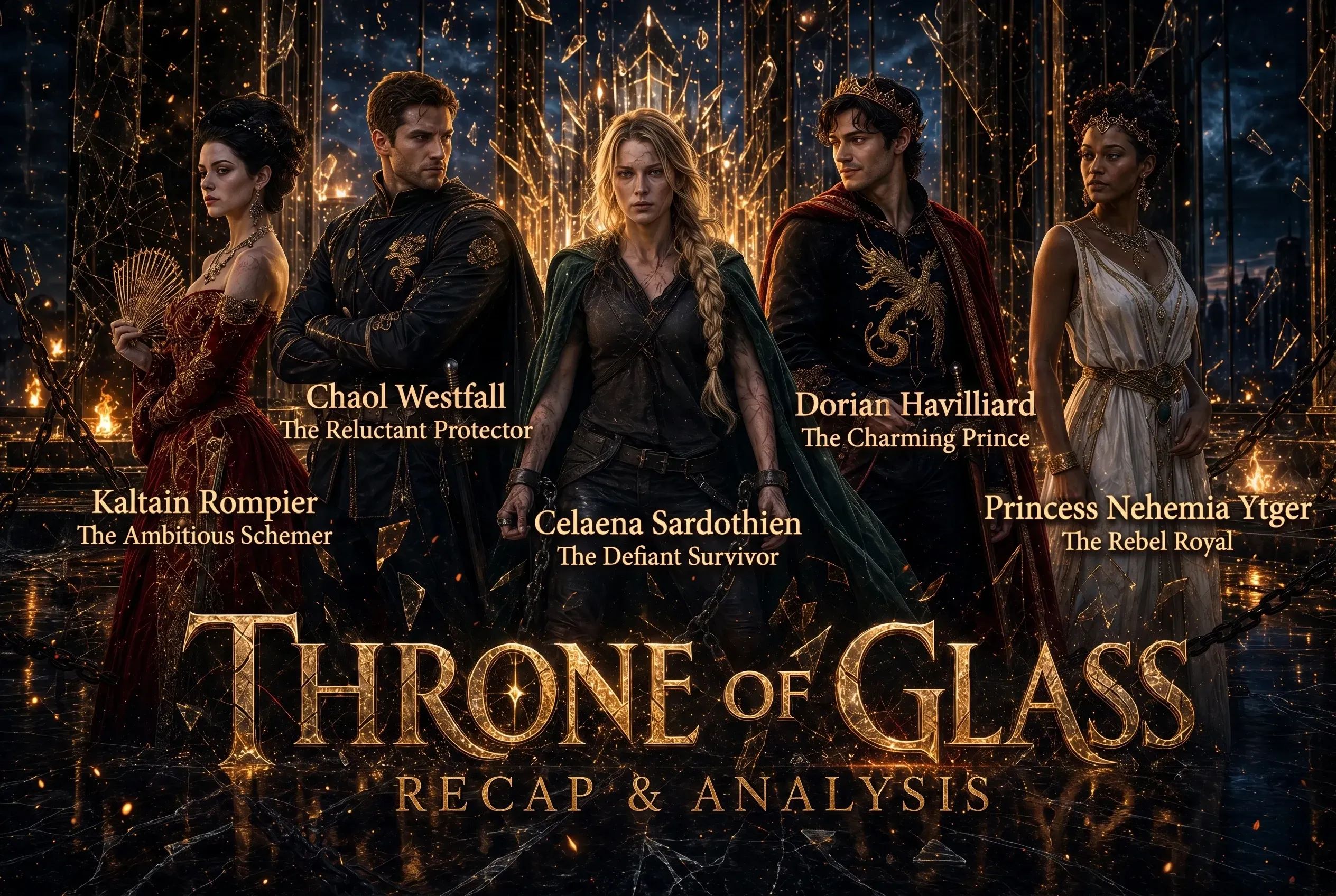
After a year breaking salt rock in the death camp of Endovier, Celaena Sardothien1 is marched in shackles before Crown Prince Dorian Havilliard.2 Adarlan's most feared assassin,1 betrayed and imprisoned at eighteen, expects the gallows. Instead Dorian2 proposes a wager: his father, the conquering King of Adarlan,6 wants a royal Champion, an assassin-on-a-leash.
Twenty-four criminals and warriors, each sponsored by a councilman, will train and compete in the glass castle. If Celaena1 fights as Dorian's2 pick and wins, she earns her freedom after years of service. If she refuses, she rots and dies in the mines. She bargains the term down and accepts, hungry less for the title than for the open sky beyond the camp wall.
The opening inverts the damsel rescue: salvation arrives wrapped in continued servitude. Maas frames freedom as a commodity negotiated between captor and captive, exposing how empire launders coercion as opportunity. Celaena's refusal to bow establishes pride as both armor and liability. Her private mantra against fear signals a survivor's discipline, the psychological scaffolding that kept her intact in darkness. Dorian's boredom-driven gamble hints at a prince estranged from his father's brutality. The scene's tension lies in mutual using: each party believes they are manipulating the other, which seeds the central irony that genuine attachment will complicate every transactional calculation to follow.
Lillian Among the Killers
Transported to Rifthold's grotesque glass castle, Celaena1 is disguised as Lillian Gordaina, a jewel thief, so competitors cannot exploit her reputation. Chaol Westfall,3 the young Captain of the Guard, becomes her stern trainer and keeper, sparring with her in secret where her true skill flashes through.
At the king's6 address she meets her competition: thieves, mercenaries, and Duke Perrington's8 monstrous soldier-Champion, Cain,5 who radiates menace. Chaol3 orders her to hide in the middle of the pack, never to win attention.
Celaena1 chafes at playing a nobody while Cain5 earns the Weapons Master Brullo's11 praise. She also begins trading sharp banter and borrowed books with Dorian,2 and sniping affectionately with Chaol,3 two relationships quietly taking root.
Identity becomes strategy. By burying Celaena under an alias, the narrative literalizes her divided self: the celebrated killer reduced to anonymous mediocrity, forced to swallow ego for survival. This rehearses a deeper question the book keeps circling, who is she beneath the names others impose. The triangulation with Chaol and Dorian begins not through romance but through intellect: books, wit, sparring. Maas codes attraction as recognition, the relief of being understood. Cain's looming physicality sets up a foil whose strength is suspiciously unnatural. The motif of concealment, of castles dropped over older stone, mirrors the heroine herself, surfaces hiding buried histories.
Champions Begin Dying
As weekly elimination Tests grind forward, archery, climbing, stealth, the contest curdles into horror. Bill Chastain, a notorious murderer-Champion, is found ripped open, his organs and brain gone. More Champions turn up slaughtered in forgotten hallways, bodies torn apart, strange chalk symbols nearby.
Chaol3 investigates and quietly fears a killer stalks the castle, but dismisses early deaths as brawls. During the wall-climbing Test, the vicious assassin Grave saws through the rope of Nox Owen,10 a thief who has befriended Celaena.1
She abandons her own chance at first place to leap and catch Nox10 midair, saving him while Cain5 claims victory. Her recklessness wins Nox's10 loyalty but exposes the deadly stakes lurking beneath the competition's pageantry.
The serial murders convert a sporting contest into a survival narrative, introducing dread as the engine beneath court intrigue. The ritualistic mutilations, organs and brains harvested, plant a supernatural mystery the rationalist Chaol refuses to credit, dramatizing how power structures explain away what they cannot control. Celaena's rescue of Nox reveals her moral floor: she protects outsiders, the trait forged among Endovier's despised. Her choice of compassion over winning marks her apart from rivals who calculate only advantage. The chalk symbols, glimpsed but unread, function as a slow-burn clue, training the reader to watch the margins where the real story is being written in blood.
The Forgotten Queen's Charge
On Samhuinn, the night of the dead, Celaena1 discovers a hidden door behind her bedroom tapestry and descends through neglected passages into the tomb of Elena, first Queen of Adarlan,9 a half-Fae heroine erased from history. The legendary sword Damaris rests among the treasure. Elena's9 spirit appears and charges Celaena1 to win the competition and to hunt down an evil festering in the castle, an evil powerful enough to make the stars tremble.
She presses a protective amulet into Celaena's1 hand and warns her to flee before the gargoyle Guardians notice. Celaena1 wakes clutching the amulet, the tomb door ajar, half-convinced it was a dream until a Champion is found that morning, eaten. The supernatural can no longer be denied.
The tomb sequence fuses the political plot with mythic inheritance. Elena, a Fae queen scrubbed from official memory, embodies suppressed history, the magic the king outlawed, the truths empire buries. Her appeal to Celaena introduces destiny against a heroine who insists she fights only for herself, generating the book's central tension between self-interest and calling. The amulet becomes a talisman of protection and obligation, gifts always carry debts. Samhuinn's threshold setting, when worlds thin, literalizes Celaena's movement between the mundane competition and a cosmic stakes she resists acknowledging. The morning's devoured corpse collapses the gap between vision and reality, confirming dread as fact.
A Princess and a Friend
Princess Nehemia Ytger of Eyllwe4 arrives at court, ostensibly to learn Adarlan's customs, secretly to watch the king6 and aid her oppressed people. Celaena,1 who learned Eyllwe from enslaved prisoners, befriends her, and the two trade language lessons and confidences, mocking the vapid courtier Kaltain Rompier7 together.
Their bond deepens into rare, genuine friendship. Meanwhile Celaena1 researches the chalk symbols, called Wyrdmarks, an outlawed ancient power, finding them around the murder sites and the clock tower where Cain5 kneels strangely.
She grows closer to Dorian2 over chess, billiards, and confessions about her dead love Sam, and to Chaol3 through shared grief and trust. Nehemia4 warns her, repeatedly and sharply, to leave the Wyrdmarks alone.
Nehemia introduces female solidarity as the book's emotional anchor, a relationship deeper than either romance. For a heroine taught to distrust women after past betrayal, the friendship is a quiet rehabilitation of intimacy. The princess also smuggles in the colonial subplot: Eyllwe's suffering gives the glittering contest a moral undertow, reminding readers that the prize is service to a genocidal regime. Celaena's Wyrdmark research positions her as investigator, knowledge as resistance in a kingdom that burned its libraries. Nehemia's warnings, layered with secrecy, generate productive ambiguity: the friend who knows too much will later be suspected, testing whether Celaena can hold faith against fear.
The Goblet of Poisons
Elena9 visits again, telling Celaena1 to look to her right for answers. At the next Test, Champions must identify seven poisons and drink the one judged harmless. Stuck between two indistinguishable goblets, Celaena1 notices young Pelor, the boy assassin13 standing to her right, who quietly signals the correct choice, having claimed mastery of poisons from the start.
She copies him; both survive while another Champion collapses on bloodbane. The clue proves Elena's9 guidance is real, not delusion. Bloodbane, the disorienting poison, registers in Celaena's1 memory.
Around this time word arrives that Adarlan's soldiers massacred five hundred Eyllwe rebels, including children, and Nehemia,4 devastated, weeps in Celaena's1 arms, sharpening Celaena's1 hatred of the empire she has bargained to serve.
The poison Test rewards alliance over isolation, echoing Endovier's lesson that the despised survive by looking after each other. Pelor's aid, returned kindness for kindness, validates Celaena's earlier compassion as pragmatic, not merely sentimental. Elena's accurate prophecy forces the rationalist heroine to accept supernatural agency, eroding her insistence on autonomy. The massacre injects historical atrocity into the romance-and-games structure, refusing to let palace flirtation eclipse imperial violence. Nehemia's grief humanizes the political, and Celaena's complicity, she is training to become this king's blade, becomes morally unbearable. Bloodbane's introduction is a precise Chekhov's gun, planted now to detonate at the climactic duel.
Masks, a Kiss, a Puppy
Fearing Nehemia4 might be the murderer and could strike at the ball, Celaena1 defies Chaol3 and sneaks into the masked Yulemas celebration in a stunning gown. Nothing violent happens; Nehemia,4 hurt and unwell, leaves early, and Celaena1 is ashamed of her suspicion. Dorian2 dances with her all night, ignoring every other woman, and afterward kisses her at her door.
Earlier he gifted her a runt pup she names Fleetfoot. The night crystallizes Dorian's2 love and Celaena's1 conflicted desire, while Chaol3 watches from the garden, quietly heartbroken. Beneath the romance, Kaltain,7 drugged on opium and manipulated by Duke Perrington,8 schemes with the duke8 to eliminate Lillian,1 whom she sees as a rival for the prince's2 hand.
The ball is the romance plot's peak and the conspiracy plot's hinge. Celaena's gatecrashing, framed as protecting Nehemia, reveals her capacity for paranoia, the survivor's reflex to expect betrayal, and her shame signals moral growth. The Dorian kiss consummates the wish-fulfillment fantasy of the killer treated as an equal, even royalty. Yet Maas immediately undercuts it with Chaol's silent witness, sustaining the triangle through restraint rather than declaration. Fleetfoot symbolizes Celaena's reclaimed tenderness, a creature she rescues as she was rescued. Meanwhile Kaltain's opium-warped ambition exposes how the court weaponizes women against each other, and Perrington's manipulation foreshadows a sinister hand pulling courtly strings.
Cain and the Ridderak
Finding Wyrdmarks chalked beneath her own bed, matching those at the corpses, Celaena1 descends the hidden passages and discovers Cain5 kneeling before a portal of pure darkness, summoning a demonic beast called the ridderak. He has been using forbidden Wyrdmark power to harvest the dead Champions' strength, which explains why he keeps growing larger and faster.
Cain5 disarms her, locks her in with the creature, and leaves her to die. Celaena1 outruns the beast down to Elena's9 tomb, seizes the ancient sword Damaris, and drives it through the ridderak's skull, though its fangs savage her hand. The mystery's solution is also its horror: the contest's frontrunner is a sorcerer feeding on his murdered rivals to guarantee victory.
The reveal collapses the natural and supernatural plots into one antagonist, retroactively charging every earlier death and Cain's swelling bulk with menace. The Wyrdmarks under her bed, later revealed as protection, here read as threat, exploiting reader and heroine paranoia. Cain's cannibalistic magic literalizes the competition's logic: he consumes rivals to ascend, an unsubtle indictment of zero-sum ambition. Celaena's flight to the tomb pays off Samhuinn's setup; Damaris, glimpsed earlier, becomes salvation, demonstrating Maas's tight setup-payoff architecture. The scene also vindicates Elena, who steered Celaena toward the tomb precisely so she would know where to find the blade that saves her life.
Healed by Forbidden Power
Bleeding from the ridderak's venomous bite, Celaena1 collapses in her chambers, dying within minutes. Nehemia4 finds her and, revealing the truth she has hidden all along, uses the Wyrdmarks to heal her, glowing turquoise symbols knitting her flesh.
Celaena1 learns Nehemia4 can read and wield the marks, that she has spent months secretly banishing the creatures Cain5 kept summoning, and that the protective symbols under the bed were Nehemia's4 work. Celaena1 confesses her real identity and her bargain with the king.6
Forgiving each other's secrets, Nehemia4 bestows on Celaena1 a new name, Elentiya,1 spirit that could not be broken. Their friendship, briefly cracked by suspicion, is restored and deepened, and Celaena1 resolves to defeat Cain5 in the coming duel.
The healing scene rewards faith over fear: Celaena's earlier suspicion of Nehemia is answered by the friend literally saving her life. Maas reframes the outsider-princess not as threat but as guardian, subverting the genre reflex to make the foreign woman suspect. The mutual confession, two women revealing hidden powers and identities, models intimacy as the surrender of secrets rather than the offering of romance. The renaming ritual is a psychological rebirth; where the king and Arobynn imposed names that owned her, Nehemia gives one that frees her. Wyrdmark magic, surviving the king's ban, becomes coded resistance: suppressed knowledge preserved by the colonized, deployed to protect.
Poisoned at the Duel
On the day of the final duels, Celaena1 easily defeats the grotesque Grave with Nehemia's4 iron-tipped staff, a deliberate symbol of Eyllwe defeating Adarlan. But Kaltain,7 acting on Perrington's8 scheme to give Cain5 the edge, slips bloodbane into the ceremonial wine Celaena1 must drink.
As she battles Cain,5 the poison sets in: dizziness, hallucinations, and worst of all, sight of the dead and demons crowding from beyond the veil. Cain,5 drawing on his stolen strength and dark power, brutalizes her, cracking ribs, slashing her thigh, dislocating her shoulder, and tormenting her with impossible knowledge of her murdered parents. Drugged and broken, surrounded by shrieking phantoms, Celaena1 collapses, certain she will die or be sent back to Endovier.
The poisoned duel exposes the competition as rigged theater: the empire never intended a fair contest, only the illusion of one. Kaltain, herself manipulated by Perrington's dark ring, is both perpetrator and pawn, illustrating how patriarchal power makes women instruments of their own degradation. Bloodbane's hallucinatory effect, planted at the poison Test, pays off by tearing the veil between worlds, fusing the political climax with the cosmic. Cain's taunts about her parents weaponize trauma, attacking the buried wound beneath Celaena's bravado. The scene strips away her competence entirely, forcing the question of what remains when skill fails: will, and the bonds that make survival meaningful.
Get Up
As Cain5 prepares the killing blow, two interventions save Celaena.1 Chaol3 kneels at the chalk ring's edge, fingers stretched across the line, urging her again and again to rise, his faith becoming her tether to life. Then Nehemia,4 tracing Wyrdmarks at the ring's edge, opens a portal and summons Elena9 herself, who explodes through the ranks of the dead, scatters the demons, and burns the bloodbane from Celaena's1 body.
Cleared of poison, Celaena1 stands, drives the broken staff into Cain's5 unguarded right side exactly where Chaol3 once taught her, and pins him beneath the iron tip. The king6 declares his son's2 Champion the victor. Celaena1 has won her freedom, collapsing into laughter and tears as Dorian2 rushes to her.
The climax resolves the book's thesis: Celaena cannot save herself alone. The girl who insisted she needed no one is rescued by a captain's faith and a friend's magic, completing her arc from isolation toward interdependence. Chaol's outstretched hand across the chalk line is the book's emotional centerpiece, hope materialized as a physical gesture, separation made visible and nearly bridged. Elena's eruption pays off every tomb visit and prophecy. Notably, Celaena's victory blow uses Chaol's training and Nehemia's weapon, literalizing that her triumph is woven from her relationships. Restraint, she spares rather than kills Cain in that instant, marks her refusal to become merely the monster the empire wants.
The Captain's Killing Blow
As Dorian2 gathers the wounded Celaena,1 Cain,5 on a signal from the king,6 draws a dagger to stab her in the back. Chaol,3 seeing it, leaps between them and runs Cain5 through the heart, killing him instantly and saving Celaena's1 life a second time. Cain's5 blood reeks of decay; the dark power leaves him.
The act haunts Chaol,3 who has never killed before and finds with horror that it came easily. Meanwhile Kaltain,7 demanding her reward, blurts out the poisoning to Perrington,8 who calmly disavows all knowledge and has her dragged to the dungeons, revealing he played her for a fool from the start. The conspiracy's pawn is sacrificed while its architects, the king6 and the duke,8 escape clean.
Chaol's kill transforms him from disciplined keeper into culpable actor, and his anguish, that murder was easy, mirrors Celaena's own history, collapsing the distance between guard and assassin. The act binds them in shared moral weight, deepening their connection through guilt rather than romance. Kaltain's downfall completes a tragedy of misplaced ambition: she gambled identity and conscience on a crown that was never offered, discarded the instant she served her purpose. Perrington's icy betrayal exposes the court's true machinery, women used and erased while powerful men maintain deniability. The king's silent sanction of the backstab confirms that the throne plays by no rules but its own appetite.
The Price of Freedom
Recovering, Celaena1 learns Nehemia's4 full truth: she came to Rifthold to spy on the king,6 and the cosmic stakes are only beginning. In a private dream, Elena9 warns that Celaena1 could rattle the stars and that others, her friends, need her to stay. Summoned to sign her contract as King's Champion, Celaena1 faces the king's6 chilling threat: fail or flee, and he will execute Chaol,3 then Nehemia4 and her family.
Bound by these chains of love, she signs, trading one servitude for another but securing four years until freedom. She gently ends things with Dorian,2 unwilling to complicate his throne or her coming liberty, choosing instead the promise of being free. She and Chaol3 toast the years ahead.
The resolution refuses tidy triumph: Celaena's hard-won freedom is immediately mortgaged to the king's hostage logic, revealing that her new relationships are also new leverage. Love, the very thing that saved her, becomes the empire's grip on her. Her choice to walk away from Dorian is an act of self-possession, freedom redefined not as romance but as autonomy never yet tasted. Elena's dream reframes the entire arc: the personal quest for liberty is being conscripted into a larger destiny Celaena still resists. The closing toast with Chaol foregrounds the bond built on equality and shared darkness, positioning their guarded intimacy as the emotional thread carried forward.
Analysis
Throne of Glass wears the costume of a tournament fantasy but pursues a sharper question: what does freedom mean for someone whose only marketable skill is killing for the powerful. Maas constructs an elaborate competition only to expose it as rigged theater, a parable about how empires manufacture the illusion of merit while reserving real power for deniable cruelty. Celaena's1 victory secures not liberty but a leash relabeled, her hard-won freedom immediately mortgaged to the king's6 hostage threats against the very people she has come to love. The book's emotional intelligence lies here: the bonds that redeem her, Nehemia's4 friendship, Chaol's3 faith, Dorian's2 tenderness, become the empire's instruments of control. Love is both salvation and snare. The novel also stages a quiet politics of memory. The king6 burned libraries, outlawed magic, and erased a Fae queen9 from history, yet suppressed knowledge survives at the margins, in the Wyrdmarks preserved by the colonized, in a forgotten tomb, in enslaved prisoners' language. Knowledge becomes resistance, and the colonized princess,4 the genre's usual suspect, is revealed as guardian rather than threat, a deliberate subversion. Psychologically, Celaena's1 arc moves from armored isolation toward interdependence; the assassin who insists she needs no one is literally unable to save herself at the climax, rescued by a reaching hand and a friend's forbidden magic. Her vanity and appetite for beauty are not flaws to be corrected but evidence of a self refusing to be reduced to function. The renaming as Elentiya,1 spirit that could not be broken, crystallizes the theme: against captors who name and own her, identity reclaimed is the truest defiance. Beneath the romance and spectacle runs a meditation on complicity, survival, and the courage to begin caring again.
Review Summary
Throne of Glass receives mixed reviews. Many praise its engaging plot, world-building, and complex characters, particularly the protagonist Celaena. Fans enjoy the blend of fantasy, romance, and action. However, some criticize the writing style, character development, and romance elements as clichéd or poorly executed. Opinions on Celaena vary widely, with some finding her compelling and others unrealistic. The book is often seen as a strong start to the series, with readers anticipating improvement in subsequent installments. Overall, it's a polarizing but popular young adult fantasy novel.
People Also Read

Characters
Celaena Sardothien
Imprisoned master assassinEighteen and famous as Adarlan's deadliest assassin, Celaena is a study in contradictions: lethal yet vain, hardened by a year in the Endovier death camp yet hungry for music, books, candy, and beautiful gowns. Orphaned at eight and raised to kill by the King of Assassins, she armors herself in arrogance and a daily vow against fear. Beneath the swagger lies grief for a lost love named Sam, trauma she keeps behind a locked mental door, and a fierce protectiveness toward the despised and powerless. She craves freedom above all, distrusts attachment, yet discovers in this castle a friend, two suitors, and a destiny she would rather refuse. Her arc bends from isolated survival toward reluctant interdependence.
Dorian Havilliard
Restless crown princeThe handsome, sapphire-eyed heir to Adarlan, nineteen and bored by court frivolity, Dorian chafes against a tyrant father6 whose cruelty shames him. A reader and a romantic who insists on marrying for love, he sponsors Celaena1 partly to needle the king6 and partly from genuine fascination. His charm masks loneliness and a growing moral conscience, especially regarding the conquered kingdoms he will one day rule. Drawn irresistibly to Celaena's1 mind and fire, he risks his father's6 wrath to pursue her, learning that real feeling carries consequences a sheltered prince has never faced. His tenderness with animals and willingness to argue politics reveal a man straining toward the king he wishes to be.
Chaol Westfall
Captain of the guardTwenty-two, disciplined, and honor-bound, Chaol is Captain of the Royal Guard and Dorian's2 oldest friend, having renounced his lordship in Anielle to earn his post. Assigned as Celaena's1 trainer and keeper, he begins contemptuous of the criminal he must mind and slowly, against every instinct, comes to trust and admire her. He values duty and country over the king6 himself, a loyalty that quietly distinguishes him. Reserved where Dorian2 is effusive, he reveals affection through training, shared books, and grudging banter. Torn between his profession's demand to contain a dangerous assassin and a deepening attachment he cannot name, Chaol embodies the conflict between order and the heart's stubborn rebellions.
Princess Nehemia
Eyllwe's rebel heirPrincess of conquered Eyllwe, regal and formidable, Nehemia arrives at court under the pretense of learning Adarlan's customs. Beloved by her oppressed people and rumored to aid rebels, she carries the weight of a kingdom's survival and will sacrifice anything to protect it. She becomes Celaena's1 truest friend, bonding over language, shared outsider status, and mutual fierceness. Guarded with secrets of her own, including hidden knowledge no one suspects, she balances warmth toward Celaena1 against the cold calculus of resistance. Her grief over her people's suffering gives the glittering contest its moral gravity, and her courage in playing a game she may not win earns even her enemies' reluctant respect.
Cain
Monstrous rival championDuke Perrington's8 Champion, a towering soldier from the brutal White Fang Mountains who grows inexplicably larger and stronger as the competition proceeds. Cruel, mocking, and obsessed with breaking Celaena1, he targets her with taunts that cut suspiciously deep. Brullo11 praises him; the other Champions fear him. His unnatural power and strange rituals at the clock tower mark him as more than a mere brute, the contest's chief threat and a figure tangled in forces darker than ambition.
King of Adarlan
Conquering tyrant rulerDorian's2 father, conqueror of a continent, who outlawed magic and burned libraries, seers, and whole cultures. A broad, scarred man whose voice chills the bone, he rules through fear and views people as instruments. He stages the Champion competition for amusement and utility, and harbors ambitions and secret knowledge that hint at something monstrous beneath his iron crown. The looming antagonist whose power shadows every choice.
Kaltain Rompier
Scheming ambitious courtierA beautiful, calculating noblewoman who came to Rifthold determined to wed Crown Prince Dorian2 and seize a crown. Increasingly dependent on opium and plagued by worsening headaches, she resents Celaena's1 hold on the prince2. Manipulated by Duke Perrington8, who courts her while pursuing his own ends, Kaltain becomes both schemer and pawn, a cautionary portrait of ambition curdling into self-destruction within a court that uses and discards women.
Duke Perrington
Sinister royal advisorThe king's6 most trusted councilman, a rotund, ruddy, scarred man who sponsors Cain5 and wears a strange black ring. Ambitious and cold, he humiliates Celaena1 from their first meeting in Endovier and pushes ruthless plans, including using Nehemia4 as a hostage. He courts Kaltain7 while manipulating her toward his purposes, revealing a capacity for calculated cruelty cloaked in courtly civility.
Elena
Ghost of first queenThe long-dead first Queen of Adarlan, half-Fae daughter of a Terrasen king, erased from official history though she once fought demons beside her husband. Her spirit charges Celaena1 with winning the competition and destroying a hidden evil, gifting a protective amulet. Cryptic and insistent, she embodies suppressed history and an unwelcome destiny, watching over Celaena1 whether wanted or not.
Nox Owen
Friendly thief competitorA clever thief from Perranth and fellow Champion who befriends Celaena1, training alongside her. Granted immunity by his sponsor, he becomes a rare ally amid hostile rivals and ultimately heeds her warning to flee the deadly castle.
Brullo
Gruff weapons masterThe castle's veteran Weapons Master and judge of the competition, who openly favors Cain5 and overlooks the disguised Celaena's1 superior skill, embodying the contest's surface obliviousness to who its true threat really is.
Philippa
Caring personal servantCelaena's1 bold, motherly chambermaid who scolds, pampers, and quietly protects her, treating the feared assassin1 as a girl in need of care and secretly aiding her schemes.
Pelor
Young poison-skilled assassinThe youngest Champion, gangly and underestimated, skilled in poisons rather than blades. Bullied by Cain5, he quietly helps Celaena1 during the poison Test, an outsider repaying her unspoken kinship.
Plot Devices
The Champion competition
Frames freedom as deadly contestThe king's6 tournament to crown a royal assassin organizes the entire narrative. Twenty-four sponsored criminals and warriors train in the glass castle and face weekly elimination Tests, with the prize being freedom after years of servitude. The structure generates rising tension through escalating trials and shrinking numbers, while disguising Celaena1 as the jewel thief Lillian to keep her reputation hidden. It also becomes the hunting ground for a serial killer picking off Champions, fusing competition with mystery. Crucially, the contest is a moral trap: winning means becoming the conquering king's6 blade. The device lets Maas interrogate the difference between freedom granted and freedom truly possessed.
The hidden alias
Conceals identity for advantageCelaena1 competes as Lillian Gordaina, a wealthy merchant's daughter and jewel thief, so rivals cannot exploit knowledge of Adarlan's Assassin1. The disguise forces her to suppress her skill and place mid-pack on Chaol's3 orders, a humiliation that fuels her temper and drives her secret training. The alias also shapes court perception, with many assuming she is the prince's2 lover. It externalizes the book's preoccupation with names and identity, who Celaena1 is beneath the labels others impose, and pays off when select characters learn or exploit her true name, raising the stakes of exposure.
The Wyrdmarks
Encodes forbidden ancient powerMysterious symbols of an outlawed pre-magic power, the Wyrdmarks appear around murdered Champions, at the clock tower, in an ancient tomb, and beneath Celaena's1 bed. Painstaking research reveals they form an alphabet capable of summoning creatures through gates between worlds, a power surviving even after magic vanished. They thread the murder mystery, the supernatural threat, and the heroine's investigation together, functioning as the book's central enigma. Their dual nature, used for protection or atrocity, mirrors the moral choices around power throughout, and their secret mastery by certain characters reframes who is friend and who is foe.
The Eye of Elena
Talisman of protection and destinyAn ancient amulet pressed into Celaena's1 hand by the ghost of the first queen9, bearing overlapping circles and a blue gem like an eye. Reputed in legend to be the necklace that let Elena9 see the Dark Lord's true name and aid his defeat, it offers protection against otherworldly harm and comfort during sleepless, dread-filled nights. Wearing an heirloom of the royal house is itself dangerous, and its presence, loss, and return track Celaena's1 vulnerability. The device materializes the burden of the dead queen's9 charge, an unwanted destiny worn literally around the heroine's throat.
Bloodbane poison
Plants peril that detonates laterA disorienting poison introduced during the goblet Test, capable of causing hallucinations and, in seers, visions of spirits from other worlds. Established early as something Celaena1 recognizes and survives, it returns at the climactic duel when slipped into her ceremonial wine, crippling her senses and tearing open her sight of the dead. A textbook setup-and-payoff, it converts a political assassination attempt into a supernatural ordeal, linking the conspiracy plot to the cosmic one and forcing the heroine to triumph not through skill but through allies and will.
FAQ
Synopsis & Basic Details
What is Throne of Glass about?
- Assassin's Path to Freedom: Celaena Sardothien, a notorious assassin, is offered a chance at freedom from slavery by competing in a deadly tournament to become the King's Champion.
- Deadly Competition: She must navigate a treacherous competition against other skilled fighters, all while concealing her true identity and battling her inner demons.
- Unraveling Mysteries: As she progresses, Celaena uncovers a dark conspiracy and ancient evil lurking within the castle, forcing her to confront her past and her destiny.
Why should I read Throne of Glass?
- Complex Female Lead: Celaena is a compelling, flawed, and powerful protagonist, offering a refreshing take on the fantasy heroine archetype.
- Intriguing Blend of Genres: The book seamlessly blends elements of fantasy, action, romance, and political intrigue, creating a captivating and multifaceted reading experience.
- Fast-Paced Plot: The story is filled with twists, turns, and high-stakes challenges, keeping readers engaged and eager to uncover the secrets of the kingdom.
What is the background of Throne of Glass?
- Post-Conquest World: The story is set in a world where the kingdom of Adarlan has conquered much of the continent, creating a tense political landscape and a culture of oppression.
- Magic's Absence: Magic has mysteriously vanished from the kingdom, leading to a society that fears and persecutes those who might possess it.
- Ancient Lore: The narrative is steeped in ancient lore and mythology, with references to forgotten gods, powerful artifacts, and the mysterious Wyrdmarks.
What are the most memorable quotes in Throne of Glass?
- "My name is Celaena Sardothien, and I will not be afraid.": This quote encapsulates Celaena's resilience and determination to overcome her past and face her fears.
- "You could rattle the stars.": This line, spoken by Queen Elena, highlights Celaena's potential for greatness and the power she possesses.
- "I will not be a monster.": This quote reveals Celaena's internal struggle with her identity as an assassin and her desire to be more than just a killer.
What writing style, narrative choices, and literary techniques does Sarah J. Maas use?
- Third-Person Limited Perspective: The story is primarily told from Celaena's point of view, allowing readers to intimately experience her thoughts, emotions, and struggles.
- Vivid Descriptions: Maas uses rich and evocative language to create a detailed and immersive world, bringing the castle, characters, and action sequences to life.
- Foreshadowing and Symbolism: The narrative is filled with subtle hints and recurring symbols that foreshadow future events and deepen the thematic complexity of the story.
Hidden Details & Subtle Connections
What are some minor details that add significant meaning?
- The Eagle Pommel: Chaol's sword, with its eagle-shaped pommel, symbolizes his loyalty and connection to the royal family, foreshadowing his role as a protector.
- The Color Red: The recurring use of red, particularly in the royal colors and clothing, represents power, danger, and the blood that has been spilled in Adarlan's conquests.
- The Clock Tower: The clock tower, built by the king, serves as a constant reminder of his power and control, and its gargoyles foreshadow the presence of darker forces.
What are some subtle foreshadowing and callbacks?
- Celaena's Skill with Knives: Her early preference for knives foreshadows her later use of them in combat and her connection to the assassin's world.
- The Wyrdmarks: The recurring appearance of Wyrdmarks throughout the castle foreshadows their significance in the larger plot and the ancient power they represent.
- The Mention of Terrasen: The subtle mentions of Terrasen, Celaena's homeland, foreshadow her true identity and the role she will play in the future of the kingdom.
What are some unexpected character connections?
- Celaena and Nehemia: Their friendship, despite their different backgrounds, reveals a shared sense of justice and a desire to fight against oppression.
- Chaol and Dorian: Their close bond, forged in childhood, highlights the complexities of loyalty and the challenges of navigating the corrupt court.
- Celaena and Elena: The connection between Celaena and the spirit of Queen Elena reveals a shared destiny and a link to the ancient powers of Erilea.
Who are the most significant supporting characters?
- Philippa Spindlehead: Celaena's personal servant, who provides a sense of normalcy and maternal care, and who is also aware of Celaena's true identity.
- Nox Owen: A fellow competitor and thief, who becomes a reluctant ally to Celaena, and who is also a skilled fighter and strategist.
- Duke Perrington: A powerful and manipulative councilman, who serves as a key antagonist and a symbol of the corruption within the court.
Psychological, Emotional, & Relational Analysis
What are some unspoken motivations of the characters?
- Celaena's Desire for Acceptance: Despite her tough exterior, Celaena craves acceptance and belonging, which is evident in her relationships with Dorian, Chaol, and Nehemia.
- Chaol's Internal Conflict: He struggles with his loyalty to the crown and his growing feelings for Celaena, creating a deep internal conflict that drives his actions.
- Dorian's Yearning for Freedom: He is stifled by his royal duties and yearns for a life beyond the confines of the court, which is why he is drawn to Celaena's rebellious spirit.
What psychological complexities do the characters exhibit?
- Celaena's Trauma: Her past experiences in Endovier and as an assassin have left her with deep emotional scars, which manifest in her nightmares, her anger, and her difficulty trusting others.
- Chaol's Guilt: He is haunted by his past actions and the weight of his responsibilities, leading to a sense of guilt and a need to protect those he cares about.
- Dorian's Idealism: He struggles with the corruption of his father's court and his own desire to create a better world, leading to a sense of disillusionment and a need to find his own path.
What are the major emotional turning points?
- Celaena's Encounter with Elena: The ghostly encounter forces her to confront her destiny and the weight of her past, leading to a shift in her priorities.
- Chaol's Killing of Cain: This act forces him to confront his own capacity for violence and the moral implications of his actions, leading to a period of self-doubt.
- Dorian's Growing Feelings for Celaena: His feelings for her challenge his beliefs and force him to confront the realities of his position, leading to a transformation in his character.
How do relationship dynamics evolve?
- Celaena and Dorian: Their relationship evolves from a playful flirtation to a deeper connection, as they find solace and understanding in each other.
- Celaena and Chaol: Their relationship is marked by tension and conflict, but also by a growing respect and understanding, as they learn to trust and rely on each other.
- Celaena and Nehemia: Their friendship is a source of strength and support, as they bond over their shared experiences and their desire to fight against oppression.
Interpretation & Debate
Which parts of the story remain ambiguous or open-ended?
- The Nature of the Evil: The true nature of the ancient evil lurking in the castle remains ambiguous, leaving readers to speculate about its origins and motivations.
- Elena's True Intentions: The queen's ghostly command and her connection to Celaena's destiny remain open to interpretation, raising questions about her true motives.
- The Power of the Wyrdmarks: The full extent of the Wyrdmarks' power and their connection to the Otherworlds remains unclear, leaving readers to wonder about their potential impact on the future of Erilea.
What are some debatable, controversial scenes or moments in Throne of Glass?
- Celaena's Relationship with Dorian: Some readers may find their relationship to be a distraction from the main plot, while others may see it as a crucial element of her character development.
- Chaol's Actions: His decision to kill Cain, while understandable, raises questions about his morality and the nature of justice.
- The King's Motives: The king's true intentions and his reasons for hosting the competition remain ambiguous, leading to debates about his character and his role in the larger conflict.
Throne of Glass Ending Explained: How It Ends & What It Means
- Celaena Becomes the King's Champion: Despite the challenges and betrayals, Celaena wins the competition and is forced to sign a contract to become the King's Champion.
- A Fragile Victory: While she has achieved her goal, her victory is bittersweet, as she is now bound to serve the very man who enslaved her.
- A Path to Freedom: The ending sets the stage for future conflicts and challenges, as Celaena must navigate her new role while also seeking to fulfill her own destiny and find true freedom.
Throne of Glass Series
About the Author
Other books by Sarah J. Maas


Download PDF
Download EPUB
.epub digital book format is ideal for reading ebooks on phones, tablets, and e-readers.








































