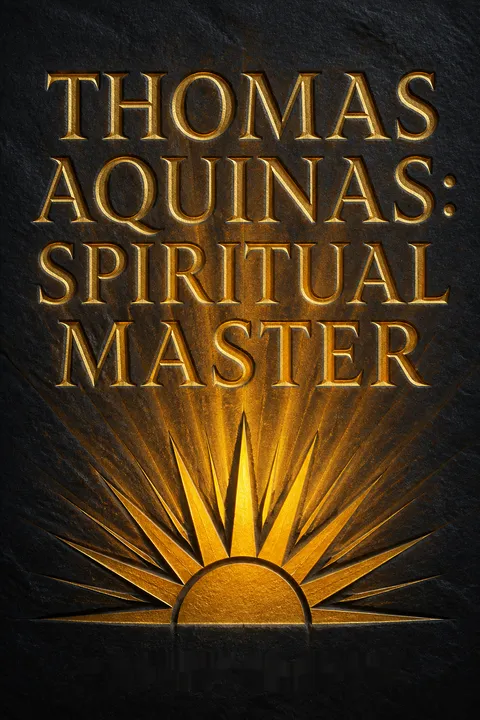

Key Takeaways
1. Thomas Aquinas: The Spiritual Master of Ecstasy
Above all, Thomas Aquinas was a consummate spiritual master, holding up the icon of the Word made flesh and inviting others into its transformative power.
Beyond rationalism. Many perceive Thomas Aquinas as a dry, rationalist philosopher, but this misses the core of his work. He was, first and foremost, a saint deeply in love with Jesus Christ, and his entire philosophical and theological edifice is permeated by this spiritual passion. His writings are not abstract speculation but a form of spiritual direction, aiming to transform hearts and draw people into the imitation of Christ.
Life of profound faith. Thomas's life exemplified this spiritual depth. From his Benedictine education, where he fell in love with Scripture, to his radical embrace of the Dominican mendicant movement, he combined intellectual rigor with evangelical simplicity. His famous response to Christ, "Non nisi te, Domine" (nothing but you, Lord), after a mystical experience, serves as the interpretive key to his thought: he desired nothing more than Christ.
Theology as spiritual path. For Aquinas, theology (sacra doctrina) was never separate from spirituality, unlike later distinctions. Its ultimate purpose, as stated in the Summa Theologiae, is to elevate believers beyond themselves into union with the ungraspable God. His work is a guide, a series of landmarks on the journey into God, always pointing to the transformative power of Christ.
2. Revelation: God's Unsurpassable Self-Disclosure
It was necessary for man’s salvation that there should be a teaching revealed by God beyond philosophical disciplines, which are investigated by human reason.
Reason's limits. Thomas argues that human reason alone cannot fully grasp God, as our ultimate end surpasses our rational comprehension. Therefore, a "sacred doctrine" revealed by God is essential for salvation. This revelation isn't merely to satisfy curiosity but to reorient human beings, moving them beyond self-complacency towards a transcendent power.
Theology for salvation. For Aquinas, theology is not an academic exercise but a matter of spiritual life and death. It's a "subalternate science" drawing its principles from the direct, experiential "science of God and of the blessed," meaning it's a participation in God's inner life and an anticipation of the beatific vision. This "knowledge" is intimate, transformative, and meant to "heal our misery."
Philosophy as handmaid. While revelation is primary, Thomas skillfully uses philosophical tools. He sees them not as foundations for theology, but as "handmaids" (manuducentes) that lead the "fallen mind" to a richer appreciation of revealed truth. This approach transforms secular wisdom into "wine," demonstrating that all provisional truth can serve the ultimate Truth disclosed in Christ.
3. Jesus Christ: The Meeting of Two Ecstasies
Forasmuch as our Savior the Lord Jesus Christ, in order “to save his people from their sins” (Matt. 1:21) . . . showed unto us in his own person the way of truth, whereby we may attain to the bliss of eternal life by rising again, it is necessary, in order to complete the work of theology . . . [that] there should follow the consideration of the Savior of all and of the benefits bestowed by him on the human race.
Christ as the Way. Jesus Christ is the "way of truth," the path to beatitude, and the consummation of all theology. The Incarnation, God becoming human, is the ultimate event of revelation, demonstrating God's "infinite might" and "superabundant goodness." It's a "jest," a "surprise" that "blows open" the human mind to the true, unimaginable greatness of God.
God's ecstatic self-offering. The Incarnation reveals God's nature as "diffusive of itself," overflowing in love. God's goodness is so immense that it expresses itself in the "fullest possible manner" by joining with created nature. This self-forgetting of God, made visible in Jesus, persuades us of divine generosity and shows that God's being is fully ecstatic, going beyond himself in love.
Archetype of humanity. Jesus, in his perfect humanity, is a "sheer receptivity" to God's outpouring grace, a model of self-forgetting love. His human will, though perfectly subordinate to the divine, is not negated but elevated, demonstrating a "noncompetitive" relationship between God and creature. Christ's grace overflows to all humanity, making him the mediator and exemplar for all who seek union with God.
4. The Strangeness of God: Beyond Human Grasp
Whatever you can say or think or assert concerning God falls infinitely short of who God actually is.
God's uncanny nature. Thomas's doctrine of God is an "anti-doctrine," consistently showing what God is not. God is "uncanny," infinitely surpassing human comprehension. The best response to the divine power is silence, awe, and reverence, as any attempt to categorize or control God turns Him into an idol.
Simple and ungraspable. God's "simplicity" means He is not a material body, nor a being among others, but the sheer act of existing itself (ipsum esse subsistens). His essence is identical to His existence, as revealed in "I Am Who I Am" (Exodus 3:14). This means God cannot be categorized or controlled; He is the inescapable ground of all being, intimately present to everything.
Alluring and unchanging. God's perfection makes Him supremely "good," attracting and captivating all desire. As the first efficient cause, He is the ultimate exemplar. This goodness is dynamic, a magnetic force drawing the universe to Himself. God is also "immutable" (unchanging) in His covenant faithfulness, providing a stable foundation for existence, not a cold, distant force. He is "eternal," existing outside of time, present to every moment, offering escape from the ravages of temporality.
5. Creation from Nothing: The World as Divine Relationship
Therefore, creation does not denote an approach to being, nor a change effected by the Creator, but merely a beginning of existence, and a relation to the Creator from whom the creature receives its being.
God's infinite power. God's power is absolute, unlimited, and salvific, always exercised for the sake of raising up creation. He can do all things, except what is logically contradictory (e.g., making 2+2=5), because such things cannot exist. This means God is not arbitrary; His power is faithful to Himself and the structures of being He establishes.
Ex nihilo, ex toto. Creation is not God forming pre-existing "stuff," but bringing forth the entire universe ex nihilo (from nothing). This means every aspect of finite reality, from the smallest particle to the grandest galaxy, flows continuously from the divine source. There is nothing "profane" or "secular"; all being is sacred, constantly sustained by God's presence.
Creature as relationship. For Thomas, creation is not a change but a "beginning of existence" and a "relation of the creature to the Creator." We are not separate "things" that have a relationship with God; we are a relationship to God. This "newness of being" (novitas essendi) means we are most ourselves when we acknowledge our total dependency on God, finding security and identity in self-forgetting love, mirroring Christ's transparency to the Father.
6. Evil: A Shadow on God's Goodness, Not a Rival Power
Hence it cannot be that evil signifies being, or any form or nature.
Evil as privation. Thomas emphatically denies that evil is a substantive force or a counter-principle to God. Instead, evil is a "privation" or "absence of good" that ought to be present. It's a wound on something positive, a parasite on being. This means pure evil cannot exist, as it always depends on an underlying good.
No escape in darkness. This understanding has profound spiritual implications. The sinner cannot find refuge from God by embracing evil, for even in the darkest rebellion, they are still within the greater context of the good. There is no "evil place" or "evil attitude" that is fundamentally separate from God's pervasive goodness. Even demons, as beings, are good in their nature, though their will is corrupted.
God's permission for greater good. God permits evil not out of impotence or ignorance, but "in order to bring a greater good therefrom." This acknowledges the conflictual nature of finitude itself; creating a finite world necessarily involves the possibility of suffering and loss (e.g., a lion's life depends on its prey's death). God, like a loving parent, allows the pain inherent in existence for the sake of the greater good of life and free will, always hoping to wear down even the most stubborn sinner with His indefatigable love.
7. The Human Being: A Unified Soul-Body Made for God
So close is the rapport between flesh and spirit that even in the rapture of the beatific vision the human soul will be unsatisfied until it is reunited with the body.
Integral humanity. Contrary to Platonic dualism, Thomas insists on the fundamental unity of the human being: the soul is the "form" of the body, intimately tied to and animating it. The body is not an obstacle to the spirit but an essential aspect of human nature, created good by God. We should "love our bodies" and celebrate the communion of flesh and spirit.
Embodied spirituality. For Aquinas, knowledge of God comes through the senses and the body, as seen in the Incarnation itself. Our highest mental activities are rooted in bodily experience. He champions a "sacramental sensibility," where God is appreciated in and through the material world. This means pleasure and carnality, when ordered, are not inimical to God but part of our good creation.
Heavenly embodiment. Even in heaven, the human soul remains unsatisfied without its body. The resurrected body, though spiritualized and glorified, retains its human form, flesh, and bones. It will be subtle, agile, and radiant, perfectly attuned to the soul. This vision underscores that it is the whole person, body and spirit, who is destined for the blissful fulfillment of God's vision.
8. Imago Dei: The Inescapable Divine Spark Within
The image of God is in man . . . first, inasmuch as man possesses a natural aptitude for understanding and loving God; and this aptitude consists in the very nature of the mind, which is common to all men.
Reflecting the divine. The human being is created in the imago Dei (image of God), a "divine spark" within each person. This image resides in the dynamism of the human spirit, particularly the mind's capacity to know and reach out to all expressions of being, to "know everything about everything." This limitless curiosity and openness to the totality of reality is, for Thomas, an orientation towards God, the sheer act of Being itself.
Built for God. We are "wired for" union with the divine, branded with God's mark. This inherent "magnet" draws us inevitably to God as our final end, whether consciously or unconsciously. Even in ignorance or sin, the imago Dei can be obscured but never shattered, remaining a "beautiful jewel" that reflects divine light and beckons the "Hound of Heaven."
Dignity and destiny. This doctrine counters both the sinner's attempt to flee God and false humility. It affirms our "royal dignity" as children of God, reminding us that our deepest relationship to the divine is that of child to parent. Cultivating this "soulfulness" means recognizing our intrinsic holiness and our destiny for full expression and union with the divine.
9. Ultimate Happiness: Found Only in God's Ecstasy
Thus God alone can satisfy the will of man.
The universal quest. All human actions, consciously or not, are driven by a fundamental desire for ultimate happiness and perfect contentment. This "last end" is the "first mover" of the will, a deep craving that spurs us on through life's journey, much like Perceval's quest for the Holy Grail.
False idols. Thomas systematically shows how common pursuits fall short of this ultimate happiness:
- Wealth: Natural wealth (food, shelter) serves bodily needs, and artificial wealth (money) serves natural wealth. Neither can satisfy the soul's infinite hunger; clinging to them is a "spiritual illness."
- Honors/Fame/Glory: These are fleeting "signs" of virtue, not virtue itself. Seeking them as ultimate leads to "ambition" and places one on the "wheel of fortune," a cycle of temporary highs and inevitable lows.
- Bodily Pleasure: While good, pleasure is particular and restricted, unable to satisfy the soul's "capacitas universi" (capacity for the universe). Prioritizing pleasure leads to "self-complacent finitude" and spiritual torpor.
The beatific vision. The true "Holy Grail" is the "universal good," found only in God. Only by leaping out of ourselves in a radical embrace of the fullness of reality—a concrete imitation of Christ's ecstatic love—can our infinite desire be quenched. This "beatific vision," the experience of God, is partially accessible in this life through prayer and contemplation, but fully realized only in the next, ensuring a healthy restlessness and longing in our earthly existence.
Review Summary
Thomas Aquinas: Spiritual Master by Robert Barron is highly praised for making Aquinas's complex theology accessible and relevant. Readers appreciate Barron's ability to present Aquinas as a spiritual guide rather than just a dry philosopher. The book is commended for its clear writing, insightful analysis, and emphasis on Aquinas's spiritual depth. While some found it challenging, most reviewers recommend it as an excellent introduction to Aquinas's thought, highlighting its potential to deepen one's faith and understanding of Catholic theology.
People Also Read







About the Author
Download PDF
Download EPUB
.epub digital book format is ideal for reading ebooks on phones, tablets, and e-readers.








































