
Key Takeaways
1. Catholicism Embraces Vibrant Paradoxes
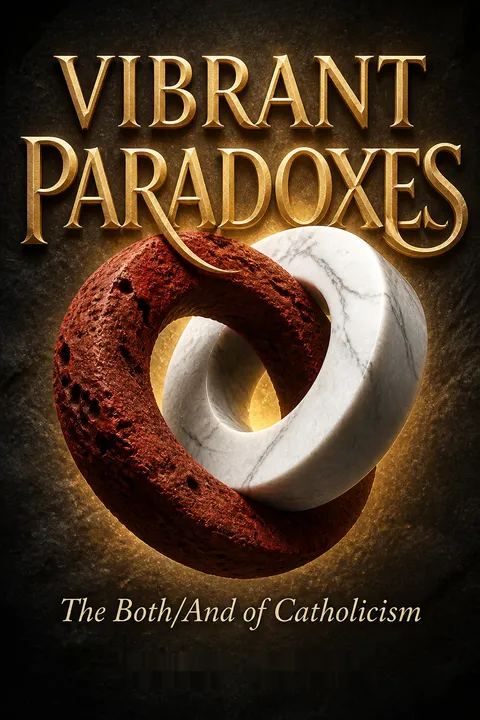
Catholicism keeps its beliefs “side by side like two strong colors, red and white…It has always had a healthy hatred of pink.”
The "both/and" principle. Catholicism uniquely celebrates the coming together of contraries, not as a bland compromise, but as a dynamic tension where opposing elements retain their full energy. This "bi-polar extremism" is rooted in the orthodox Christology, where Jesus is both fully divine and fully human, without one nature diminishing the other. This principle permeates Catholic thought, from its saints to its theological concepts.
Examples of paradoxes. This vibrant paradox is evident across various aspects of Catholic life and doctrine.
- Saints: Warrior Joan of Arc and pacifist Francis of Assisi; intellectual Thomas Aquinas and illiterate Catherine of Siena.
- Theology: Grace and nature; faith and reason; Scripture and tradition; body and soul; God’s immanence and transcendence.
- Moral Life: Extreme demands coupled with extreme mercy.
Illuminating contraries. By holding these seemingly contradictory truths in tension, Catholicism allows light to shine in every direction, revealing a richer, more complex understanding of reality. This approach avoids simplistic "either/or" reductions, instead embracing the fullness of truth found in the interplay of opposites, making the ancient faith "permanently fresh, startling, and urgent."
2. Divine Mercy Acknowledges Profound Sin
To speak of mercy is to be intensely aware of sin and its peculiar form of destructiveness.
Mercy's true context. Divine mercy is not a denial of sin's reality or a softening of moral demands; rather, it is God's profound response to the deep destructiveness of sin. Pope Francis emphasizes that the Church is a "field hospital" for the gravely wounded, implying that people are spiritually sick and in desperate need of healing, not just minor adjustments.
God joins our dysfunction. The Incarnation itself demonstrates God's willingness to enter into humanity's flawed and compromised reality. Jesus's genealogy, for instance, includes figures like:
- Jacob, who wrestled with God and bore spiritual wounds.
- Ruth, a foreigner and outsider.
- King David, a man of great piety but also a murderer and adulterer.
- Rahab, a prostitute.
- Forgotten figures like Abiud, Zadok, and Azor.
This shows God's embrace of humanity's imperfections, becoming our brother despite our unworthiness.
Extraordinary demands, extraordinary forgiveness. The Church calls people to heroic virtue and sanctity, setting stringent moral ideals (e.g., just war theory, sexual morality). Yet, it couples these demands with an extraordinarily lenient penitential system, offering infinite mercy and absolute forgiveness to those who fail, because its mission is to produce saints, not just "nice people."
3. Faith and Reason are Complementary Paths to Truth
Thoughtful Christians must battle the myth of the eternal warfare of science and religion.
Beyond false dichotomies. The idea that science and religion are implacable enemies is a modern myth, often perpetuated by "scientism"—the philosophical assumption that reality is reducible to what empirical sciences can verify. However, the greatest figures of modern science were often devoutly religious, and science itself emerged from a Christian worldview that affirmed a created, intelligible universe.
God as ultimate intelligibility. The universal intelligibility of nature, a prerequisite for all scientific inquiry, points to an infinite and creative mind that thought the world into being. God is not a "gap" in scientific explanation, but the very ground of being, ipsum esse, the reason why there is something rather than nothing. Science explores how the universe works, while faith and philosophy address why it exists at all.
Faith as trust and understanding. Authentic faith is not credulity or a sacrifice of the intellect. It is a rational act of trust in God's self-disclosure, building upon what reason can discover about Him. Just as knowing a person involves both objective observation and trusting their self-revelation, so too with God. Reason leads us to the limits of our understanding, where faith invites us to listen, trust, and open our hearts to the supreme Person.
4. God's Invisibility Defines His Transcendence
The invisible God is he whose reality transcends and includes whatever perfection can be found in creatures, since he himself is the source and ground of creatureliness in all its manifestations.
Beyond empirical limits. The "invisible friend" taunt of atheists misunderstands the classical theological concept of God. God is not a supreme being within or alongside the universe, but the unconditioned ground of the contingent universe itself. Anything visible is, by definition, a particular being, conditioned and finite. God, as ipsum esse subsistens (sheer act of to-be itself), transcends all categories of visible, finite being.
Unconditioned love. God's invisibility signifies His unconditioned nature. He needs nothing, not even creation, for His perfection is complete. Therefore, His act of creating the universe ex nihilo (from nothing) is a sheer act of generosity and love, a desire to share His goodness. This fundamental stance of friendship means God continually loves the universe into existence, finding it "good, indeed very good."
Humanity's unique role. As images of God, humans are meant to be His friends par excellence, reflecting divine goodness and channeling the world's praise back to Him. This relationship is not dehumanizing, as God is not a rival to human flourishing. Instead, as St. Irenaeus stated, "the glory of God is a human being fully alive," meaning God's joy is found in our fullest good.
5. The Body and Spirit are Integrated, Not Opposed
Many Christians today remain haunted by the Platonic view that matter and spirit are opponents and that the purpose of life is finally to affect a prison-break, releasing the soul from the body. This might have been Plato’s philosophy, but it has precious little to do with the Bible.
Biblical affirmation of matter. Biblical Christianity emphatically insists on the goodness of matter and the body, rejecting Gnostic dualism that denigrates the material world. From creation to Incarnation and Resurrection, the Church's theology consistently involves bodiliness and materiality. Redemption is not an escape of the soul from the body, but the salvation and perfection of the body itself.
Rejecting Gnostic anthropology. Modern attitudes, influenced by Cartesian dualism, often echo Gnostic ideas by separating the mind/will ("real me") from the body (an object to be manipulated). This is seen in discussions around gender identity, where the inner self is prioritized over the body's distinctive form.
- Bruce Jenner's transformation: Justified by the idea that the "true identity" (mind/will) can and should remake the body.
- "Theology of love" vs. "theology of the body": A potential Gnostic tendency to separate human love from its embodied reality.
For Biblical people, the body is an essential constituent of the true self, not a prison or an object for manipulation.
Jesus fulfills, not abolishes, the material. Jesus did not come to abolish the material world or institutional religion, but to fulfill and transfigure them. He was a loyal, observant Jew who transformed Israelite religion's institutions, sacraments, and practices into those of the Church. The Resurrection itself is a bodily event, signifying that heaven and earth are coming together, and God has not given up on His creation, including its material dimension.
6. True Freedom is Found in Discipline for Excellence
On this reading, freedom is the disciplining of desire so as to make the achievement of the good, first possible, then effortless.
Freedom of indifference vs. freedom for excellence. Our culture often defines freedom as the "freedom of indifference"—the capacity to choose based on personal inclination, where choice is paramount. However, a more classical understanding is "freedom for excellence"—the disciplined ordering of desire to achieve the good effortlessly.
- Freedom of indifference: Views objective rules as limitations.
- Freedom for excellence: Sees laws and disciplines as liberating, enabling the achievement of great goods (e.g., mastering a language or a sport).
Surrender to Christ, become free. St. Paul's paradox, "I am the slave of Christ Jesus" and "it is for freedom that Christ has set you free," becomes coherent under the "freedom for excellence" model. The more one surrenders to Christ, the greatest good, the freer one becomes to be who they are meant to be—a child of God. This internalizing of Christ's moral demands leads to authentic freedom and prompt response to God's call.
Beyond self-determination. The human project went astray when Adam arrogated to himself the right to determine good and evil, leading to self-deification and misery. This "deified freedom" is seen in contemporary culture's emphasis on individual self-creation and self-determination. The Bible, however, teaches that our lives do not belong to us, but to God, and true joy and creativity come from following the Holy Spirit's promptings, which order our freedom towards transcendent possibilities.
7. Human Dignity is Grounded in God's Existence
When God is removed from the picture, human rights evanesce rather rapidly, which can be seen with clarity in both ancient and modern times.
The source of dignity. The classical Western perspective holds that human dignity stems from our status as creatures made in God's image and likeness, destined for eternal life. This divine origin guarantees inalienable rights, as articulated by Thomas Jefferson, who understood these rights as "endowed by their Creator." Without God, attempts to ground human dignity in intelligence, creativity, or sentiment prove insufficient, as these qualities can be underdeveloped, lost, or change.
Consequences of God's absence. The attenuation of belief in God leads to a forgetfulness of human dignity, making startling violence against human beings possible.
- Historical examples: Ancient societies relegated many to inferior status or slavery; 20th-century totalitarianisms, marked by aggressive dismissal of God, treated millions as vermin.
- Contemporary issues: The casual discussion of selling aborted infant body parts, the push for euthanasia, and rampant urban violence reflect a culture where human life is increasingly dispensable.
God as absolute goodness. Catholic moral philosophy identifies basic, irreducible values like truth, life, friendship, justice, and beauty as structuring elements of the moral life. These values are reflections of, and participations in, God, who is absolute or unconditioned goodness. When God is denied, these basic goods lose their ultimate ground, leading to moral relativism and the self-legislating will, where "anything is permissible."
8. Suffering Can Be a Path to Divine Grace
The whole point of the Christian life is to find joy, but the attainment of true joy comes, in a sinful world, at the cost of some suffering.
The paradox of suffering. The problem of suffering, exemplified by Job's lament or Stephen Fry's atheistic critique, is not new to Christianity. While God cannot be the cause of evil (as He is love and being itself), He permits it to bring about a greater good. This divine "permission" can be understood through a "free process" defense for natural evils (like tsunamis) and a "free will" defense for moral evils.
Divinization of passivities. Suffering, or "passivities"—things done to us over which we have no control (sickness, loss, unfair criticism)—can be divinized by offering them to God. This participation in the cross of Christ allows God to work out His purpose with unsurpassed power. It's a deeper spiritual move than divinizing one's activities or accomplishments.
Joy through self-emptying. The Christian spiritual tradition teaches that true joy is found not by filling oneself with worldly pleasures or achievements, but by emptying oneself in love for others. This self-gift, even in the midst of suffering, fills one with divine life. The "dark night of the soul," experienced by saints like Mother Teresa, is a painful cleansing process that purifies attachments to finite things, leading to deeper union with God and profound compassion.
9. Evangelization Requires Walking with Sinners, Opening Scripture, and Breaking Bread
So prospective evangelists, do what Jesus did. Walk with sinners, open the Book, break the Bread.
Jesus's evangelical technique. Luke's narrative of the disciples on the road to Emmaus provides the ultimate model for evangelization.
- Walk with sinners: Jesus joined the disciples going the "wrong way," engaging them on their terms, showing love and willingness to enter their world, just as he associated with sinners throughout his ministry.
- Open the Book: Jesus disclosed the great Biblical patterns that made sense of their experiences, revealing the overarching design and meaning of events. The Scriptures are the means by which we "get" Jesus Christ and our lives.
- Break the Bread: In the Eucharistic moment, their eyes were opened, and they recognized Him. The Eucharist, as Christ himself, is the ultimate means to understand Jesus, embodying His love and broken heart.
Beyond superficiality. Effective evangelism is not primarily about personal witness, inspiring sermons, or even just understanding Scripture. It is about leading people to encounter the living Christ, especially through the Eucharist. This approach avoids reducing the Gospel to bland spiritual abstractions or moral bromides, instead presenting the startling, revolutionary truth of Christ.
The Church as mission. The Church is a mission, not just has one, aiming to bring the merciful face of Jesus to everyone. It is a home for sinners, not an exclusive club for the morally perfect. Leading with the saving cross of Jesus, rather than moral regulations, allows people to encounter Christ first, and then understand the disciplines that bring them into conformity with Him.
10. The Church's Enduring Strength Amidst Persecution
The Church has faced this sort of thing before—and we’re still standing.
A history of opposition. From its earliest centuries, the Church has faced persecution, from Roman emperors to totalitarian regimes and aggressive secularism. This history includes thousands of martyrs, popes imprisoned, and widespread hatred. This enduring opposition highlights a "peculiar logic" in supernatural matters: that which should stifle Christianity often makes it grow stronger.
Martyrs as seeds. Tertullian's adage, "the blood of martyrs is the seed of Christians," is repeatedly proven throughout history. The brutal execution of the Ugandan martyrs at Namugongo, for instance, did not end Christianity in Africa but ignited its explosive growth. Their courage galvanized others, demonstrating that "the supernatural is the real" and inspiring millions.
Resilience in the face of secularism. In the modern West, the Church faces a new form of opposition from an increasingly aggressive secular state and the ideology of the self-defining individual. While this can be disheartening, the Church's long history of confronting cultural shifts and maintaining its core identity provides courage. It continues to propose its views winsomely and nonviolently, trusting in its divine foundation.
11. Celibacy and Detachment Witness to Transcendent Love
Their mission is to witness to a transcendent form of love, the way that we will love in heaven.
Beyond negative connotations. Priestly celibacy is often misunderstood as unnatural or unnecessary, or as a denigration of marriage and sexuality. However, it is not a "no" to good things, but a "no" to a "no"—a negation of imperfect forms of love in service of a greater "yes." It is a behavioral concomitant to the anti-idolatry principle, refusing to make anything less than God the ultimate center of one's life.
Sacramental witness. In Biblical narratives, prophets often acted out truths to make them vividly known. Celibates, in this prophetic tradition, witness to the non-ultimacy of sex, family, and worldly relationships, making viscerally real a transcendent form of love—the way we will love in heaven. This eschatological context is crucial for understanding celibacy's meaning.
- God's "yes" and "no": The doctrine of creation involves both a "yes" to the goodness of the world and a "no" to divinizing any worldly reality.
- Detachment: Reverencing all creation while letting go of everything for God's sake.
Fascination for another world. Celibacy, when properly understood, is not a denial but a radical affirmation of a wider, more inclusive, and abiding form of marriage and procreation. It makes priests uniquely positioned to serve and advise families, embodying a spiritual fatherhood. The "fascinating" quality of the priest, as Andrew Greeley noted, comes from this witness to another world, a deeper, more mystical reality.
Review Summary
Vibrant Paradoxes is highly praised for its insightful, thought-provoking essays on Catholic faith and culture. Readers appreciate Bishop Barron's ability to explain complex theological concepts in an accessible manner. The book's short essays cover various topics, from philosophy to contemporary issues, and are described as perfect for daily reflection. While some found certain arguments less convincing, most reviewers commend Barron's intellectual depth, writing style, and capacity to strengthen readers' faith. The book is recommended for both Catholics and non-Catholics seeking a deeper understanding of Catholicism.
People Also Read






About the Author

Download PDF
Download EPUB
.epub digital book format is ideal for reading ebooks on phones, tablets, and e-readers.








































