
Key Takeaways
1. Modern Education Creates "Men Without Chests"
The operation of The Green Book and its kind is to produce what may be called Men without Chests.
Critique of textbooks. Lewis begins by dissecting a common English textbook, "The Green Book," authored by "Gaius and Titius." He argues that by reducing statements of value (like calling a waterfall "sublime") to mere descriptions of the speaker's feelings ("I have sublime feelings"), these educators inadvertently teach students that all value judgments are subjective and unimportant. This approach, while seemingly innocuous, subtly conditions young minds to dismiss objective truth in matters of emotion and morality.
Eradicating noble sentiments. The textbook's method of "debunking" historical or natural associations (e.g., dismissing the romance of the "Western Ocean where Drake sailed") strips away the very emotions that connect intellect to action. Instead of teaching students to discern good from bad literature that expresses these emotions, it encourages them to view all such sentiments as irrational and contemptible. This process, Lewis warns, removes a crucial part of the human heritage before children are old enough to understand its value.
The missing "chest." Lewis posits that humans are not merely intellect (head) or appetite (belly), but also possess a "chest"—the seat of magnanimity, sentiment, and trained emotions. This "chest" acts as the indispensable liaison between reason and desire, enabling virtue and enterprise. By systematically undermining objective value and the cultivation of just sentiments, modern education produces "Men without Chests," individuals whose intellect is powerless against their animalistic impulses, leaving them vulnerable to propaganda and incapable of true virtue.
2. The Tao: The Universal Moral Law
This conception in all its forms, Platonic, Aristotelian, Stoic, Christian, and Oriental alike, I shall henceforth refer to for brevity simply as ‘the Tao’.
Objective value. Lewis introduces "the Tao" as a shorthand for the universal, objective moral law recognized across diverse cultures and historical periods. This concept, also known as Natural Law, Traditional Morality, or the First Principles of Practical Reason, asserts that certain attitudes and responses are inherently true or false to the nature of the universe and humanity. It's the belief that objects can merit our approval or disapproval, reverence or contempt, independent of our personal feelings.
Harmony with reason. Within the Tao, emotions are not merely alogical psychological events; they can be reasonable or unreasonable depending on whether they conform to Reason. For example, feeling veneration for a sublime waterfall is a reasonable emotion because the object merits it. Conversely, a lack of appropriate emotional response (like not enjoying small children) is seen as a defect in oneself, akin to being tone-deaf. The heart, while not replacing the head, is meant to obey it, aligning sentiments with objective truth.
Foundational principles. The Tao encompasses fundamental moral principles such as:
- General Beneficence (e.g., "Do not murder," "Love thy neighbour")
- Special Beneficence (e.g., duties to family, community)
- Duties to Parents, Elders, Ancestors
- Duties to Children and Posterity
- Justice (sexual, honesty, in court)
- Good Faith and Veracity
- Mercy
- Magnanimity (courage, self-control)
These principles are not arbitrary but are seen as self-evident truths that form the bedrock of human morality.
3. Subjectivism Undermines All Values
If it is rejected, all value is rejected. If any value is retained, it is retained.
Inherent contradiction. Lewis argues that the very act of "debunking" traditional values implies a hidden set of values held by the debunkers themselves. Gaius and Titius, for instance, implicitly value certain states of mind (like critical thinking) and societal outcomes (like peace and comfort). However, their subjectivist philosophy provides no logical basis for these preferences. If all values are merely subjective feelings, then their own preferences are equally arbitrary and lack any claim to validity or correctness.
The "only" problem. The language used by subjectivists, such as saying we are "only saying something about our own feelings," subtly trivializes all value judgments. This linguistic conditioning leads students to believe that such statements are unimportant. Once this assumption takes root, it becomes impossible to distinguish between noble sentiments and base impulses, as both are reduced to equally non-rational "mists" between us and reality.
No ground to stand on. If the Tao is rejected, there is no external standard against which to judge any sentiment as reasonable or unreasonable. All emotions become equally valid or invalid, equally non-rational. This leaves no basis for moral education beyond either:
- Removing all sentiments from the pupil's mind.
- Encouraging certain sentiments for purely utilitarian reasons, without believing in their intrinsic "justness."
Both paths lead to a profound moral vacuum, where the concept of "good" loses all objective meaning.
4. The Futility of Basing Values on Utility or Instinct
From propositions about fact alone no practical conclusion can ever be drawn.
Utility's dead end. Attempts to ground values in utility (e.g., "Good means what is useful to the community") quickly falter. While the death of some individuals might be useful to others, this doesn't explain why those individuals ought to sacrifice themselves. Without appealing to concepts like pride, honor, or love (which are themselves sentiments derived from the Tao), there's no rational imperative for self-sacrifice. The question "Why should I be one of those who take the risk?" remains unanswered by mere utility.
Instinct's contradictions. Similarly, basing values on "instinct" (e.g., an instinctive urge to preserve the species) is equally problematic. Firstly, "instinct" is often a placeholder for unknown mechanisms. Secondly, if we must obey instinct, why the need for moral exhortation? Thirdly, and most critically, instincts are often contradictory. We have instincts for self-preservation, sexual gratification, and parental love, but no inherent "rule of precedence" to decide which instinct should be obeyed when they conflict.
The imperative gap. Lewis highlights the fundamental logical flaw: one cannot derive an "ought" (a practical conclusion or imperative) from an "is" (a factual proposition or observation about instinct). The statement "This will preserve society" cannot logically lead to "Do this" without the mediating principle "Society ought to be preserved," which is itself a value judgment. Any attempt to find a "rational" or "basic" core for values outside the Tao inevitably smuggles in unacknowledged principles from the Tao itself.
5. The Tao is the Sole Source of Value
The effort to refute it and raise a new system of value in its place is self-contradictory.
Inescapable foundation. Lewis asserts that the Tao is not merely one system of values among many, but the sole source of all value judgments. If the Tao is rejected, all value is rejected; if any value is retained, it is implicitly retained from the Tao. Any purported "new system" or "ideology" is merely a collection of fragments arbitrarily wrenched from the Tao, inflated in isolation, and still dependent on the Tao for any validity they possess.
Self-defeating rebellion. The rebellion of new ideologies against the Tao is likened to branches rebelling against the tree. If they succeed, they destroy themselves, as their very existence and ability to articulate values depend on the root system they seek to sever. The human mind, Lewis argues, cannot invent a truly new value any more than it can invent a new primary color or a new sun. All attempts to do so are ultimately parasitic on the existing moral framework.
Arbitrary selection. Innovators who claim to supersede the Tao inevitably pick and choose which traditional values to retain (e.g., duty to posterity, economic well-being) and which to discard (e.g., duty to ancestors, justice). However, they have no logical warrant for this selection. If the rejected parts of the Tao have no authority, neither do the retained parts. Their authority, if any, comes from the Tao itself, making their selective acceptance arbitrary and inconsistent.
6. Legitimate vs. Fatal Criticism of Morality
Only those who are practising the Tao will understand it.
Internal development. Lewis acknowledges that the Tao is not a static, unchanging code; it admits "development from within." This means that those who understand its spirit and are guided by it can modify or refine it in directions that the spirit itself demands. This is akin to a great poet altering a language from within its genius, rather than an external theorist imposing wholesale changes. Such internal criticism seeks to harmonize discrepancies by penetrating to the spirit of the law.
The outsider's blindness. In contrast, "fatal external criticism" challenges the very credentials of traditional morality, demanding "Why?" or "What good does it do?" Lewis argues this approach is impermissible because no values can justify themselves on that level. If one persists in this kind of trial, all values will be destroyed, including the basis for the criticism itself. The corrupted man, standing outside the Tao, cannot truly understand or critically engage with ethics because its very starting point is invisible to him.
Obedience precedes understanding. Understanding the Tao requires practice and participation. One cannot postpone obedience until its credentials have been fully examined, because only through living within its principles does its rationality become apparent. The "well-nurtured man" or "cuor gentil" is the one who can recognize Reason when it comes. An "open mind" about the ultimate foundations of Practical Reason is not wisdom but idiocy, as it renders one incapable of purposeful moral discourse.
7. "Man's Conquest of Nature" is Power Over Other Men
From this point of view, what we call Man’s power over Nature turns out to be a power exercised by some men over other men with Nature as its instrument.
Ambivalent power. Lewis redefines "Man's conquest of Nature" not as a collective human triumph, but as the power of some men over other men, using natural forces and scientific advancements as tools. Technologies like aeroplanes, wireless, and contraceptives, while seemingly empowering humanity, are actually wielded by specific individuals or groups (sellers, owners, governments) who can grant or withhold their benefits.
The patient, not just the possessor. In this conquest, "Man" is also the "patient" or "subject." For example, while some men use aeroplanes to bomb, others are bombed. Contraceptives, used for selective breeding, allow one generation to pre-ordain the characteristics of future generations without their consent. This means that every new power gained by "Man" is simultaneously a power over man.
Intergenerational control. The most significant aspect of this power dynamic is the control of earlier generations over later ones. If one age achieves the ability to shape its descendants through eugenics and scientific education, all subsequent generations become "patients" of that power, weaker and less autonomous. The idea of a steadily growing human power is an illusion; instead, it's a shifting balance where a dominant age or a small minority within it becomes the "real master of the human species."
8. The Final Conquest: Human Nature Itself
Human nature will be the last part of Nature to surrender to Man.
The ultimate frontier. The culmination of "Man's conquest of Nature" is the subjugation of human nature itself. This final victory is achieved when humanity gains full control over its own biological and psychological makeup through eugenics, pre-natal conditioning, and a perfectly applied psychology for education and propaganda. At this point, the "battle will be won," but the crucial question becomes: who precisely will have won it?
Unprecedented power. This future scenario differs from past educational efforts in two critical ways:
- Enormous increase in power: Unlike previous educators whose plans often failed due to the "beneficent obstinacy" of real children and parents, the "man-moulders" of the new age will be armed with the omnicompetent state and irresistible scientific techniques, truly able to shape posterity as they please.
- Emancipation from the Tao: Older systems of education were bound by the Tao, a norm to which teachers themselves were subject. They transmitted a received understanding of humanity. The new "Conditioners," however, will view values as mere natural phenomena, to be produced in the pupil as part of the conditioning, rather than being guided by them.
Nature as instrument. In this final stage, the ultimate springs of human action are no longer "given" but are controlled. The Conditioners will know how to produce conscience and decide what kind of conscience to produce. They stand "outside, above" human nature, having conquered it and now using it as an instrument, much like electricity.
9. The Conditioners' Moral Vacuum
Every motive they try to act on becomes at once a pelitio.
Self-referential dilemma. The Conditioners, having conquered human nature and transcended the Tao, face a profound dilemma: what will motivate them? They might initially be driven by remnants of the old Tao (e.g., a "duty" to do humanity "good"), but their own philosophy has debunked duty and good as mere conditioned responses. They cannot use duty or good to decide what kind of duty or good to produce in others, as these concepts are themselves "up for trial."
Stepping into the void. By stepping outside the Tao, the Conditioners step into a moral void. They are no longer "men" in the traditional sense, as "good" and "bad" become meaningless when they are the ones defining their content. Even if they claim to act on universal desires like food, amusement, or long life, these are merely "what we happen to like," providing no objective imperative for their laborious efforts to condition others.
Rule of impulse. With all "rational" or "spiritual" motives explained away, the Conditioners are left with only one driving force: their own pleasure, their "sic volo, sic jubeo" (thus I will, thus I command). Their impulses, stripped of any objective preference or encouragement from the Tao, become purely "natural"—springing from heredity, digestion, weather, or association of ideas. Their extreme rationalism, by "seeing through" all rational motives, ironically leaves them as creatures of wholly irrational behavior, subject to chance.
10. The Abolition of Man
Man’s conquest of Nature turns out, in the moment of its consummation, to be Nature’s conquest of Man.
The magician's bargain. Lewis likens the process of "Man's conquest of Nature" to a magician's bargain: surrendering object after object, and finally oneself, to Nature in return for power. The paradox is that once our "selves" (our souls, our capacity for objective value) are given up, the power gained no longer belongs to "us." We become slaves and puppets of that to which we surrendered.
Humanity as raw material. If man chooses to treat himself as mere "natural object" and his value judgments as raw material for scientific manipulation, then raw material he will be. But this material will not be manipulated by "himself" (a rational, moral agent), but by "mere appetite"—that is, by mere Nature, embodied in the dehumanized Conditioners. The very abstraction "Man" conceals this reality; it's the rule of a few Conditioners over conditioned human material.
Nature's ultimate triumph. The final victory of "Man over Nature" is revealed as Nature's ultimate conquest of Man. The restive species that once revolted against her, with its "chatter of truth and mercy and beauty and happiness," is finally subdued. Humanity, having abolished its own essence by rejecting objective value, becomes an artifact, ruled by irrational impulses, until the end of time. This is the tragic absurdity of carrying a principle (explaining things away) to its logical, self-defeating conclusion: if you see through everything, you see nothing at all.
Review Summary
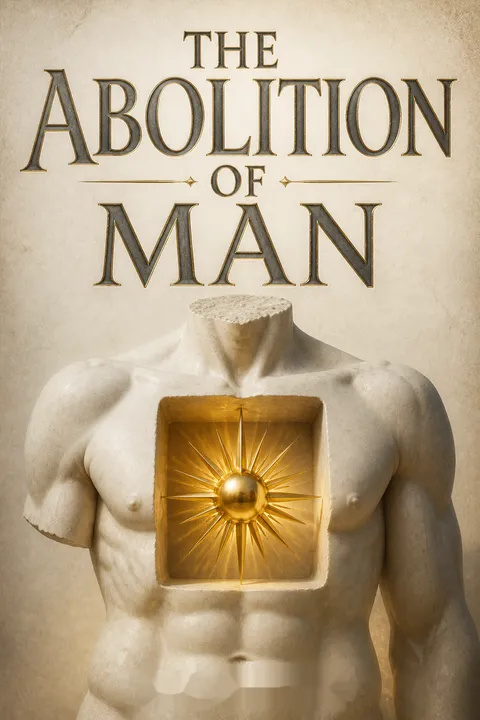
The Abolition of Man by C.S. Lewis examines moral relativism and objective values in education and society. Published in 1943, it critiques modern educational approaches that treat emotions as merely subjective. Lewis argues for the "Tao"—universal moral truths found across cultures—and warns against creating "men without chests" who lack moral character. The book explores how scientific rationalism, when taken to extremes, threatens human nature itself. Readers praise its prescience regarding contemporary issues, though many note its density requires multiple readings to fully grasp Lewis's philosophical arguments.
People Also Read


About the Author
Other books by C.S. Lewis







Download PDF
Download EPUB
.epub digital book format is ideal for reading ebooks on phones, tablets, and e-readers.








































