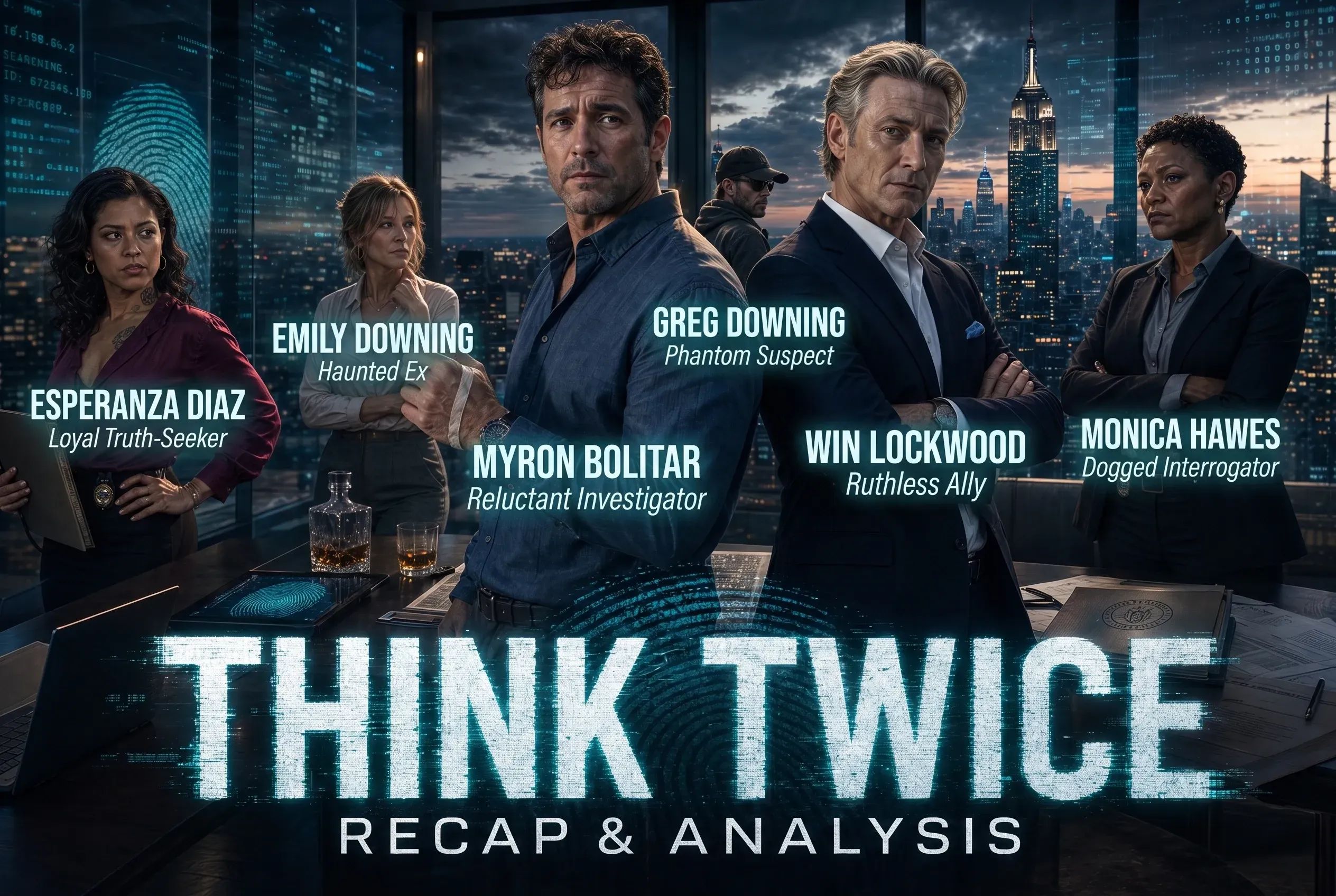


Plot Summary
Prologue
In chillingly intimate second person, a meticulous killer narrates the destruction of a life. Over six weeks of surveillance, the killer learns a man's habits, spikes his nightly cognac, lifts his thumbprint to open a biometric gun case, and borrows his Audi and phone.
Then the killer drives to a lakeside Airbnb in Marshfield where a frightened woman hides, shoots her twice through the chest, and leaves behind the man's planted DNA. Everything is returned: car, phone, gun hidden under peat moss. Ballistics, GPS, DNA, and phone records will all point to an innocent man. For the woman, the horror ends. For the framed man, it has only begun.
Coben weaponizes the second-person voice to implicate the reader in the killer's craftsmanship, turning us into accomplices who admire the artistry of cruelty. The prologue establishes the novel's signature inversion: murder is quick, almost anticlimactic, while the true thrill lies in the slow architecture of framing the innocent. The killer's self-aware references to la petite mort and emptiness expose a hollow addiction dressed as connoisseurship. By withholding identities, Coben makes the method itself the antagonist, priming readers to scrutinize every subsequent solved case. The patience-over-passion ethos foreshadows a predator who has industrialized wrongful conviction as a form of godlike control.
A Dead Man's DNA
Two FBI agents interrupt Myron Bolitar,1 the former basketball star turned sports agent and attorney, with an impossible question: where is Greg Downing?3 Greg,3 Myron's1 lifelong on-court rival and former client, died three years ago and was eulogized by Myron1 himself.
Yet Greg's3 skin cells were found under the fingernails of slain ex-model Cecelia Callister, whose son Clay was also killed. The agents believe Greg3 faked his death and committed double murder.
Myron's1 wealthy, lethal best friend Win2 cooly walks out, later admitting that Greg's3 old financial maneuvers suggest he planned to vanish. Bound by attorney-client obligation and a tangled history, Myron1 resolves to find the man he buried, beginning with his destructive college love, Emily.5
The opening fuses procedural intrigue with personal wound. Coben anchors a fantastical premise (a resurrected client) in the granular realism of DNA and privilege law, making the absurd feel actionable. Myron's compulsion to help a man who once destroyed him reveals his core pathology: a need to be magnanimous, to convert injury into moral superiority. Win's detachment contrasts Myron's reflexive idealism, establishing the dyad that drives the series. The chapter also seeds the book's thesis about evidence: overwhelming proof should comfort us, yet here it disturbs, because the impossible cannot be true. Resurrection becomes a metaphor for buried history refusing to stay interred.
The Sock Puppet and the Stripper
Emily,5 Greg's3 widow and the mother of Myron's1 secret biological son,6 reveals a clandestine Instagram account Greg3 used to message Bo Storm,9 a young, oiled-up gay fitness model and sex worker in Las Vegas. Bo9 stopped posting five years ago, right as Greg3 ran off claiming burnout. Emily5 assumes Greg3 was closeted and fled with the younger man.
Esperanza,8 Myron's1 old partner now at a victims-rights firm, digs deeper: Bo9 worked at a gay sports bar called Man United, owned by Donna Kravat,13 whose son Jordan was murdered around the same time Bo9 disappeared. A mob boss named Joey Turant,14 nicknamed Joey the Toe for his grisly souvenirs, was convicted of that killing. The timing feels orchestrated.
This section excavates the messy substrate of midlife identity, where reinvention and concealment blur. Emily's theory about Greg's hidden sexuality reflects how survivors retrofit narratives onto absence, projecting coherence onto a man who left only silence. Coben uses social-media archaeology (follower lists, dormant accounts, timestamps) as the modern forensic tool, suggesting that in the digital age, vanishing is itself a constructed performance. The convergence of dates (Bo's silence, Jordan's death, Greg's flight) plants the structural suspicion that separate tragedies share a hidden author. The chapter quietly interrogates assumption itself: everyone reads the evidence through the lens of their own desires and wounds.
Pruning Shears in Vegas
Flying to Las Vegas, Myron1 interviews Donna Kravat,13 Jordan's grieving mother, who gives up Bo's9 claimed real name, Brian Connors, and his Oklahoma roots, then secretly texts the mob to warn them. A fake driver abducts Myron,1 and goons led by a thug called Jazz tie him to a chair, intent on amputating his pinky toe per their boss's signature.
Myron1 stalls with wisecracks until Win2 arrives and executes three of the captors with surgical precision, sparing Jazz only because he is Joey the Toe's14 cousin. Over dinner, Donna13 admits she doubts Joey14 killed her son, arguing the evidence was too perfect, and suspects Bo9 himself, possibly aided by someone smarter, was behind it.
Violence here doubles as characterization. Myron survives through verbal deflection and athletic reflex, embodying decency under duress, while Win dispatches threats without flinching, the cold yin to Myron's anxious yang. Coben's gallows comedy (the goons debating the abbreviation MO) humanizes menace and undercuts its theatricality, exposing how criminals perform their own genre. Donna's insistence that the evidence was too clean reintroduces the prologue's logic into the present timeline: perfection is suspicious. Her pivot toward Bo as a possible mastermind models the novel's recurring misdirection, training readers to distrust tidy guilt and to sense an unseen architect arranging the pieces from the shadows.
He's Done It Again
Win2 visits Joey the Toe14 in prison. The mobster insists he never killed Jordan Kravat and was framed by overwhelming planted evidence, then grins when Win2 mentions a fresh murder case with a DNA-implicated suspect: someone, he says, has done it again. Meanwhile, the trail to Bo9 runs through his older brother, Spark Konners,10 a giant former player who worked as Greg's3 assistant coach.
Win2 lures Spark10 to Vegas with a fabricated NBA franchise job, and Myron1 exposes the ruse, revealing Bo9 is Spark's10 brother. Spark10 refuses to talk, but Win2 snatches his phone, traces a recent call, and pinpoints a cheap motel bar in Havre, Montana, sending Myron1 after the man everyone has been hunting.9
Joey's claim transforms the book from a single mystery into a pattern, recasting one conviction as a possible template. His glee is unnerving because a murderer's innocence in one crime threatens the entire edifice of justice. Coben stages the Spark deception as a moral stain on the heroes, dangling false hope before a striving family man, a cruelty Myron later tries to atone for. The brotherly protectiveness of Spark introduces the recurring motif of family members who lie to shield their kin. Technology again functions as omniscience: facial recognition and cell triangulation render hiding nearly impossible, framing the chase as surveillance versus secrecy.
Wrong Love Entirely
In Montana, Myron1 finds Bo9 reinvented as Stevie, a clean-shaven, crew-cut bartender living quietly with his boyfriend Cal. When Myron1 accuses him of a romance with Greg,3 Bo9 bursts out laughing and corrects the misreading: the Instagram messages were between Greg3 and Bo's9 mother, Grace,4 a striking woman Greg3 met at a Phoenix game through Spark.10
Greg3 and Grace4 fell in love and ran off together. Bo9 insists Joey14 killed Jordan, that the mob forced him to flee, and that Greg3 fled because he was dying of cancer. He swears he had nothing to do with Jordan's death. Myron1 senses partial deception but lets Bo9 talk himself out, filing away the contradictions for later.
The comic reversal (the assumed gay lover was actually a heterosexual romance with the mother) skewers the certainty of all prior interpretation, a sly authorial rebuke to readers who accepted Emily's narrative. Bo's reinvention as a small-town bartender dramatizes the novel's fascination with escape and the fragile peace of anonymity. Yet Coben signals that survival often requires curated lies, and Myron's detective instinct, to nod along while distrusting, becomes the chapter's quiet engine. The cancer story functions as a sympathetic cover, the kind of explanation that disarms scrutiny precisely because it invites pity. Truth here is layered, each revelation peeling back to expose another concealment.
The Man He Buried
Tracing Grace,4 now living as Grace Conte on a renovated property in rural Pine Bush, New York, Myron1 confronts her lies until a bearded, permed Greg Downing3 steps out of hiding. Over coffee, Greg3 explains he quit basketball, fell for Grace,4 and tried to free Bo9 from Jordan Kravat's abusive, mob-entangled grip, after which Joey14 allegedly killed Jordan in a botched attempt on Bo.9
Greg3 faked his death to escape it all. He swears he never killed Cecelia and cannot explain his DNA. Then a bullhorn sounds: FBI agents, having tailed Myron1 the entire way, swarm the house and arrest Greg.3 Grace4 turns on Myron,1 accusing him of leading the law straight to their door.
The resurrection pays off as anticlimax and indictment. Greg, supposedly seeking peace, is instead exposed, and Myron, trying to help, becomes the instrument of capture, a cruel inversion of the rescuer fantasy that defines him. Coben dramatizes the unintended consequences of intervention: the hero complex that Grace later names as genetic. Greg's calm denial, paired with his inexplicable DNA, sustains the central paradox between damning evidence and plausible innocence. The domestic idyll Greg built, the whimsical white A-frame, becomes a stage for collapse, suggesting that escape is always provisional and that the past, embodied by Myron, inevitably tracks you down.
The Son and the Secret Rape
With Greg3 jailed and refusing Myron's1 help, Myron's1 biological son Jeremy,6 raised by Greg3 and now a clandestine military officer, flies home and insists Myron1 fight for his father.3 Emily5 confides that decades ago Cecelia Callister told her she had been raped by a Broadway predator, later identified as the now-dead Howard Mostring, and that the assault produced her son Clay.
Visiting Greg3 in prison, Myron1 hears a possible explanation for the impossible DNA: weeks before the murder, Greg3 was bloodied and scratched in a rough pickup basketball game in Wallkill. If someone collected his blood that night, they could have planted it at the scene. Myron1 agrees to keep digging.
This section braids inheritance and trauma. Jeremy embodies the redemptive fruit of Myron and Emily's transgression, and his quiet authority forces both men to behave. Coben handles Cecelia's assault with retrospective sorrow, indicting a culture that silenced victims long before any reckoning, and reframing Clay's paternity as a wound rather than a scandal. The pickup-game theory restores hope by offering a mechanism for the DNA, yet it also deepens the mystery: who could harvest a man's blood and know exactly where to use it. The chapter privileges fatherhood as chosen rather than biological, a theme that quietly governs the entire emotional architecture.
Lunch With the Shadow
At an exclusive lunch, the FBI fixer known only as PT11 lays out a staggering theory. A rare modern serial killer is at work, one who evades detection precisely because the murders never look unsolved. In Vegas, Texas, Nebraska, New Jersey, and Massachusetts, victims were killed and innocent people, with motive and planted evidence, were convicted in their place.
No hair, no location, no victim type connects the cases. The only thread the Bureau has found ties Jordan Kravat's killing to the Callister murders, and that thread is Greg Downing.3 PT11 frames three possibilities: Greg3 is the killer, Greg is a victim being framed, or everything orbits Greg3 for reasons unknown. The hunt acquires national stakes.
Coben elevates the premise into a meditation on the epistemology of justice. The killer's genius is institutional: by feeding the system satisfying culprits, the predator exploits prosecutorial hunger for closure and the public appetite for resolution. PT's lecture on the near-extinction of serial killers, throttled by surveillance, makes this offender's method feel like evolutionary adaptation. The revelation reframes every solved case as a potential lie, indicting confirmation bias as the true accomplice. Greg as sole connective tissue is the structural fulcrum, forcing the reader to hold contradictory readings simultaneously. The scene also dramatizes power that operates off the record, mirroring the killer's own invisible agency.
A Gun on His Father
An elderly woman posing as a client corners Myron1 in his office, demanding Bo's9 location for Joey Turant.14 On a video call, her accomplice, the bald stranger who had befriended Myron's1 father in Florida under the name Allen Castner, pistol-whips Myron's1 dad and threatens to execute him. To save Myron's1 parents, Win2 has already secretly given the mob Bo's9 Montana hideout.
The hostage standoff ends only once Turant's14 men confirm Bo's9 whereabouts and seize him from the Shanty Lounge. Myron's1 father survives with a broken nose, downplayed to protect Myron's1 fragile mother. Win2 is unrepentant: he would trade a hundred strangers for Myron's1 family, and forces Myron1 to confront that, beneath his idealism, so would he.
The kidnapping collapses Myron's moral cushion. Win's calculus, family over strangers, is presented not as villainy but as honest hierarchy, and Coben implicates Myron by insisting he shares it. The infiltration of the parents' sunny retirement world via a fake friend weaponizes intimacy, echoing the prologue's patient surveillance and suggesting predators thrive in trust. The episode also exposes the cost of the heroes' earlier choices: their Vegas violence and reckless pursuit endangered everyone connected to Bo. Win's loyalty, absolute and amoral, functions as both the series' comfort and its ethical provocation, asking whether love for the few licenses indifference to the many.
The Contractor's Rifle
Recognizing the killer's signature, Myron1 turns to a fresh case his wife Terese,7 a television journalist, is covering. Real estate mogul Ronald Prine was gunned down, and Jacqueline Newton, a struggling contractor whose business and father Prine had ruined, sits in jail. The murder weapon is her father's rifle, found in her closet, and threatening emails came from her home network.
Driving to Philadelphia, Myron1 meets Jackie and her cynical public defender, both of whom convince him she is innocent. The evidence is excessive in the now-familiar way: a stolen weapon returned, a tidy digital trail, a built-in motive. Crucially, Prine was killed while Greg3 sat in custody, meaning the framer is still active and cannot be Greg.
Jackie Newton's backstory, the David-and-Goliath crushing of a small family business by a predatory tycoon, gives the procedural a beating social heart and supplies the killer a ready-made scapegoat. Coben underscores how class shapes culpability: a poor woman with motive is convicted on evidence that wealth would dissolve. The Prine timing is the logical lever that begins to exonerate Greg while proving the predator remains free, tightening the noose of the central question. Terese's involvement also grounds Myron's marriage as a partnership of competence, contrasting the toxic gravitational pull of Emily. The chapter rewards the reader's pattern-recognition, validating the prologue's template in real time.
The Press Conference Bomb
Sadie Fisher,12 the fierce founder of the victims-rights firm now defending Greg,3 stages a televised press conference in Las Vegas with a recovered Bo9 at her side.
She reveals that prosecutors coerced Bo9 into falsely testifying against Joey Turant,14 that innocent people languish in prisons nationwide, and that the FBI knows a serial killer has been framing scapegoats while authorities drag their heels to avoid embarrassment. She names the victims and the wrongly convicted, christens the predator the Setup Serial Killer, and demands their release.
The fallout is immediate: Greg3 is freed from the Manhattan correctional center amid a media frenzy. PT11 privately admits to Myron1 that he engineered the leak, using Myron1 and Win2 to force the truth public.
Sadie's performance is both genuine advocacy and savvy theater, embodying the modern collision of justice and spectacle. Coben uses her to articulate the book's outrage: bureaucratic self-preservation that values reputation over freedom is itself a crime. The reveal democratizes the secret PT seeded, weaponizing publicity against institutional inertia. Yet the victory is uneasy, since exposure unleashes a flood of false innocence claims, complicating the very justice it serves. Greg's release should resolve the plot, and Terese voices exactly that, but Myron's lingering unease signals that liberation is not truth. The chapter pivots from clearing a name to identifying an author, redirecting the hunt inward.
Taped Beneath the Bed
Emily5 discovers a vibrating burner phone taped under Jeremy's6 childhood bed in her apartment. Its outgoing calls reach the Prine Organization, the very murder Myron1 just connected to the serial killer, suggesting someone is now framing Jeremy.6 A freed Greg3 arrives, and the three estranged parents huddle over the phone.
Greg,3 the obsessive planner, urges silence and offers to claim the phone as his own to shield their son,6 while Emily5 pleads that Jeremy6 is innocent. Myron1 resists, pointing out that Prine was killed while Greg3 was jailed. Tension boils over old wounds, but the standoff breaks when Jeremy6 calls Myron1 directly, asking to meet at Win's2 home to explain his hidden discharge and false identity.
The discovered phone detonates the family's fragile truce, exposing how each parent metabolizes fear: Greg through control and self-sacrifice, Emily through denial, Myron through stubborn truth-seeking. Coben sharpens the paternity drama, as Emily invokes Jeremy as ours only when convenient, and Myron finally claims his contested stake. The frame-up reaching Jeremy raises the personal cost to its apex, weaponizing the protagonist's deepest love. Greg's instinct to absorb blame reads as devotion, yet it also models the killer's logic of redirected guilt, an irony the reader cannot yet fully parse. The chapter converts abstract menace into intimate dread, setting an irreversible collision course.
Blood at Strawberry Fields
Walking home through Central Park, Myron1 gets simultaneous alarms: PT11 reports the burner phone pinging beside him, meaning he is being followed, and Esperanza8 sends a rental-car screenshot from Pennsylvania showing the person who used Grace's4 hidden account. The face in the black cap is Grace.4
She ambushes him from behind, and though Myron1 deflects the muzzle, she shoots him in the neck and back, leaving him bleeding out by the Imagine mosaic. Jeremy6 sprints in first, grabbing the gun and losing two fingers to a blast. As Grace4 turns to finish Jeremy,6 Greg3 arrives and shoots her dead. Win2 reaches Myron1 and clamps the wound, begging him to hold on as everything goes black.
The climax detonates the central misdirection: the soulmate, the grieving mother, the bystander Grace was the prologue's patient predator all along. Coben springs the female-serial-killer twist by exploiting our gendered assumptions about who plans and who kills. The setting, a shrine to peace and imagination, ironizes the carnage, while the convergence of three men who all love Jeremy renders the violence a collision of fatherhoods. Greg killing the woman he adores to save Jeremy stages the novel's cruelest choice and hints at moral complexity beneath his devotion. Myron's near-death strips the hero of invulnerability, fulfilling Win's earlier warning that they are not bulletproof.
Two Hearts, One Killer
Months into Myron's1 brutal recovery, he tracks the fugitive Greg3 to a Marrakech hotel under a false name. Greg,3 knowing Win2 is near, confesses everything: he and Grace4 were not victim and predator but a matched pair, a killing team born when they murdered Jordan Kravat together and discovered they craved it.
Across five years they killed and framed strangers nationwide, Greg3 the meticulous planner, Grace4 the one who loved the moment of death. The Callister job unraveled only when Clay came home early. Grace,4 learning Jeremy6 was not Greg's3 blood, framed him and tried to kill Myron,1 which is why Greg3 shot her. Declaring that his capacity to kill died with her, Greg3 hurls himself through the window.
The final reversal completes the book's assault on certainty: the framed man was guilty, just not of the crime that caught him. Coben renders evil as folie a deux, two ordinary compounds turning toxic in combination, echoing Greg and Myron's own combustible rivalry. Greg's image of synchronized heartbeats reframes love as mutual annihilation, and his suicide claims a perverse moral logic, that without his other half the monster is extinct. The confrontation also closes the lifelong duel between Myron and Greg, two hypercompetitive men whose collisions repeatedly wrecked lives. Truth arrives not as justice but as exhausted understanding, the only closure Myron's survival will permit.
Epilogue
Three days after Greg's3 death, Win2 and Terese7 support a gaunt, fragile Myron1 onto the jet and fly to his parents' Florida condo. His father, weeping, leaps into the elevator and cups the back of his son's head the way he once blessed him at his bar mitzvah, whispering that he is right there.
The whole family dissolves into tears and complaints that Myron1 must eat more. Then his mother reveals a surprise waiting down the hall. Jeremy,6 his hand bandaged, steps into view and greets Myron,1 then runs toward him. Even the famously dry-eyed Win2 wipes his eyes.
After a narrative obsessed with manufactured guilt and severed bonds, the coda restores chosen, embodied love. The father's gesture, head cupped across decades, collapses time and reasserts continuity against the story's chaos of reinvented identities and faked deaths. Coben answers the killer's cold artistry with warmth that cannot be planned. Jeremy's arrival heals the book's central ache: the biological son finally claimed in the open, fatherhood validated by presence rather than blood. Win's single tear, narrated by Win himself, signals that even the series' detached killer is permeable to this particular family. Survival, not vengeance, becomes the true resolution, fragile and earned.
Analysis
Think Twice is built on a single subversive idea: that the most damning evidence should make us most suspicious. Coben inverts the procedural's faith in proof by imagining a predator whose artistry is not murder but the manufacture of guilt, exploiting the system's appetite for tidy closure. The recurring word overkill becomes a thesis, since juries and prosecutors mistake excess for certainty, and innocent scapegoats with convenient motives are buried beneath planted DNA and digital trails. The novel argues that surveillance has nearly extinguished the classic serial killer, forcing evil to evolve into something institutional, hiding inside solved cases the way a parasite hides inside a healthy host. Beneath the thriller machinery runs a meditation on fatherhood and chosen love. Myron's1 contested paternity of Jeremy,6 Greg's3 decision to raise another man's son, and the elderly father cupping his grown son's head all insist that blood is less than devotion. The book repeatedly stages rescuer guilt: Myron's1 compulsion to help, named by another character as a genetic hero complex, repeatedly causes the harm he means to prevent, complicating any simple celebration of heroism. Win's2 amoral loyalty offers the counterargument that love is hierarchical and that protecting the few may license indifference to the many, a discomfort the narrative refuses to resolve. Coben also threads contemporary grievance, online misogyny, predatory wealth, silenced sexual assault, and prosecutorial cowardice, suggesting that the culture itself supplies the killer endless ready-made motives. The ultimate twist, that intimacy can incubate evil as a folie a deux, reframes the lifelong rivalry at the story's center as a study in how ordinary people become toxic in combination. Survival, fragile and bloodied, replaces vengeance as the only available grace.
Review Summary
Think Twice is the latest installment in Harlan Coben's Myron Bolitar series. Readers praise the return of beloved characters Myron and Win, along with their witty banter and complex relationships. The plot, involving a supposedly dead man implicated in murders, keeps readers guessing with its twists and turns. Many appreciate Coben's decision to age the characters realistically. While some found the dialogue repetitive, most enjoyed the fast-paced, humorous narrative and satisfying conclusion. Overall, fans are thrilled with this long-awaited addition to the series.
People Also Read



Characters
Myron Bolitar
Sleuthing sports agentA former basketball phenom whose career ended on a rookie injury, Myron rebuilt himself as a Harvard-trained lawyer and sports agent who cannot stop rescuing people. Loyal, wisecracking, and emotionally porous, he leads with conscience and pays for it. His defining wound is Emily5, the college love who left him, and Jeremy6, the biological son he was forbidden to raise. Myron's idealism is both his moral compass and his blind spot: he believes in second chances, forgiveness, and tilting at windmills, even when intervention causes harm. He hates carrying guns, prefers talking to violence, and relies on Win2 to do what he cannot. Newly and happily married to Terese7, he still carries pieces of every heart he has loved.
Win (Windsor Lockwood III)
Lethal blue-blood fixerHeir to a financial dynasty whose name adorns the skyscraper, Win is a natty, golf-club aristocrat and a meticulously trained killer who manages clients' wealth and Myron's1 enemies with equal cold efficiency. He trains daily, collects Vermeers, indulges in discreet hedonism, and feels no guilt about lethal pragmatism. Beneath the aloof snobbery lies absolute, almost frightening loyalty to Myron1, the one person he loves without reservation. Win operates by a clear hierarchy: protect the few, accept collateral among the many. He provides the muscle, money, and moral darkness that Myron's1 conscience forbids, yet he ages, drinks more, and quietly fears mortality. His detachment is a fortress built by an unspoken early trauma.
Greg Downing
Resurrected rival clientMyron's1 lifelong basketball nemesis since sixth grade, Greg became a beloved NBA player and coach before abruptly quitting, fleeing overseas, and reportedly dying. Hypercompetitive, meticulous, and emotionally guarded, he was the smartest, most prepared competitor Myron1 ever faced. Greg married and remarried Emily5 in a transactional arrangement, raised Jeremy6 as his own despite knowing the boy was Myron's1, and claims blood meant little to him because of a cruel father. His reappearance scrambles every assumption. A master planner who studies opponents like game film, Greg presents as a man seeking peace and love, having found a soulmate in Grace4. The reconciliation he and Myron1 achieved masks decades of mutual betrayal and damage.
Grace
Greg's devoted soulmateA striking woman who reinvented herself after a hard past, Grace is the mother of Bo9 and Spark10 and the great love of Greg's3 later life. Charismatic and fiercely protective of her sons, she met Greg3 through Spark10 and ran away with him to travel and start over. She is intelligent, careful, and capable of vanishing completely off the grid, changing names and erasing trails. Beneath warmth lies steel: she pushes back against Myron's1 intrusions, guards her family ferociously, and harbors a chilling capacity to read and manipulate situations. Grace embodies the novel's question about who we underestimate, the maternal figure assumed harmless, whose composure masks depths that few around her ever glimpse.
Emily Downing
Myron's destructive exMyron's1 first love, who rejected his marriage proposal, married his rival Greg3, and slept with Myron1 the night before her wedding, conceiving Jeremy6. Glamorous, self-aware, and lonely in her Fifth Avenue life, Emily gives off a vibe she neither apologizes for nor controls. She craved independence over the suburban future Myron1 wanted, yet she still feels their bond. Above all she is a mother, ferociously devoted to Jeremy6, willing to bend any truth to protect him.
Jeremy
Myron's biological sonRaised by Greg3 and Emily5, Jeremy learned at thirteen that Myron1 was his biological father and set the careful terms of their relationship. A childhood survivor of Fanconi anemia saved by a bone marrow transplant, he grew into a disciplined, clandestine military officer whose work and whereabouts are classified. Wise beyond his years, calm under pressure, and quietly heroic, he commands rooms gently. He guards his identity behind cover stories and craves connection without sentimentality.
Terese Collins
Myron's journalist wifeA television news anchor and Myron's1 wife, forged in shared grief when they first met and healed each other on a private island. Substantial, secure, and refreshingly unneedy, she cannot have children, a fact she carries with grace. Terese matches Myron's1 banter, tolerates his windmill-tilting, and trusts him even through the gravitational pull of Emily5. Honest and clear-eyed, she covers the Prine murder and quietly aids his investigation.
Esperanza Diaz
Loyal investigative partnerA former pro wrestler turned lawyer, once Myron's1 receptionist and full partner, now a senior attorney at a victims-rights firm. Sharp, sarcastic, and unmatched at digital sleuthing, she runs facial-recognition searches and background dives that crack the case open. She never forgave Greg3 for ending Myron's1 career and resents being pulled back in. Fiercely devoted to Myron1, she is also a single mother weighing where she belongs.
Bo Storm (Brian Konners)
Vanished Vegas escortGrace's4 younger son, who worked as a dancer and sex worker under the name Bo Storm at a mob-tainted Vegas club before disappearing after his boyfriend Jordan Kravat was murdered. Once strung out and exploited, he later rebuilt a quiet, sober life in rural Montana as a bartender named Stevie with a protective boyfriend. Affable and not particularly cunning, Bo carries trauma and secrets, and his testimony sits at the heart of a contested conviction.
Spark Konners
Protective coaching brotherGrace's4 enormous older son, a former college standout who became Greg's3 assistant coach and now scrapes by at a small college. Earnest, family-devoted, and easily wounded, he married with two boys and dreams of a bigger coaching break. Lured to Vegas by a fake job, he lies to protect his brother and mother, his fierce loyalty making him both sympathetic and obstructive to Myron's1 hunt.
PT
Shadowy FBI insiderA massive, aging power broker whose real name no one knows, intimate with every president and FBI director since Reagan. He recruited Myron1 and Win2 decades ago for clandestine work. Principled in his own way, he wants justice over optics and believes the Bureau should be transparent even as he operates from the shadows. He lays out the serial-killer theory and subtly manipulates events toward exposure.
Sadie Fisher
Crusading defense attorneyThe charismatic, media-savvy founder of a female-led victims-rights firm that battles stalkers and abusers. Dressed boldly as defiance against victim-blaming, she is a gifted orator who weaponizes publicity for her clients. She takes Greg's3 defense through personal ties and stages a galvanizing press conference. Fierce, theatrical, and genuinely outraged by injustice, she fights like hell and knows how to find the right cameras.
Donna Kravat
Grieving club ownerMother of the murdered Jordan Kravat and former owner of the Vegas gay sports bar Man United. A onetime college athlete who recognizes Myron1, she is flirtatious, sharp, and haunted by her son's death, convinced the mob boss14 was framed and willing to betray a stranger to chase the truth.
Joey the Toe (Joseph Turant)
Imprisoned mob bossA career crime-family boss serving life for Jordan Kravat's murder, infamous for collecting victims' baby toes. Shrewd and unrepentant, he insists he was framed and obsessively hunts Bo Storm9. His insistence that someone has done it again helps crack open the larger pattern of staged convictions.
Big Cyndi
Flamboyant fierce receptionistA six-foot-six former pro wrestler and Esperanza's8 old tag-team partner, now Myron's1 loyal, theatrical receptionist who favors costumes like a custom Batgirl suit. Loud, authentic, and unembarrassed, she loves hard, hugs harder, and would rather provoke shock than pity.
Plot Devices
The Setup Frame
Kill one, jail anotherThe novel's engine is a killer's method of murdering a target while meticulously framing a second person who already has motive, ensuring the case is solved rather than left open. Planted DNA, borrowed cars, returned weapons, spoofed digital trails, and anonymous tips manufacture airtight convictions. Because each crime appears solved, no investigator searches for a pattern, rendering the predator invisible across states and years. Coben uses the device to indict prosecutorial hunger for closure and the public's faith in overwhelming evidence. The prologue demonstrates it in clinical detail, and subsequent chapters replay it on new victims, training the reader to recognize the signature excess of evidence that betrays a frame.
The Faked Death
Disappearance enables everythingGreg Downing's3 staged heart-attack death, complete with obituary, cremation, and memorial, lets a living man operate as a ghost. The maneuver, financed by offshore money moves Win2 helped arrange years earlier, allows Greg3 to hide under new identities and gives any sighting deniability, since a dead man cannot be a suspect. Coben deploys it both as a mystery hook (how can a dead client's DNA appear at a crime scene) and as thematic commentary on reinvention. The faked death intersects with attorney-client privilege, obligating Myron1 to act, and it ultimately becomes a layer of cover that complicates the question of who is truly hunting whom.
The Sock Puppet Account
Hidden online identity misleadsGreg's3 secret Instagram profile, messaging a young Vegas escort named Bo Storm9, launches Myron's1 investigation down a deliberately misleading path. Emily5 reads the heart emojis and intimate plans and assumes a closeted romance, sending the heroes chasing the wrong relationship entirely. Coben uses dormant accounts, follower lists, and posting timelines as forensic breadcrumbs, dramatizing how the digital age makes vanishing a performance and how assumptions distort interpretation. The eventual correction, that Greg3 was courting Bo's9 mother, not Bo9, executes a comic and structural reversal that rebukes premature certainty and reframes the entire chain of clues built atop the original misreading.
The Burner Phone
Plants guilt, betrays locationA disposable phone recurs as both murder tool and tracking beacon. Burners purchase anonymity for threats to victims like the Prine Organization, yet their very signals can be triangulated by emergency-beacon provisions, allowing law enforcement to pinpoint a holder in real time. When one such phone is found taped beneath Jeremy's6 childhood bed, its calls to a murder victim's company implicate Myron's1 son6, raising the stakes to family. Later, a phone's ping beside Myron1 in Central Park warns that he is being followed. Coben exploits the device's dual nature, secrecy and exposure, to escalate paranoia and drive the climactic confrontation toward its irreversible collision.
Surveillance Forensics
Technology hunts the hiddenThroughout, the investigation relies on the modern panopticon: facial-recognition image searches that surface a person across the entire web, CCTV from rental counters and reservoirs, private-plane flight tracking, limo GPS, bank-account triangulation, and location-shared phones. Coben uses these tools as a double-edged motif. They expose fugitives like Bo9 and Grace4, enable rescues such as Win2 tracing Myron's1 captors, and ultimately deliver the screenshot that unmasks the killer mid-attack. Yet the same omniscience explains why a true serial killer must frame others to survive, since unsolved patterns would otherwise emerge instantly. The device frames the central tension between secrecy and an inescapably recorded world.
FAQ
Synopsis & Basic Details
What is Think Twice about?
- Twisted web of deceit: Think Twice follows Myron Bolitar as he gets drawn into a complex case involving a former client, Greg Downing, who is presumed dead but linked to a double murder.
- Unraveling a conspiracy: The story explores themes of identity, betrayal, and the lengths people will go to protect themselves and their loved ones, as Myron uncovers a web of lies and hidden agendas.
- High-stakes investigation: Myron must navigate a dangerous path, facing threats and moral dilemmas as he tries to uncover the truth behind the murders and Greg's mysterious reappearance.
Why should I read Think Twice?
- Intricate plot twists: Harlan Coben masterfully crafts a narrative filled with unexpected turns, keeping readers guessing until the very end.
- Compelling characters: The story features a cast of complex and flawed characters, each with their own secrets and motivations, making them both relatable and intriguing.
- Exploration of moral ambiguity: Think Twice delves into the gray areas of right and wrong, forcing readers to question their own perceptions of justice and morality.
What is the background of Think Twice?
- Contemporary setting: The story is set in the present day, incorporating modern technology and social issues into the narrative.
- Focus on personal relationships: The plot revolves around the complex relationships between the characters, exploring themes of love, betrayal, and family loyalty.
- Exploration of criminal justice: The story delves into the intricacies of the legal system, highlighting the potential for corruption and manipulation within law enforcement.
What are the most memorable quotes in Think Twice?
- "It's about preparation and patience.": This quote, repeated in the prologue, highlights the meticulous planning of the killer and foreshadows the complex plot.
- "You are always seventeen waiting for your life to begin.": Emily's reflection on her past with Myron reveals a sense of longing and the enduring impact of past choices.
- "We are all contradictions, Myron. We are all hypocrites. We want black and white. But it's all gray.": Win's observation encapsulates the moral ambiguity of the story and the flawed nature of its characters.
What writing style, narrative choices, and literary techniques does Harlan Coben use?
- Fast-paced and suspenseful: Coben employs a quick, engaging style with short chapters and cliffhangers, creating a sense of urgency and keeping readers hooked.
- First-person perspective: The story is primarily told from Myron's point of view, allowing readers to experience his thoughts, emotions, and internal conflicts firsthand.
- Foreshadowing and red herrings: Coben uses subtle clues and misdirection to create suspense and keep readers guessing, often leading them down false paths before revealing the truth.
Hidden Details & Subtle Connections
What are some minor details that add significant meaning?
- The mention of a "hide-a-key fake rock": This seemingly minor detail in the prologue reveals the killer's meticulous planning and foreshadows the ease with which they gain access to their victims.
- The description of Win's vintage Blancpain watch: This detail highlights Win's wealth and status, but also his detachment and aloofness, which are key to his character.
- The recurring mention of the song "The Heart of Rock and Roll": This seemingly random detail becomes a motif, connecting seemingly disparate scenes and adding a layer of irony to the violence.
What are some subtle foreshadowing and callbacks?
- The discussion of mausoleums vs. columbariums: This seemingly pedantic exchange between Myron and Win foreshadows the faked death of Greg Downing and the use of cremated remains.
- Emily's comment about Greg's "type": This seemingly throwaway line foreshadows the connection between Greg and Cecelia Callister and hints at his possible motives.
- The mention of Huey Lewis and the News: This seemingly random conversation foreshadows the song playing during a critical scene, highlighting the killer's twisted sense of humor.
What are some unexpected character connections?
- Emily and Cecelia's past friendship: This connection reveals a shared history and adds a layer of complexity to the Callister murder, suggesting a possible motive for Greg.
- Donna Kravat's connection to both Bo and Joey the Toe: This connection reveals a complex web of relationships and highlights the dangerous world Bo was involved in.
- Spark Konners's connection to Greg Downing: This connection reveals a hidden link between Greg and Bo, suggesting a deeper conspiracy and a possible motive for Greg's actions.
Who are the most significant supporting characters?
- Esperanza Diaz: Myron's former partner, now a lawyer, provides crucial investigative skills and a strong moral compass, helping to uncover the truth.
- Big Cyndi: Myron's receptionist, a former wrestler, provides comic relief and unwavering loyalty, adding a unique dynamic to the story.
- PT: Myron and Win's former contact in the FBI, provides crucial information and insights, highlighting the complex world of law enforcement and intelligence.
Psychological, Emotional, & Relational Analysis
What are some unspoken motivations of the characters?
- Greg's need for control: Greg's meticulous planning and manipulation of events suggest a deep-seated need for control, stemming from his past and his desire to escape his old life.
- Emily's desire for stability: Emily's transactional marriage with Greg reveals her need for financial security and social acceptance, highlighting her vulnerability and past insecurities.
- Win's need for detachment: Win's aloofness and emotional distance suggest a deep-seated fear of vulnerability, stemming from his past traumas and his desire to remain in control.
What psychological complexities do the characters exhibit?
- Myron's guilt and self-doubt: Myron's past mistakes and failures haunt him, leading to self-doubt and a need to prove himself, driving his relentless pursuit of justice.
- Greg's narcissism and manipulation: Greg's charm and charisma mask a deep-seated narcissism and a willingness to manipulate others to achieve his goals, highlighting his dangerous nature.
- Grace's twisted sense of justice: Grace's actions are driven by a warped sense of justice and a desire to protect her son, revealing a complex and dangerous psyche.
What are the major emotional turning points?
- Myron's realization of Greg's betrayal: Myron's shock and disappointment at learning Greg's true nature mark a turning point in his understanding of their relationship.
- Emily's confession about her past with Myron: Emily's vulnerability and honesty about her past with Myron reveal her inner turmoil and her struggle to reconcile her past and present.
- Jeremy's confrontation with his father: Jeremy's emotional response to Greg's actions highlights the deep bond between them and the pain of betrayal.
How do relationship dynamics evolve?
- Myron and Win's enduring friendship: Despite their differences, Myron and Win's friendship remains a constant source of support and loyalty, highlighting the power of true connection.
- Myron and Emily's complex history: Myron and Emily's relationship evolves from a romantic past to a complicated present, marked by shared history and unresolved feelings.
- Greg and Grace's twisted partnership: Greg and Grace's relationship is a dangerous mix of love and manipulation, highlighting the destructive nature of their shared darkness.
Interpretation & Debate
Which parts of the story remain ambiguous or open-ended?
- The true extent of Grace's crimes: The story leaves open the possibility that Grace was responsible for more murders than were uncovered, leaving a sense of unease and uncertainty.
- The full truth about Jeremy's past: Jeremy's secretive military background and his true motivations remain somewhat ambiguous, leaving room for future exploration.
- The long-term impact on Myron's health: The story leaves Myron's long-term physical and emotional recovery open-ended, suggesting that the trauma will continue to affect him.
What are some debatable, controversial scenes or moments in Think Twice?
- Win's decision to give up Bo Storm: Win's choice to prioritize Myron's safety over Bo's well-being raises questions about the morality of sacrificing one life to save another.
- Emily's past actions and their impact on Greg: Emily's affair with Myron and her subsequent marriage to Greg raise questions about her culpability in the events that unfold.
- Myron's decision to help Greg despite his past actions: Myron's loyalty to Greg, despite his betrayal and the harm he caused, raises questions about the nature of forgiveness and redemption.
Think Twice Ending Explained: How It Ends & What It Means
- Greg's suicide: Greg's decision to take his own life highlights the destructive nature of his actions and his inability to escape his past.
- Myron's survival and recovery: Myron's survival and slow recovery emphasize his resilience and the importance of family and friendship in overcoming trauma.
- The ongoing search for truth: The story ends with a sense of uncertainty, suggesting that the search for truth and justice is an ongoing process, and that some questions may never be fully answered.
Myron Bolitar Series
About the Author
Other books by Harlan Coben




Download PDF
Download EPUB
.epub digital book format is ideal for reading ebooks on phones, tablets, and e-readers.








































